towing TOYOTA 86 2018 User Guide
[x] Cancel search | Manufacturer: TOYOTA, Model Year: 2018, Model line: 86, Model: TOYOTA 86 2018Pages: 532, PDF Size: 6.48 MB
Page 387 of 532

5
When trouble arises
387
5-1. Essential
information
NOTICE
■To prevent causing serious damage to the transmission in emerge ncy
towing (vehicles with an a utomatic transmission)
Never tow a vehicle from the rear with four wheels on the groun d. This may
cause serious damage to the transmission.
■ To prevent damage to the vehicle
●When towing this vehicle, make sure to observe the following:
• Do not use a wire rope
• Keep vehicle speed below 20 mph (30 km/h) and do not tow for d is-
tances over 19 miles (30 km)
• Tow the vehicle in the forward direction
• Do not apply rope to the vehicle's suspension and so forth
● Do not tow another vehicle, boat (trailer) and so forth, that i s heavier than
this vehicle.
■ When towing down a long slope
Use a wheel lift-type or flat bed truck. ( P. 391, 392)
If a wheel lift-type or flat bed truck is not used, the brakes may overheat,
leading to poor brake performance.
Page 388 of 532
388 5-1. Essential information
Installing a towing eyelet
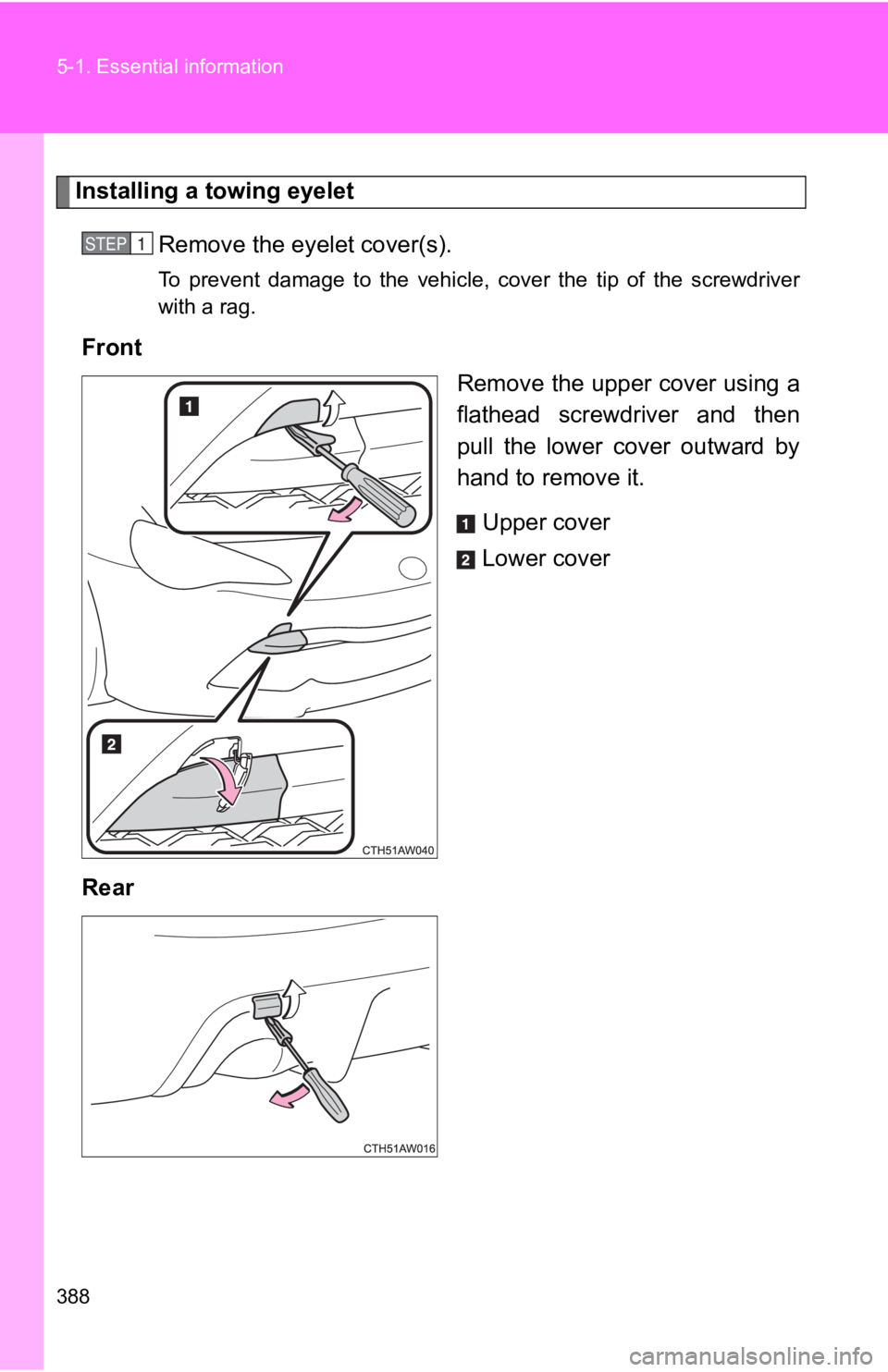
Remove the eyel et cover(s).
To prevent damage to the vehicle, cover the tip of the screwdriver
with a rag.
Front
Remove the upper cover using a
flathead screwdriver and then
pull the lower cover outward by
hand to remove it.
Upper cover
Lower cover
Rear
STEP 1
Page 389 of 532
5
When trouble arises
389
5-1. Essential
information
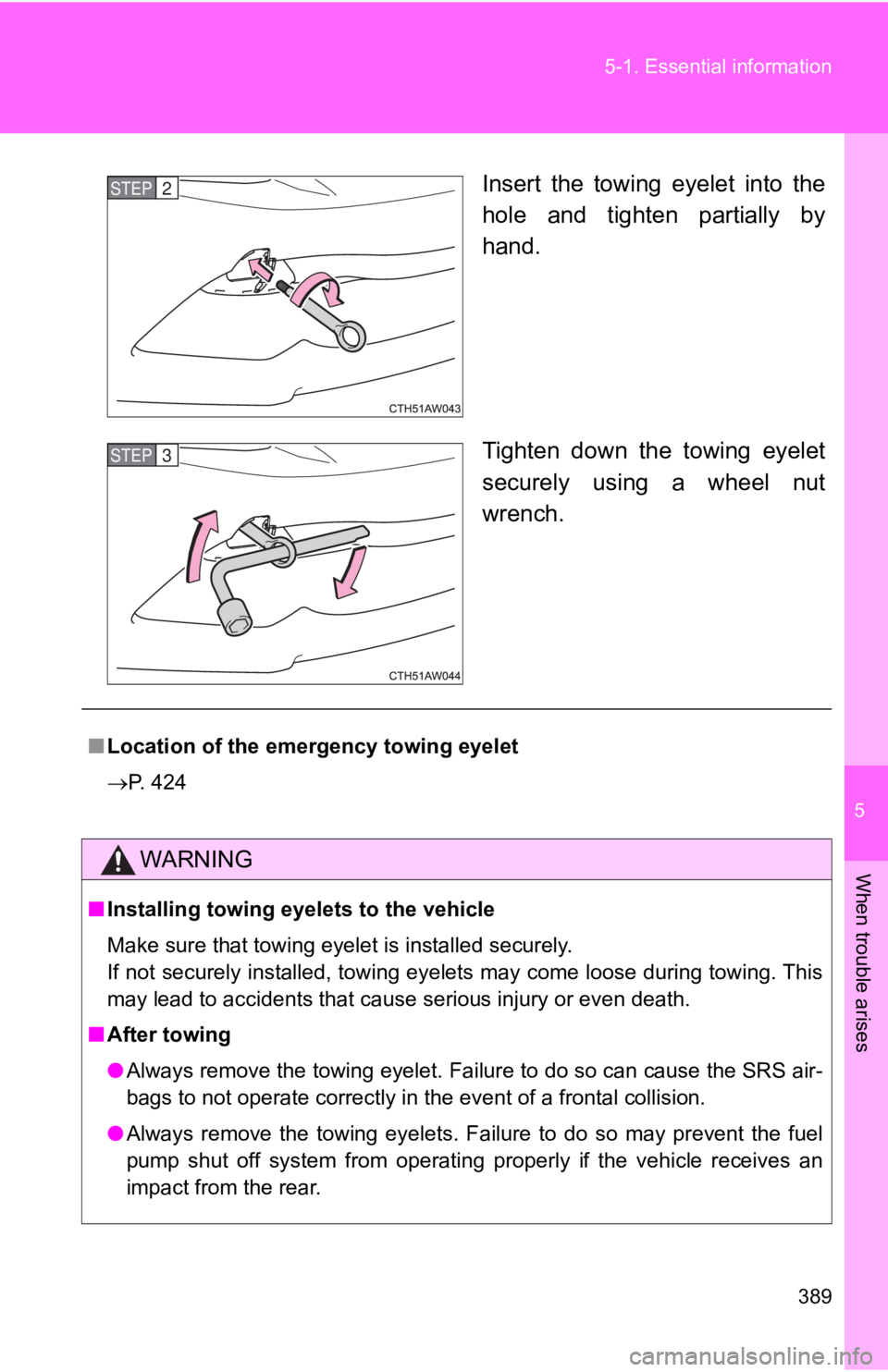
Insert the towing eyelet into the
hole and tighten partially by
hand.
Tighten down the towing eyelet
securely using a wheel nut
wrench.STEP 2
STEP 3
■Location of the eme rgency towing eyelet
P. 424
WARNING
■ Installing towing eyelets to the vehicle
Make sure that towing eyelet is installed securely.
If not securely installed, towing eyelets may come loose during towing. This
may lead to accidents that cause serious injury or even death.
■ After towing
●Always remove the towing eyelet. Failure to do so can cause the SRS air-
bags to not operate correctly in the event of a frontal collisi on.
● Always remove the towing eyelets. Failure to do so may prevent the fuel
pump shut off system from operating properly if the vehicle receives an
impact from the rear.
Page 390 of 532
390 5-1. Essential information
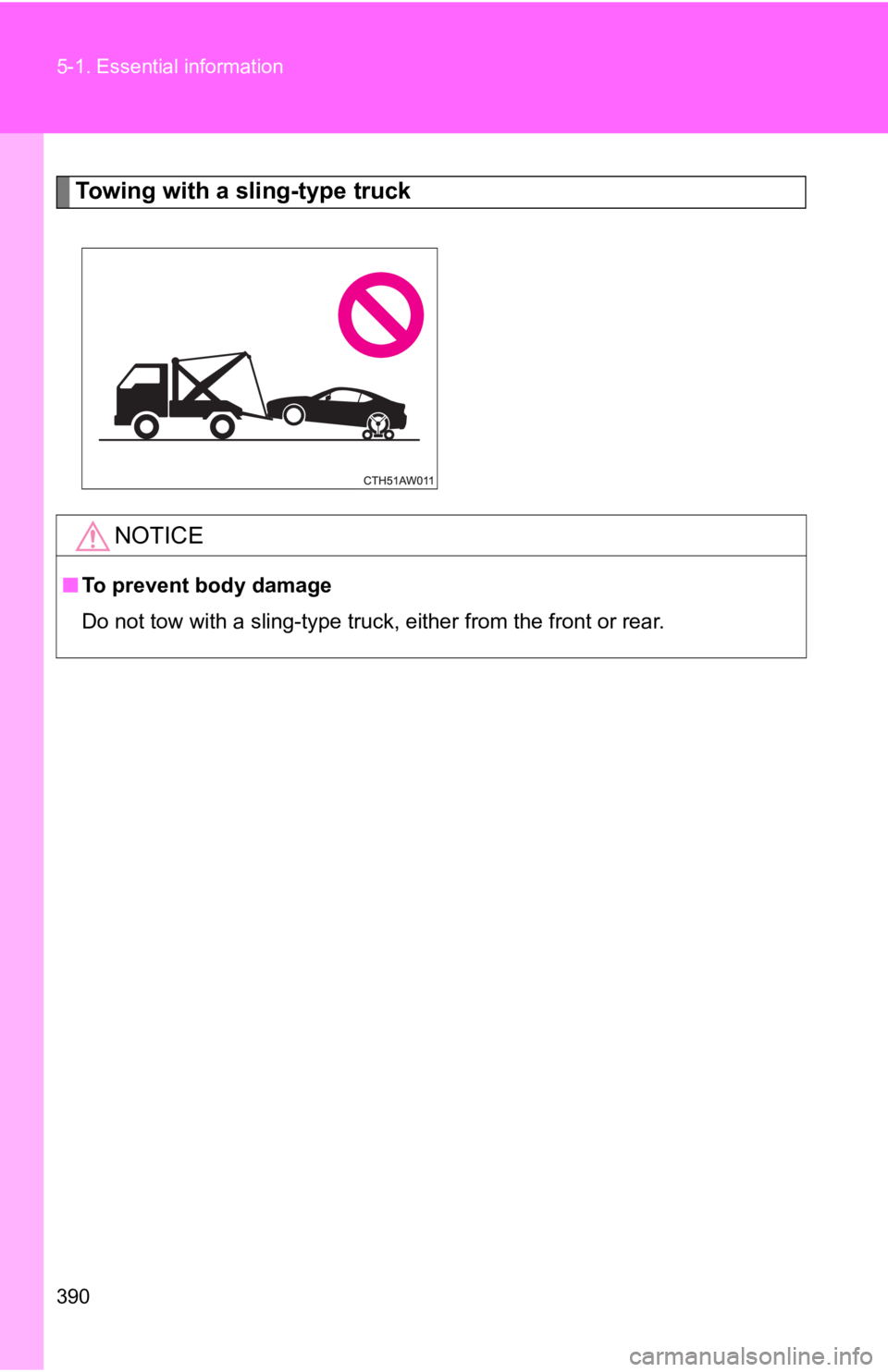
Towing with a sling-type truck
NOTICE
■To prevent body damage
Do not tow with a sling-type truck, either from the front or re ar.
Page 391 of 532
5
When trouble arises
391
5-1. Essential
information
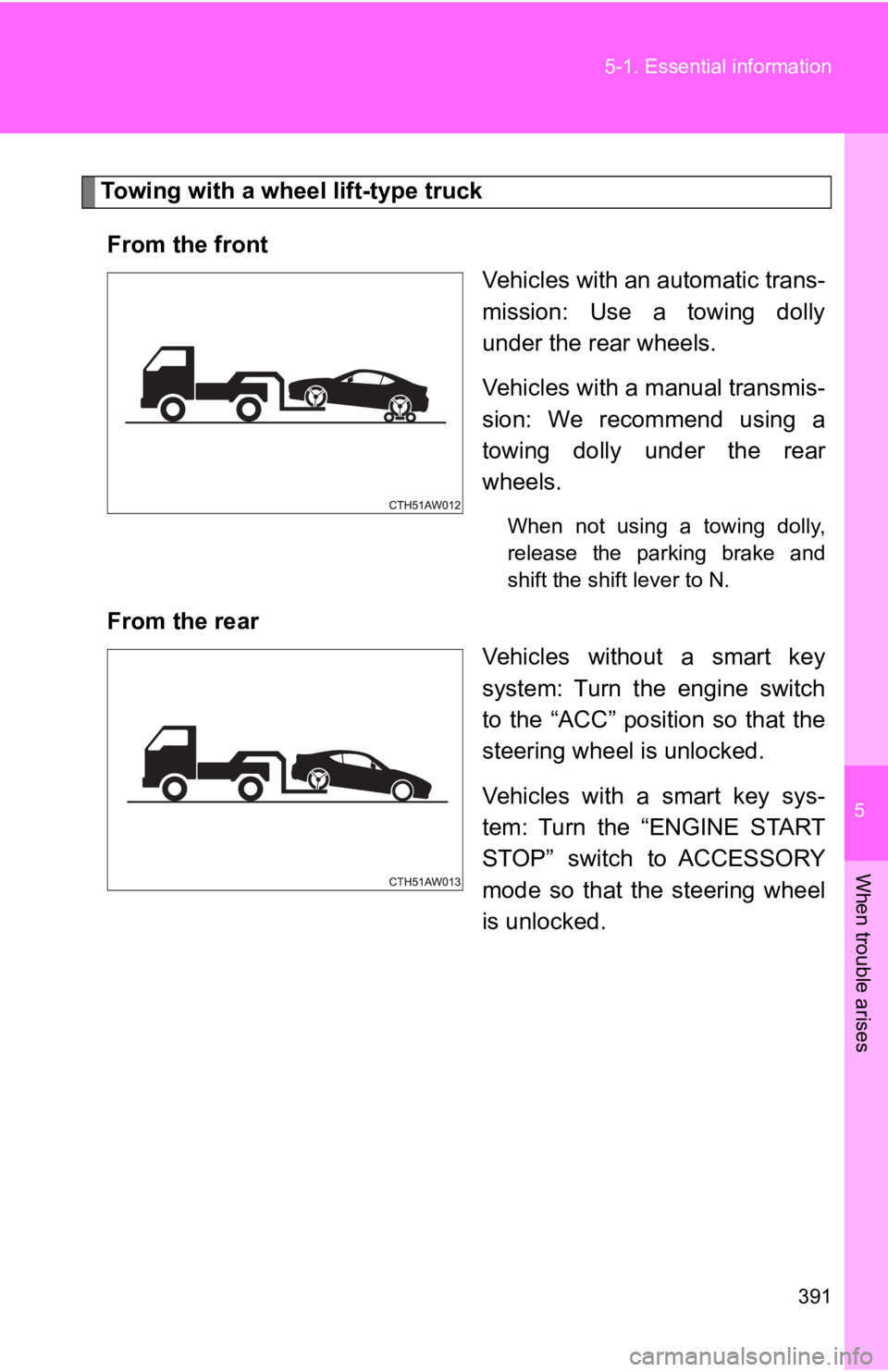
Towing with a wheel lift-type truck
From the front Vehicles with an automatic trans-
mission: Use a towing dolly
under the rear wheels.
Vehicles with a manual transmis-
sion: We recommend using a
towing dolly under the rear
wheels.
When not using a towing dolly,
release the parking brake and
shift the shift lever to N.
From the rearVehicles without a smart key
system: Turn the engine switch
to the “ACC” position so that the
steering wheel is unlocked.
Vehicles with a smart key sys-
tem: Turn the “ENGINE START
STOP” switch to ACCESSORY
mode so that the steering wheel
is unlocked.
Page 392 of 532
392 5-1. Essential information
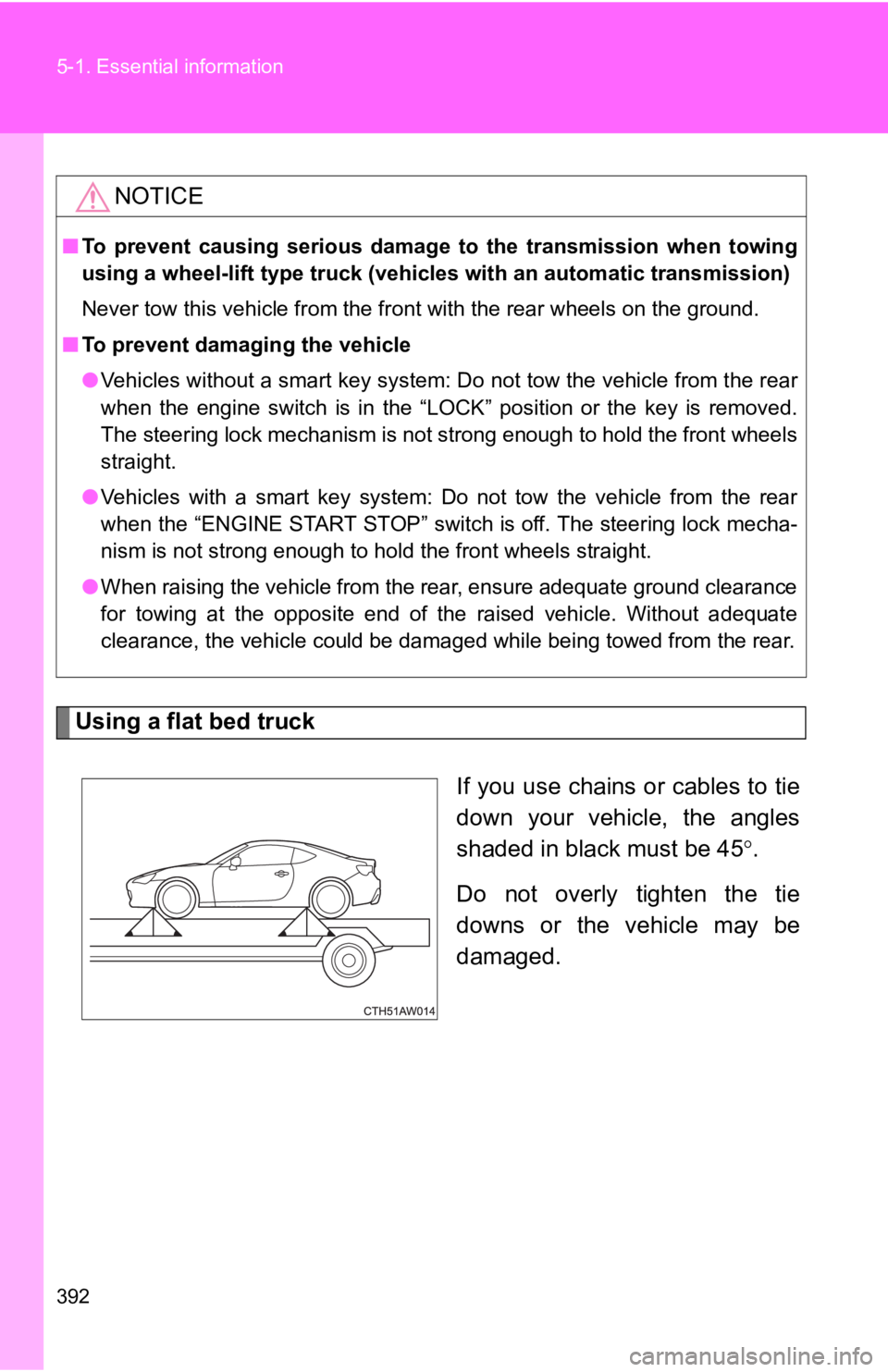
Using a flat bed truck
If you use chains or cables to tie
down your vehicle, the angles
shaded in black must be 45.
Do not overly tighten the tie
downs or the vehicle may be
damaged.
NOTICE
■ To prevent causing serious damage to the transmission when towi ng
using a wheel-lift type truck (vehicles with an automatic trans mission)
Never tow this vehicle from the front with the rear wheels on t he ground.
■ To prevent damaging the vehicle
●Vehicles without a smart key system: Do not tow the vehicle fro m the rear
when the engine switch is in the “LOCK” position or the key is removed.
The steering lock mechanism is not strong enough to hold the fr ont wheels
straight.
● Vehicles with a smart key system: Do not tow the vehicle from t he rear
when the “ENGINE START STOP” switch is off. The steering lock m echa-
nism is not strong enough to hold the front wheels straight.
● When raising the vehicle from the rear, ensure adequate ground clearance
for towing at the opposite end of the raised vehicle. Without a dequate
clearance, the vehicle could be damaged while being towed from the rear.
Page 424 of 532
424
5-2. Steps to take in an emergency
If you have a flat tire
Your vehicle is equipped with a spare tire. The flat tire can be
replaced with the spare tire.
■ Before jacking up the vehicle
●Stop the vehicle in a safe place on a hard, flat surface.
● Set the parking brake.
● Shift the shift lever to P (vehicles with an automatic transmis-
sion) or R (vehicles with a manual transmission).
● Stop the engine.
● Turn on the emergency flashers. ( P. 3 8 4 )
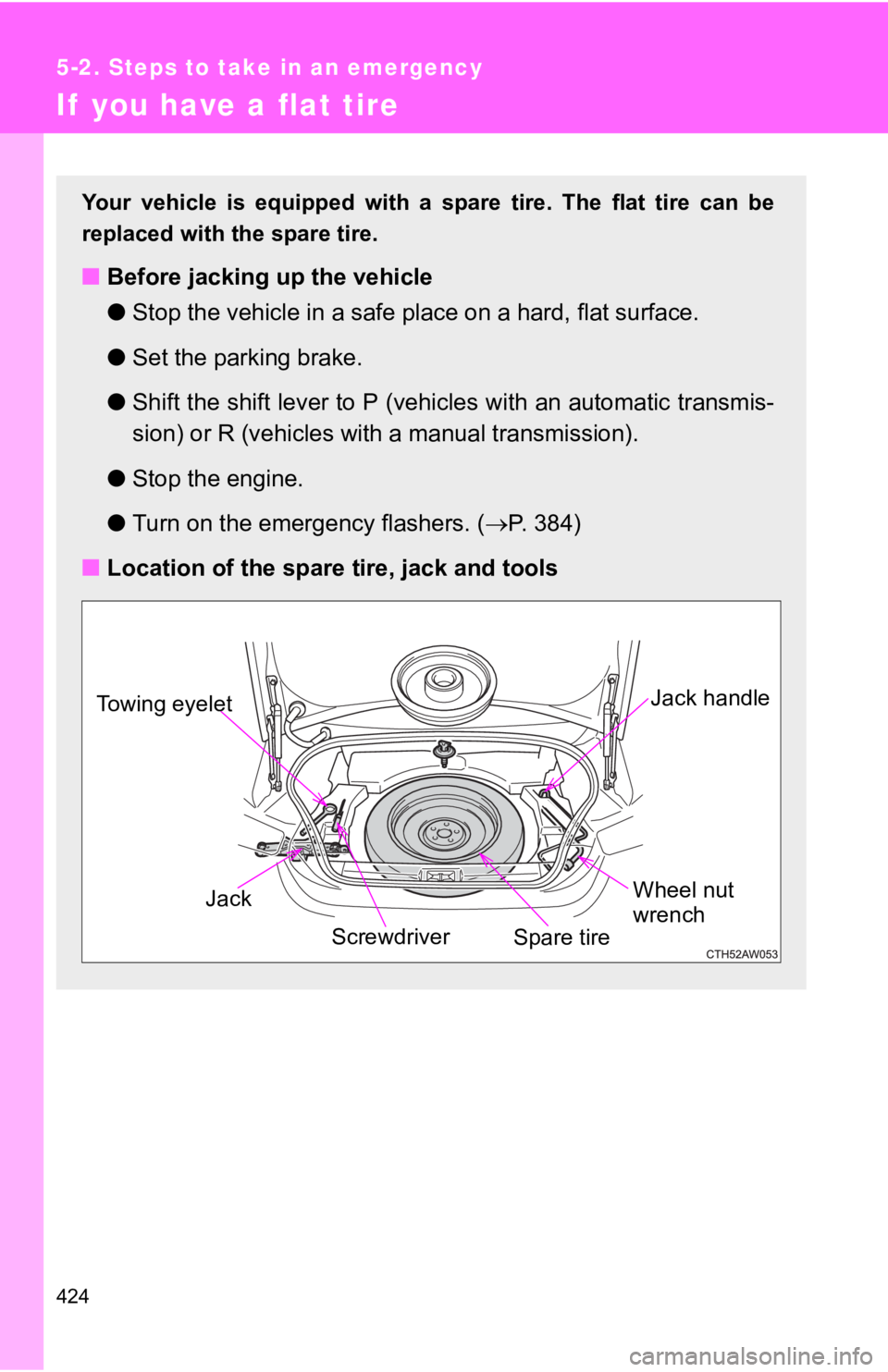
■ Location of the spare t ire, jack and tools
Jack Jack handle
Spare tire
Towing eyelet
Screwdriver Wheel nut
wrench
Page 434 of 532

434 5-2. Steps to take in an emergency
NOTICE
■Do not drive the vehicle with a flat tire.
Do not continue drivi ng with a flat tire.
Driving even a short distance wi th a flat tire can damage the tire and the
wheel beyond repair.
■Be careful when driving over bumps with the compact spare tire
installed on the vehicle.
The vehicle becomes lower when d riving with the compact spare tire
compared to when driving with standard tires. Be careful when d riving
over uneven road surfaces.
■Driving with tire chains and the compact spare tire
Do not fit tire chains to t he compact spare tire.
Tire chains may damage the vehicle body and adversely affect dr iving
performance.
■When replacing the tires
When removing or fitting the wheels, tires or the tire pressure warning
valve and transmitter, contact yo ur Toyota dealer as the tire pressure
warning valve and transmitter ma y be damaged if not handled correctly.
■To avoid damage to the tire pressure warning valves and transmi t-
ters
When a tire is repaired with liquid sealants, the tire pressure warning
valve and transmitter may not operate properly. If a liquid sea lant is
used, contact your Toyota dealer or other qualified service shop as soon
as possible. Make sure to replace the tire pressure warning val ve and
transmitter when replacing the tire. ( P. 3 4 6 )
■Stowing the jack
When stowing the jack in the jack holder, make sure that the pa rt that the
jack handle attaches to is pointing towards the inside of the t runk. Failure
to do so may damage the vehicle body.
Page 453 of 532

5
When trouble arises
453
5-2. Steps to take in an emergency
WARNING
■
When attempting to free a stuck vehicle
If you choose to push the vehicle back and forth to free it, ma ke sure the sur-
rounding area is clear to avoid striking other vehicles, object s or people. The
vehicle may also lunge forward or lunge back suddenly as it bec omes free.
Use extreme caution.
■ When shifting the shift lever
For vehicles with an automatic transmission, be careful not to shift the shift
lever with the accelerator pedal depressed.
This may lead to unexpected rapid acceleration of the vehicle t hat may
cause an accident resulting in death or serious injury.
NOTICE
■ To avoid damage to the trans mission and other components
● Avoid spinning the rear wheels and depressing the accelerator p edal more
than necessary.
● If the vehicle remains stuck even after these procedures are performed,
the vehicle may require towing to be freed.
Page 523 of 532

523
Alphabetical index
Dimension ................................ 458
Dinghy towing ......................... 266
Display
Drive information .................. 210
Multi-information display ........................ 200, 207
Trip information ............ 202, 208
Warning messages............... 407
Do-it-yourself maintenance .... 324
Door courtesy lights Door courtesy lights.............. 289
Wattage ................................ 469
Doors Door lock .................... 25, 38, 43
Door windows ......................... 72
Side mirrors ............................ 69
Driver's seat belt
reminder light ........................ 399
Driving Break-in tips ......................... 155
Correct posture....................... 87
Procedures ........................... 152
Winter drive tips.................... 261
Electric power steering........... 245
Electronic key If the electronic key does not operate properly ........... 440
Emergency flashers Switch ................................... 384
Emergency, in case of
If the electronic key does not operate properly ........... 440
If the engine will not start...... 435
If the shift lever cannot
be shifted from P ................ 438
If the vehicle has a
discharged battery ............. 444
If the warning buzzer sounds ............................... 395
If the warning light turns on .............................. 395 If the warning message
is displayed .........................407
If you have a flat tire .............424
If you lose your keys .............439
If you think something is wrong ..................................393
If your vehicle becomes stuck ...................................452
If your vehicle has to be stopped in an
emergency ..........................454
If your vehicle needs to be towed .............................385
If your vehicle overheats .......449
Engine Compartment ........................331
Engine switch ................166, 175
Hood......................................327
How to start the engine .........................166, 175
Identification number .............459
If the engine will not start ......435
Ignition switch................166, 175
Overheating...........................449
Engine coolant Capacity ................................464
Checking ...............................335
Engine coolant temperature gauge ......................................191
Engine immobilizer system.......79
Engine oil Capacity ................................462
Checking ...............................332
Preparing and checking before winter .......................261
Engine switch ...................166, 175
Engine switch light ..................289
EPS ............................................245
Event data recorder ...................18
E