ECU TOYOTA 86 2018 Owner's Manual
[x] Cancel search | Manufacturer: TOYOTA, Model Year: 2018, Model line: 86, Model: TOYOTA 86 2018Pages: 532, PDF Size: 6.48 MB
Page 146 of 532
146 1-7. Safety information
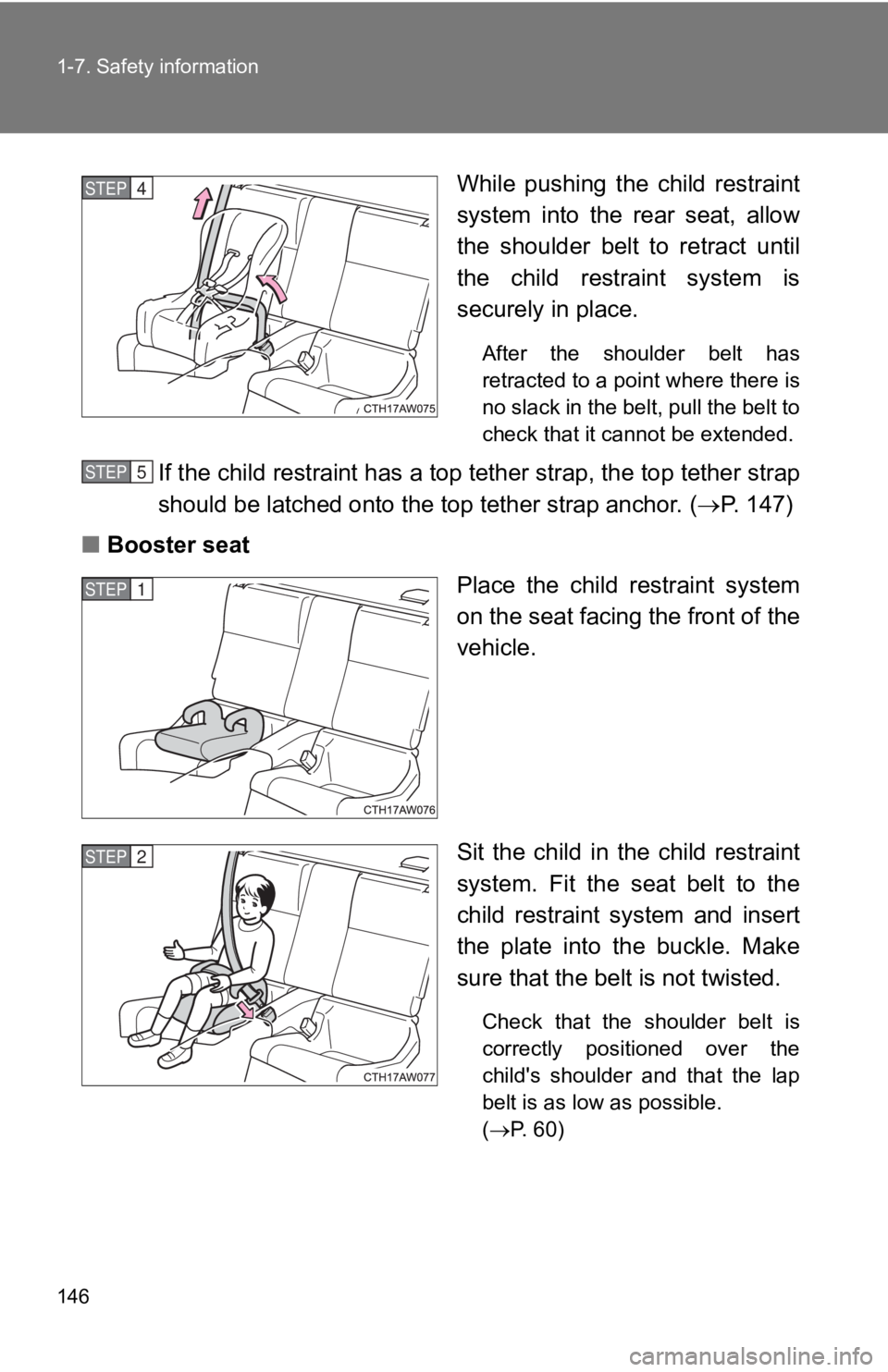
While pushing the child restraint
system into the rear seat, allow
the shoulder belt to retract until
the child restraint system is
securely in place.
After the shoulder belt has
retracted to a point where there is
no slack in the belt, pull the belt to
check that it cannot be extended.
If the child restraint has a top tether strap, the top tether strap
should be latched onto the t op tether strap anchor. (P. 147)
■ Booster seat
Place the child restraint system
on the seat facing the front of the
vehicle.
Sit the child in the child restraint
system. Fit the seat belt to the
child restraint system and insert
the plate into the buckle. Make
sure that the belt is not twisted.
Check that the shoulder belt is
correctly positioned over the
child's shoulder and that the lap
belt is as low as possible.
(P. 60)
STEP 4
STEP 5
STEP 1
STEP 2
Page 147 of 532
147
1-7. Safety information
1
Before driving
Removing a child restraint i
nstalled with a seat belt
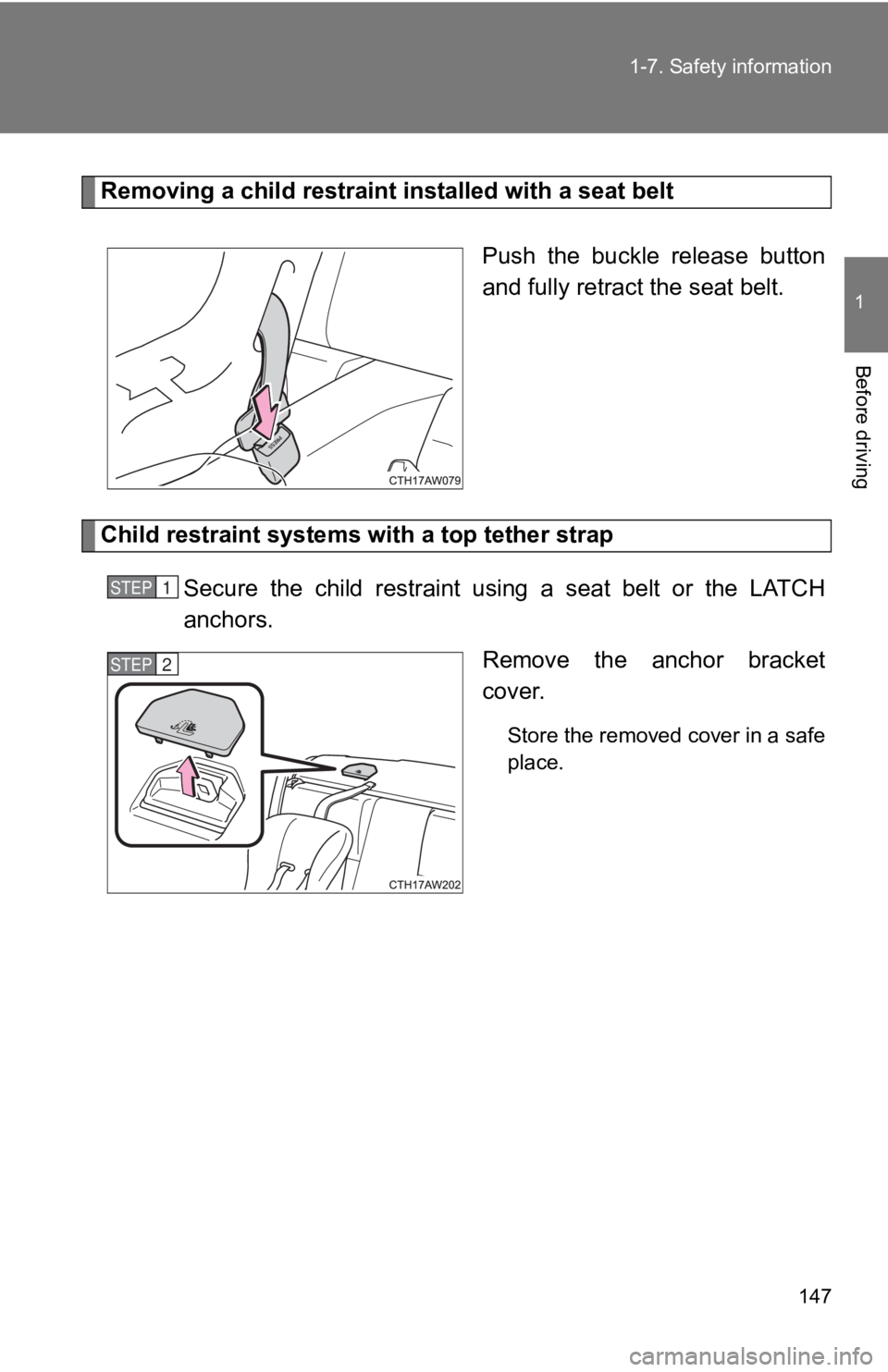
Push the buckle release button
and fully retract the seat belt.
Child restraint systems with a top tether strap Secure the child restraint using a seat belt or the LATCH
anchors. Remove the anchor bracket
cover.
Store the removed cover in a safe
place.
STEP 1
STEP 2
Page 148 of 532
148 1-7. Safety information
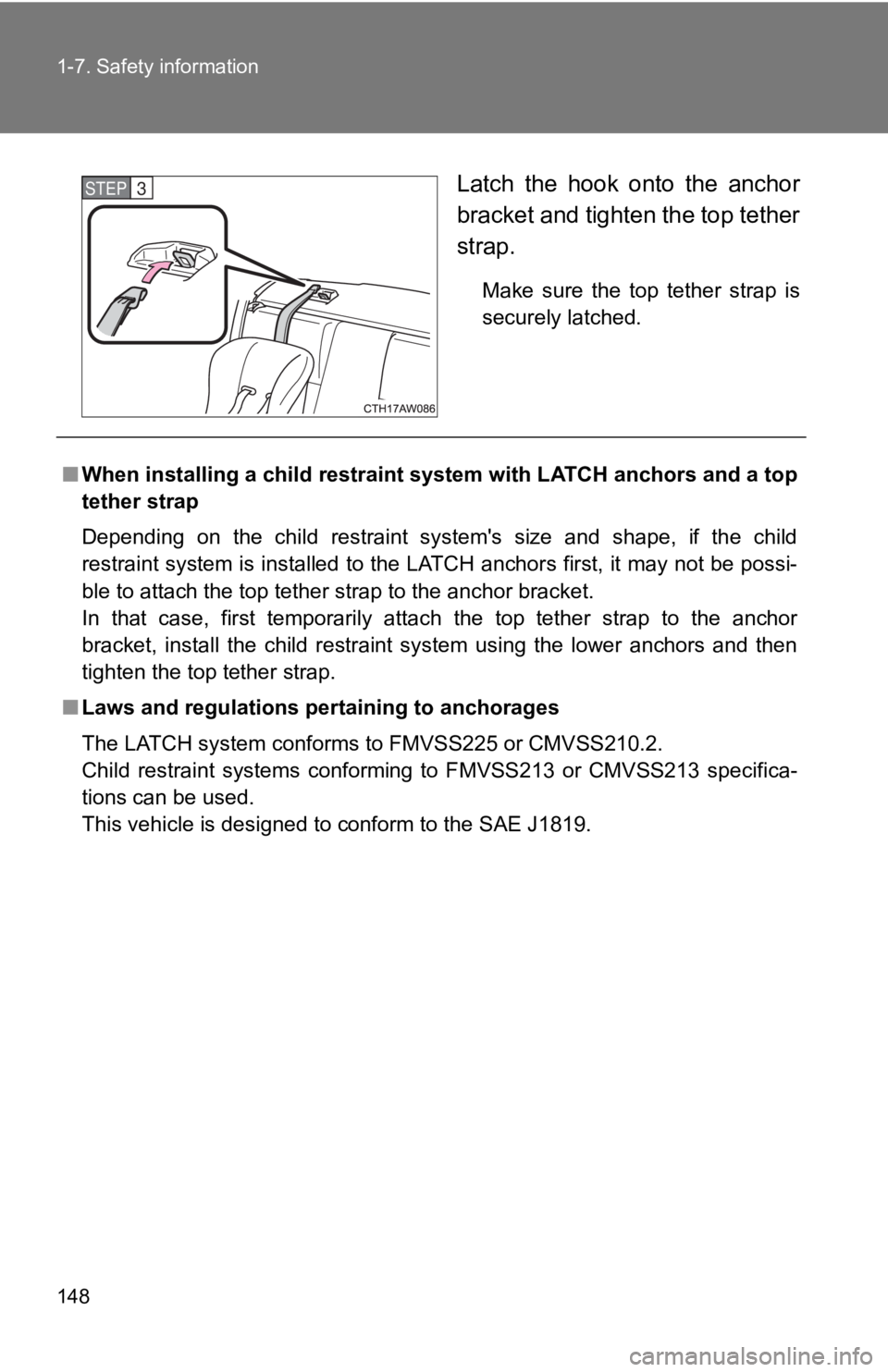
Latch the hook onto the anchor
bracket and tighten the top tether
strap.
Make sure the top tether strap is
securely latched.
STEP 3
■When installing a child restraint system with LATCH anchors and a top
tether strap
Depending on the child restraint system's size and shape, if th e child
restraint system is installed to the LATCH anchors first, it ma y not be possi-
ble to attach the top tether strap to the anchor bracket.
In that case, first temporarily attach the top tether strap to the anchor
bracket, install the child restraint system using the lower anc hors and then
tighten the top tether strap.
■ Laws and regulations pertaining to anchorages
The LATCH system conforms to FMVSS225 or CMVSS210.2.
Child restraint systems conforming to FMVSS213 or CMVSS213 spec ifica-
tions can be used.
This vehicle is designed to conform to the SAE J1819.
Page 149 of 532
149
1-7. Safety information
1
Before driving
WARNING
■
When installing a booster seat
To prevent the belt from going into ALR lock mode, do not fully extend the
shoulder belt. ALR mode causes the belt to tighten only. This c ould cause
injury or discomfort to the child. ( P. 62)
■ When installing a child restraint system
Follow the directions given in the child restraint system insta llation manual
and fix the child restraint system securely in place.
If the child restraint system is not correctly fixed in place, the child or other
passengers may be injured or even killed in the event of sudden braking,
sudden swerving or an accident.
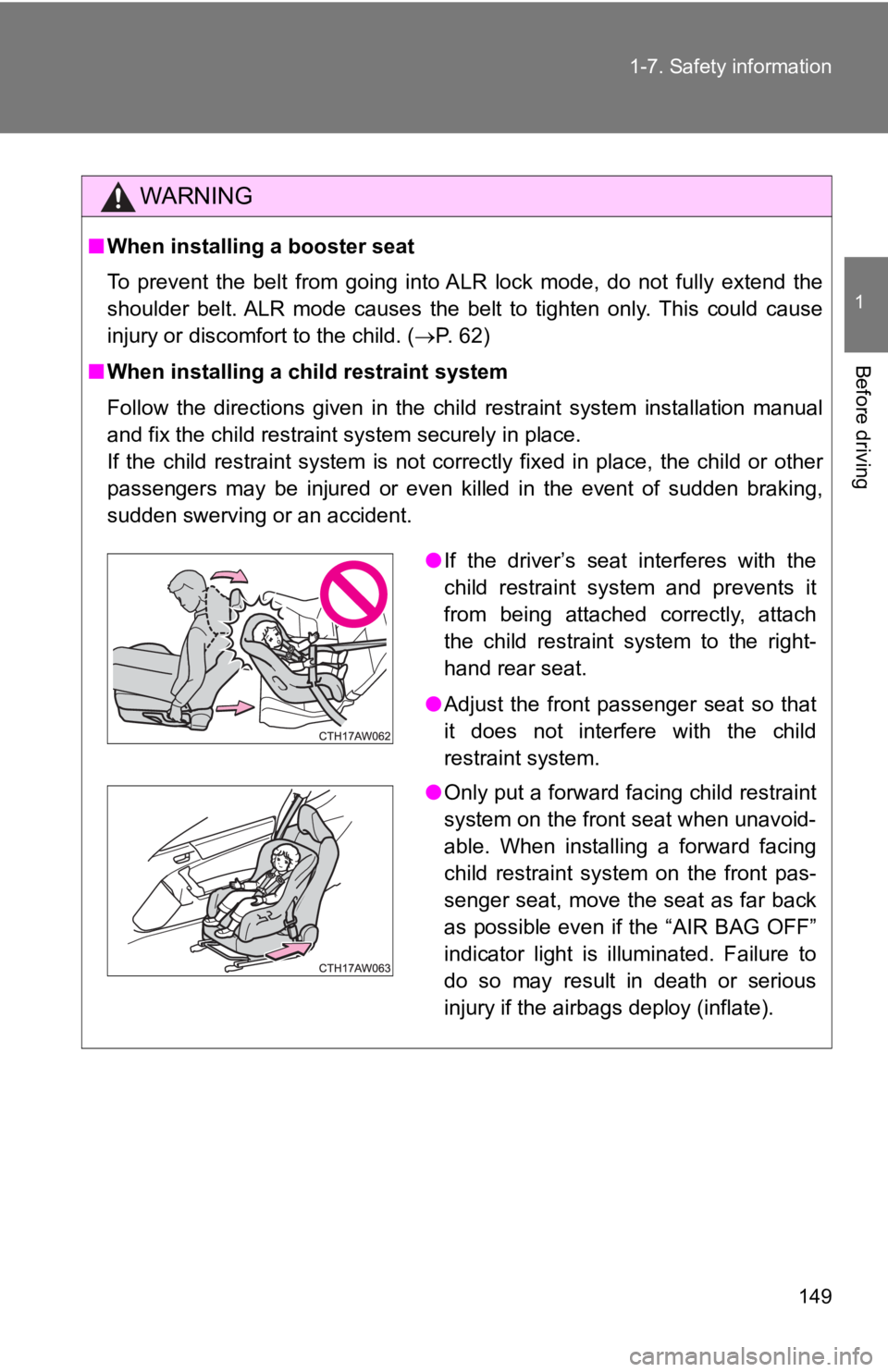
● If the driver’s seat interferes with the
child restraint system and prevents it
from being attached correctly, attach
the child restraint system to the right-
hand rear seat.
● Adjust the front passenger seat so that
it does not interfere with the child
restraint system.
● Only put a forward facing child restraint
system on the front seat when unavoid-
able. When installing a forward facing
child restraint system on the front pas-
senger seat, move the seat as far back
as possible even if the “AIR BAG OFF”
indicator light is illuminated. Failure to
do so may result in death or serious
injury if the airbags deploy (inflate).
Page 150 of 532
150 1-7. Safety information
WARNING
■When installing a ch ild restraint system
● When a booster seat is installed, always ensure that the should er belt is
positioned across the center of the child's shoulder. The belt should be
kept away from the child's neck, but not so that it could fall off the child's
shoulder. Failure to do so may result in death or serious injury in the event
of sudden braking, sudden swerving or an accident.
● Ensure that the belt and plate are securely locked and the seat belt is not
twisted.
● Shake the child restraint system left and right, and forward an d backward
to ensure that it has been securely installed.
● After securing a child restraint system, never adjust the seat.
● Follow all installation instructions provided by the child rest raint system
manufacturer.
■ To correctly attach a child rest raint system to the anchors
When using the LATCH anchors, be sure that there are no foreign objects
around the anchors and that the seat belt is not caught behind the child
restraint. Make sure the child restraint system is securely att ached, or it may
cause death or serious injury to the child or other passengers in the event of
sudden braking, sudden swerve or an accident.
Page 156 of 532
156 2-1. Driving procedures
■After the engine starts
In order to secure a rich exhaust sound when starting the vehicle and envi-
ronmental performance, air intake and exhaust sounds become lou d and
vibrations may increase for a little while after the engine starts. This is not a
malfunction.
■ Operating your vehicle in a foreign country
Comply with the relevant vehicle registration laws and confirm the availability
of the correct fuel. ( P. 461)
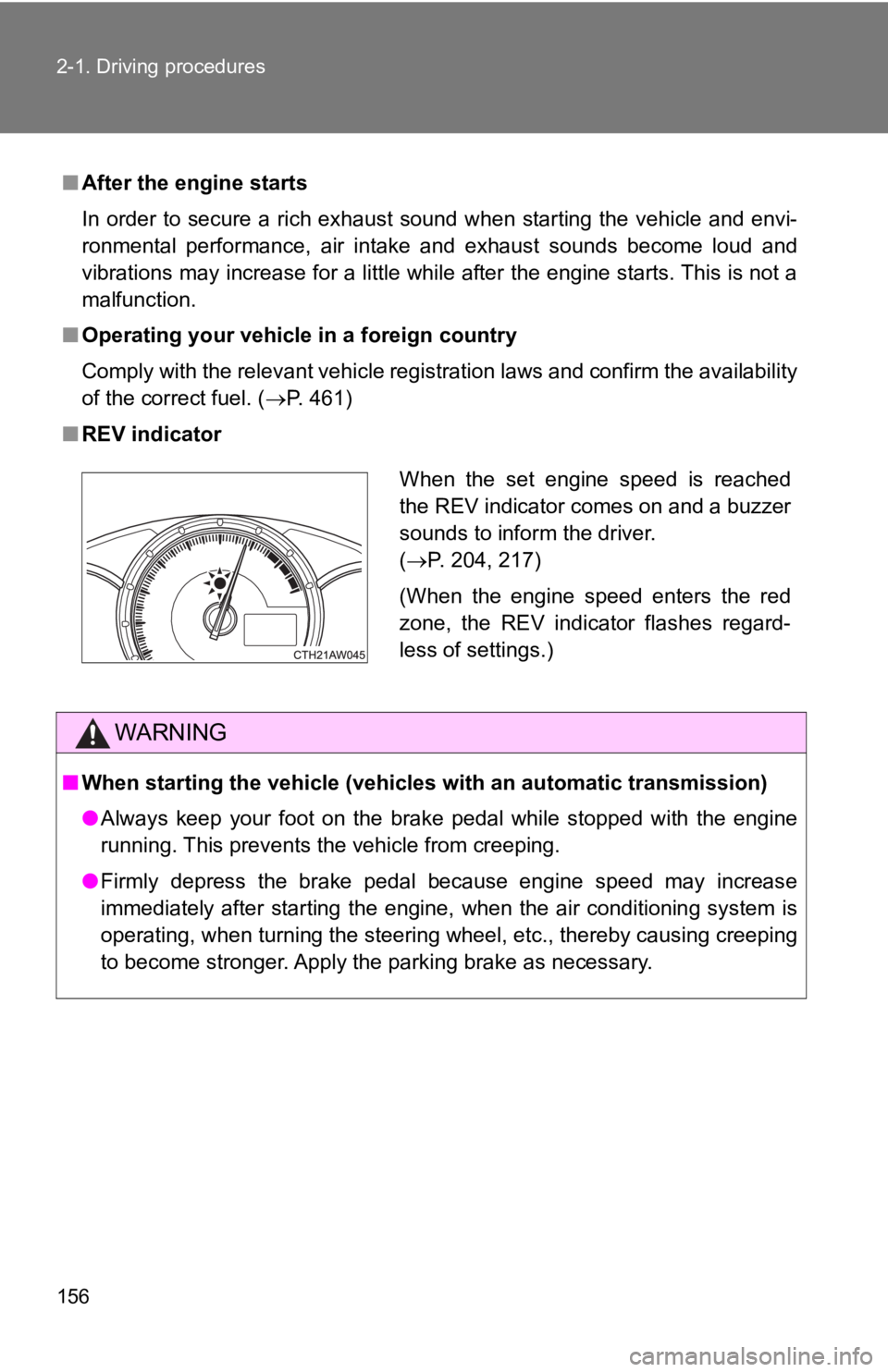
■ REV indicator
WARNING
■When starting the vehicle (vehicl es with an automatic transmission)
● Always keep your foot on the brake pedal while stopped with the engine
running. This prevents the vehicle from creeping.
● Firmly depress the brake pedal because engine speed may increas e
immediately after starting the engine, when the air conditionin g system is
operating, when turning the steering wheel, etc., thereby causi ng creeping
to become stronger. Apply the parking brake as necessary.
When the set engine speed is reached
the REV indicator comes on and a buzzer
sounds to inform the driver.
( P. 204, 217)
(When the engine speed enters the red
zone, the REV indicator flashes regard-
less of settings.)
Page 160 of 532
160 2-1. Driving procedures
WARNING
■When the vehicle is stopped
●Do not race the engine.
If the vehicle is in any gear other than P (vehicles with an au tomatic trans-
mission only) or N, the vehicle may accelerate suddenly and une xpectedly,
causing an accident.
● Do not leave the vehicle with the engine running for a long tim e.
If such a situation cannot be avoided, park the vehicle in an open space
and check that exhaust fumes do not enter the vehicle interior.
● On vehicles with an automatic transmission, in order to prevent accidents
due to the vehicle rolling away, always keep depressing the brake pedal
while the engine is running, and apply the parking brake as nec essary.
● If the vehicle is stopped on an incline, in order to prevent ac cidents caused
by the vehicle rolling forward or backward, always depress the brake pedal
and securely apply the parking brake as needed.
● Avoid revving or racing the engine.
Running the engine at high speed while the vehicle is stopped m ay cause
the exhaust system to overheat, which could result in a fire if combustible
material is nearby.
Page 163 of 532
163
2-1. Driving procedures
2
When driving
WARNING
■
When braking
●When the brakes are wet, drive more cautiously.
Braking distance increases when the brakes are wet, and this may cause
one side of the vehicle to brake differently than the other sid e. Also, the
parking brake may not securely hold the vehicle.
● If the power brake assist function does not operate, do not fol low other
vehicles closely and avoid hills or sharp turns that require br aking.
In this case, braking is still possible, but the brake pedal should be
depressed more firmly than usual. Also, the braking distance wi ll increase.
Have your brakes fixed immediately.
● Do not pump the brake pedal if the engine stalls.
Each push on the brake pedal uses up the reserve for the power- assisted
brakes.
● The brake system consists of 2 individual hydraulic systems; if one of the
systems fails, the other will still operate. In this case, the brake pedal
should be depressed more firmly than usual and the braking dist ance will
increase.
Have your brakes fixed immediately.
Page 171 of 532
171
2-1. Driving procedures
2
When driving
■
Operation of the “EN GINE START STOP” switch
If the switch is not pressed shortly and firmly, the “ENGINE ST ART STOP”
switch mode may not change or the engine may not start.
■ Electronic key battery depletion
P. 35
■ Conditions affecting operation
P. 31
■ Note for the entry function
P. 32
■ If the engine does not start
The engine immobilizer system may not have been deactivated. ( P. 79)
Contact your Toyota dealer.
■ Steering lock
After turning the “ENGINE START STOP” switch off and opening an d closing
the doors, the steering wheel will be locked due to the steerin g lock function.
Operating the “ENGINE START STOP” switch again automatically cancels
the steering lock.
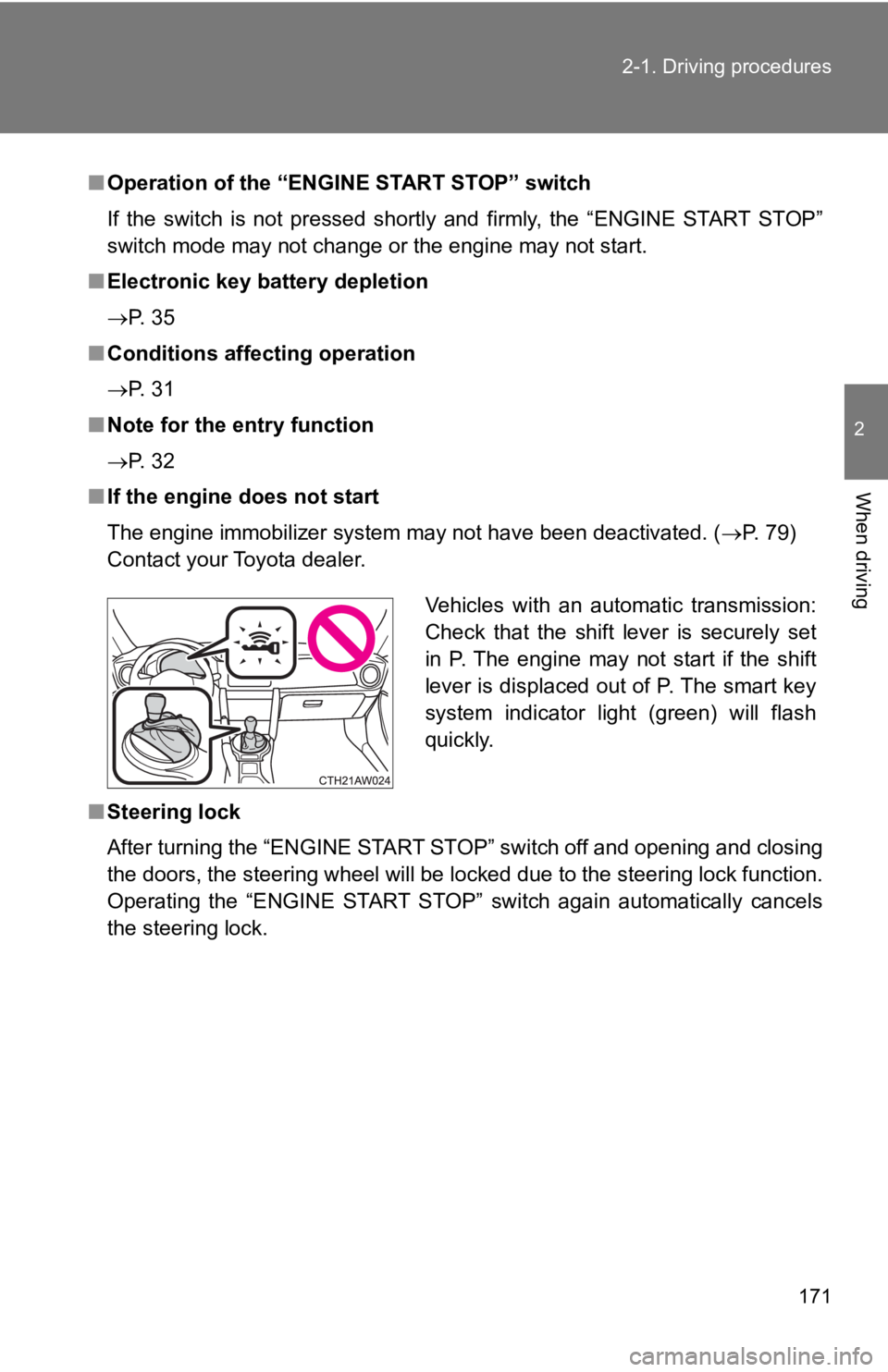
Vehicles with an automatic transmission:
Check that the shift lever is securely set
in P. The engine may not start if the shift
lever is displaced out of P. The smart key
system indicator light (green) will flash
quickly.
Page 190 of 532
190
2-1. Driving procedures
Hor n
■After adjusting the steering wheel
Make sure that the steering wheel is securely locked.
The horn may not sound if the steering wheel is not securely lo cked.
( P. 67)
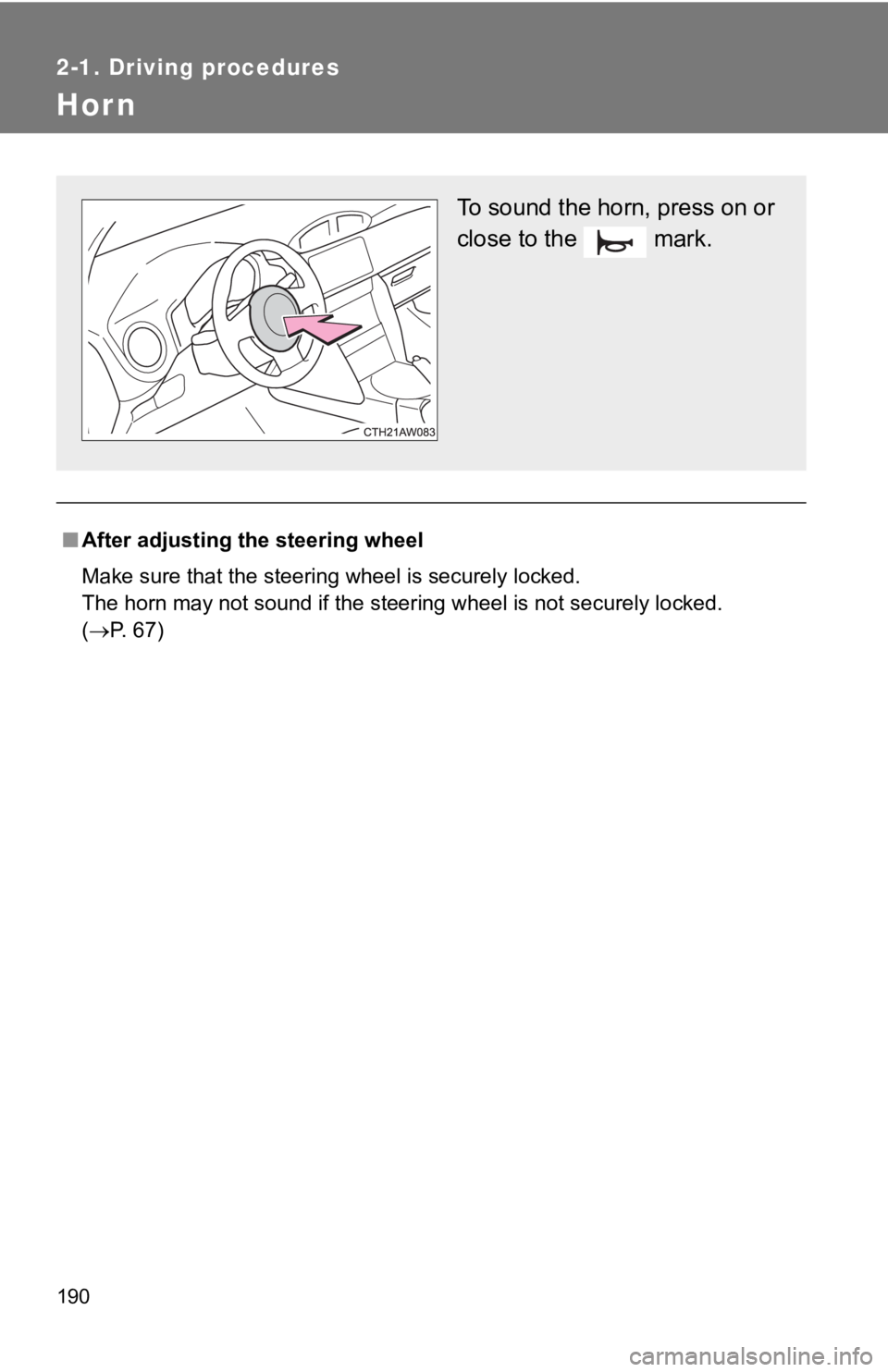
To sound the horn, press on or
close to the mark.