seats TOYOTA 86 2018 Owner's Manual
[x] Cancel search | Manufacturer: TOYOTA, Model Year: 2018, Model line: 86, Model: TOYOTA 86 2018Pages: 532, PDF Size: 6.48 MB
Page 95 of 532

95
1-7. Safety information
1
Before driving
Your vehicle is equipped with ADVANCED AIRBAGS designed based
on US motor vehicle safety standards (FMVSS208). The airbag sys
-
tem controls airbag deployment power for the driver and front p as-
senger. The front passenger's air bag system consists of the front
passenger occupant detec tion control module etc.
The main SRS airbag system components are shown above. The
SRS airbag system is controlled by the airbag control module. T he
airbag control module cons ists of an airbag sensor.
In certain types of severe front or side impacts, the SRS airba g sys-
tem triggers the airbag inflators. A chemical reaction in the inflators
quickly fills the airbags with non- toxic gas to help restrain t he motion
of the occupants.
Side airbag sensor (center
pillar left-hand side)
Side airbag module (driver’s
side)
Door impact sensor (left-
hand side) Airbag control module
(including impact sensors
and rollover sensors)
Front sub sensor (left-hand
side)
Curtain shield airbag mod-
ule (left-hand side)
■
If the SRS airbags deploy (inflate)
●Slight abrasions, burns, bruisi ng etc., may be sustained from S RS air-
bags, due to the extremely high speed deployment (inflation) by hot
gases.
● A loud noise and white powder will be emitted.
● Parts of the airbag module (steering wheel hub, airbag cover an d inflator)
as well as the front seats, parts of the front and rear pillars , and roof side
rails, may be hot for several minutes. The airbag itself may al so be hot.
● The windshield may crack.
Page 109 of 532

109
1-7. Safety information
1
Before driving
WARNING
■
If the SRS airbags deploy
Do not touch the SRS airbag system components around the steeri ng wheel
and dashboard with bare hands right after deployment. Doing so can cause
burns because the components can be very hot as a result of dep loyment.
■ Child restraint precautions
NEVER INSTALL A REARWARD FACING CHILD SEAT IN THE FRONT
PASSENGER’S SEAT EVEN IF THE FRONT PASSENGER’S SRS FRON-
TAL AIRBAG IS DEACTIVATED. Be sure to install it in the REAR se at in a
correct manner. Also, it is strongly recommended that any forwa rd facing
child seat or booster seat be installed in the REAR seat, and t hat even chil-
dren who have outgrown a child restraint system be also seated in the
REAR seat. This is because children sitting in the front passen ger’s seat
may be killed or severely injured should the front passenger’s SRS frontal
airbag deploy. REAR seats are the safest place for children.
Page 111 of 532

111
1-7. Safety information
1
Before driving
■
Operation
The SRS side airbag and SRS curtain shield airbag can function only when
the engine switch is in the “ON” position (vehicles without a s mart key sys-
tem) or when the “ENGINE START ST OP” switch is in IGNITION ON mode
(vehicles with a smart key system).
The driver’s and front passenger’s SRS side airbags and SRS cur tain shield
airbags deploy independently of each other since each has its o wn impact
sensor. Therefore, they may not both deploy in the same acciden t. Also, the
SRS side airbag and SRS curtain shield airbag deploys independe ntly of the
driver’s and front passenger’s SRS front airbags in the steerin g wheel and
instrument panel.
A rollover sensor is also located inside the airbag control mod ule.
An impact sensor, which senses impact force, is located in each of the left
and right center pillars, doors and rear wheel houses. Another impact sen-
sor, which also senses impact force, is located under the center of the rear
seats.
If the impact sensor that is located under the center of the re ar seats and
one of the center pillar impact sensors or door impact sensors together
sense an impact force above a predetermined level in a side col lision, the
control module causes both the SRS side airbag and curtain shield airbag on
the impacted side to inflate regardless of whether the rear whe el house
impact sensor on the same side senses an impact.
If the impact sensor that is located under the center of the re ar seats and
one of the rear wheel house impact sensors together sense an im pact force
above a predetermined level, the control module causes only the SRS cur-
tain shield airbag on the impacted side to inflate.
If the rollover sensor detects rollover of the vehicle, the control module
inflates the SRS curtain shield airbags. At this time, the driver's and front
passenger’s seat belt pretensioners also operate at the same ti me.
Page 119 of 532
119
1-7. Safety information
1
Before driving
■
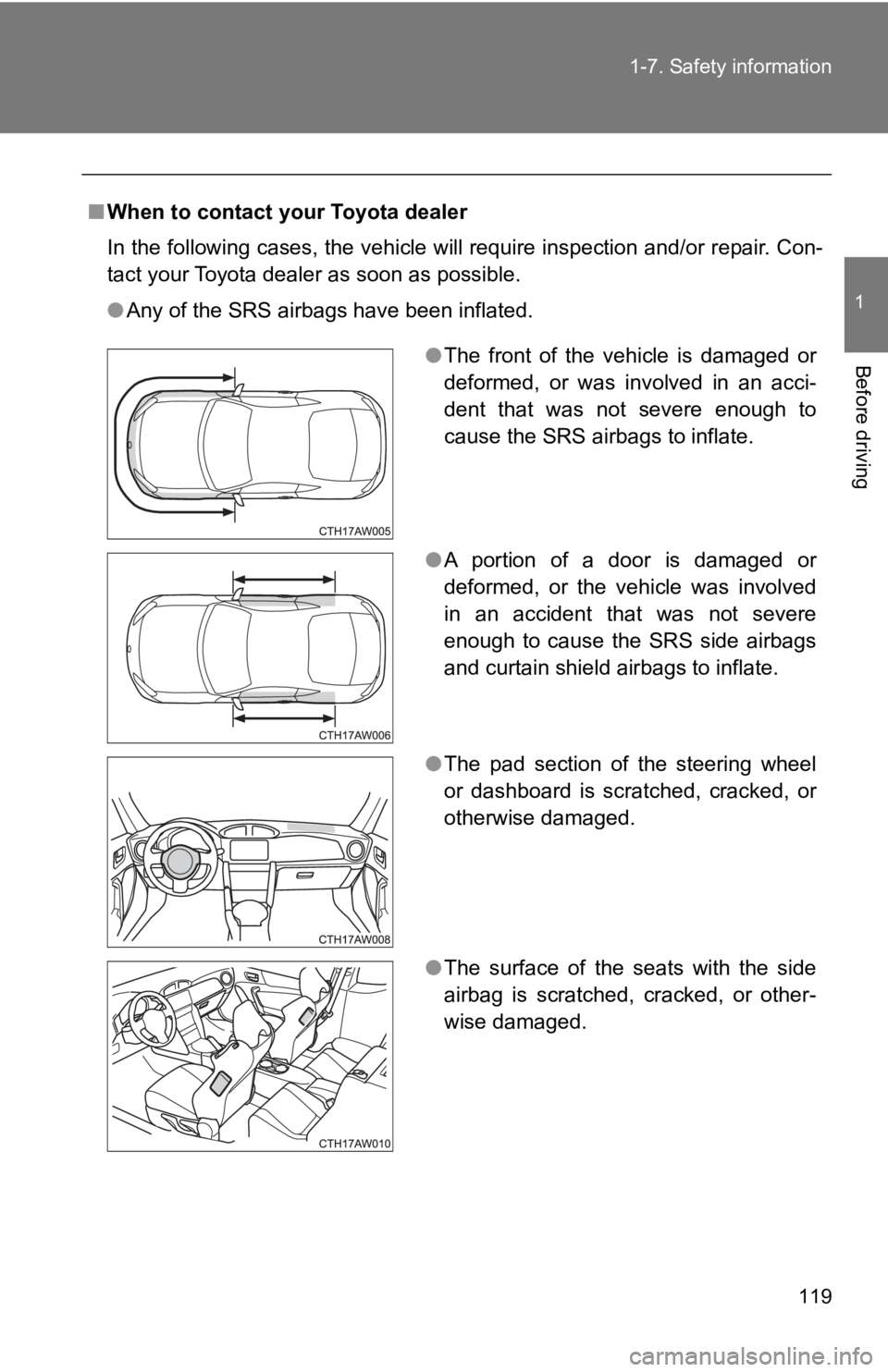
When to contact your Toyota dealer
In the following cases, the vehicle will require inspection and /or repair. Con-
tact your Toyota dealer as soon as possible.
● Any of the SRS airbags have been inflated.
●The front of the vehicle is damaged or
deformed, or was involved in an acci-
dent that was not severe enough to
cause the SRS airbags to inflate.
● A portion of a door is damaged or
deformed, or the vehicle was involved
in an accident that was not severe
enough to cause the SRS side airbags
and curtain shield airbags to inflate.
● The pad section of the steering wheel
or dashboard is scratched, cracked, or
otherwise damaged.
● The surface of the seats with the side
airbag is scratched, cracked, or other-
wise damaged.
Page 121 of 532

121
1-7. Safety information
1
Before driving
WARNING
■
SRS airbag precautions
●The SRS driver airbag deploys with considerable force, and can cause
death or serious injury especially if the driver is very close to the airbag.
The National Highway Traffic Safety Administration (“NHTSA”) advises:
Since the risk zone for the driver’s airbag is the first 2 - 3 in. (50 - 75 mm)
of inflation, placing yourself 10 in. (250 mm) from your driver airbag pro-
vides you with a clear margin of safety. This distance is measu red from the
center of the steering wheel to your breastbone. If you sit less than 10 in.
(250 mm) away now, you can change your driving position in seve ral
ways:
• Move your seat to the rear as far as you can while still reaching the pedals comfortably.
• Slightly recline the back of the seat. Although vehicle design s vary,
many drivers can achieve the 10 in. (250 mm) distance, even wit h the
driver seat all the way forward, simply by reclining the back o f the seat
somewhat. If reclining the back of your seat makes it hard to s ee the
road, raise yourself by using a firm, non-slippery cushion, or raise the
seat if your vehicle has that feature.
• If your steering wheel is adjustable, tilt it downward. This p oints the air-
bag toward your chest instead of your head and neck.
The seat should be adjusted as recommended by NHTSA above, whil e
still maintaining control of the foot pedals, steering wheel, a nd your view of
the instrument panel controls.
● The SRS front passenger airbag al so deploys with considerable force, and
can cause death or serious injury especially if the front passe nger is very
close to the airbag. The front passenger seat should be as far from the air-
bag as possible with the seatback adjusted, so the front passen ger sits
upright.
● Improperly seated and/or restrained infants and children can be killed or
seriously injured by a deploying airbag. An infant or child who is too small
to use a seat belt should be properly secured using a child res traint sys-
tem. Toyota strongly recommends that all infants and children be placed in
the rear seats of the vehicle and properly restrained. The rear seats are
safer for infants and children than the front passenger seat. ( P. 137)
Page 124 of 532

124 1-7. Safety information
WARNING
■SRS airbag precautions
●Do not touch any of the component parts immediately after the S RS air-
bags have deployed (inflated) as they may be hot.
● If breathing becomes difficult after the SRS airbag has deploye d, open a
door or window to allow fresh air in, or leave the vehicle if i t is safe to do
so. Wash off any residue as soon as possible to prevent skin ir ritation.
● If the areas where the SRS airbags are stored, such as the stee ring wheel
pad and front and rear pillar garnishes, are damaged or cracked, have
them replaced by your Toyota dealer.
■ Modification and disposal of SRS airbag system components
Do not dispose of your vehicle or perform any of the following modifications
without consulting your Toyota dealer.
The SRS airbags may malfunction or deploy (inflate) accidentall y, causing
death or serious injury.
● Installation, removal, disassem bly and repair of the SRS airbag s.
● Repairs, modifications, removal or replacement of the steering wheel,
instrument panel, dashboard, seats or seat upholstery, front, side and rear
pillars or roof side rails.
● Repairs or modifications of the front fender, front bumper, or side of the
occupant compartment.
● Installation of a grille guard (bull bars, kangaroo bar, etc.), snow plows,
winches.
● Modifications to the vehicle's suspension system.
● Installation of electronic devices such as mobile two-way radio s and CD
players.
● Modifications to your vehicle for a person with a physical disa bility.
Page 126 of 532

126 1-7. Safety information
●Side airbag module (fro nt passenger’s side)
● Curtain shield airbag sensor (re ar wheel house right-hand side)
● Curtain shield airbag sensor (re ar wheel house left-hand side)
● Curtain shield airbag module (right-hand side)
● Curtain shield airbag module (left-hand side)
● Satellite safing sensor (under the center of the rear seats)
● Seat belt pretensi oner (driver’s side)
● Seat belt pretensioner (front passenger’s side)
● Seat belt buckle switch (front passenger’s side)
● Front passenger’s occupant cla ssification system sensor
● Front passenger’s occupan t detection control module
● Front passenger’s frontal air bag ON and OFF indicator
● All related wiring
Page 136 of 532

136 1-7. Safety information
WARNING
■Front passenger occupant classification system precautions
●Never install a rearward facing child seat in the front passeng er’s seat
even if the front passenger’s SRS frontal airbag is deactivated . Be sure to
install it in the rear seat in a correct manner. Also, it is strongly recom-
mended that any forward facing child seat or booster seat be in stalled in
the rear seat, and that even children who have outgrown a child restraint
system be also seated in the rear seat. This is because childre n sitting in
the front passenger’s seat may be killed or severely injured should the
front passenger’s SRS frontal airbag deploy. Toyota believes th at the rear
seats are the safest place for children
● If luggage or electronic devices are placed on the front passen ger seat,
the OFF indicator may turn off and the ON indicator may illumin ate. If this
occurs, the front passenger’s airbag may deploy during a collision. If this is
not desirable, remove the luggage or electronic devices from th e front pas-
senger seat.
● Modifications for persons with disabilities that may affect the front passen-
ger occupant classification system. (U.S. only) Removing, repla cing or
modifying any parts of the front seats, seat belts, front bumpe r, front side
frame, instrument panel, combination meter, steering wheel, ste ering col-
umn, tires, suspension or floor panel can affect the operation of the Toyota
front passenger occupant classification system.
Page 141 of 532
141
1
1-7. Safety information
Before driving
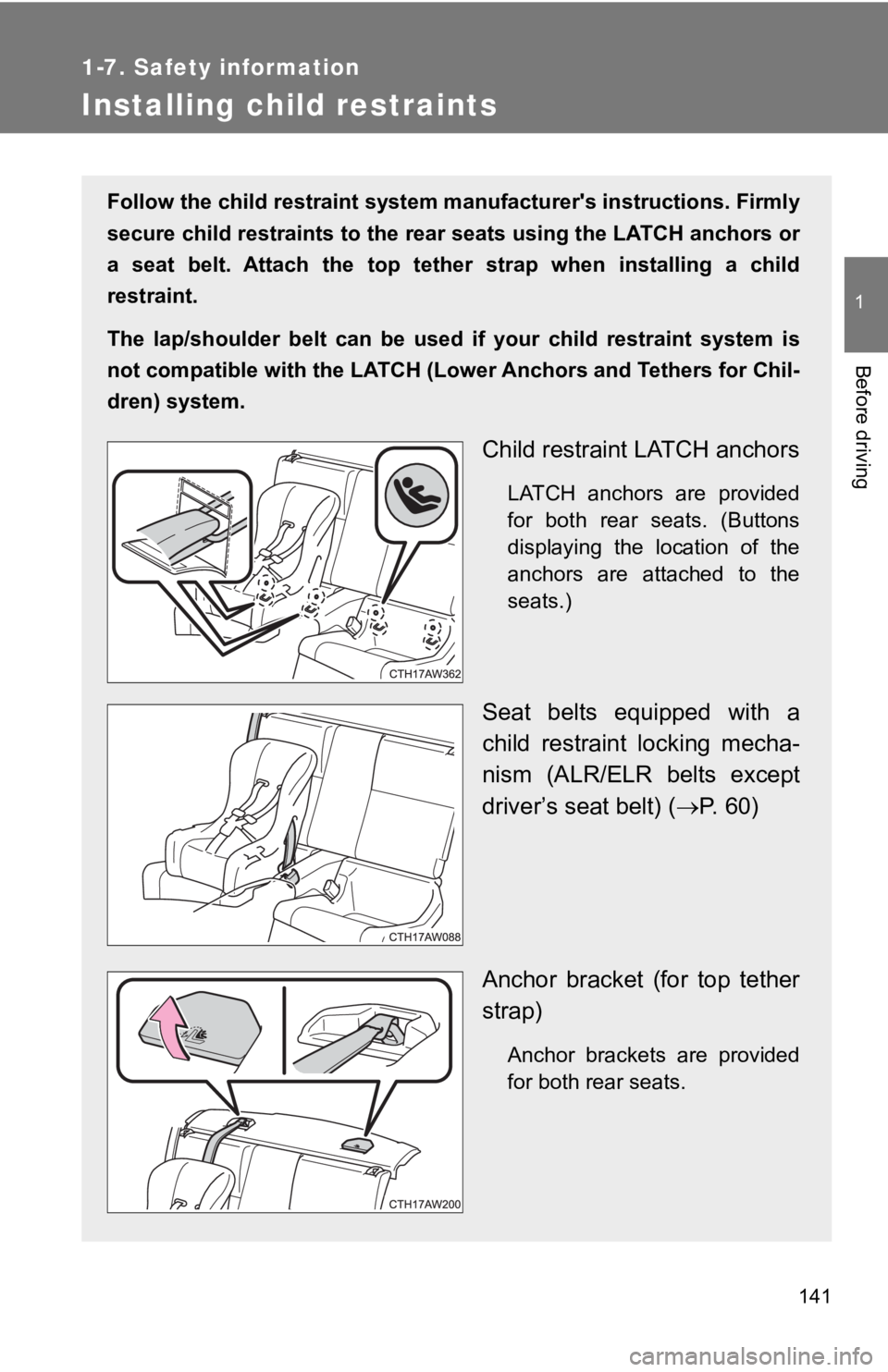
Installing child restraints
Follow the child restraint system manufacturer's instructions. Firmly
secure child restraints to the r ear seats using the LATCH ancho rs or
a seat belt. Attach the top tether strap when installing a chil d
restraint.
The lap/shoulder belt can be used if your child restraint system is
not compatible with the LATCH (Lower Anchors and Tethers for Ch il-
dren) system.
Child restraint LATCH anchors
LATCH anchors are provided
for both rear seats. (Buttons
displaying the location of the
anchors are attached to the
seats.)
Seat belts equipped with a
child restraint locking mecha-
nism (ALR/ELR belts except
driver’s seat belt) ( P. 6 0 )
Anchor bracket (for top tether
strap)
Anchor brackets are provided
for both rear seats.
Page 259 of 532
259
2-5. Driving information
2
When driving
WARNING
■Storage precautions
Observe the following precautions.
Failure to do so may result i
n death or serious injury.
●Stow cargo and luggage in the trunk whenever possible.
●To prevent cargo and luggage from sliding forward during brakin g, do
not stack anything in the enlarged trunk. Keep cargo and luggag e low,
as close to the floor as possible.
●When you fold down the rear seats, long items should not be pla ced
directly behind the front seats.
●Never allow anyone to ride in the enlarged trunk. It is not des igned for
passengers. They should ride in their seats with their seat belts prop-
erly fastened. Otherwise, they are much more likely to suffer d eath or
serious bodily injury, in the event of sudden braking, sudden s werving
or an accident.
●Do not place cargo or luggage in or on the following locations as the
item may get under the clutch, brake or accelerator pedal and p revent
the pedals from being depressed properly, block the driver’s vi sion, or
hit the driver or passengers, causing an accident:
• At the feet of the driver
• On the front passenger or rear seats (when stacking items)
• On the package tray
• On the instrument panel
• On the dashboard
●Secure all items in the occupant compartment, as they may shift and
injure someone during sudden braking, sudden swerving or an acc i-
dent.
■Capacity and distribution
●Do not exceed the maximum axle weight rating or the total vehic le
weight rating.
●Even if the total load of occupant's weight and the cargo load is less
than the total load capacity, do not apply the load unevenly. I mproper
loading may cause deterioration of steering or braking control which
may cause death or serious injury.