stop start TOYOTA 86 2019 Owners Manual
[x] Cancel search | Manufacturer: TOYOTA, Model Year: 2019, Model line: 86, Model: TOYOTA 86 2019Pages: 532, PDF Size: 6.89 MB
Page 442 of 532
4425-2. Steps to take in an emergency
Vehicles with a manual transmission
Ensure that the shift lever is in N and depress the clutch
pedal.
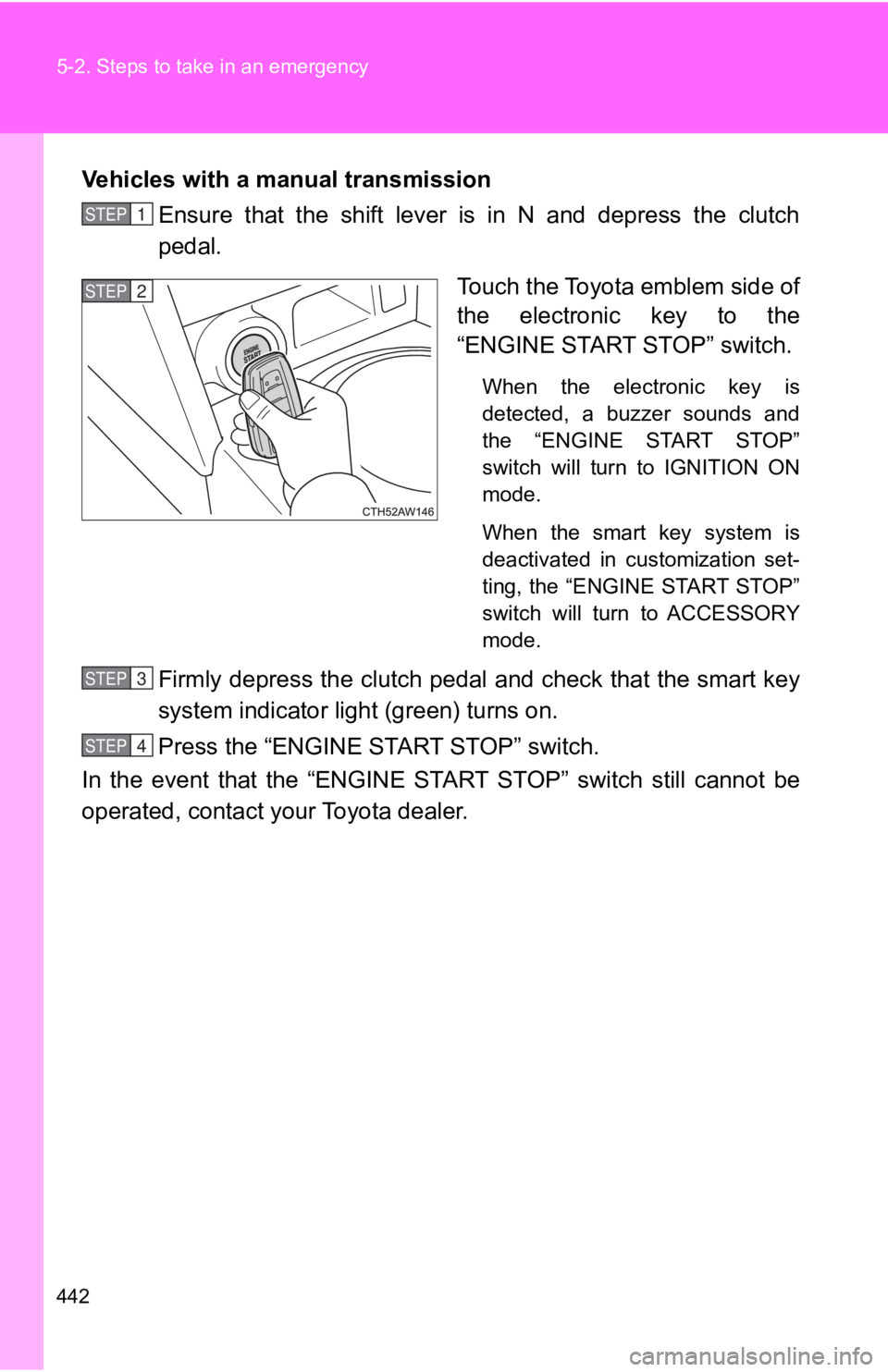
Touch the Toyota emblem side of
the electronic key to the
“ENGINE START STOP” switch. When the electronic key is
detected, a buzzer sounds and
the “ENGINE START STOP”
switch will turn to IGNITION ON
mode.
When the smart key system is
deactivated in customization set-
ting, the “ENGINE START STOP”
switch will turn to ACCESSORY
mode.
Firmly depress the clutch pedal and check that the smart key
system indicator ligh t (green) turns on.
Press the “ENGINE START STOP” switch.
In the event that the “ENGINE START STOP” switch still cannot b e
operated, contact your Toyota dealer. STEP 1
STEP 2
STEP 3
STEP 4
Page 443 of 532
5
When trouble arises
4435-2. Steps to take in an emergency
■ Stopping the engine
Vehicles with an automatic transmission: Shift the shift lever to P and press
the “ENGINE START STOP” switch as you normally do when stopping the
engine.
Vehicles with a manual transmission: Shift the shift lever to N and press the
“ENGINE START STOP” switch as you normally do when stopping the
engine.
■ Replacing the key battery
As the above procedure is a temporary measure, it is recommende d that the
electronic key battery be replaced immediately when the battery depletes.
( P. 363)
■ Alarm
Using the mechanical key to lock the doors will not set the ala rm system.
If a door is unlocked using the mechanical key when the alarm s ystem is set,
the alarm may be triggered. ( P. 82)
■ Changing “ENGINE START STOP” switch modes
Vehicles with an automatic transmission
Release the brake pedal and press the “ENGINE START STOP” switch in
above.The engine does not start and modes will be changed each
time the switch is pressed. ( P. 169)
Vehicles with a manual transmission
Release the clutch pedal and press the “ENGINE START STOP” swit ch in
above.The engine does not start and modes will be changed each
time the switch is pressed. ( P. 169)
■ If the doors cannot be locked or unlocked by the smart key syst em
Lock and unlock the doors by the mechanical key or wireless rem ote control.STEP 3
STEP 3
Page 445 of 532
5
When trouble arises
4455-2. Steps to take in an emergency
Start the engine of the second vehicle. Increase the engine
speed slightly and maintain at that level for approximately 5
minutes to recharge the battery of your vehicle.
Vehicles with a smart key sy stem only: Open and close any
of the doors of your vehicle with the “ENGINE START
STOP” switch off.
Vehicles without a smart key system: Maintain the engine
speed of the second vehicle and turn the engine switch to
the “ON” position, then start the vehicle's engine.
Vehicles with a smart key system: Maintain the engine
speed of the second vehicle and turn the “ENGINE START
STOP” switch to IGNITION ON mode, then start the vehi-
cle's engine.
Once the vehicle’s engine has started, remove the jumper
cables in the exact reverse order in which they were con-
nected.
Once the engine starts, have the vehicle checked at your Toyota
dealer as soon as possible.STEP 2
STEP 3
STEP 4
STEP 5
Page 446 of 532

4465-2. Steps to take in an emergency
■ Starting the engine when the battery is discharged
The engine cannot be started by push-starting.
■ Avoiding a discharged battery
● Turn off the headlights and the air conditioning system while t he engine is
off.
● Turn off any unnecessary electrical components when the vehicle is run-
ning at a low speed for an extended period, such as in heavy tr affic, etc.
■ Charging the battery
The electricity stored in the battery will discharge gradually even when the
vehicle is not in use, due to natural discharge and the draining effects of cer-
tain electrical appliances. If the vehicle is left for a long t ime, the battery may
discharge, and the engine may be unable to start. (The battery recharges
automatically during driving.)
■ Precautions when the battery is discharged (vehicles with a sma rt key
system)
● In some cases, it may not be possible to unlock the doors using the smart
key system when the battery is discharged. Use the wireless remote con-
trol or the mechanical key to lock or unlock the doors.
● The engine may not start on the first attempt after the battery has
recharged but will start normally after the second attempt. Thi s is not a
malfunction.
● The “ENGINE START STOP” switch mode is memorized by the vehicle .
When the battery is reconnected, the system will return to the mode it
was in before the battery was discharged. Before disconnecting the bat-
tery, turn the “ENGINE START STOP” switch off.
If you are unsure what mode the “ENGINE START STOP” switch was in
before the battery discharged, be especially careful when reconnecting
the battery.
Page 450 of 532
4505-2. Steps to take in an emergency
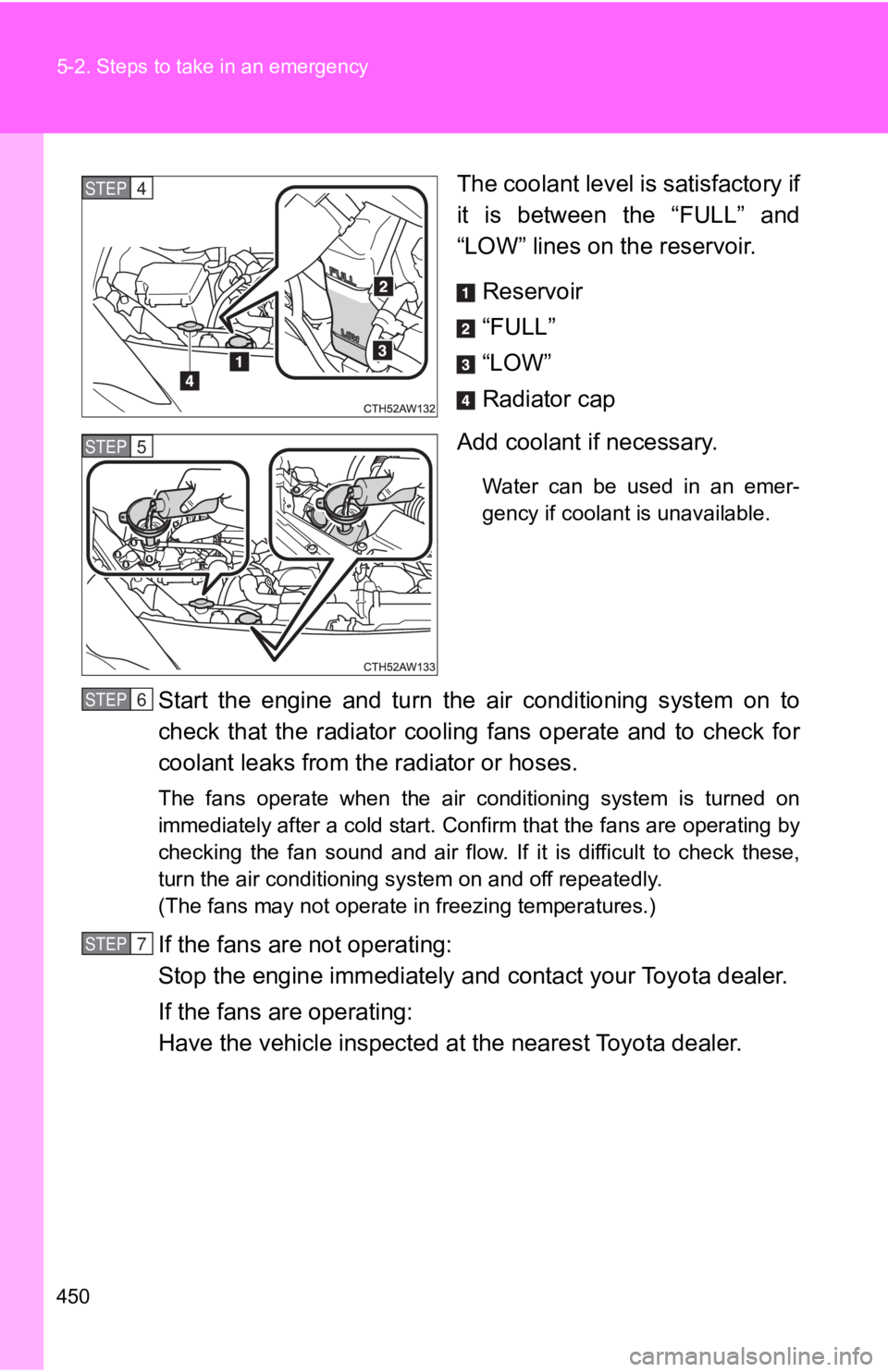
The coolant level is satisfactory if
it is between the “FULL” and
“LOW” lines on the reservoir.
Reservoir
“FULL”
“LOW”
Radiator cap
Add coolant if necessary. Water can be used in an emer-
gency if coolant is unavailable.
Start the engine and turn the air conditioning system on to
check that the radiator cooling fans operate and to check for
coolant leaks from the radiator or hoses.The fans operate when the air conditioning system is turned on
immediately after a cold start. Confirm that the fans are operating by
checking the fan sound and air flow. If it is difficult to check these,
turn the air conditioning system on and off repeatedly.
(The fans may not operate in freezing temperatures.)
If the fans are not operating:
Stop the engine immediately and contact your Toyota dealer.
If the fans are operating:
Have the vehicle in spected at the neare st Toyota dealer.STEP 4
STEP 5
STEP 6
STEP 7
Page 452 of 532
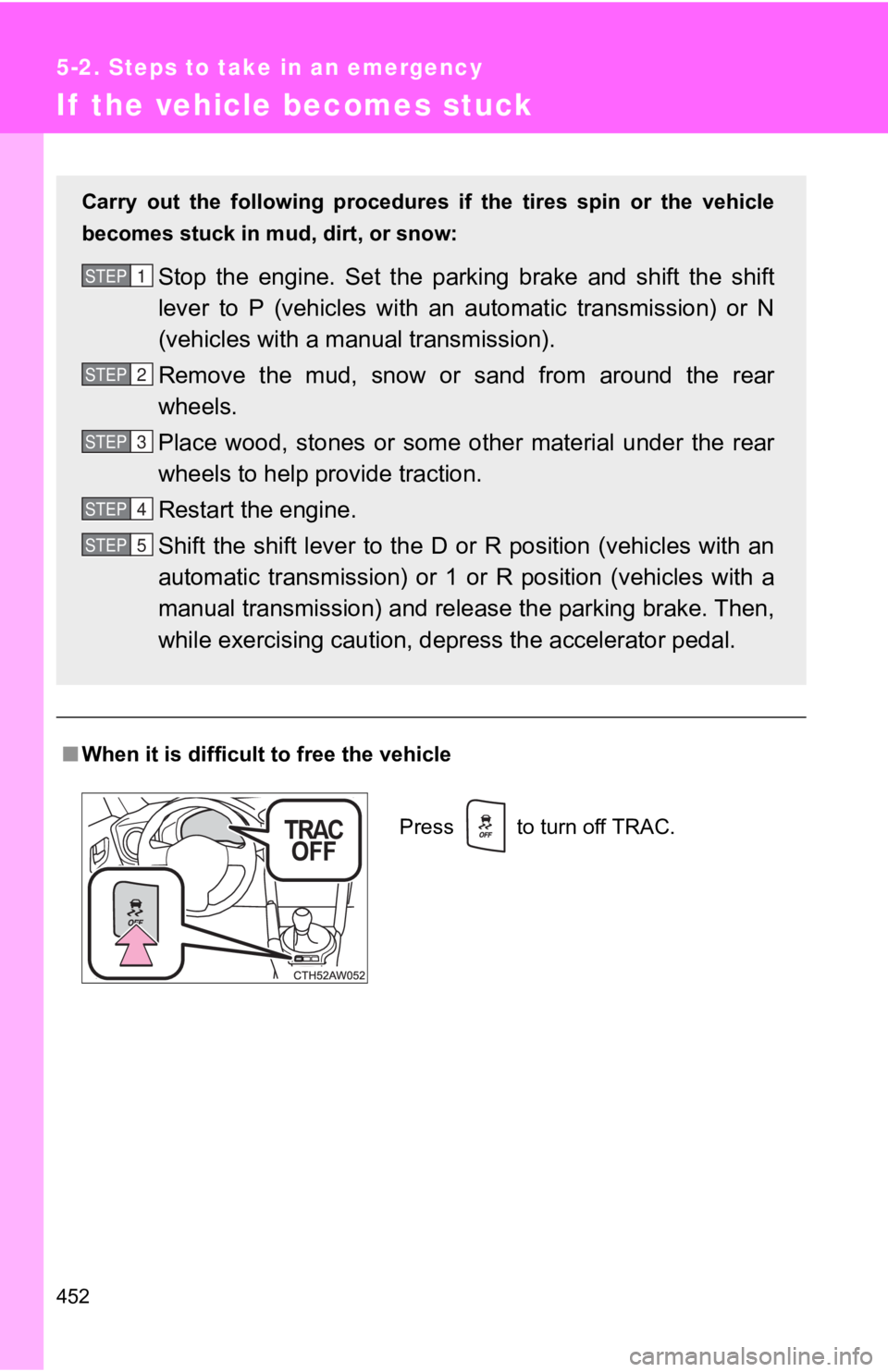
4525-2. Steps to take in an emergency
If the vehicle becomes stuck
■ When it is difficult to free the vehicleCarry out the following procedur es if the tires spin or the veh icle
becomes stuck in mud, dirt, or snow:
Stop the engine. Set the parki ng brake and shift the shift
lever to P (vehicles with an automatic transmission) or N
(vehicles with a manual transmission).
Remove the mud, snow or sand from around the rear
wheels.
Place wood, stones or some other material under the rear
wheels to help provide traction.
Restart the engine.
Shift the shift lever to the D or R position (vehicles with an
automatic transmission) or 1 or R position (vehicles with a
manual transmission) and release the parking brake. Then,
while exercising caution, depr ess the accelerator pedal.STEP 1
STEP 2
STEP 3
STEP 4
STEP 5
Press to turn off TRAC.
Page 455 of 532
5
When trouble arises
4555-2. Steps to take in an emergency
WARNING■ If the engine has to be turned off while driving
● Power assist for the brakes and steering wheel will be lost, ma king the
brake pedal harder to depress and the steering wheel heavier to turn.
Decelerate as much as possible before turning off the engine.
● Vehicles without a smart key system: Never attempt to remove the key, as
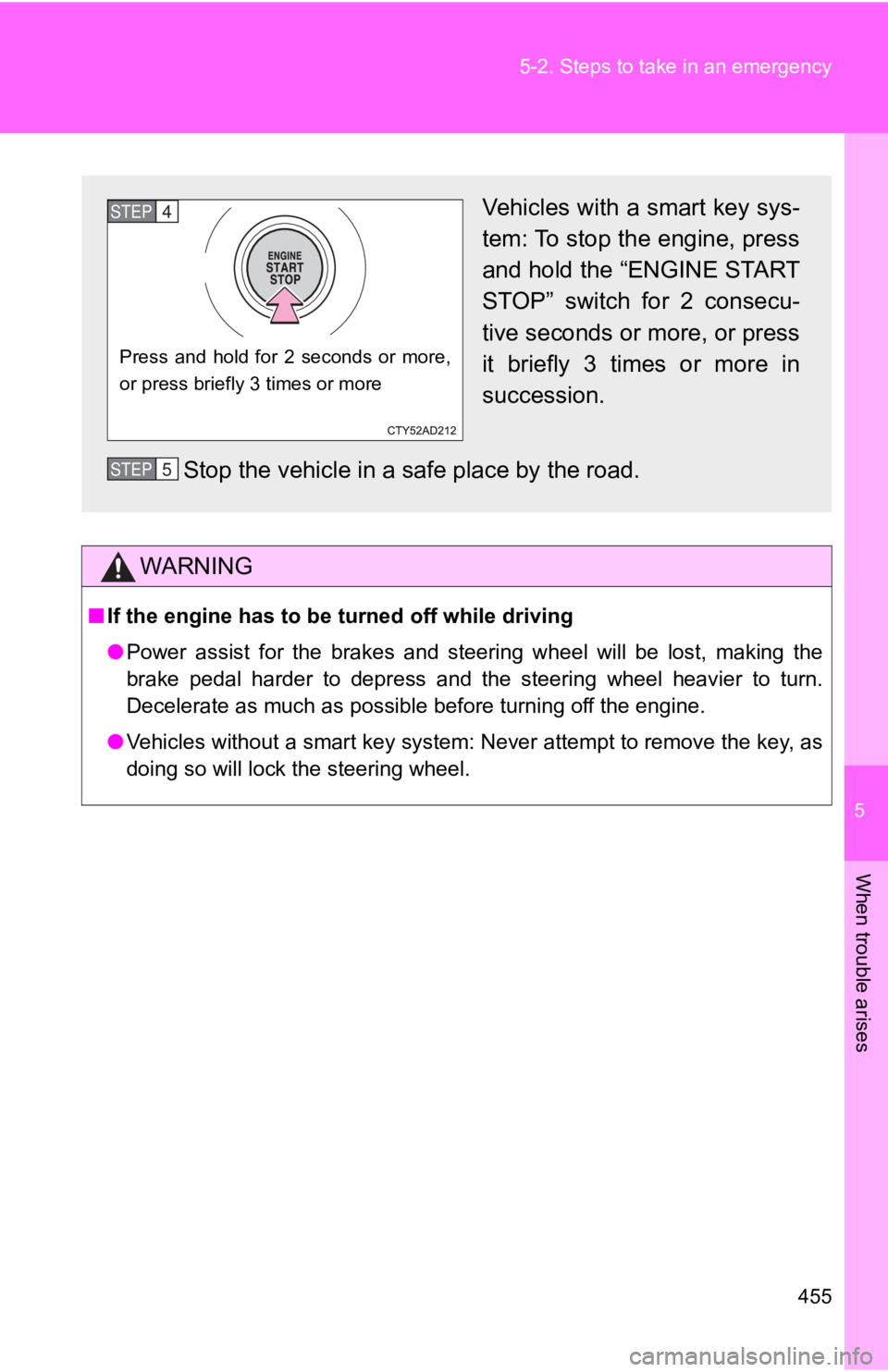
doing so will lock the steering wheel. Vehicles with a smart key sys-
tem: To stop the engine, press
and hold the “ENGINE START
STOP” switch for 2 consecu-
tive seconds or more, or press
it briefly 3 times or more in
succession.
Stop the vehicle in a s afe place by the road.Press and hold for 2 seconds or more,
or press briefly 3 times or more STEP 4
STEP 5
Page 514 of 532
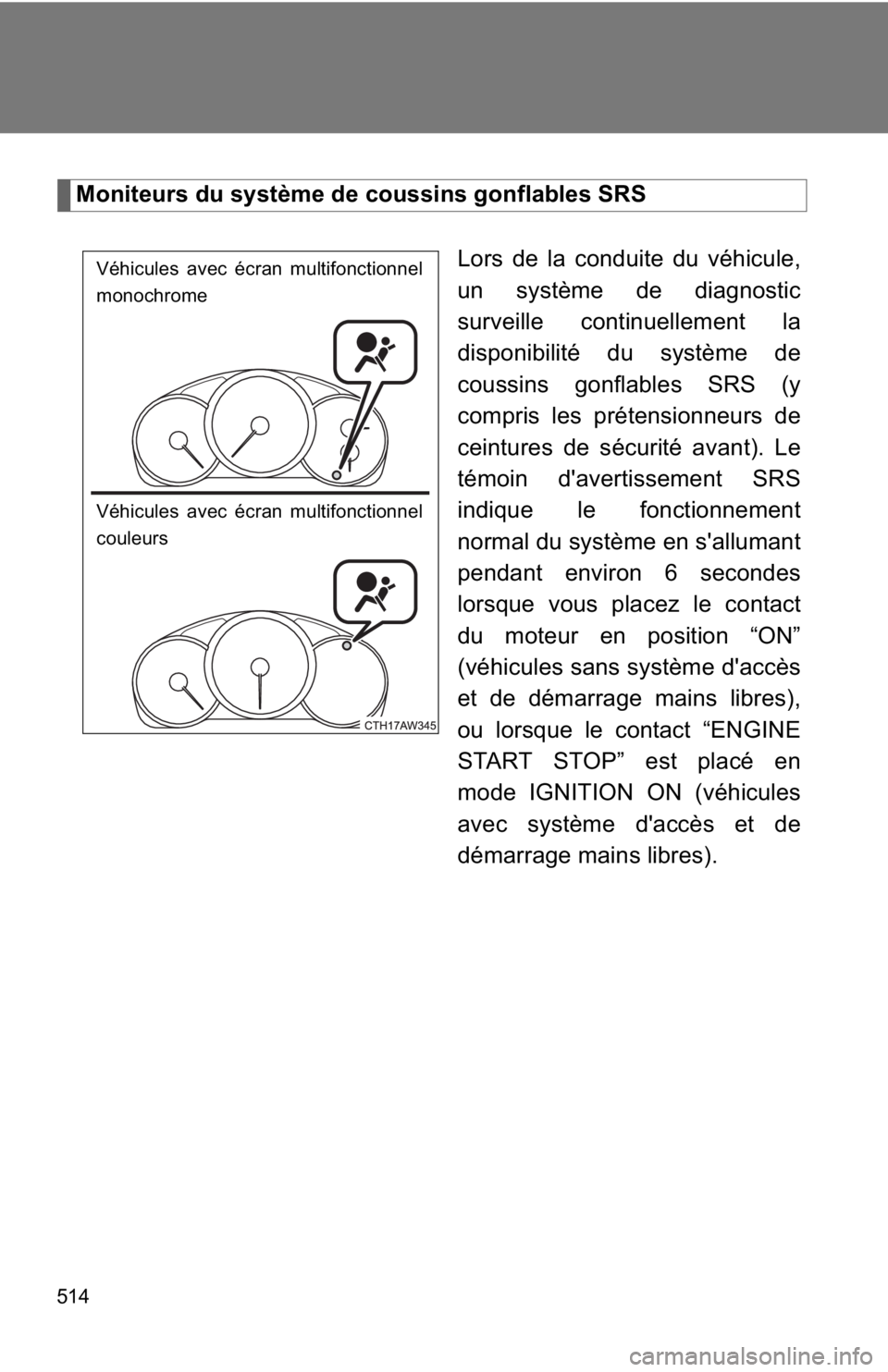
514 Moniteurs du système de coussins gonflables SRS
Lors de la conduite du véhicule,
un système de diagnostic
surveille continuellement la
disponibilité du système de
coussins gonflables SRS (y
compris les prétensionneurs de
ceintures de sécurité avant). Le
témoin d'avertissement SRS
indique le fonctionnement
normal du système en s'allumant
pendant environ 6 secondes
lorsque vous placez le contact
du moteur en position “ON”
(véhicules sans système d'accès
et de démarrage mains libres),
ou lorsque le contact “ENGINE
START STOP” est placé en
mode IGNITION ON (véhicules
avec système d'accès et de
démarrage mains libres).Véhicules avec écran multifonctionnel
monochrome
Véhicules avec écran multifonctionnel
couleurs
Page 517 of 532
517 7
For owners AT T E N T I O N■ Témoin d'avertissement SRS
Si le témoin d'avertissement montre l'un des états suivants, il peut y avoir un
dysfonctionnement des prétensionneurs de ceintures de sécurité, du
système de coussins gonflables SRS et/ou du système de classification de
l'occupant du siège passager avant. Amenez immédiatement votre véhicule
chez votre concessionnaire Toyota le plus proche afin de faire vérifier le
système. Sans vérification et réparation adaptées, les prétensionneurs de
ceintures de sécurité, le système de coussins gonflables SRS et/ou le
système de classification de l'occupant du siège passager avant ne
fonctionneront pas correctement en cas de collision, ce qui pourrait
augmenter les risques de blessures graves, voire mortelles.
● Clignotement du témoin d'avertissement
● Le témoin ne s'allume pas lorsque le contact du moteur est d'abord placé
sur la position “ON” (véhicules sans système d'accès et de démarrage
mains libres), ou que le contact “ENGINE START STOP” est placé en
mode IGNITION ON (véhicules avec système d'accès et de démarrage
mains libres).
● Le témoin d'avertissement reste allumé en permanence
● Le témoin d'avertissement s'allume pendant la conduite
Page 523 of 532

523Alphabetical index
Dimension ................................ 458
Dinghy towing ......................... 266
Display
Drive information .................. 210
Multi-information
display ........................ 200, 207
Trip information ............ 202, 208
Warning messages............... 407
Do-it-yourself maintenance .... 324
Doors
Door lock .................... 25, 38, 43
Door windows ......................... 72
Side mirrors ............................ 69
Driver's seat belt
reminder light ........................ 399
Driving
Break-in tips ......................... 155
Correct posture....................... 87
Procedures ........................... 152
Winter drive tips.................... 261
Electric power steering........... 245
Electronic key
If the electronic key does
not operate properly ........... 440
Emergency flashers
Switch ................................... 384
Emergency, in case of
If the electronic key does
not operate properly ........... 440
If the engine will not start...... 435
If the shift lever cannot
be shifted from P ................ 438
If the vehicle has a
discharged battery ............. 444
If the warning buzzer
sounds ............................... 395
If the warning light
turns on .............................. 395 If the warning message
is displayed .........................407
If you have a flat tire .............424
If you lose your keys .............439
If you think something is
wrong ..................................393
If your vehicle becomes
stuck ...................................452
If your vehicle has to be
stopped in an
emergency ..........................454
If your vehicle needs to
be towed .............................385
If your vehicle overheats .......449
Engine
Compartment ........................331
Engine switch ................166, 175
Hood......................................327
How to start the
engine .........................166, 175
Identification number .............459
If the engine will not start ......435
Ignition switch................166, 175
Overheating...........................449
Engine coolant
Capacity ................................464
Checking ...............................335
Engine coolant temperature
gauge ......................................191
Engine immobilizer system.......79
Engine oil
Capacity ................................462
Checking ...............................332
Preparing and checking
before winter .......................261
Engine switch ...................166, 175
Engine switch light ..................289
EPS ............................................245
Event data recorder ...................18E