engine TOYOTA 86 2019 Owners Manual
[x] Cancel search | Manufacturer: TOYOTA, Model Year: 2019, Model line: 86, Model: TOYOTA 86 2019Pages: 532, PDF Size: 6.89 MB
Page 372 of 532

3724-3. Do-it-yourself maintenance
Note
One of each of the following spare fuses are provided: 7.5 A, 10 A, 15
A, 20 A, 25 A, 30 A. 37
HORN NO. 2 7.5 A Horn38
HORN NO. 1 7.5 A Horn39
H-LP LH LO 15 A Left-hand headlight (low beam)40
H-LP RH LO 15 A Right-hand headlight (low beam)41
H-LP LH HI 10 A Left-hand headlight (high beam)42
H-LP RH HI 10 A Right-hand headlight (high beam)
43
INJ 30 A Multiport fuel injection system/
sequential multiport fuel injection
system44
H-LP WASHER 30 A
45
AM2 NO. 1 40 A Starting system, engine control unit
46
EPS 80 A Electric power steering
47
A/B MAIN 15 A SRS airbag system
48
ECU-B 7.5 A Wireless remote control, main body
ECU
49
DOME 20 A Interior light
50
IG2 7.5 A Engine control unitFuse Ampere Circuit
Page 373 of 532
3734-3. Do-it-yourself maintenance
4
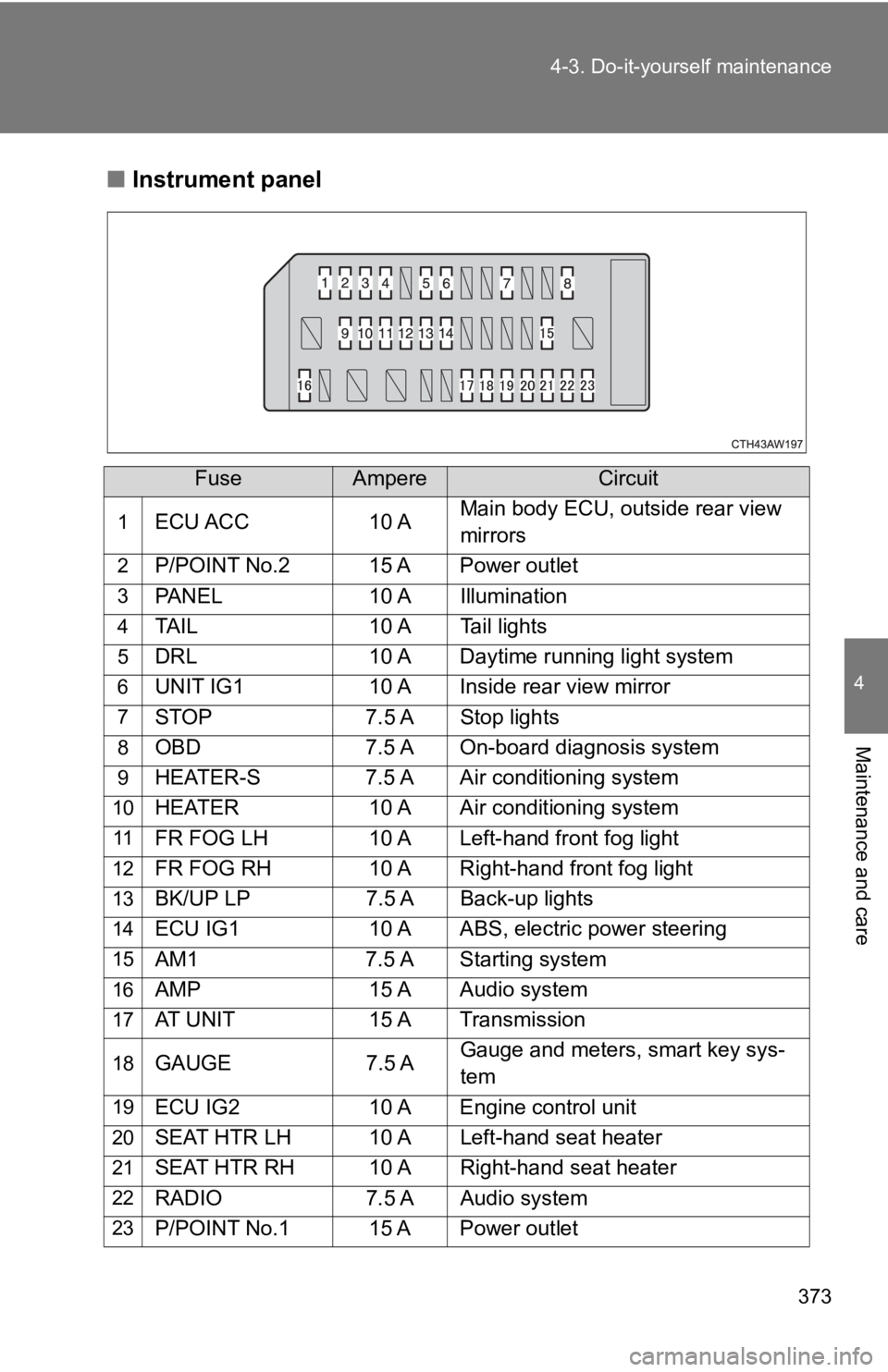
Maintenance and care ■ Instrument panel
Fuse Ampere Circuit1
ECU ACC 10 A Main body ECU, outside rear view
mirrors2
P/POINT No.2 15 A Power outlet3
PANEL 10 A Illumination4
TAIL 10 A Tail lights5
DRL 10 A Daytime running light system6
UNIT IG1 10 A Inside rear view mirror7
STOP 7.5 A Stop lights8
OBD 7.5 A On-board diagnosis system9
HEATER-S 7.5 A Air conditioning system
10
HEATER 10 A Air conditioning system
11
FR FOG LH 10 A Left-hand front fog light
12
FR FOG RH 10 A Right-hand front fog light
13
BK/UP LP 7.5 A Back-up lights
14
ECU IG1 10 A ABS, electric power steering
15
AM1 7.5 A Starting system
16
AMP 15 A Audio system
17
AT UNIT 15 A Transmission
18
GAUGE 7.5 A Gauge and meters, smart key sys-
tem
19
ECU IG2 10 A Engine control unit
20
SEAT HTR LH 10 A Left-hand seat heater
21
SEAT HTR RH 10 A Right-hand seat heater
22
RADIO 7.5 A Audio system
23
P/POINT No.1 15 A Power outlet
Page 381 of 532
3814-3. Do-it-yourself maintenance
4
Maintenance and care WARNING■ Replacing light bulbs
● Turn off the lights. Do not attempt to replace the bulb immedia tely after
turning off the lights.
The bulbs become very hot and may cause burns.
● Do not touch the glass portion of the light bulb with bare hand s. When it is
unavoidable to hold the glass portion, use and hold with a clea n dry cloth
to avoid getting moisture and oils on the bulb.
Also, if the bulb is scratched or dropped, it may blow out or c rack.
● Fully install the light bulbs and any parts used to secure them . Failure to
do so may result in heat damage, fire, or water entering a light unit. This
may damage the light or cause condensation to build up on the i nner side
of the lens.
■ When changing the back-up lights
Stop the engine and wait until the exhaust pipes have cooled do wn suffi-
ciently. The lights are located near the exhaust pipe and touching a hot
exhaust pipe can cause burns.
■ To prevent damage or fire
Make sure bulbs are fully seated and locked.
Page 383 of 532
When trouble arises
5
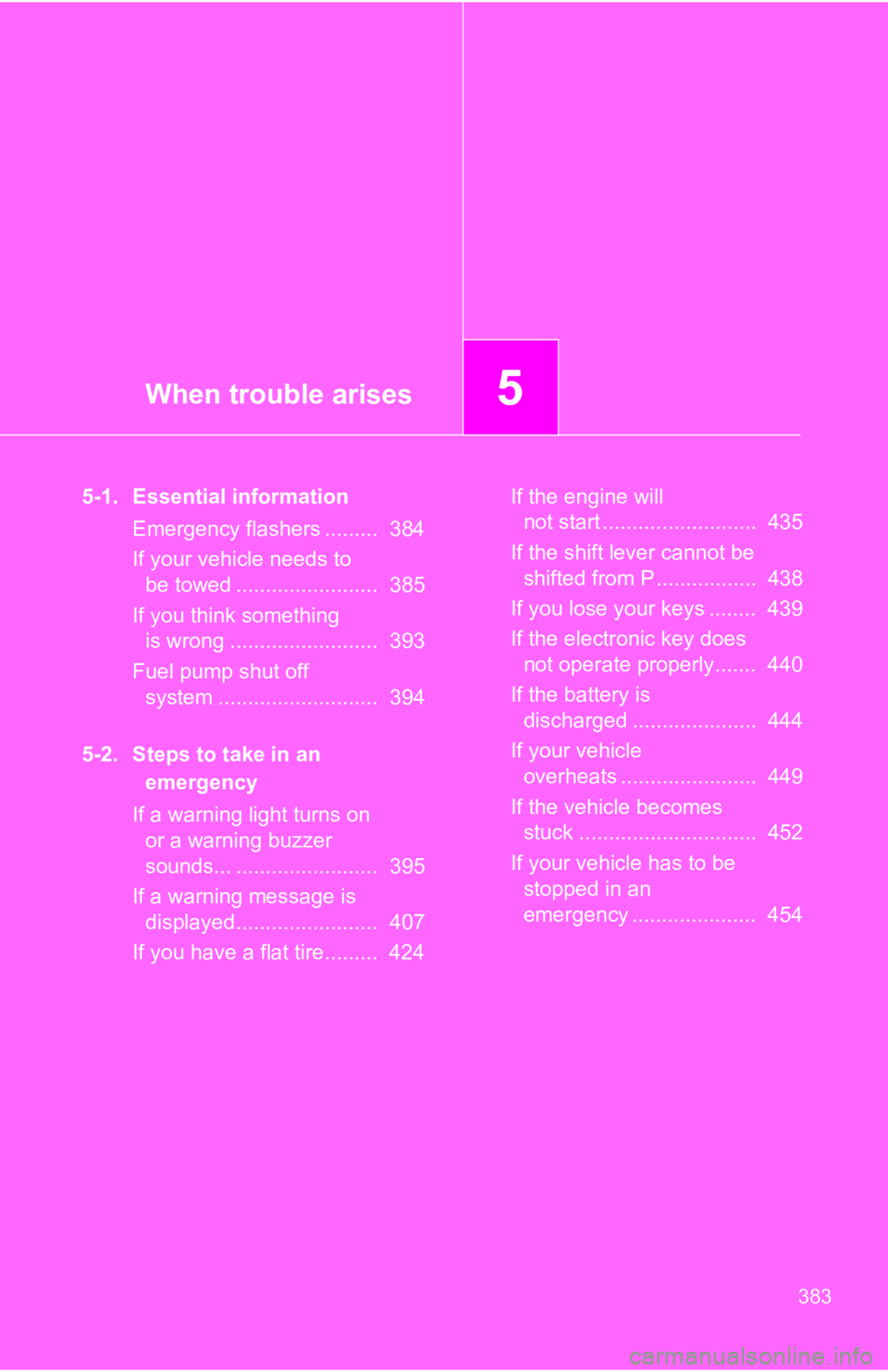
3835-1. Essential information
Emergency flashers ......... 384
If your vehicle needs to
be towed ........................ 385
If you think something
is wrong ......................... 393
Fuel pump shut off
system ........................... 394
5-2. Steps to take in an
emergency
If a warning light turns on
or a warning buzzer
sounds... ........................ 395
If a warning message is
displayed........................ 407
If you have a flat tire......... 424 If the engine will
not start .......................... 435
If the shift lever cannot be
shifted from P................. 438
If you lose your keys ........ 439
If the electronic key does
not operate properly....... 440
If the battery is
discharged ..................... 444
If your vehicle
overheats ....................... 449
If the vehicle becomes
stuck .............................. 452
If your vehicle has to be
stopped in an
emergency ..................... 454
Page 385 of 532
5
When trouble arises
3855-1. Essential information
If your vehicle needs to be towed
Before towing
The following may indicate a problem with your transmission. Co ntact
your Toyota dealer before towing.
● The engine is running, but t he vehicle will not move.
● The vehicle makes an abnormal sound.
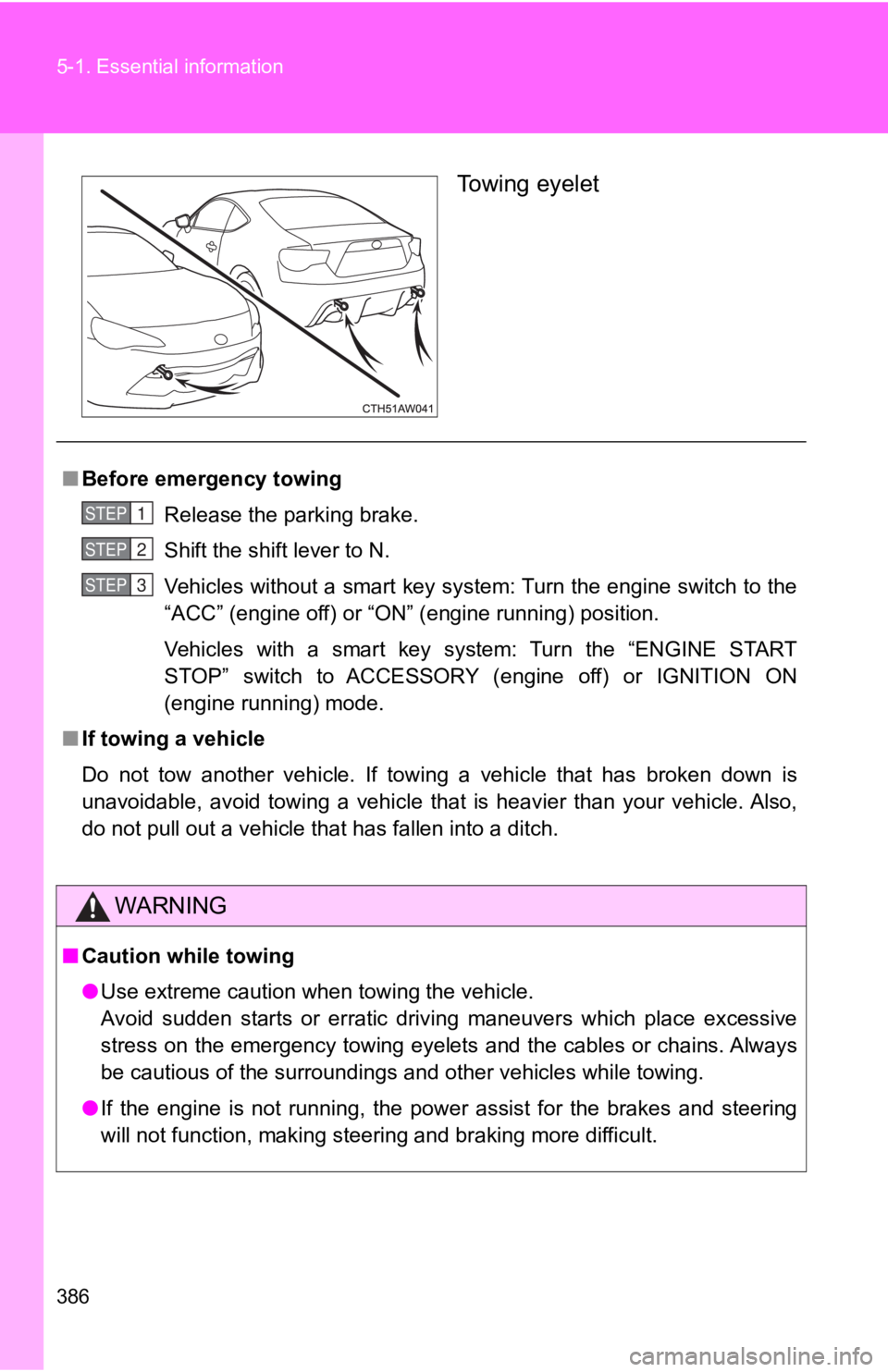
Emergency towing
If a tow truck is not available in an emergency, your vehicle m ay be
temporarily towed using a cable or chain secured to the emergen cy
towing eyelet. This should only be attempted on hard surfaced r oads
for short distances at low speeds.
A driver must be in the vehicle to steer and operate the brakes . The
vehicle’s wheels, drive train, axles, steering and brakes must be in
good condition.
For vehicles with an automatic transmission, only the front tow ing
eyelet may be used. If towing is necessary, we recommen d having your vehicle towed by
your Toyota dealer or a commerci al towing service, using a lift -type
truck or a flat bed truck.
Use a safety chain system for all towing, and abide by all stat e/pro-
vincial and local laws.
If towing from the rear, the vehicle's front wheels and axles m ust be
in good condition. ( P. 391)
If they are damaged, use a to wing dolly or flat bed truck.
Page 386 of 532
3865-1. Essential information
To w i n g e y e l e t
■ Before emergency towing
Release the parking brake.
Shift the shift lever to N.
Vehicles without a smart key system: Turn the engine switch to the
“ACC” (engine off) or “ON” (engine running) position.
Vehicles with a smart key system: Turn the “ENGINE START
STOP” switch to ACCESSORY (engine off) or IGNITION ON
(engine running) mode.
■ If towing a vehicle
Do not tow another vehicle. If towing a vehicle that has broken down is
unavoidable, avoid towing a vehicle that is heavier than your v ehicle. Also,
do not pull out a vehicle that has fallen into a ditch.
WARNING
■ Caution while towing
● Use extreme caution when towing the vehicle.
Avoid sudden starts or erratic driving maneuvers which place ex cessive
stress on the emergency towing eyelets and the cables or chains. Always
be cautious of the surroundings and other vehicles while towing .
● If the engine is not running, the power assist for the brakes a nd steering
will not function, making steering and braking more difficult. STEP 1
STEP 2
STEP 3
Page 391 of 532
5
When trouble arises
3915-1. Essential information
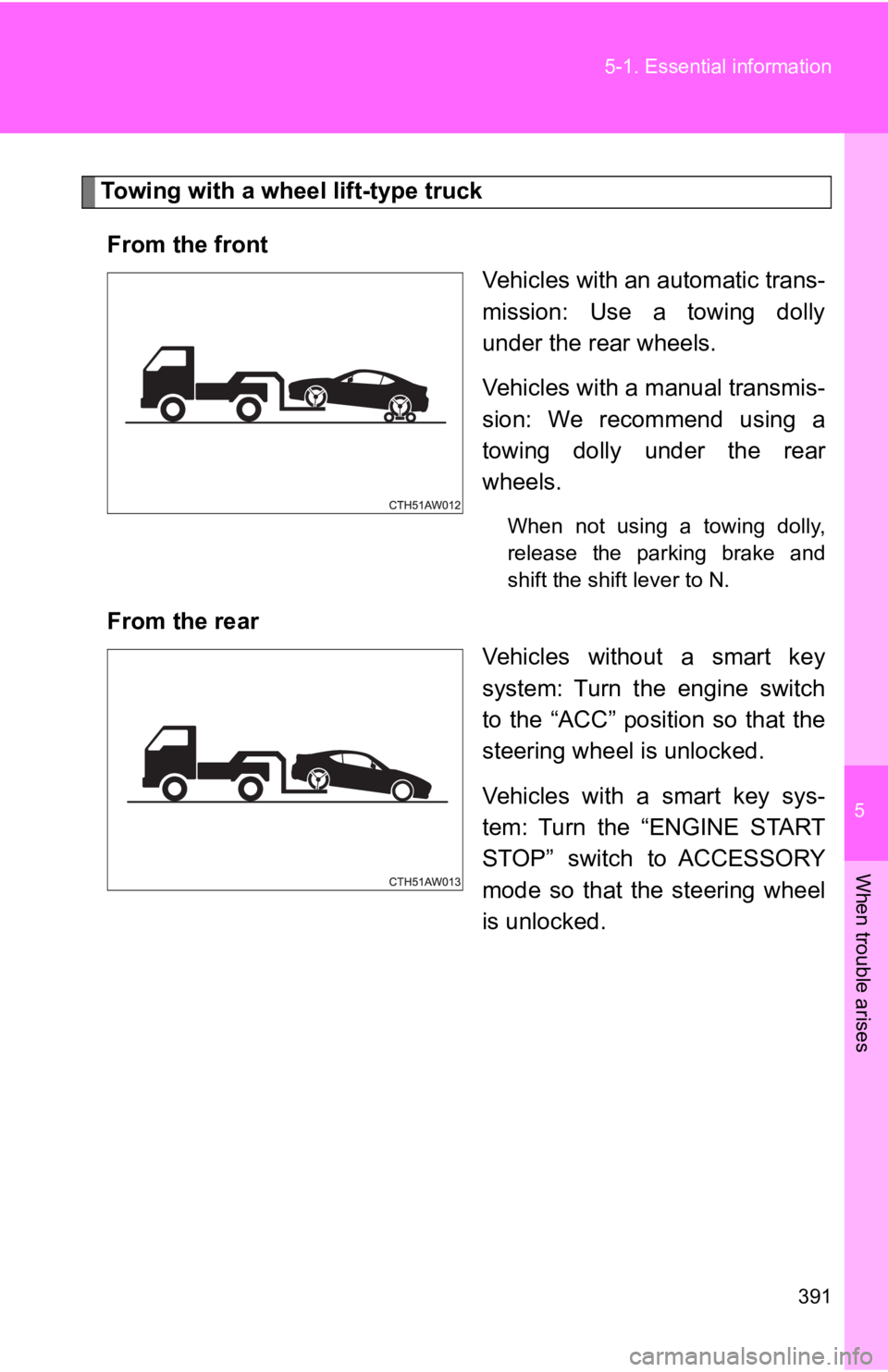
Towing with a wheel lift-type truck
From the front
Vehicles with an automatic trans-
mission: Use a towing dolly
under the rear wheels.
Vehicles with a manual transmis-
sion: We recommend using a
towing dolly under the rear
wheels. When not using a towing dolly,
release the parking brake and
shift the shift lever to N.
From the rear
Vehicles without a smart key
system: Turn the engine switch
to the “ACC” position so that the
steering wheel is unlocked.
Vehicles with a smart key sys-
tem: Turn the “ENGINE START
STOP” switch to ACCESSORY
mode so that the steering wheel
is unlocked.
Page 392 of 532
3925-1. Essential information
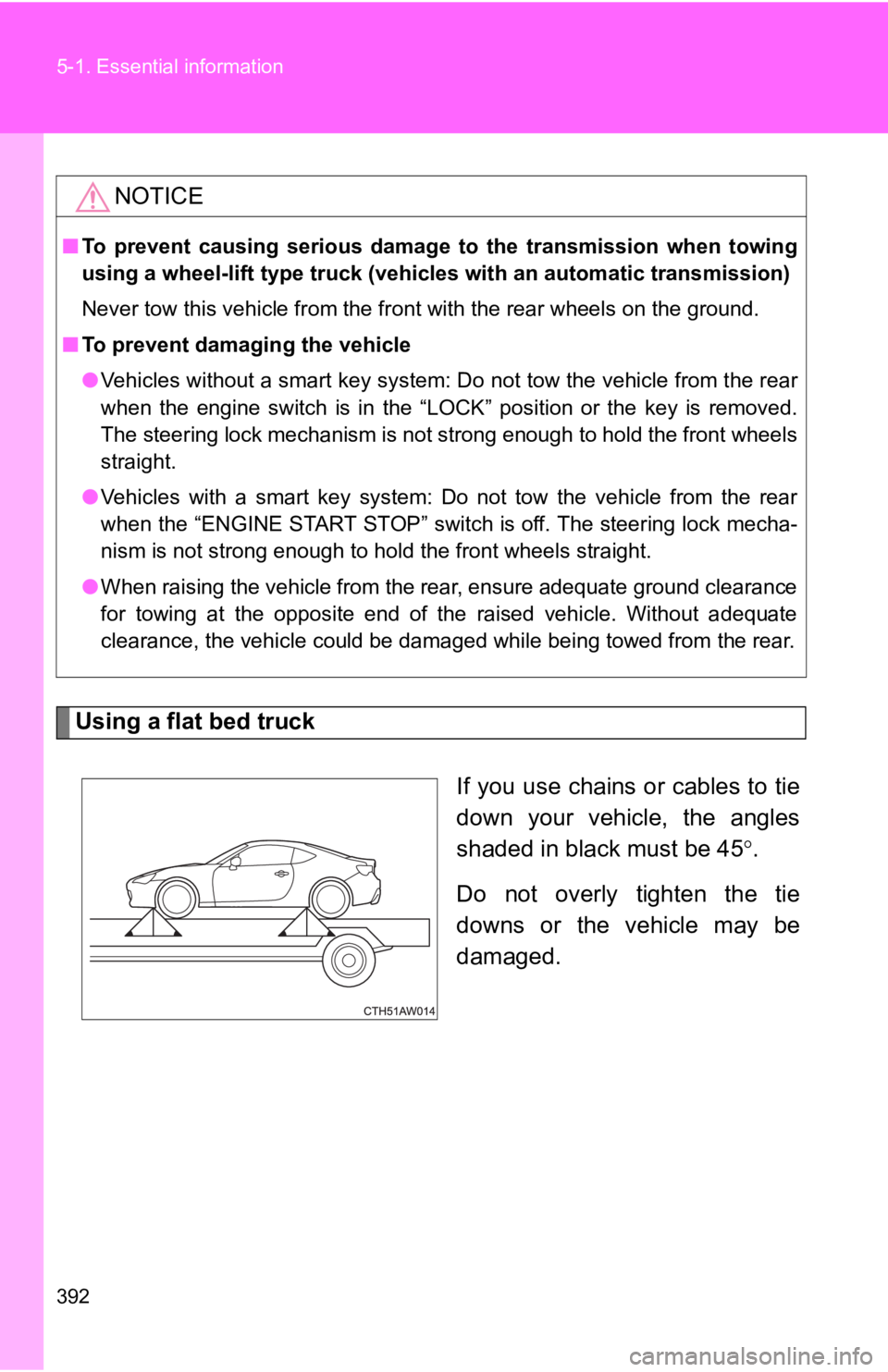
Using a flat bed truck
If you use chains or cables to tie
down your vehicle, the angles
shaded in black must be 45 .
Do not overly tighten the tie
downs or the vehicle may be
damaged.NOTICE■ To prevent causing serious damage to the transmission when towi ng
using a wheel-lift type truck (vehicles with an automatic trans mission)
Never tow this vehicle from the front with the rear wheels on t he ground.
■ To prevent damaging the vehicle
● Vehicles without a smart key system: Do not tow the vehicle fro m the rear
when the engine switch is in the “LOCK” position or the key is removed.
The steering lock mechanism is not strong enough to hold the fr ont wheels
straight.
● Vehicles with a smart key system: Do not tow the vehicle from t he rear
when the “ENGINE START STOP” switch is off. The steering lock m echa-
nism is not strong enough to hold the front wheels straight.
● When raising the vehicle from the rear, ensure adequate ground clearance
for towing at the opposite end of the raised vehicle. Without a dequate
clearance, the vehicle could be damaged while being towed from the rear.
Page 393 of 532
5
When trouble arises
3935-1. Essential information
If you think something is wrong If you notice any of the followi ng symptoms, your vehicle proba bly
needs adjustment or repair. Cont act your Toyota d ealer as soon as
possible.
■ Visible symptoms
● Fluid leaks under the vehicle
(Water dripping from t he air conditioning after use is normal.)
● Flat-looking tires or uneven tire wear
● Vehicles with a monochrome multi-information display: The
engine coolant temperature gauge needle continually points
higher than normal
● Vehicles with a color multi-information display: The high
engine coolant temperature wa rning light flashes or illumi-
nates
■ Audible symptoms
● Changes in exhaust sound
● Excessive tire squeal when cornering
● Strange noises related to the suspension system
● Pinging or other noises related to the engine
■ Operational symptoms
● Engine missing, stumbling or running rough
● Appreciable loss of power
● Vehicle pulls heavily to one side when braking
● Vehicle pulls heavily to one side when driving on a level road
● Loss of brake effectiveness, s pongy feeling, pedal almost
touches the floor
Page 394 of 532
3945-1. Essential information
Fuel pump shut off system Follow the procedure below to restart the engine after the syst em is
activated.
Vehicles without a smart key system
Turn the engine switch to t he “ACC” or “LOCK” position.
Restart the engine.
Vehicles with a smart key system
Turn the “ENGINE START STOP” switch to ACCESSORY mode
or turn it off.
Restart the engine.
NOTICE■ Before starting the engine
Inspect the ground under the vehicle.
If you find that fuel has leaked on to the ground, the fuel sys tem has been
damaged and is in need of repair. Do not restart the engine.When the vehicle sustains an impact in an accident, etc., the f uel
pump shut off system operates to stop supplying fuel in order t o
minimize fuel leakage.
STEP 1
STEP 2
STEP 1
STEP 2