tow TOYOTA 86 2019 Owner's Manual
[x] Cancel search | Manufacturer: TOYOTA, Model Year: 2019, Model line: 86, Model: TOYOTA 86 2019Pages: 532, PDF Size: 6.89 MB
Page 293 of 532
2933-4. Using the storage features
3
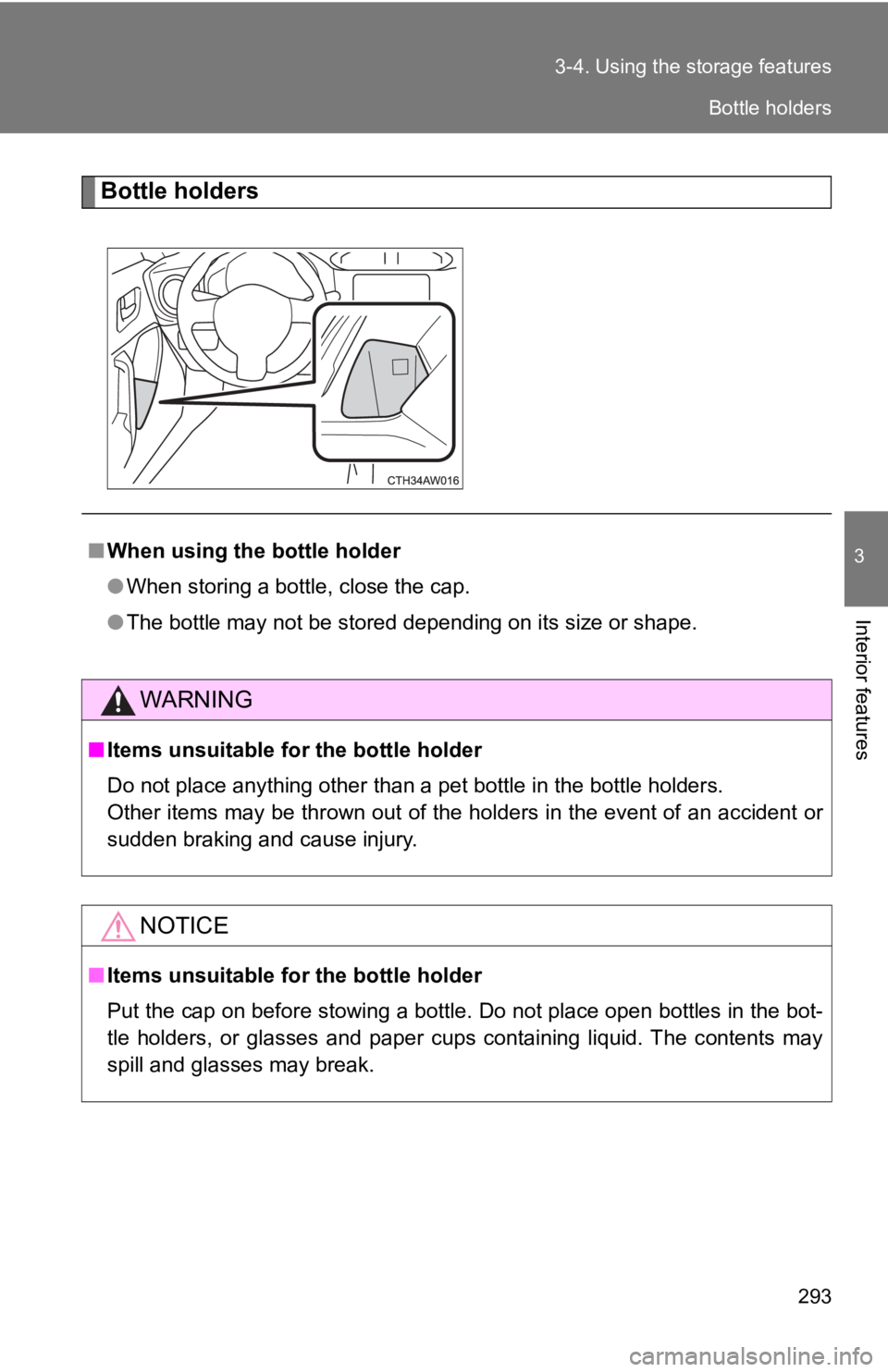
Interior features Bottle holders
■ When using the bottle holder
● When storing a bottle, close the cap.
● The bottle may not be stored depending on its size or shape.
WARNING■ Items unsuitable for the bottle holder
Do not place anything other than a pet bottle in the bottle hol ders.
Other items may be thrown out of the holders in the event of an accident or
sudden braking and cause injury.
NOTICE
■ Items unsuitable for the bottle holder
Put the cap on before stowing a bottle. Do not place open bottles in the bot-
tle holders, or glasses and paper cups containing liquid. The c ontents may
spill and glasses may break. Bottle holders
Page 324 of 532
3244-3. Do-it-yourself maintenance
Do-it-yourself ser vice precautions If you perform maintenance yoursel f, be sure to follow the corr ect
procedure as given in these sections.
Items Parts and tools
Battery condition ( P. 339) •Warm water
• Baking soda
• Grease
• Conventional wrench
(for terminal clamp bolts)
• Distilled water
Brake fluid level ( P. 337) • FMVSS No.116 fresh DOT 3
brake fluid
• Rag or paper towel
• Funnel (used only for adding
brake fluid)
Engine coolant level ( P. 335) • “TOYOTA Genuine 50/50 Pre-
mixed Super Long Life Coolant
BLUE” or similar high-quality
ethylene glycol-based non-
silicate, non-amine, non-nitrite
and non-borate coolant with long-
life hybrid organic acid
technology.
“TOYOTA Genuine 50/50 Pre-
mixed Super Long Life Coolant
BLUE” is pre-mixed with 50%
coolant and 50% deionized
water.
• Funnel (used only for adding
engine coolant)
Engine oil level ( P. 332) • “Toyota Genuine Motor Oil” or
equivalent
• Rag or paper towel, funnel (used
only for adding engine oil)
Page 360 of 532
3604-3. Do-it-yourself maintenance
Air conditioning filter The air conditioning filter must be changed regularly to mainta in air
conditioning efficiency.
■ Removal method
Vehicles without a smart key system
Turn the engine switch off.
Vehicles with a smart key system
Turn the “ENGINE START STOP” switch off.
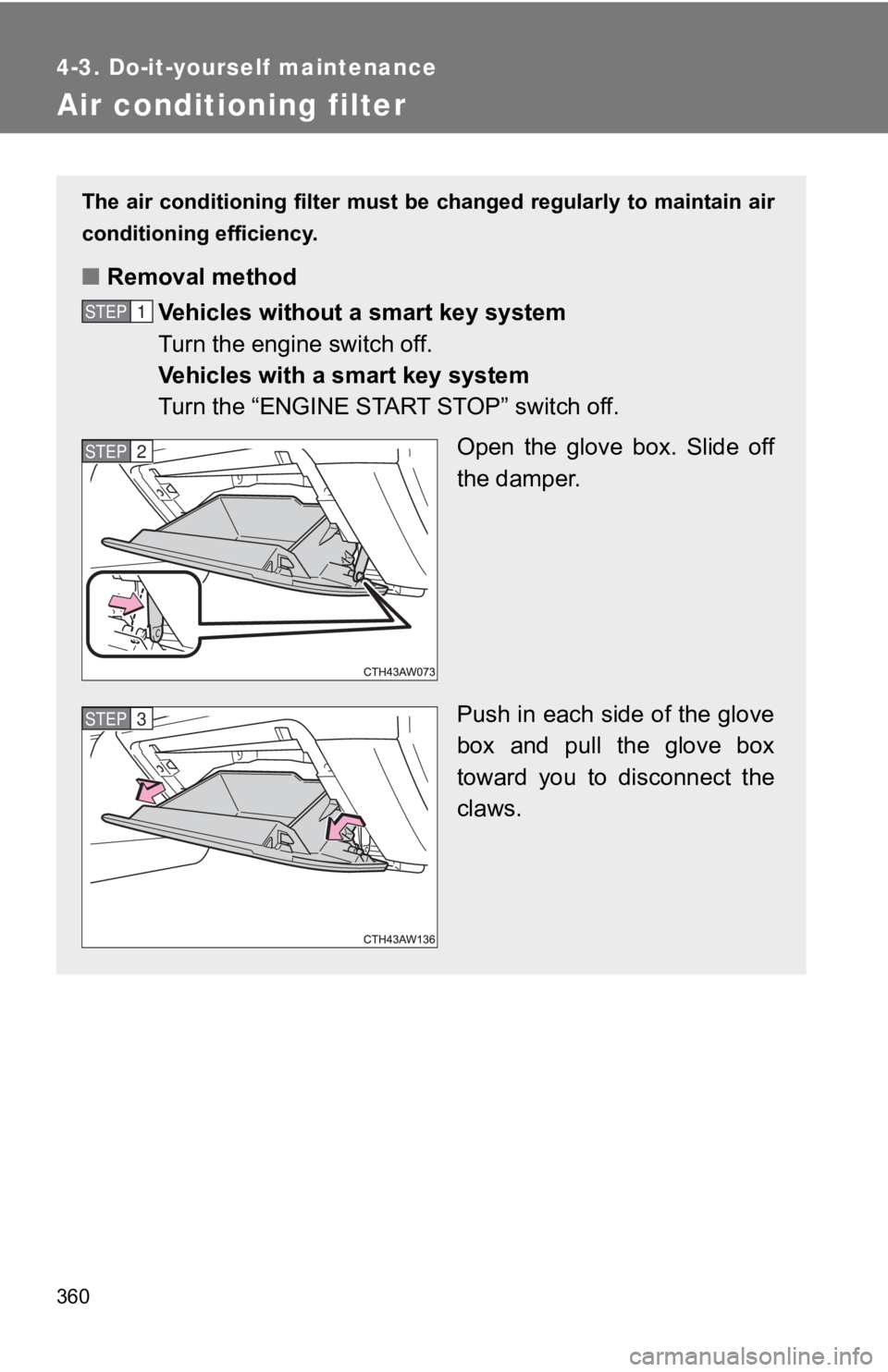
Open the glove box. Slide off
the damper.
Push in each side of the glove
box and pull the glove box
toward you to disconnect the
claws.STEP 1
STEP 2
STEP 3
Page 376 of 532
3764-3. Do-it-yourself maintenance
Replacing light bulbs
■ Front side marker lights
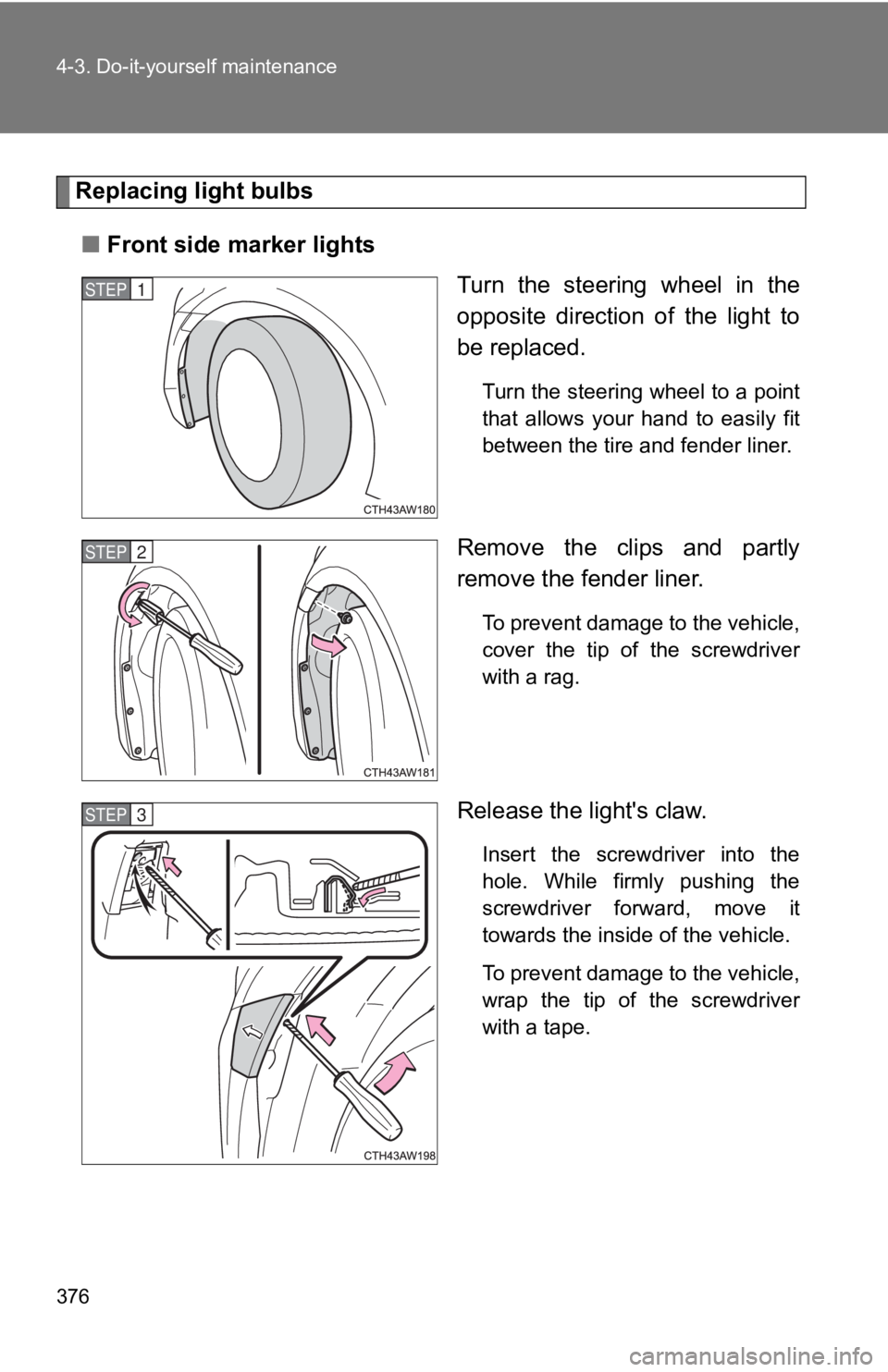
Turn the steering wheel in the
opposite direction of the light to
be replaced. Turn the steering wheel to a point
that allows your hand to easily fit
between the tire and fender liner.
Remove the clips and partly
remove the fender liner. To prevent damage to the vehicle,
cover the tip of the screwdriver
with a rag.
Release the light's claw. Insert the screwdriver into the
hole. While firmly pushing the
screwdriver forward, move it
towards the inside of the vehicle.
To prevent damage to the vehicle,
wrap the tip of the screwdriver
with a tape.STEP 1
STEP 2
STEP 3
Page 383 of 532
When trouble arises
5
3835-1. Essential information
Emergency flashers ......... 384
If your vehicle needs to
be towed ........................ 385
If you think something
is wrong ......................... 393
Fuel pump shut off
system ........................... 394
5-2. Steps to take in an
emergency
If a warning light turns on
or a warning buzzer
sounds... ........................ 395
If a warning message is
displayed........................ 407
If you have a flat tire......... 424 If the engine will
not start .......................... 435
If the shift lever cannot be
shifted from P................. 438
If you lose your keys ........ 439
If the electronic key does
not operate properly....... 440
If the battery is
discharged ..................... 444
If your vehicle
overheats ....................... 449
If the vehicle becomes
stuck .............................. 452
If your vehicle has to be
stopped in an
emergency ..................... 454
Page 385 of 532
5
When trouble arises
3855-1. Essential information
If your vehicle needs to be towed
Before towing
The following may indicate a problem with your transmission. Co ntact
your Toyota dealer before towing.
● The engine is running, but t he vehicle will not move.
● The vehicle makes an abnormal sound.
Emergency towing
If a tow truck is not available in an emergency, your vehicle m ay be
temporarily towed using a cable or chain secured to the emergen cy
towing eyelet. This should only be attempted on hard surfaced r oads
for short distances at low speeds.
A driver must be in the vehicle to steer and operate the brakes . The
vehicle’s wheels, drive train, axles, steering and brakes must be in
good condition.
For vehicles with an automatic transmission, only the front tow ing
eyelet may be used. If towing is necessary, we recommen d having your vehicle towed by
your Toyota dealer or a commerci al towing service, using a lift -type
truck or a flat bed truck.
Use a safety chain system for all towing, and abide by all stat e/pro-
vincial and local laws.
If towing from the rear, the vehicle's front wheels and axles m ust be
in good condition. ( P. 391)
If they are damaged, use a to wing dolly or flat bed truck.
Page 386 of 532
3865-1. Essential information
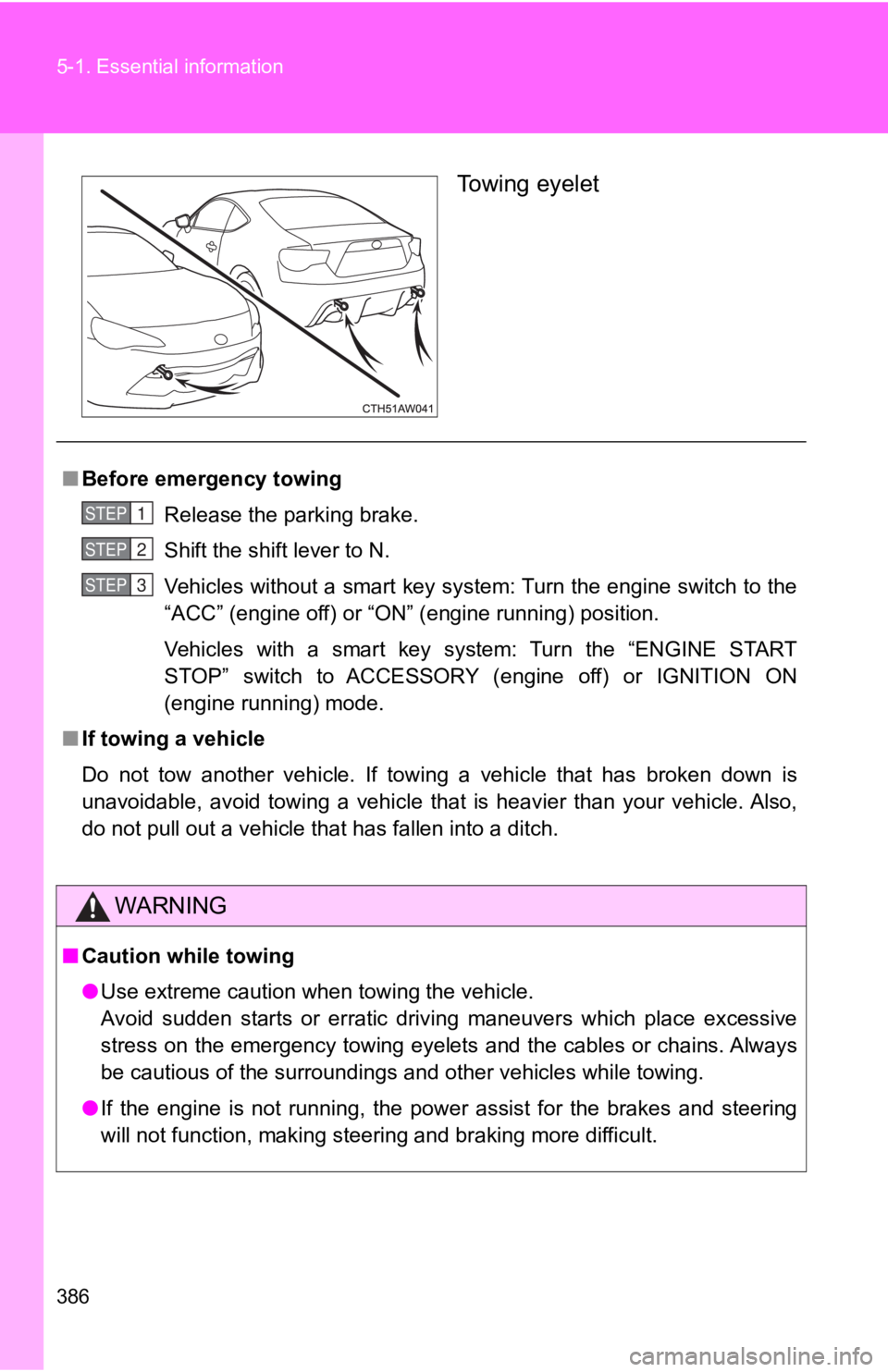
To w i n g e y e l e t
■ Before emergency towing
Release the parking brake.
Shift the shift lever to N.
Vehicles without a smart key system: Turn the engine switch to the
“ACC” (engine off) or “ON” (engine running) position.
Vehicles with a smart key system: Turn the “ENGINE START
STOP” switch to ACCESSORY (engine off) or IGNITION ON
(engine running) mode.
■ If towing a vehicle
Do not tow another vehicle. If towing a vehicle that has broken down is
unavoidable, avoid towing a vehicle that is heavier than your v ehicle. Also,
do not pull out a vehicle that has fallen into a ditch.
WARNING
■ Caution while towing
● Use extreme caution when towing the vehicle.
Avoid sudden starts or erratic driving maneuvers which place ex cessive
stress on the emergency towing eyelets and the cables or chains. Always
be cautious of the surroundings and other vehicles while towing .
● If the engine is not running, the power assist for the brakes a nd steering
will not function, making steering and braking more difficult. STEP 1
STEP 2
STEP 3
Page 387 of 532
5
When trouble arises
3875-1. Essential information
NOTICE■ To prevent causing serious damage to the transmission in emerge ncy
towing (vehicles with an a utomatic transmission)
Never tow a vehicle from the rear with four wheels on the groun d. This may
cause serious damage to the transmission.
■ To prevent damage to the vehicle
● When towing this vehicle, make sure to observe the following:
• Do not use a wire rope
• Keep vehicle speed below 20 mph (30 km/h) and do not tow for d is-
tances over 19 miles (30 km)
• Tow the vehicle in the forward direction
• Do not apply rope to the vehicle's suspension and so forth
● Do not tow another vehicle, boat (trailer) and so forth, that i s heavier than
this vehicle.
■ When towing down a long slope
Use a wheel lift-type or flat bed truck. ( P. 391, 392)
If a wheel lift-type or flat bed truck is not used, the brakes may overheat,
leading to poor brake performance.
Page 388 of 532
3885-1. Essential information
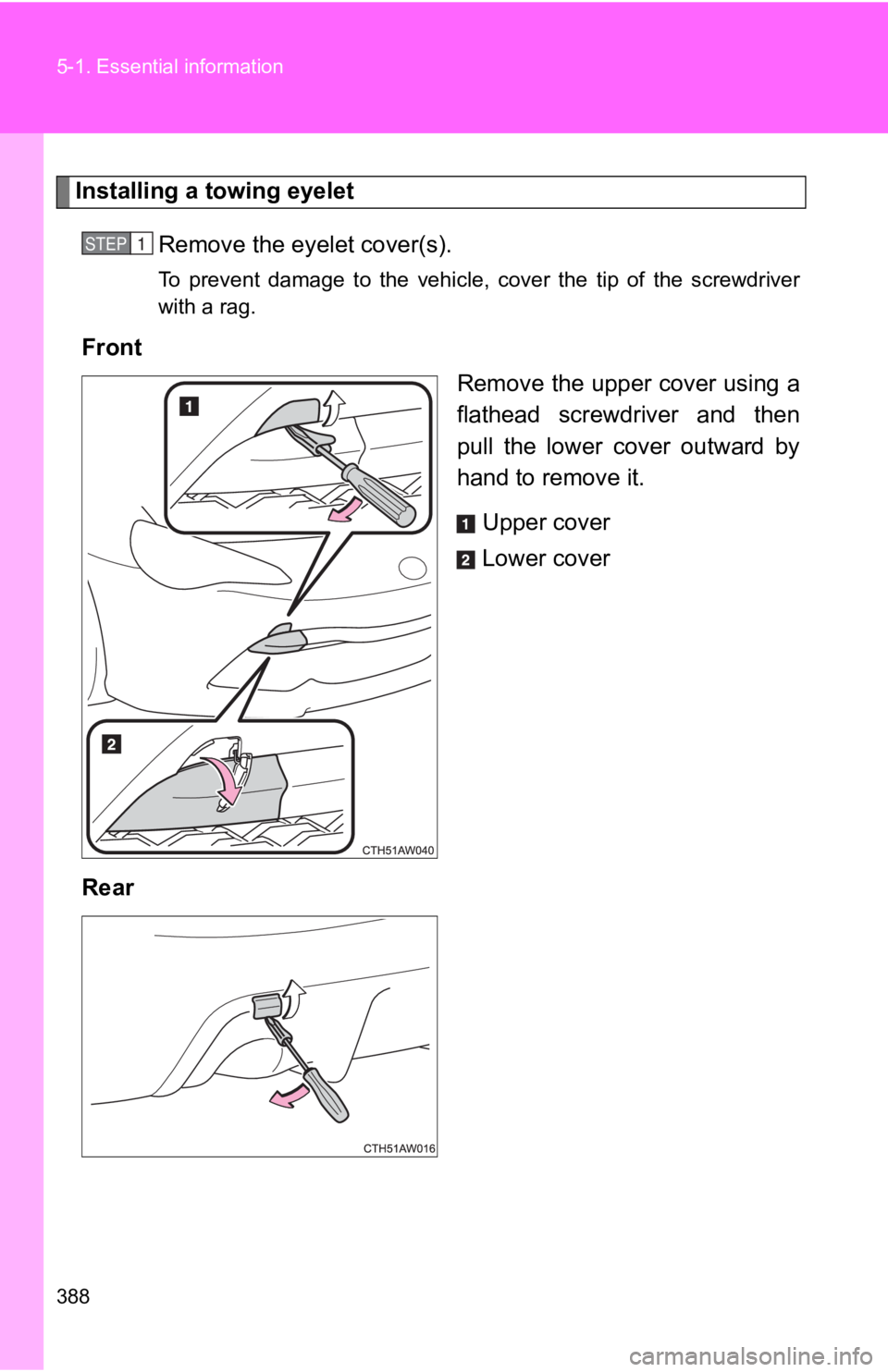
Installing a towing eyelet
Remove the eyel et cover(s).To prevent damage to the vehicle, cover the tip of the screwdri ver
with a rag.
Front
Remove the upper cover using a
flathead screwdriver and then
pull the lower cover outward by
hand to remove it.
Upper cover
Lower cover
Rear STEP 1
Page 389 of 532
5
When trouble arises
3895-1. Essential information
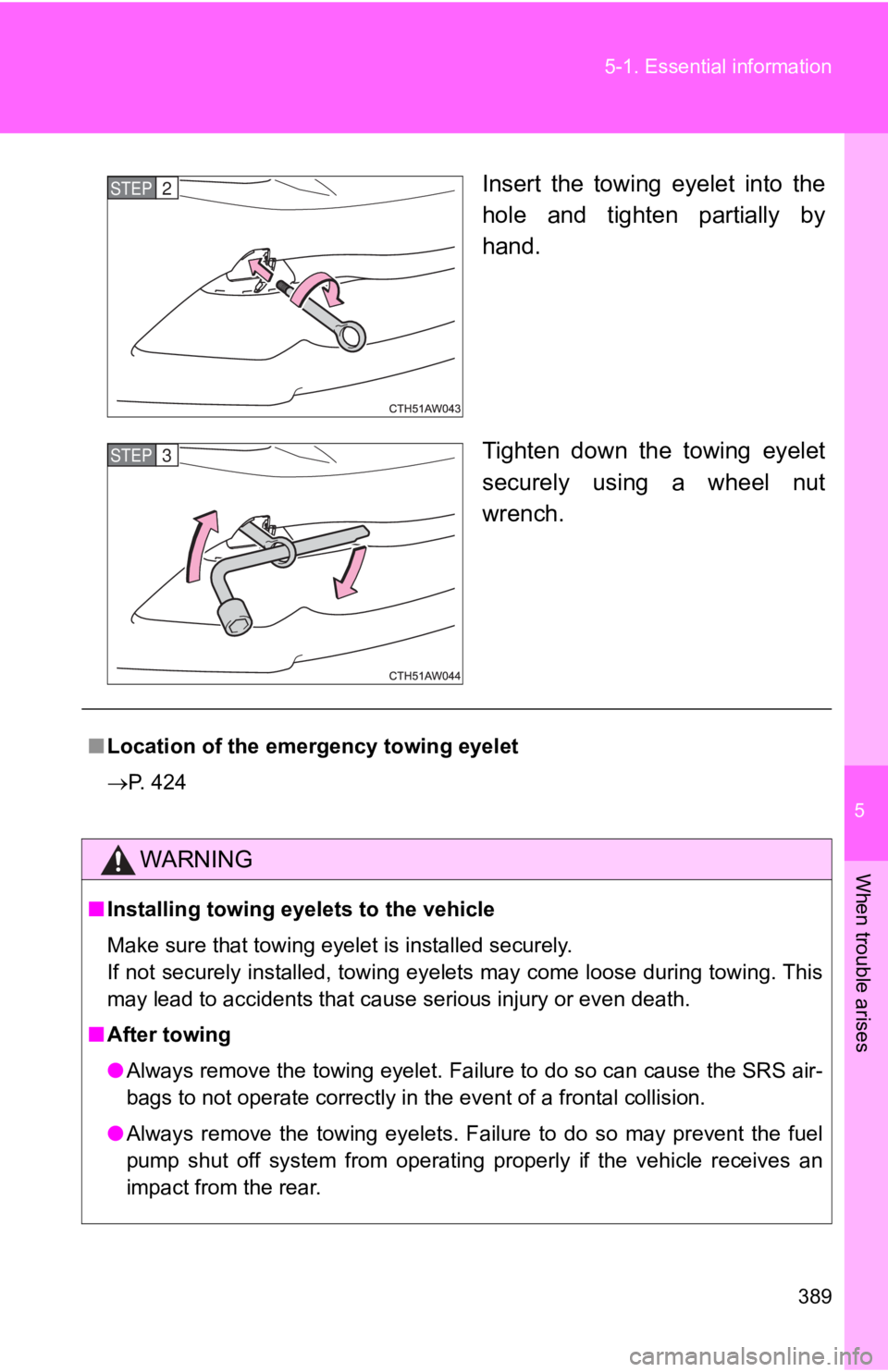
Insert the towing eyelet into the
hole and tighten partially by
hand.
Tighten down the towing eyelet
securely using a wheel nut
wrench.STEP 2
STEP 3
■ Location of the eme rgency towing eyelet
P. 424
WARNING
■ Installing towing eyelets to the vehicle
Make sure that towing eyelet is installed securely.
If not securely installed, towing eyelets may come loose during towing. This
may lead to accidents that cause serious injury or even death.
■ After towing
● Always remove the towing eyelet. Failure to do so can cause the SRS air-
bags to not operate correctly in the event of a frontal collisi on.
● Always remove the towing eyelets. Failure to do so may prevent the fuel
pump shut off system from operating properly if the vehicle receives an
impact from the rear.