automatic transmission TOYOTA 86 2019 Owner's Guide
[x] Cancel search | Manufacturer: TOYOTA, Model Year: 2019, Model line: 86, Model: TOYOTA 86 2019Pages: 532, PDF Size: 6.89 MB
Page 392 of 532
3925-1. Essential information
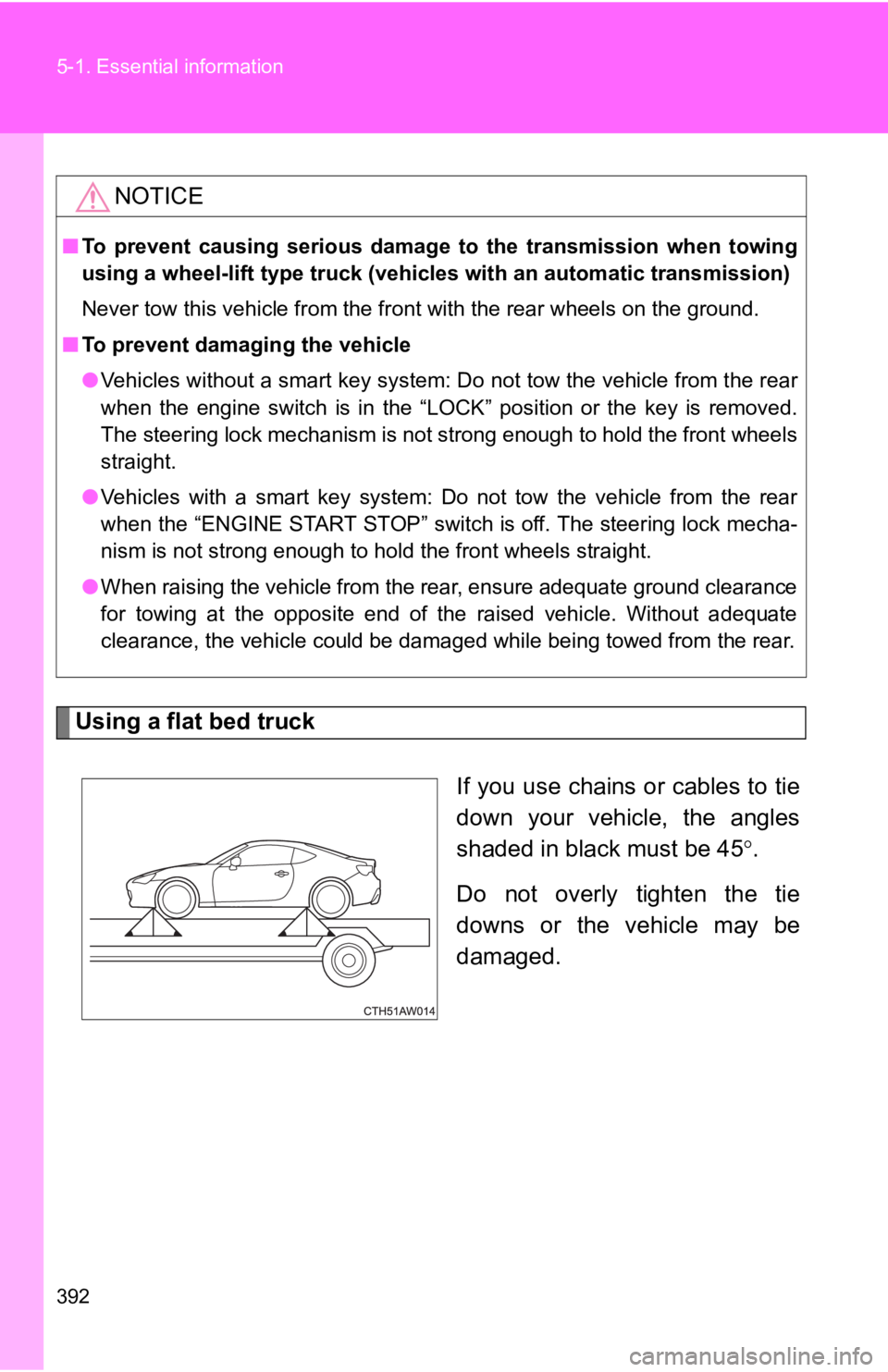
Using a flat bed truck
If you use chains or cables to tie
down your vehicle, the angles
shaded in black must be 45 .
Do not overly tighten the tie
downs or the vehicle may be
damaged.NOTICE■ To prevent causing serious damage to the transmission when towi ng
using a wheel-lift type truck (vehicles with an automatic trans mission)
Never tow this vehicle from the front with the rear wheels on t he ground.
■ To prevent damaging the vehicle
● Vehicles without a smart key system: Do not tow the vehicle fro m the rear
when the engine switch is in the “LOCK” position or the key is removed.
The steering lock mechanism is not strong enough to hold the fr ont wheels
straight.
● Vehicles with a smart key system: Do not tow the vehicle from t he rear
when the “ENGINE START STOP” switch is off. The steering lock m echa-
nism is not strong enough to hold the front wheels straight.
● When raising the vehicle from the rear, ensure adequate ground clearance
for towing at the opposite end of the raised vehicle. Without a dequate
clearance, the vehicle could be damaged while being towed from the rear.
Page 397 of 532
5
When trouble arises
3975-2. Steps to take in an emergency
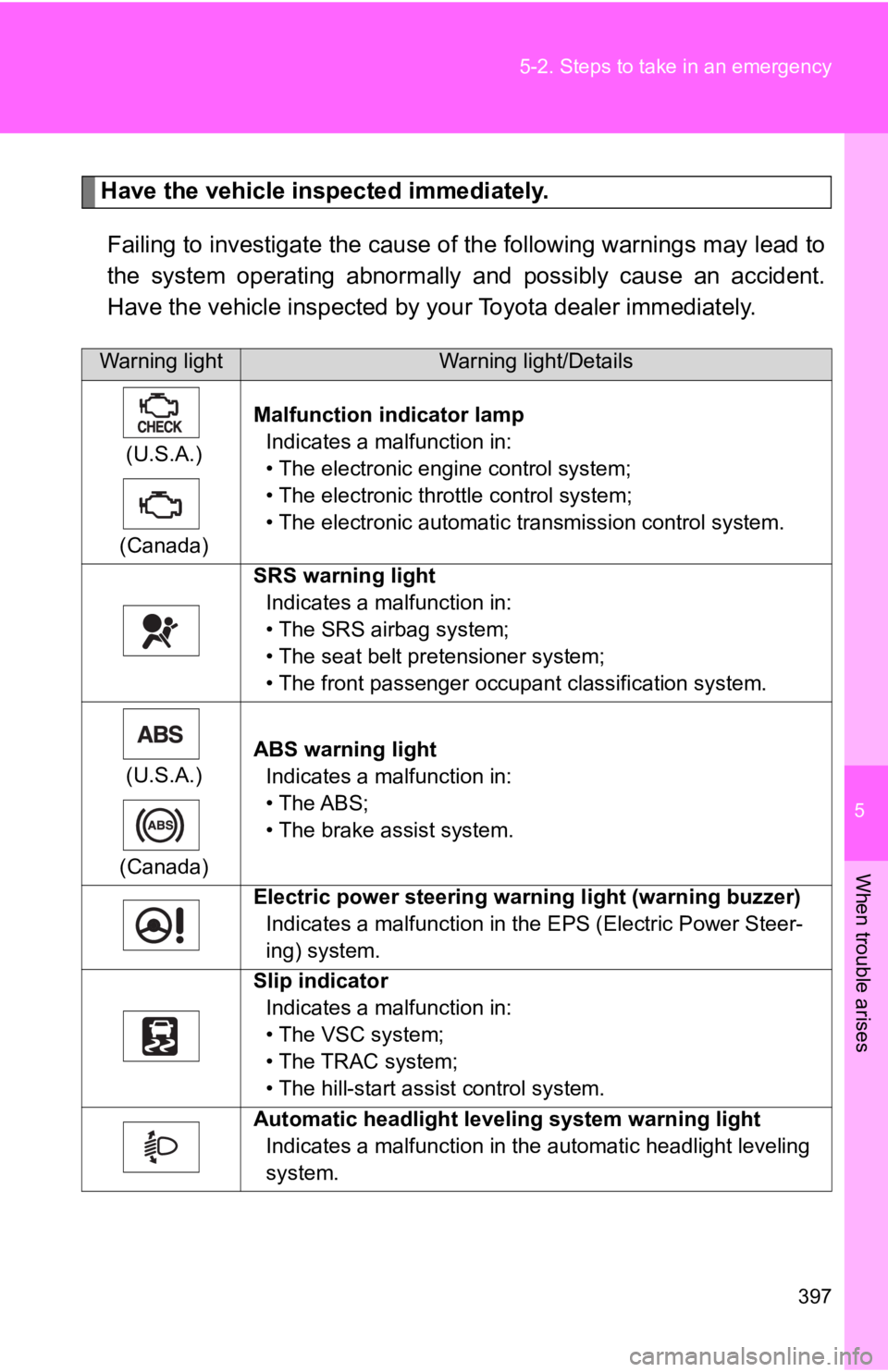
Have the vehicle ins pected immediately.
Failing to investigate the cause of the following warnings may lead to
the system operating abnormally and possibly cause an accident.
Have the vehicle ins pected by your Toyota dealer immediately.Warning light Warning light/Details
(U.S.A.)
(Canada) Malfunction indicator lamp
Indicates a malfunction in:
• The electronic engine control system;
• The electronic throttle control system;
• The electronic automatic transmission control system.
SRS warning light
Indicates a malfunction in:
• The SRS airbag system;
• The seat belt pretensioner system;
• The front passenger occupant classification system.
(U.S.A.)
(Canada) ABS warning light
Indicates a malfunction in:
• The ABS;
• The brake assist system.
Electric power steering warning light (warning buzzer)
Indicates a malfunction in the EPS (Electric Power Steer-
ing) system.
Slip indicator
Indicates a malfunction in:
• The VSC system;
• The TRAC system;
• The hill-start assist control system.
Automatic headlight leveling system warning light
Indicates a malfunction in the automatic headlight leveling
system.
Page 400 of 532
4005-2. Steps to take in an emergency
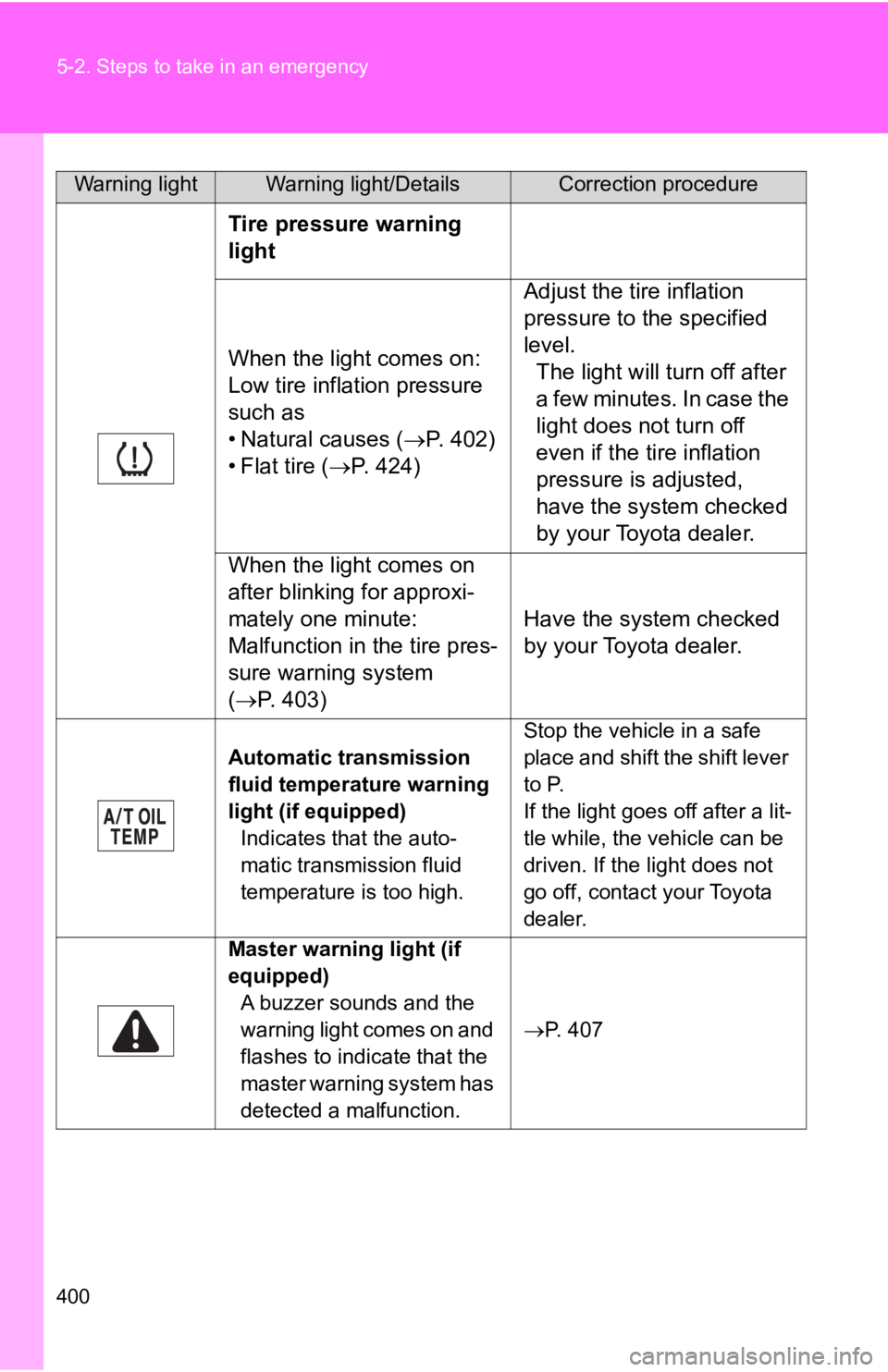
Tire pressure warning
light
When the light comes on:
Low tire inflation pressure
such as
• Natural causes ( P. 402)
• Flat tire ( P. 4 2 4 ) Adjust the tire inflation
pressure to the specified
level.
The light will turn off after
a few minutes. In case the
light does not turn off
even if the tire inflation
pressure is adjusted,
have the system checked
by your Toyota dealer.
When the light comes on
after blinking for approxi-
mately one minute:
Malfunction in the tire pres-
sure warning system
( P. 4 0 3 ) Have the system checked
by your Toyota dealer.
Automatic transmission
fluid temperature warning
light (if equipped)
Indicates that the auto-
matic transmission fluid
temperature is too high. Stop the vehicle in a safe
place and shift the shift lever
to P.
If the light goes off after a lit-
tle while, the vehicle can be
driven. If the light does not
go off, contact your Toyota
dealer.
Master warning light (if
equipped)
A buzzer sounds and the
warning light comes on and
flashes to indicate that the
master warning system has
detected a malfunction. P. 407Warning light Warning light/Details Correction procedure
Page 424 of 532
4245-2. Steps to take in an emergency
If you have a flat tire Your vehicle is equipped with a spare tire. The flat tire can b e
replaced with the spare tire.
■ Before jacking up the vehicle
● Stop the vehicle in a safe place on a hard, flat surface.
● Set the parking brake.
● Shift the shift lever to P (vehicles with an automatic transmis -
sion) or R (vehicles with a manual transmission).
● Stop the engine.
● Turn on the emergency flashers. ( P. 3 8 4 )
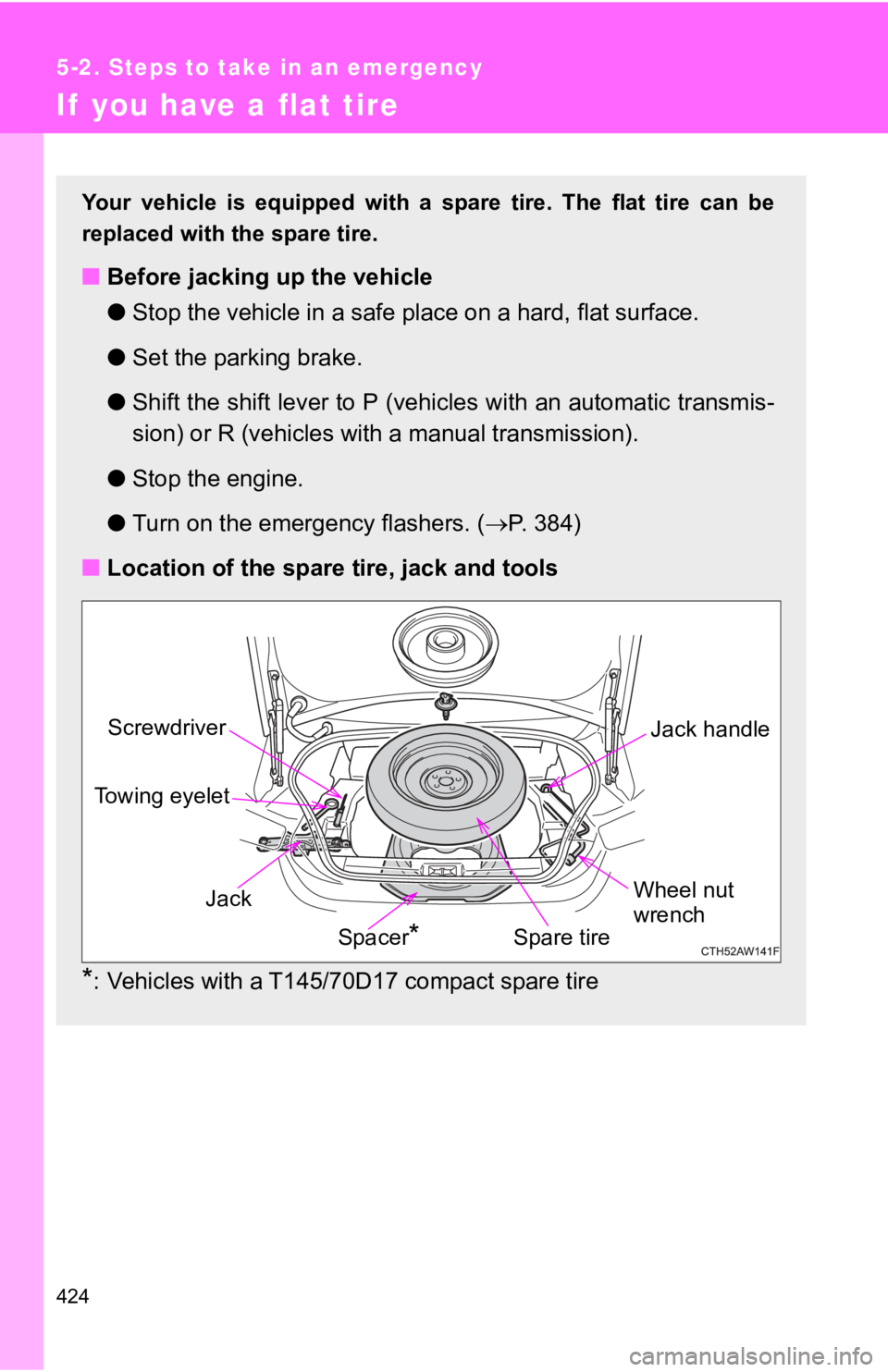
■ Location of the spare t ire, jack and tools
* : Vehicles with a T145/70D 17 compact spare tireJack Jack handle
Spare tireTowing eyelet Screwdriver
Wheel nut
wrench
Spacer
*
Page 438 of 532
4385-2. Steps to take in an emergency
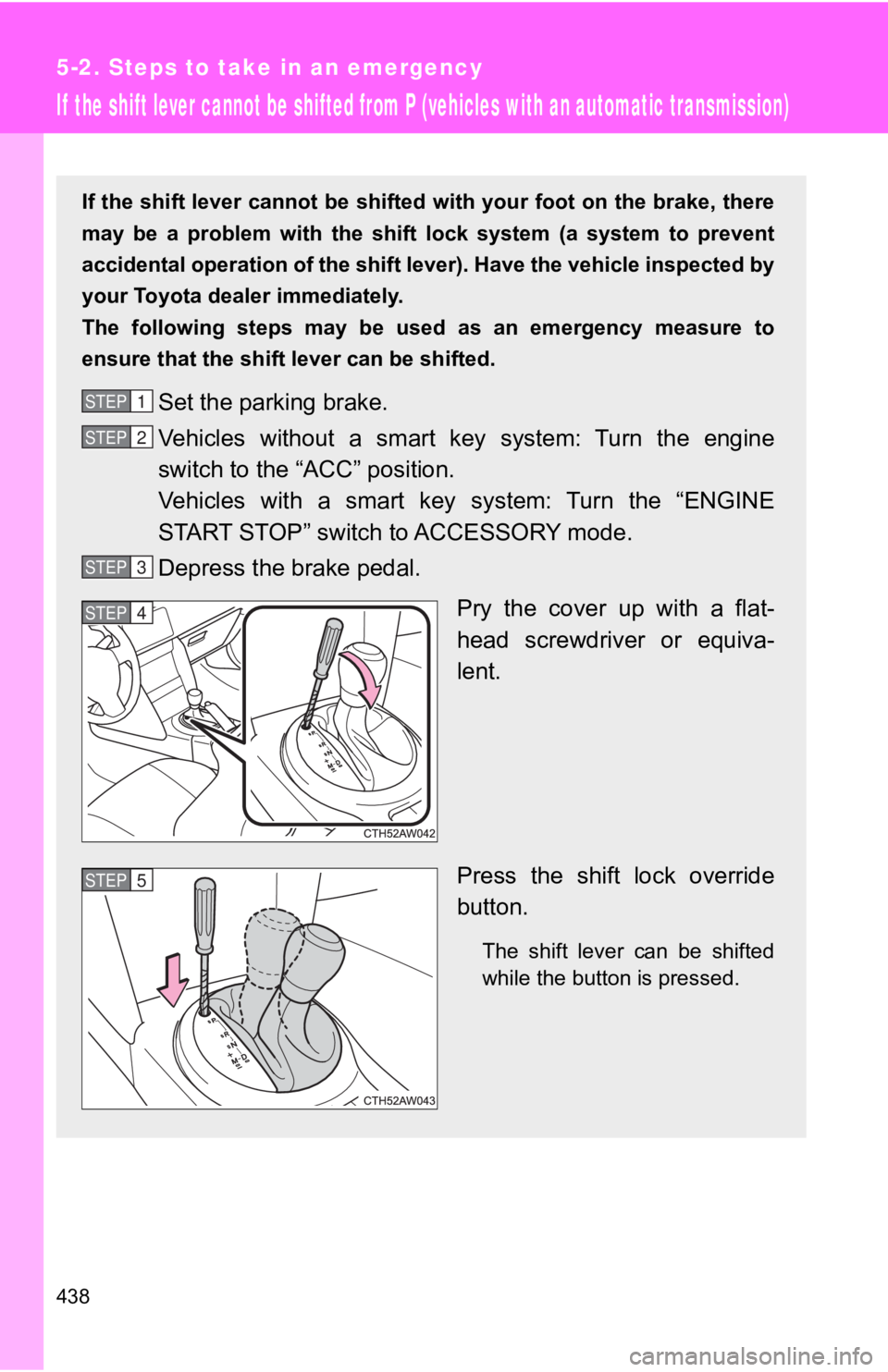
If the shift lever cannot be shifted from P (vehicles with an automatic transmission) If the shift lever cannot be shif ted with your foot on the brak e, there
may be a problem with the shif t lock system (a system to preven t
accidental operation of the shift lever). Have the vehicle insp ected by
your Toyota dealer immediately.
The following steps may be used as an emergency measure to
ensure that the shift lever can be shifted.
Set the parking brake.
Vehicles without a smart key system: Turn the engine
switch to the “A CC” position.
Vehicles with a smart key system: Turn the “ENGINE
START STOP” switch to ACCESSORY mode.
Depress the brake pedal.
Pry the cover up with a flat-
head screwdriver or equiva-
lent.
Press the shift lock override
button. The shift lever can be shifted
while the button is pressed.STEP 1
STEP 2
STEP 3
STEP 4
STEP 5
Page 443 of 532

5
When trouble arises
4435-2. Steps to take in an emergency
■ Stopping the engine
Vehicles with an automatic transmission: Shift the shift lever to P and press
the “ENGINE START STOP” switch as you normally do when stopping the
engine.
Vehicles with a manual transmission: Shift the shift lever to N and press the
“ENGINE START STOP” switch as you normally do when stopping the
engine.
■ Replacing the key battery
As the above procedure is a temporary measure, it is recommende d that the
electronic key battery be replaced immediately when the battery depletes.
( P. 363)
■ Alarm
Using the mechanical key to lock the doors will not set the ala rm system.
If a door is unlocked using the mechanical key when the alarm s ystem is set,
the alarm may be triggered. ( P. 82)
■ Changing “ENGINE START STOP” switch modes
Vehicles with an automatic transmission
Release the brake pedal and press the “ENGINE START STOP” switch in
above.The engine does not start and modes will be changed each
time the switch is pressed. ( P. 169)
Vehicles with a manual transmission
Release the clutch pedal and press the “ENGINE START STOP” swit ch in
above.The engine does not start and modes will be changed each
time the switch is pressed. ( P. 169)
■ If the doors cannot be locked or unlocked by the smart key syst em
Lock and unlock the doors by the mechanical key or wireless rem ote control.STEP 3
STEP 3
Page 452 of 532
4525-2. Steps to take in an emergency
If the vehicle becomes stuck
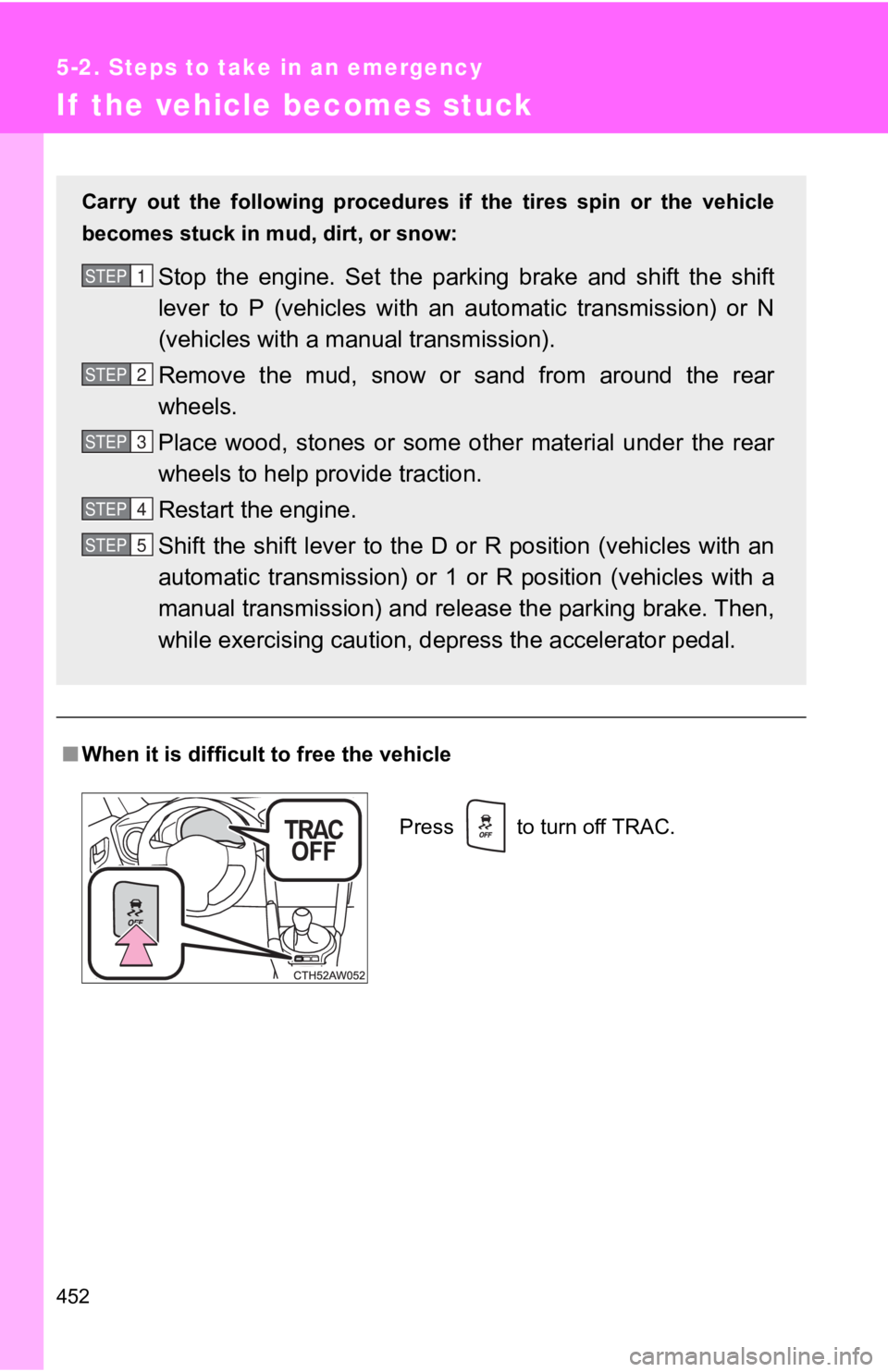
■ When it is difficult to free the vehicleCarry out the following procedur es if the tires spin or the veh icle
becomes stuck in mud, dirt, or snow:
Stop the engine. Set the parki ng brake and shift the shift
lever to P (vehicles with an automatic transmission) or N
(vehicles with a manual transmission).
Remove the mud, snow or sand from around the rear
wheels.
Place wood, stones or some other material under the rear
wheels to help provide traction.
Restart the engine.
Shift the shift lever to the D or R position (vehicles with an
automatic transmission) or 1 or R position (vehicles with a
manual transmission) and release the parking brake. Then,
while exercising caution, depr ess the accelerator pedal.STEP 1
STEP 2
STEP 3
STEP 4
STEP 5
Press to turn off TRAC.
Page 453 of 532

5
When trouble arises
4535-2. Steps to take in an emergency
WARNING■ When attempting to free a stuck vehicle
If you choose to push the vehicle back and forth to free it, ma ke sure the sur-
rounding area is clear to avoid striking other vehicles, object s or people. The
vehicle may also lunge forward or lunge back suddenly as it bec omes free.
Use extreme caution.
■ When shifting the shift lever
For vehicles with an automatic transmission, be careful not to shift the shift
lever with the accelerator pedal depressed.
This may lead to unexpected rapid acceleration of the vehicle t hat may
cause an accident resulting in death or serious injury.
NOTICE■ To avoid damage to the trans mission and other components
● Avoid spinning the rear wheels and depressing the accelerator p edal more
than necessary.
● If the vehicle remains stuck even after these procedures are performed,
the vehicle may require towing to be freed.
Page 464 of 532
4646-1. Specifications
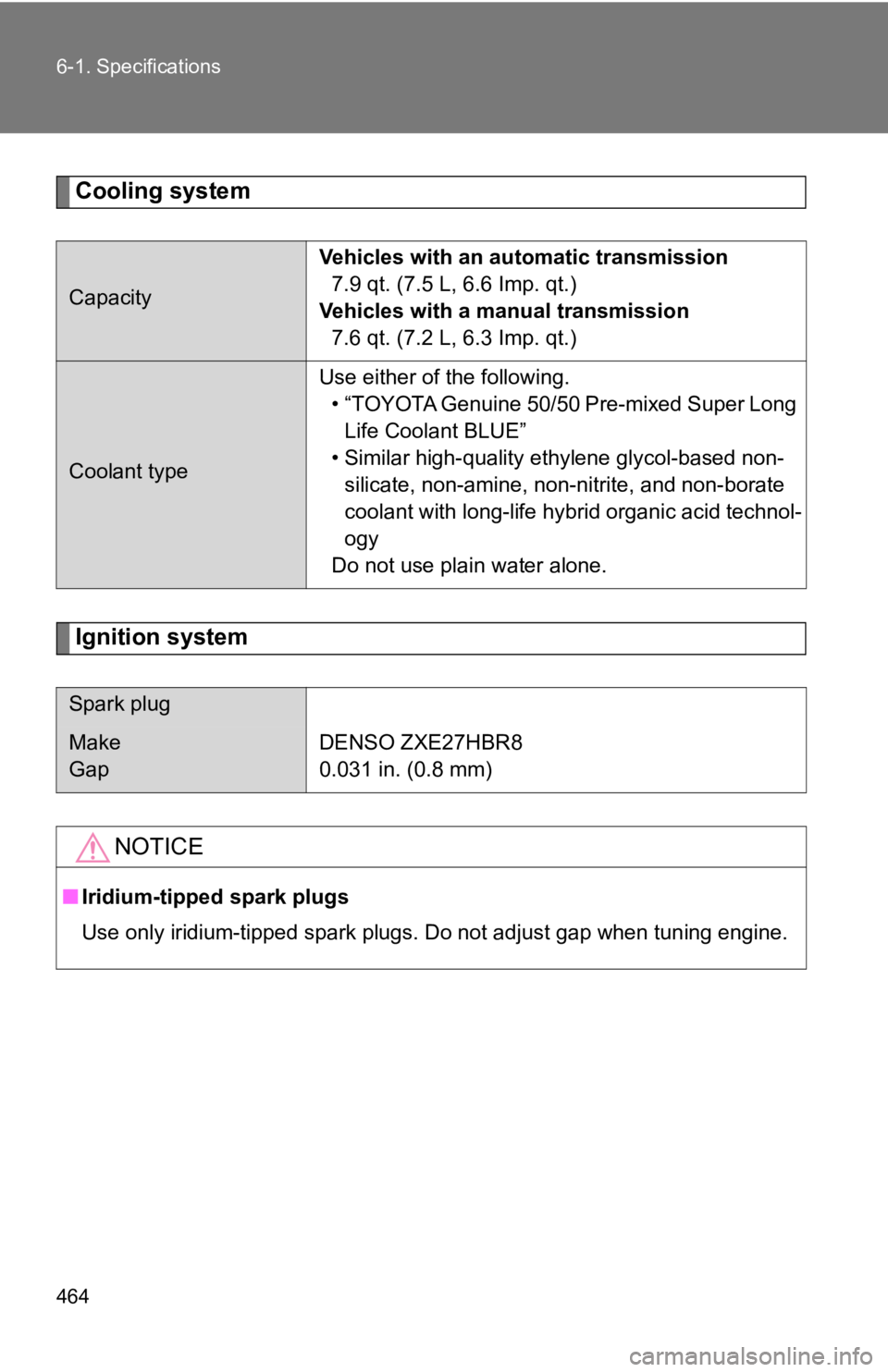
Cooling system
Ignition system Capacity Vehicles with an automatic transmission
7.9 qt. (7.5 L, 6.6 Imp. qt.)
Vehicles with a manual transmission
7.6 qt. (7.2 L, 6.3 Imp. qt.)
Coolant type Use either of the following.
• “TOYOTA Genuine 50/50 Pre-mixed Super Long
Life Coolant BLUE”
• Similar high-quality ethylene glycol-based non-
silicate, non-amine, non-nitrite, and non-borate
coolant with long-life hybrid organic acid technol-
ogy
Do not use plain water alone.
Spark plug
Make
Gap DENSO ZXE27HBR8
0.031 in. (0.8 mm)
NOTICE■ Iridium-tipped spark plugs
Use only iridium-tipped spark plugs. Do not adjust gap when tun ing engine.
Page 466 of 532
4666-1. Specifications
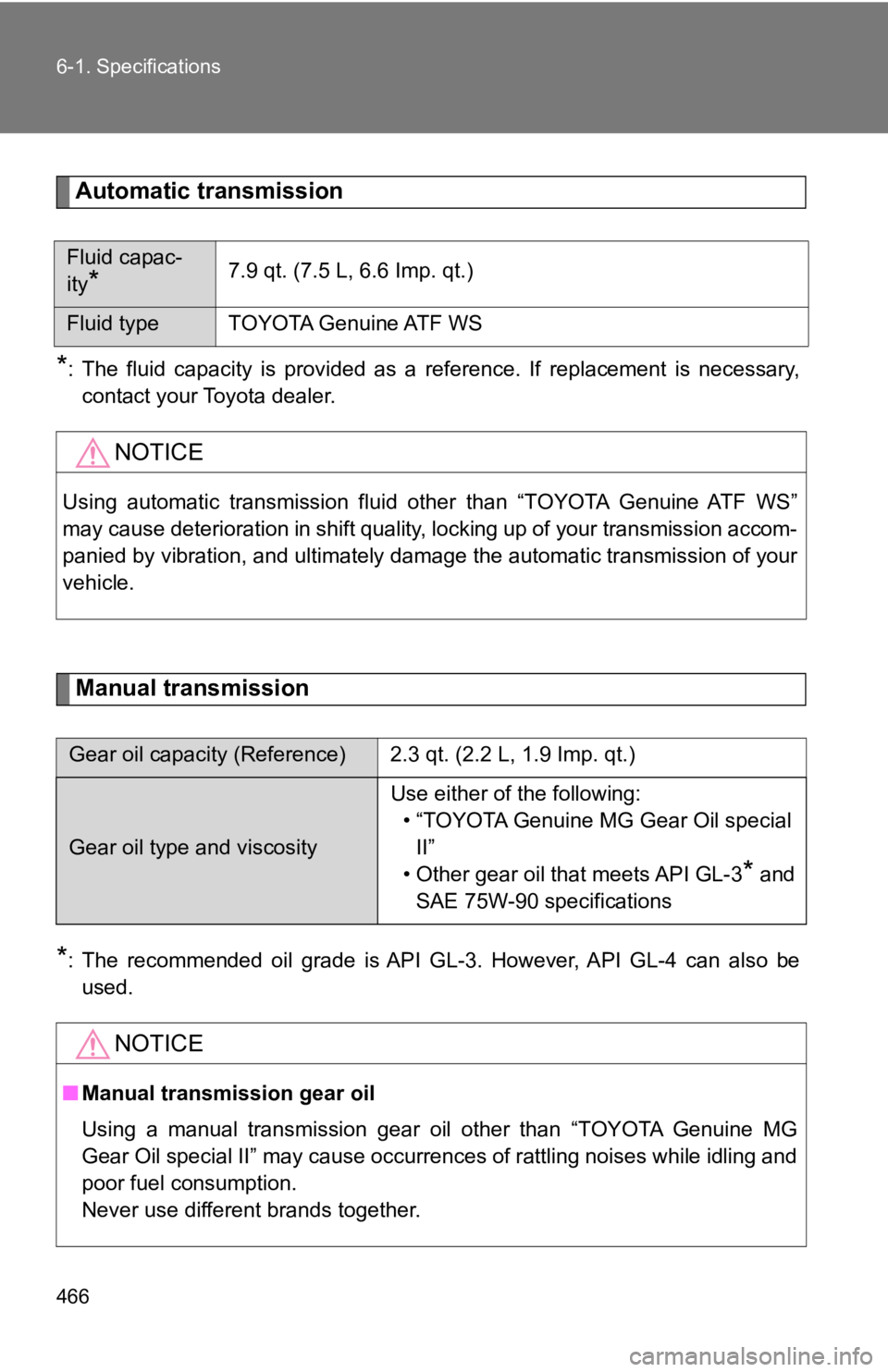
Automatic transmission
* : The fluid capacity is provided as a reference. If replacement is necessary,
contact your Toyota dealer.
Manual transmission
* : The recommended oil grade is API GL-3. However, API GL-4 can a lso be
used.Fluid capac-
ity
* 7.9 qt. (7.5 L, 6.6 Imp. qt.)
Fluid type TOYOTA Genuine ATF WS
NOTICEUsing automatic transmission fluid other than “TOYOTA Genuine A TF WS”
may cause deterioration in shift quality, locking up of your transmission accom-
panied by vibration, and ultimately damage the automatic transmission of your
vehicle.
Gear oil capacity (Reference) 2.3 qt. (2.2 L, 1.9 Imp. qt.)
Gear oil type and viscosity Use either of the following:
• “TOYOTA Genuine MG Gear Oil special
II”
• Other gear oil that meets API GL-3
* and
SAE 75W-90 specifications
NOTICE
■ Manual transmission gear oil
Using a manual transmission gear oil other than “TOYOTA Genuine MG
Gear Oil special II” may cause occurrences of rattling noises w hile idling and
poor fuel consumption.
Never use different brands together.