brakes TOYOTA 86 2020 User Guide
[x] Cancel search | Manufacturer: TOYOTA, Model Year: 2020, Model line: 86, Model: TOYOTA 86 2020Pages: 532, PDF Size: 8 MB
Page 387 of 532
5
When trouble arises
387
5-1. Essential
information
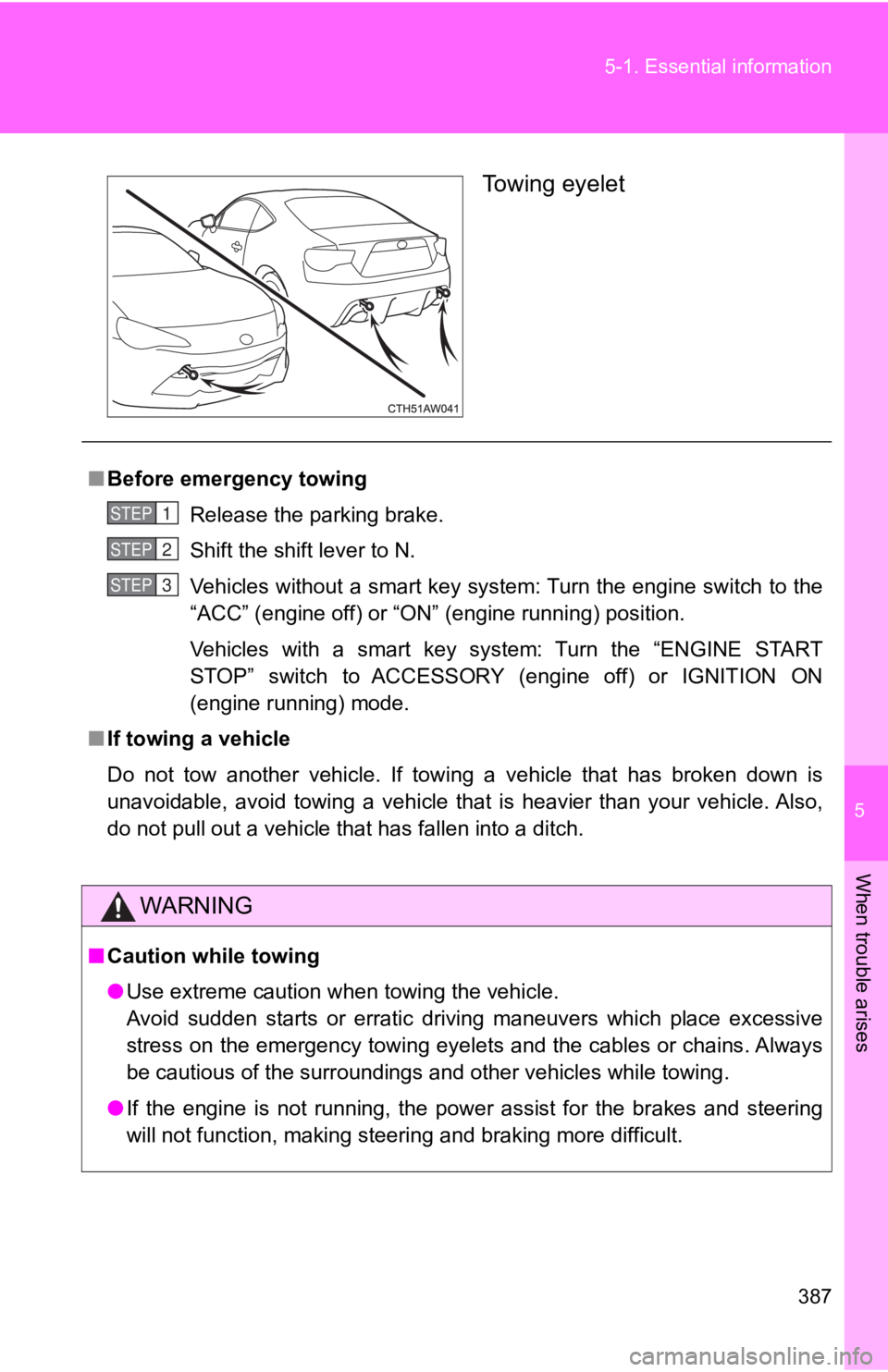
To w i n g e y e l e t
■Before emergency towing
Release the parking brake.
Shift the shift lever to N.
Vehicles without a smart key system: Turn the engine switch to the
“ACC” (engine off) or “ON” (engine running) position.
Vehicles with a smart key system: Turn the “ENGINE START
STOP” switch to ACCESSORY (engine off) or IGNITION ON
(engine running) mode.
■ If towing a vehicle
Do not tow another vehicle. If towing a vehicle that has broken down is
unavoidable, avoid towing a vehicle that is heavier than your v ehicle. Also,
do not pull out a vehicle that has fallen into a ditch.
WARNING
■ Caution while towing
●Use extreme caution when towing the vehicle.
Avoid sudden starts or erratic driving maneuvers which place ex cessive
stress on the emergency towing eyelets and the cables or chains. Always
be cautious of the surroundings and other vehicles while towing .
● If the engine is not running, the power assist for the brakes a nd steering
will not function, making steering and braking more difficult.
STEP 1
STEP 2
STEP 3
Page 388 of 532

388 5-1. Essential information
NOTICE
■To prevent causing serious damage to the transmission in emerge ncy
towing (vehicles with an a utomatic transmission)
Never tow a vehicle from the rear with four wheels on the groun d. This may
cause serious damage to the transmission.
■ To prevent damage to the vehicle
●When towing this vehicle, make sure to observe the following:
• Do not use a wire rope
• Keep vehicle speed below 20 mph (30 km/h) and do not tow for d is-
tances over 19 miles (30 km)
• Tow the vehicle in the forward direction
• Do not apply rope to the vehicle's suspension and so forth
● Do not tow another vehicle, boat (trailer) and so forth, that i s heavier than
this vehicle.
■ When towing down a long slope
Use a wheel lift-type or flat bed truck. ( P. 392, 393)
If a wheel lift-type or flat bed truck is not used, the brakes may overheat,
leading to poor brake performance.
Page 405 of 532
5
When trouble arises
405
5-2. Steps to take in an emergency
WARNING
■If the tire pressure warning light comes on
Be sure to observe the following precautions. Failure to do so
could
cause loss of vehicle control and result in death or serious injury.
●Stop your vehicle in a safe plac e as soon as possible. Adjust the tire
inflation pressure immediately.
●If the tire pressure warning light comes on even after tire inf lation pres-
sure adjustment, it is probable that you have a flat tire. Check the tires.
If the tire is flat, change to the spare tire and have the flat tire repaired
by the nearest Toyota dealer.
●Avoid abrupt maneuvering and braking. If the vehicle tires dete riorate,
you could lose control of the steering wheel or the brakes.
■If a blowout or sudden air leakage should occur
The tire pressure warning system may not activate immediately.
Page 433 of 532
5
When trouble arises
433
5-2. Steps to take in an emergency
WARNING
■Replacing a flat tire
●Do not touch the disc wheels or the area around the brakes imme
di-
ately after the vehicle has been driven.
After the vehicle has been driven the disc wheels and the area around
the brakes will be extremely hot . Touching these areas with han ds, feet
or other body parts w hile changing a tire, etc. may result in b urns.
●Do not attach a heavily damaged wheel ornament, as it may fly o ff the
wheel while the ve hicle is moving.
●Failure to follow these precautions could cause the wheel nuts to
loosen and the tire to fall off, resulting in death or serious injury.
• Have the wheel nuts tightened with a torque wrench to 89 ft•lb f (120
N•m, 12.2 kgf•m) as soon as possible after changing wheels.
• When installing a tire, only use wheel nuts that have been spe cifi-
cally designed for that wheel.
• If there are any cracks or deformations in the bolt screws, nu t
threads or bolt holes of the wh eel, have the vehicle inspected by
your Toyota dealer.
• When installing the wheel nuts, be sure to install them with t he
tapered ends facing inward. ( P. 358)
Page 456 of 532
456 5-2. Steps to take in an emergency
WARNING
■If the engine has to be turned off while driving
● Power assist for the brakes and steering wheel will be lost, making the
brake pedal harder to depress and the steering wheel heavier to turn.
Decelerate as much as possible before turning off the engine.
● Vehicles without a smart key system: Never attempt to remove th e key, as
doing so will lock the steering wheel.
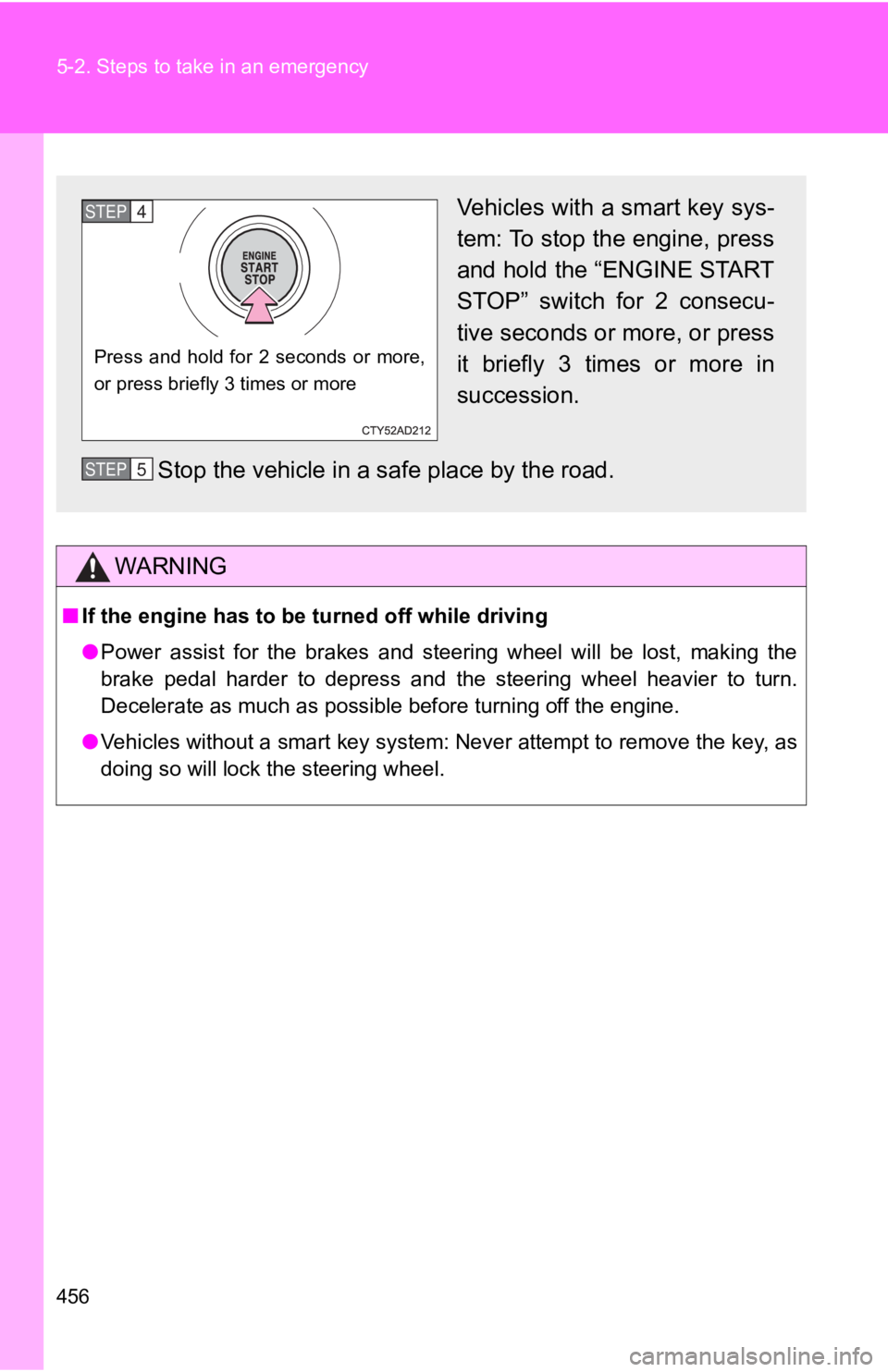
Vehicles with a smart key sys-
tem: To stop the engine, press
and hold the “ENGINE START
STOP” switch for 2 consecu-
tive seconds or more, or press
it briefly 3 times or more in
succession.
Stop the vehicle in a s afe place by the road.
Press and hold for 2 seconds or more,
or press briefly 3 times or more
STEP 4
STEP 5
Page 467 of 532
467
6-1. Specifications
6
Vehicle specifications
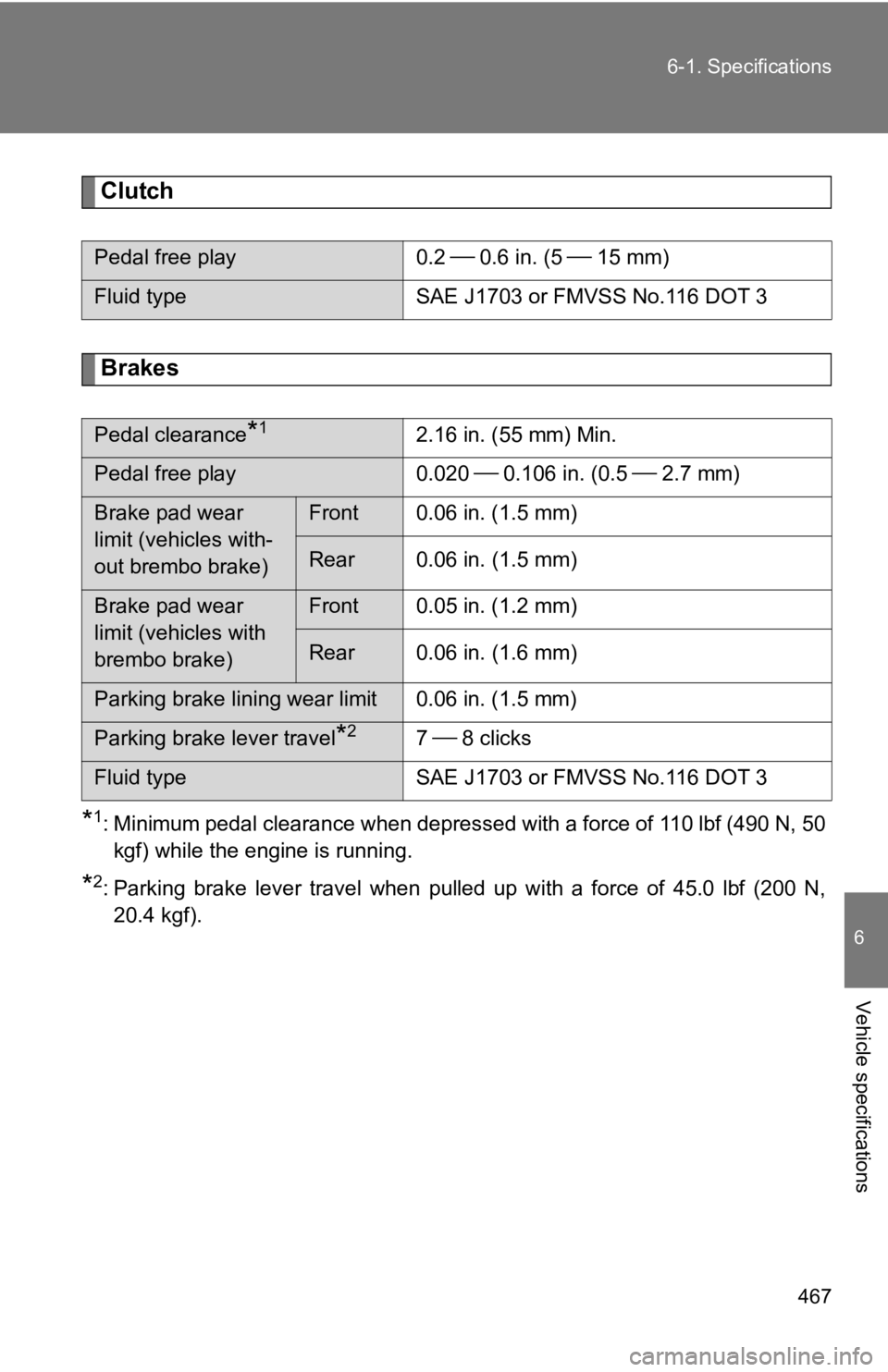
Clutch
Brakes
*1: Minimum pedal clearance when depressed with a force of 110 lbf
(490 N, 50
kgf) while the engine is running.
*2: Parking brake lever travel when pulled up with a force of 45.0 lbf (200 N,
20.4 kgf).
Pedal free play 0.2 0.6 in. (5 15 mm)
Fluid typeSAE J1703 or FMVSS No.116 DOT 3
Pedal clearance*12.16 in. (55 mm) Min.
Pedal free play0.020 0.106 in. (0.5 2.7 mm)
Brake pad wear
limit (vehicles with-
out brembo brake)Front 0.06 in. (1.5 mm)
Rear 0.06 in. (1.5 mm)
Brake pad wear
limit (vehicles with
brembo brake)Front 0.05 in. (1.2 mm)
Rear 0.06 in. (1.6 mm)
Parking brake lining wear limit 0.06 in. (1.5 mm)
Parking brake lever travel*27 8 clicks
Fluid typeSAE J1703 or FMVSS No.116 DOT 3
Page 480 of 532

480 6-1. Specifications
Warning: The temperature grades of a tire assume that it is properly
inflated and not overloaded.
Excessive speed, underinflation, or excessive loading, either s epa-
rately or in combination, can cause heat buildup and possible t ire fail-
ure.
Glossary of tire terminology
Tire related termMeaning
Cold tire inflation
pressure Tire pressure when the vehicle has been
parked for three hours or more, or has not
been driven more than 1
mile or 1.5 km under
that condition
Maximum inflation
pressure The maximum cold inflated pressure to which a
tire may be inflated, shown on the sidewall of
the tire
Recommended
inflation pressure Cold tire inflation pressure recommended by a
manufacturer.
Accessory weight The combined weight (i
n excess of those stan-
dard items which may be replaced) of auto-
matic transmission, po wer steering, power
brakes, power windows, power seats, radio
and heater, to the exten t that these items are
available as factory-installed equipment
(whether installed or not)
Curb weight The weight of a
motor vehicle with standard
equipment, including th e maximum capacity of
fuel, oil and coolant, and if so equipped, air
conditioning and additional weight optional
engine
Maximum loaded
vehicle weight The sum of:
(a) Curb weight
(b) Accessory weight
(c) Vehicle capacity weight
(d) Production options weight
Page 481 of 532
481
6-1. Specifications
6
Vehicle specifications
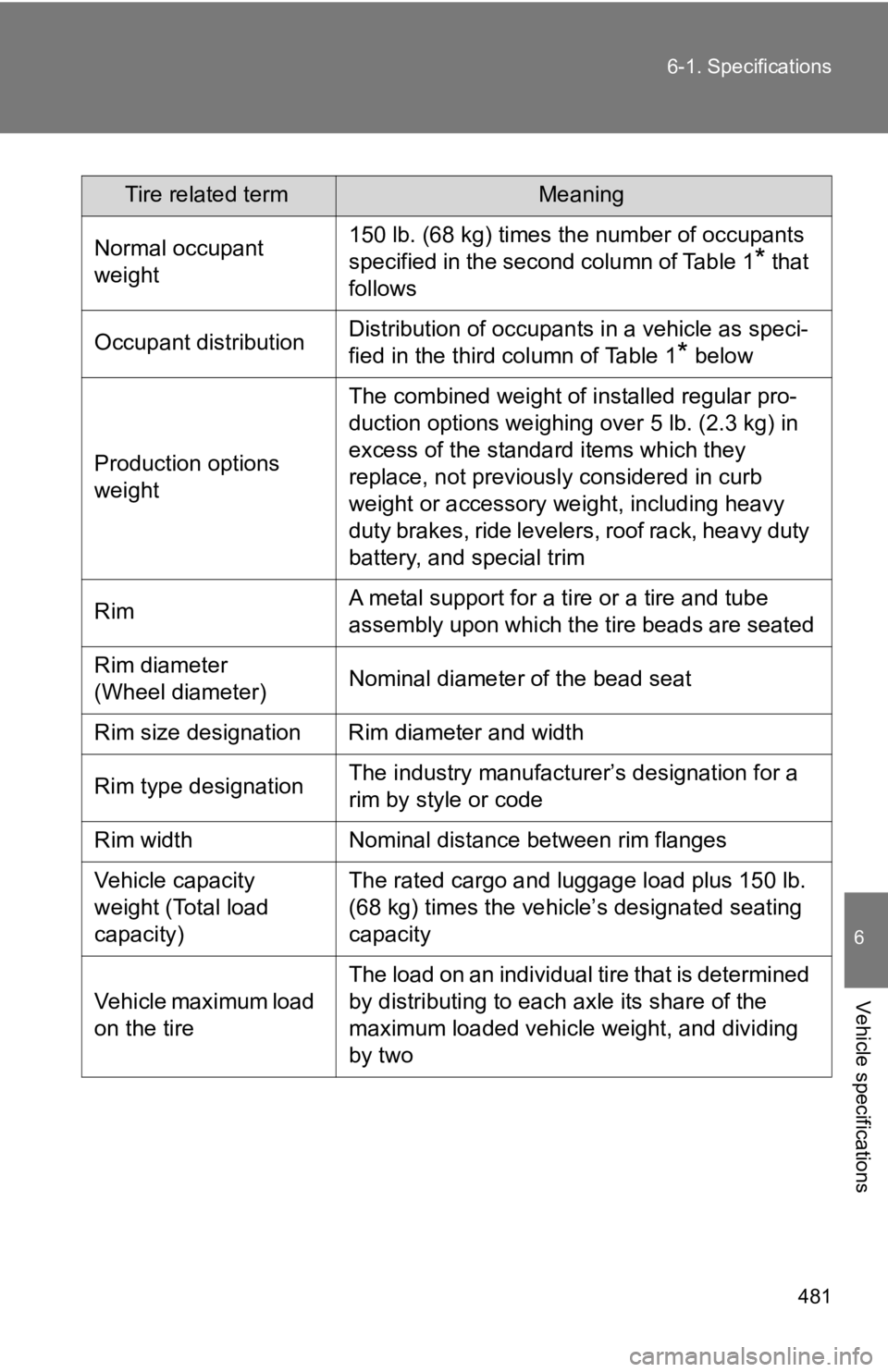
Tire related termMeaning
Normal occupant
weight 150 lb. (68 kg) times the
number of occupants
specified in the second column of Table 1
* that
follows
Occupant distribution Distribution of occupant
s in a vehicle as speci-
fied in the third column of Table 1
* below
Production options
weight The combined weight of installed regular pro-
duction options weighing over 5 lb. (2.3 kg) in
excess of the standard items which they
replace, not previously considered in curb
weight or accessory weight, including heavy
duty brakes, ride levelers, roof rack, heavy duty
battery, and special trim
Rim A metal support for a ti
re or a tire and tube
assembly upon which the tire beads are seated
Rim diameter
(Wheel diameter) Nominal diameter o
f the bead seat
Rim size designation R im diameter and width
Rim type designation The industry manufacturer’s designation for a
rim by style or code
Rim width Nominal distan ce between rim flanges
Vehicle capacity
weight (Total load
capacity) The rated cargo and luggage load plus 150 lb.
(68 kg) times the vehicl
e’s designated seating
capacity
Vehicle maximum load
on the tire The load on an individual tire that is determined
by distributing to each
axle its share of the
maximum loaded vehicle weight, and dividing
by two