flat tire TOYOTA 86 2020 User Guide
[x] Cancel search | Manufacturer: TOYOTA, Model Year: 2020, Model line: 86, Model: TOYOTA 86 2020Pages: 532, PDF Size: 8 MB
Page 346 of 532
346 4-3. Do-it-yourself maintenance
Installing tire pressure warning valves and transmitters
When replacing tires or wheels, tire pressure warning valves an d
transmitters must a lso be installed.
When new tire pressure warning valves and transmitters are
installed, new tire pressure warning valve and transmitter ID c odes
must be registered in the tire pressure warning computer and ti re
pressure warning system must be i nitialized. Have tire pressure
warning valve and transmitter ID codes registered by your Toyot a
dealer. ( P. 346)
Registering ID codes
The tire pressure warning valve and transmitter is equipped wit h a
unique ID code. When replacing a tire pressure warning valve an d
transmitter, it is necessary to register the ID code. Have the ID code
registered by your Toyota dealer.
■ The tire pressure warning system
Your Toyota is equipped with a tire pressure warning system tha t
uses tire pressure warning valves and transmitters to detect lo w
tire inflation pressure befor e serious problems arise.
( P. 4 0 0 )
Page 347 of 532

347
4-3. Do-it-yourself maintenance
4
Maintenance and care
■When to replace your vehicle’s tires
Tires should be replaced if:
●The treadwear indicators are showing on a tire.
●You have tire damage such as c
uts, splits, cracks deep enough to
expose the fabric or bulges indicating internal damage
●A tire goes flat repeatedly or cannot be properly repaired due to the
size or location of a cut or other damage
If you are not sure, consul t with your Toyota dealer.
■Replacing tires and wheels
If the ID code of the tire pressure warning valve and transmitt er is not
registered, the tire pressure w arning system will not work prop erly. After
driving for about 20 minutes, t he tire pressure warning light c omes on
after blinking for 1 minute to indicate a system malfunction.
■Tire life
Any tire over 6 years old must be checked by a qualified techni cian even
if they have seldom or never b een used or damage is not obvious.
■If the tread wears down below 0.16 in. (4 mm) on snow tires
The effectiveness of snow tires is lost.
■Low profile tires
Generally, low profile tires will wear more rapidly and tire gr ip perfor-
mance will be reduced on snowy and /or icy roads when compared to
standard tires. Be sure to use snow tires or tire chains on sno wy and/or
icy roads and drive carefully at a speed appropriate for road a nd weather
conditions.
Page 348 of 532
348 4-3. Do-it-yourself maintenance
■Maximum load of tire
Check that the maximum load of the replacement tire is greater than 1/2
of the Gross Axle Weight Ratings (GAWR) of either the front axle or the
rear axle, whichever is greater.
■Tire types
1 Summer tires
Summer tires are high-speed performance tires best suited to hi ghway
driving under dry conditions. Since summer tires do not have th e same
traction performance as snow tires, summer tires are inadequate for
driving on snow-covered or icy roads. For driving on snow-cover ed
roads or icy roads, the use of snow tires is recommended. When
installing snow tires, be sure to replace all four tires.
2 All season tires
All season tires are designed to provide better traction in sno w and to
be adequate for driving in most winter conditions, as well as f or use
year round. All season tires, however, do not have adequate tra ction
performance compared with snow tires in heavy or loose snow. Al so,
all season tires fall short in acceleration and handling perfor mance
compared with summer tires in highway driving.
3Snow tires For driving on snow-covered roads or icy roads, we recommend us ing
snow tires. If you need snow tires, select tires of the same si ze, con-
struction and load capacity as th e originally installed tires. Since your
vehicle has radial tires as original equipment, make sure your snow
tires also have radial construction. Do not install studded tir es without
first checking local regulations for possible restriction. Snow tires
should be installed on all wheels. ( P. 261)
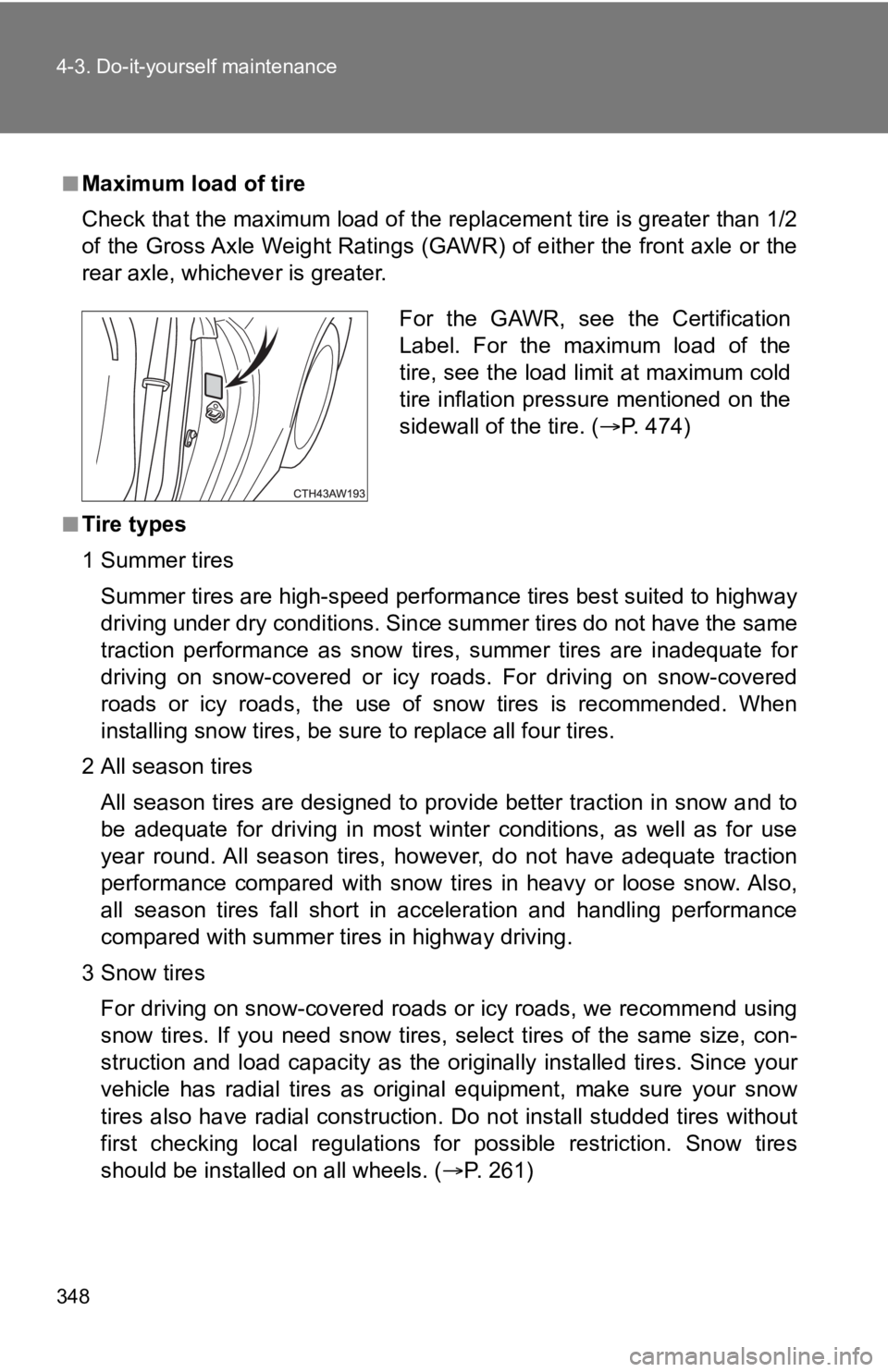
For the GAWR, see the Certification
Label. For the maximum load of the
tire, see the load limit at maximum cold
tire inflation pressure mentioned on the
sidewall of the tire. ( P. 4 7 4 )
Page 349 of 532

349
4-3. Do-it-yourself maintenance
4
Maintenance and care
■Initializing the tire p
ressure warning system
Initialize the system with the ti re inflation pressure adjusted to the speci-
fied level.
■Routine tire infla tion pressure checks
The tire pressure warning system does not replace routine tire inflation
pressure checks. Make sure to check tire inflation pressure as part of
your routine of daily vehicle checks.
■Tire pressure warning system certification (vehicles without a
smart key system)
For vehicles sold in the U.S.A.
MODEL/FCC IDs:
Transmitter: PAXPMVC010
Receiver: HYQ23AAC
This device complies with part 15 of the FCC Rules. Operation is subject
to the following two conditions: (1) This device may not cause harmful
interference, and (2) this device must accept any interference received,
including interference that may cause undesired operation.
FCC WARNING:
Changes or modifications not expressly approved by the party re sponsi-
ble for compliance could void the user's authority to operate t he equip-
ment.
For vehicles sold in Canada
Model: PMV-C010
NOTE:
This device complies with Industr y Canada’s licence-exempt RSSs.
Operation is subject to the following two conditions: (1) This device may
not cause interference; and (2) This device must accept any int erfer-
ence, including interference that may cause undesired operation of the
device.
NOTE:
Le présent appareil est conforme aux CNR d’Industrie Canada applica-
bles aux appareils radio exempts de licence. L’exploitation est autorisée
aux deux conditions suivantes: (1) l’appareil ne doit pas produ ire de
brouillage; (2) l’utilisateur de l’appareil doit accepter tout brouillage
radioélectrique subi, même si le brouillage est susceptible d’en compro-
mettre le fonctionnement.
Page 352 of 532

352 4-3. Do-it-yourself maintenance
NOTICE
■Driving on rough roads
Take particular care when driving on roads with loose surfaces or pot
holes.
These conditions may cause losses in tire inflation pressure, r educing
the cushioning ability of the tire s. In addition, driving on rough roads may
cause damage to the tires themselves, as well as the vehicle’s wheels
and body.
■Low profile tires and wheels
Low profile tires may cause greater damage than usual to the ti re wheel
when receiving impact from the road surface. Therefore pay attention to
the following:
●Be sure to use proper tire inflation pressure. If tires are und er-inflated,
they may be damaged more severely.
●Avoid pot holes, uneven pavement, curbs and other road hazards.
Failure to do so may lead to severe tire and wheel damage.
■If tire inflation pressures become low while driving
Do not continue driving, or your tires and/or wheels may be ruined.
■Replacing a flat tire
Do not hit and bend the disc rotor backing plate when removing and
installing the tire. A bent backi ng plate may scrape against th e disc rotor
and cause noise while the vehicle is in motion.
Page 353 of 532
353
4-3. Do-it-yourself maintenance
4
Maintenance and care
Tire inflation pressure
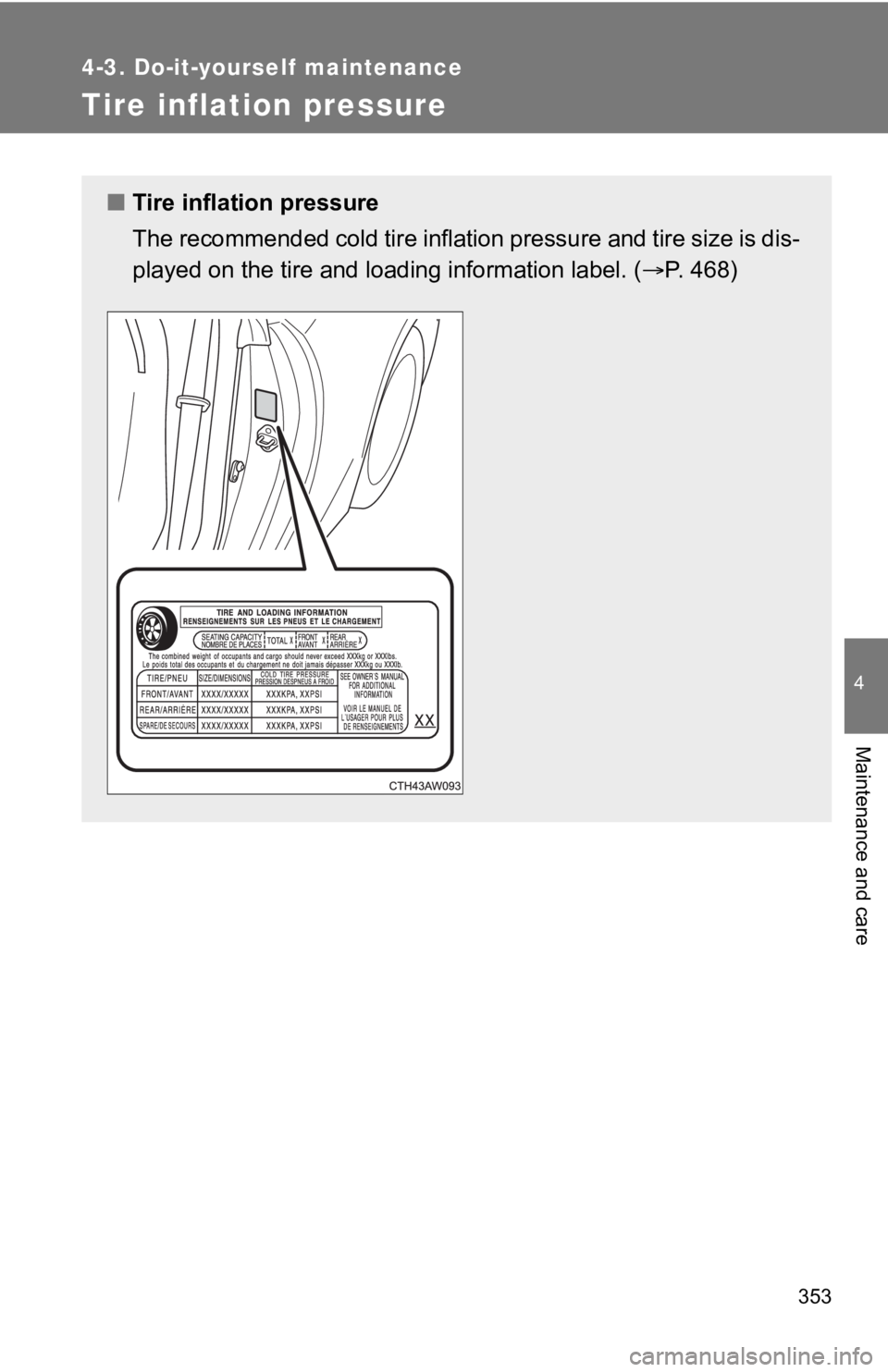
■Tire inflation pressure
The recommended cold tire inflation pressure and tire size is d is-
played on the tire and loading information label. ( P. 4 6 8 )
Page 354 of 532
354 4-3. Do-it-yourself maintenance
■Tire inflation pressure check interval
You should check tire inflation pressure every two weeks, or at least
once a month.
Do not forget to check the spare.
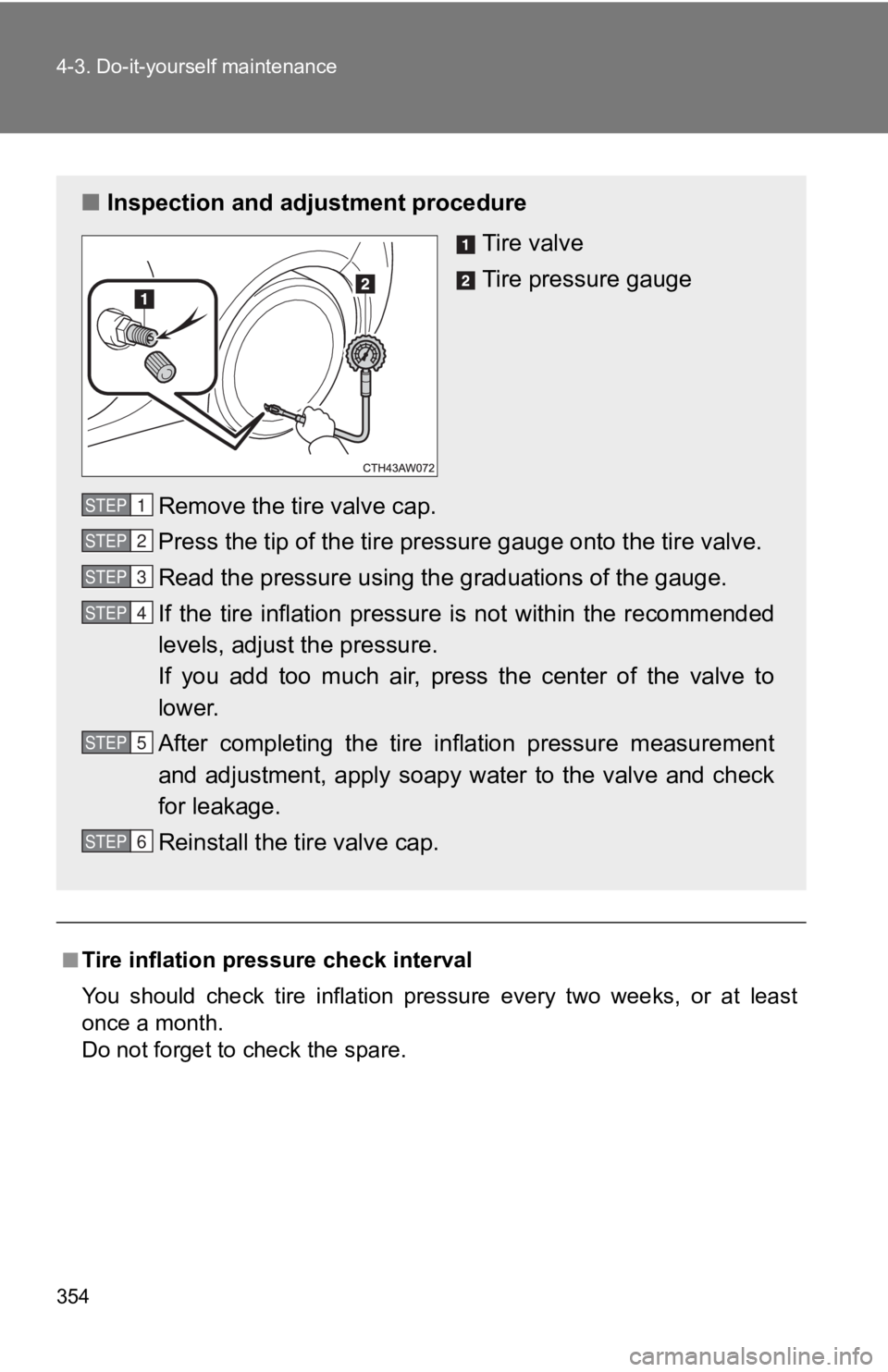
■Inspection and adjustment procedure
Tire valve
Tire pressure gauge
Remove the tire valve cap.
Press the tip of the tire pressure gauge onto the tire valve.
Read the pressure using the graduations of the gauge.
If the tire inflation pressure is not within the recommended
levels, adjust the pressure.
If you add too much air, press the center of the valve to
lower.
After completing the tire inflation pressure measurement
and adjustment, apply soapy water to the valve and check
for leakage.
Reinstall the tire valve cap.
STEP 1
STEP 2
STEP 3
STEP 4
STEP 5
STEP 6
Page 355 of 532

355
4-3. Do-it-yourself maintenance
4
Maintenance and care
■Effects of inco
rrect tire inflation pressure
Driving with incorrect tire inflation pressure may result in th e following:
●Reduced fuel economy
●Reduced driving comfort and poor handling
●Reduced tire life due to wear
●Reduced safety
●Damage to the drive train
If a tire needs frequ ent refilling, have it checked by your Toy ota dealer.
■Instructions for checking tire inflation pressure
When checking tire inflation pressure, observe the following:
●Check only when the tires are cold.
If your vehicle has been parked for at least 3 hours and has not been
driven for more than 1 mile or 1.5 km, you will get an accurate cold
tire inflation pressure reading.
●Always use a tire pressure gauge.
It is difficult to judge if a tir e is properly inflated based o nly on its
appearance.
●It is normal for the tire inflation pressure to be higher after driving as
heat is generated in the tire. Do not reduce tire inflation pre ssure after
driving.
●Never exceed the vehicle capacity weight.
Passengers and luggage weight should be placed so that the vehi cle
is balanced.
Page 356 of 532

356 4-3. Do-it-yourself maintenance
WARNING
■Proper inflation is critical to save tire performance
Keep your tires properly inflated.
If the tires are not properly inflated, the following conditions may occur
which could lead to an accident resulting in death or serious injury:
●Excessive wear
●Uneven wear
●Poor handling
●Possibility of blowouts resulting from overheated tires
●Air leaking from between tire and wheel
●Wheel deformation and/or tire damage
●Greater possibility of tire damage while driving (due to road hazards,
expansion joints, sharp edges in the road, etc.)
NOTICE
■When inspecting and adjust ing tire inflation pressure
Be sure to reinstall the tire valve caps.
If a valve cap is not installed, dirt or moisture may get into the valve and
cause an air leak, resulting in decreased tire inflation pressu re.
Page 358 of 532
358 4-3. Do-it-yourself maintenance
■When replacing wheels
The wheels of your Toyota are equipped with tire pressure warning
valves and transmitters that allow the tire pressure warning sy stem to
provide advanced warning in the event of a loss in tire inflati on pressure.
Whenever wheels are replaced, the tire pressure warning valves and
transmitters mus t be installed. (P. 3 4 6 )
WARNING
■When replacing wheels
●Do not use wheels that are a different size from those recommen ded in
the Owner’s Manual, as this may result in loss of handling cont rol.
●Never use an inner tube in a leaking wheel which is designed fo r a
tubeless tire. Doing so may result in an accident, causing deat h or seri-
ous injury.
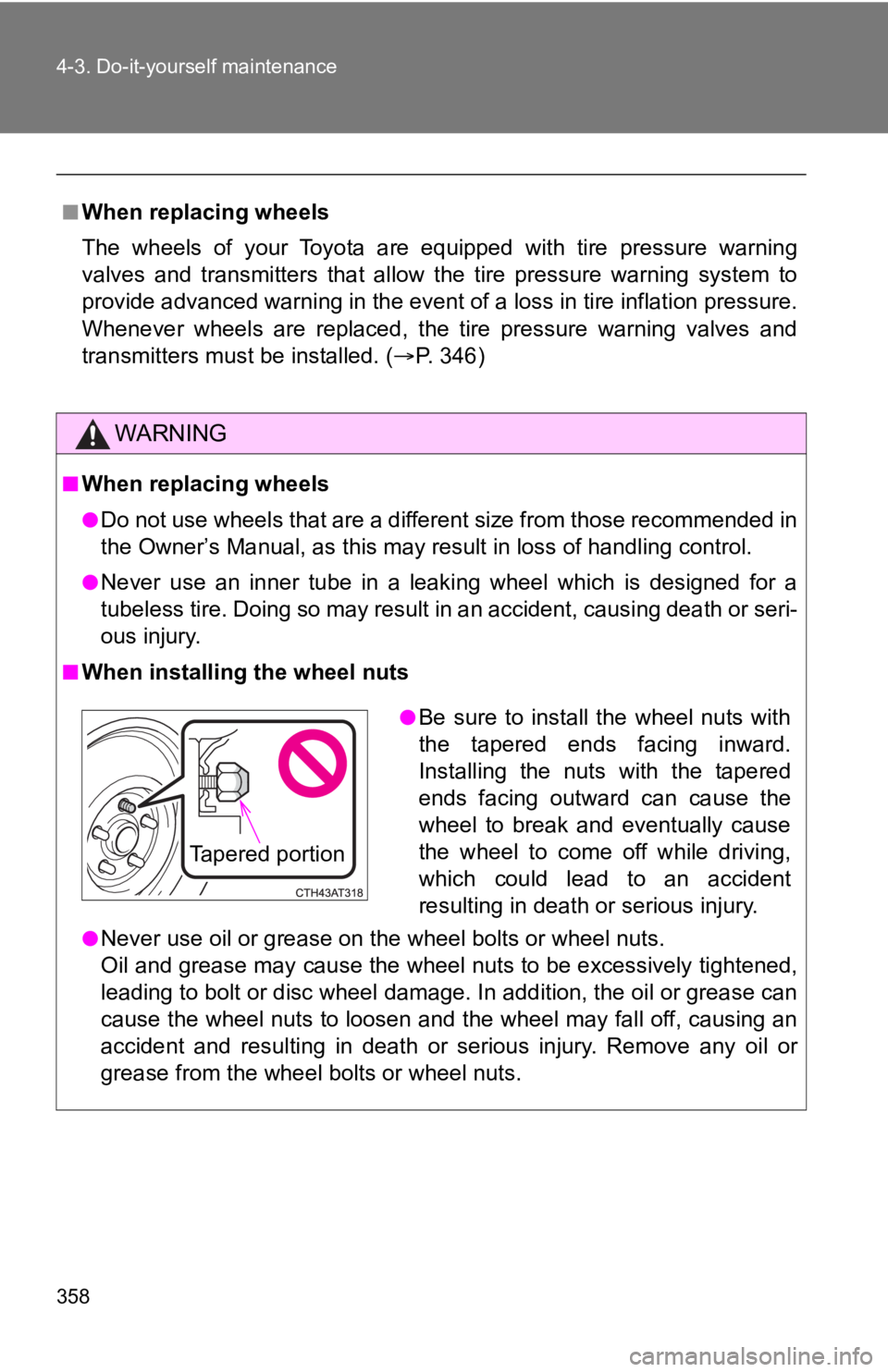
■When installing the wheel nuts
●Never use oil or grease on the wheel bolts or wheel nuts.
Oil and grease may cause the wheel nuts to be excessively tight ened,
leading to bolt or disc wheel damage. In addition, the oil or g rease can
cause the wheel nuts to loosen and the wheel may fall off, caus ing an
accident and resulting in death or serious injury. Remove any o il or
grease from the wheel bolts or wheel nuts.
●Be sure to install the wheel nuts with
the tapered ends facing inward.
Installing the nuts with the tapered
ends facing outward can cause the
wheel to break and eventually cause
the wheel to come off while driving,
which could lead to an accident
resulting in death or serious injury.
Tapered portion