ECO mode TOYOTA 86 2020 Owner's Manual
[x] Cancel search | Manufacturer: TOYOTA, Model Year: 2020, Model line: 86, Model: TOYOTA 86 2020Pages: 532, PDF Size: 8 MB
Page 254 of 532

254 2-4. Using other driving systems
■Operating conditions of hill-start assist control
When the following conditions are met, the hill-start assist co ntrol will oper-
ate:
● Vehicles with an automatic transmission: The shift lever is in D or M
(when starting off forward on while facing uphill) or in R (whe n starting off
backward while facing downhill).
● Vehicles with a manual transmission: The shift lever is in a po sition other
than R (when starting off forward while facing uphill) or in R (when start-
ing off backward while facing downhill).
● The vehicle is stopped.
● The accelerator pedal is not depressed.
● The parking brake is not engaged.
■ Hill-start assist control will not operate when
Hill-start assist control will not operate when any of the following conditions
are met:
●Vehicles with an automatic transmission: The shift lever is in a position
other than D or M (when facing uphill) or in a position other t han R (when
facing downhill).
● Vehicles with a manual transmission: The shift lever is in R (w hen facing
uphill) or in a position other than R (when facing downhill).
● Vehicles with an automatic transmission: The accelerator pedal is
depressed.
● The parking brake is applied.
● Vehicles with a manual transmission: The clutch is engaged.
● Approximately 2 seconds have elapsed since the brake pedal was
released.
● The hill-start assist control ON indicator is not illuminated.
● Vehicles without a smart key system: The engine switch is turne d to the
“ACC” or “LOCK” position.
● Vehicles with a smart key system: The “ENGINE START STOP” switc h is
turned to ACCESSORY mode or turned off.
Page 273 of 532
273
3-1. Using the air condit
ioning system and defogger
3
Interior features
■For quick cooling
Turn the temperature control dial to the “MAX A/C” position and select the
recirculated air mode.
■ Fogging up of the windows
●The windows will easily fog up when the humidity in the vehicle is high.
Turning
on will dehumidify the air from the outlets and defog the
windshield effectively.
● If you turn
off, the windows may fog up more easily.
● The windows may fog up if the recirculated air mode is used.
■ When driving on dusty roads
Close all windows. If dust thrown up by the vehicle is still drawn into the vehi-
cle after closing the windows, it is recommended that the air i ntake mode be
set to outside air mode and the fan speed to any setting except off.
■ Outside/recirculated air mode
Setting to the recirculated air mode temporarily is recommended in prevent-
ing dirty air from entering the vehicle interior and helping to cool the vehicle
when the outside air temperature is high.
■ When the outside temperature falls to nearly 32°F (0°C)
The dehumidification function may not operate even when is
pressed.
■ Ventilation and air conditioning odors
●To let fresh air in, set the air conditioning system to the out side air mode.
● During use, various odors from inside and outside the vehicle may enter
into and accumulate in the air conditioning system. This may then cause
odor to be emitted from the vents.
● To reduce potential odors from occurring:
It is recommended that the air conditioning system be set to ou tside air
mode prior to turning the vehicle off.
■ Air conditioning filter
P. 360
Page 283 of 532
283
3-1. Using the air condit
ioning system and defogger
3
Interior features
■Ventilation and air conditioning odors
●To let fresh air in, set the air conditioning system to the out side air mode.
● During use, various odors from inside and outside the vehicle may enter
into and accumulate in the air conditioning system. This may then cause
odor to be emitted from the vents.
● To reduce potential odors from occurring:
• It is recommended that the air conditioning system be set to outside air
mode prior to turning the vehicle off.
• The start timing of the blower may be delayed for a short peri od of time
immediately after the air conditioning system is started in automatic
mode.
■ Air conditioning filter
P. 360
WARNING
■To prevent the windshield from fogging up
Do not use during cool air operation in extremely humid weathe r. T h e
difference between the temperature of the outside air and that of the wind-
shield can cause the outer surface of the windshield to fog up, blocking your
vision.
NOTICE
■ To prevent battery discharge
Do not leave the air conditioning system on longer than necessa ry when the
engine is stopped.
Page 285 of 532
285
3-1. Using the air condit
ioning system and defogger
3
Interior features
■The defoggers can b e operated when
Vehicles without a smart key system
The engine switch is in the “ON” position.
Vehicles with a smart key system
The “ENGINE START STOP” switch is in IGNITION ON mode.
■ The outside rear view mirror def oggers (vehicles with outside rear view
mirror defoggers)
Turning the rear window defogger on will turn the outside rear view mirror
defoggers on.
■ When continuous operation is set (vehicles with an automatic air con-
ditioning system)
During continuous operation, the defogger stops operating for 2 minutes
after every 15 minutes of continual operation. Even during the 2 minutes that
operation stops, the operating light remains illuminated. The r ear window
defogger will continue to operate in this cycle until it is tur ned off.
■ Customization that can be config ured at Toyota dealer (vehicles with
an automatic air conditioning system)
The rear window defogger can be set to 15-minute operation or c ontinuous
operation. (Customizable features P. 487)
WARNING
■When the outside rear view mirror defoggers are on (vehicles wi th out-
side rear view mirror defoggers)
Do not touch the outside surface of the rear view mirrors, as they can
become very hot and burn you.
NOTICE
■ To prevent battery discharge
Do not leave the rear window defogger on longer than necessary when the
engine is stopped.
Page 298 of 532
298
3-5. Other interior features
Clock
■The clock is displayed when
Vehicles without a smart key system
The engine switch is in the “ACC” or “ON” position.
Vehicles with a smart key system
The “ENGINE START STOP” switch is in ACCESSORY or IGNITION ON
mode.
■ When disconnecting and reco nnecting battery terminals
The clock data will be reset.
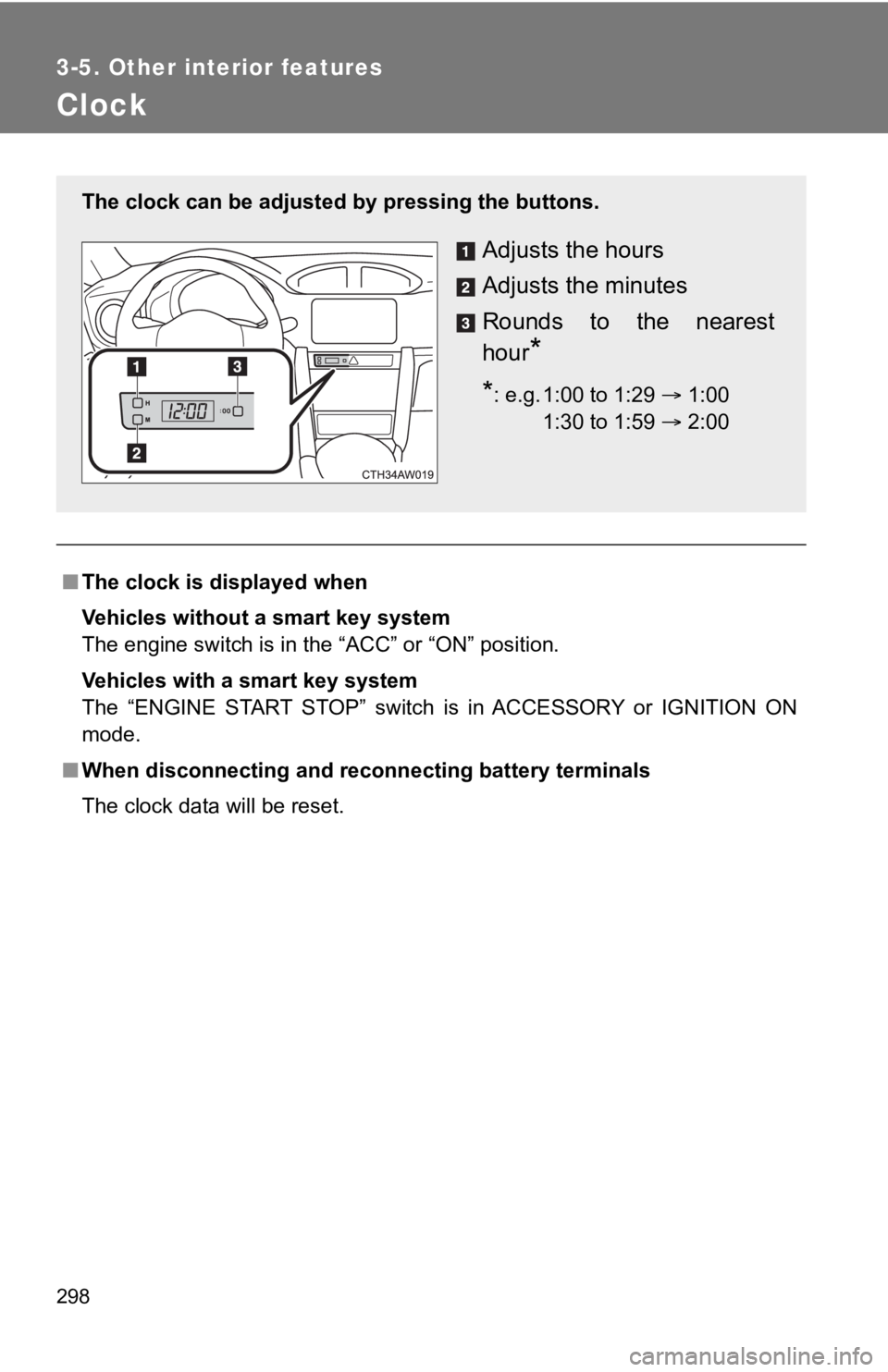
The clock can be adjusted by pressing the buttons.
Adjusts the hours
Adjusts the minutes
Rounds to the nearest
hour
*
*: e.g. 1:00 to 1:29 1:00 1:30 to 1:59 2:0000
Page 304 of 532
304 3-5. Other interior features
WARNING
Observe the following precautions.
Failure to do so may cause the driver's floor mat to slip, possibly interfering
with the pedals while driving. An unexpectedly high speed may result or it may
become difficult to stop the vehicle. This could lead to an acc ident, resulting in
death or serious injury.
■ When installing a floor mat
●Do not use floor mats designed for other models or different mo del year
vehicles, even if they are Toyota Genuine floor mats.
● Driver’s seat floor mat: Only use floor mats designed for the d river's seat.
● Front: Always install the floor mat securely using the retaining hooks (clips)
provided.
● Do not use two or more floor mats on top of each other.
● Do not place the floor mat bottom-side up or upside-down.
■ Before driving
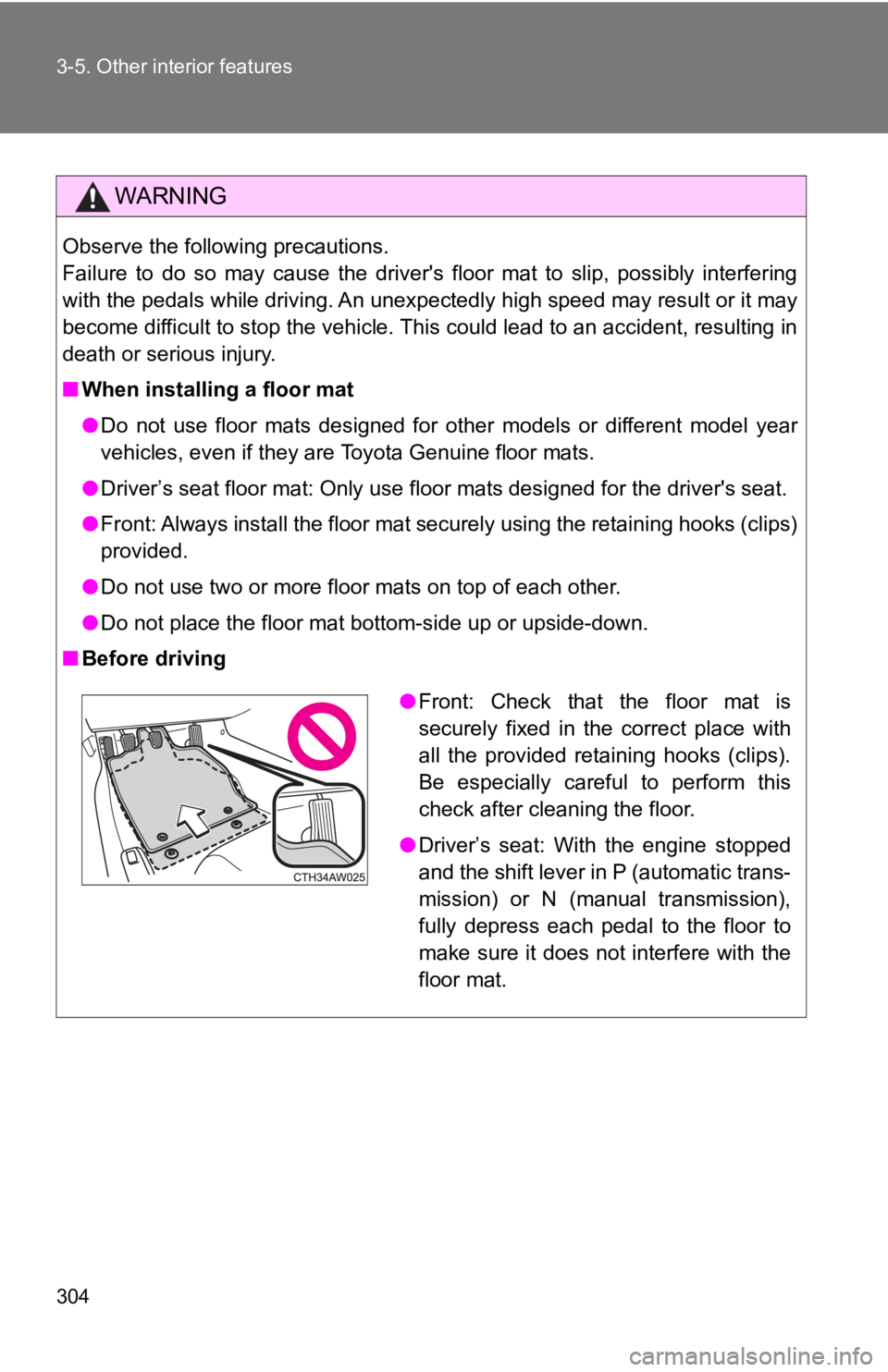
●Front: Check that the floor mat is
securely fixed in the correct place with
all the provided retaining hooks (clips).
Be especially careful to perform this
check after cleaning the floor.
● Driver’s seat: With the engine stopped
and the shift lever in P (automatic trans-
mission) or N (manual transmission),
fully depress each pedal to the floor to
make sure it does not interfere with the
floor mat.
Page 326 of 532

326 4-3. Do-it-yourself maintenance
WARNING
The engine compartment contains many mechanisms and fluids that may
move suddenly, become hot, or become electrically energized. To avoid death
or serious injury, observe the following precautions.
■ When working on the engine compartment
●Keep hands, clothing, and tools away from the moving fan and engine
drive belt.
● Be careful not to touch the engine, radiator, exhaust manifold, etc. right
after driving as they may be hot. Oil and other fluids may also be hot.
● Do not leave anything that may burn easily, such as paper or ra gs, in the
engine compartment.
● Do not smoke, cause sparks or expose an open flame to fuel or t he bat-
tery. Fuel and battery fumes are flammable.
● Be extremely cautious when working on the battery. It contains poisonous
and corrosive sulfuric acid.
■ When working near the electric cooling fans or radiator grille
Vehicles without a smart key system: Be sure the engine switch is off. With
the engine switch in the “ON” position, the electric cooling fa ns may auto-
matically start to run if the air conditioning is on and/or the coolant tempera-
ture is high. ( P. 337)
Vehicles with a smart key system: Be sure the “ENGINE START STO P”
switch is off. With the “ENGINE START STOP” switch in IGNITION ON
mode, the electric cooling fans may automatically start to run if the air condi-
tioning is on and/or the coolant temperature is high. ( P. 337)
■ Safety glasses
Wear safety glasses to prevent flying or falling material, fluid spray, etc. from
getting in the eyes.
NOTICE
■If you remove the air cleaner filter
Driving with the air cleaner filter removed may cause excessive engine wear
due to dirt in the air.
Page 341 of 532

341
4-3. Do-it-yourself maintenance
4
Maintenance and care
■
After recharging/reconnecting the battery (vehicles with a smar t key
system)
● Unlocking the doors using the smart key system may not be possi ble
immediately after reconnecting the battery. If this happens, use the wire-
less remote control or the mechanical key to lock/unlock the do ors.
● Start the engine with the “ENGINE START STOP” switch in ACCES-
SORY mode. The engine may not start with the “ENGINE START STOP ”
switch turned off. However, the engine will operate normally from the sec-
ond attempt.
● The “ENGINE START STOP” switch mode is recorded by the vehicle. If
the battery is reconnected, the vehicle will return the “ENGINE START
STOP” switch mode to the status it was in before the battery was discon-
nected. Make sure to turn off the engine before disconnect the battery.
Take extra care when connecting the battery if the “ENGINE STAR T
STOP” switch mode prior to discharge is unknown.
If the engine will not start even after multiple attempts, cont act your Toyota
dealer.
Page 392 of 532
392 5-1. Essential information
Towing with a wheel lift-type truck
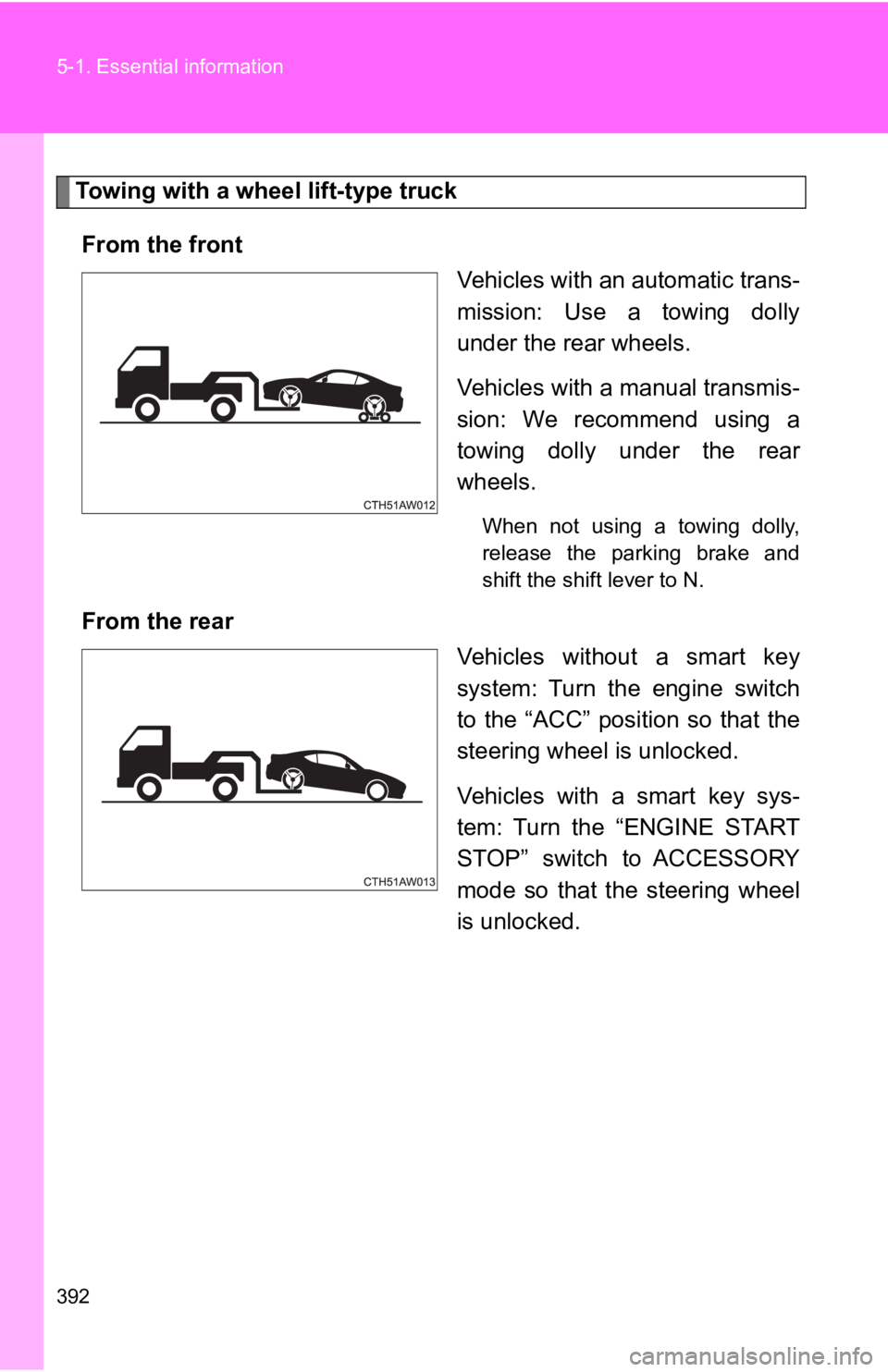
From the front Vehicles with an automatic trans-
mission: Use a towing dolly
under the rear wheels.
Vehicles with a manual transmis-
sion: We recommend using a
towing dolly under the rear
wheels.
When not using a towing dolly,
release the parking brake and
shift the shift lever to N.
From the rearVehicles without a smart key
system: Turn the engine switch
to the “ACC” position so that the
steering wheel is unlocked.
Vehicles with a smart key sys-
tem: Turn the “ENGINE START
STOP” switch to ACCESSORY
mode so that the steering wheel
is unlocked.
Page 402 of 532

402 5-2. Steps to take in an emergency
*1: Driver’s seat belt buzzer:Vehicles without a smart key system
The driver’s seat belt buzzer sounds to alert the driver that h is or her seat
belt is not fastened. Once the engine switch is turned to the “ ON” position,
the buzzer sounds for 6 seconds. If the vehicle reaches a speed of 12 mph
(20 km/h), the buzzer sounds once. If the seat belt is still un fastened after 24
seconds, the buzzer will sound intermittently for 10 seconds. T hen, if the
seat belt is still unfastened, the buzzer will sound in a different tone for 20
more seconds.
Vehicles with a smart key system
The driver’s seat belt buzzer sounds to alert the driver that h is or her seat
belt is not fastened. Once the “ENGINE START STOP” switch is turned to
IGNITION ON mode, the buzzer sounds for 6 seconds. If the vehic le
reaches a speed of 12 mph (20 km/h), the buzzer sounds once. If the seat
belt is still unfastened after 24 seconds, the buzzer will soun d intermittently
for 10 seconds. Then, if the seat belt is still unfastened, the buzzer will
sound in a different tone for 20 more seconds.
*2: Front passenger’s seat belt buzzer:
The front passenger’s seat belt buzzer sounds to alert the front passenger
that his or her seat belt is not fastened. The buzzer sounds on ce if the vehi-
cle reaches a speed of 12 mph (20 km/h). If the seat belt is st ill unfastened
after 24 seconds, the buzzer will sound intermittently for 10 s econds. Then,
if the seat belt is still unfastened, the buzzer will sound in a different tone for
20 more seconds.