stop start TOYOTA 86 2020 Owner's Manual
[x] Cancel search | Manufacturer: TOYOTA, Model Year: 2020, Model line: 86, Model: TOYOTA 86 2020Pages: 532, PDF Size: 8 MB
Page 152 of 532
152
2-1. Driving procedures
Driving the vehicle
The following procedures should be observed to ensure safe driv-
ing:
■ Starting the engine
P. 166, 175
■ Driving
Vehicles with an auto matic transmission
With the brake pedal depressed, shift the shift lever to D.
( P. 1 7 8 )
Release the parking brake. ( P. 189)
Gradually release the brake pedal and gently depress the
accelerator pedal to accelerate the vehicle.
Vehicles with a manual transmission While depressing the clutch pedal , shift the shift lever to 1.
( P. 1 8 5 )
Release the parking brake. ( P. 189)
Gradually release the clutch pedal. At the same time, gently
depress the accelerator pedal to accelerate the vehicle.
■ Stopping
Vehicles with an auto matic transmission
With the shift lever in D, depress the brake pedal.
If necessary, set the parking brake.
If the vehicle is to be stopped for an extended period of time, shift
the shift lever to P or N. ( P. 178)
Vehicles with a manual transmission
While depressing the clutch pedal, depress the brake
pedal.
If necessary, set the parking brake.
If the vehicle is to be stopped for an extended period of time, shift
the shift lever to N. (
P. 185)
STEP 1
STEP 2
STEP 3
STEP 1
STEP 2
STEP 3
STEP 1
STEP 2
STEP 1
STEP 2
Page 153 of 532
153
2-1. Driving procedures
2
When driving
■
Parking the vehicle
Vehicles with an auto matic transmission
With the shift lever in D, depress the brake pedal.
Shift the shift lever to P. ( P. 1 7 8 )
Set the parking brake. ( P. 1 8 9 )
Vehicles without a smart key system:
Turn the engine switch to the “LOCK” position to stop the
engine.
Vehicles with a smart key system:
Press the “ENGINE START STOP” switch to stop the
engine.
Lock the door, making sure that you have the key on your
person.
If parking on a hill, block the wheels as needed.
Vehicles with a manual transmission
While depressing the clutch pedal, depress the brake
pedal.
Shift the shift lever to N. ( P. 185)
Set the parking brake. ( P. 1 8 9 )
Vehicles without a smart key system:
Turn the engine switch to the “LOCK” position to stop the
engine.
Vehicles with a smart key system:
Press the “ENGINE START STOP” switch to stop the
engine.
Lock the door, making sure that you have the key on your
person.
If parking on a hill, shift the shift lever to 1 or R and block the
wheels as needed.
STEP 1
STEP 2
STEP 3
STEP 4
STEP 5
STEP 1
STEP 2
STEP 3
STEP 4
STEP 5
Page 156 of 532
156 2-1. Driving procedures
■After the engine starts
In order to secure a rich exhaust sound when starting the vehicle and envi-
ronmental performance, air intake and exhaust sounds become lou d and
vibrations may increase for a little while after the engine starts. This is not a
malfunction.
■ Operating your vehicle in a foreign country
Comply with the relevant vehicle registration laws and confirm the availability
of the correct fuel. ( P. 461)
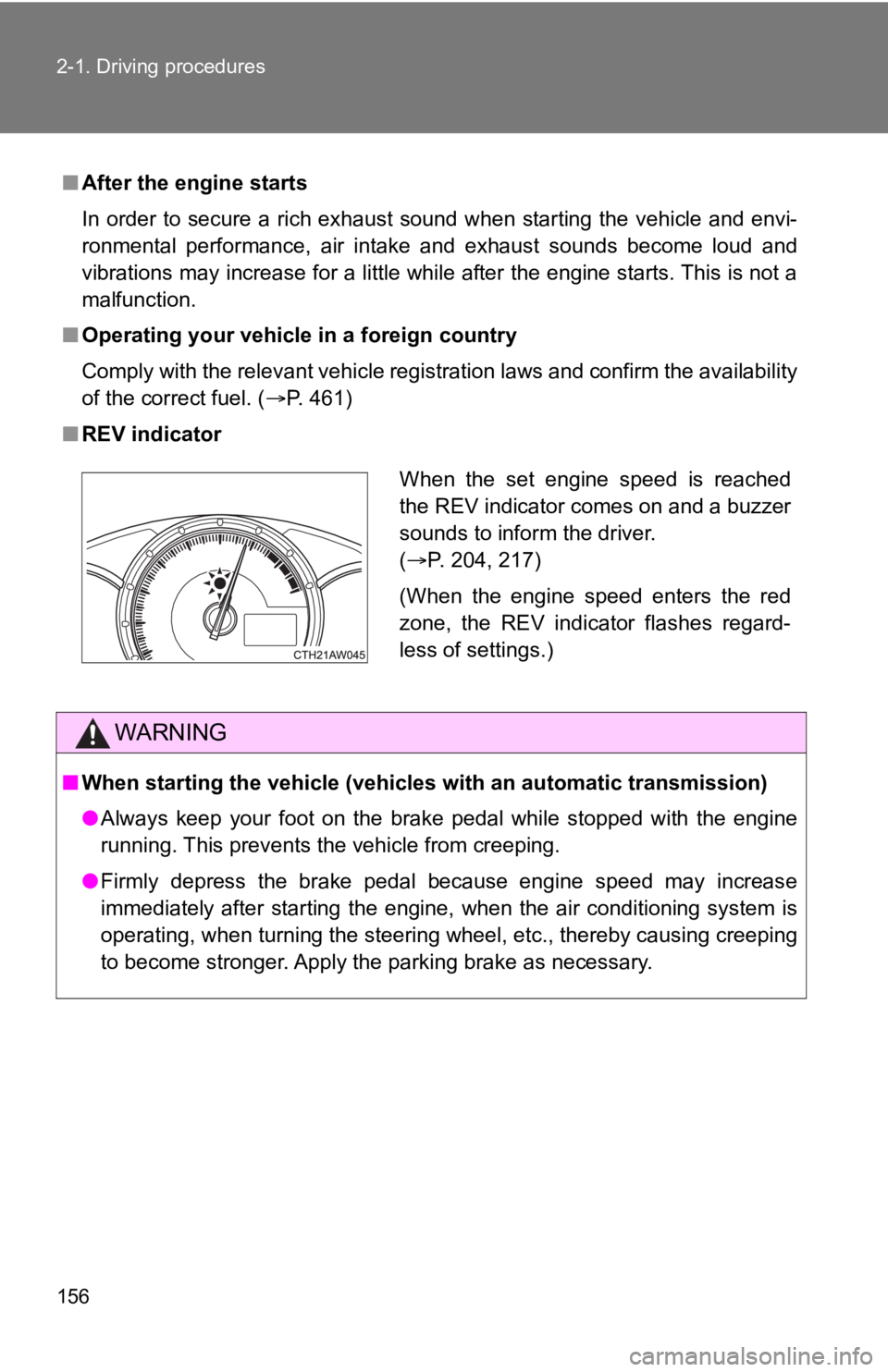
■ REV indicator
WARNING
■When starting the vehicle (vehicl es with an automatic transmission)
● Always keep your foot on the brake pedal while stopped with the engine
running. This prevents the vehicle from creeping.
● Firmly depress the brake pedal because engine speed may increas e
immediately after starting the engine, when the air conditioning system is
operating, when turning the steering wheel, etc., thereby causi ng creeping
to become stronger. Apply the parking brake as necessary.
When the set engine speed is reached
the REV indicator comes on and a buzzer
sounds to inform the driver.
( P. 204, 217)
(When the engine speed enters the red
zone, the REV indicator flashes regard-
less of settings.)
Page 164 of 532

164 2-1. Driving procedures
NOTICE
■Pre-driving check
Trapping small animals in the cooling fan and belts of the engi ne may result
in a malfunction. Check that no small animal enters the engine compartment
and under the vehicle before starting the engine.
■ When driving the vehicle
Vehicles with an automatic transmission
●Do not depress the accelerator and brake pedals at the same tim e during
driving, as this may r estrain driving torque.
● Do not use the accelerator pedal or depress the accelerator and brake
pedals at the same time to hold the vehicle on a hill.
Vehicles with a manual transmission
● Do not depress the accelerator and brake pedals at the same tim e during
driving, as this may r estrain driving torque.
● Do not shift gears unless the clutch pedal is fully depressed. After shifting,
do not release the clutch pedal abruptly. Doing so may damage t he clutch,
transmission and gears.
● Observe the following to prevent the clutch from being damaged.
• Do not rest your foot on the clutch pedal while driving.
Doing so may cause clutch trouble.
• Do not use any gear other than the 1st gear when starting off and mov-
ing forward.
Doing so may damage the clutch.
• Do not use the clutch to hold the vehicle when stopping on an uphill
grade.
Doing so may damage the clutch.
● Do not shift the shift lever to R when the vehicle is still moving. Doing so
may damage the clutch, transmission and gears.
● Do not release the clutch pedal too quickly. Doing so may damag e the
transmission.
■ When parking the vehicle (vehicl es with an automatic transmission)
Always shift the shift lever to P. Failure to do so may cause t he vehicle to
move or the vehicle may accelerate suddenly if the accelerator pedal is acci-
dentally depressed.
Page 166 of 532
166
2-1. Driving procedures
Engine (ignition) switch (vehicles with a smart key system)
Performing the following operations when carrying the electroni c
key on your person starts the engine or changes “ENGINE START
STOP” switch modes.
■ Starting the engine
Vehicles with an auto matic transmission
Check that the parking brake is set.
Check that the shift lever is set in P.
If the shift lever is not set in P, the engine may not be started.
( P. 178)
Firmly depress the brake pedal.
The smart key system indicator light (green) will turn on. If t he
indicator light does not turn on, the engine cannot be started.
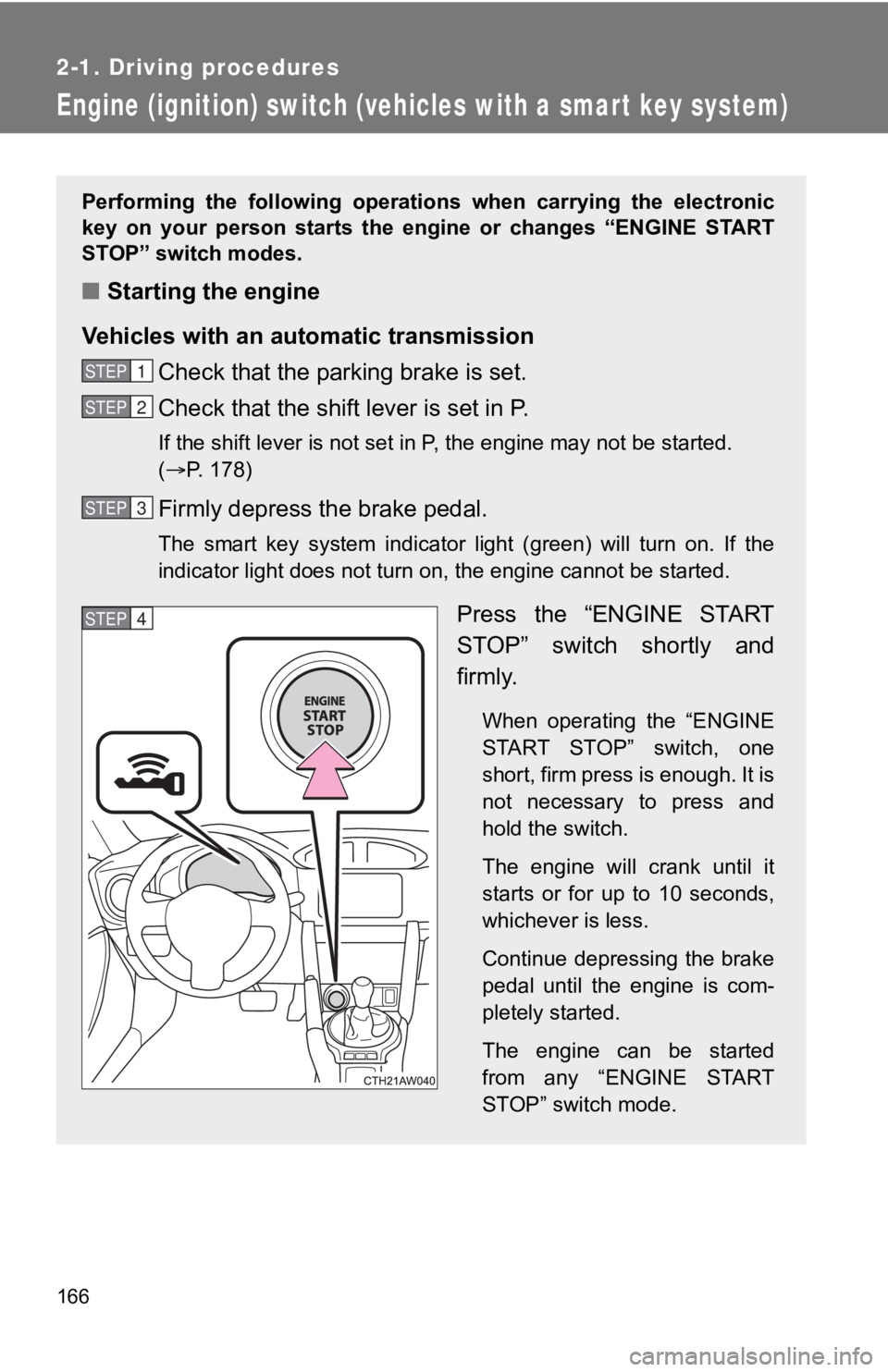
Press the “ENGINE START
STOP” switch shortly and
firmly.
When operating the “ENGINE
START STOP” switch, one
short, firm press is enough. It is
not necessary to press and
hold the switch.
The engine will crank until it
starts or for up to 10 seconds,
whichever is less.
Continue depressing the brake
pedal until the engine is com-
pletely started.
The engine can be started
from any “ENGINE START
STOP” switch mode.
STEP 1
STEP 2
STEP 3
STEP 4
Page 167 of 532
167
2-1. Driving procedures
2
When driving
Vehicles with a manual transmission
Check that the parking brake is set.
Check that the shift lever is set in N.
Firmly depress the clutch pedal.
The smart key system indicator light (green) will turn on. If t he
indicator light does not turn on, the engine cannot be started.
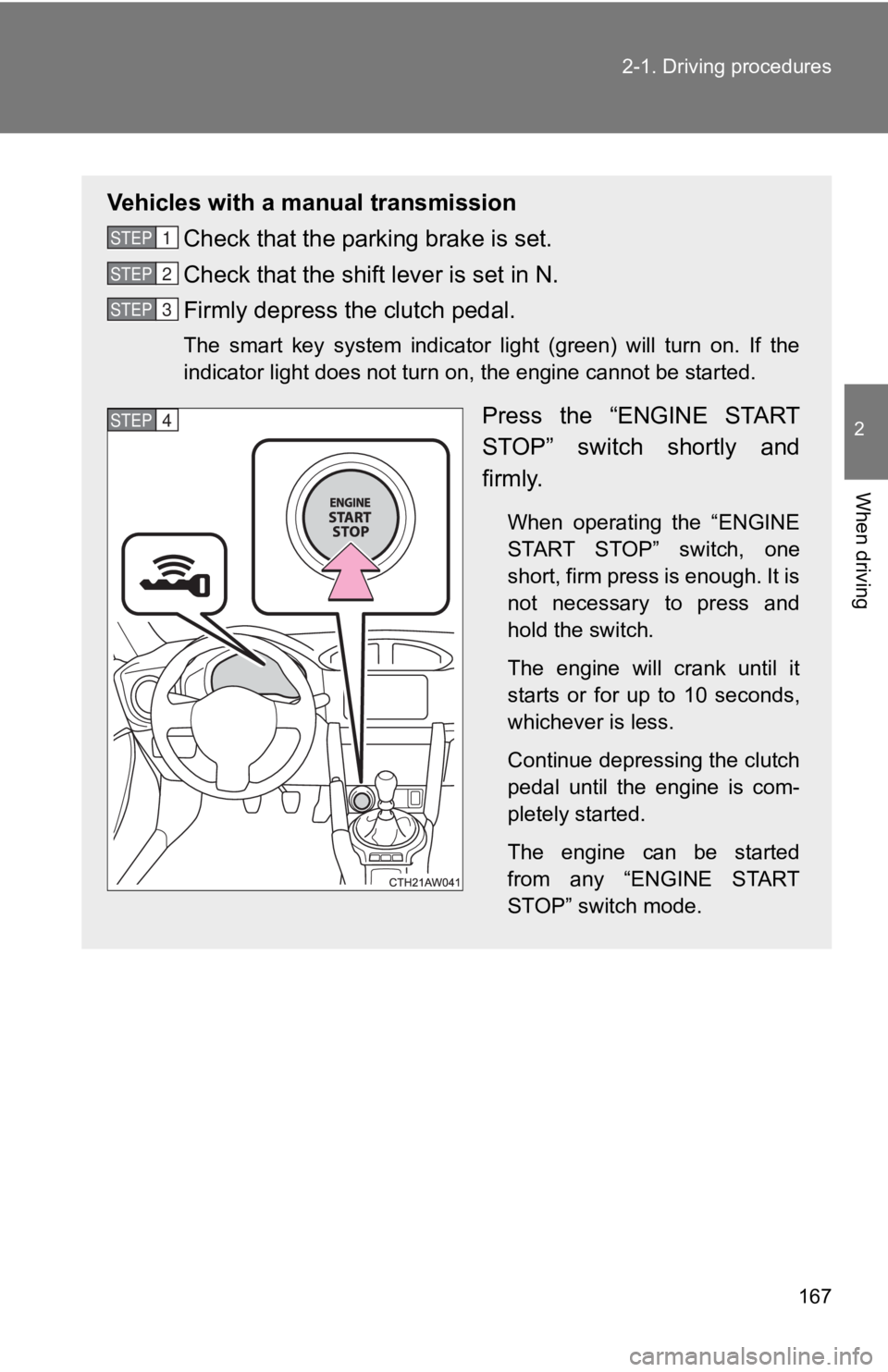
Press the “ENGINE START
STOP” switch shortly and
firmly.
When operating the “ENGINE
START STOP” switch, one
short, firm press is enough. It is
not necessary to press and
hold the switch.
The engine will crank until it
starts or for up to 10 seconds,
whichever is less.
Continue depressing the clutch
pedal until the engine is com-
pletely started.
The engine can be started
from any “ENGINE START
STOP” switch mode.
STEP 1
STEP 2
STEP 3
STEP 4
Page 168 of 532
168 2-1. Driving procedures
■Stopping the engine
Vehicles with an auto matic transmission
Stop the vehicle.
Shift the shift lever to P.
Set the parking brake. ( P. 1 8 9 )
Release the brake pedal.
Press the “ENGINE START STOP” switch.
Check that the smart key system indicator light (green) is
off.
Vehicles with a manual transmission While depressing the clutch pedal, stop the vehicle.
Shift the shif t lever to N.
Set the parking brake. ( P. 1 8 9 )
Release the clutch pedal.
Press the “ENGINE START STOP” switch.
Check that the smart key system indicator light (green) is
off.
STEP 1
STEP 2
STEP 3
STEP 4
STEP 5
STEP 6
STEP 1
STEP 2
STEP 3
STEP 4
STEP 5
STEP 6
Page 169 of 532
169
2-1. Driving procedures
2
When driving
■
Changing “ENGINE START STOP” switch mode
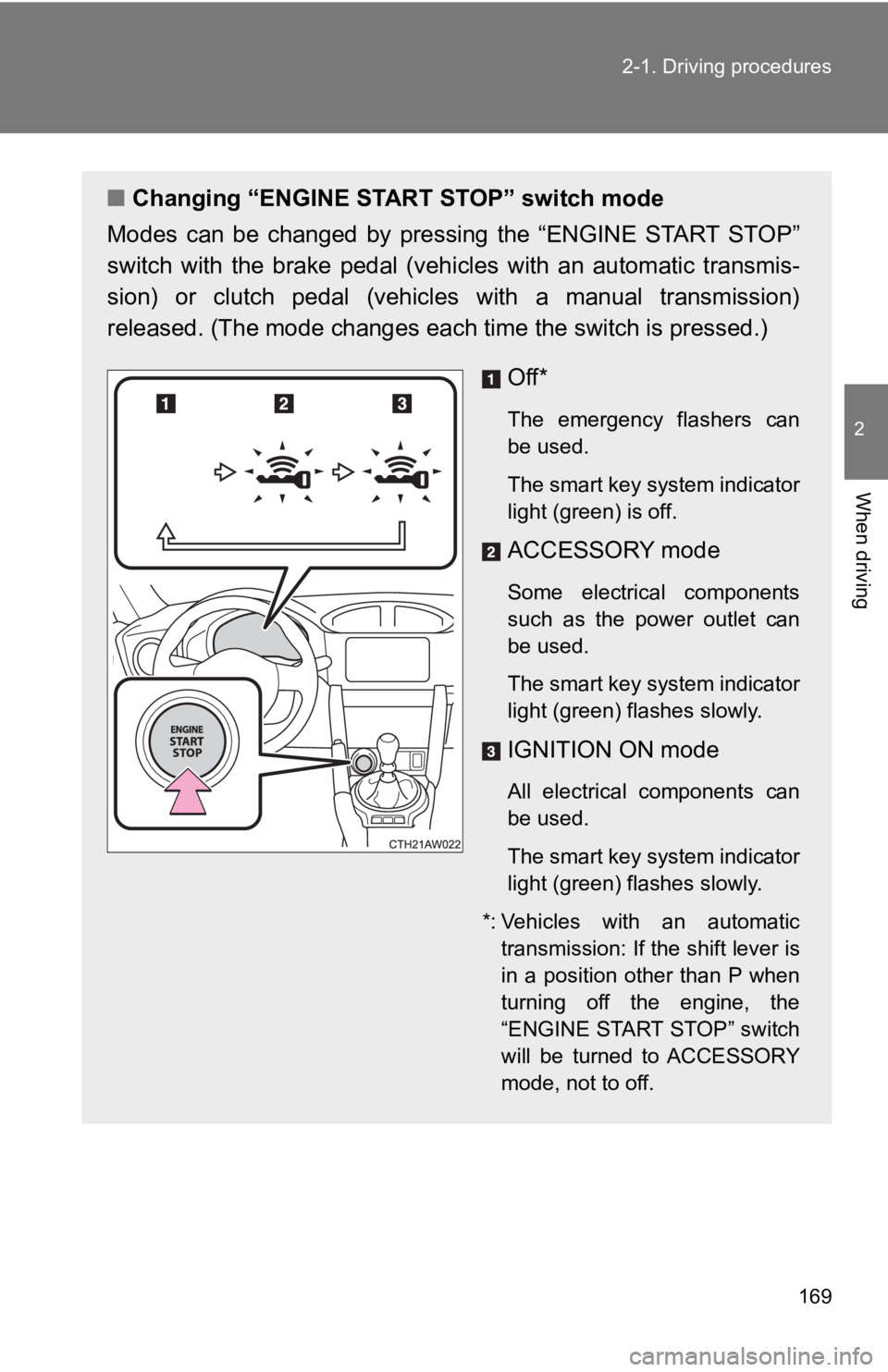
Modes can be changed by pressing the “ENGINE START STOP”
switch with the brake pedal (vehi cles with an automatic transmis-
sion) or clutch pedal (vehicles with a manual transmission)
released. (The mode changes eac h time the switch is pressed.)
Off*
The emergency flashers can
be used.
The smart key system indicator
light (green) is off.
ACCESSORY mode
Some electrical components
such as the power outlet can
be used.
The smart key system indicator
light (green) flashes slowly.
IGNITION ON mode
All electrical components can
be used.
The smart key system indicator
light (green) flashes slowly.
*: Vehicles with an automatic transmission: If the shift lever is
in a position other than P when
turning off the engine, the
“ENGINE START STOP” switch
will be turned to ACCESSORY
mode, not to off.
Page 170 of 532
170 2-1. Driving procedures
When stopping the engine with the shift lever in a position other
than P (vehicles with an automatic transmission)
If the engine is stopped with the shift lever in a position oth er than P,
the “ENGINE START STOP” switch will not be turned off but inste ad
be turned to ACCESSORY mode. Perform the following procedure to
turn the switch off:
Check that the parking brake is set.
Shift the shift lever to P.
Check that the smart key system indicator light (green)
flashes slowly and then press the “ENGINE START STOP”
switch once.
Check that the smart key system indicator light (green) is off.
■Auto power o ff function
Vehicles with an automatic transmission
If the vehicle is left in ACCESSORY mode for more than 20 minut es or IGNI-
TION ON mode (the engine is not running) for more than an hour with the
shift lever in P, the “ENGINE START STOP” switch will automatic ally turn off.
However, this function cannot entirely prevent battery discharg e. Do not
leave the vehicle with the “ENGINE START STOP” switch in ACCESS ORY
or IGNITION ON mode for long periods of time when the engine is not run-
ning.
Vehicles with a manual transmission
If the vehicle is left in ACCESSORY mode for more than 20 minut es or IGNI-
TION ON mode (the engine is not running) for more than an hour, the
“ENGINE START STOP” switch will automatically turn off. However , this
function cannot entirely prevent battery discharge. Do not leav e the vehicle
with the “ENGINE START STOP” switch in ACCESSORY or IGNITION ON
mode for long periods of time when the engine is not running.
STEP 1
STEP 2
STEP 3
STEP 4
Page 171 of 532
171
2-1. Driving procedures
2
When driving
■
Operation of the “EN GINE START STOP” switch
If the switch is not pressed shortly and firmly, the “ENGINE ST ART STOP”
switch mode may not change or the engine may not start.
■ Electronic key battery depletion
P. 35
■ Conditions affecting operation
P. 31
■ Note for the entry function
P. 32
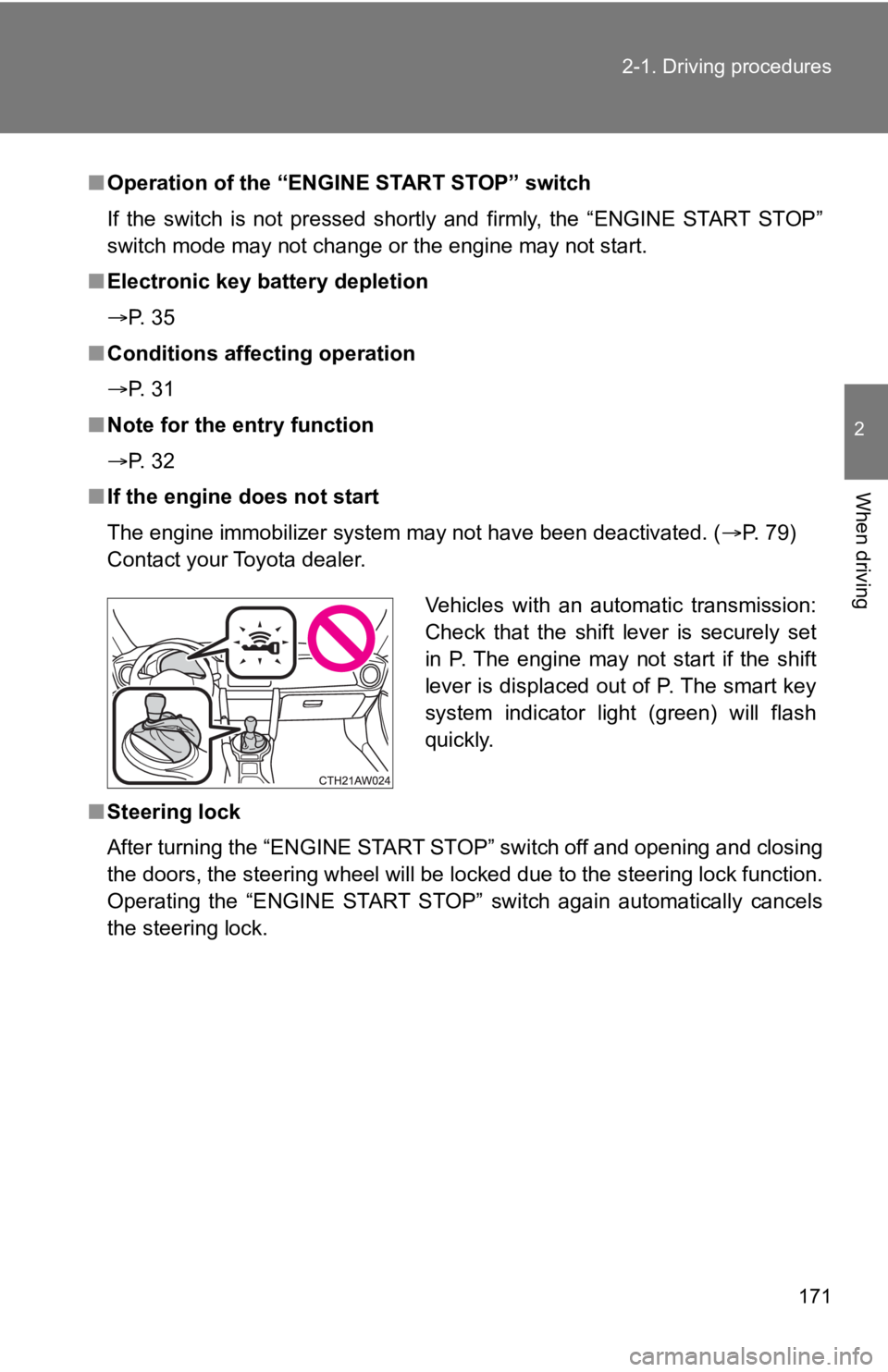
■ If the engine does not start
The engine immobilizer system may not have been deactivated. ( P. 79)
Contact your Toyota dealer.
■ Steering lock
After turning the “ENGINE START STOP” switch off and opening an d closing
the doors, the steering wheel will be locked due to the steerin g lock function.
Operating the “ENGINE START STOP” switch again automatically cancels
the steering lock.
Vehicles with an automatic transmission:
Check that the shift lever is securely set
in P. The engine may not start if the shift
lever is displaced out of P. The smart key
system indicator light (green) will flash
quickly.