automatic transmission TOYOTA 86 2020 Owners Manual
[x] Cancel search | Manufacturer: TOYOTA, Model Year: 2020, Model line: 86, Model: TOYOTA 86 2020Pages: 532, PDF Size: 8 MB
Page 2 of 532

TABLE OF CONTENTSIndex
2
1-1. Key informationKeys ..................................... 22
1-2. Opening, closing and locking the doors and
trunk
Smart key system................. 25
Wireless remote control ....... 38
Doors.................................... 43
Trunk .................................... 46
1-3. Adjustable components (seats, mirrors,
steering wheel)
Front seats ........................... 53
Rear seats ............................ 56
Head restraints ..................... 58
Seat belts ............................. 60
Steering wheel ..................... 67
Anti-glare inside rear view mirror.......................... 68
Outside rear view mirrors ..... 69
1-4. Opening and closing the windows
Power windows .................... 72
1-5. Refueling Opening the fuel tank cap .... 75 1-6. Theft deterrent system
Engine immobilizer system ................................ 79
Alarm .................................... 82
Theft prevention labels (U.S.A.)............................... 86
1-7. Safety information Correct driving posture ......... 87
SRS airbag (Supplemental Restraint
System airbag) ................... 89
Front passenger occupant classification system ......... 128
Child restraint systems ....... 137
Installing child restraints ..... 141
2-1. Driving procedures Driving the vehicle .............. 152
Engine (ignition) switch (vehicles with a smart
key system) ...................... 166
Engine (ignition) switch (vehicles without a
smart key system) ............ 175
Automatic transmission ...... 178
Manual Transmission ......... 185
Turn signal lever ................. 188
Parking brake ..................... 189
Horn .................................... 190
1Before driving
2When driving
Page 56 of 532
56
1-3. Adjustable components (seats, mirrors, steering wheel)
Rear seats
■Seat dust cover
Always remove the seat dust cover that may be attached at the t ime of pur-
chase before using the seat.
WARNING
■ When folding the rear seatbacks down
Observe the following precautions. Failure to do so may result in death or
serious injury.
●Do not fold the seatbacks down while driving.
● Stop the vehicle on level ground, set the parking brake and shi ft the shift
lever to P (automatic transmission) or N (manual transmission).
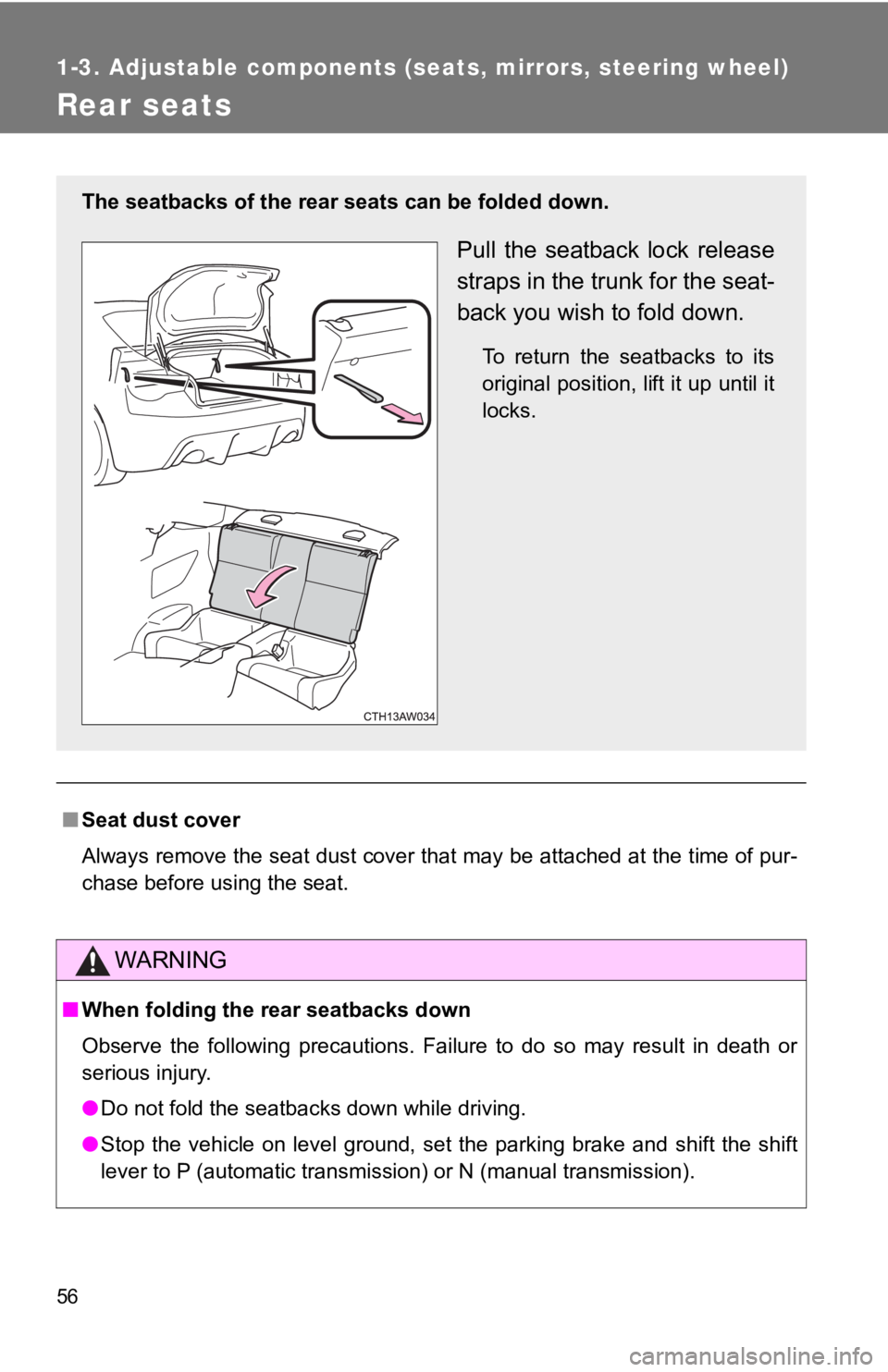
The seatbacks of the rear seats can be folded down.
Pull the seatback lock release
straps in the trunk for the seat-
back you wish to fold down.
To return the seatbacks to its
original position, lift it up until it
locks.
Page 151 of 532
When driving2
151
2-1. Driving proceduresDriving the vehicle............ 152
Engine (ignition) switch (vehicles with a smart
key system).................... 166
Engine (ignition) switch (vehicles without a
smart key system).......... 175
Automatic transmission .... 178
Manual Transmission ....... 185
Turn signal lever .............. 188
Parking brake ................... 189
Horn ................................. 190
2-2. Instrument cluster Gauges and meters ......... 191
Indicators and warning lights .............................. 194
Multi-information display (monochrome display) ... 200
Multi-information display (color display) ................ 207 2-3. Operating the lights and
windshield wipers
Headlight switch ............... 222
Fog light switch ................ 228
Windshield wipers and washer ........................... 229
2-4. Using other driving systems
Cruise control ................... 232
Rear view monitor system ........................... 237
Driving assist systems ..... 245
Hill-start assist control ...... 252
2-5. Driving information Cargo and luggage .......... 256
Vehicle load limits ............ 260
Winter driving tips ............ 261
Trailer towing ................... 265
Dinghy towing .................. 266
Page 154 of 532
154 2-1. Driving procedures
Starting off on a steep uphillVehicles with an automatic transmission Make sure that the parking brake is set and shift the shift lever
to D.
Gently depress the accelerator pedal.
Release the parking brake.
Vehicles with a manual transmission With the parking brake firmly set and the clutch pedal fully
depressed, shift the shift lever to 1.
Lightly depress the accelerator pedal at the same time as
gradually releasing the clutch pedal.
Release the parking brake.
■ When starting off on an uphill
When enabled, the hill-start assist control can operate. ( P. 252)
■ Driving in the rain
●Drive carefully when it is raining, because visibility will be reduced, the
windows may become fogged-up, and the road will be slippery.
● Drive carefully when it starts to rain, because the road surfac e will be
especially slippery.
● Refrain from high speeds when driving on an expressway in the r ain,
because there may be a layer of water between the tires and the road
surface, preventing the steering and brakes from operating prop erly.
STEP 1
STEP 2
STEP 3
STEP 1
STEP 2
STEP 3
Page 155 of 532

155
2-1. Driving procedures
2
When driving
■
Engine speed while driving (vehicles with an automatic transmission)
In the following conditions, the engine speed may become high while driving.
This is due to automatic up-shifting control or down-shifting i mplementation
to meet driving conditions. It does not indicate sudden acceleration.
● The vehicle is judged to be driving uphill or downhill
● When the accelerator pedal is released
● When driving on curves
● When the brake pedal is firmly depressed
■ New vehicle break-in driving (the first 1000 miles [1600 km])
The performance and long life of your vehicle are dependent on how you
handle and care for your vehicle while it is new. Follow these instructions
during the first 1000 miles (1600 km):
● Do not race the engine. And do not allow the engine speed to exceed
4000 rpm except in an emergency.
● Do not drive at one constant engine or vehicle speed for a long time,
either fast or slow.
● Avoid starting suddenly and rapid acceleration, except in an em ergency.
● Avoid hard braking, except in an emergency.
The same break-in procedures should be applied to an overhauled
engine, newly mounted engine or when brake pads or brake lining s are
replaced with new ones.
■ High friction brake pads (if equipped)
The brake pads and discs are designed for use under high load c onditions.
Therefore, brake noise may be generated depending on the vehicl e speed,
braking force and vehicle environment (temperature, humidity, e tc.).
■ Drum-in-disc type parking brake system
Your vehicle has a drum-in-disc type parking brake system. This type of
brake system needs bedding-down of the brake shoes periodically or when-
ever the parking brake shoes and/or drum are replaced. Have you r Toyota
dealer perform the bedding down.
Page 156 of 532
156 2-1. Driving procedures
■After the engine starts
In order to secure a rich exhaust sound when starting the vehicle and envi-
ronmental performance, air intake and exhaust sounds become lou d and
vibrations may increase for a little while after the engine starts. This is not a
malfunction.
■ Operating your vehicle in a foreign country
Comply with the relevant vehicle registration laws and confirm the availability
of the correct fuel. ( P. 461)
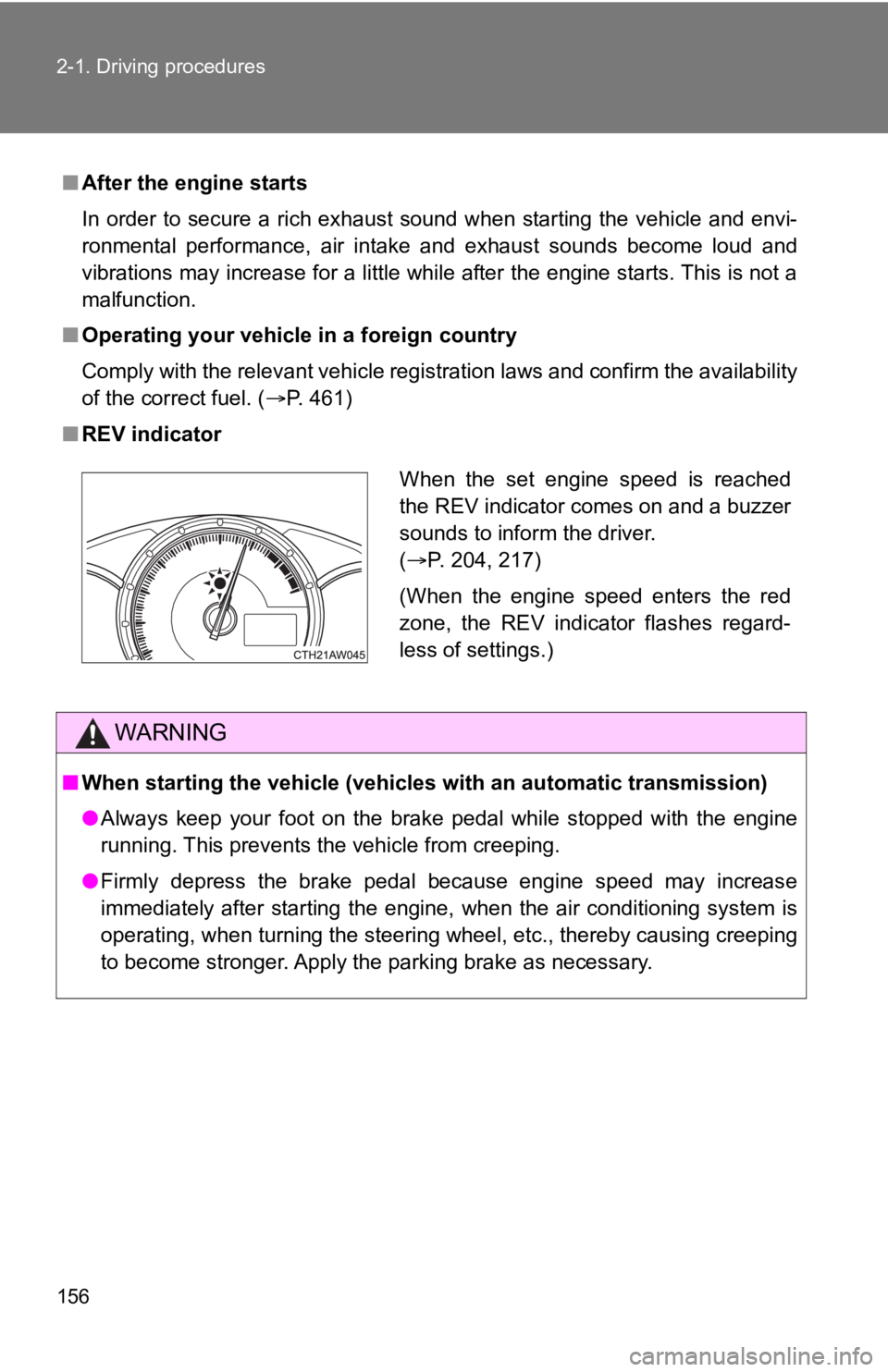
■ REV indicator
WARNING
■When starting the vehicle (vehicl es with an automatic transmission)
● Always keep your foot on the brake pedal while stopped with the engine
running. This prevents the vehicle from creeping.
● Firmly depress the brake pedal because engine speed may increas e
immediately after starting the engine, when the air conditioning system is
operating, when turning the steering wheel, etc., thereby causi ng creeping
to become stronger. Apply the parking brake as necessary.
When the set engine speed is reached
the REV indicator comes on and a buzzer
sounds to inform the driver.
( P. 204, 217)
(When the engine speed enters the red
zone, the REV indicator flashes regard-
less of settings.)
Page 157 of 532

157
2-1. Driving procedures
2
When driving
WARNING
■
When driving the vehicle
●Do not drive if you are unfamiliar with the location of the brake and accel-
erator pedals to avoid depressing the wrong pedal.
• Accidentally depressing the accelerator pedal instead of the b rake
pedal will result in sudden acceleration that may lead to an accident
that could result in death or serious injury.
• When backing up, you may twist your body around, leading to a diffi-
culty in operating the pedals. Make sure to operate the pedals properly.
• Make sure to keep a correct driving posture even when moving t he
vehicle only slightly. This allows you to depress the brake and acceler-
ator pedals properly.
• Depress the brake pedal using your right foot. Depressing the brake
pedal using your left foot may delay response in an emergency, result-
ing in an accident.
● Do not drive the vehicle over or stop the vehicle near flammabl e materials.
The exhaust system and exhaust gases can be extremely hot. Thes e hot
parts may cause a fire if there is any flammable material nearb y.
● On vehicles with an automatic transmission, do not let the vehi cle roll
backward while the shift lever is in a driving position, or roll forward while
the shift lever is in R.
Doing so may cause the engine to stall or lead to poor brake and steering
performance, resulting in an accident or damage to the vehicle.
● If the smell of exhaust is noticed inside the vehicle, open the windows and
check that the trunk is closed. Large amounts of exhaust in the vehicle can
cause driver drowsiness and an accident, resulting in death or a serious
health hazard. Have the vehicle inspected by your Toyota dealer immedi-
ately.
● On vehicles with a manual transmission, do not shift the shift lever to R
while the vehicle is moving forward.
Doing so can damage the transmission and may result in a loss o f vehicle
control.
● Do not shift the shift lever to a driving position while the ve hicle is moving
backward.
Doing so can damage the transmission and may result in a loss o f vehicle
control.
Page 159 of 532

159
2-1. Driving procedures
2
When driving
WARNING
■
When driving on slippery road surfaces
●Sudden braking, acceleration and steering may cause tire slippa ge and
reduce your ability to control the vehicle, resulting in an acc ident.
● Sudden acceleration, engine braking due to shifting, or changes in engine
speed could cause the vehicle to skid, resulting in an accident .
● After driving through a puddle, lightly depress the brake pedal to make
sure that the brakes are functioning properly. Wet brake pads m ay prevent
the brakes from functioning properly. If the brakes on only one side are wet
and not functioning properly, steering control may be affected, resulting in
an accident.
■ When shifting the shift lever
●On vehicles with an automatic transmission, be careful not to s hift the shift
lever with the accelerator pedal depressed. Shifting the shift lever to a
gear other than P or N may lead to unexpected rapid acceleration of the
vehicle that may cause an accident and result in death or serious injury.
● Do not place items in the shift lever's surrounding area. It may cause incor-
rect operation.
● If the shift boot is pulled out during cleaning, return it to i ts previous posi-
tion. If the shift boot is left pulled out, the shift lever may become difficult to
operate.
■ If you hear a squealing or scrap ing noise (brake pad wear limit indica-
tors)
Have your Toyota dealer check and replace the brake pads as soo n as pos-
sible.
Rotor damage may result if the pads are not replaced when needed.
It is dangerous to drive the vehicle when the wear limits of th e brake pads
and/or those of the brake discs are exceeded.
Page 160 of 532

160 2-1. Driving procedures
WARNING
■When the vehicle is stopped
●Do not race the engine.
If the vehicle is in any gear other than P (vehicles with an au tomatic trans-
mission only) or N, the vehicle may accelerate suddenly and une xpectedly,
causing an accident.
● Do not leave the vehicle with the engine running for a long tim e.
If such a situation cannot be avoided, park the vehicle in an open space
and check that exhaust fumes do not enter the vehicle interior.
● On vehicles with an automatic transmission, in order to prevent accidents
due to the vehicle rolling away, always keep depressing the brake pedal
while the engine is running, and apply the parking brake as nec essary.
● If the vehicle is stopped on an incline, in order to prevent ac cidents caused
by the vehicle rolling forward or backward, always depress the brake pedal
and securely apply the parking brake as needed.
● Avoid revving or racing the engine.
Running the engine at high speed while the vehicle is stopped m ay cause
the exhaust system to overheat, which could result in a fire if combustible
material is nearby.
Page 161 of 532

161
2-1. Driving procedures
2
When driving
WARNING
■
When the vehicle is parked
●Do not leave glasses, cigarette lighters, spray cans, or soft d rink cans in
the vehicle when it is in the sun.
Doing so may result in the following:
• Gas may leak from a cigarette lighter or spray can, and may lead to a fire.
• The temperature inside the vehicle may cause the plastic lense s and
plastic material of glasses to deform or crack.
• Soft drink cans may fracture, causing the contents to spray ov er the
interior of the vehicle, and may also cause a short circuit in the vehi-
cle's electrical components.
● Do not leave cigarette lighters in the vehicle. If a cigarette lighter is in a
place such as the glove box or on the floor, it may be lit acci dentally when
luggage is loaded or the seat is adjusted, causing a fire.
● Do not attach suction cups to the windshield or windows. Do not place
containers such as air fresheners on the instrument panel or da shboard.
Suction cups or containers may act as lenses, causing a fire in the vehicle.
● Do not leave a door or window open if the curved glass is coate d with a
metallized film such as a silver-colored one. Reflected sunligh t may cause
the glass to act as a lens, causing a fire.
● Always apply the parking brake, shift the shift lever to P (veh icles with an
automatic transmission only), stop the engine and lock the vehi cle.
Do not leave the vehicle unattended while the engine is running .
● Do not touch the exhaust pipe while the engine is running or im mediately
after turning the engine off.
Doing so may cause burns.
● Do not leave the engine running in an area with snow build-up, or where it
is snowing. If snowbanks build up around the vehicle while the engine is
running, exhaust gases may collect and enter the vehicle. This may lead
to death or a serious health hazard.