audio TOYOTA 86 2022 User Guide
[x] Cancel search | Manufacturer: TOYOTA, Model Year: 2022, Model line: 86, Model: TOYOTA 86 2022Pages: 449, PDF Size: 8.5 MB
Page 239 of 449
2394-6. Using other driving systems
4
Driving
*: If equipped
The Reverse Automatic Braking
(RAB) system records and stores
the following data when automatic
braking operates. It does not record
conversations, personal information
or other audio data.
●Distance from the object
●Vehicle speed
●Accelerator pedal operation status
●Brake pedal operation status
●Shift lever position
●Outside temperature
●The sensitivity setting of the sonar
sensors
Toyota and third parties contracted
by Toyota may acquire and use the
recorded data for the purpose of
vehicle research and development.
Toyota and third parties contracted
by Toyota will not disclose or pro-
vide the acquired data to any other
third party except under the follow-
ing conditions.
●The vehicle owner has given
his/her consent.
●The disclosure/prov ision is based
NOTICE
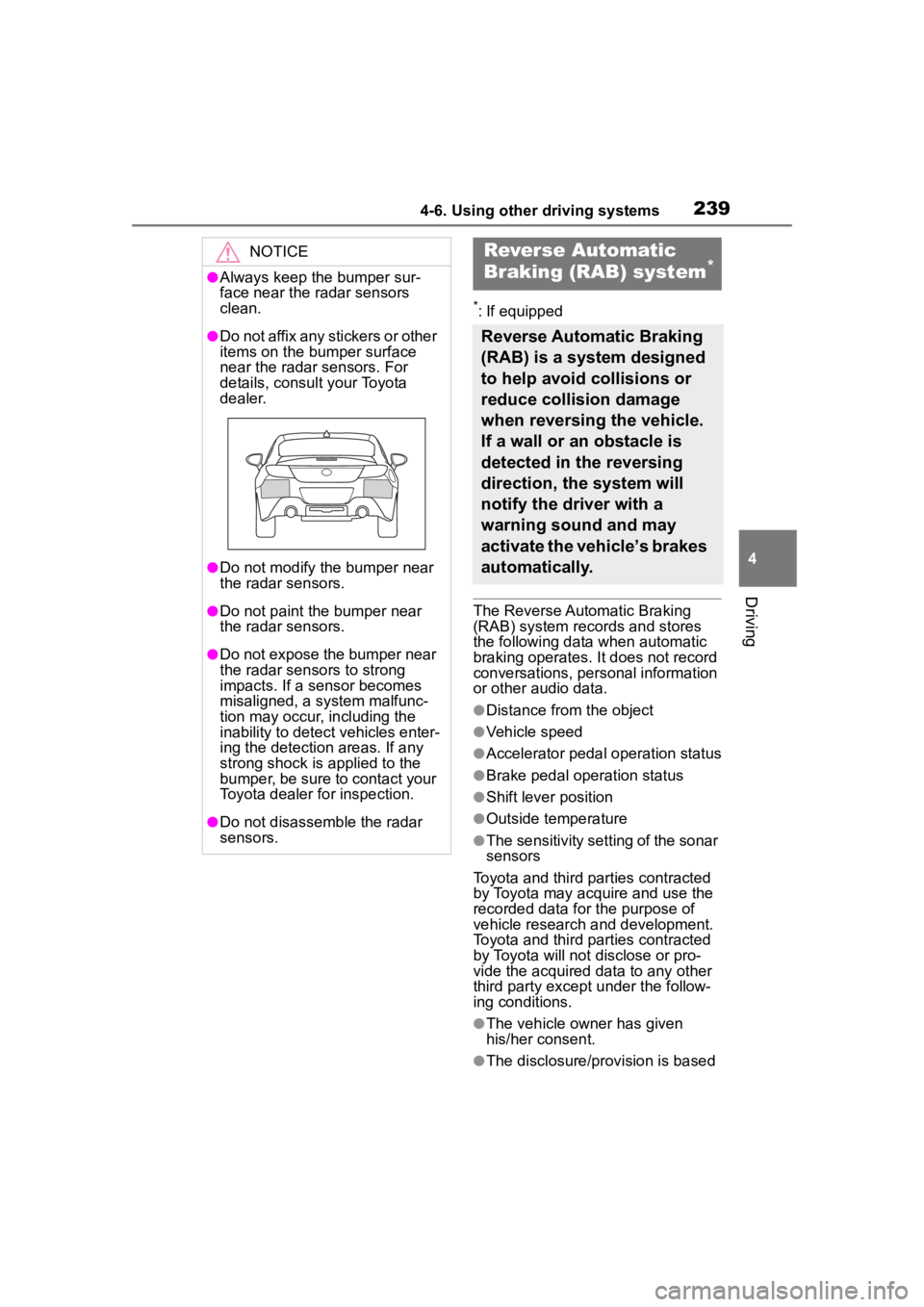
●Always keep the bumper sur-
face near the radar sensors
clean.
●Do not affix any stickers or other
items on the bumper surface
near the radar sensors. For
details, consult your Toyota
dealer.
●Do not modify the bumper near
the radar sensors.
●Do not paint the bumper near
the radar sensors.
●Do not expose the bumper near
the radar sensors to strong
impacts. If a sensor becomes
misaligned, a system malfunc-
tion may occur, including the
inability to detect vehicles enter-
ing the detection areas. If any
strong shock is applied to the
bumper, be sure to contact your
Toyota dealer for inspection.
●Do not disassemble the radar
sensors.
Reverse Automatic
Braking (RAB) system*
Reverse Automatic Braking
(RAB) is a system designed
to help avoid collisions or
reduce collision damage
when reversing the vehicle.
If a wall or an obstacle is
detected in the reversing
direction, the system will
notify the driver with a
warning sound and may
activate the vehicle’s brakes
automatically.
Page 292 of 449
2926-1. Maintenance and care
Remove dirt and dust using a
vacuum cleaner.
Wipe off any excess dirt and
dust with a soft cloth damp-
ened with diluted detergent.
Use a diluted water solution of
approximately 5% neutral wool
detergent.
Wring out any excess water
from the cloth and thoroughly
wipe off all remaining traces
NOTICE
●Do not use a chemical agent
containing silicone
(highly-polymerized silicon com-
pound) when cleaning any of
the electrical appliances such
as the air conditioning, all
switches and their surrounding
areas.
If silicon (highly-polymerized sil-
icon compound) contacts these
components, it may cause the
electrical appliances to malfunc-
tion.
■Preventing damage to leather
surfaces
Observe the following precautions
to avoid damage to and deteriora-
tion of leather surfaces:
●Remove any dust or dirt from
leather surfaces immediately.
●Do not expose the vehicle to
direct sunlight for extended peri-
ods of time. Park the vehicle in
the shade, especially during
summer.
●Do not place items made of
vinyl, plastic, or containing wax
on the upholstery, as they may
stick to the leather surface if the
vehicle interior heats up signifi-
cantly.
■Water on the floor
Do not wash the vehicle floor with
water.
Vehicle systems such as the
audio system may be damaged if
water comes into contact with
electrical components such as the
audio system above or under the
floor of the vehicle. Water may
also cause the body to rust.
■When cleaning the inside of
the windshield
Do not allow glass cleaner to con-
tact the lens. Also, do not touch
the lens. (
P.174)
■Cleaning the inside of the rear
window
●Do not use glass cleaner to
clean the rear window, as this
may cause damage to the rear
window defogger heater wires.
Use a cloth dampened with
lukewarm water to gently wipe
the window clean. Wipe the win-
dow in strokes running parallel
to the heater wires.
●Be careful not to scratch or
damage the heater wires.
■When cleaning the instrument
panel
When small grains of sand and so
forth have gotten into instrument
panel’s surface and cannot be
wiped away using a cloth, use a
clay bar without adding water.
Forcibly trying to wipe the surface
clean with a brush or sponge may
scratch the surface or fragments
of the cloth may be left in the sur-
face.
Cleaning the leather areas
Page 355 of 449
3557-2. Steps to take in an emergency
7
When trouble arises
■If the tire pressure warning light
frequently comes on after blink-
ing for 1 minute
If the tire pressure warning light fre-
quently comes on after blinking for 1
minute when the engine switch is
turned to ON, have it checked by
your Toyota dealer.
■Warning buzzer
In some cases, the buzzer may not
be heard due to being in a noisy
location or audio sound.
WARNING
■If both the ABS and the brake
system warning lights remain
on
Stop your vehicle in a safe place
immediately and contact your Toy-
ota dealer. The vehicle will
become extremely unstable
during braking, and the ABS sys-
tem may fail, which could cause
an accident resulting in death or
serious injury.
■When the electric power
steering system warning light
comes on
The steering wheel may become
extremely heavy.
When steering wheel operations
are heavier than usual, grip the
steering wheel firmly and operate
it using more force than usual.
■If the tire pressure warning
light comes on
Be sure to observe the following
precautions. Failure to do so
could cause a loss of vehicle con-
trol and result in death or serious
injury.
●Stop your vehicle in a safe place
as soon as possible. Adjust the
tire inflation pressure immedi-
ately.
●If the tire pressure warning light
comes on even after tire infla-
tion pressure adjustment, it is
probable that you have a flat
tire. Check the tires. If a tire is
flat, repair the flat tire by using
emergency tire puncture repair
kit.
●Avoid abrupt maneuvering and
braking. If the vehicle tires dete-
riorate, you could lose control of
the steering wheel or the
brakes.
■If a blowout or sudden air
leakage should occur
The tire pressure warning system
may not activate immediately.
■Maintenance of the tires
Each tire, includi ng the spare (if
provided), should be checked
monthly when cold and inflated to
the inflation pressure recom-
mended by the vehicle manufac-
turer on the vehicle placard or tire
inflation pressure label (tire and
load information label). (If your
vehicle has tires of a different size
than the size indicated on the
vehicle placard or tire inflation
pressure label [tire and load infor-
mation label], you should deter-
mine the proper tire inflation
pressure for those tires.)
Page 357 of 449
3577-2. Steps to take in an emergency
7
When trouble arises
■Warning messages
The warning messages explained
below may differ from the actual
messages according to operation
conditions and vehicle specifica-
tions.
■Warning buzzer
In some cases, the buzzer may not
be heard due to being in a noisy
location or audio sound.
■If “Check Owner’s Manual” is
displayed
●If the following messages are
shown, following the instructions,
accordingly.
• “High Coolant Temperature” ( P.374)
• “Transmission Oil Temperature” ( P.149)
●If any of the following messages
are shown on the multi-informa-
tion display, it may indicate a mal-
function. Have the vehicle
inspected by your Toyota dealer
immediately.
• “EyeSight OFF”
• “Headlights Disabled”
• “ABS”
• “Steering System”
• “Vehicle Stability Control”
• “Transmission”
• “Low Tire Pressure”
• “RAB Disabled”
• “BSD/RCTA Disabled”
• “Keyless Access System Dis- abled”
• “Auto Headlight Leveler Disabled”
• “SRH Disabled”
●If any of the following messages
are shown on the multi-informa-
tion display, it may indicate a mal-
function. Immediately stop the
vehicle and contact your Toyota
dealer.
• “Brake System”
• “Check Engine”
• “SRS Airbag System”
If a war ning message
is displayed
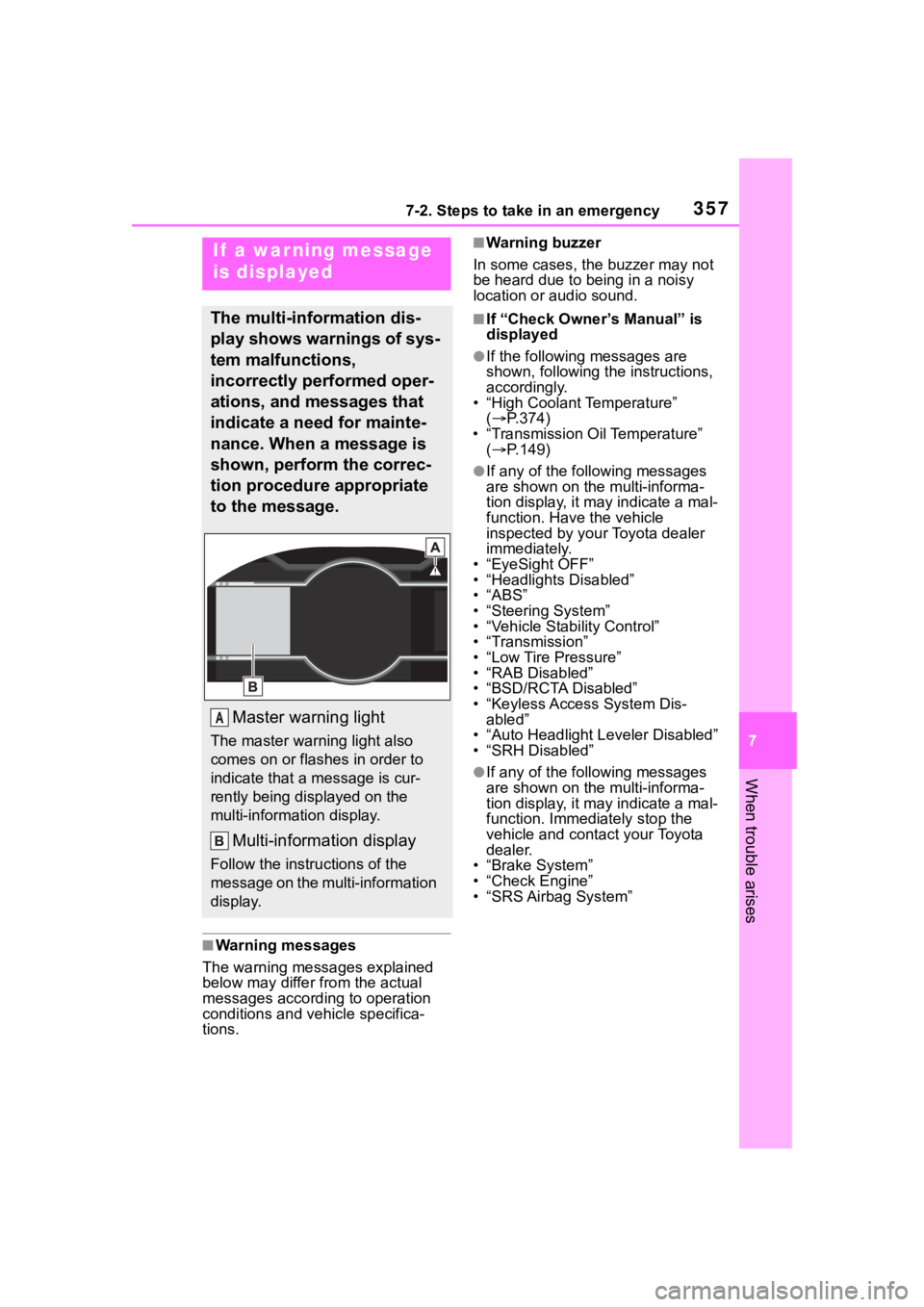
The multi-information dis-
play shows warnings of sys-
tem malfunctions,
incorrectly performed oper-
ations, and messages that
indicate a need for mainte-
nance. When a message is
shown, perform the correc-
tion procedure appropriate
to the message.
Master warning light
The master warning light also
comes on or flashes in order to
indicate that a message is cur-
rently being displayed on the
multi-information display.
Multi-information display
Follow the instru ctions of the
message on the multi-information
display.
A
Page 372 of 449
3727-2. Steps to take in an emergency
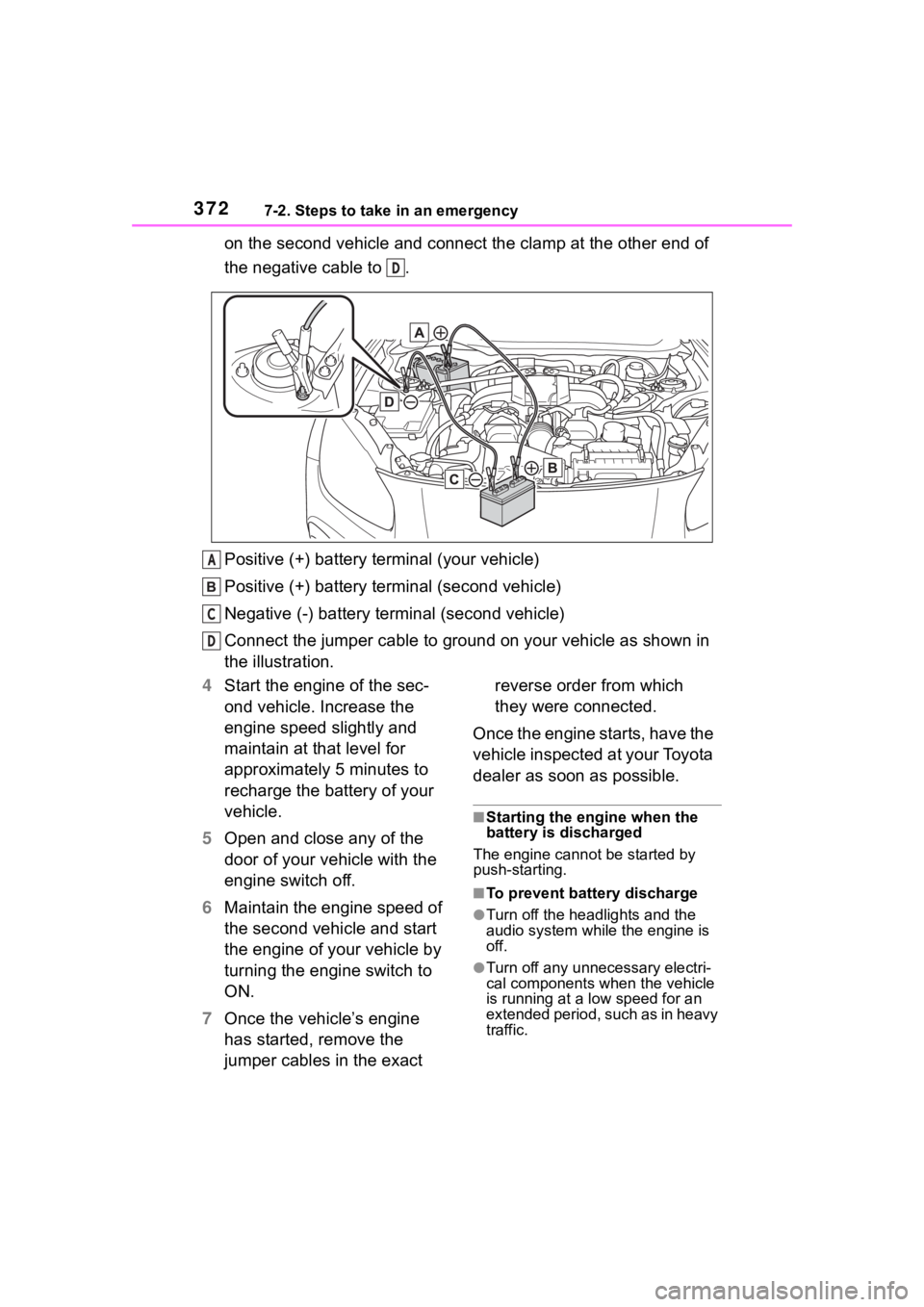
on the second vehicle and connect the clamp at the other end of
the negative cable to .
Positive (+) battery terminal (your vehicle)
Positive (+) battery terminal (second vehicle)
Negative (-) battery term inal (second vehicle)
Connect the jumper cable to ground on your vehicle as shown in
the illustration.
4 Start the engine of the sec-
ond vehicle. Increase the
engine speed slightly and
maintain at that level for
approximately 5 minutes to
recharge the battery of your
vehicle.
5 Open and close any of the
door of your vehicle with the
engine switch off.
6 Maintain the engine speed of
the second vehicle and start
the engine of your vehicle by
turning the engine switch to
ON.
7 Once the vehicle’s engine
has started, remove the
jumper cables in the exact reverse order from which
they were connected.
Once the engine starts, have the
vehicle inspected at your Toyota
dealer as soon as possible.
■Starting the engine when the
battery is discharged
The engine cannot be started by
push-starting.
■To prevent bat tery discharge
●Turn off the headlights and the
audio system while the engine is
off.
●Turn off any unnecessary electri-
cal components when the vehicle
is running at a low speed for an
extended period, such as in heavy
traffic.
D
A
C
D
Page 429 of 449
429Alphabetical Index
Alphabetical Index
A
A/CAir conditioning filter ............. 327
Automatic air conditioning sys-tem ..................................... 270
ABS (Anti-lock Brake System) ............................................... 261Warning light ........................ 349
Active Sound Control (ASC).. 157
Adaptive Cruise Control ........ 190 Warning message ................ 357
Air conditioning filter ............. 327
Air conditioning system Air conditioning filter ............. 327
Automatic air conditioning sys-tem ..................................... 270
Airbags Correct driving posture ........... 21
Front passenger occupant clas-sification system ................... 55
Locations of airbags ............... 27
SRS airbags ........................... 27
SRS warning light................. 349
Alarm ......................................... 80 Warning buzzer .................... 348
Anchor brackets ................. 65, 72
Antennas (smart key system) 111
Anti-lock Brake System (ABS) ............................................... 261Warning light ........................ 349
ASC (Active Sound Control).. 157
Audio system-linked display ... 98
Automatic air conditioning sys- tem ......................................... 270
Automatic headlight leveling system ................................... 159
Automatic light control system ............................................... 159
Automatic transmission ........ 149 Manual mode ....................... 152
Paddle shift switches.... 151, 152 Auxiliary box ...........................282
Auxiliary boxes .......................281
Average fuel consumption ......94
Average vehicle speed .............94
B
Back-up light
Replacing light bulbs ............334
Wattage ................................387
Battery Battery checking ...................309
If the battery is d ischarged ...371
Preparing and checking before winter ..................................265
Warning light.........................348
Blind Spot Detection (BSD) ...231
Bottle holders .........................280
Brake Fluid......................................385
Parking brake .......................156
Warning light.........................348
Brake assist ............................261
Break-in tips ............................133
Brightness control Instrument panel light control .91
BSD (Blind Spot D etection) ...231
C
Camera
High Beam Assist system .....162
Care Exterior .................................288
Interior ..........................291, 293
Seat belts .............................291
Ultrasuede
®..........................293
Wheels and wheel ornaments ...........................................288
Cargo capacity ........................143
Chains......................................267
Child restraint system Fixed with a LATCH system ...70
Page 434 of 449
434Alphabetical Index
General maintenance ........... 296
Maintenance date................. 380
Maintenance requirements... 295
Malfunction indicator lamp.... 349
Manual transmission ............. 153
Master warning light .............. 353
Menu icons ............................... 93
Meter Clock ...................................... 88
Indicators................................ 85
Instrument panel light control . 91
Meters .................................... 88
Multi-information display ........ 93
Settings .................................. 98
Warning lights....................... 348
Warning messages............... 357
Mirrors Inside rear view mirror.......... 126
Outside rear view mirror defog-gers .................................... 272
Outside rear view mirrors ..... 127
Vanity mirrors ....................... 284
Multi-information display......... 93 Audio system-linked display ... 98
Driving information ................. 94
Menu icons ............................. 93
Meter control switches ........... 94
Navigation system-linked display............................................. 98
Pop-up display ....................... 93
Settings .................................. 98
Sport information .................... 96
Tire pressure ........................ 315
Warning messages............... 357
N
Navigation system-linked display ................................................. 98
Noise from under vehicle .......... 5
O
Odometer...................................90
Odometer and trip meter display
Display change button ............90
Display items ..........................91
Oil Engine oil..............................382
Opener Fuel filler door.......................167
Hood .....................................302
Trunk ....................................109
Outside rear view mirrors Adjustment ...........................127
BSD (Blind Spot Detection) ..231
Folding..................................127
Outside rear view mirror defog-gers ....................................272
RCTA function.......................231
Outside temperature ................88
Overheating.............................374
P
Paddle shift switches .....151, 152
Panic mode .............................103
Parking brake Operation..............................156
Parking lights Light switch...........................158
Replacing light bulbs ............334
Power and torque curve...........96
Power outlets ..........................284
Power steering (Electric power steering system) ...................261Warning light.........................350
Power windows Jam protection function ........129
Operation..............................129
Window lock switch ..............130
Pre-Collision Braking System179 Function................................179
Warning message.................357