radio TOYOTA 86 2022 User Guide
[x] Cancel search | Manufacturer: TOYOTA, Model Year: 2022, Model line: 86, Model: TOYOTA 86 2022Pages: 449, PDF Size: 8.5 MB
Page 115 of 449

1153-2. Opening, closing and locking the doors and trunk
3
Before driving
In the following situations, the
smart key system should be dis-
abled.
When people with implantable
cardiac pacemakers, cardiac
resynchronization therapy
pacemakers or implantable cardioverter defibrillators ride
in the vehicle.
When the vehicle will not be
used for a long time, or the
smart key system is not used.
When storing an electronic
key near or inside the vehicle
cannot be avoided.
When the smart key system is
disabled, use the wireless
remote control to lock and
unlock the doors.
When starting the engine, it will
be necessary to hold the elec-
tronic key near the engine
switch. ( P.370)
■Disabling the smart key
system
The smart key system can be
disabled by opening and closing
the doors or using the wireless
remote control.
Door opening/closing method
1 While sitting in the driver’s
seat, close the door.
2 Press of the door lock
switch.
3 Within 5 seconds of perform-
ing step 2, open the driver’s
door.
4 Within 5 seconds of perform-
ing step 3, press of the
door lock switch 2 times with
the door open.
5 Within 10 seconds of per-
forming step 4, close and
WARNING
■Caution regarding interfer-
ence with electronic devices
●People with implantable car-
diac pacemakers, cardiac
resynchronization ther-
apy-pacemakers or implantable
cardioverter defib rillators should
keep away from the smart key
system antennas. ( P. 1 1 1 )
The radio waves may affect the
operation of such devices. If
necessary, the entry function
can be disabled. Ask your Toy-
ota dealer for details, such as
the frequency of radio waves
and timing of the emitted radio
waves. Then, consult your doc-
tor to see if you should disable
the entry function.
●Users of any electrical medical
device other than implantable
cardiac pacemakers, cardiac
resynchronization ther-
apy-pacemakers or implantable
cardioverter defib rillators should
consult the manufacturer of the
device for information about its
operation under the influence of
radio waves.
Radio waves could have unex-
pected effects on the operation
of such medical devices.
The smart key system can be dis-
abled. ( P. 1 1 5 )
When to disable the smart
key system
Page 231 of 449
2314-6. Using other driving systems
4
Driving
4-6.Using other driving systems
*: If equippedBSD/RCTA consists of the fol-
lowing functions.
To detect a vehicle in a blind
spot on an adjacent lane or a
vehicle approaching at high
speed while driving the vehi-
cle (Blind Spot Detection)
To detect a vehicle approach-
ing from the right or left while
reversing the vehicle (Rear
Cross Traffic Alert)
The system uses radar sensors
for the following features.
The BSD/RCTA radar sensor has
been certified by the radio wave
related laws of the U.S. and other
FCC compliant countries and Can-
ada. When drivi ng in other coun-
tries, certification of the country
where the vehicle is driven must be
obtained. For certif ication in the U.S.
and other FCC comp liant countries
and Canada, refer to P.440.
■Blind Spot Detection (BSD)
The system notifies the driver of
the presence of vehicles in its
blind spot.
If the system detects a vehicle
in its blind spot, it warns the
driver by illuminating the
BSD/RCTA approach indica-
tor(s) on the outside mirror(s).
If the driver operates the turn
signal lever in the direction
where the BSD/RCTA
approach indicator is illumi-
nating, the system warns the
BSD/RCTA*
The BSD/RCTA consists of
rear corner radars with
Blind Spot Detection, Lane
Change Assist and Rear
Cross Traffic Alert.
These functions of
BSD/RCTA are the systems
that detect objects and vehi-
cles to the rear and draw
attention to the driver when
changing a lane or when
driving in reverse.
WARNING
The driver is responsible for driv-
ing safely. Always be sure to
check the surroundings with your
eyes when changing lanes or
reversing the vehicle.
The system is designed to assist
the driver in changing lanes or
reversing safely by monitoring the
rear and side areas of the vehicle.
However, you cannot rely on this
system alone in assuring the
safety during a lane change or
reversing. Overconfidence in this
system could result in an accident
and lead to serious injury or
death. Since the system operation
has various limitations, the flash-
ing or illumination of the
BSD/RCTA approach indicator
may be delayed or it may not
operate at all even when a vehicle
is present in a neighboring lane or
approaching from either side.
The driver is responsible for pay-
ing attention to t he rear and side
areas of the vehicle.
System features
Page 243 of 449
2434-6. Using other driving systems
4
Driving
temperatures in which the area
near the sonar sensor becomes
too hot or too cold to operate.
• The sonar sensors or the rear bumper near the sonar sensors
are exposed to heavy rain or a
significant amount of water.
• Fog, snow or sandstorm, etc.
• Air is moving rapidly such as when a strong wind is blowing.
●Parts attached to the rear bumper
near the sonar sensor:
• Commercial electronic parts (fog light, fender pole, radio antenna)
or commercial attachment parts
(trailer hitch, bicycle carrier,
bumper guard) are attached.
• Parts that emit high frequency sound, such as a horn or speaker,
are attached.
●Vehicle conditions:
• Ice, snow or mud is adhered to the sonar sensors or the rear bumper
near the sonar sensor.
• The vehicle is significantly inclined.
• The ground clearance is signifi- cantly reduced due to the vehi-
cle’s loading condition, etc.
• When the sonar sensor is mis- aligned due to a collision or an
accident.
●Surrounding environment:
• A cloth banner, flag, hanging branch or railroad crossing bars
are present in the reversing direc-
tion.
• When reversing on a gravel or
grassy area.
• When reversing in an area where objects or walls are adjacent to
the vehicle such as narrow tun-
nels, narrow bridges, narrow
roads or narrow garages.
• Wheel track or hole is present in
the ground of the reversing direc-
tion.
• When reversing over a drainage
cover (grating cover).
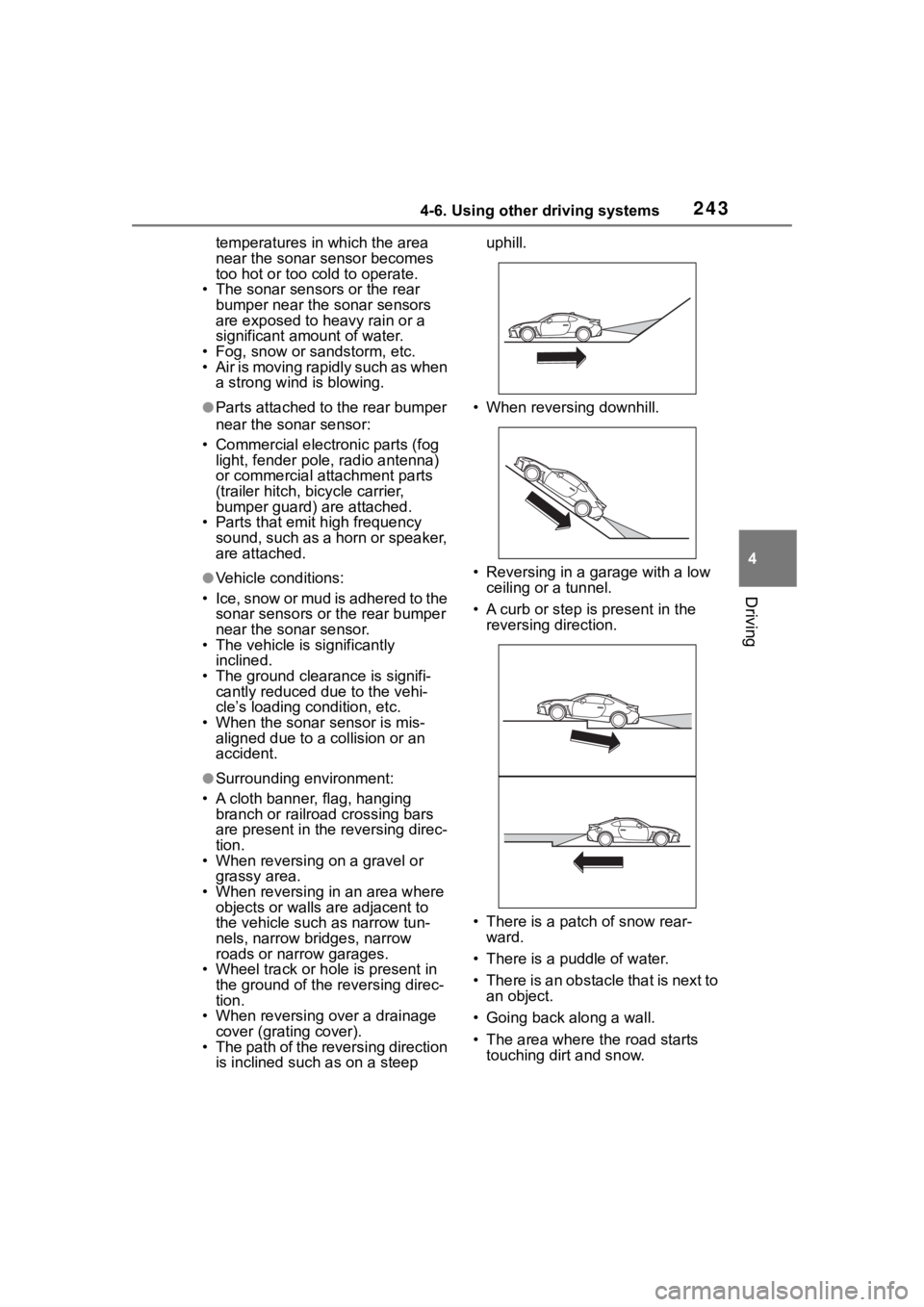
• The path of the reversing direction is inclined such as on a steep uphill.
• When reversing downhill.
• Reversing in a garage with a low ceiling or a tunnel.
• A curb or step is present in the
reversing direction.
• There is a patch of snow rear- ward.
• There is a puddle of water.
• There is an obstacle that is next to an object.
• Going back along a wall.
• The area where the road starts touching dirt and snow.
Page 316 of 449
3166-3. Do-it-yourself maintenance
is equipped.
• If a window tint that affects the radio wave signals is installed.
• If there is a lot of snow or ice on the vehicle, particularly around the
wheels or wheel housings.
• If the tire inflation pressure is extremely higher than the speci-
fied level.
• If tires not equipped with tire pres- sure warning valves and transmit-
ters are used.
• If the ID code on the tire pressure warning valves and transmitters is
not registered in the tire pressure
warning computer.
●Performance may be affected in
the following situations.
• When driving near a TV tower, electric power plant, gas station,
radio station, large display, airport
or other facility that generates
strong radio waves or electrical
noise
• When carrying a portable radio, cellular phone, cordless phone or
other wireless communication
device
If tire position information is not cor-
rectly displayed due to the radio
wave conditions, the display may be
corrected by driving and changing
the radio wave conditions.
●When the vehicle is parked, the
time taken for the warning to start
or go off could be extended.
●When tire inflation pressure
declines rapidly for example when
a tire has burst, the warning may
not function.
■Warning performance of the tire
pressure warning system
The warning of the tire pressure
warning system will change in
accordance with driving conditions.
For this reason, the system may
give a warning even if the tire pres-
sure does not reach a low enough
level, or if the p ressure is higher
than the pressure that was adjusted
to when the system was initialized.
When replacing tires or wheels,
tire pressure warning valves and
transmitters must also be
installed.
When new tire pressure warning
valves and transmitters are
installed, new ID codes must be
registered in the tire pressure
warning computer and the tire
pressure warning system must
be initialized. Have tire pressure
warning valve and transmitter ID
codes registered by your Toyota
dealer. ( P.318)
■Replacing tires and wheels
If the ID code of the tire pressure
warning valve and tr ansmitter is not
registered, the tire pressure warning
system will not work properly. After
driving for about 20 minutes, the tire
pressure warning light blinks for 1
minute and stays on to indicate a
system malfunction.
Installing tire pressure
warning valves and trans-
mitters
NOTICE
■Repairing or replacing tires,
wheels, tire pressure warn-
ing valves, transmitters and
tire valve caps
●When removing or fitting the
wheels, tires or the tire pressure
warning valves and transmit-
ters, contact your Toyota dealer
as the tire pressure warning
valves and transmitters may be
damaged if not handled cor-
rectly.
Page 394 of 449

3948-1. Specifications
Recommended inflation pres-
sureCold tire inflation pressure recommended
by a manufacturer
Accessory weight
The combined weight (in excess of those
standard items which may be replaced) of
automatic transmission, power steering,
power brakes, power windows, power
seats, radio and heater, to the extent that
these items are available as fac-
tory-installed equipment (whether installed
or not)
Curb weight
The weight of a motor vehicle with stan-
dard equipment, including the maximum
capacity of fuel, oil and coolant, and if so
equipped, air conditioning and additional
weight optional engine
Maximum loaded vehicle
weight
The sum of:
(a) Curb weight
(b) Accessory weight
(c) Vehicle capacity weight
(d) Production options weight
Normal occupant weight
150 lb. (68 kg) times the number of occu-
pants specified in the second column of
Table 1
* that follows
Occupant distribution
Distribution of occupan ts in a vehicle as
specified in the thi rd column of Table 1
*
below
Production options weight
The combined weight o f installed regular
production options weighing over 5 lb. (2.3
kg) in excess of the s tandard items which
they replace, not previously considered in
curb weight or accessory weight, including
heavy duty brakes, ride levelers, roof rack,
heavy duty battery, and special trim
Rim
A metal support for a tire or a tire and tube
assembly upon which the tire beads are
seated
Tire related termMeaning
Page 420 of 449
4209-1. For owners
AVERTISSEMENT
• Installation de volants person-nalisés
• Fixation de matériaux de garni- ture supplémentaires au tableau
de bord
• Installation de sièges person- nalisés
• Remplacement du tissu ou du cuir de siège
• Installation de tissu ou de cuir supplémentaire sur le siège
avant
• Ne fixez pas un microphone mains libres ou de tout autre
accessoire sur un montant
avant, un montan t central, un
montant arrière, le pare-brise,
une vitre latérale, une poignée
d’assistance ou toute autre sur-
face de l’habitacle qui se trou-
verait à proximité d’un coussin
gonflable rideau SRS qui se
déploie.
• Il est déconseillé d’installer un équipement électrique/électro-
nique supplémentaire, tel
qu’une radio mobile bidirection-
nelle, sur ou à proximité des
composants et/ou du câblage
du système de coussins gonfla-
bles SRS. Cela pourrait nuire au
bon fonctionnement du système
de coussins gonflables SRS.
• Modifications sur ou à l’intérieur des panneaux de porte en vue
du remplacement d’un
haut-parleur ou de l’isolation
acoustique
●Les capteurs d’impact, qui
détectent la pression d’un
impact, sont situés dans les
portes. Ne modifiez aucun élé-
ment des portes ou des garni-
tures de porte, comme l’ajout de
haut-parleurs de porte par
exemple. Toute modification des
portes entraîne un risque de
dysfonctionnement du système
de coussins gonflables ou de
déploiement involontaire de
coussins gonflables.
●N’effectuez pas l’une des opéra-
tions suivantes. De telles modi-
fications peuvent nuire au bon
fonctionnement du système de
coussins gonflables SRS.
• Fixation d’un équipement (barre d’appui, treuils, chasse-neige,
plaque de protection, etc.) autre
que des pièces accessoires
Toyota d’origine sur le train
avant.
• Modification du système de sus- pension ou de la structure
avant.
• Installation d’un pneu de taille et de construction différentes des
pneus spécifiés sur la plaque
d’identification du véhicule fixée
au montant central du conduc-
teur ou spécifiés pour les
modèles de véhicules individu-
els dans ce Manuel du pro-
priétaire.
• Fixation de tout équipement (marchepieds latéraux ou pro-
tections de bas de caisse, etc.)
autre que des pièces acces-
soires d’origine Toyota sur la
carrosserie latérale.
Consultez toujours votre conces-
sionnaire Toyota si vous souhai-
tez installer des pièces
accessoires sur votre véhicule.
Page 426 of 449
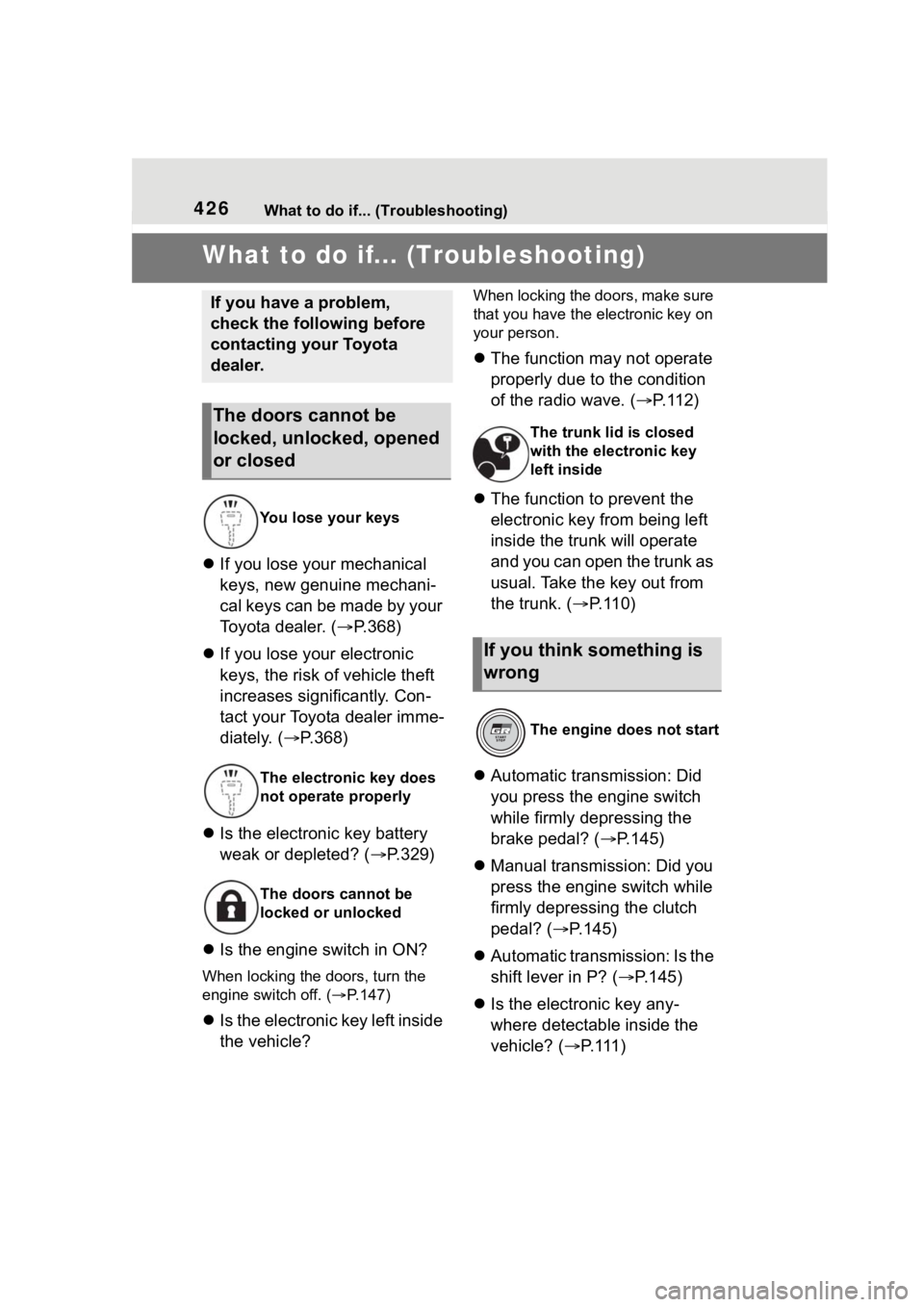
426What to do if... (Troubleshooting)
1-1.What to do if... (Troubleshooting)What to do if... (Troubleshooting)
If you lose your mechanical
keys, new genuine mechani-
cal keys can be made by your
Toyota dealer. ( P.368)
If you lose your electronic
keys, the risk of vehicle theft
increases significantly. Con-
tact your Toyota dealer imme-
diately. ( P.368)
Is the electronic key battery
weak or depleted? ( P.329)
Is the engine switch in ON?
When locking the doors, turn the
engine switch off. ( P.147)
Is the electronic key left inside
the vehicle?
When locking the doors, make sure
that you have the electronic key on
your person.
The function may not operate
properly due to the condition
of the radio wave. ( P. 1 1 2 )
The function to prevent the
electronic key from being left
inside the trunk will operate
and you can open the trunk as
usual. Take the key out from
the trunk. ( P. 1 1 0 )
Automatic transmission: Did
you press the engine switch
while firmly depressing the
brake pedal? ( P.145)
Manual transmission: Did you
press the engine switch while
firmly depressing the clutch
pedal? ( P.145)
Automatic transmission: Is the
shift lever in P? ( P.145)
Is the electronic key any-
where detectable inside the
vehicle? ( P. 111 )
If you have a problem,
check the following before
contacting your Toyota
dealer.
The doors cannot be
locked, unlocked, opened
or closed
You lose your keys
The electronic key does
not operate properly
The doors cannot be
locked or unlocked
The trunk lid is closed
with the electronic key
left inside
If you think something is
wrong
The engine does not start