wheel TOYOTA 86 2022 User Guide
[x] Cancel search | Manufacturer: TOYOTA, Model Year: 2022, Model line: 86, Model: TOYOTA 86 2022Pages: 449, PDF Size: 8.5 MB
Page 45 of 449
451-1. For safe use
1
For safety and security
ota dealer.
WARNING
■When using a child restraint
system
NEVER INSTALL A CHILD
RESTRAINT SYSTEM IN THE
FRONT PASSENGER’S SEAT
EVEN IF THE FRONT PASSEN-
GER’S SRS FRONTAL AIRBAG
IS DEACTIVATED. Be sure to
install it in the REAR seat in a cor-
rect manner. Also, it is strongly
recommended that any forward
facing child seat o r booster seat
be installed in the REAR seat, and
that even children who have out-
grown a child restraint system be
also seated in the REAR seat.
This is because children sitting in
the front passenger’s seat may be
killed or severely injured should
the front passenger’s SRS frontal
airbag deploy. REAR seats are
the safest place for children.
■General Precautions regard-
ing front passenger’s SRS
frontal airbag
When the front passenger's seat
is occupied by an adult, observe
the following precautions. Failure
to do so may lessen the load on
the front passenger 's seat, deacti-
vating the front passenger's SRS
frontal airbag despite the fact that
the seat is occupied by an adult.
This may result in personal injury.
●Do not allow the rear seat occu-
pant to lift the front passenger's
seat cushion using his/her feet.
●Do not place any article under
the front passenger's seat, or
squeeze any article from behind
and under the seat.
●Do not squeeze any article
between the front passenger's
seat and side trim /pillar, door or
center console box. This may lift
the seat cushion.
■When a small adu lt is seated
in the front passenger’s seat
When a small adult is seated in
the front passenger’s seat, the
Toyota advanced frontal airbag
system may or may not activate
the front passenger’s SRS frontal
airbag depending on the occu-
pant’s seating posture. If the OFF
indicator rema ins illuminated
while the ON indicator turns off
when a small adult is seated in
the front passenger's seat, refer to
P.43.
■General Precautions regard-
ing occupant detection sys-
tem
Do not kick the front passenger
seat or subject it to severe impact.
Otherwise, the SRS warning light
may illuminate to indicate a mal-
function of the front passenger
occupant detection system. In this
case, contact your Toyota dealer
immediately.
■After deployment
Do not touch the SRS airbag sys-
tem components around the
steering wheel and dashboard
with bare hands right after deploy-
ment. Doing so can cause burns
because the components can be
very hot as a result of deploy-
ment.
Page 48 of 449

481-1. For safe use
sensor.
Driver’s SRS side airbag
Front passenger’s SRS side
airbag
SRS curtain shield airbag
(right-hand side)
SRS curtain shield airbag
(left-hand side)
Therefore, they may not both
deploy in the same accident.
Also, the SRS side airbag and
SRS curtain shield airbag
deploys independently of the
driver’s and front passenger’s
SRS frontal airbags in the steer-
ing wheel and instrument panel.
For the locations of the sensors
and control modules, refer to
P.27.
■After deployment
After the deployment, the SRS
side airbag immediately starts to
deflate. The time required from
detection of an impact to defla-
tion of an SRS side airbag after
deployment is shorter than the
blink of an eye.
The SRS curtain shield airbag
remains inflated for a while fol-
lowing deployment then slowly
deflates.
The SRS side airbag and SRS
curtain shield airbag deploy
even when no one occupies the
seat on the side on which an
impact is applied.
When the SRS side airbag and SRS curtain shield airbag
deploy, a sudden, fairly loud
inflation noise will be heard and
some smoke will be released.
These occurrences are a normal
result of the deployment. This
smoke does not indicate a fire in
the vehicle.
■Example of the type of acci-
dent
The SRS side airbag and SRS
curtain shield airbag are
designed as follows:
To deploy in the event of an
accident involving a moderate
to severe side impact collision
To function on a one-time-only
basis.
The SRS side airbag and SRS
curtain shield airbag are not
designed to deploy in the follow-
ing cases:
In most lesser side impact
In most frontal or most rear
impacts (because the SRS
side airbag and SRS curtain
shield airbag deployment
would not protect the occu-
pant in those situations)
The SRS curtain shield airbags
are also designed to deploy
when the vehicle is in an
extremely inclined state such as
during a rollover. They are not
designed to deploy in most
lesser inclined states.
SRS side airbag and SRS cur-
Page 53 of 449

531-1. For safe use
1
For safety and security
A diagnostic system continually
monitors the readiness of the
SRS airbag system (including
seatbelt pretensioners) with the
engine switch is in ON. The
SRS warning light will show nor-
mal system operation by illumi-
nating for approximately 6
seconds when the engine switch
is turned to ON.
The following components are
monitored by the indicator:
Front impact sensor
• Right-hand side
• Left-hand side
Airbag control module (includ-
ing impact sensor and rollover
sensor)
Frontal airbag module
• Driver’s side
• Front passenger’s side
Knee airbag module
• Driver’s side
Side impact sensor
• Center pillar left-hand side
• Center pillar right-hand side
• Forward of rear wheel house left-hand side
• Forward of rear wheel house right-hand side
• Door left-hand side
• Door right-hand side
Side airbag module
• Driver’s side
• Front passenger’s side
Curtain shield airbag module
• Right-hand side
• Left-hand side
Seatbelt pretensioner
• Driver’s side
Seatbelt pretensioner and
adaptive force limiter
• Front passenger’s side
Seatbelt buckle switch
• Front passenger’s side
Front passenger’s occupant
WARNING
■After deployment
●Do not touch the SRS side air-
bag system components around
the front seat seatback with
bare hands right after deploy-
ment. Doing so can cause burns
because the components can
be very hot as a result of
deployment.
●After deployment, do not touch
any part of the SRS curtain
shield airbag system (from the
front pillar to the part of the roof
side over the rear seat). Doing
so can cause burns because
the components can be very hot
as a result of deployment.
SRS Airbag System Moni-
tors
Page 57 of 449
571-1. For safe use
1
For safety and security
■Adult*2
■Child*5, *6
WARNING
●Modifications for persons with
disabilities that may affect the
front passenger occupant clas-
sification system. (U.S. only)
Removing, replacing or modify-
ing any parts of the front seats,
seat belts, front bumper, front
side frame, instrument panel,
meter, steering wheel, steering
column, tires, suspension or
floor panel can affect the opera-
tion of the Toyota front passen-
ger occupant classification
system.
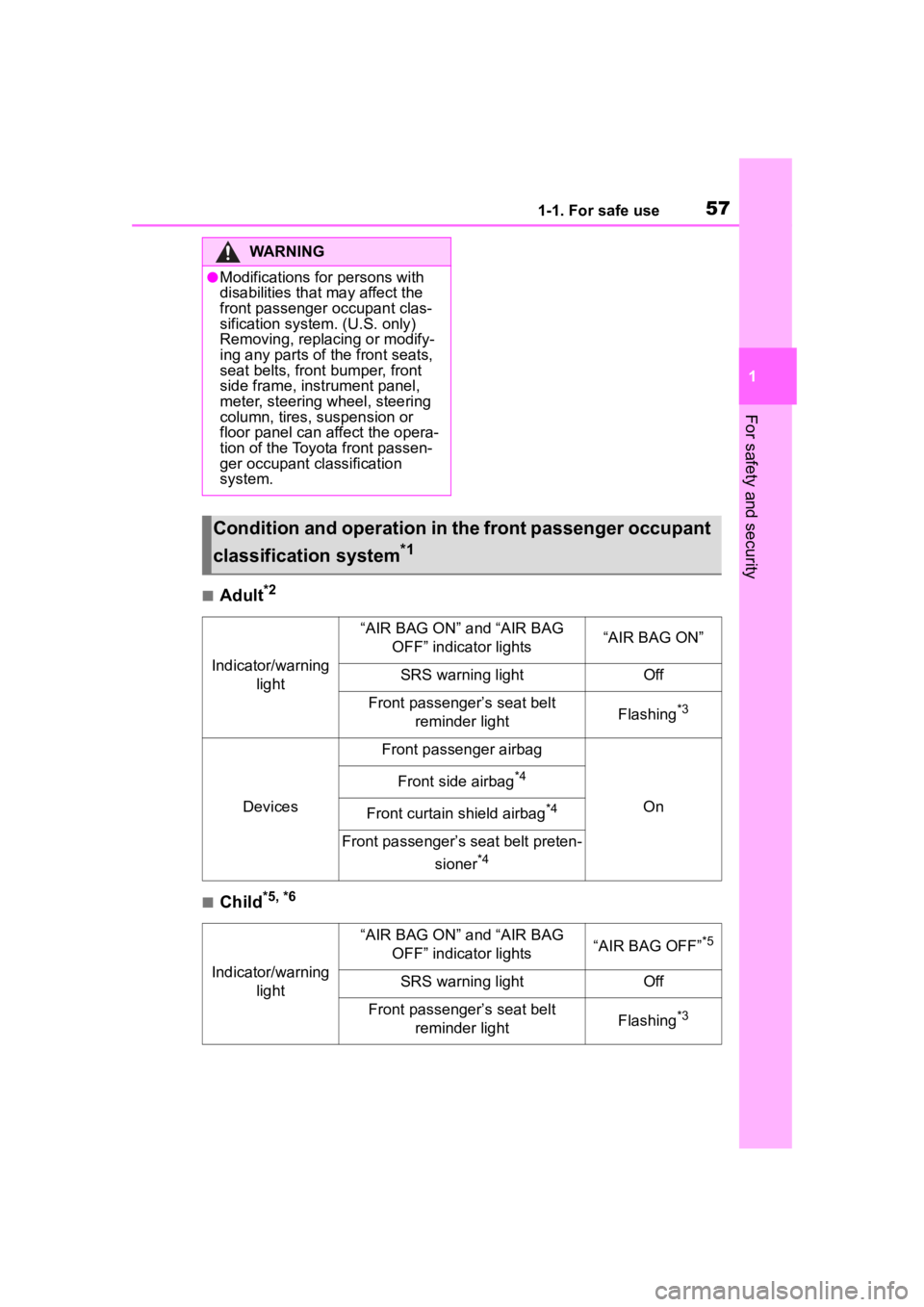
Condition and operation in the front passenger occupant
classification system
*1
Indicator/warning light
“AIR BAG ON” and “AIR BAG OFF” indicator lights“AIR BAG ON”
SRS warning lightOff
Front passenger’s seat belt reminder lightFlashing*3
Devices
Front passenger airbag
On
Front side airbag*4
Front curtain shield airbag*4
Front passenger’s seat belt preten-
sioner
*4
Indicator/warning light
“AIR BAG ON” and “AIR BAG OFF” indicator lights“AIR BAG OFF”*5
SRS warning lightOff
Front passenger’s seat belt reminder lightFlashing*3
Page 101 of 449

101
3
3
Before driving
Before driving
.3-1. Key informationKeys ............................ 102
3-2. Opening, closing and locking the doors and
trunk
Doors .......................... 105
Trunk ........................... 107
Smart key system ....... 111
3-3. Adjusting the seats Front seats .................. 119
Rear seats................... 121
Head restraints............ 123
3-4. Adjusting the steering wheel and mirrors
Steering wheel ............ 125
Inside rear view mirror .................................. 126
Outside rear view mirrors .................................. 127
3-5. Opening, closing the win- dows and moon roof
Power windows ........... 129
Page 125 of 449
1253-4. Adjusting the steering wheel and mirrors
3
Before driving
3-4.Adjusting the steering wheel and mirrors
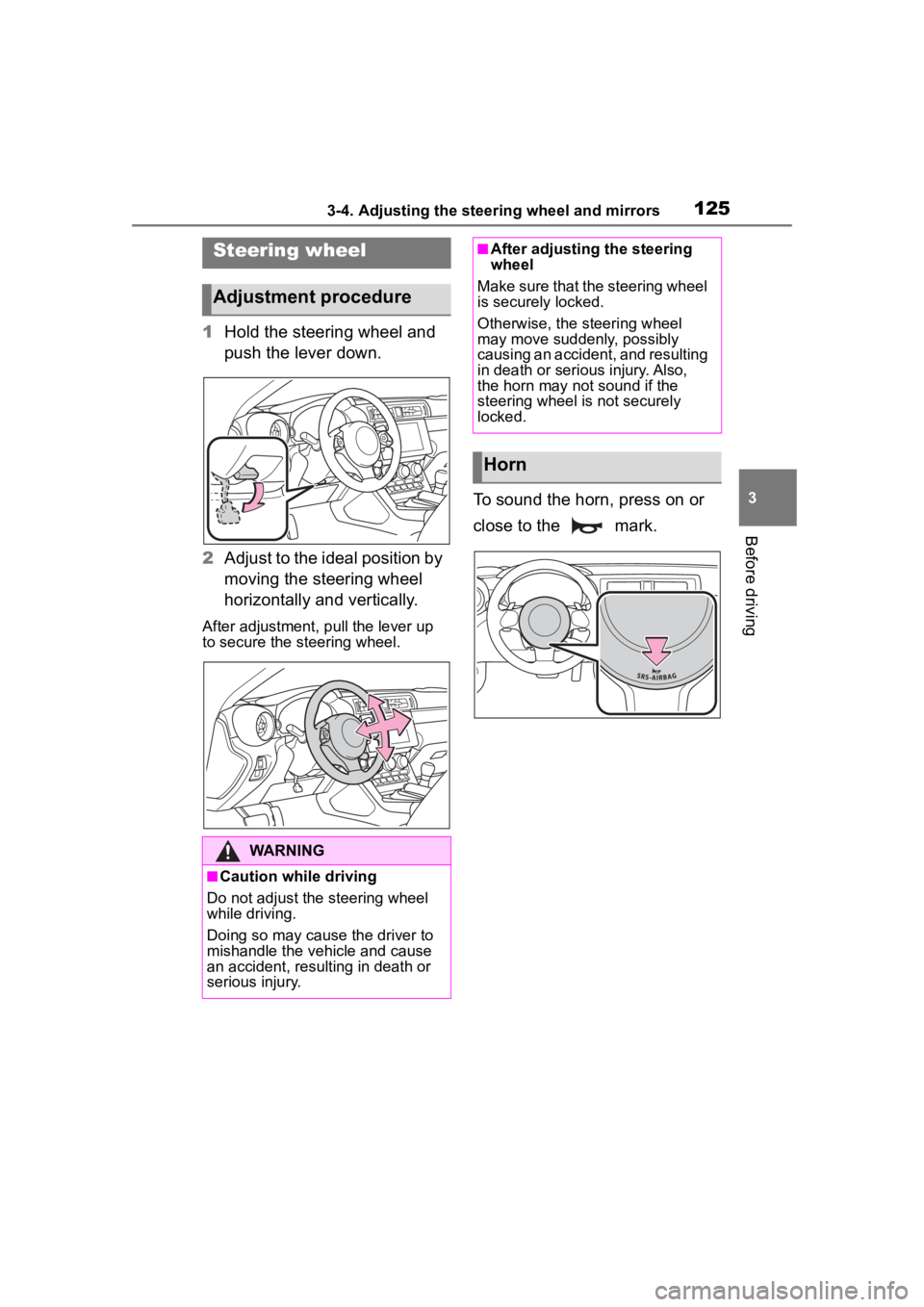
1Hold the steering wheel and
push the lever down.
2 Adjust to the ideal position by
moving the steering wheel
horizontally and vertically.
After adjustment, pull the lever up
to secure the steering wheel.
To sound the horn, press on or
close to the mark.
Steering wheel
Adjustment procedure
WARNING
■Caution while driving
Do not adjust the steering wheel
while driving.
Doing so may cause the driver to
mishandle the vehicle and cause
an accident, resul ting in death or
serious injury.
■After adjusting the steering
wheel
Make sure that the steering wheel
is securely locked.
Otherwise, the steering wheel
may move suddenly, possibly
causing an accident, and resulting
in death or serious injury. Also,
the horn may not sound if the
steering wheel is not securely
locked.
Horn
Page 126 of 449
1263-4. Adjusting the steering wheel and mirrors
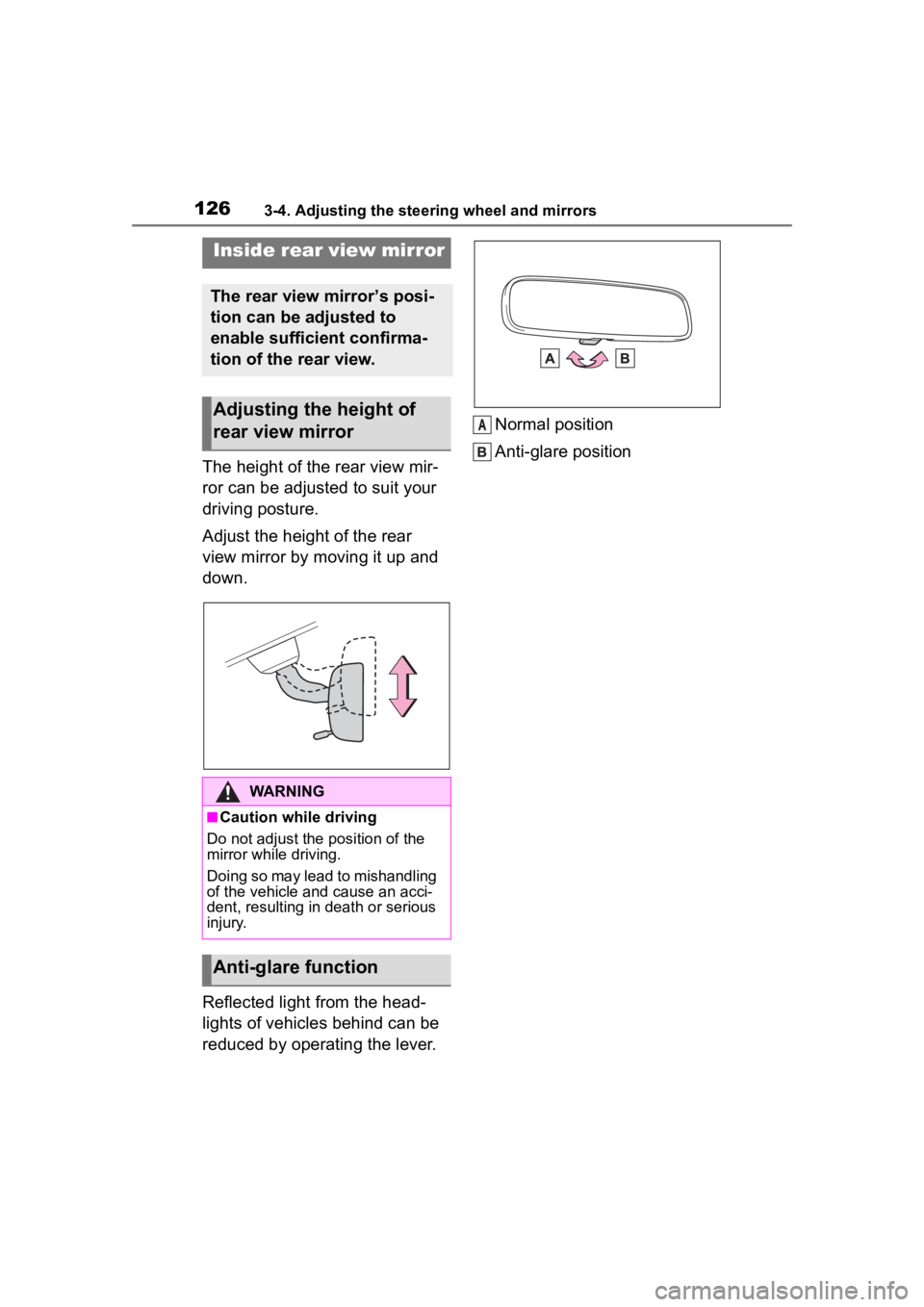
The height of the rear view mir-
ror can be adjusted to suit your
driving posture.
Adjust the height of the rear
view mirror by moving it up and
down.
Reflected light from the head-
lights of vehicles behind can be
reduced by operating the lever.Normal position
Anti-glare position
Inside rear view mirror
The rear view mirror’s posi-
tion can be adjusted to
enable sufficient confirma-
tion of the rear view.
Adjusting the height of
rear view mirror
WARNING
■Caution while driving
Do not adjust the position of the
mirror while driving.
Doing so may lead to mishandling
of the vehicle and cause an acci-
dent, resulting in death or serious
injury.
Anti-glare function
A
Page 127 of 449
1273-4. Adjusting the steering wheel and mirrors
3
Before driving
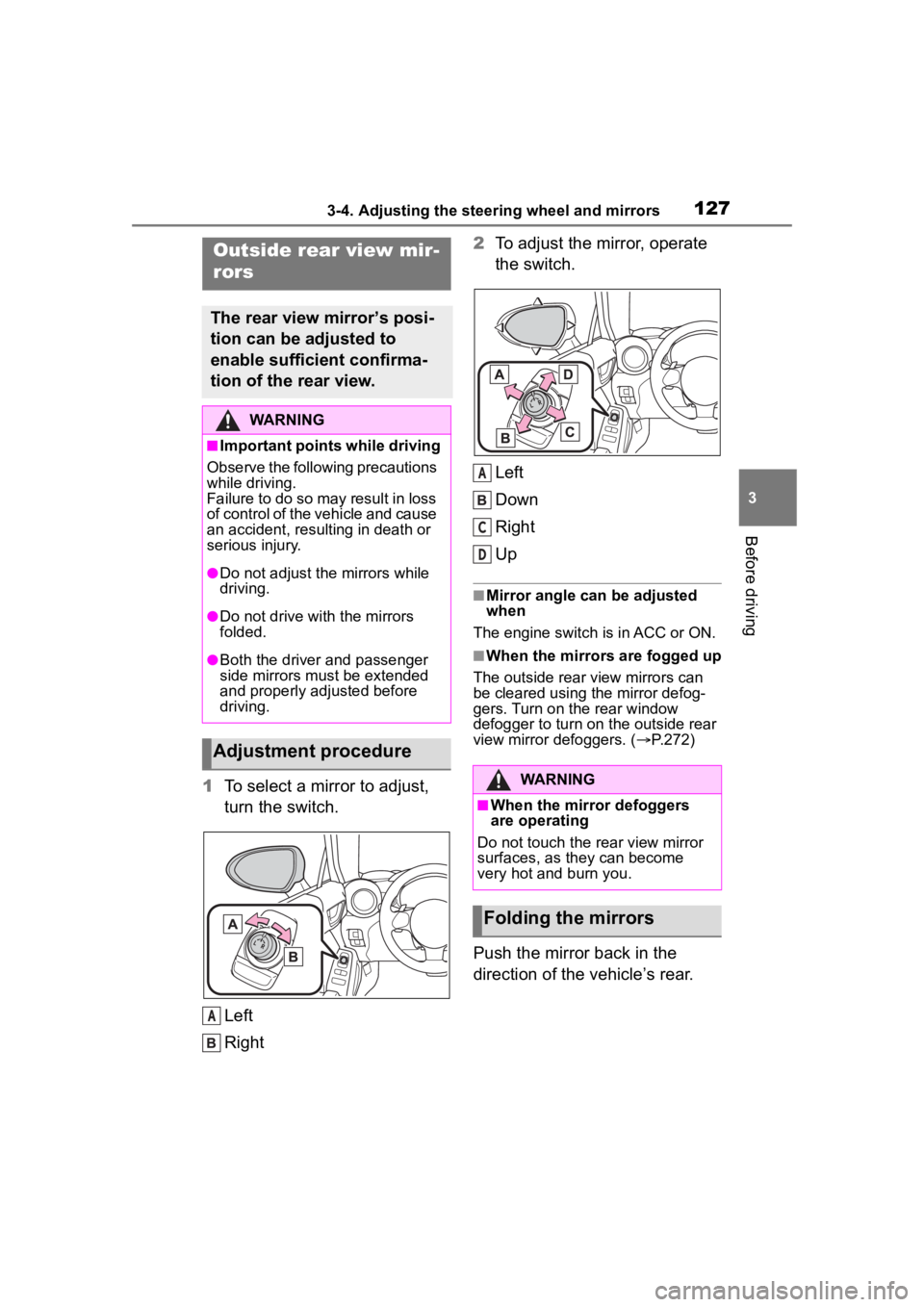
1To select a mirror to adjust,
turn the switch.
Left
Right 2
To adjust the mirror, operate
the switch.
Left
Down
Right
Up
■Mirror angle can be adjusted
when
The engine switch i s in ACC or ON.
■When the mirrors are fogged up
The outside rear view mirrors can
be cleared using the mirror defog-
gers. Turn on the rear window
defogger to turn on the outside rear
view mirror defoggers. ( P.272)
Push the mirror back in the
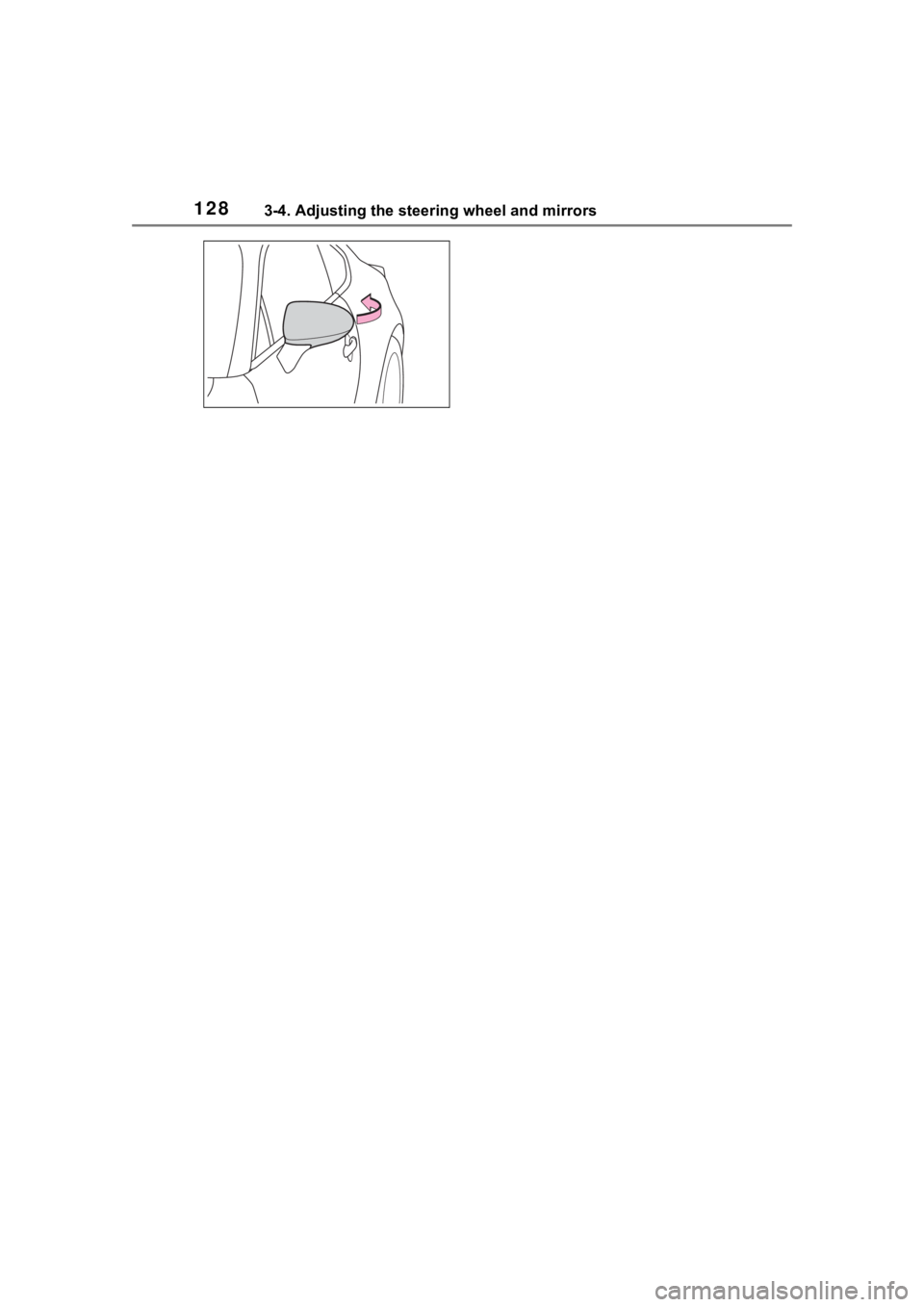
direction of the vehicle’s rear.
Outside rear view mir-
rors
The rear view mirror’s posi-
tion can be adjusted to
enable sufficient confirma-
tion of the rear view.
WARNING
■Important points while driving
Observe the following precautions
while driving.
Failure to do so may result in loss
of control of the vehicle and cause
an accident, resul ting in death or
serious injury.
●Do not adjust the mirrors while
driving.
●Do not drive with the mirrors
folded.
●Both the driver and passenger
side mirrors must be extended
and properly adjusted before
driving.
Adjustment procedure
A
WARNING
■When the mirror defoggers
are operating
Do not touch the rear view mirror
surfaces, as they can become
very hot and burn you.
Folding the mirrors
A
C
D
Page 128 of 449
1283-4. Adjusting the steering wheel and mirrors
Page 132 of 449
1324-1. Before driving
4-1.Before driving
■Starting the engine
P. 1 4 5
■Driving
Automatic transmission
1 With the brake pedal
depressed, shift the shift
lever to D. ( P.149)
2 Release the parking brake.
( P.156)
3 Gradually release the brake
pedal and gently depress the
accelerator pedal to acceler-
ate the vehicle.
Manual transmission
1 While depressing the clutch
pedal, shift the shift lever to
1. ( P.153)
2 Release the parking brake.
( P.156)
3 Gradually release the clutch
pedal. At the same time, gen-
tly depress the accelerator
pedal to accelerate the vehi-
cle.
■Stopping
Automatic transmission
1 With the shift lever in D,
depress the brake pedal. 2
If necessary, set the parking
brake.
If the vehicle is to be stopped for an
extended period of time, shift the
shift lever to P. ( P.149)
Manual transmission
1 While depressing the clutch
pedal, depress the brake
pedal.
2 If necessary, set the parking
brake.
If the vehicle is to be stopped for an
extended period of time, shift the
shift lever to N. ( P.153)
■Parking the vehicle
Automatic transmission
1 With the shift lever in D,
depress the brake pedal to
stop the vehicle completely.
2 Set the parking brake
( P.156), shift the shift lever
to P. ( P.149)
Check the parking brake indicator
is illuminated.
3 Press the engine switch to
stop the engine.
4 Slowly release the brake
pedal.
5 Lock the door, making sure
that you have the key on your
person.
If parking on a hill, block the wheels
as needed.
Manual transmission
1 While depressing the clutch
pedal, depress the brake
pedal to stop the vehicle
completely.
Driving the vehicle
The following procedures
should be observed to
ensure safe driving:
Driving procedure