warning TOYOTA 86 2022 Owner's Guide
[x] Cancel search | Manufacturer: TOYOTA, Model Year: 2022, Model line: 86, Model: TOYOTA 86 2022Pages: 449, PDF Size: 8.5 MB
Page 55 of 449

551-1. For safe use
1
For safety and security
The front passenger’s frontal airbag ON and OFF indicators show
you the status of the front passenger’s SRS frontal airbag. When the
engine switch is turned to ON, both the ON and OFF indicators illu-
minate while the system is checked, after which both indicators turn
off.
After that, one of the indicators illuminates depending on the status
of the front passenger’s SRS frontal airbag determined by the T oyota
advanced frontal airbag monitoring system.
SRS warning light
Front passenger’s seat belt reminder light
“AIR BAG OFF” indicator light
“AIR BAG ON” indicator light
Front passenger occupant classification system
Your vehicle is equipped with a front passenger occupant
classification system. This system detects the conditions of
the front passenger seat and activates or deactivates the front
passenger airbag.
System components
A
C
D
Page 56 of 449

561-1. For safe use
WARNING
■Front passenger occupant
classification system precau-
tions
Observe the following precautions
regarding the front passenger
occupant classification system.
Failure to do so may cause the
occupant classifi cation system to
not function correctly, resulting in
death or serious injury.
●Wear the seat belt properly.
●Do not apply excessive force to
the seat.
●Do not put sharp object(s) on
the seat or pierce the seat
upholstery.
●Do not put objects under the
front passenger seat.
●Do not use a seat accessory,
such as a cushion or seat cover,
that covers the seat cushion
surface.
●Do not spill liqui d on the front
passenger seat. If liquid is
spilled, wipe it off immediately
and dry the seat. If the SRS
warning light illumi nates, dry the
seat until the warning light turns
off. If the SRS warning light
stays on even when the seat
has dried, do not allow anyone
to sit on the front passenger
seat and have the system
checked by your Toyota dealer.
If the SRS warning light does
not illuminate, check that the
airbag ON/OFF indicator light
works properly. If the indicator
light does not work properly, do
not allow anyone to sit in the
front passenger’s seat and have
the system inspected by your
Toyota dealer.
●Do not remove or disassemble
the front passenger seat. Also,
do not replace or modify the
seat upholstery or foam inside
the seat.
●Do not install any accessory
(such as an audio amplifier)
other than a genuine Toyota
accessory under t he front pas-
senger’s seat.
●Do not place a magnetized
items near the seat belt buckle.
●Never install a rearward facing
child seat in the front passen-
ger’s seat even if the front pas-
senger’s SRS frontal airbag is
deactivated. Be sure to install it
in the rear seat in a correct
manner. Also, it is strongly rec-
ommended that any forward
facing child seat or booster seat
be installed in the rear seat, and
that even children who have
outgrown a child restraint sys-
tem be also seated in the rear
seat. This is because children
sitting in the front passenger’s
seat may be killed or severely
injured should the front passen-
ger’s SRS frontal airbag deploy.
Toyota believes that the rear
seats are the safest place for
children.
●If luggage or electronic devices
are placed on the front passen-
ger seat, the OFF indicator may
turn off and the ON indicator
may illuminate. If this occurs,
the front passenger’s airbag
may deploy during a collision. If
this is not desirable, remove the
luggage or electronic devices
from the front passenger seat.
Page 57 of 449
571-1. For safe use
1
For safety and security
■Adult*2
■Child*5, *6
WARNING
●Modifications for persons with
disabilities that may affect the
front passenger occupant clas-
sification system. (U.S. only)
Removing, replacing or modify-
ing any parts of the front seats,
seat belts, front bumper, front
side frame, instrument panel,
meter, steering wheel, steering
column, tires, suspension or
floor panel can affect the opera-
tion of the Toyota front passen-
ger occupant classification
system.
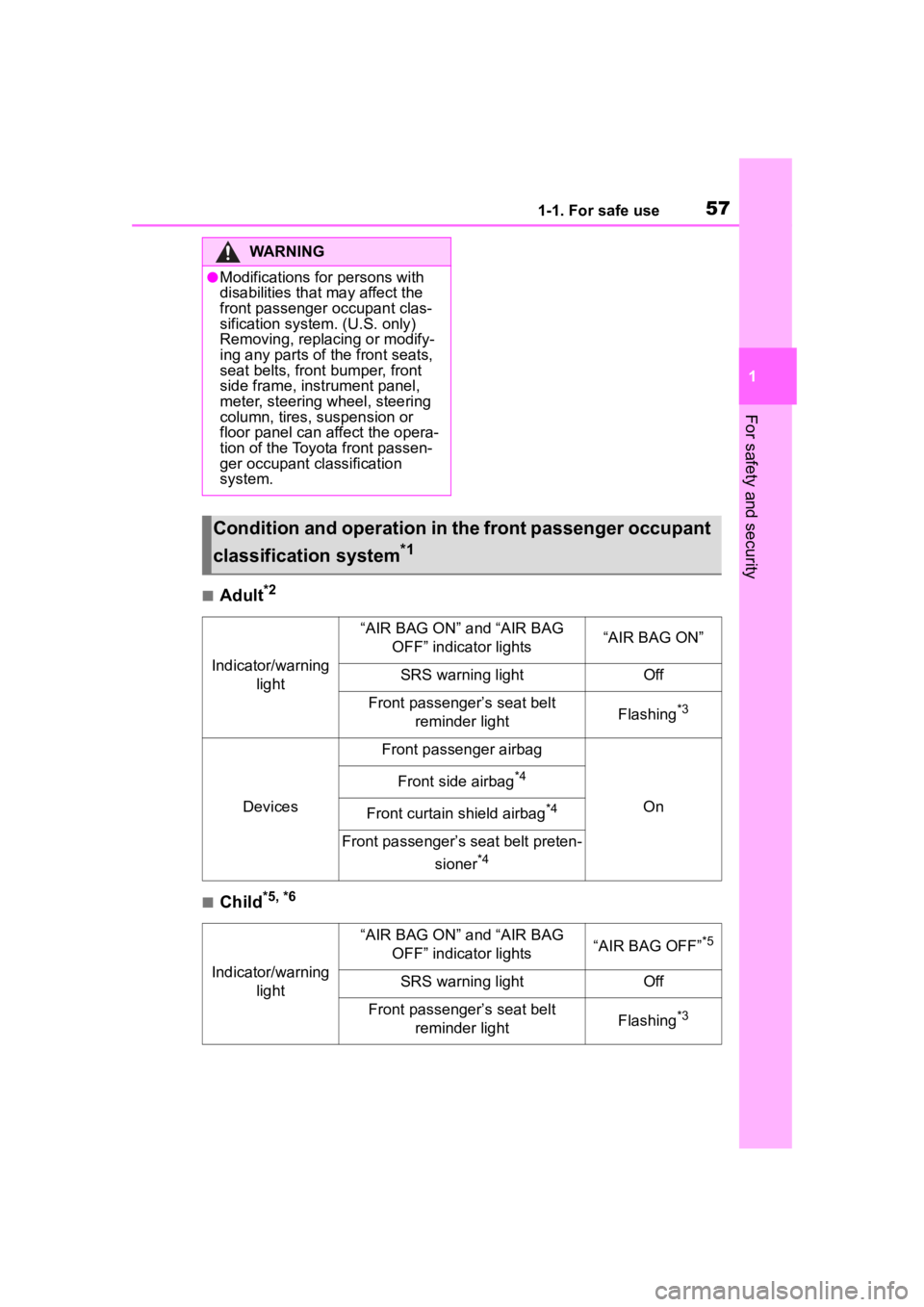
Condition and operation in the front passenger occupant
classification system
*1
Indicator/warning light
“AIR BAG ON” and “AIR BAG OFF” indicator lights“AIR BAG ON”
SRS warning lightOff
Front passenger’s seat belt reminder lightFlashing*3
Devices
Front passenger airbag
On
Front side airbag*4
Front curtain shield airbag*4
Front passenger’s seat belt preten-
sioner
*4
Indicator/warning light
“AIR BAG ON” and “AIR BAG OFF” indicator lights“AIR BAG OFF”*5
SRS warning lightOff
Front passenger’s seat belt reminder lightFlashing*3
Page 58 of 449
581-1. For safe use
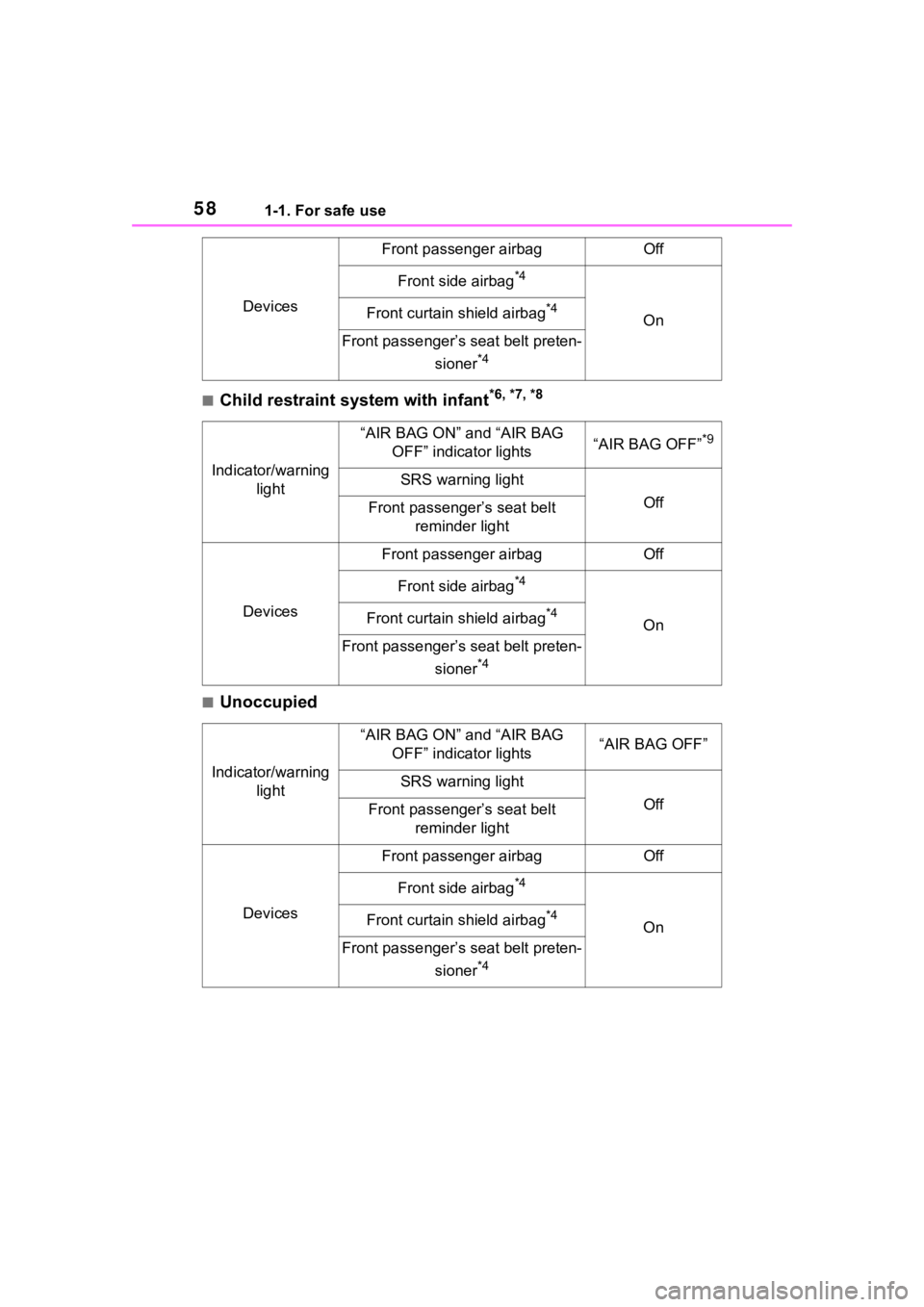
■Child restraint system with infant*6, *7, *8
■Unoccupied
Devices
Front passenger airbagOff
Front side airbag*4
OnFront curtain shield airbag*4
Front passenger’s seat belt preten-sioner
*4
Indicator/warning light
“AIR BAG ON” and “AIR BAG OFF” indicator lights“AIR BAG OFF”*9
SRS warning light
OffFront passenger’s seat belt reminder light
Devices
Front passenger airbagOff
Front side airbag*4
OnFront curtain shield airbag*4
Front passenger’s seat belt preten-
sioner
*4
Indicator/warning light
“AIR BAG ON” and “AIR BAG OFF” indicator lights“AIR BAG OFF”
SRS warning light
OffFront passenger’s seat belt reminder light
Devices
Front passenger airbagOff
Front side airbag*4
OnFront curtain shield airbag*4
Front passenger’s seat belt preten-
sioner
*4
Page 59 of 449
591-1. For safe use
1
For safety and security
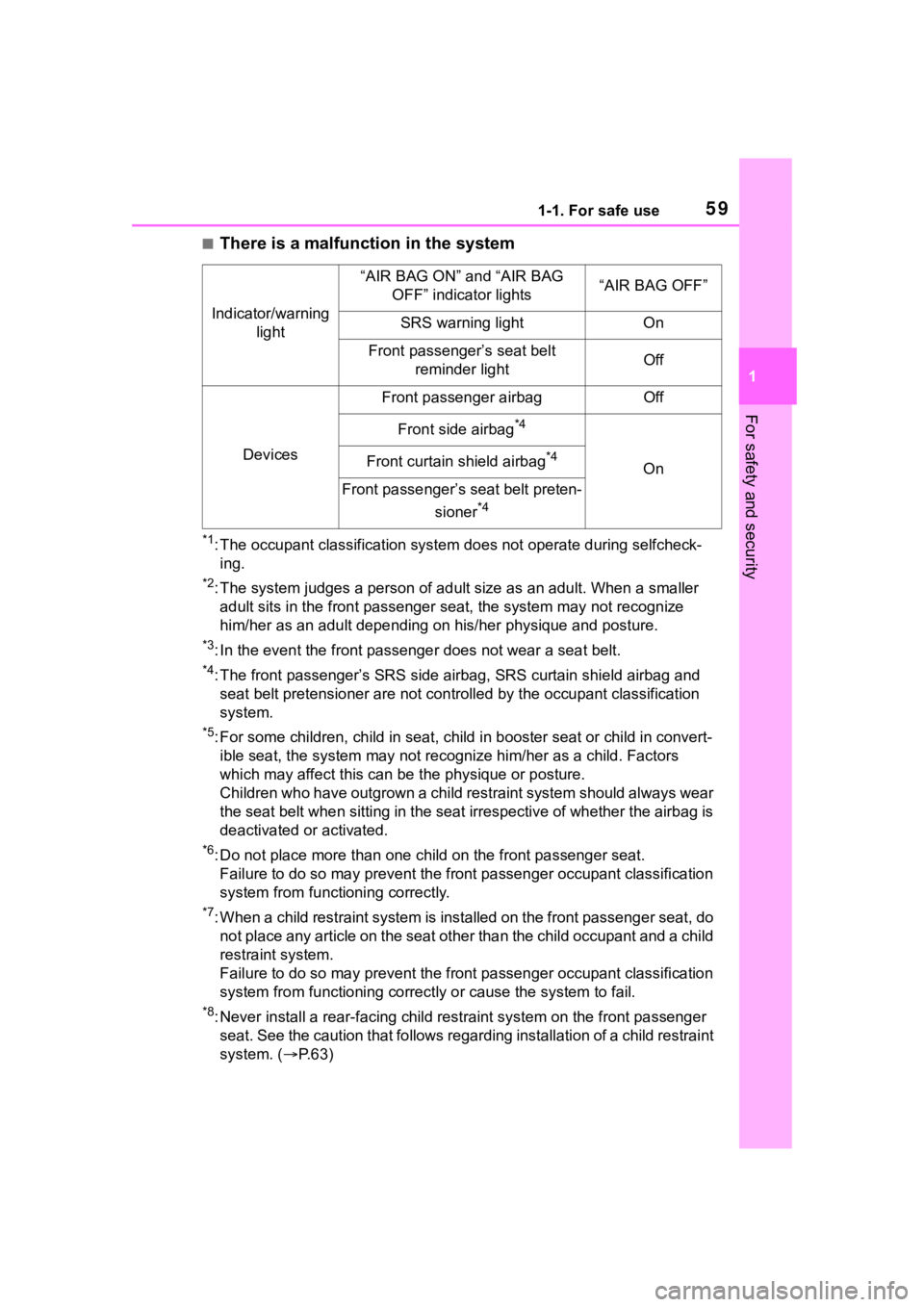
■There is a malfunction in the system
*1: The occupant classification system does not operate during selfcheck-
ing.
*2: The system judges a person of adult size as an adult. When a smaller
adult sits in the front passenger seat, the system may not recognize
him/her as an adult depending on his/her physique and posture.
*3: In the event the front passenge r does not wear a seat belt.
*4: The front passenger’s SRS side airbag, SRS curtain shield airbag and
seat belt pretensioner are not c ontrolled by the occupant classification
system.
*5: For some children, child in seat, child in booster seat or chi ld in convert-
ible seat, the system may not recognize him/her as a child. Fac tors
which may affect this can be the physique or posture.
Children who have outgrown a child restraint system should alwa ys wear
the seat belt when sitting in the seat irrespective of whether the airbag is
deactivated o r activated.
*6: Do not place more than one child on the front p assenger seat.
Failure to do so may prevent the front passenger occupant class ification
system from functioning correctly.
*7: When a child restraint system is installed on the front passen ger seat, do
not place any article on the seat other than the child occupant and a child
restraint system.
Failure to do so may prevent the front passenger occupant class ification
system from functioning correctly or cause the system to fail.
*8: Never install a rear-facing ch ild restraint system on the front passenger
seat. See the caution that follows regarding installation of a child restraint
system. ( P.63)
Indicator/warning
light
“AIR BAG ON” and “AIR BAG OFF” indicator lights“AIR BAG OFF”
SRS warning lightOn
Front passenger’s seat belt reminder lightOff
Devices
Front passenger airbagOff
Front side airbag*4
OnFront curtain shield airbag*4
Front passenger’s seat belt preten-
sioner
*4
Page 61 of 449

611-1. For safe use
1
For safety and security
Exhaust gas precau-
tions
Harmful substance to the
human body is included in
exhaust gases if inhaled.
WARNING
Exhaust gases include harmful
carbon monoxide (CO), which is
colorless and odorless. Observe
the following precautions.
Failure to do so may cause
exhaust gases enter the vehicle
and may lead to an accident
caused by light-headedness, or
may lead to death or a serious
health hazard.
■Important points while driving
●Keep the trunk lid closed.
●If you smell exhaust gases in
the vehicle even when the trunk
lid is closed, open the windows
and have the vehicle inspected
at your Toyota dealer as soon
as possible.
■When parking
●If the vehicle is in a poorly venti-
lated area or a closed area,
such as a garage, stop the
engine.
●Do not leave the vehicle with
the engine on for a long time.
If such a situation cannot be
avoided, park the vehicle in an
open space and ensure that
exhaust fumes do not enter the
vehicle interior.
●Do not leave the engine running
in an area with snow build-up,
or where it is snowing. If snow-
banks build up around the vehi-
cle while the engine is running,
exhaust gases may collect and
enter the vehicle.
■Exhaust pipe
The exhaust system needs to be
checked periodically. If there is a
hole or crack caused by corro-
sion, damage to a joint or abnor-
mal exhaust noise, be sure to
have the vehicle inspected and
repaired by your Toyota dealer.
Page 62 of 449

621-2. Child safety
1-2.Child safety
Riding with children
Observe the following pre-
cautions when children are
in the vehicle.
Use a child restraint system
appropriate for the child,
until the child becomes
large enough to properly
wear the vehicle’s seat belt.
It is recommended that chil-
dren sit in the rear seats to
avoid accidental contact
with the shift lever, wiper
switch, etc.
Use the window lock switch
to avoid children operating
the power window acciden-
tally. ( P.130)
Do not let small children
operate equipment which
may catch or pinch body
parts, such as the power
window, hood, trunk, seats
etc.
WARNING
■When children are in the vehi-
cle
Never leave children unattended
in the vehicle, and never allow
children to have or use the key.
Children may be able to start the
vehicle or shift the vehicle into
neutral. There is also a danger
that children ma y injure them-
selves by playing with the win-
dows or other features of the
vehicle. In addition, heat build-up
or extremely cold temperatures
inside the vehicle can be fatal to
children.
Page 63 of 449

631-2. Child safety
1
For safety and security
Points to remember: P.63
Child restraint system: P. 6 5
When using a child restraint sys-
tem: P. 6 5
Child restraint system installa-
tion method
• Fixed with a seat belt: P.66
• Fixed with child restraint LATCH anchors: P.70
• Using an anchor bracket (for top tether strap): P.72 The laws of all 50 states of the
U.S.A. as well as Canada now
require the use of child restraint
systems.
Prioritize and observe the
warnings, as well as the laws
and regulations for child
restraint systems.
Use a child restraint system
until the child becomes large
enough to properly wear the
vehicle’s seat belt.
Choose a child restraint sys-
tem that suits your vehicle
and is appropriate to the age
and size of the child.
Child restraint sys-
tems
Before installing a child
restraint system in the vehi-
cle, there are precautions
that need to be observed,
different types of child
restraint systems, as well as
installation methods, etc.,
written in this manual.
Use a child restraint system
when riding with a small
child that cannot properly
use a seat belt. For the
child’s safety, install the
child restraint system to a
rear seat. Be sure to follow
the installation method that
is in the operation manual
enclosed with the restraint
system.
Table of contents
Points to remember
WARNING
■When a child is riding
Observe the following precau-
tions.
Failure to do so may result in
death or serious injury.
●For effective protection in auto-
mobile accidents and sudden
stops, a child must be properly
restrained, using a seat belt or
child restraint system which is
correctly installe d. For installa-
tion details, refer to the opera-
tion manual enclosed with the
child restraint system. General
installation instruction is pro-
vided in this manual.
Page 64 of 449

641-2. Child safety
WARNING
●Toyota strongly urges the use of
a proper child restraint system
that conforms to the weight and
size of the child, installed on the
rear seat. According to accident
statistics, the child is safer when
properly restrained in the rear
seat than in the front seat.
●Holding a child in your or some-
one else’s arms is not a substi-
tute for a child restraint system.
In an accident, the child can be
crushed against the windshield
or between the holder and the
interior of the vehicle.
■Handling the child restraint
system
If the child restraint system is not
properly fixed in place, the child or
other passengers may be seri-
ously injured or even killed in the
event of sudden braking, sudden
swerving, or an accident.
●If the vehicle were to receive a
strong impact from an accident,
etc., it is possib le that the child
restraint system has damage
that is not readily visible. In
such cases, do not reuse the
restraint system.
●Make sure you have complied
with all installation instructions
provided with the child restraint
system manufacturer and that
the system is properly secured.
●Keep the child restraint system
properly secured on the seat
even if it is not in use. Do not
store the child restraint system
unsecured in the passenger
compartment.
●If it is necessa ry to detach the
child restraint system, remove it
from the vehicle or store it
securely in the trunk.
Page 66 of 449

661-2. Child safety
A child restraint system for a
small child or baby must itself be
properly restrained on the seat
with the lap portion of the
lap/shoulder belt.
■Installing child restraint
system using a seat belt
(child restraint lock func-
tion belt)
Install the child restraint system
in accordance to the operation
manual enclosed with the child
restraint system.
WARNING
■When installing a child
restraint system
Observe the following precau-
tions.
Failure to do so m ay result in
death or serious injury.
●Never use a child restraint sys-
tem on the front passenger
seat.
The force of the rapid inflation of
the front passenger airbag can
cause death or serious injury to
children in the event of an acci-
dent.
●Do not allow the child to lean
his/her head or any part of
his/her body against the door or
the area of the seat, front pillars
or roof side rails from which the
SRS side airbags or SRS cur-
tain shield airbags deploy even
if the child is seated in the child
restraint system. It is dangerous
if the SRS side and curtain
shield airbags inflate, and the
impact could cause death or
serious injury to the child.
●When a booster seat is
installed, always ensure that the
shoulder belt is positioned
across the center of the child’s
shoulder. The belt should be
kept away from the child’s neck,
but not so that it could fall off the
child’s shoulder.
●Use child restraint system suit-
able to the age and size of the
child and install it to the rear
seat.
●If the driver’s seat interferes
with the child restraint system
and prevents it from being
attached correct ly, attach the
child restraint system to the
right-hand rear seat.
●Adjust the front passenger seat
so that it does not interfere with
the child restraint system.
Child restraint system
fixed with a seat belt