fuel TOYOTA 86 2022 Owners Manual
[x] Cancel search | Manufacturer: TOYOTA, Model Year: 2022, Model line: 86, Model: TOYOTA 86 2022Pages: 449, PDF Size: 8.5 MB
Page 1 of 449
GR 86_U
1
2
3
4
5
6
7
8
9
9
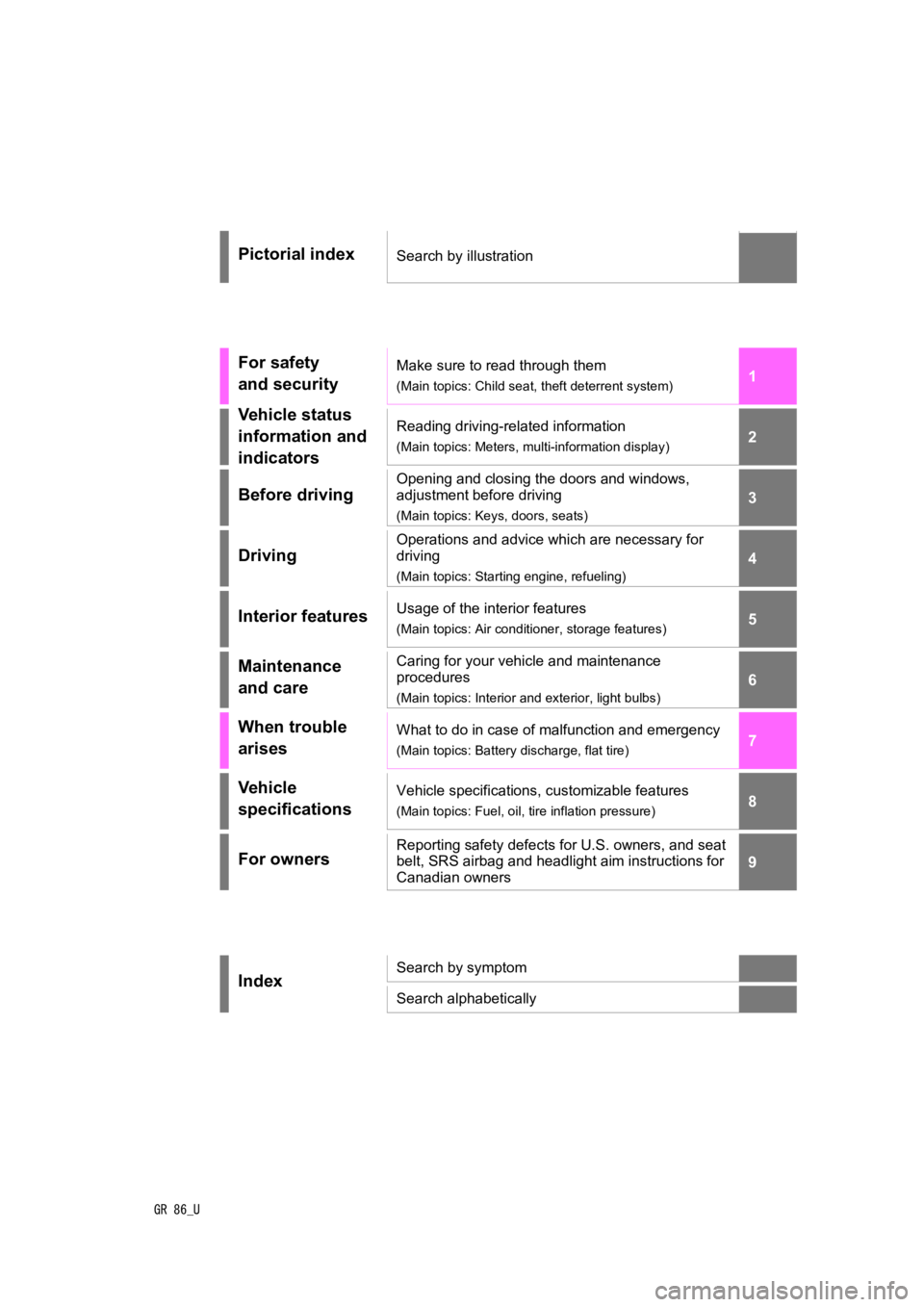
Pictorial indexSearch by illustration
For safety
and securityMake sure to read through them
(Main topics: Child seat, theft deterrent system)
Vehicle status
information and
indicatorsReading driving-related information
(Main topics: Meters, multi-information display)
Before driving
Opening and closing the doors and windows,
adjustment before driving
(Main topics: Keys, doors, seats)
Driving
Operations and advice which are necessary for
driving
(Main topics: Starting engine, refueling)
Interior featuresUsage of the interior features
(Main topics: Air conditioner, storage features)
Maintenance
and careCaring for your vehicle and maintenance
procedures
(Main topics: Interior and exterior, light bulbs)
When trouble
arisesWhat to do in case of malfunction and emergency
(Main topics: Battery discharge, flat tire)
Vehicle
specificationsVehicle specifications, customizable features
(Main topics: Fuel, oil, tire inflation pressure)
For ownersReporting safety defects for U.S. owners, and seat
belt, SRS airbag and headlight aim instructions for
Canadian owners
IndexSearch by symptom
Search alphabetically
Page 2 of 449
2TABLE OF CONTENTS
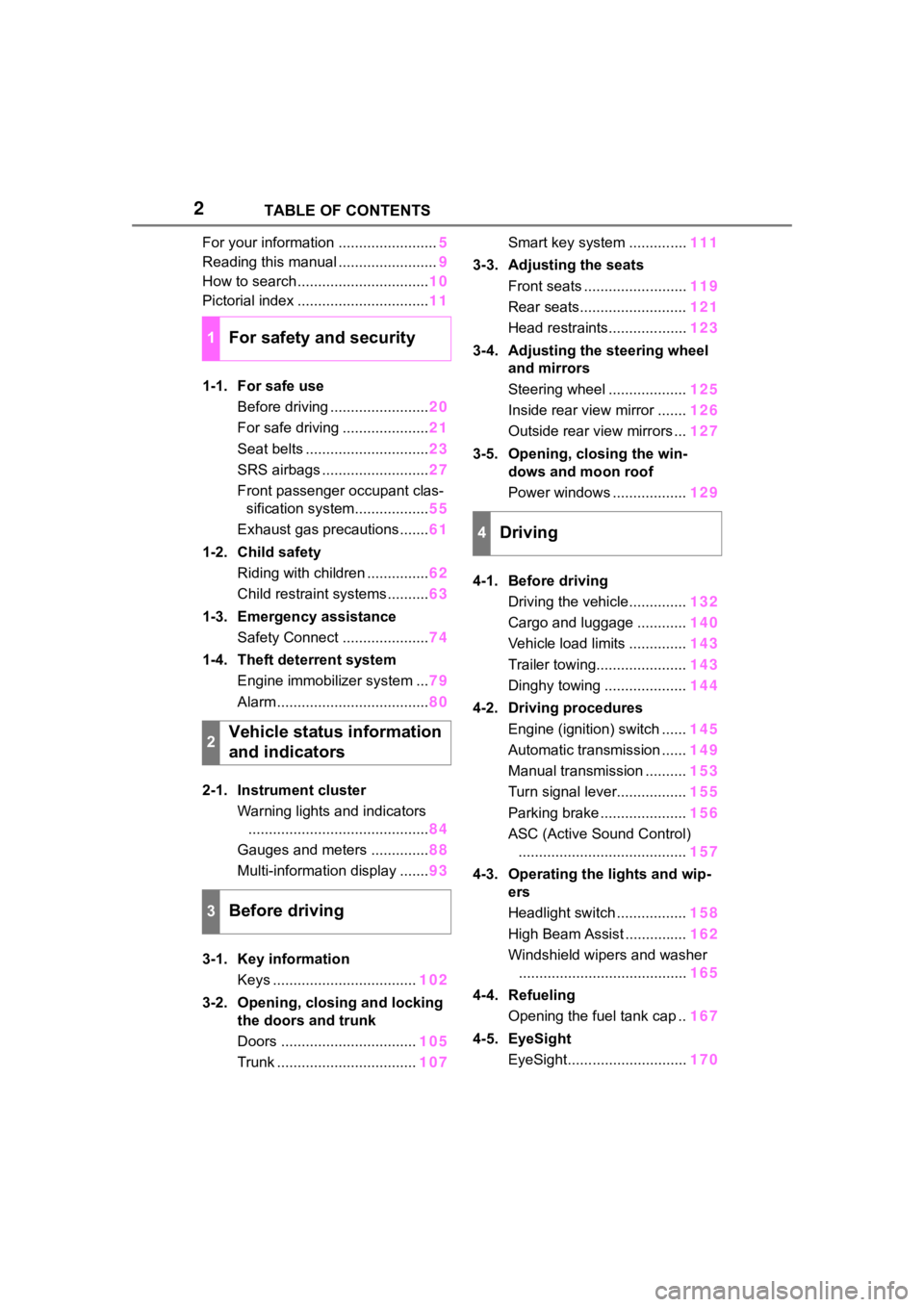
For your information ........................5
Reading this manual ........................ 9
How to search ................................ 10
Pictorial index ................................ 11
1-1. For safe use Before driving ........................ 20
For safe driving ..................... 21
Seat belts .............................. 23
SRS airbags .......................... 27
Front passenger occupant clas- sification system.................. 55
Exhaust gas precautions....... 61
1-2. Child safety Riding with children ............... 62
Child restraint systems .......... 63
1-3. Emergency assistance Safety Connect ..................... 74
1-4. Theft deterrent system Engine immobilizer system ... 79
Alarm ..................................... 80
2-1. Instrument cluster Warning lights and indicators............................................ 84
Gauges and meters .............. 88
Multi-information display ....... 93
3-1. Key information Keys ................................... 102
3-2. Opening, closing and locking the doors and trunk
Doors ................................. 105
Trunk .................................. 107Smart key system ..............
111
3-3. Adjusting the seats Front seats ......................... 119
Rear seats.......................... 121
Head restraints................... 123
3-4. Adjusting the steering wheel and mirrors
Steering wheel ................... 125
Inside rear view mirror ....... 126
Outside rear view mirrors ... 127
3-5. Opening, closing the win- dows and moon roof
Power windows .................. 129
4-1. Before driving Driving the vehicle.............. 132
Cargo and luggage ............ 140
Vehicle load limits .............. 143
Trailer towing...................... 143
Dinghy towing .................... 144
4-2. Driving procedures Engine (ignition) switch ...... 145
Automatic transmission ...... 149
Manual transmission .......... 153
Turn signal lever................. 155
Parking brake ..................... 156
ASC (Active Sound Control) ......................................... 157
4-3. Operating the lights and wip- ers
Headlight switch ................. 158
High Beam Assi
st ............... 162
Windshield wipers and washer ......................................... 165
4-4. Refueling Opening the fuel tank cap .. 167
4-5. EyeSight EyeSight............................. 170
1For safety and security
2Vehicle status information
and indicators
3Before driving
4Driving
Page 4 of 449
4TABLE OF CONTENTS
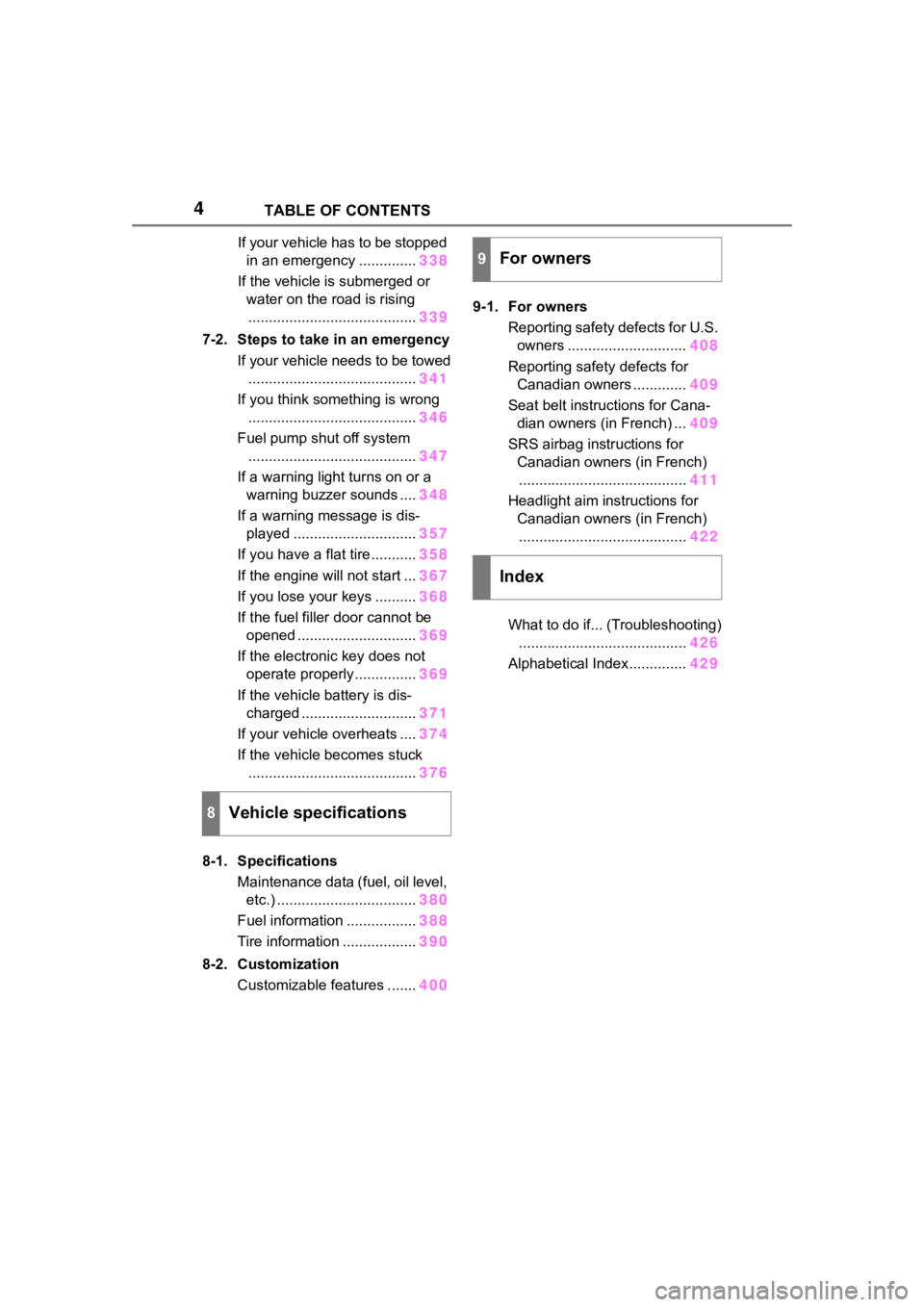
If your vehicle has to be stopped in an emergency .............. 338
If the vehicle is submerged or water on the road is rising......................................... 339
7-2. Steps to take in an emergency If your vehicle needs to be towed......................................... 341
If you think something is wrong ......................................... 346
Fuel pump shut off system ......................................... 347
If a warning light turns on or a warning buzzer sounds .... 348
If a warning message is dis- played .............................. 357
If you have a flat tire ........... 358
If the engine will not start ... 367
If you lose your keys .......... 368
If the fuel filler door cannot be opened ............................. 369
If the electronic key does not operate properly ............... 369
If the vehicle battery is dis- charged ............................ 371
If your vehicle overheats .... 374
If the vehicle becomes stuck ......................................... 376
8-1. Specifications Maintenance data (fuel, oil level, etc.) .................................. 380
Fuel information ................. 388
Tire information .................. 390
8-2. Customization Customizable features ....... 4009-1. For owners
Reporting safety defects for U.S. owners ............................. 408
Reporting safety defects for Canadian owners ............. 409
Seat belt instructions for Cana- dian owners (in French) ... 409
SRS airbag instructions for Canadian owners (in French)
......................................... 411
Headlight aim instructions for Canadian owners (in French)......................................... 422
What to do if... (Troubleshooting) ......................................... 426
Alphabetical Index.............. 429
8Vehicle specifications
9For owners
Index
Page 5 of 449
5
Please note that this manual
applies to all models and
explains all equipment, including
options. Therefore, you may find
explanations for equipment not
installed on your vehicle and the
illustrations used may differ from
your vehicle.
All specifications provided in this
manual are current at the time of
printing. Over time, your vehicle
may receive updates that modify
the vehicle and make material in
this manual incomplete and/or
inaccurate. Because of Toyota’s
interest in continual product
improvement, Toyota reserves
the right to make changes to this
manual at any time without
notice.
If Toyota chooses to update the
manual, updated versions can
be viewed by selecting your
vehicle by model and year at the
following URL or on your mobile
device if you have access to the
Toyota app.
www.toyota.com/owners
Approximately five hours after
the engine is turned off, you
may hear sound coming from under the vehicle for several
minutes. This is the sound of a
fuel evaporation leakage check
and, it does not indicate a mal-
function.
A wide variety of non-genuine
spare parts and accessories for
Toyota vehicles are currently
available in the market. You
should know that Toyota does
not warrant these products and
is not responsible for their per-
formance, repair, or replace-
ment, or for any damage they
may cause to, or adverse effect
they may have on, your Toyota
vehicle.
This vehicle should not be modi-
fied with non-genuine Toyota
products. Modification with
non-genuine Toyota products
could affect its performance,
safety or durability, and may
even violate governmental regu-
lations. In addition, damage or
performance problems resulting
from the modification may not
be covered under warranty.
The installation of a mobile
two-way radio system in your
vehicle could affect electronic
For your information
Main Owner’s Manual
Noise from under vehicle
after turning off the engine
Accessories, spare parts
and modification of your
To y o t a
Installation of a mobile
two-way radio system
Page 6 of 449
6
systems such as:
Multiport fuel injection sys-
tem/sequential multiport fuel
injection system
EyeSight system
Cruise control system
Anti-lock brake system
Vehicle dynamics integrated
management
SRS airbag system
Seat belt pretensioner system
Be sure to check with your Toy-
ota dealer for precautionary
measures or special instructions
regarding installation of a mobile
two-way radio system.
The vehicle is equipped with
sophisticated computers that will
record certain data, such as:
• Engine speed / Electric motor speed (traction motor speed)
• Accelerator status
• Brake status
• Vehicle speed
• Operation status of the driving assist systems
• Images from the cameras
Your vehicle is equipped with cam-
eras. Contact your Toyota dealer for
the location of re cording cameras.
The recorded data varies
according to the vehicle grade
level and options with which it is
equipped. These computers do not record
conversations or sounds, and
only record images outside of
the vehicle in certain situations.
Data Transmission
Your vehicle may transmit the data
recorded in these computers to
Toyota and third parties contracted
by Toyota without notification to
you.
Data usage
Toyota and third parties contracted
by Toyota may use the data
recorded in this c omputer to diag-
nose malfunctions, conduct
research and development, and
improve quality.
Toyota and third parties contracted
by Toyota will not disclose the
recorded data to a third party
except:
• With the consen t of the vehicle
owner or with the consent of the
lessee if the vehicle is leased
• In response to an official request by the police, a court of law or a
government agency
• For use by Toyota in a lawsuit
• For research purposes where the data is not tied to a specific vehi-
cle or vehicle owner
To learn more about the vehi-
cle data collected, used and
shared by Toyota, please visit
www.toyota.com/privacyvts/
.
Vehicle data recording
Page 11 of 449
11Pictorial index
Pictorial index
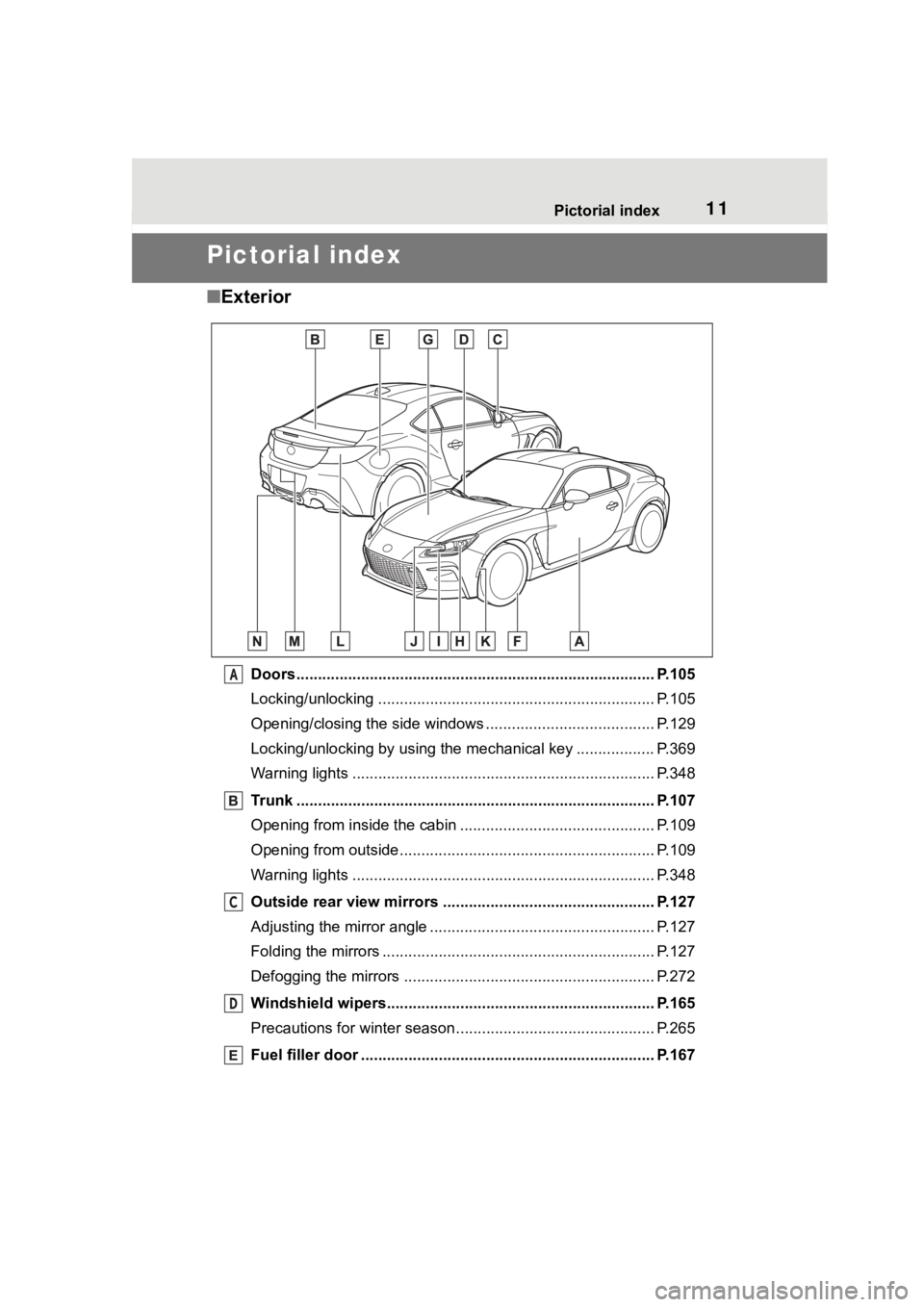
■Exterior
Doors.......................................................... ......................... P.105
Locking/unlocking .............................................. .................. P.105
Opening/closing the side windows ............................... ........ P.129
Locking/unlocking by using the mechanical key .................. P. 3 6 9
Warning lights ................................................. ..................... P.348
Trunk ................................................................................... P.107
Opening from inside the cabin .................................. ........... P.109
Opening from outside........................................... ................ P.109
Warning lights ................................................. ..................... P.348
Outside rear view mirrors ................................................. P.127
Adjusting the mirror angle ..................................... ............... P.127
Folding the mirrors ............................................ ................... P.127
Defogging the mirrors .......................................... ................ P.272
Windshield wipers.............................................. ................ P.165
Precautions for winter seas on.............................................. P.265
Fuel filler door ............................................... ..................... P.167A
C
D
Page 12 of 449
12Pictorial index
Refueling method ................................................................. P.167
Fuel type/fuel tan k capacity ................................... .............. P.381
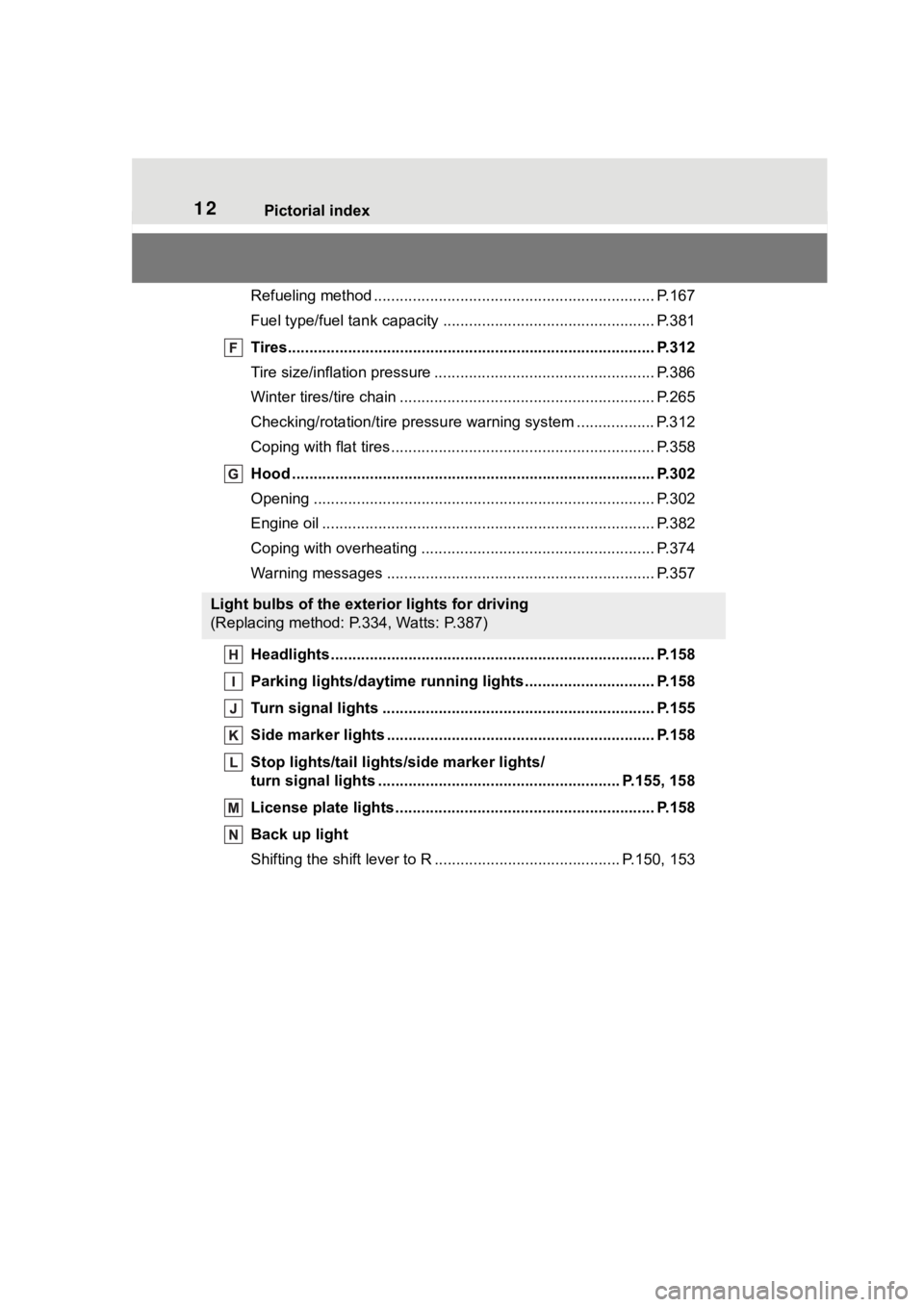
Tires.......................................................... ........................... P.312
Tire size/inflation pressure ................................... ................ P.386
Winter tires/tire chain ........................................ ................... P.265
Checking/rotation/tire pressur e warning system ..................P.312
Coping with flat tires......................................... .................... P.358
Hood ........................................................... ......................... P.302
Opening ............................................................................... P.302
Engine oil ..................................................... ........................ P.382
Coping with overheating ...................................................... P.374
Warning messages ............................................... ............... P.357
Headlights..................................................... ...................... P.158
Parking lights/dayt ime running lights .......................... .... P.158
Turn signal lights ............................................. .................. P.155
Side marker lights ............................................. ................. P.158
Stop lights/tail light s/side marker lights/
turn signal lights ........................................................ P.155, 158
License plate lights........................................... ................. P.158
Back up light
Shifting the shift lever to R ........................................... P.150, 153
Light bulbs of the exterior lights for driving
(Replacing method: P.334, Watts: P.387)
Page 30 of 449
301-1. For safe use
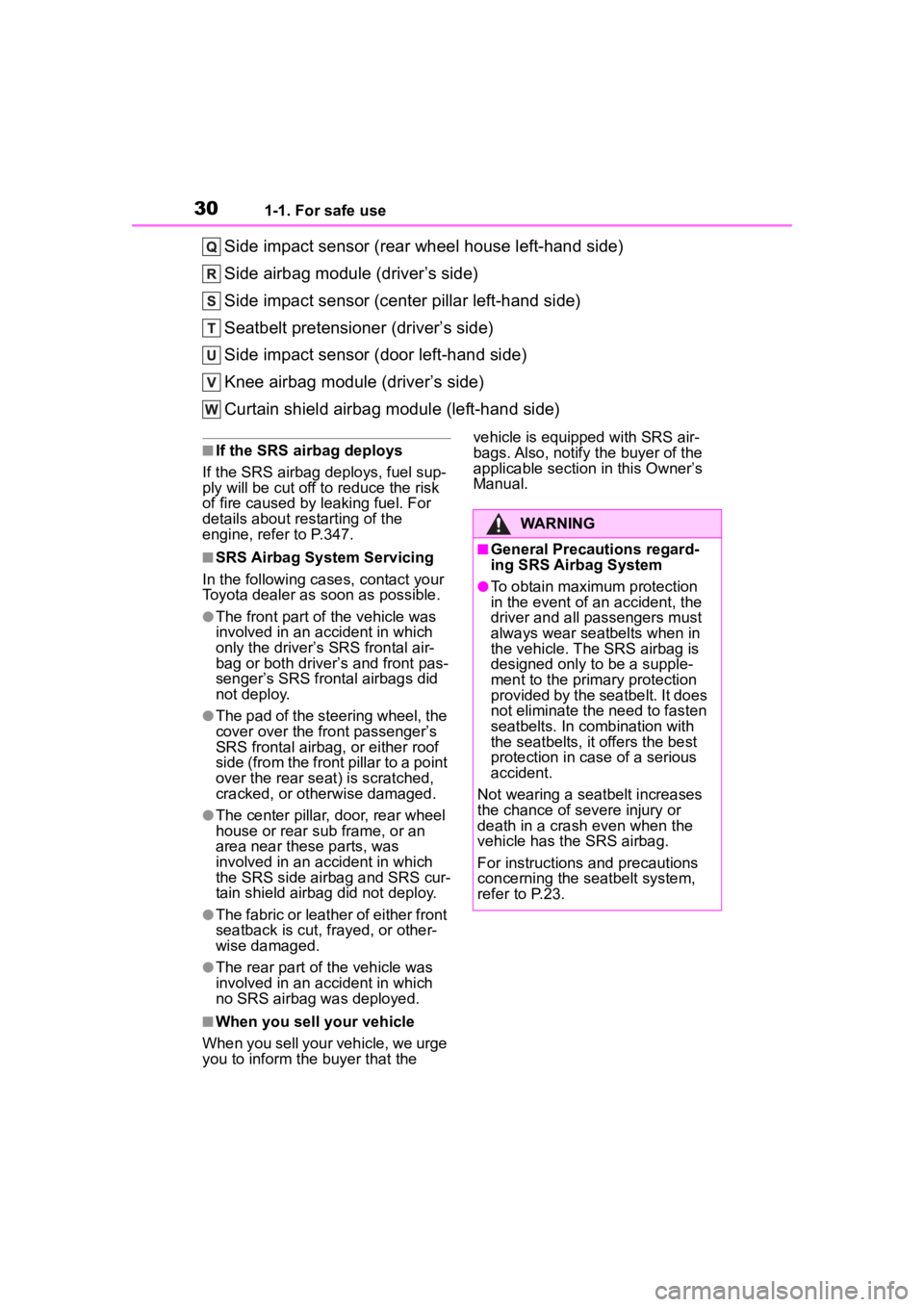
Side impact sensor (rear wheel house left-hand side)
Side airbag module (driver’s side)
Side impact sensor (center pillar left-hand side)
Seatbelt pretensioner (driver’s side)
Side impact sensor (door left-hand side)
Knee airbag module (driver’s side)
Curtain shield airbag module (left-hand side)
■If the SRS airbag deploys
If the SRS airbag deploys, fuel sup-
ply will be cut off to reduce the risk
of fire caused by leaking fuel. For
details about restarting of the
engine, refer to P.347.
■SRS Airbag System Servicing
In the following cases, contact your
Toyota dealer as soon as possible.
●The front part of the vehicle was
involved in an accident in which
only the driver’s SRS frontal air-
bag or both driver’s and front pas-
senger’s SRS frontal airbags did
not deploy.
●The pad of the steering wheel, the
cover over the front passenger’s
SRS frontal airbag, or either roof
side (from the front pillar to a point
over the rear seat) is scratched,
cracked, or otherwise damaged.
●The center pillar, door, rear wheel
house or rear sub frame, or an
area near these parts, was
involved in an accident in which
the SRS side air bag and SRS cur-
tain shield airbag did not deploy.
●The fabric or leather of either front
seatback is cut, frayed, or other-
wise damaged.
●The rear part of the vehicle was
involved in an accident in which
no SRS airbag was deployed.
■When you sell your vehicle
When you sell your vehicle, we urge
you to inform the buyer that the vehicle is equipped with SRS air-
bags. Also, notify the buyer of the
applicable section in this Owner’s
Manual.
WARNING
■General Precautions regard-
ing SRS Airbag System
●To obtain maximum protection
in the event of an accident, the
driver and all passengers must
always wear seatbelts when in
the vehicle. The SRS airbag is
designed only to be a supple-
ment to the primary protection
provided by the seatbelt. It does
not eliminate the need to fasten
seatbelts. In combination with
the seatbelts, it offers the best
protection in case of a serious
accident.
Not wearing a seat belt increases
the chance of severe injury or
death in a crash even when the
vehicle has the SRS airbag.
For instructions and precautions
concerning the seatbelt system,
refer to P.23.
Page 77 of 449
771-3. Emergency assistance
1
For safety and security
connection screen on the multime-
dia system screen to cancel the
connection to a response-center
agent.
■Enhanced Roadside Assis-
tance (“i” button)
Enhanced Roadside Assistance
adds GPS data to the already
included warranty-based Toyota
roadside service.
Subscribers can press the “i”
button on the interior lights to
contact a Roadside Assistance
provider, who can help with a
wide range of needs, such as:
towing, flat tire, fuel delivery, etc.
For a description of the
Enhanced Roadside Assistance
services and their limitations,
please see the Safety Connect
Terms and Conditions, which
are available at Toyota.com in
the United States and Toyota.ca
in Canada.
If the “i” button on the interior
lights is pressed unintentionally,
press and hold the “i” button for
approximately 2 seconds or
more or operate the connection
screen on the multimedia sys-
tem screen to cancel the con-
nection to a roadside assistance
provider.
Important! Read this informa-
tion before using Safety Con- nect.
■Exposure to radio fre-
quency signals
The Safety Connect system
installed in your vehicle is a
low-power radio transmitter and
receiver. It receives and also
sends out radio frequency (RF)
signals.
In August 1996, the Federal
Communications Commission
(FCC) adopted RF exposure
guidelines with safety levels for
mobile wireless phones. Those
guidelines are consistent with
the safety standards previously
set by the following U.S. and
international standards bodies.
ANSI (American National
Standards Institute) C95.1
[1992]
NCRP (National Council on
Radiation Protection and
Measurement) Report 86
[1986]
ICNIRP (International Com-
mission on Non-Ionizing Radi-
ation Protection) [1996]
Those standards were based on
comprehensive and periodic
evaluations of the relevant sci-
entific literature. Over 120 scien-
tists, engineers, and physicians
from universities, and govern-
ment health agencies and
industries reviewed the avail-
able body of research to
develop the ANSI Standard
Safety information for
Safety Connect
Page 85 of 449
852-1. Instrument cluster
2
Vehicle status information and indicators
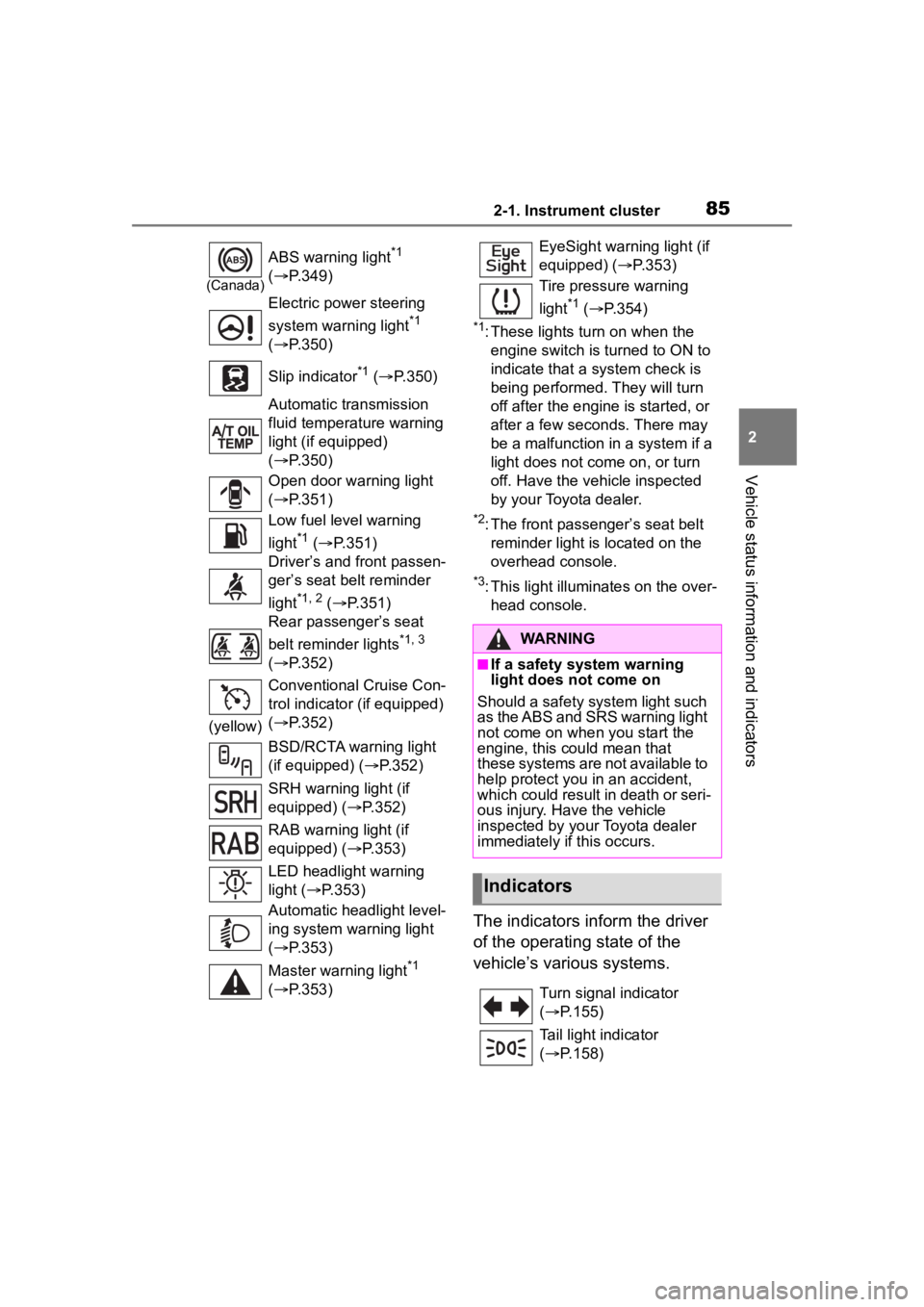
*1: These lights turn on when the
engine switch is turned to ON to
indicate that a system check is
being performed. They will turn
off after the engine is started, or
after a few seconds. There may
be a malfunction in a system if a
light does not come on, or turn
off. Have the vehicle inspected
by your Toyota dealer.
*2: The front passenger’s seat belt reminder light is located on the
overhead console.
*3: This light illuminates on the over-head console.
The indicators inform the driver
of the operating state of the
vehicle’s various systems.
(Canada)
ABS warning light*1
( P.349)
Electric power steering
system warning light
*1
( P.350)
Slip indicator
*1 ( P.350)
Automatic transmission
fluid temperature warning
light (if equipped)
( P.350)
Open door warning light
( P.351)
Low fuel level warning
light
*1 ( P.351)
Driver’s and front passen-
ger’s seat belt reminder
light
*1, 2 ( P.351)
Rear passenger’s seat
belt reminder lights
*1, 3
( P.352)
(yellow) Conventional Cruise Con-
trol indicator (if equipped)
(
P.352)
BSD/RCTA warning light
(if equipped) ( P.352)
SRH warning light (if
equipped) ( P.352)
RAB warning light (if
equipped) ( P.353)
LED headlight warning
light ( P.353)
Automatic headlight level-
ing system warning light
( P.353)
Master warning light
*1
( P.353)
EyeSight warning light (if
equipped) ( P.353)
Tire pressure warning
light
*1 ( P.354)
WARNING
■If a safety system warning
light does not come on
Should a safety system light such
as the ABS and SRS warning light
not come on when you start the
engine, this could mean that
these systems are not available to
help protect you in an accident,
which could result in death or seri-
ous injury. Have the vehicle
inspected by you r Toyota dealer
immediately if this occurs.
Indicators
Turn signal indicator
( P.155)
Tail light indicator
( P.158)