towing TOYOTA 86 2023 User Guide
[x] Cancel search | Manufacturer: TOYOTA, Model Year: 2023, Model line: 86, Model: TOYOTA 86 2023Pages: 449, PDF Size: 8.5 MB
Page 255 of 449
2554-6. Using other driving systems
4
Driving
●Conventional Cruise Control
enables you to maintain a con-
stant vehicle speed without hold-
ing your foot on the accelerator
pedal and it is operative when the
vehicle speed is 20 mph (30 km/h)
or more.
●Make sure the Conventional
Cruise Control system is turned
off when the Conventional Cruise
Control is not in use to avoid unin-
tentionally setting of the Conven-
tional Cruise Control.
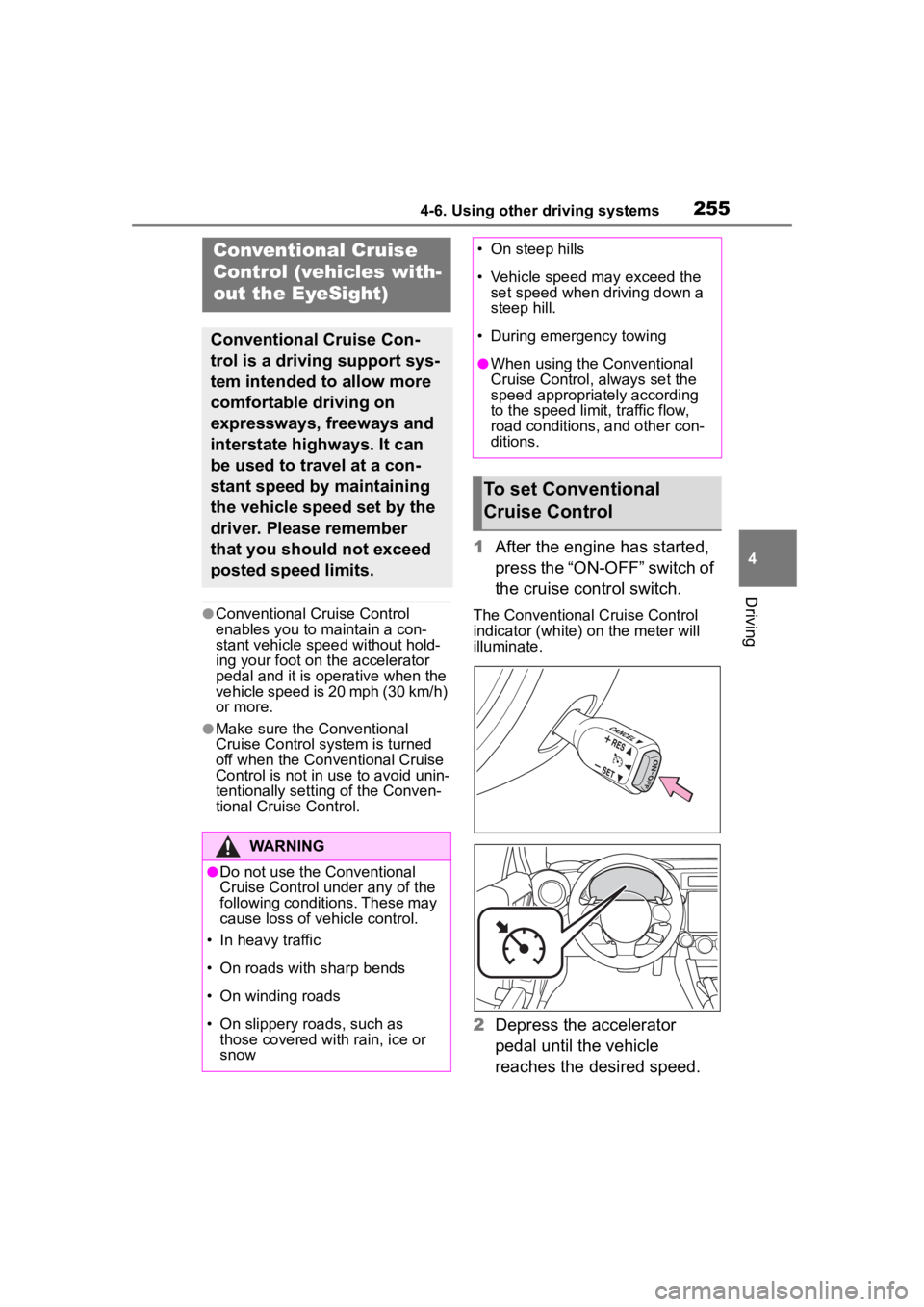
1After the engine has started,
press the “ON-OFF” switch of
the cruise control switch.
The Conventional Cruise Control
indicator (white) on the meter will
illuminate.
2Depress the accelerator
pedal until the vehicle
reaches the desired speed.
Conventional Cruise
Control (vehicles with-
out the EyeSight)
Conventional Cruise Con-
trol is a driving support sys-
tem intended to allow more
comfortable driving on
expressways, freeways and
interstate highways. It can
be used to travel at a con-
stant speed by maintaining
the vehicle speed set by the
driver. Please remember
that you should not exceed
posted speed limits.
WARNING
●Do not use the Conventional
Cruise Control under any of the
following conditions. These may
cause loss of vehicle control.
• In heavy traffic
• On roads with sharp bends
• On winding roads
• On slippery roads, such as those covered with rain, ice or
snow
• On steep hills
• Vehicle speed may exceed the set speed when d riving down a
steep hill.
• During emergency towing
●When using the Conventional
Cruise Control, always set the
speed appropriately according
to the speed limit, traffic flow,
road conditions, and other con-
ditions.
To set Conventional
Cruise Control
Page 280 of 449
2805-3. Using the storage features
■Bottle holders
●When storing a bottle, close the
cap.
●The bottle may not be stored
depending on its size or shape.
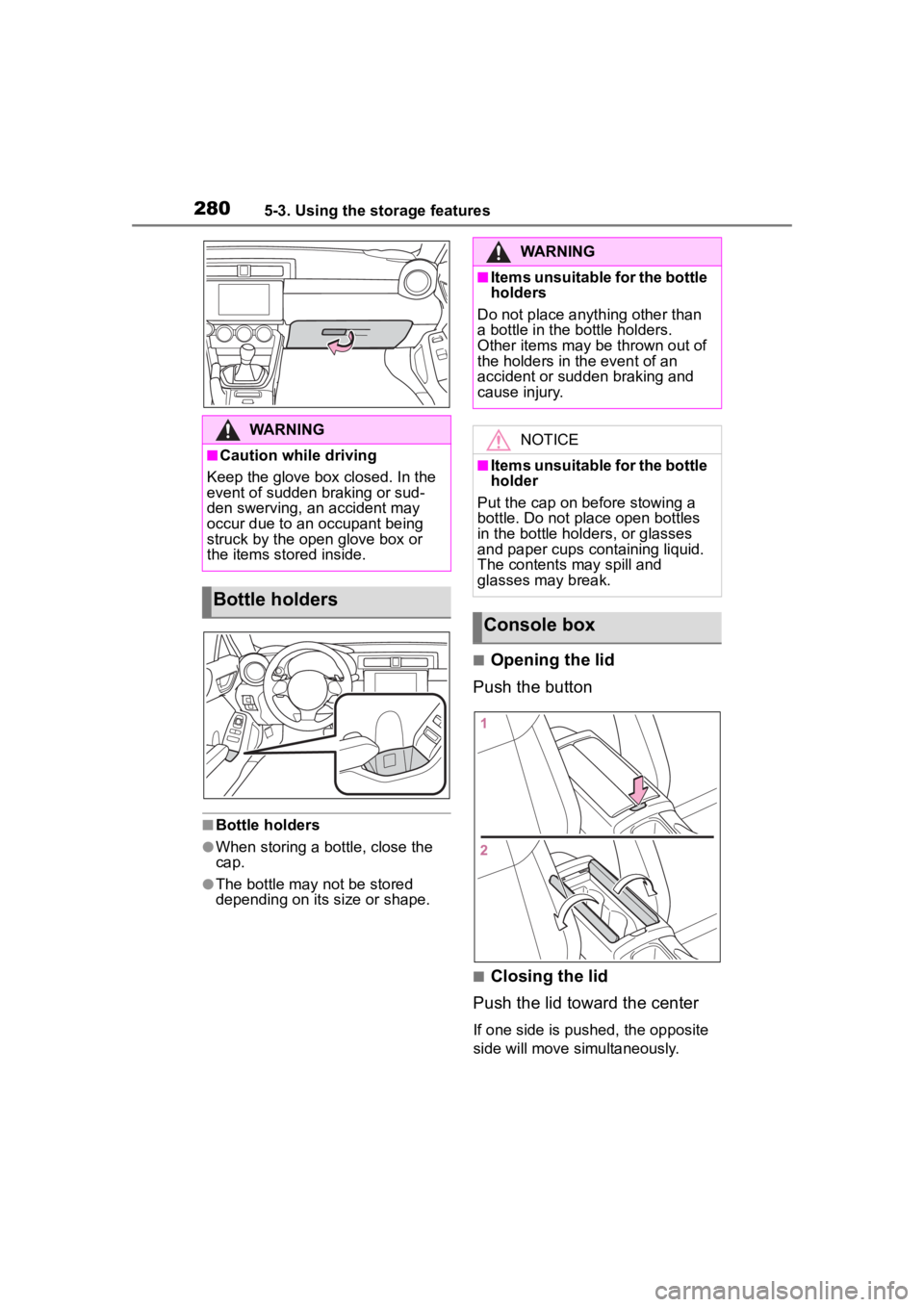
■Opening the lid
Push the button
■Closing the lid
Push the lid toward the center
If one side is pus hed, the opposite
side will move simultaneously.
WARNING
■Caution while driving
Keep the glove box closed. In the
event of sudden braking or sud-
den swerving, an accident may
occur due to an occupant being
struck by the open glove box or
the items stored inside.
Bottle holders
WARNING
■Items unsuitable for the bottle
holders
Do not place anyth ing other than
a bottle in the bottle holders.
Other items may be thrown out of
the holders in the event of an
accident or sudden braking and
cause injury.
NOTICE
■Items unsuitable for the bottle
holder
Put the cap on before stowing a
bottle. Do not pla ce open bottles
in the bottle holders, or glasses
and paper cups containing liquid.
The contents may spill and
glasses may break.
Console box
Page 320 of 449
3206-3. Do-it-yourself maintenance
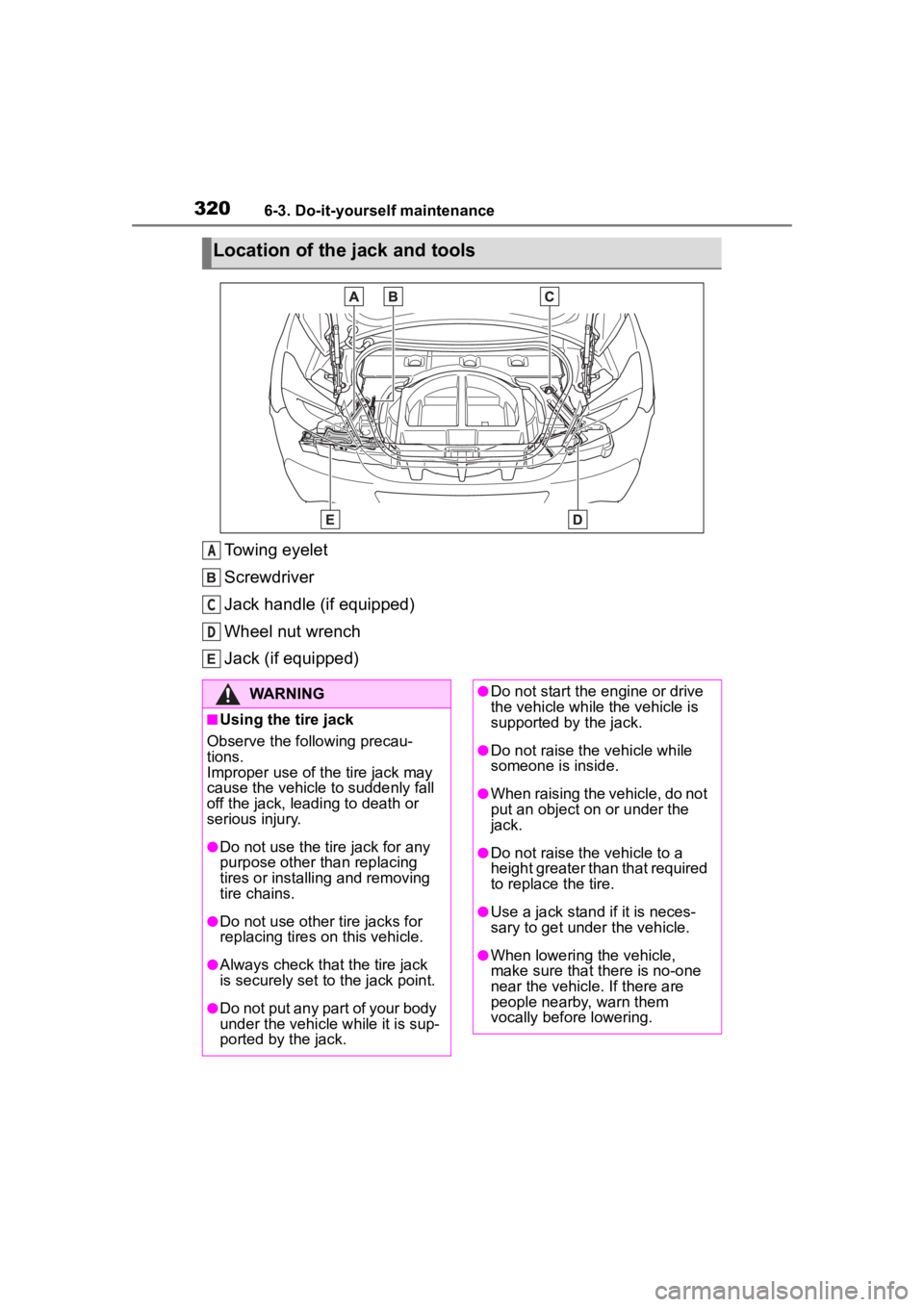
Towing eyelet
Screwdriver
Jack handle (if equipped)
Wheel nut wrench
Jack (if equipped)
Location of the jack and tools
A
C
D
WARNING
■Using the tire jack
Observe the following precau-
tions.
Improper use of the tire jack may
cause the vehicle to suddenly fall
off the jack, leading to death or
serious injury.
●Do not use the tire jack for any
purpose other than replacing
tires or installing and removing
tire chains.
●Do not use other tire jacks for
replacing tires on this vehicle.
●Always check that the tire jack
is securely set to the jack point.
●Do not put any part of your body
under the vehicle while it is sup-
ported by the jack.
●Do not start the engine or drive
the vehicle while the vehicle is
supported by the jack.
●Do not raise the vehicle while
someone is inside.
●When raising the vehicle, do not
put an object on or under the
jack.
●Do not raise the vehicle to a
height greater than that required
to replace the tire.
●Use a jack stand if it is neces-
sary to get under the vehicle.
●When lowering the vehicle,
make sure that there is no-one
near the vehicle. If there are
people nearby, warn them
vocally before lowering.
Page 341 of 449
3417-2. Steps to take in an emergency
7
When trouble arises
7-2.Steps to take in an emergency
If your vehicle needs
to be towed
If towing is necessary, we
recommend having your
vehicle towed by your Toy-
ota dealer or commercial
towing service, using a
wheel-lift type truck or flat-
bed truck.
Use a safety chain system
for all towing, and abide by
all state/provincial and local
laws.
If towing your vehicle with a
wheel-lift type truck from
the front, the vehicle's rear
wheels and axles must be in
good conditions. ( P.342)
If they are damaged, use a
towing dolly or flatbed
truck.
WARNING
Observe the following precau-
tions.
Failure to do so m ay result in
death or serious injury.
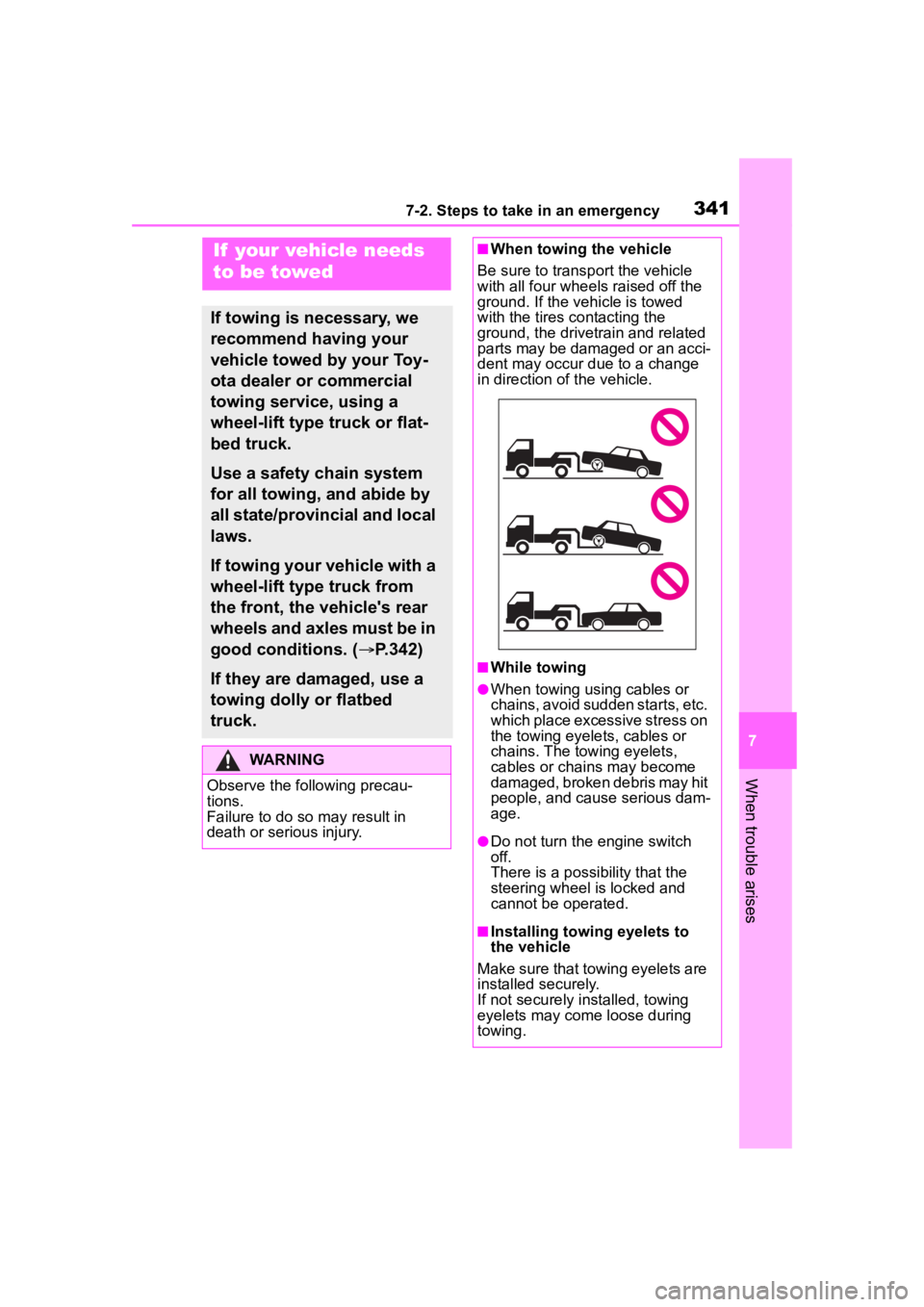
■When towing the vehicle
Be sure to transp ort the vehicle
with all four wheels raised off the
ground. If the vehicle is towed
with the tires co ntacting the
ground, the drivetrain and related
parts may be damaged or an acci-
dent may occur due to a change
in direction of the vehicle.
■While towing
●When towing using cables or
chains, avoid sudden starts, etc.
which place excessive stress on
the towing eyelets, cables or
chains. The towing eyelets,
cables or chains may become
damaged, broken debris may hit
people, and cause serious dam-
age.
●Do not turn the engine switch
off.
There is a possibility that the
steering wheel is locked and
cannot be operated.
■Installing towing eyelets to
the vehicle
Make sure that towing eyelets are
installed securely.
If not securely installed, towing
eyelets may come loose during
towing.
Page 342 of 449
3427-2. Steps to take in an emergency
The following may indicate a
problem with your transmission.
Contact your Toyota dealer or
commercial towing service
before towing.
The engine is running but the
vehicle does not move.
The vehicle makes an abnor-
mal sound.
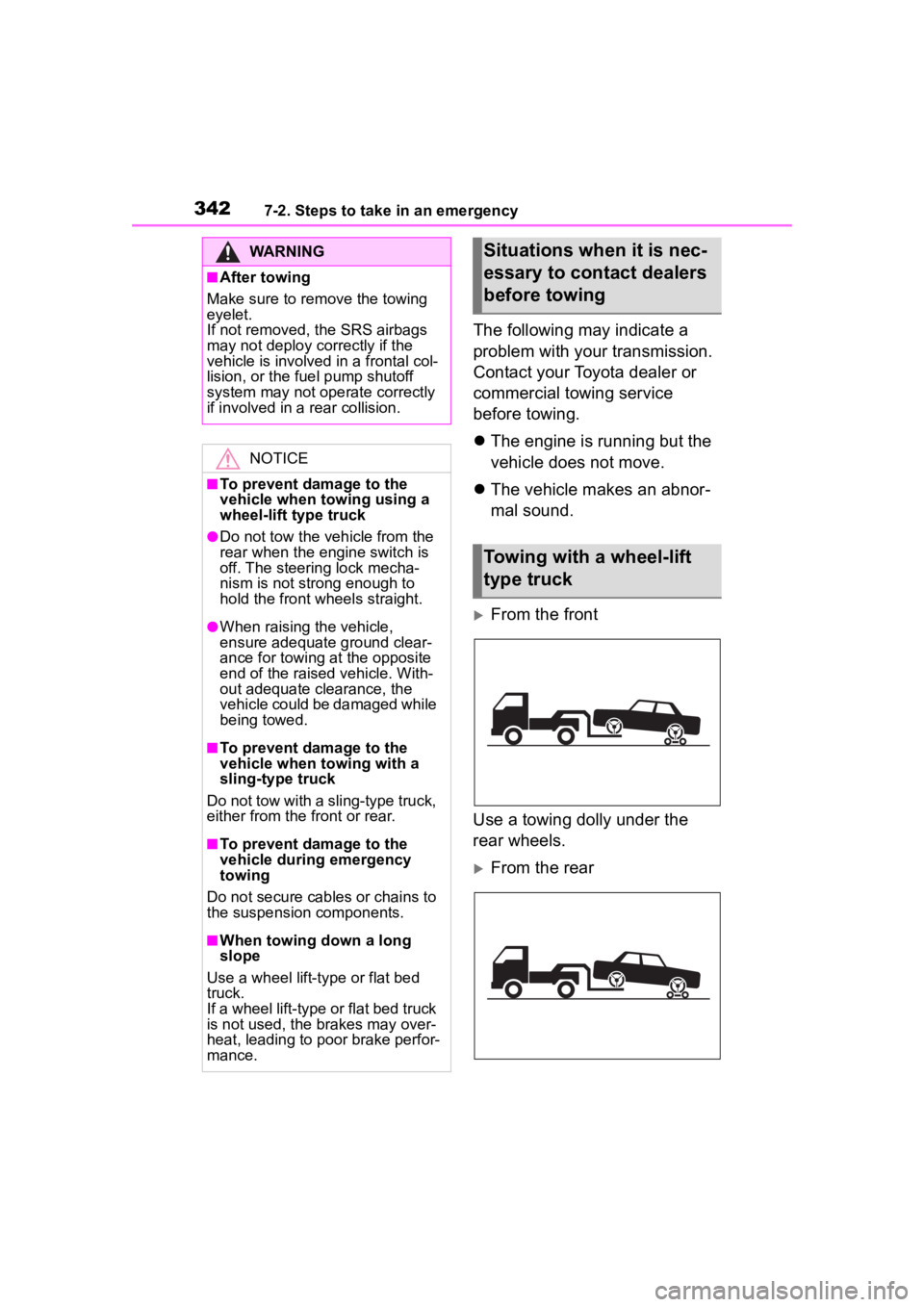
From the front
Use a towing dolly under the
rear wheels.
From the rear
WARNING
■After towing
Make sure to remove the towing
eyelet.
If not removed, the SRS airbags
may not deploy correctly if the
vehicle is involved in a frontal col-
lision, or the fuel pump shutoff
system may not operate correctly
if involved in a rear collision.
NOTICE
■To prevent damage to the
vehicle when towing using a
wheel-lift type truck
●Do not tow the vehicle from the
rear when the engine switch is
off. The steering lock mecha-
nism is not strong enough to
hold the front wheels straight.
●When raising the vehicle,
ensure adequate ground clear-
ance for towing at the opposite
end of the raised vehicle. With-
out adequate clearance, the
vehicle could be damaged while
being towed.
■To prevent damage to the
vehicle when towing with a
sling-type truck
Do not tow with a sling-type truck,
either from the front or rear.
■To prevent damage to the
vehicle during emergency
towing
Do not secure cables or chains to
the suspension components.
■When towing down a long
slope
Use a wheel lift-type or flat bed
truck.
If a wheel lift-type or flat bed truck
is not used, the brakes may over-
heat, leading to poor brake perfor-
mance.
Situations when it is nec-
essary to contact dealers
before towing
Towing with a wheel-lift
type truck
Page 343 of 449
3437-2. Steps to take in an emergency
7
When trouble arises
Use a towing dolly under the
front wheels.
When using a flat-bed truck to
transport the vehicle, use tire
strapping belts. Refer to the
owner’s manual of the flat-bed
truck for the tire strapping
method.
In order to suppress vehicle
movement during transporta-
tion, set the parking brake and
turn the engine switch off.
If a tow truck is not available in
an emergency, your vehicle may
be temporarily towed using
cables or chains secured to the
emergency towing eyelets. This
should only be attempted on
hard surfaced roads for at most
19 miles (30 km) at under 18
mph (30 km/h).
A driver must be in the vehicle to steer and operate the brakes.
The vehicle’s wheels, drive train,
axles, steering and brakes must
be in good condition.
For vehicles with an automatic
transmission, only the front tow-
ing eyelets may be used.
To have your vehicle towed by
another vehicle, the towing eye-
let must be installed to your
vehicle. Install the towing eyelet
using the following procedure.
1
Take out the wheel nut
wrench, flathead screwdriver
and towing eyelet. ( P.359)
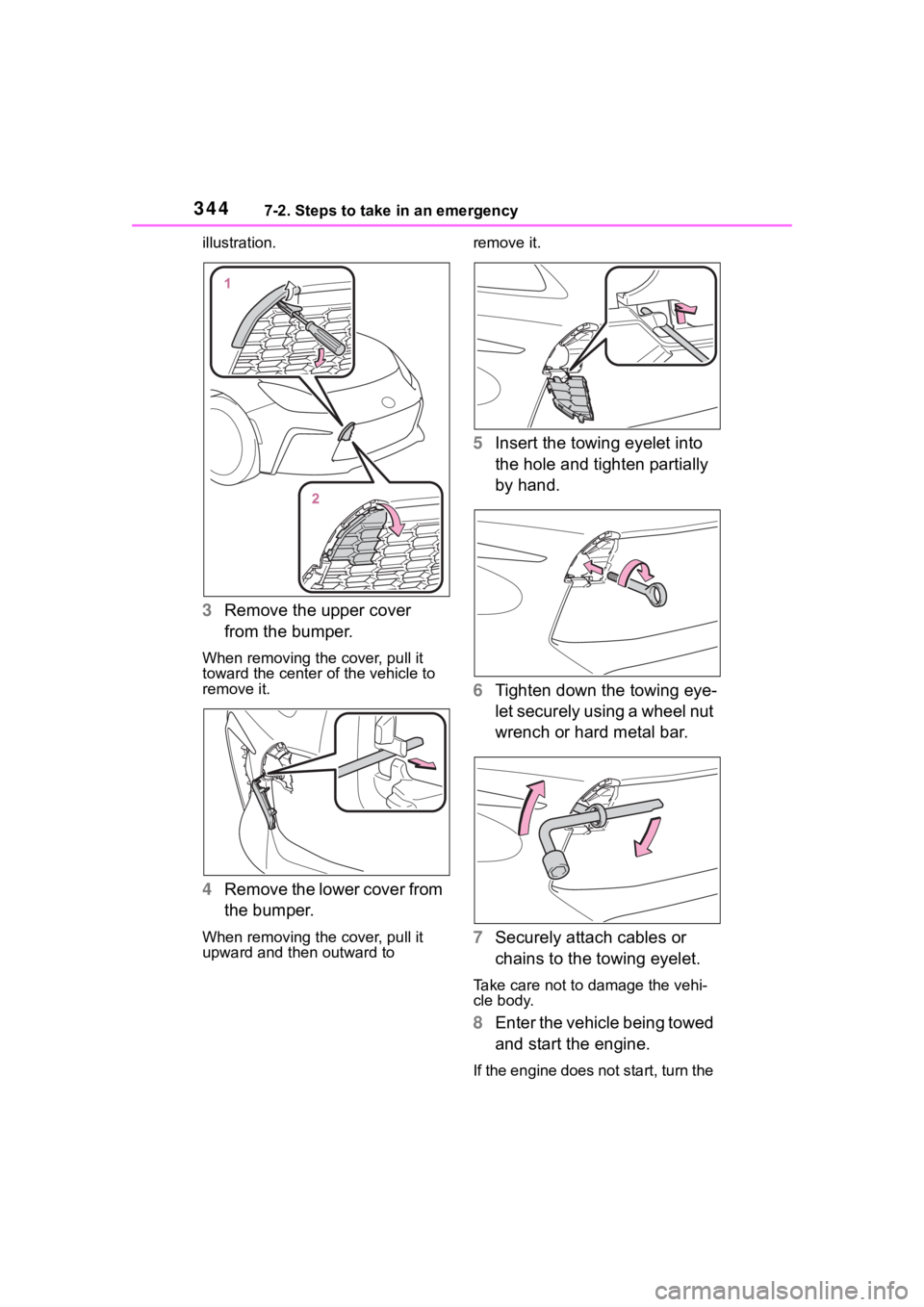
2 Remove the eyelet cover
using a flathead screwdriver.
To protect the b odywork, place a
rag between the screwdriver and
the vehicle body as shown in the
NOTICE
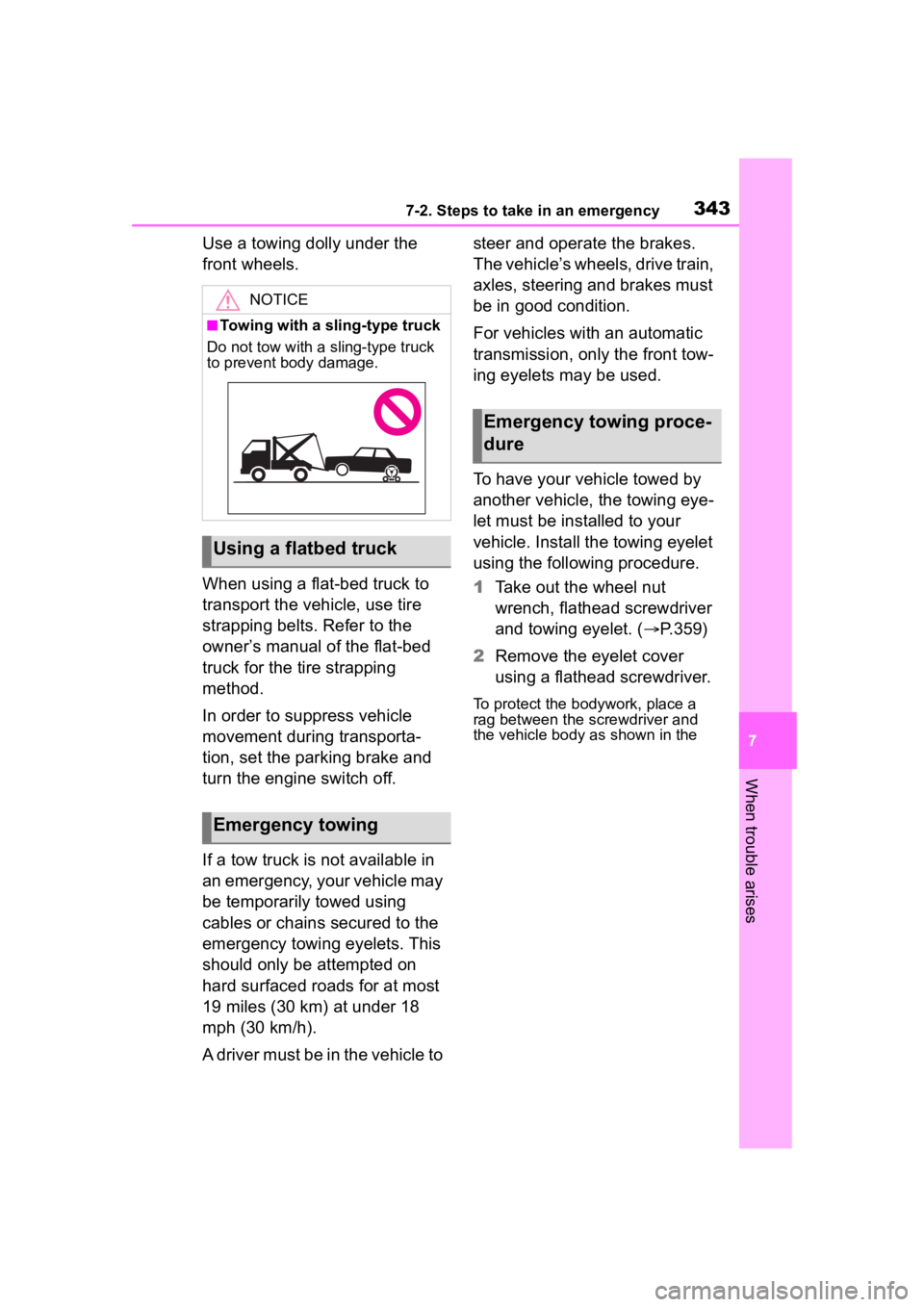
■Towing with a sling-type truck
Do not tow with a sling-type truck
to prevent body damage.
Using a flatbed truck
Emergency towing
Emergency towing proce-
dure
Page 344 of 449
3447-2. Steps to take in an emergency
illustration.
3Remove the upper cover
from the bumper.
When removing the cover, pull it
toward the center of the vehicle to
remove it.
4Remove the lower cover from
the bumper.
When removing the cover, pull it
upward and then outward to remove it.
5
Insert the towing eyelet into
the hole and tighten partially
by hand.
6 Tighten down the towing eye-
let securely using a wheel nut
wrench or hard metal bar.
7 Securely attach cables or
chains to the towing eyelet.
Take care not to damage the vehi-
cle body.
8Enter the vehicle being towed
and start the engine.
If the engine does not start, turn the
Page 345 of 449
3457-2. Steps to take in an emergency
7
When trouble arises
engine switch to ON.
9Shift the shift lever to N and
release the parking brake.
Vehicles with an automatic trans-
mission: When the shift lever can-
not be shifted: P. 1 5 0
■Towing eyelet purpose
The towing eyelet i s to be used to
tow your vehicle, not to tow other
vehicles.
■While towing
If the engine is not running, the
power assist for the brakes and
steering will not function, making
steering and braking more difficult.
■Wheel nut wrench
Wheel nut wrench is installed in
trunk. ( P.359)
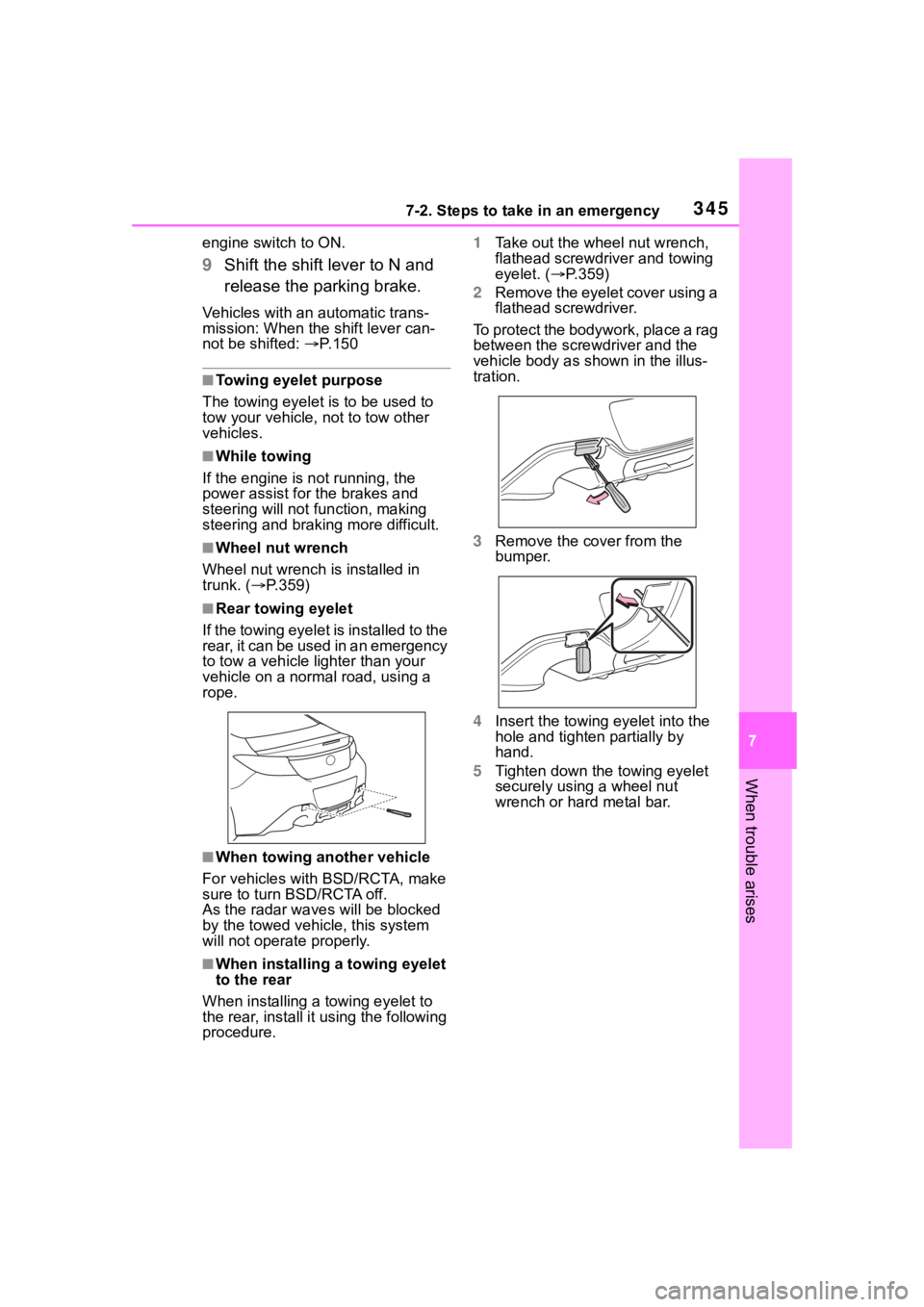
■Rear towing eyelet
If the towing eyelet is installed to the
rear, it can be used in an emergency
to tow a vehicle lig hter than your
vehicle on a norma l road, using a
rope.
■When towing another vehicle
For vehicles with BSD/RCTA, make
sure to turn BSD/RCTA off.
As the radar wave s will be blocked
by the towed vehicle, this system
will not operat e properly.
■When installing a towing eyelet
to the rear
When installing a towing eyelet to
the rear, install it using the following
procedure. 1
Take out the wheel nut wrench,
flathead screwdriver and towing
eyelet. ( P.359)
2 Remove the eyelet cover using a
flathead screwdriver.
To protect the bodywork, place a rag
between the screwdriver and the
vehicle body as shown in the illus-
tration.
3 Remove the cover from the
bumper.
4 Insert the towing eyelet into the
hole and tighten partially by
hand.
5 Tighten down the towing eyelet
securely using a wheel nut
wrench or hard metal bar.
Page 359 of 449
3597-2. Steps to take in an emergency
7
When trouble arises
more
●When the wheel is damaged
●When 2 or more sharp objects,
such as nails or screws, have
passed through the tread on a sin- gle tire
●When there is more than one hole
or cut in the damaged tire
●When the sealant has expired
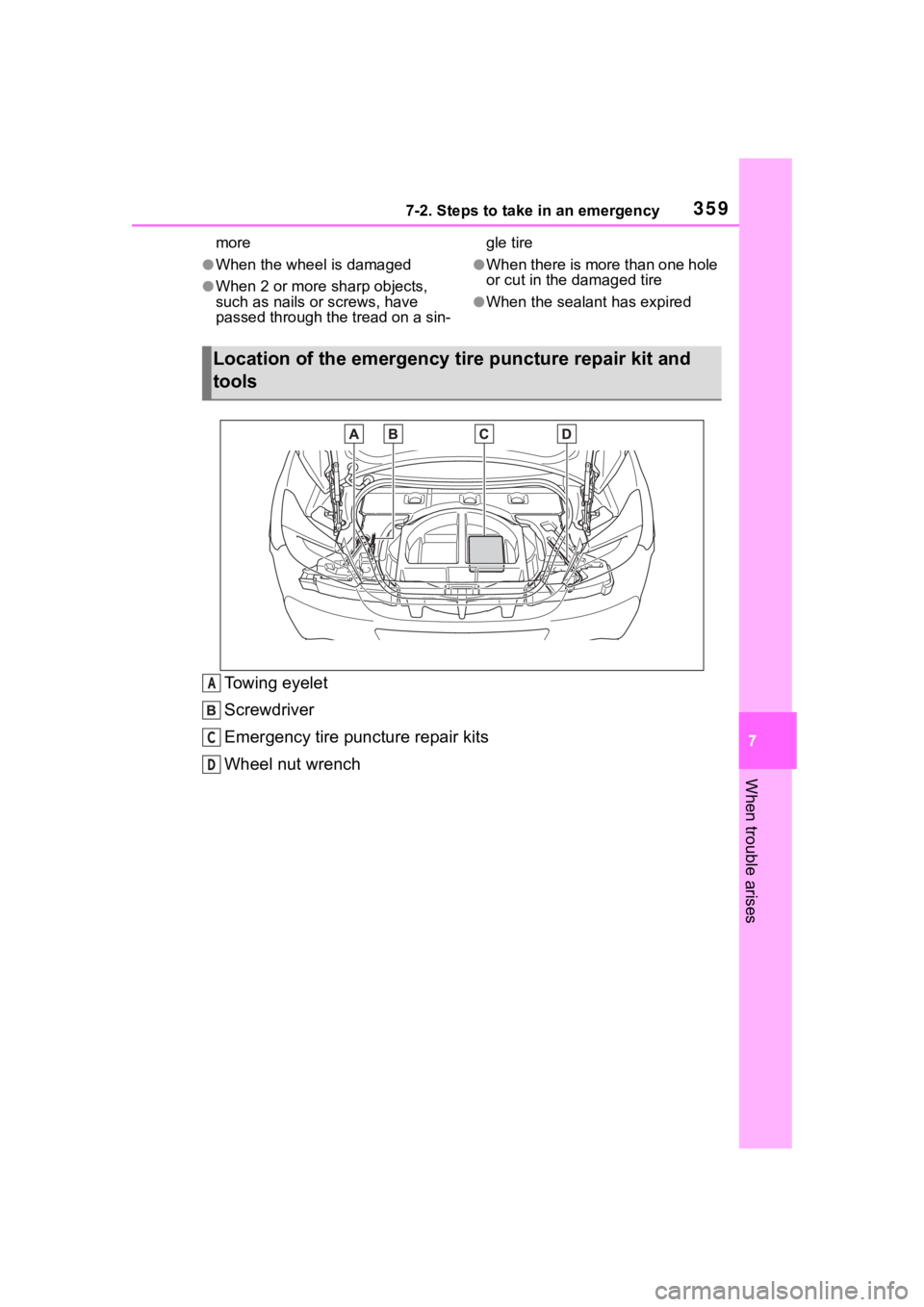
Towing eyelet
Screwdriver
Emergency tire puncture repair kits
Wheel nut wrench
Location of the emergency ti
re puncture repair kit and
tools
A
C
D
Page 377 of 449
3777-2. Steps to take in an emergency
7
When trouble arises
1Stop the engine. Set the
parking brake and shift the
shift lever to P (automatic
transmission) or N (manual
transmission).
2 Remove the mud, snow or
sand from around the rear
wheels.
3 Place wood, stones or some
other material under the rear
wheels to help provide trac-
tion.
4 Restart the engine.
5 Shift the shift lever to D or R
(automatic transmission) or 1
or R (manual transmission)
and release the parking
brake. Then, while exercising
caution, depress the acceler-
ator pedal.
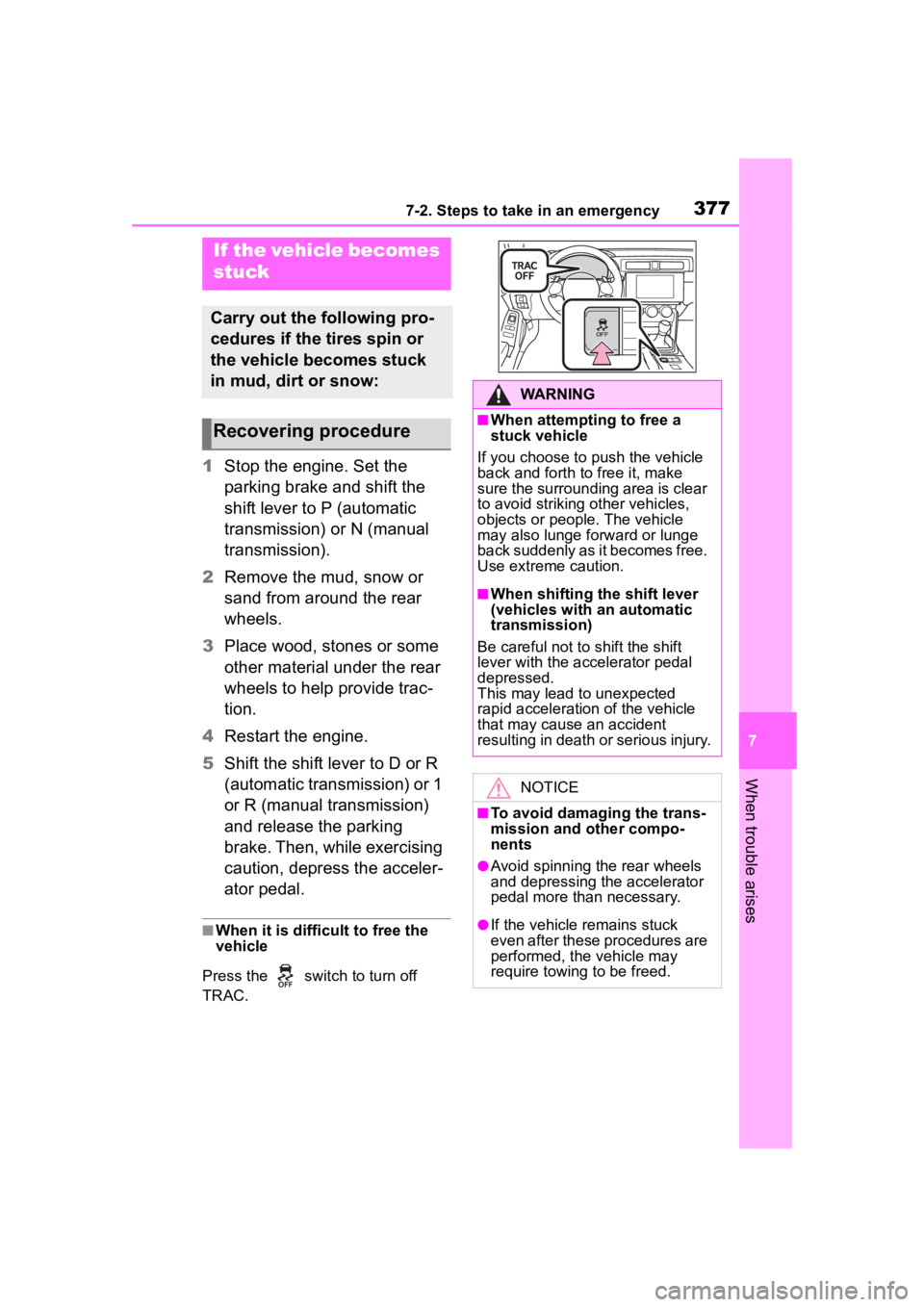
■When it is difficult to free the
vehicle
Press the switch to turn off
TRAC.
If the vehicle becomes
stuck
Carry out the following pro-
cedures if the tires spin or
the vehicle becomes stuck
in mud, dirt or snow:
Recovering procedure
WARNING
■When attempting to free a
stuck vehicle
If you choose to push the vehicle
back and forth to free it, make
sure the surrounding area is clear
to avoid striking other vehicles,
objects or people. The vehicle
may also lunge forward or lunge
back suddenly as it becomes free.
Use extreme caution.
■When shifting the shift lever
(vehicles with an automatic
transmission)
Be careful not to shift the shift
lever with the accelerator pedal
depressed.
This may lead to unexpected
rapid acceleration of the vehicle
that may cause an accident
resulting in death o r serious injury.
NOTICE
■To avoid damaging the trans-
mission and other compo-
nents
●Avoid spinning the rear wheels
and depressing the accelerator
pedal more than necessary.
●If the vehicle remains stuck
even after these procedures are
performed, the vehicle may
require towing to be freed.