warning light TOYOTA 86 2023 Service Manual
[x] Cancel search | Manufacturer: TOYOTA, Model Year: 2023, Model line: 86, Model: TOYOTA 86 2023Pages: 449, PDF Size: 8.5 MB
Page 166 of 449
1664-3. Operating the lights and wipers
■The windshield wiper and
washer can be operated when
The engine switch is in ON.
■If no windshield washer fluid
sprays
Check that the wash er nozzles are
not blocked if there is washer fluid in
the windshield washer fluid reser-
v oi r.
WARNING
■Caution regarding the use of
washer fluid
When it is cold, do not use the
washer fluid until the windshield
becomes warm. The fluid may
freeze on the windshield and
cause low visibility. This may lead
to an accident, resulting in death
or serious injury.
NOTICE
■When the washer fluid tank is
empty
Do not operate the switch continu-
ally as the washer fluid pump may
overheat.
■When a nozzle becomes
blocked
In this case, contact your Toyota
dealer. Do not try to clear it with a
pin or other object. The nozzle will
be damaged.
Page 168 of 449
1684-4. Refueling
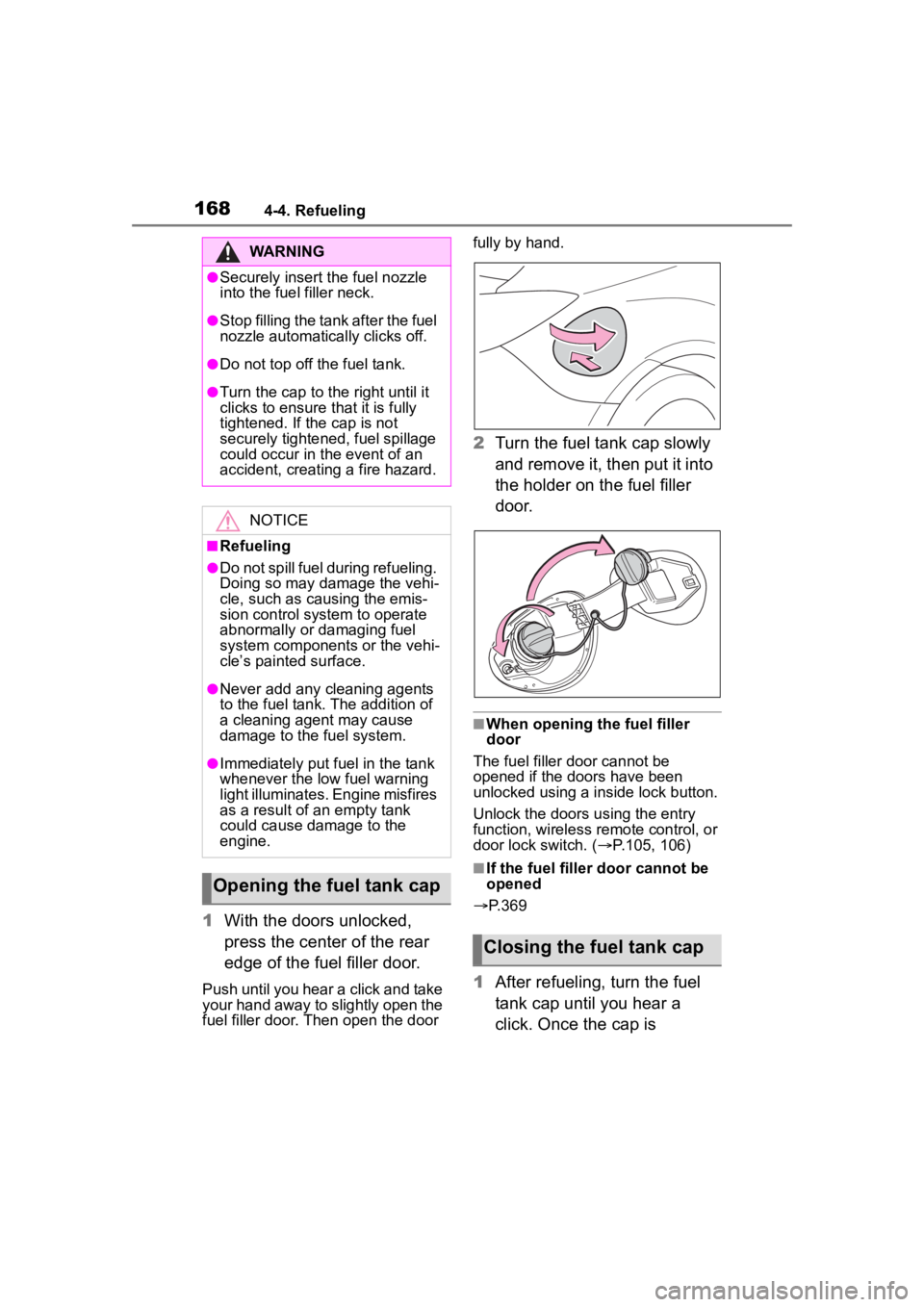
1With the doors unlocked,
press the center of the rear
edge of the fuel filler door.
Push until you hear a click and take
your hand away to slightly open the
fuel filler door. Then open the door fully by hand.
2
Turn the fuel tank cap slowly
and remove it, then put it into
the holder on the fuel filler
door.
■When opening the fuel filler
door
The fuel filler door cannot be
opened if the doo rs have been
unlocked using a inside lock button.
Unlock the doors u sing the entry
function, wireless remote control, or
door lock switch. ( P.105, 106)
■If the fuel filler door cannot be
opened
P.369
1 After refueling, turn the fuel
tank cap until you hear a
click. Once the cap is
WARNING
●Securely insert the fuel nozzle
into the fuel filler neck.
●Stop filling the tank after the fuel
nozzle automatically clicks off.
●Do not top off the fuel tank.
●Turn the cap to the right until it
clicks to ensure that it is fully
tightened. If the cap is not
securely tightened, fuel spillage
could occur in t he event of an
accident, creating a fire hazard.
NOTICE
■Refueling
●Do not spill fuel during refueling.
Doing so may damage the vehi-
cle, such as causing the emis-
sion control system to operate
abnormally or damaging fuel
system components or the vehi-
cle’s painted surface.
●Never add any cleaning agents
to the fuel tank. The addition of
a cleaning agent may cause
damage to the fuel system.
●Immediately put fuel in the tank
whenever the low fuel warning
light illuminates. Engine misfires
as a result of an empty tank
could cause damage to the
engine.
Opening the fuel tank cap
Closing the fuel tank cap
Page 169 of 449
1694-4. Refueling
4
Driving
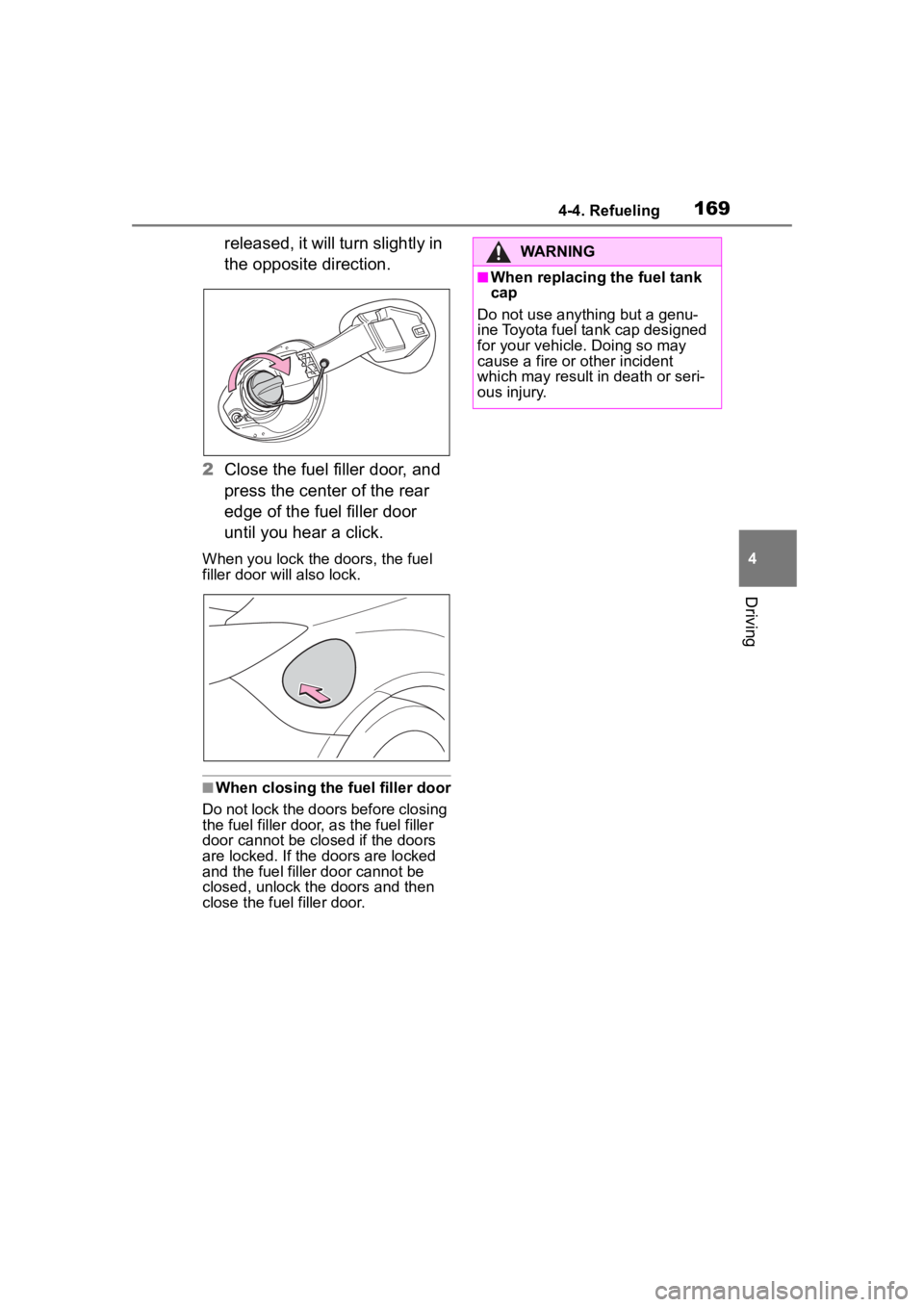
released, it will turn slightly in
the opposite direction.
2 Close the fuel filler door, and
press the center of the rear
edge of the fuel filler door
until you hear a click.
When you lock the doors, the fuel
filler door will also lock.
■When closing the fuel filler door
Do not lock the doors before closing
the fuel filler door , as the fuel filler
door cannot be closed if the doors
are locked. If the doors are locked
and the fuel filler door can not be
closed, unlock the doors and then
close the fuel filler door.
WARNING
■When replacing the fuel tank
cap
Do not use anything but a genu-
ine Toyota fuel tank cap designed
for your vehicle. Doing so may
cause a fire or other incident
which may result i n death or seri-
ous injury.
Page 171 of 449
1714-5. EyeSight
4
Driving
WARNING
There are limits to the EyeSight
recognition performance and con-
trol performance. Be sure to read
the instructions for each function
before using the system, and
always use it properly. Improper
use may lead to failure of control
performance, which could cause
an accident.
Refer to the fo llowing pages for
each function:
●For Pre-Collision Braking Sys-
tem, refer to P.179.
●For Adaptive Cruise Control,
refer to P.190.
●For Conventional Cruise Con-
trol, refer to P.207.
●For Pre-Collision Throttle Man-
agement, refer to P.215.
●For Lane Departure Warning,
refer to P.220.
●For Lane Sway Warning, refer
to P.222.
●For Lead Vehicle Start Alert,
refer to P.224.
In left-hand drive vehicles, Eye-
Sight is configured for driving on
the right-hand side of the road.
However, it can be reconfigured
by changing the driving lane set-
ting for driving o n the left-hand
side.
* (P.400)
If the setting for the traffic lane
(driving side of the road) does not
match the traffic lane, full Eye-
Sight performance may not be
available.
*: Characteristics and settings that are affected by specific differ-
ences between right-hand drive
and left-hand drive vehicles
cannot be changed.
●The system may not operate
correctly under the conditions
listed below. When these condi-
tions occur, turn off Pre-Colli-
sion Braking Sy stem. Also, do
not use Adaptive Cruise Control
or Conventional Cruise Control.
• The tire pressure is not cor- rect.
*1
• The temporary spare tire is installed.*1
• Tires that are unevenly worn or tires with uneven wear patterns
are installed.
*1
• Tires that are the wrong size are
installed.*1
• A flat tire has been fixed tempo-rarily with a tire repair kit.
• The suspension has been modi- fied (including a genuine Toyota
suspension that has been modi-
fied).
• An object that obstructs the ste- reo camera’s view is installed
on the vehicle.
• Tire chains are installed.
• The headlights are dirty or they have snow and ice or dirt on
them. (Objects are not correctly
illuminated and are difficult to
detect.)
• The optical axes are not aligned correctly. (Objects are not cor-
rectly illuminated and are diffi-
cult to detect.)
Page 172 of 449
1724-5. EyeSight
WARNING
• The lights including headlights and fog lights have been modi-
fied.
• Vehicle operation has become unstable due to an accident or
malfunction.
• The brake system warning light is illuminated in red.
*2
• A heavy cargo is inside the vehicle.
• The maximum number of occu- pants is exceeded.
• The meter is not operating prop- erly; such as when the lights do
not illuminate, the beeps do not
sound, the display is different
from when it is normal, etc.
*3
●The system will not operate cor-
rectly in the following condi-
tions. Do not use Adaptive
Cruise Control or Conventional
Cruise Control.
• The wheels are out of balance (e.g., the balance weight is
removed or misaligned).
*1
• The wheels are out of align-
ment.*1
• A trailer or another vehicle, etc. is being towed.
*1: The wheels and tires have
functions that are critically
important. Be sure to use the
correct ones. (
P.386)
*2: If the brake system warning
light (red) does not turn off,
immediately pull the vehicle
over in a safe place and con-
tact a Toyota dealer to have the
system inspected.
*3: For details about the meter, refer to P.88.
NOTICE
●The characteristics of the stereo
camera are simila r to those of
human eyes. For this reason,
conditions that make it difficult
for the driver to see in the for-
ward direction have the same
effect on the stereo camera.
They also make it difficult for the
system to detect vehicles,
obstacles, and traffic lanes.
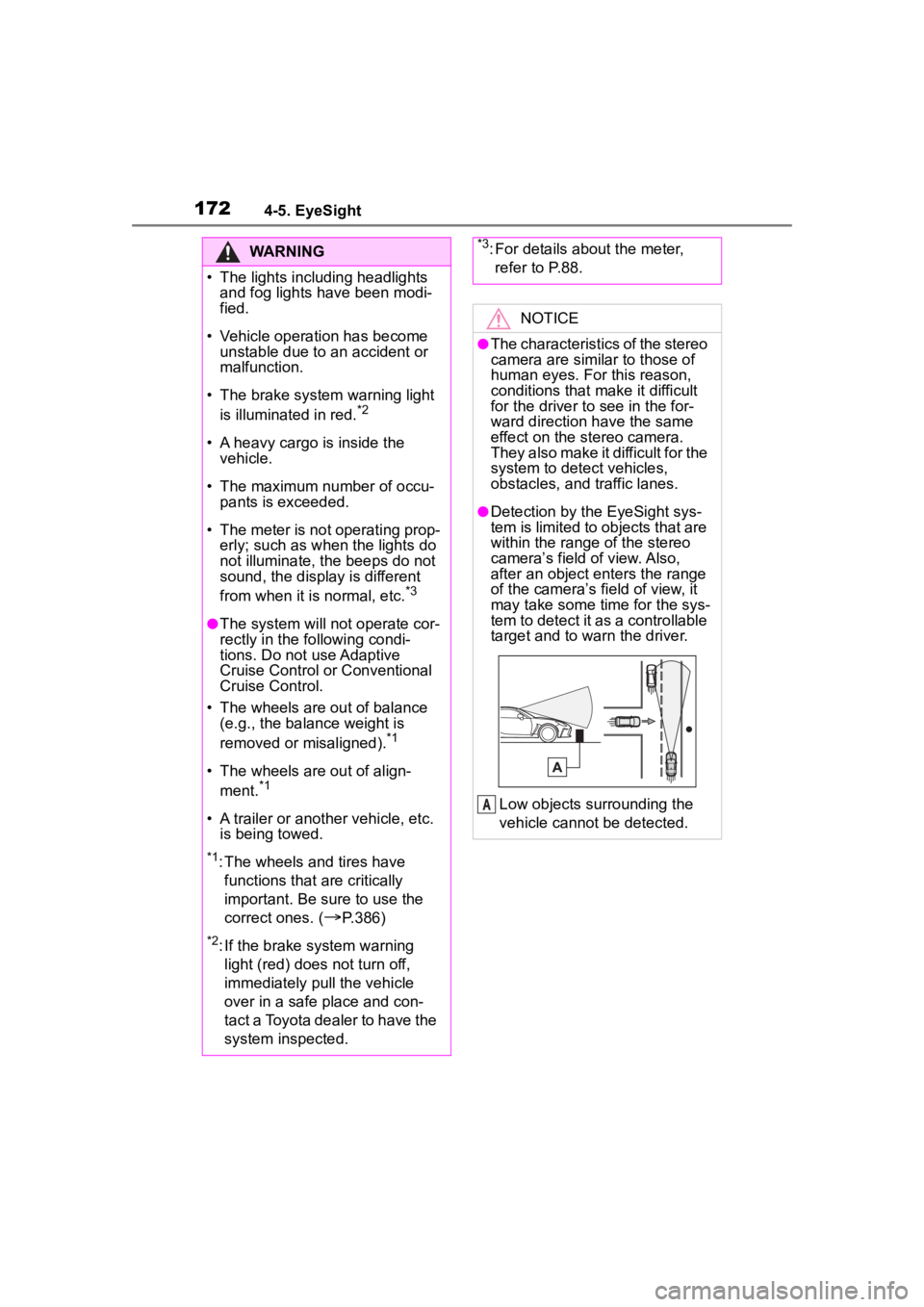
●Detection by the EyeSight sys-
tem is limited to objects that are
within the range of the stereo
camera’s field of view. Also,
after an object enters the range
of the camera’s field of view, it
may take some time for the sys-
tem to detect it as a controllable
target and to warn the driver.
Low objects surrounding the
vehicle cannot be detected.
A
Page 174 of 449
1744-5. EyeSight
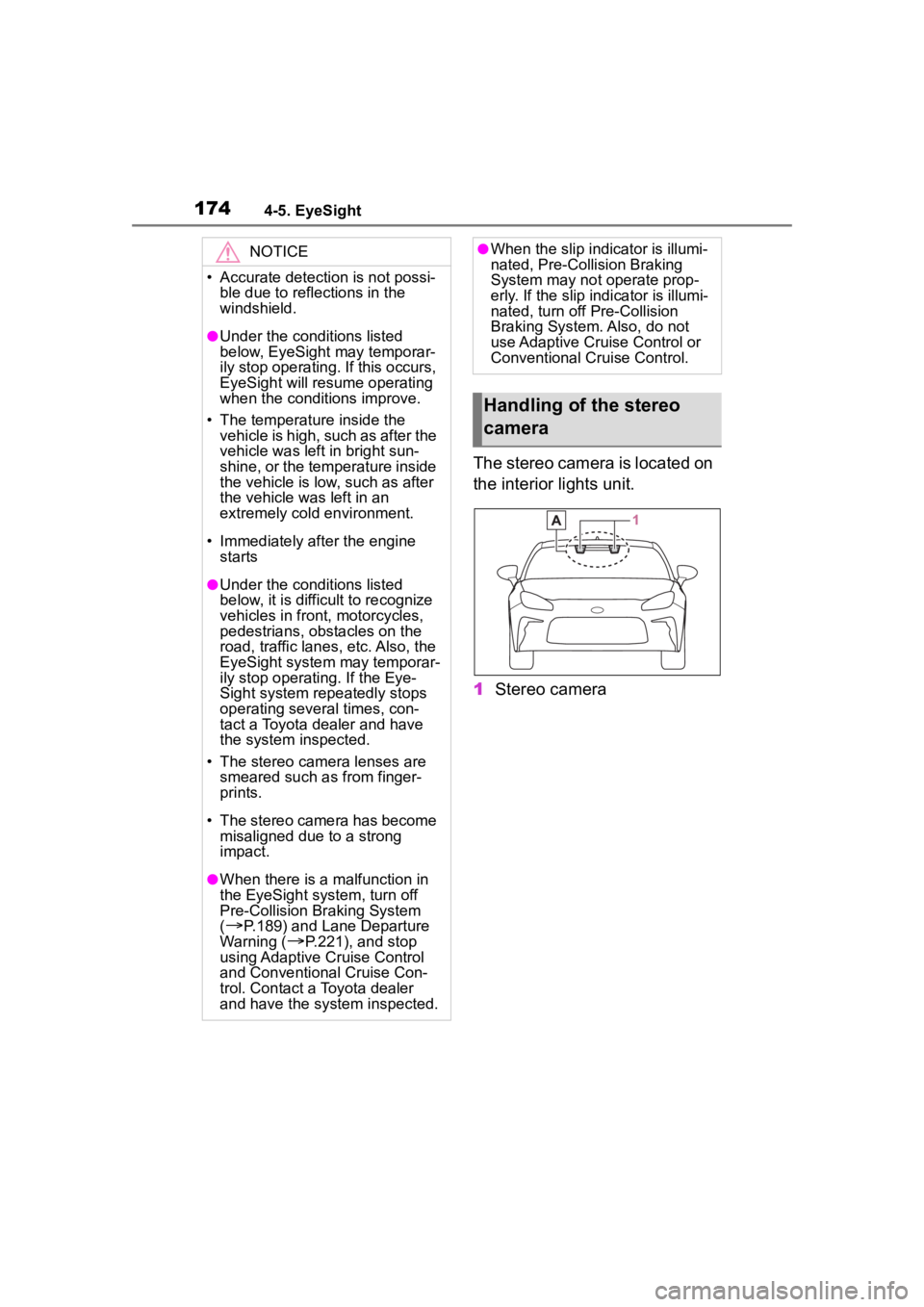
The stereo camera is located on
the interior lights unit.
1Stereo camera
NOTICE
• Accurate detecti on is not possi-
ble due to reflections in the
windshield.
●Under the conditions listed
below, EyeSight may temporar-
ily stop operating. If this occurs,
EyeSight will resume operating
when the conditions improve.
• The temperature inside the vehicle is high, such as after the
vehicle was left in bright sun-
shine, or the temperature inside
the vehicle is low, such as after
the vehicle was left in an
extremely cold environment.
• Immediately after the engine starts
●Under the conditions listed
below, it is difficult to recognize
vehicles in front, motorcycles,
pedestrians, obstacles on the
road, traffic lanes, etc. Also, the
EyeSight system may temporar-
ily stop operating. If the Eye-
Sight system repeatedly stops
operating several times, con-
tact a Toyota dealer and have
the system inspected.
• The stereo camera lenses are smeared such as from finger-
prints.
• The stereo camera has become misaligned due to a strong
impact.
●When there is a malfunction in
the EyeSight system, turn off
Pre-Collision Br aking System
(
P.189) and Lane Departure
Warning (
P.221), and stop
using Adaptive Cruise Control
and Conventional Cruise Con-
trol. Contact a Toyota dealer
and have the system inspected.
●When the slip indicator is illumi-
nated, Pre-Collision Braking
System may not operate prop-
erly. If the slip indicator is illumi-
nated, turn off Pre-Collision
Braking System. Also, do not
use Adaptive Cruise Control or
Conventional Cruise Control.
Handling of the stereo
camera
Page 183 of 449
1834-5. EyeSight
4
Driving
WARNING
The speed difference between
your vehicle and an obstacle is 4
mph (5 km/h) or less (As braking
is performed once the obstacle is
in close proximity to your vehicle,
depending on the shape and size
of the obstacle, there may be
some cases when the obstacle is
outside the range of the camera’s
field of view.).
On sharp curves, steep uphill
grades or steep downhill grades
On a bumpy or unpaved road
There are changes in bright-
ness, such as at a tunnel
entrance or exit.
●Do not test Pre-Collision Brak-
ing System on its own. It may
operate improperly and cause
an accident.
●The system may not operate
correctly under the conditions
listed below. When these condi-
tions occur, turn off Pre-Colli-
sion Braking System. (
P.189)
• The tire pressure is not cor- rect.
*1
• The temporary spare tire is installed.*1
• Tires that are unevenly worn or tires with uneven wear patterns
are installed.
*1
• Tires that are the wrong size are
installed.*1
• A flat tire has been fixed tempo-rarily with a tire repair kit.
• The suspension has been modi- fied (including a genuine Toyota
suspension that has been modi-
fied).
• An object that obstructs the ste- reo camera’s view is installed
on the vehicle.
• Tire chains are installed.
• The headlights are dirty or they have snow and ice or dirt on
them. (Objects are not correctly
illuminated and are difficult to
detect.)
• The optical axes are not aligned correctly. (Objects are not cor-
rectly illuminated and are diffi-
cult to detect.)
• The lights including headlights and fog lights have been modi-
fied.
• Vehicle operation has become unstable due to an accident or
malfunction.
• The brake system warning light is illuminated in red.
*2
• A heavy cargo is inside the vehicle.
• The maximum number of occu- pants is exceeded.
• The meter is not operating prop- erly; such as when the lights do
not illuminate, the beeps do not
sound, the display is different
from when it is normal, etc.
*3
*1
: The wheels and tires have functions that are critically
important. Be sure to use the
correct ones. ( P.386)
Page 184 of 449
1844-5. EyeSight
WARNING
*2: If the brake system warning light (red) does not turn off,
immediately pull the vehicle
over in a safe place and con-
tact a Toyota dealer to have the
system inspected.
*3: For details about the meter,
refer to P.88.
NOTICE
In the following situations, turn off
Pre-Collision Braking System.
Otherwise Pre-Collision Braking
System may activate unexpect-
edly.
●The vehicle is being towed.
●The vehicle is being loaded onto
a carrier.
●A chassis dynamometer,
free-rollers or similar equip-
ment is being used.
●A mechanic lifts up the vehicle,
starts the engine and spins the
wheels freely.
●Passing hanging banners, flags
or branches
●Thick/tall vegeta tion is touching
the vehicle.
●Driving on a race track
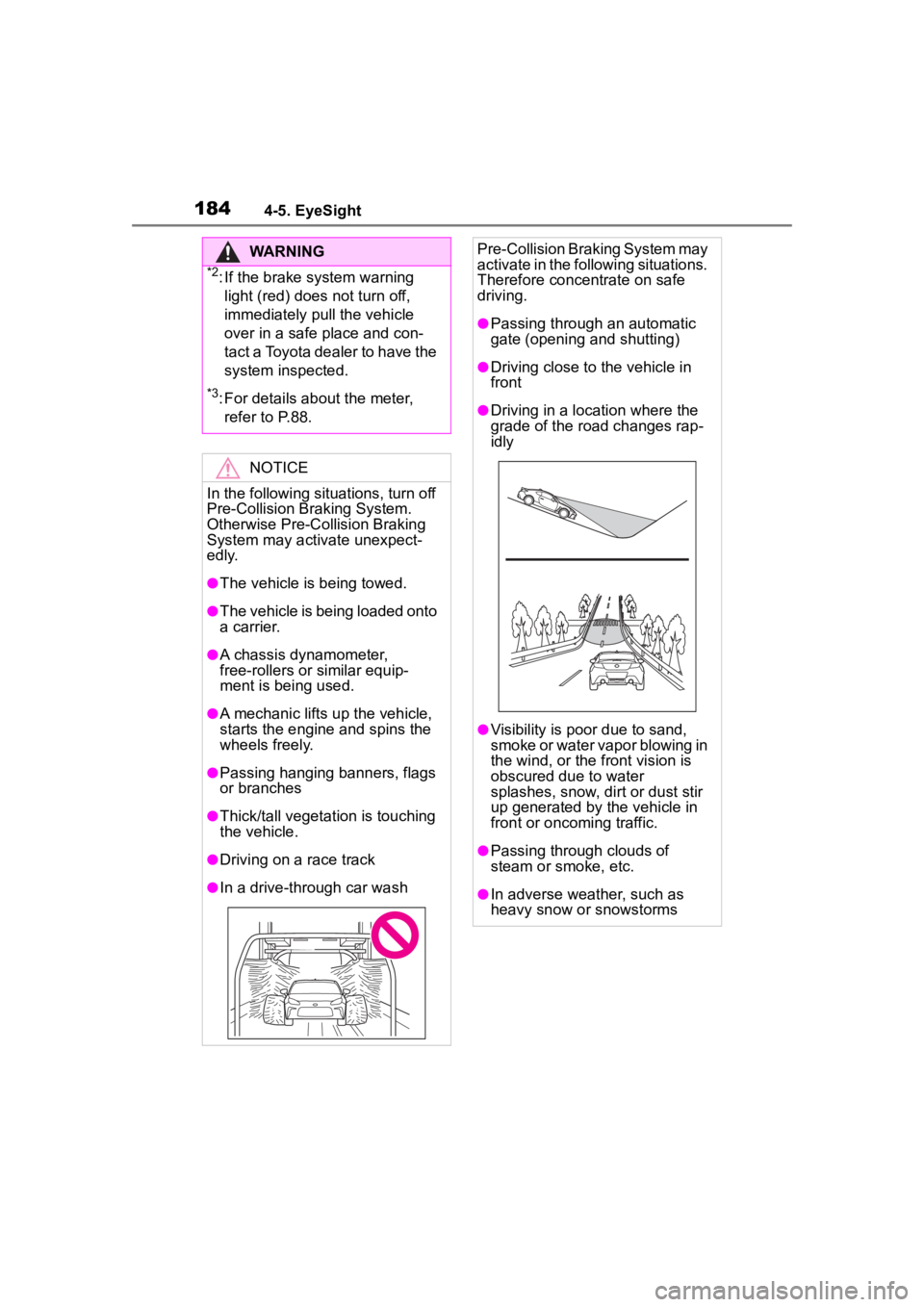
●In a drive-through car wash
Pre-Collision Braking System may
activate in the following situations.
Therefore concentrate on safe
driving.
●Passing through an automatic
gate (opening and shutting)
●Driving close to the vehicle in
front
●Driving in a loc ation where the
grade of the road changes rap-
idly
●Visibility is poor due to sand,
smoke or water vapor blowing in
the wind, or the front vision is
obscured due to water
splashes, snow, dirt or dust stir
up generated by the vehicle in
front or oncoming traffic.
●Passing through clouds of
steam or smoke, etc.
●In adverse weather, such as
heavy snow or snowstorms
Page 186 of 449
1864-5. EyeSight
When there is an obstacle in front of you during driving, the system
activates in the following sequence in order to warn the driver and to
activate braking control and the stop lights.
Following distance warning:
When the system determines that t here is a risk of collision, an alert sounds
repeated short beeps and the indicators on the meter display il luminate to
warn the driver.
The Following Distance Warning ope rates when Adaptive Cruise Control is
not activated.
When the driver depresses the bra ke pedal to decelerate and achieves a
suitable following distanc e, the warning is canceled.
First braking and warning:
When the system determines that there is a high risk of collisi on with an
obstacle in front, an alert sounds repeated short beeps and the indicators
on the meter display illuminate to warn the driver. Braking control may be
activated and in some situations, engine output may also be controlled. If
the system determines that the amount of evasive action (brakin g, steering,
etc.) taken by the driver has reduced the risk of collision, br aking activation
is canceled.
Secondary braking and warning:
WARNING
The EyeSight system’s Pre-Colli-
sion Braking function also identi-
fies pedestrians as obstacles.
However, depending on the con-
ditions, there may be cases when
the system cannot detect a
pedestrian. In the following condi-
tions, the possibility that the sys-
tem may not be able to detect a
pedestrian as an object is particu-
larly high.
●Pedestrians are walking in a
group.
●A pedestrian is next to a wall or
other obstacle.
●A pedestrian is using an
umbrella.
●A pedestrian is wearing clothes
that are a similar color to the
surrounding environment.
●A pedestrian is carrying bulky
luggage.
●A pedestrian is bent over,
crouching down o r lying down.
●A pedestrian is in a dark loca-
tion.
●A pedestrian suddenly crosses
in front of you from the side or
suddenly runs in front of you.
Pre-Collision Braki ng System operation
Page 191 of 449
1914-5. EyeSight
4
Driving
WARNING
●When the vehicle in front
changes lanes, your vehicle will
not follow. Always pay attention
and take caution of the sur-
rounding traffic condition.
The system may not operate cor-
rectly under the c onditions listed
below. When these conditions
occur, do not use Adaptive Cruise
Control.
●The tire pressure is not cor-
rect.*1
●The temporary spare tire is
installed.*1
●Tires that are u nevenly worn or
tires with uneven wear patterns
are installed.
*1
●Tires that are the wrong size are
installed.*1
●A flat tire has been fixed tempo-
rarily with a tire repair kit.
●The suspension has been modi-
fied (including a genuine Toyota
suspension that has been modi-
fied).
●An object that obstructs the ste-
reo camera’s view is installed
on the vehicle.
●Tire chains are installed.
●The headlights are dirty or they
have snow and ice or dirt on
them. (Objects are not correctly
illuminated and are difficult to
detect.)
●The optical axes are not aligned
correctly. (Objects are not cor-
rectly illuminate d and are diffi-
cult to detect.)
●The lights including headlights
and fog lights have been modi-
fied.
●Vehicle operation has become
unstable due to an accident or
malfunction.
●The brake system warning light
is illuminated in red.*2
●A heavy cargo is inside the
vehicle.
●The maximum number of occu-
pants is exceeded.
●The meter is not operating prop-
erly; such as when the lights do
not illuminate, the beeps do not
sound, the display is different
from when it is normal, etc.
*3
*1
: The wheels and tires have functions that are critically
important. Be sure to use the
correct ones. (
P.386)
*2: If the brake s ystem warning
light (red) does not turn off,
immediately pull the vehicle
over in a safe place and con-
tact a Toyota dealer to have the
system inspected.
*3: For details about the meter, refer to P.88.
Adaptive Cruise Control is
designed for use on expressways,
freeways, toll roads, interstate
highways and similar limited
access roads. It is not intended to
be used in city traffic. In the fol-
lowing conditions, do not use
Adaptive Cruise Control. Doing so
may result in an accident.