fuel pressure TOYOTA 86 2023 Owners Manual
[x] Cancel search | Manufacturer: TOYOTA, Model Year: 2023, Model line: 86, Model: TOYOTA 86 2023Pages: 449, PDF Size: 8.5 MB
Page 1 of 449

GR 86_U
1
2
3
4
5
6
7
8
9
9
Pictorial indexSearch by illustration
For safety
and securityMake sure to read through them
(Main topics: Child seat, theft deterrent system)
Vehicle status
information and
indicatorsReading driving-related information
(Main topics: Meters, multi-information display)
Before driving
Opening and closing the doors and windows,
adjustment before driving
(Main topics: Keys, doors, seats)
Driving
Operations and advice which are necessary for
driving
(Main topics: Starting engine, refueling)
Interior featuresUsage of the interior features
(Main topics: Air conditioner, storage features)
Maintenance
and careCaring for your vehicle and maintenance
procedures
(Main topics: Interior and exterior, light bulbs)
When trouble
arisesWhat to do in case of malfunction and emergency
(Main topics: Battery discharge, flat tire)
Vehicle
specificationsVehicle specifications, customizable features
(Main topics: Fuel, oil, tire inflation pressure)
For ownersReporting safety defects for U.S. owners, and seat
belt, SRS airbag and headlight aim instructions for
Canadian owners
IndexSearch by symptom
Search alphabetically
Page 13 of 449
13Pictorial index
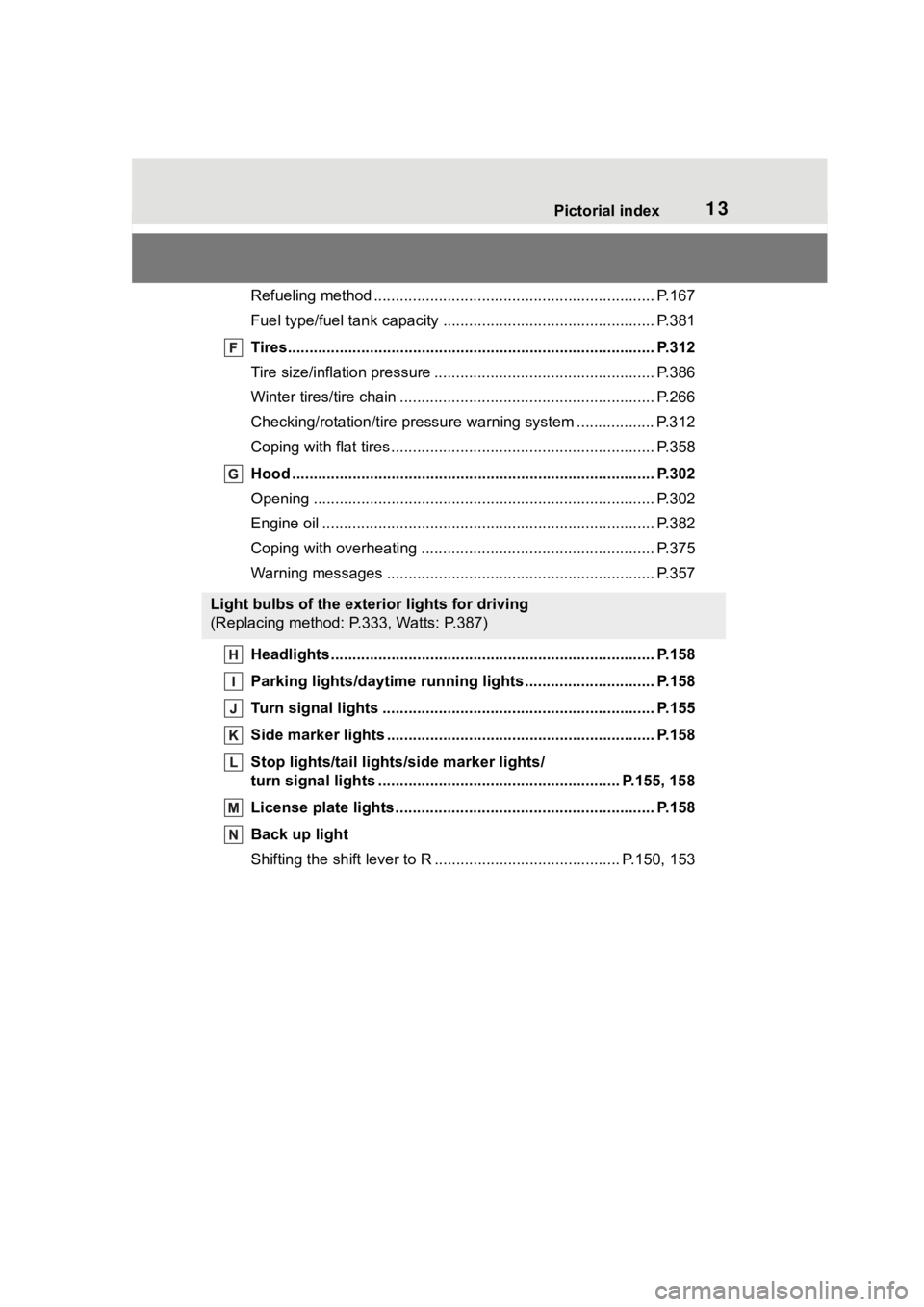
Refueling method ................................................................. P.167
Fuel type/fuel tan k capacity ................................... .............. P.381
Tires.......................................................... ........................... P.312
Tire size/inflation pressure ................................... ................ P.386
Winter tires/tire chain ........................................ ................... P.266
Checking/rotation/tire pressur e warning system ..................P.312
Coping with flat tires......................................... .................... P.358
Hood ........................................................... ......................... P.302
Opening ............................................................................... P.302
Engine oil ..................................................... ........................ P.382
Coping with overheating ...................................................... P.375
Warning messages ............................................... ............... P.357
Headlights..................................................... ...................... P.158
Parking lights/dayt ime running lights .......................... .... P.158
Turn signal lights ............................................. .................. P.155
Side marker lights ............................................. ................. P.158
Stop lights/tail light s/side marker lights/
turn signal lights ........................................................ P.155, 158
License plate lights........................................... ................. P.158
Back up light
Shifting the shift lever to R ........................................... P.150, 153
Light bulbs of the exterior lights for driving
(Replacing method: P.333, Watts: P.387)
Page 85 of 449
852-1. Instrument cluster
2
Vehicle status information and indicators
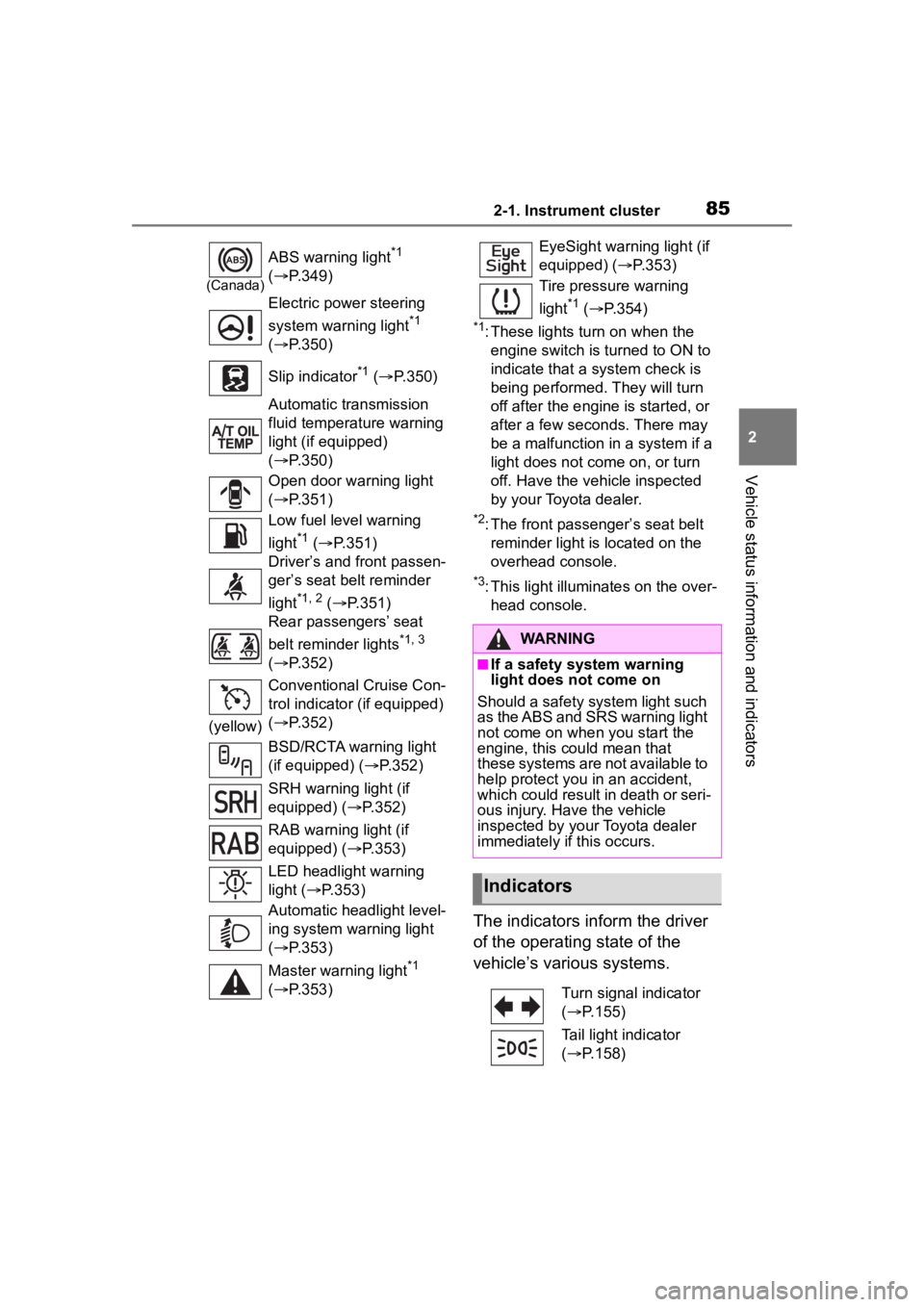
*1: These lights turn on when the
engine switch is turned to ON to
indicate that a system check is
being performed. They will turn
off after the engine is started, or
after a few seconds. There may
be a malfunction in a system if a
light does not come on, or turn
off. Have the vehicle inspected
by your Toyota dealer.
*2: The front passenger’s seat belt reminder light is located on the
overhead console.
*3: This light illuminates on the over-head console.
The indicators inform the driver
of the operating state of the
vehicle’s various systems.
(Canada)
ABS warning light*1
( P.349)
Electric power steering
system warning light
*1
( P.350)
Slip indicator
*1 ( P.350)
Automatic transmission
fluid temperature warning
light (if equipped)
( P.350)
Open door warning light
( P.351)
Low fuel level warning
light
*1 ( P.351)
Driver’s and front passen-
ger’s seat belt reminder
light
*1, 2 ( P.351)
Rear passengers’ seat
belt reminder lights
*1, 3
( P.352)
(yellow) Conventional Cruise Con-
trol indicator (if equipped)
(
P.352)
BSD/RCTA warning light
(if equipped) ( P.352)
SRH warning light (if
equipped) ( P.352)
RAB warning light (if
equipped) ( P.353)
LED headlight warning
light ( P.353)
Automatic headlight level-
ing system warning light
( P.353)
Master warning light
*1
( P.353)
EyeSight warning light (if
equipped) ( P.353)
Tire pressure warning
light
*1 ( P.354)
WARNING
■If a safety system warning
light does not come on
Should a safety system light such
as the ABS and SRS warning light
not come on when you start the
engine, this could mean that
these systems are not available to
help protect you in an accident,
which could result in death or seri-
ous injury. Have the vehicle
inspected by you r Toyota dealer
immediately if this occurs.
Indicators
Turn signal indicator
( P.155)
Tail light indicator
( P.158)
Page 301 of 449
3016-3. Do-it-yourself maintenance
6
Maintenance and care
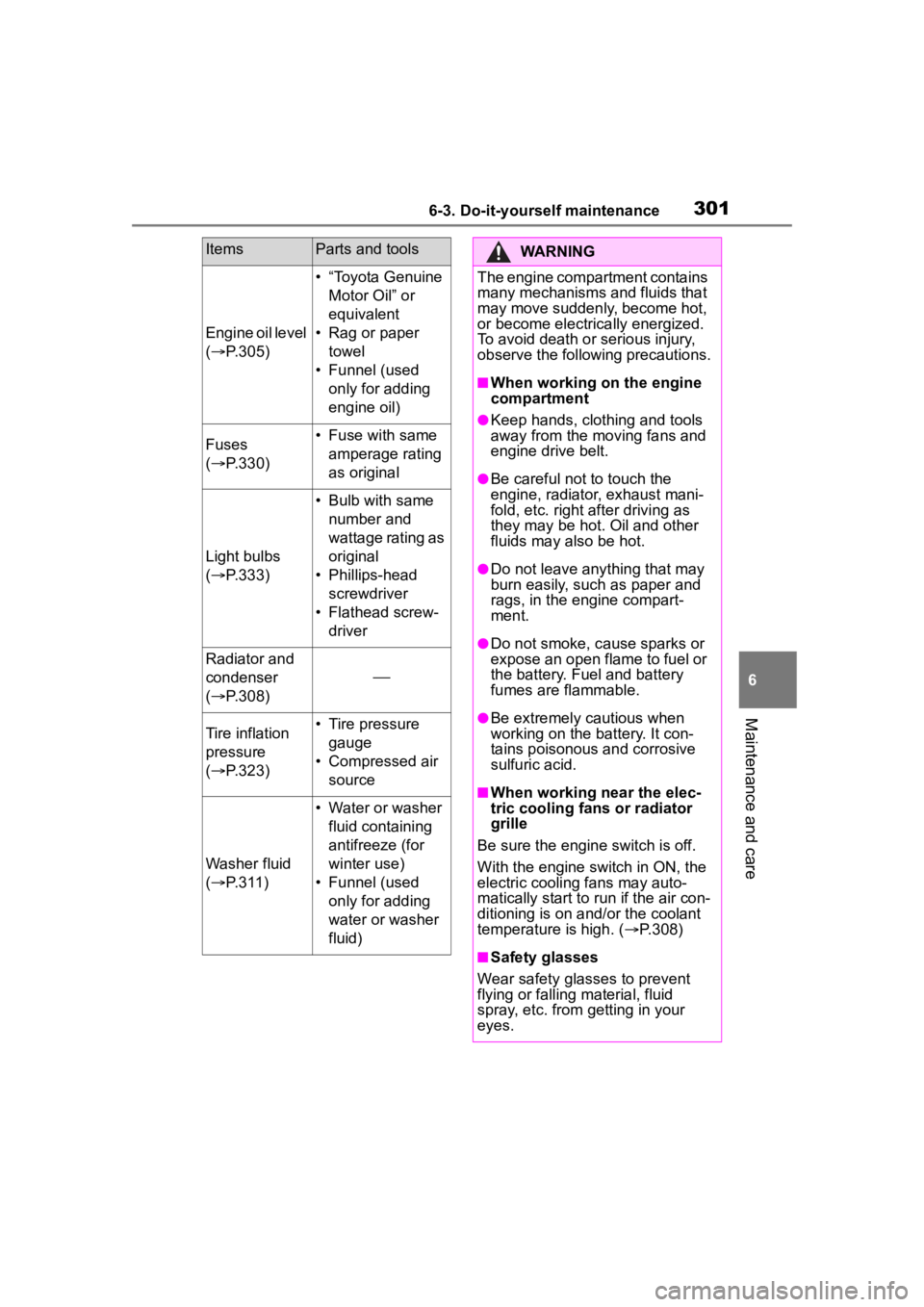
Engine oil level
( P.305)
• “Toyota Genuine
Motor Oil” or
equivalent
• Rag or paper towel
• Funnel (used only for adding
engine oil)
Fuses
( P.330)• Fuse with same
amperage rating
as original
Light bulbs
( P.333)
• Bulb with same
number and
wattage rating as
original
• Phillips-head screwdriver
• Flathead screw- driver
Radiator and
condenser
( P.308)
Tire inflation
pressure
( P.323)• Tire pressure
gauge
• Compressed air source
Washer fluid
( P.311)
• Water or washer
fluid containing
antifreeze (for
winter use)
• Funnel (used only for adding
water or washer
fluid)
ItemsParts and toolsWARNING
The engine compartment contains
many mechanisms and fluids that
may move suddenly, become hot,
or become electrically energized.
To avoid death or serious injury,
observe the following precautions.
■When working on the engine
compartment
●Keep hands, clothing and tools
away from the moving fans and
engine drive belt.
●Be careful not to touch the
engine, radiator, exhaust mani-
fold, etc. right a fter driving as
they may be hot. Oil and other
fluids may also be hot.
●Do not leave anything that may
burn easily, such as paper and
rags, in the engine compart-
ment.
●Do not smoke, cause sparks or
expose an open flame to fuel or
the battery. Fuel and battery
fumes are flammable.
●Be extremely cautious when
working on the battery. It con-
tains poisonous and corrosive
sulfuric acid.
■When working near the elec-
tric cooling fans or radiator
grille
Be sure the engine switch is off.
With the engine switch in ON, the
electric cooling fans may auto-
matically start to r un if the air con-
ditioning is on an d/or the coolant
temperature is high. ( P.308)
■Safety glasses
Wear safety glasses to prevent
flying or falling material, fluid
spray, etc. from getting in your
eyes.
Page 324 of 449
3246-3. Do-it-yourself maintenance
Tire pressure gauge
1 Remove the tire valve cap.
2 Press the tip of the tire pres-
sure gauge onto the tire
valve.
3 Read the pressure using the
gauge gradations.
4 If the tire inflation pressure is
not at the recommended
level, adjust the pressure.
If you add too much air, press
the center of the valve to
deflate.
5 After completing the tire infla-
tion pressure measurement
and adjustment, apply soapy
water to the valve and check
for leakage.
6 Put the tire valve cap back
on.
■Tire inflation pressure check
interval
You should check tire inflation pres-
sure every two weeks, or at least
once a month.
■Effects of incorrect tire inflation
pressure
Driving with incorrect tire inflation
pressure may result in the following:
●Reduced fuel economy
●Reduced driving comfort and poor
handling
●Reduced tire life due to wear
●Reduced safety
●Damage to the drivetrain
If a tire needs frequent inflating,
have it checked by your Toyota
dealer.
■Instructions for checking tire
inflation pressure
When checking tire inflation pres-
sure, observe the following:
●Check only when the tires are
cold.
If your vehicle has been parked for
at least 3 hours or has not been
driven for more than 1 mile or 1.5
km, you will get an accurate cold
tire inflation pressure reading.
●Always use a tire pressure gauge.
It is difficult to j udge if a tire is
properly inflated based only on its
appearance.
●It is normal for the tire inflation
pressure to be higher after driving
as heat is generated in the tire. Do
not reduce tire inflation pressure
after driving.
●Never exceed the vehicle capacity
weight.
Passengers and luggage weight
should be placed so that the vehi-
cle is balanced.
WARNING
■Proper inflation is critical to
save tire performance
Keep your tires properly inflated.
If the tires are not properly
inflated, the following conditions
may occur which could lead to an
accident resulting in death or seri-
ous injury:
●Excessive wear
●Uneven wear
●Poor handling
●Possibility of blowouts resulting
from overheated tires
●Air leaking from between tire
and wheel
●Wheel deformation and/or tire
damage
Page 354 of 449
3547-2. Steps to take in an emergency
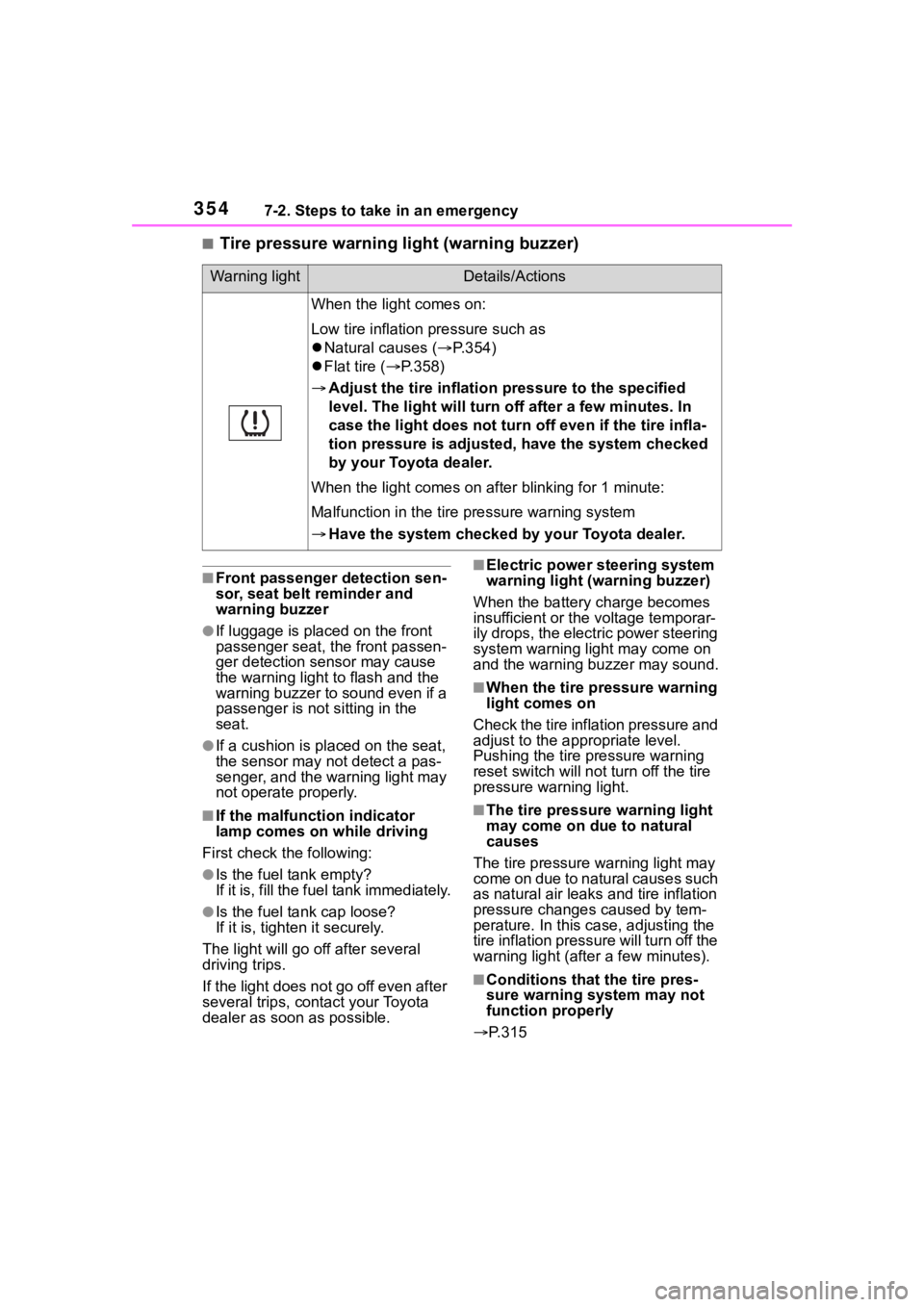
■Tire pressure warning light (warning buzzer)
■Front passenger detection sen-
sor, seat belt reminder and
warning buzzer
●If luggage is placed on the front
passenger seat, the front passen-
ger detection sensor may cause
the warning light to flash and the
warning buzzer to sound even if a
passenger is not sitting in the
seat.
●If a cushion is placed on the seat,
the sensor may not detect a pas-
senger, and the warning light may
not operate properly.
■If the malfunction indicator
lamp comes on while driving
First check the following:
●Is the fuel t ank empty?
If it is, fill the f uel tank immediately.
●Is the fuel tank cap loose?
If it is, tighten it securely.
The light will go o ff after several
driving trips.
If the light does not go off even after
several trips, contact your Toyota
dealer as soon as possible.
■Electric power steering system
warning light (warning buzzer)
When the battery charge becomes
insufficient or the voltage temporar-
ily drops, the electric power steering
system warning light may come on
and the warning buzzer may sound.
■When the tire pressure warning
light comes on
Check the tire inflation pressure and
adjust to the appropriate level.
Pushing the tire pressure warning
reset switch will not turn off the tire
pressure warning light.
■The tire pressure warning light
may come on due to natural
causes
The tire pressure warning light may
come on due to natural causes such
as natural air leaks and tire inflation
pressure changes caused by tem-
perature. In this ca se, adjusting the
tire inflation pressure will turn off the
warning ligh t (after a few minutes).
■Conditions that the tire pres-
sure warning system may not
function properly
P.315
Warning lightDetails/Actions
When the light comes on:
Low tire inflation pressure such as
Natural causes ( P.354)
Flat tire ( P.358)
Adjust the tir e inflation pressure to the specified
level. The light will turn of f after a few minutes. In
case the light does not turn off even if the tire infla-
tion pressure is adjusted, have the system checked
by your Toyota dealer.
When the light comes on a fter blinking for 1 minute:
Malfunction in the tire pressure warning system
Have the system checked by your Toyota dealer.
Page 356 of 449
3567-2. Steps to take in an emergency
WARNING
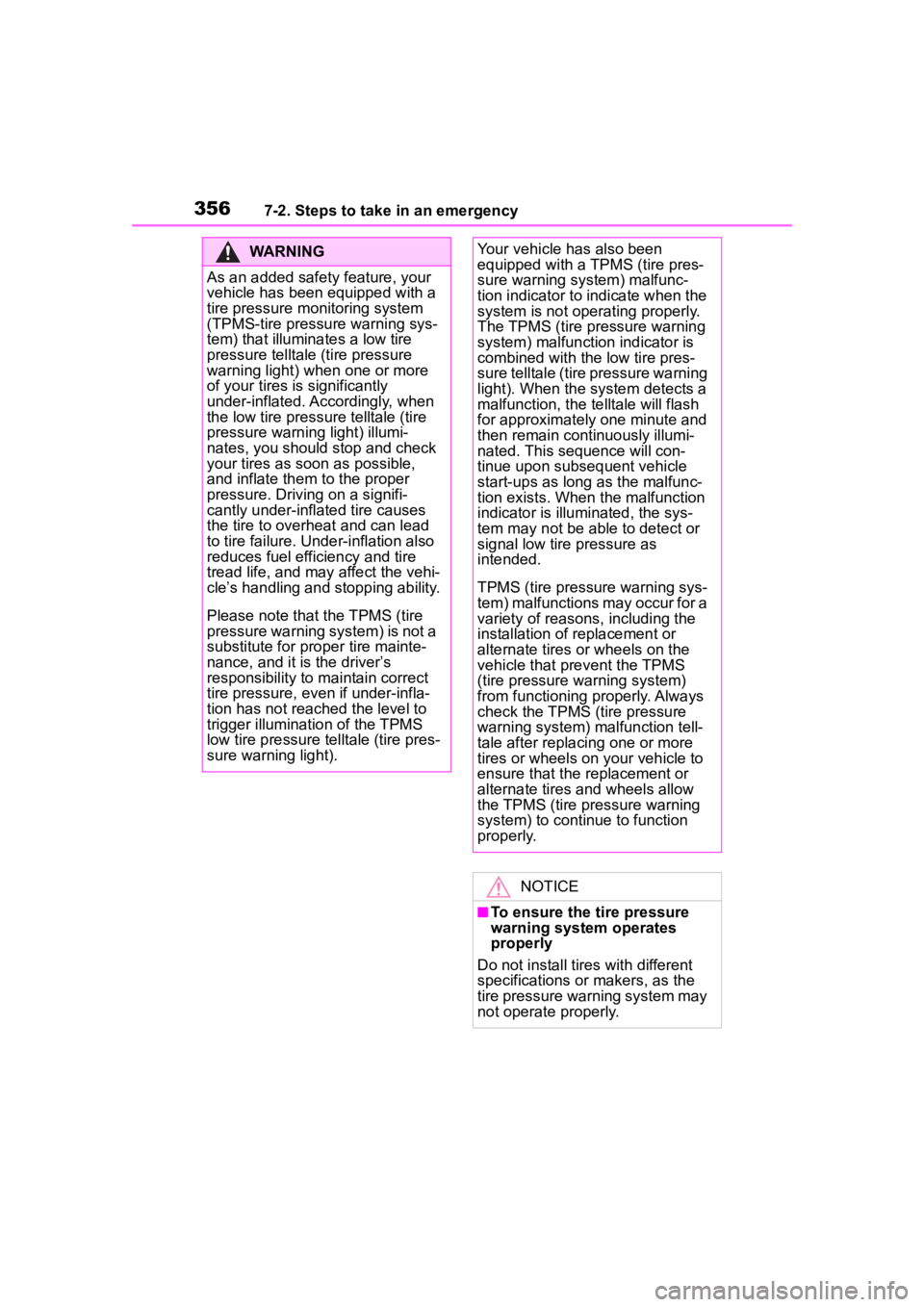
As an added safety feature, your
vehicle has been equipped with a
tire pressure m onitoring system
(TPMS-tire pressure warning sys-
tem) that illuminates a low tire
pressure telltale (tire pressure
warning light) when one or more
of your tires is significantly
under-inflated. Accordingly, when
the low tire pressure telltale (tire
pressure warning light) illumi-
nates, you should stop and check
your tires as soon as possible,
and inflate them to the proper
pressure. Driving on a signifi-
cantly under-inflated tire causes
the tire to overheat and can lead
to tire failure. Under-inflation also
reduces fuel efficiency and tire
tread life, and may affect the vehi-
cle’s handling and stopping ability.
Please note that the TPMS (tire
pressure warning system) is not a
substitute for pro per tire mainte-
nance, and it is the driver’s
responsibility to maintain correct
tire pressure, even if under-infla-
tion has not reach ed the level to
trigger illumination of the TPMS
low tire pressure telltale (tire pres-
sure warning light).
Your vehicle has also been
equipped with a TPMS (tire pres-
sure warning system) malfunc-
tion indicator to indicate when the
system is not operating properly.
The TPMS (tire pressure warning
system) malfunction indicator is
combined with the low tire pres-
sure telltale (tire pressure warning
light). When the system detects a
malfunction, the te lltale will flash
for approximately one minute and
then remain continuously illumi-
nated. This sequence will con-
tinue upon subsequent vehicle
start-ups as long as the malfunc-
tion exists. When the malfunction
indicator is illuminated, the sys-
tem may not be ab le to detect or
signal low tire pressure as
intended.
TPMS (tire pressure warning sys-
tem) malfunctions may occur for a
variety of reasons, including the
installation of replacement or
alternate tires or wheels on the
vehicle that prevent the TPMS
(tire pressure warning system)
from functioning properly. Always
check the TPMS (tire pressure
warning system) malfunction tell-
tale after replacing one or more
tires or wheels on your vehicle to
ensure that the replacement or
alternate tires and wheels allow
the TPMS (tire pressure warning
system) to continue to function
properly.
NOTICE
■To ensure the tire pressure
warning system operates
properly
Do not install tires with different
specifications or makers, as the
tire pressure warning system may
not operate properly.
Page 367 of 449
3677-2. Steps to take in an emergency
7
When trouble arises
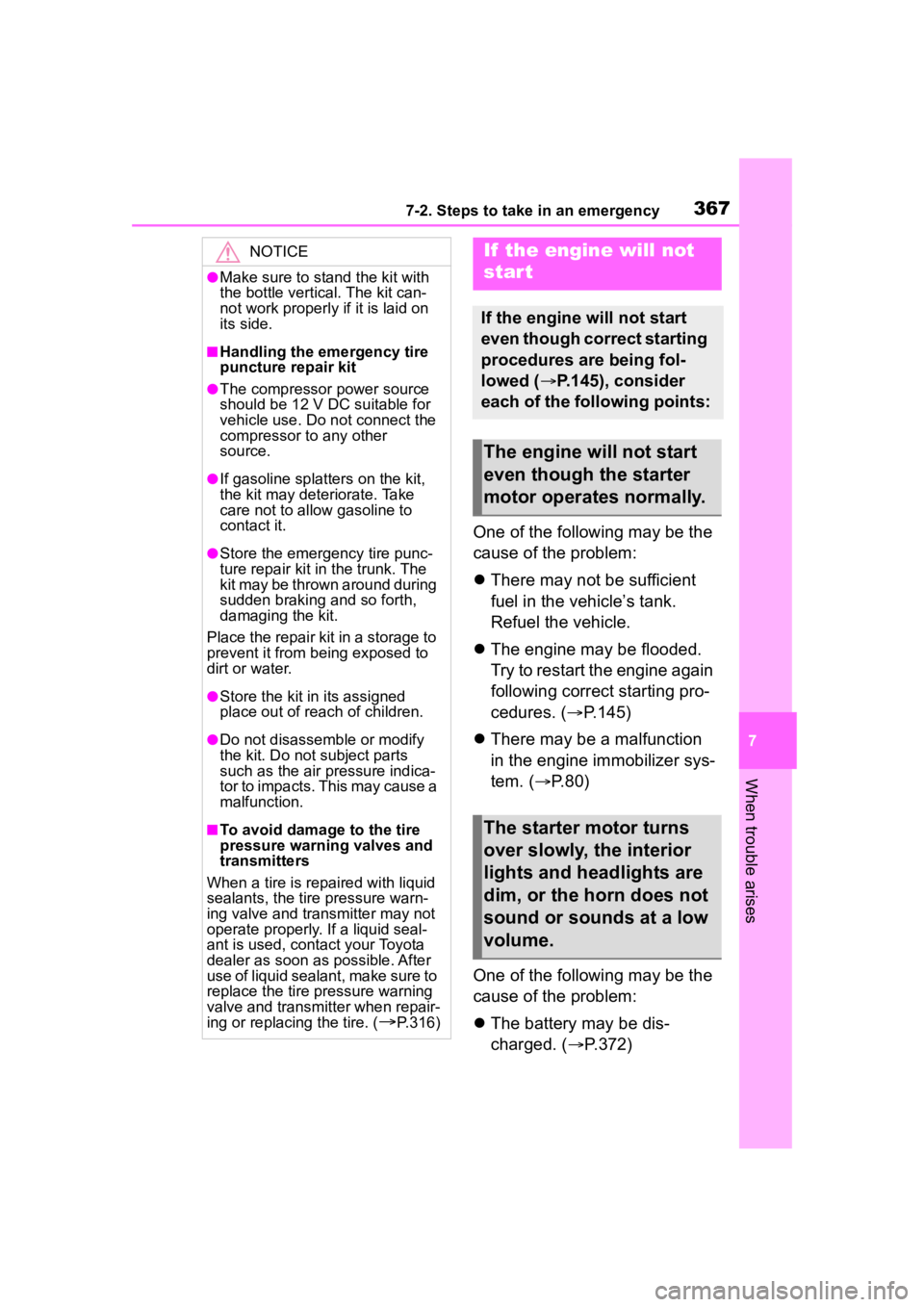
One of the following may be the
cause of the problem:
There may not be sufficient
fuel in the vehicle’s tank.
Refuel the vehicle.
The engine may be flooded.
Try to restart the engine again
following correct starting pro-
cedures. ( P.145)
There may be a malfunction
in the engine immobilizer sys-
tem. ( P.80)
One of the following may be the
cause of the problem:
The battery may be dis-
charged. ( P.372)
NOTICE
●Make sure to stand the kit with
the bottle vertical. The kit can-
not work properly if it is laid on
its side.
■Handling the emergency tire
puncture repair kit
●The compressor power source
should be 12 V DC suitable for
vehicle use. Do not connect the
compressor to any other
source.
●If gasoline splatters on the kit,
the kit may deteriorate. Take
care not to allo w gasoline to
contact it.
●Store the emergency tire punc-
ture repair kit in the trunk. The
kit may be thrown around during
sudden braking and so forth,
damaging the kit.
Place the repair kit in a storage to
prevent it from b eing exposed to
dirt or water.
●Store the kit in its assigned
place out of reach of children.
●Do not disassemble or modify
the kit. Do not subject parts
such as the air pressure indica-
tor to impacts. This may cause a
malfunction.
■To avoid damage to the tire
pressure warning valves and
transmitters
When a tire is repaired with liquid
sealants, the tire pressure warn-
ing valve and transmitter may not
operate properly. If a liquid seal-
ant is used, contact your Toyota
dealer as soon as possible. After
use of liquid sealant, make sure to
replace the tire pressure warning
valve and transmitter when repair-
ing or replacing the tire. (
P.316)
If the engine will not
star t
If the engine will not start
even though correct starting
procedures are being fol-
lowed ( P.145), consider
each of the following points:
The engine will not start
even though the starter
motor operates normally.
The starter motor turns
over slowly, the interior
lights and headlights are
dim, or the horn does not
sound or sounds at a low
volume.
Page 394 of 449
3948-1. Specifications
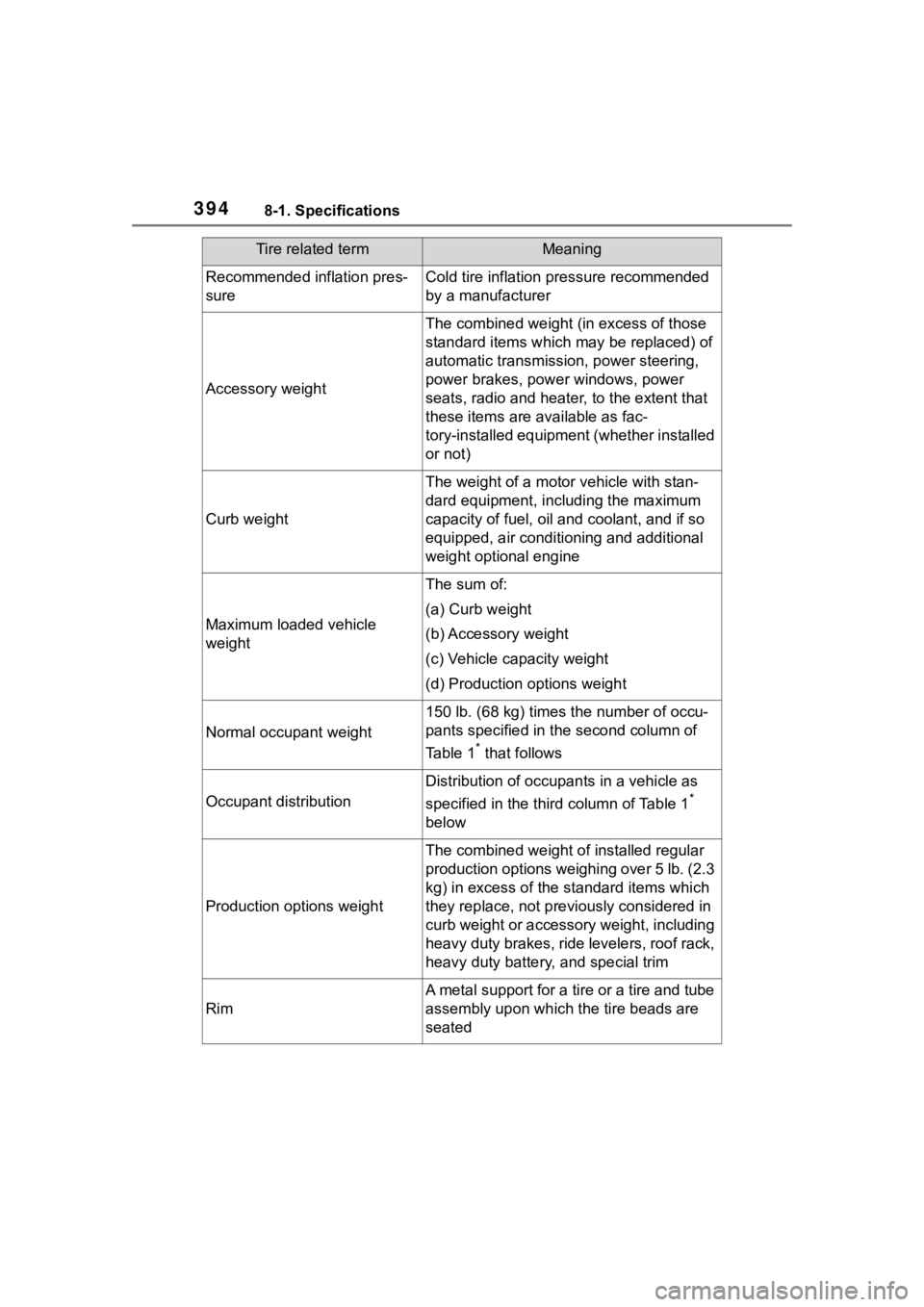
Recommended inflation pres-
sureCold tire inflation pressure recommended
by a manufacturer
Accessory weight
The combined weight (in excess of those
standard items which may be replaced) of
automatic transmission, power steering,
power brakes, power windows, power
seats, radio and heater, to the extent that
these items are available as fac-
tory-installed equipment (whether installed
or not)
Curb weight
The weight of a motor vehicle with stan-
dard equipment, including the maximum
capacity of fuel, oil and coolant, and if so
equipped, air conditioning and additional
weight optional engine
Maximum loaded vehicle
weight
The sum of:
(a) Curb weight
(b) Accessory weight
(c) Vehicle capacity weight
(d) Production options weight
Normal occupant weight
150 lb. (68 kg) times the number of occu-
pants specified in the second column of
Table 1
* that follows
Occupant distribution
Distribution of occupan ts in a vehicle as
specified in the thi rd column of Table 1
*
below
Production options weight
The combined weight o f installed regular
production options weighing over 5 lb. (2.3
kg) in excess of the s tandard items which
they replace, not previously considered in
curb weight or accessory weight, including
heavy duty brakes, ride levelers, roof rack,
heavy duty battery, and special trim
Rim
A metal support for a tire or a tire and tube
assembly upon which the tire beads are
seated
Tire related termMeaning
Page 432 of 449

432Alphabetical Index
Pre-Collision Throttle Manage-ment ................................... 215
Temporary stop .................... 228
F
Flat tire Tire pressure warning system........................................... 315
Vehicles without a spare tire 358
Floor mats ................................. 22
Fluid Automatic transmission ........ 384
Brake ............................ 308, 385
Clutch ................................... 308
Manual transmission ............ 385
Washer ................................. 311
Front passenger occupant clas- sification system .................... 56
Front position lights Wattage ................................ 387
Front seats Adjustment ........................... 119
Cleaning ....................... 291, 293
Correct driving posture ........... 23
Head restraints ..................... 123
Seat heaters ......................... 276
Front side marker light Light switch .......................... 158
Front turn signal lights Replacing light bulbs ............ 334
Turn signal lever ................... 155
Wattage ................................ 387
Fuel Capacity ............................... 381
Fuel gauge ............................. 88
Fuel pump shut off system ... 347
Information ........................... 388
Refueling .............................. 167
Type ..................................... 381
Warning light ........................ 351 Fuel filler door
If the fuel filler door cannot be opened ...............................369
Refueling ..............................167
Fuel gauge.................................88
Fuel pump shut off system ....347
Fuses .......................................330
G
Gauges ......................................88
G-force .......................................96
Glove box ................................279
H
Head restraints .......................123
Headlight aim ..........................332
Headlights High Beam Assist system .....162
Light switch...........................158
Replacing light bulbs ............334
Wattage ................................387
Heaters Automatic air conditioning sys-tem .....................................270
Outside rear view mirrors .....272
Seat heaters ....... ..................276
High Beam Assist ...................162
High mounted stoplight Replacing light bulbs ............334
Hill-start assist control...........262
Hood Open.....................................302
Hooks Retaining hooks (floor mat) ....22
Horn .........................................125
I
I/M test .....................................299
Identification Engine ..................................381