tire type TOYOTA 86 2023 Owners Manual
[x] Cancel search | Manufacturer: TOYOTA, Model Year: 2023, Model line: 86, Model: TOYOTA 86 2023Pages: 449, PDF Size: 8.5 MB
Page 13 of 449
13Pictorial index
Refueling method ................................................................. P.167
Fuel type/fuel tan k capacity ................................... .............. P.381
Tires.......................................................... ........................... P.312
Tire size/inflation pressure ................................... ................ P.386
Winter tires/tire chain ........................................ ................... P.266
Checking/rotation/tire pressur e warning system ..................P.312
Coping with flat tires......................................... .................... P.358
Hood ........................................................... ......................... P.302
Opening ............................................................................... P.302
Engine oil ..................................................... ........................ P.382
Coping with overheating ...................................................... P.375
Warning messages ............................................... ............... P.357
Headlights..................................................... ...................... P.158
Parking lights/dayt ime running lights .......................... .... P.158
Turn signal lights ............................................. .................. P.155
Side marker lights ............................................. ................. P.158
Stop lights/tail light s/side marker lights/
turn signal lights ........................................................ P.155, 158
License plate lights........................................... ................. P.158
Back up light
Shifting the shift lever to R ........................................... P.150, 153
Light bulbs of the exterior lights for driving
(Replacing method: P.333, Watts: P.387)
Page 51 of 449
511-1. For safe use
1
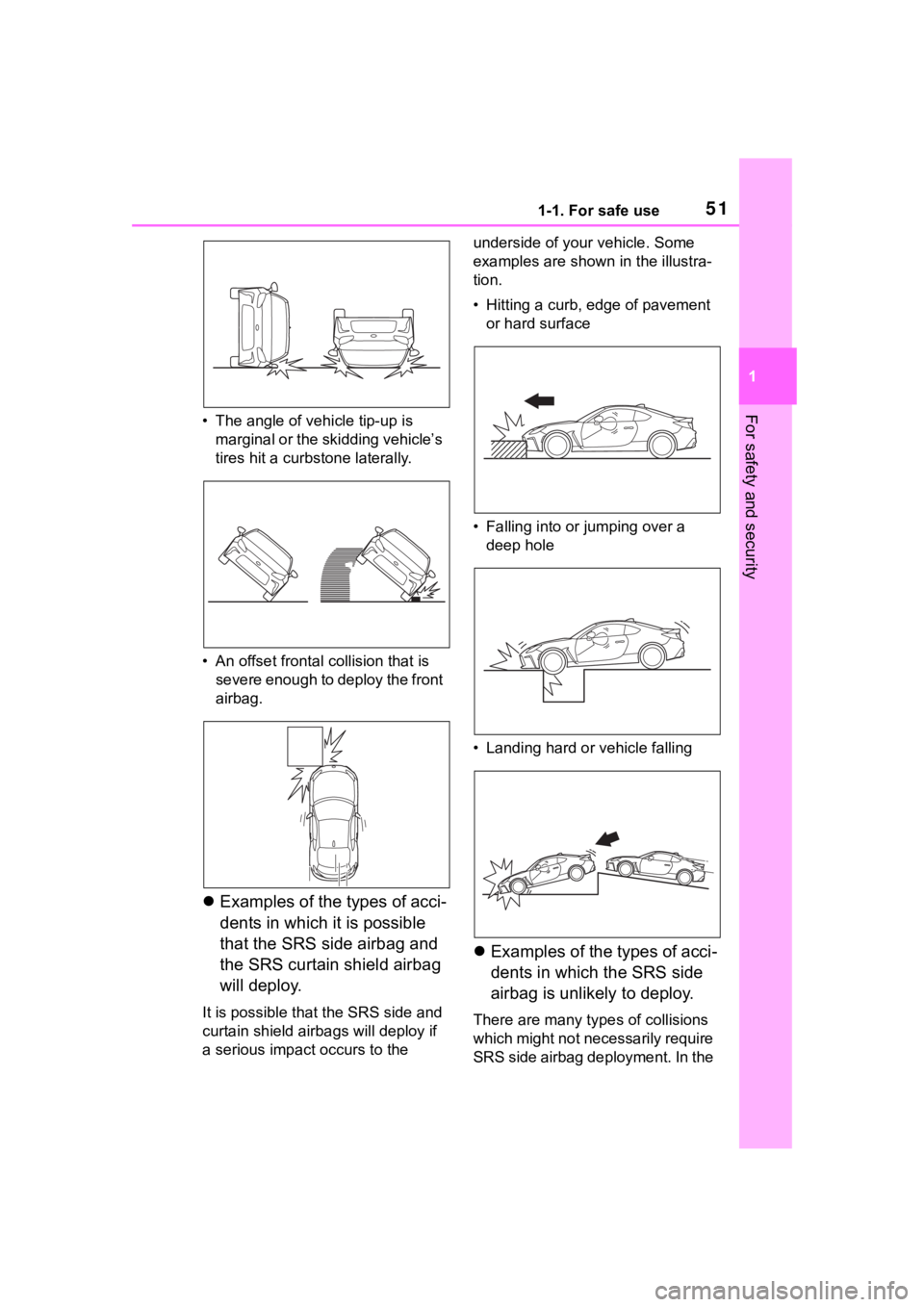
For safety and security• The angle of vehicle tip-up is marginal or the skidding vehicle’s
tires hit a curbstone laterally.
• An offset frontal collision that is
severe enough to deploy the front
airbag.
Examples of the types of acci-
dents in which it is possible
that the SRS side airbag and
the SRS curtain shield airbag
will deploy.
It is possible that the SRS side and
curtain shield air bags will deploy if
a serious impact occurs to the underside of your vehicle. Some
examples are shown
in the illustra-
tion.
• Hitting a curb, edge of pavement or hard surface
• Falling into or jumping over a
deep hole
• Landing hard or vehicle falling
Examples of the types of acci-
dents in which the SRS side
airbag is unlikely to deploy.
There are many types of collisions
which might not necessarily require
SRS side airbag deployment. In the
Page 266 of 449
2664-7. Driving tips
4-7.Driving tips
Use fluids that are appropriate
to the prevailing outside tem-
peratures.
• Engine oil
• Engine coolant
• Washer fluid
Have a service technician
inspect the condition of the
battery.
Have the vehicle fitted with
four snow tires.
Make sure to install 4 tires that are
of the specified size, and that all 4
tires are the sa me size, same
maker, same brand and tread pat-
tern.
Perform the following according
to the driving conditions:
Do not try to forcibly open a
window or move a wiper that
is frozen. Pour warm water
over the frozen area to melt
the ice. Wipe away the water
immediately to prevent it from
freezing.
To ensure proper operation of
the climate control system
fan, remove any snow that
has accumulated on the air
inlet vents in front of the wind-
shield.
Check for and remove any
excess ice or snow that may
have accumulated on the
exterior lights, vehicle’s roof,
Winter driving tips
Carry out the necessary
preparations and inspec-
tions before driving the
vehicle in winter. Always
drive the vehicle in a man-
ner appropriate to the pre-
vailing weather conditions.
Preparation for winter
WARNING
■Driving with snow tires
Observe the following precautions
to reduce the risk of accidents.
Failure to do so m ay result in a
loss of vehicle control and cause
death or serious injury.
●Use tires of the specified size,
and that are the same size,
same maker, same brand and
tread pattern.
●Maintain the recommended
level of air pressure.
●Do not drive in excess of 75
mph (120 km/h), regardless of
the type of snow tires being
used.
●Use snow tires on all, not just
some wheels.
NOTICE
■Repairing or replacing snow
tires
Request repairs or replacement of
snow tires from Toyota dealers or
legitimate tire retailers.
This is because the removal and
attachment of snow tires affects
the operation of the tire pressure
warning valves and transmitters.
Before driving the vehicle
Page 268 of 449

2684-7. Driving tips
Tire chains cannot be used on
your vehicle because of the lack
of clearance between the tires
and vehicle body.
When tire chains cannot be
used, use of another type of
traction device (such as spring
chains) may be acceptable if
use on your vehicle is recom-
mended by the device manufac-
turer, taking into account tire
size and road conditions. Follow
the device manufacturer's
instructions, especially regard-
ing maximum vehicle speed.
To help avoid damage to your
vehicle, drive slowly, readjust or
remove the device if it is con-
tacting your vehicle, and do not
spin your wheels. Damage
caused to your vehicle by use of
a traction device is not covered
under warranty.
Make certain that any traction
device you use is an SAE class
“S” device, and use it on the rear
wheels only. Always use the
utmost care when driving with a
traction device. Overconfidence
b e c a u s e y o u a r e u s i n g a t r a c t i o n
device could easily lead to a
serious accident.
We recommend that you consult
your Toyota dealer for informa-tion about the chains that you
can use.
Tire chains
Selecting tire chains
Page 313 of 449

3136-3. Do-it-yourself maintenance
6
Maintenance and care
etc., molded into the sidewall of
each tire.
Replace the tires if the treadwear
indicators are showing on a tire.
■When to replace your vehicle’s
tires
Tires should be replaced if:
●The treadwear indicators are
showing on a tire.
●You have tire damage such as
cuts, splits, cracks deep enough
to expose the fabric, and bulges
indicating internal damage
●A tire goes flat r epeatedly or can-
not be properly repaired due to the
size or location of a cut or other
damage
If you are not sure, consult your Toy-
ota dealer.
■Tire life
Any tire over 6 years old must be
checked by a qualified technician
even if it has seldom or never been
used or damage i s not obvious.
■Low profile tires
Generally, low prof ile tires will wear
more rapidly and t ire grip perfor-
mance will be reduced on snowy
and/or icy roads when compared to
standard tires. Be sure to use snow
tires or tire chains on snowy and/or
icy roads and drive carefully at a
speed appropriate for road and
weather conditions.
■Maximum load of tire
Check that the maximum load of the
replacement tire is greater than 1/2
of the Gross Axle Weight Ratings
(GAWR) of either the front axle or
the rear axle, whichever is greater.
For the GAWR, see the Certification
Label. For the maximum load of the
tire, see the load limit at maximum
cold tire inflation pressure men-
tioned on the sidewall of the tire.
( P.390)
■Tire types
●Summer tires
Summer tires are high-speed perfor-
mance tires best suited to highway
driving under dry conditions. Since
summer tires do not have the same
traction performance as snow tires,
summer tires are inadequate for
driving on snow-covered or icy
roads. For driving on snow-covered
roads or icy roads, the use of snow
tires is recommended. When install-
ing snow tires, be sure to replace all
four tires.
●All season tires
All season tires are designed to pro-
vide better traction in snow and to
be adequate for driving in most win-
ter conditions as well as for use
year-round. All se ason tires, how-
ever, do not have adequate traction
performance compared with snow
tires in heavy or loose snow. Also,
all season tires fall short in accelera-
tion and handling performance com-
pared with summer tires in highway
driving.
●Snow tires
For driving on snow-covered roads
or icy roads, we recommend using
snow tires. If you need snow tires,
select tires of the same size, con-
struction and load capacity as the
originally installed tires. Since your
vehicle has radial tires as original
equipment, make sure your snow
Page 325 of 449
3256-3. Do-it-yourself maintenance
6
Maintenance and care
When replacing wheels, care
should be taken to ensure that
they are equivalent to those
removed in load capacity, diam-
eter, rim width and inset
*.
Replacement wheels are avail-
able at your Toyota dealer.
*: Conventionally referred to as off- set.
Toyota does not recommend
using the following:
Wheels of different sizes or
types
Used wheels
Bent wheels that have been
straightened
■When replacing wheels
The wheels of your vehicle are
equipped with tire pressure warning
valves and transmitters that allow
the tire pressure warning system to
provide advance warning in the
event of a loss in tire inflation pres-
sure. Whenever wheels are
replaced, tire pressure warning
valves and transmitters must be
installed. ( P.316)
WARNING
●Greater possibility of tire dam-
age while driving (due to road
hazards, expansion joints,
sharp edges in the road, etc.)
NOTICE
■When inspecting and adjust-
ing tire inflation pressure
Be sure to put the tire valve caps
back on.
If a valve cap is not installed, dirt
or moisture may get into the valve
and cause an air leak, resulting in
decreased tire inflation pressure.
Wheels
If a wheel is bent, cracked or
heavily corroded, it should
be replaced. Otherwise, the
tire may separate from the
wheel or cause a loss of
handling control.
Wheel selection
Page 341 of 449
3417-2. Steps to take in an emergency
7
When trouble arises
7-2.Steps to take in an emergency
If your vehicle needs
to be towed
If towing is necessary, we
recommend having your
vehicle towed by your Toy-
ota dealer or commercial
towing service, using a
wheel-lift type truck or flat-
bed truck.
Use a safety chain system
for all towing, and abide by
all state/provincial and local
laws.
If towing your vehicle with a
wheel-lift type truck from
the front, the vehicle's rear
wheels and axles must be in
good conditions. ( P.342)
If they are damaged, use a
towing dolly or flatbed
truck.
WARNING
Observe the following precau-
tions.
Failure to do so m ay result in
death or serious injury.
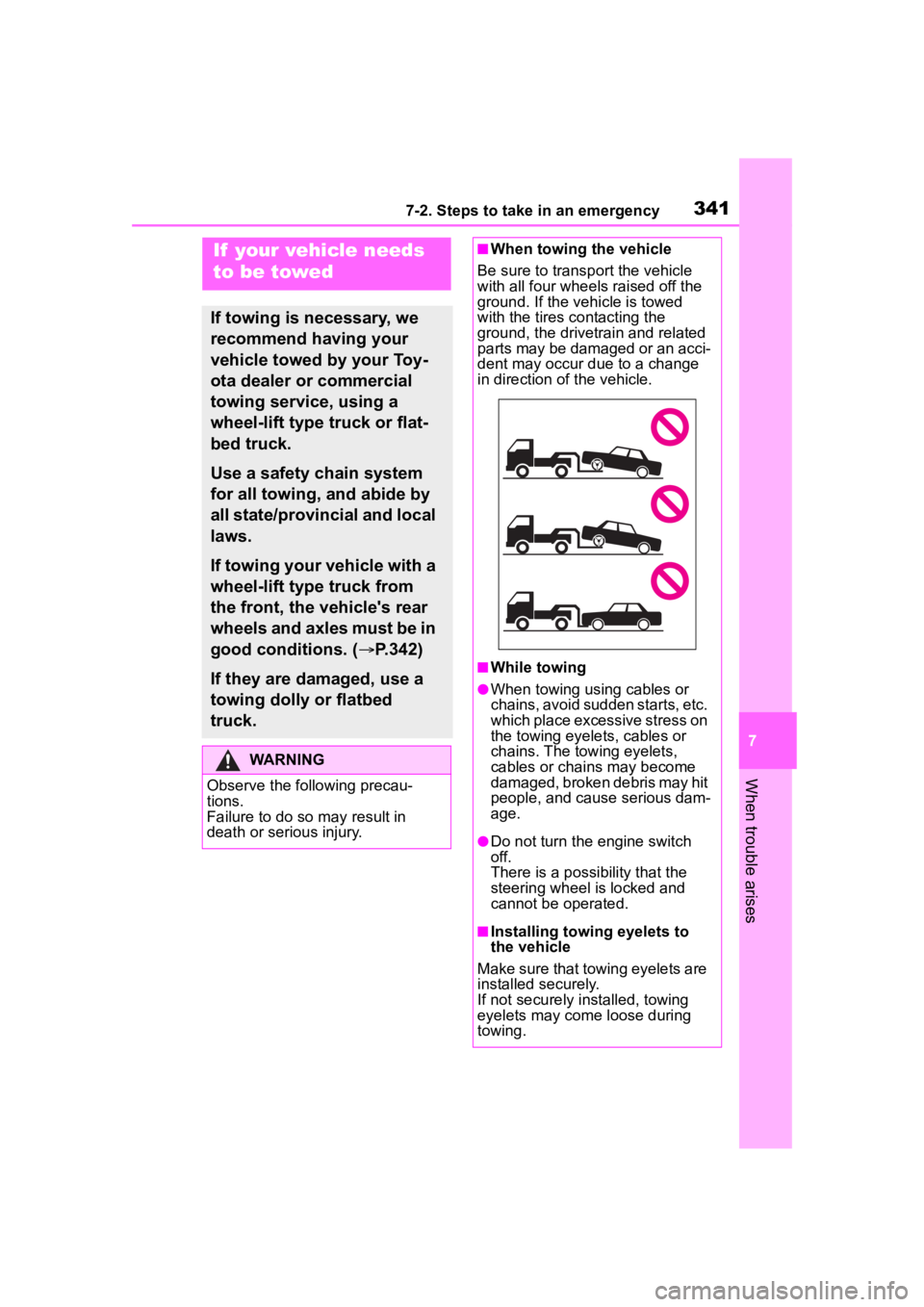
■When towing the vehicle
Be sure to transp ort the vehicle
with all four wheels raised off the
ground. If the vehicle is towed
with the tires co ntacting the
ground, the drivetrain and related
parts may be damaged or an acci-
dent may occur due to a change
in direction of the vehicle.
■While towing
●When towing using cables or
chains, avoid sudden starts, etc.
which place excessive stress on
the towing eyelets, cables or
chains. The towing eyelets,
cables or chains may become
damaged, broken debris may hit
people, and cause serious dam-
age.
●Do not turn the engine switch
off.
There is a possibility that the
steering wheel is locked and
cannot be operated.
■Installing towing eyelets to
the vehicle
Make sure that towing eyelets are
installed securely.
If not securely installed, towing
eyelets may come loose during
towing.
Page 343 of 449
3437-2. Steps to take in an emergency
7
When trouble arises
Use a towing dolly under the
front wheels.
When using a flat-bed truck to
transport the vehicle, use tire
strapping belts. Refer to the
owner’s manual of the flat-bed
truck for the tire strapping
method.
In order to suppress vehicle
movement during transporta-
tion, set the parking brake and
turn the engine switch off.
If a tow truck is not available in
an emergency, your vehicle may
be temporarily towed using
cables or chains secured to the
emergency towing eyelets. This
should only be attempted on
hard surfaced roads for at most
19 miles (30 km) at under 18
mph (30 km/h).
A driver must be in the vehicle to steer and operate the brakes.
The vehicle’s wheels, drive train,
axles, steering and brakes must
be in good condition.
For vehicles with an automatic
transmission, only the front tow-
ing eyelets may be used.
To have your vehicle towed by
another vehicle, the towing eye-
let must be installed to your
vehicle. Install the towing eyelet
using the following procedure.
1
Take out the wheel nut
wrench, flathead screwdriver
and towing eyelet. ( P.359)
2 Remove the eyelet cover
using a flathead screwdriver.
To protect the b odywork, place a
rag between the screwdriver and
the vehicle body as shown in the
NOTICE
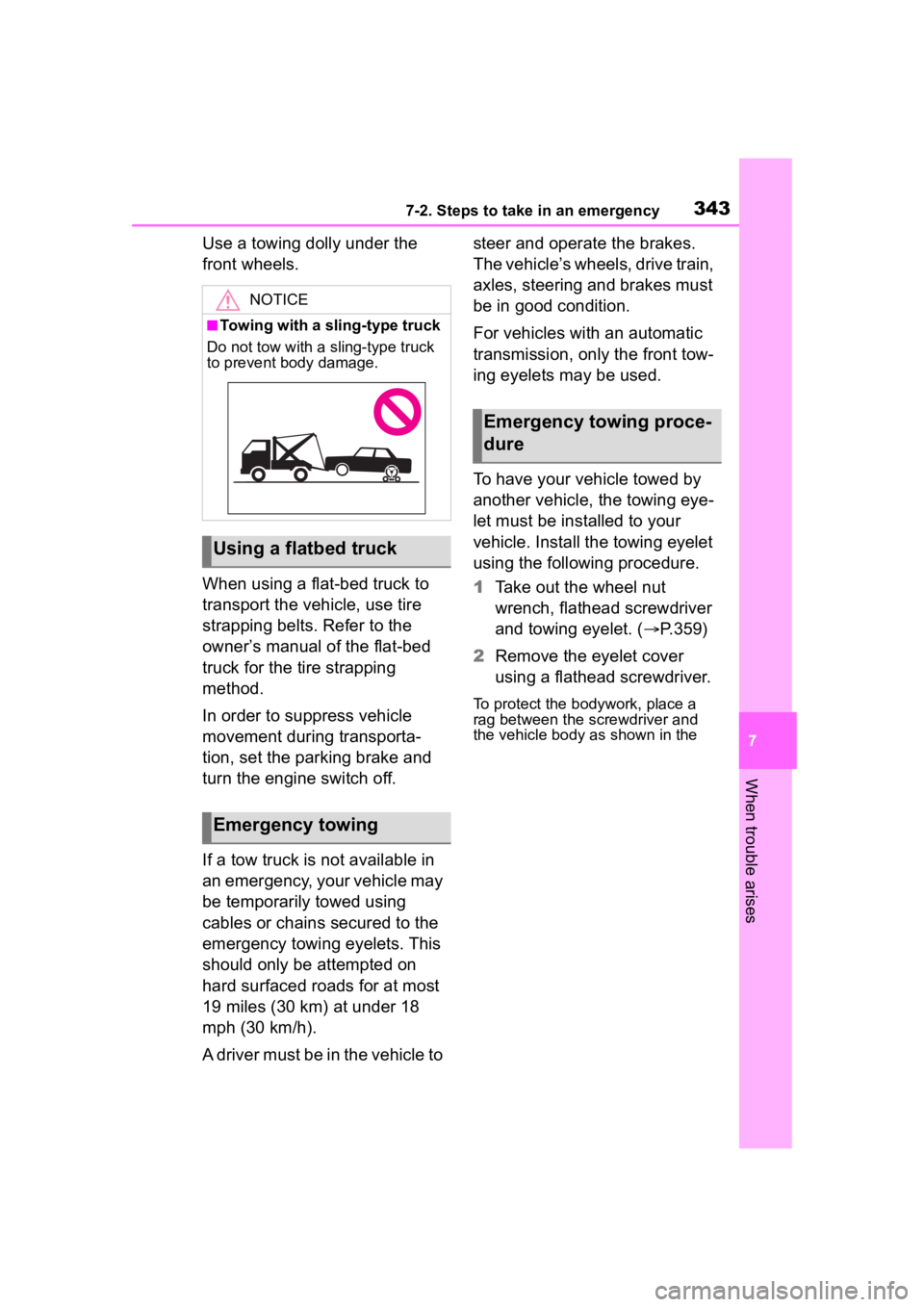
■Towing with a sling-type truck
Do not tow with a sling-type truck
to prevent body damage.
Using a flatbed truck
Emergency towing
Emergency towing proce-
dure
Page 361 of 449
3617-2. Steps to take in an emergency
7
When trouble arises
gency tire puncture repair kit can
be used only once to temporarily
repair a single tire. If the sealant
has been used and needs to be
purchased, contact your Toyota
dealer. The compressor is reus-
able.
●The sealant can be used when the
outside temperature is from -22°F
(-30°C) to 140°F (60°C).
●The kit is exclusively designed for
size and type of tires originally
installed on your vehicle. Do not
use it for tires that a different size
than the original ones, or for any
other purposes.
●If the sealant gets on your clothes,
it may stain.
●If the sealant adheres to a wheel
or the surface of the vehicle body,
the stain may not be removable if
it is not cleaned at once. Immedi-
ately wipe away the sealant with a
wet cloth.
●During operation of the kit, a loud
operation noise is produced. This
does not indicate a malfunction.
●Do not use the emergency tire
puncture repair kit to check or to
adjust the tire pressure.
●In extremely low temperatures
-22°F to -4°F (-30°C to -20°C), the
viscosity of the sealant increases
and the sealant will flow more
slowly. In such temperatures,
bring the sealant into the vehicle
to warm it up before use.
■Note for checking the emer-
gency tire puncture repair kit
Check the sealant expiry date occa-
sionally.
The expiry date is shown on the bot-
tle. Do not use sealant whose expiry
date has already passed. Other-
wise, repairs conducted using the
emergency tire puncture repair kit
may not be performed properly.
WARNING
■Caution while driving
●Store the repair kit in the trunk.
Injuries may result in the event
of an accident or sudden brak-
ing.
●The repair kit is exclusively only
for your vehicle.
Do not use repair kit on other
vehicles, which could lead to an
accident causing death or seri-
ous injury.
●Do not use repair kit for tires
that are differen t size than the
original ones, or for any other
purpose. If the tires have not
been completely repaired, it
could lead to an accident caus-
ing death or serious injury.
■Precautions for use of the
sealant
●Ingesting the sealant is hazard-
ous to your health. If you ingest
sealant, consume as much
water as possible, then immedi-
ately consult a doctor.
●If sealant gets in eyes or
adheres to skin, immediately
wash it off with water. If discom-
fort persists, consult a doctor.
●If a person who is allergic to nat-
ural rubber comes in contact the
sealant, allergy symptoms may
occur.
Page 386 of 449
3868-1. Specifications
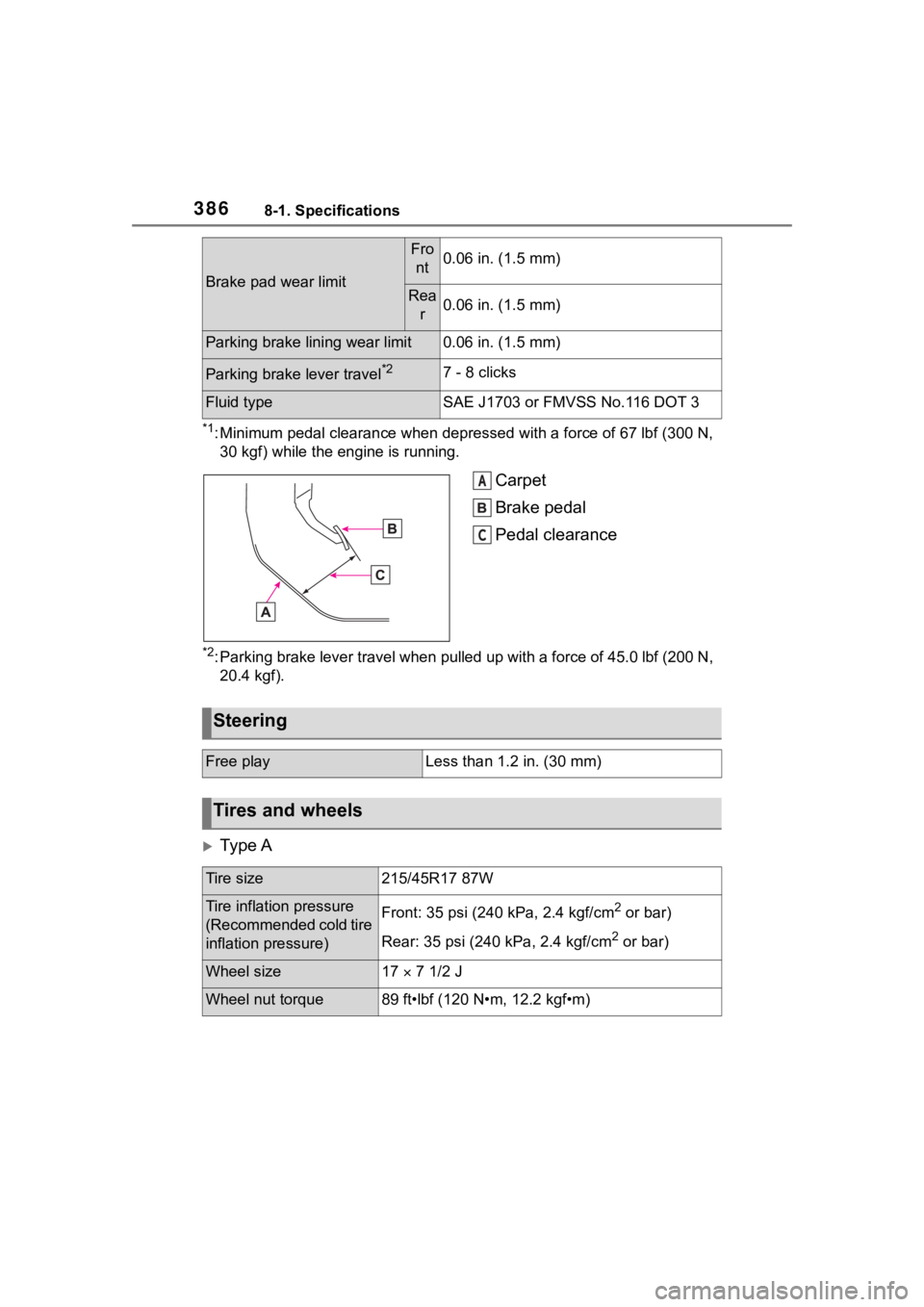
*1: Minimum pedal clearance when depressed with a force of 67 lbf (300 N,
30 kgf) while the engine is running.
Carpet
Brake pedal
Pedal clearance
*2: Parking brake lever travel when pulled up with a force of 45.0 lbf (200 N,
20.4 kgf).
Ty p e A
Brake pad wear limit
Fro nt0.06 in. (1.5 mm)
Rea r0.06 in. (1.5 mm)
Parking brake lining wear limit0.06 in. (1.5 mm)
Parking brake lever travel*27 - 8 clicks
Fluid typeSAE J1703 or FMVSS No.116 DOT 3
A
C
Steering
Free playLess than 1.2 in. (30 mm)
Tires and wheels
Tire size215/45R17 87W
Tire inflation pressure
(Recommended cold tire
inflation pressure)Front: 35 psi (240 kPa, 2.4 kgf/cm2 or bar)
Rear: 35 psi (240 kPa, 2.4 kgf/cm
2 or bar)
Wheel size17 7 1/2 J
Wheel nut torque89 ft•lbf (120 N•m, 12.2 kgf•m)