engine TOYOTA AURIS HYBRID 2011 User Guide
[x] Cancel search | Manufacturer: TOYOTA, Model Year: 2011, Model line: AURIS HYBRID, Model: TOYOTA AURIS HYBRID 2011Pages: 524, PDF Size: 26.34 MB
Page 170 of 524
170 2-1. Driving procedures
UK_AURIS_HV_EE
CAUTION
Do not adjust the display, the position of the steering wheel, the seat, or
the inside or outside rear view mirrors while driving.
Doing so may result in a loss of vehicle control that can cause accidents
that may result in death or serious injury.
Always check that all passengers' arms, heads or other parts of their bod-
ies are not outside the vehicle, as this may result in death or serious injury.
When driving on slippery road surfaces
Sudden braking, acceleration and steering may cause tire slippage and
reduce your ability to control the vehicle, resulting in an accident.
Abrupt changes from shift position D to B and rapid changes in the engine
speed could cause the vehicle to skid, resulting in an accident.
After driving through a puddle, lightly depress the brake pedal to make
sure that the brakes are functioning properly. Wet brake pads may prevent
the brakes from functioning properly. If the brakes on only one side are wet
and not functioning properly, steering control may be affected, resulting in
an accident.
When changing the shift position
Be careful not to change the shift position with the accelerator pedal
depressed.
This may lead to unexpected rapid acceleration of the vehicle that may
cause an accident and result in death or serious injury.
After the shift lever is operated, make sure to check the current shift position
using the shift position indicator. (P. 193)
When the vehicle is stopped
Do not race the hybrid system.
If the vehicle is in any shift position other than P or N, the vehicle may
accelerate suddenly and unexpectedly, and may cause an accident.
Do not leave the vehicle with the hybrid system on for a long time.
If such a situation cannot be avoided, park the vehicle in an open space
and check that exhaust fumes do not enter the vehicle interior.
Always keep a foot on the brake pedal while the hybrid system is operating
to prevent an accident caused by the vehicle moving.
Page 174 of 524
174 2-1. Driving procedures
UK_AURIS_HV_EE
NOTICE
If you get a flat tire while driving
A flat or damaged tire may cause the following situations. Hold the steering
wheel firmly and gradually press the brake pedal to slow down the vehicle.
It may be difficult to control your vehicle.
The vehicle will make abnormal sounds.
The vehicle will behave abnormally.
Information on what to do in case of a flat tire. (P. 447, 459)
When encountering flooded roads
Do not drive on a road that has flooded after heavy rain etc. Doing so may
cause the following serious damage to the vehicle.
Engine stalling
Short in electrical components
Engine damage caused by water immersion
In the event that you drive on a flooded road and the vehicle is flooded, be
sure to have any authorized Toyota dealer or repairer, or another duly quali-
fied and equipped professional check the following.
Brake function
Changes in quantity and quality of oil and fluid used for the engine, hybrid
system, transmission, etc.
Lubricant condition for the bearings and suspension joints (where possi-
ble) and the function of all joints, bearings, etc.
As flooding may damage components involved in P position control, the
parking lock may jam in the locked position.
Page 175 of 524
175
2-1. Driving procedures
2
When driving
UK_AURIS_HV_EE
Power (ignition) switch
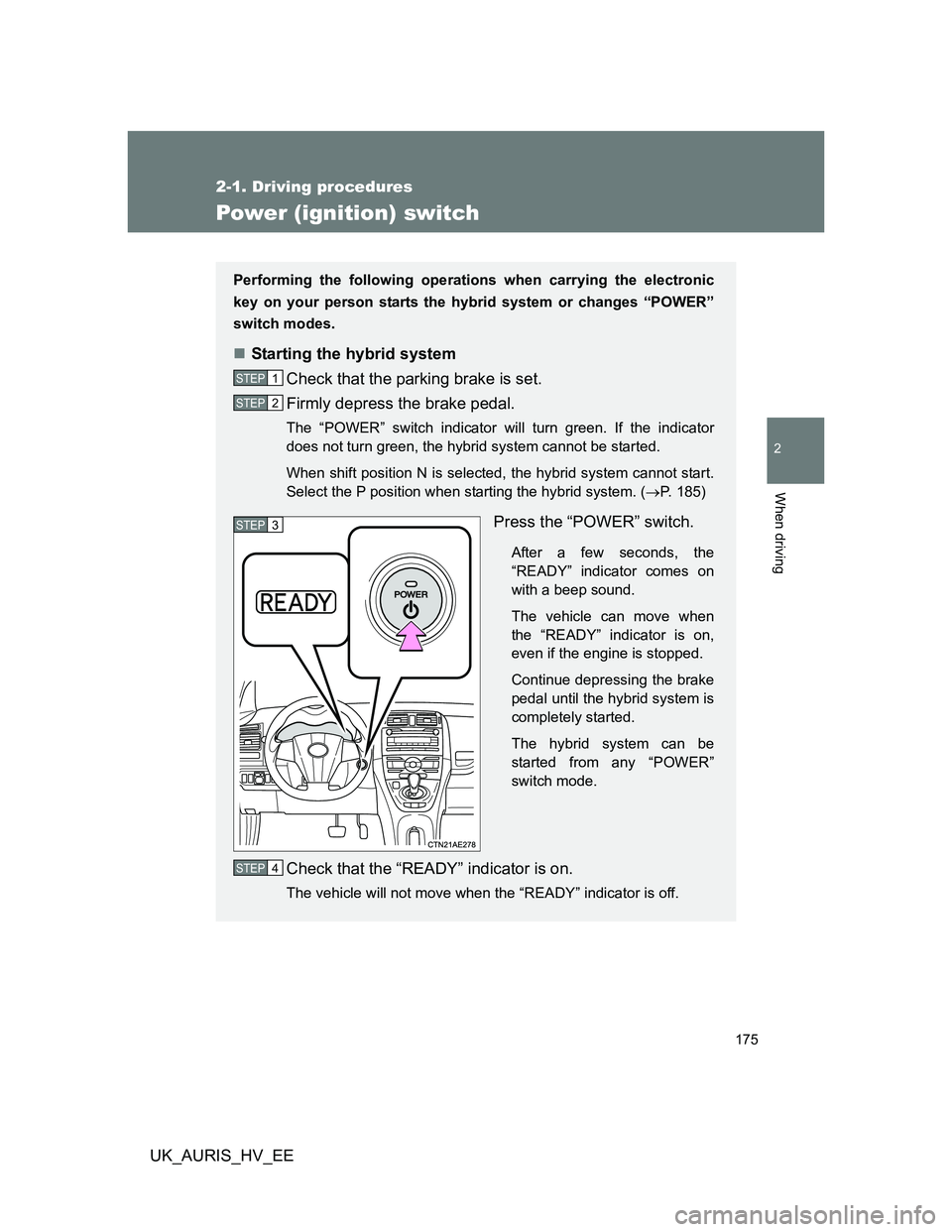
Performing the following operations when carrying the electronic
key on your person starts the hybrid system or changes “POWER”
switch modes.
Starting the hybrid system
Check that the parking brake is set.
Firmly depress the brake pedal.
The “POWER” switch indicator will turn green. If the indicator
does not turn green, the hybrid system cannot be started.
When shift position N is selected, the hybrid system cannot start.
Select the P position when starting the hybrid system. (P. 185)
Press the “POWER” switch.
After a few seconds, the
“READY” indicator comes on
with a beep sound.
The vehicle can move when
the “READY” indicator is on,
even if the engine is stopped.
Continue depressing the brake
pedal until the hybrid system is
completely started.
The hybrid system can be
started from any “POWER”
switch mode.
Check that the “READY” indicator is on.
The vehicle will not move when the “READY” indicator is off.
STEP1
STEP2
STEP3
STEP4
Page 180 of 524
180
2-1. Driving procedures
UK_AURIS_HV_EE
EV-Drive Mode
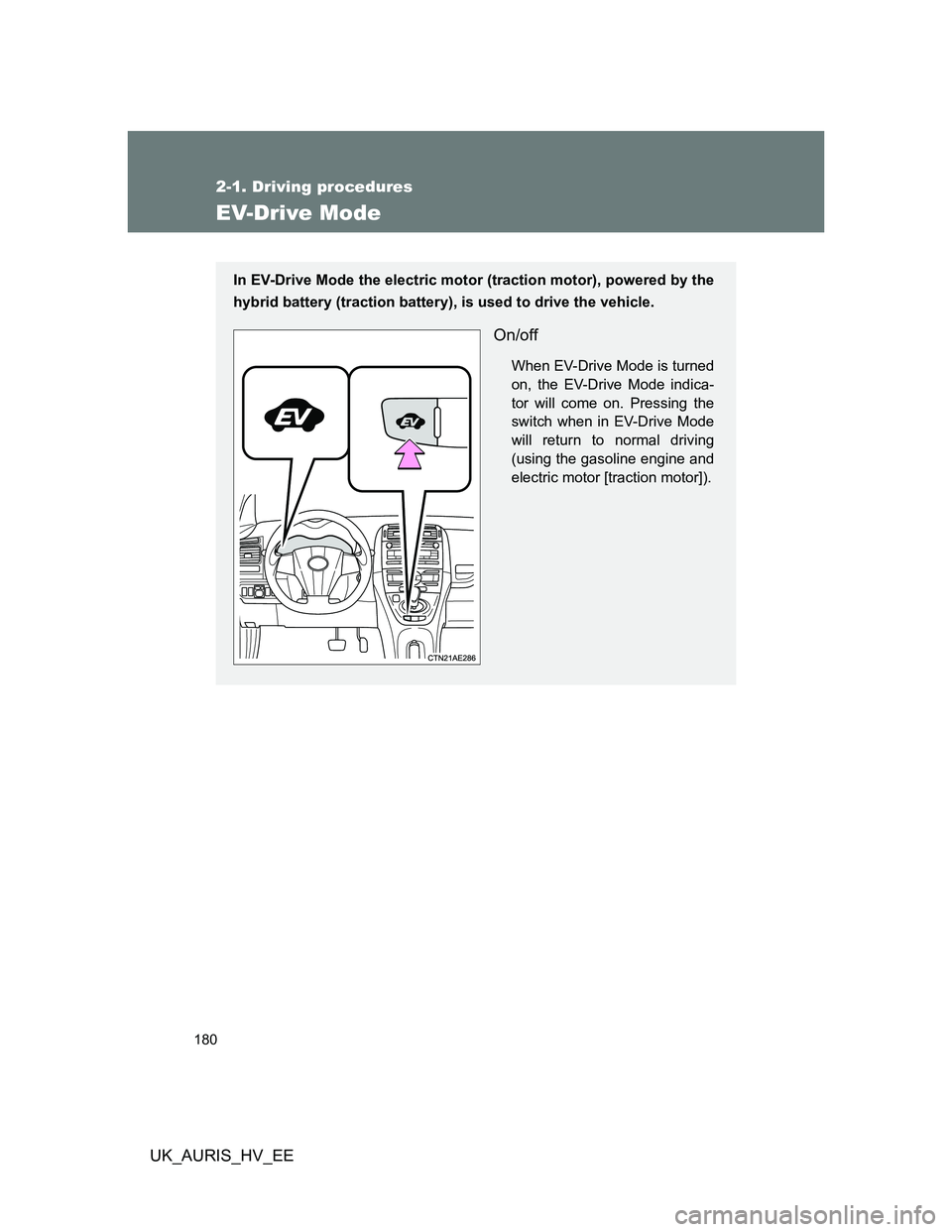
In EV-Drive Mode the electric motor (traction motor), powered by the
hybrid battery (traction battery), is used to drive the vehicle.
On/off
When EV-Drive Mode is turned
on, the EV-Drive Mode indica-
tor will come on. Pressing the
switch when in EV-Drive Mode
will return to normal driving
(using the gasoline engine and
electric motor [traction motor]).
Page 181 of 524
181 2-1. Driving procedures
2
When driving
UK_AURIS_HV_EE
Situations in which EV-Drive Mode cannot be turned on
The followings are examples of situations under which the EV-Drive Mode
may not be turned on. If it cannot be turned on, a buzzer will sound and a
message will be shown on the multi-information display.
The temperature of the hybrid system is high.
The vehicle has been left in the sun, driven on a hill, driven at high
speeds, etc.
The temperature of the hybrid system is low.
The vehicle has been left in freezing temperatures for a long period of
time etc.
The gasoline engine is warming up.
The hybrid battery (traction battery) is low.
The remaining battery level indicated in the “Energy Monitor” display is
low. (P. 36)
Vehicle speed is high.
The accelerator pedal is depressed firmly or the vehicle is on a hill etc.
The windshield defogger is in use.
Switching to EV-Drive Mode when the gasoline engine is cold
If the hybrid system is started while the gasoline engine is cold, the gasoline
engine will start automatically after a short period of time in order to warm
up. In this case, you will become unable to switch to EV-Drive Mode.
After the hybrid system has started and the “READY” indicator has illumi-
nated, press the “EV” switch before the gasoline engine starts to switch to
EV-Drive Mode.
Automatic cancellation of EV-Drive Mode
When driving in EV-Drive Mode, the gasoline engine may automatically
restart in the following situations. When EV-Drive Mode is canceled, a
buzzer will sound and the EV-Drive Mode indicator will flash and go off.
The hybrid battery (traction battery) becomes low.
The remaining battery level indicated in the “Energy Monitor” display is
low. (P. 36)
Vehicle speed becomes high.
The accelerator pedal is depressed firmly or the vehicle is on a hill etc.
Page 182 of 524
182 2-1. Driving procedures
UK_AURIS_HV_EE
Possible driving distance when driving in EV-Drive Mode
Possible driving distance when driving in EV-Drive Mode is up to about 1 km
(1/2 mile) if driven at a speed of about 40 km/h (25 mph) or less. (Possible
driving distance depends on the hybrid battery [traction battery] level and
driving conditions.)
Changing a driving mode when in EV-Drive Mode
EV-Drive Mode can be used in conjunction with Eco drive mode and power
mode.
However, EV-Drive Mode may be automatically canceled when used in con-
junction with power mode.
Fuel economy
Your Toyota is designed to achieve the best possible fuel economy during
normal driving (using the gasoline engine and electric motor [traction
motor]). Driving in EV-Drive Mode more than necessary may lower fuel
economy.
CAUTION
While driving
When driving in EV-Drive Mode, pay special attention to the area around the
vehicle. Because there is no engine noise, pedestrians, people riding bicy-
cles or other people and vehicles in the area may not be aware of the vehicle
starting off or approaching them, so take extra care while driving.
Page 184 of 524
184 2-1. Driving procedures
UK_AURIS_HV_EE
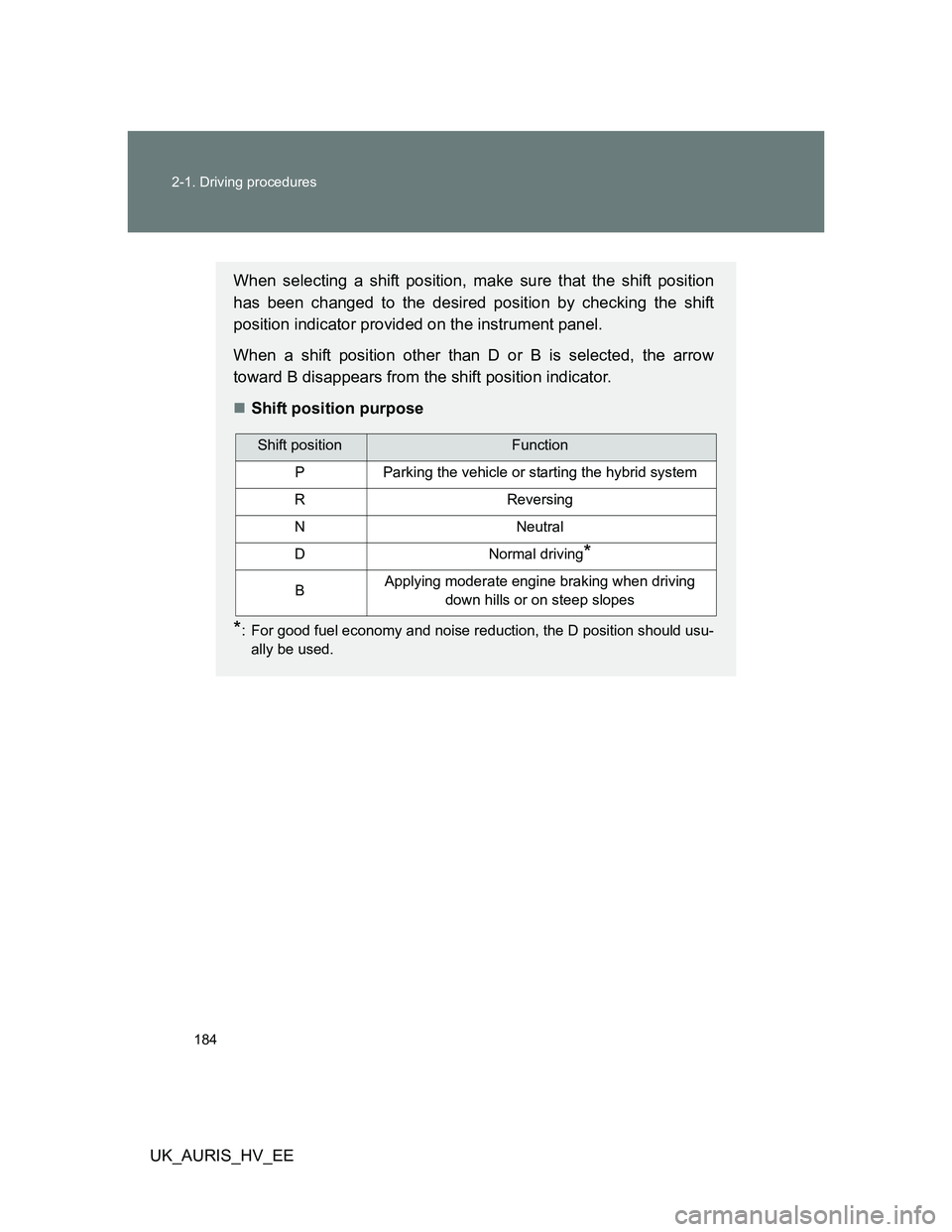
When selecting a shift position, make sure that the shift position
has been changed to the desired position by checking the shift
position indicator provided on the instrument panel.
When a shift position other than D or B is selected, the arrow
toward B disappears from the shift position indicator.
Shift position purpose
*: For good fuel economy and noise reduction, the D position should usu-
ally be used.
Shift positionFunction
PParking the vehicle or starting the hybrid system
RReversing
NNeutral
DNormal driving*
BApplying moderate engine braking when driving
down hills or on steep slopes
Page 187 of 524
187 2-1. Driving procedures
2
When driving
UK_AURIS_HV_EE
Using engine braking
To use engine braking, select the B position.
During high speed driving, you may feel that deceleration by engine brak-
ing is less than that of a conventional vehicle.
Do not continue normal driving with the transmission in B for a long time.
This may cause decreased fuel economy. To prevent this, use D for nor-
mal driving.
Reverse warning buzzer
When shifting into R, a buzzer will sound to inform the driver that the shift
lever is in R.
Eco drive mode
When the accelerator pedal is depressed in Eco drive mode, it may take
more time to accelerate than usual. This is normal operation.
Alarms
If the shift position is changed in any of the following situations, a buzzer will
sound and the shifting operation will be disabled or the shift position will
automatically change to N. When this happens, select an appropriate shift
position.
Situations where the shifting operation will be disabled:
• When the shift lever is changed from P to another position without
depressing the brake pedal.
• When the shift position is changed from P or N to B.
Situations where the shift position will automatically change to N:
• When the P position switch is pushed while the vehicle is moving.
• When shift position R is selected while the vehicle is moving forward.
• When shift position D is selected while the vehicle is moving in reverse.
• When the shift position is changed from R to B.
Page 188 of 524
188 2-1. Driving procedures
UK_AURIS_HV_EE
CAUTION
When driving on slippery road surfaces
Do not accelerate or shift gears suddenly.
Sudden changes in engine braking may cause the vehicle to spin or skid,
resulting in an accident.
Shift lever precautions
Do not hang anything on the shift lever.
Doing so could prevent the shift lever from returning to position, causing
unexpected accidents to occur when the vehicle is in motion.
NOTICE
Situations where P position control system malfunctions are possible
If any of the following situations occurs, P position control system malfunc-
tions are possible.
Immediately stop the vehicle in a safe place on level ground, apply the park-
ing brake, and then contact any authorized Toyota dealer or repairer, or
another duly qualified and equipped professional.
When a warning message indicating malfunction appears on the multi-
information display. (P. 437)
When the P position switch indicator flashes.
When the shift position symbols (such as P and R) are flashing on the shift
position indicator.
When the shift position indicator remains off.
When in heavy traffic
If shift position N is selected, the hybrid battery (traction battery) will not be
charged. To help prevent the battery from discharging, avoid leaving the N
position selected for an extended period of time.
Page 193 of 524
193
2
When driving
UK_AURIS_HV_EE
2-2. Instrument cluster
Gauges and meters
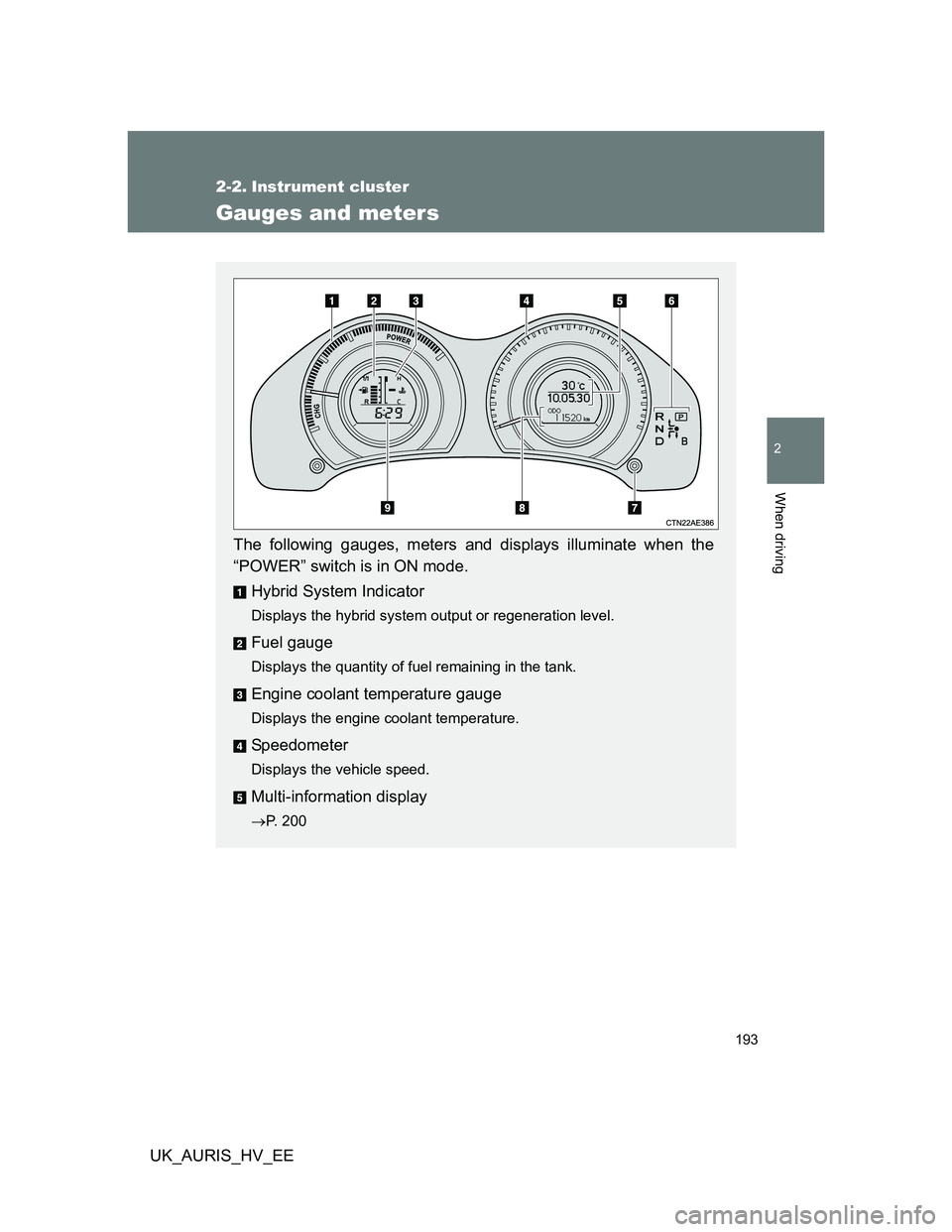
The following gauges, meters and displays illuminate when the
“POWER” switch is in ON mode.
Hybrid System Indicator
Displays the hybrid system output or regeneration level.
Fuel gauge
Displays the quantity of fuel remaining in the tank.
Engine coolant temperature gauge
Displays the engine coolant temperature.
Speedometer
Displays the vehicle speed.
Multi-information display
P. 200