electrical TOYOTA AURIS HYBRID 2012 User Guide
[x] Cancel search | Manufacturer: TOYOTA, Model Year: 2012, Model line: AURIS HYBRID, Model: TOYOTA AURIS HYBRID 2012Pages: 524, PDF Size: 26.34 MB
Page 361 of 524
361 4-1. Maintenance and care
4
Maintenance and care
UK_AURIS_HV_EE
Caring for leather areas
Toyota recommends cleaning the interior of the vehicle at least twice a year
to maintain the quality of the vehicle's interior.
Shampooing the carpets
There are several commercial foaming-type cleaners available. Use a
sponge or brush to apply the foam. Rub in overlapping circles. Do not apply
water. Excellent results are obtained by keeping the carpet as dry as possi-
ble.
Seat belts
Clean with mild soap and lukewarm water using a cloth or sponge. Also
check the belts periodically for excessive wear, fraying or cuts.
CAUTION
Water in the vehicle
Do not splash or spill liquid in the vehicle, such as on the floor, in the
hybrid battery (traction battery) air vents, and in the luggage compartment.
Doing so may cause the hybrid battery, electrical components, etc. to mal-
function or catch fire.
Do not get any of the SRS components or wiring in the vehicle interior wet.
(P. 130)
An electrical malfunction may cause the airbags to deploy or not function
properly, resulting in death or severe injury.
Cleaning the interior (especially instrument panel)
Do not use polish wax or polish cleaner. The instrument panel may reflect off
the windshield, obstructing the driver's view and leading to an accident,
resulting in death or serious injury.
Page 362 of 524
362 4-1. Maintenance and care
UK_AURIS_HV_EE
NOTICE
Cleaning detergents
Do not use organic substances such as benzene or gasoline, acidic or
alkaline solutions, dye, bleach or other detergent. Doing so may discolor
the vehicle interior or cause streaks or damage to painted surfaces.
Do not use polish wax or polish cleaner. The instrument panel's or other
interior part’s painted surface may be damaged.
Preventing damage to leather surfaces
Observe the following precautions to avoid damage to and deterioration of
leather surfaces:
Remove any dust or dirt from leather surfaces immediately.
Do not expose the vehicle to direct sunlight for extended periods of time.
Park the vehicle in the shade, especially during summer.
Do not place items made of vinyl, plastic, or that contain wax on the uphol-
stery, as they may stick to the leather surface if the vehicle interior heats
up significantly.
Water on the floor
Do not wash the vehicle floor with water.
Vehicle systems such as the audio system may be damaged if water comes
into contact with electrical components under the floor of the vehicle, and
may also cause the body to rust.
Cleaning the inside of the rear window
Do not use glass cleaner to clean the rear window, as this may cause
damage to the rear window defogger heater wires. Use a cloth dampened
with lukewarm water to gently wipe the window clean. Wipe the window in
strokes running parallel to the heater wires.
Be careful not to scratch or damage the heater wires.
Page 367 of 524
367 4-3. Do-it-yourself maintenance
4
Maintenance and care
UK_AURIS_HV_EE
CAUTION
The engine compartment contains many mechanisms and fluids that may
move suddenly, become hot, or become electrically energized. To avoid death
or serious injury observe the following precautions:
When working on the engine compartment
Keep hands, clothing, and tools away from the moving fan.
Be careful not to touch the engine, power control unit, radiator, exhaust
manifold, etc. right after driving as they may be hot. Oil and other fluids
may also be hot.
Do not leave anything that may burn easily, such as paper or rags, in the
engine compartment.
Do not smoke, cause sparks or expose an open flame to fuel. Fuel fumes
are flammable.
Take care because brake fluid can harm your hands or eyes and damage
painted surfaces.
If fluid gets on your hands or in your eyes, flush the affected area with
clean water immediately.
If you still experience discomfort, see a doctor.
When working near the electric cooling fan or radiator grille
Be sure the “POWER” switch is off.
With the “POWER” switch in ON mode, the electric cooling fans may auto-
matically start to run if the air conditioning is on and/or the coolant tempera-
ture is high. (P. 379)
Safety glasses
Wear safety glasses to prevent flying or falling material, fluid spray, etc. from
getting in the eyes.
Page 400 of 524
400
4-3. Do-it-yourself maintenance
UK_AURIS_HV_EE
Checking and replacing fuses
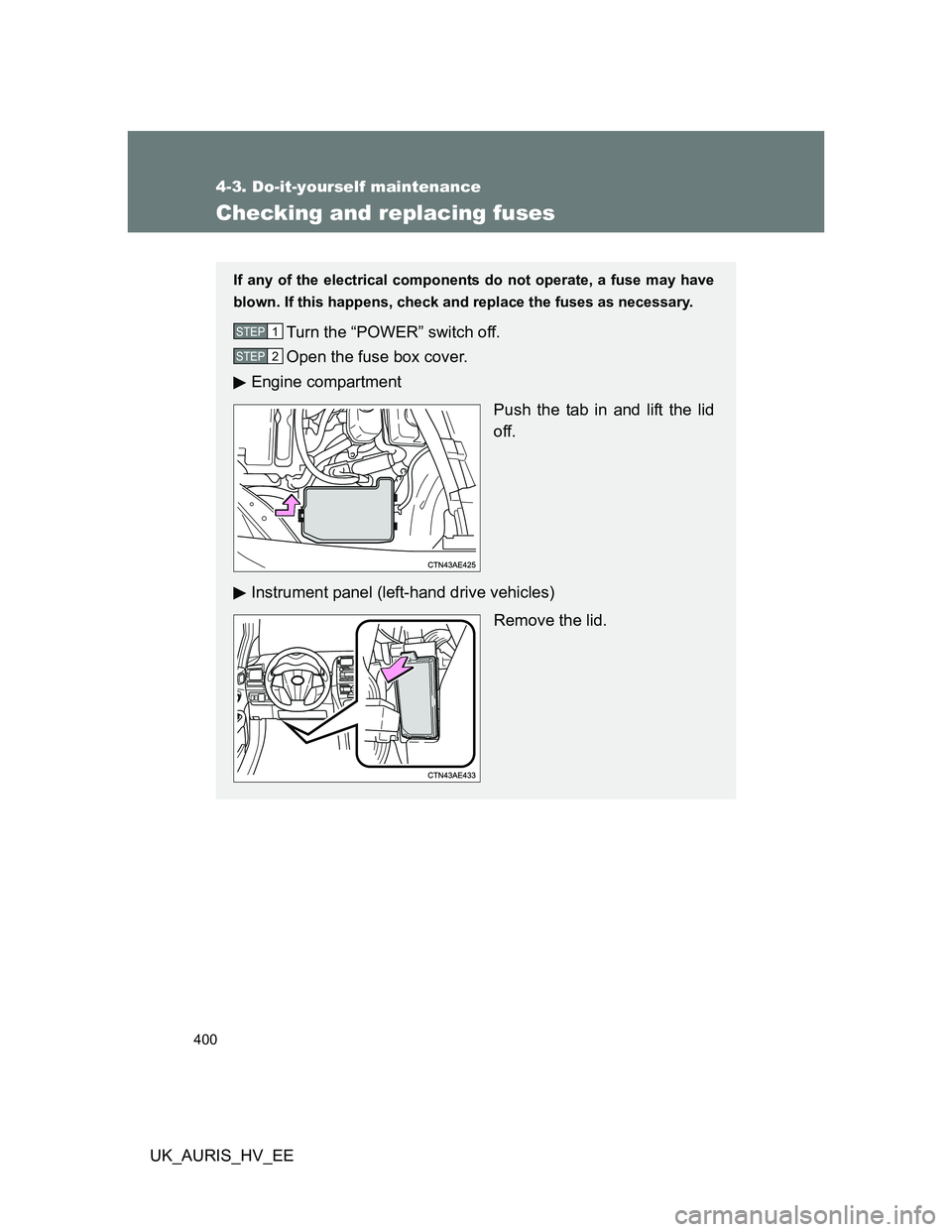
If any of the electrical components do not operate, a fuse may have
blown. If this happens, check and replace the fuses as necessary.
Turn the “POWER” switch off.
Open the fuse box cover.
Engine compartment
Push the tab in and lift the lid
off.
Instrument panel (left-hand drive vehicles)
Remove the lid.STEP1
STEP2
Page 410 of 524
410 4-3. Do-it-yourself maintenance
UK_AURIS_HV_EE
After a fuse is replaced
If the lights do not turn on even after the fuse has been replaced, a bulb
may need replacement. (P. 411)
If the replaced fuse blows again, have the vehicle inspected by any
authorized Toyota dealer or repairer, or another duly qualified and
equipped professional.
If there is an overload in the circuits
The fuses are designed to blow, protecting the wiring harness from damage.
When replacing light bulbs
Toyota recommends that you use genuine Toyota products.
Because certain bulbs are connected to circuits designed to prevent over-
load, non-genuine parts may be unusable.
CAUTION
To prevent system breakdowns and vehicle fire
Observe the following precautions.
Failing to do so may cause damage, and possibly a fire or injury.
Never use a fuse of a higher amperage rating than indicated, or use any
other object in place of a fuse.
Always use a genuine Toyota fuse or equivalent.
Never replace a fuse with a wire, even as a temporary fix.
This can cause extensive damage or even a fire.
Do not modify the fuse or the fuse box.
NOTICE
Before replacing fuses
Have the cause of electrical overload determined and repaired by any autho-
rized Toyota dealer or repairer, or another duly qualified and equipped pro-
fessional, as soon as possible.
Page 471 of 524
5
471
5-2. Steps to take in an emergency
When trouble arises
UK_AURIS_HV_EE
If the hybrid system will not start
If the hybrid system still does not start after following the correct
starting procedure (P. 175), confirm the following points.
The hybrid system will not start even if you are carrying the
correct key.
One of the following may be the cause of the problem.
The electronic key may not be functioning properly.*
(P. 474)
There may not be sufficient fuel in the vehicle’s tank. Refuel
the vehicle.
The electronic key battery may be discharged. (P. 474)
There may be a malfunction in the P position control system.
The hybrid system may be malfunctioning due to an electrical
problem such as an open circuit or a blown fuse. However,
depending on the type of malfunction, an interim measure is
available to start the hybrid system. (P. 472)
There may be a malfunction in the immobilizer system.*
(P. 107)
*: It may not be possible to shift out of P.
The interior lights and headlights are dim, or the horn does
not sound or sounds at a low volume.
One of the following may be the cause of the problem.
The 12-volt battery may be discharged. (P. 476)
The 12-volt battery terminal connections may be loose or cor-
roded.
Page 478 of 524
478 5-2. Steps to take in an emergency
UK_AURIS_HV_EE
Starting the hybrid system when the 12-volt battery is discharged
The hybrid system cannot be started by push-starting.
Avoiding a discharged 12-volt battery
Turn off the headlights and the audio system while the hybrid system is
turned off.
Turn off any unnecessary electrical components when the vehicle is run-
ning at a low speed for an extended period, such as in heavy traffic, etc.
When the 12-volt battery is removed or discharged
If the 12-volt battery is depleted with the shift position in P, it will not be
possible to shift out of P. In this case, the vehicle cannot be towed without
lifting both front wheels because the front wheels are locked by the park-
ing lock. (P. 423)
The hybrid system may not start. (P. 384)
Charging the 12-volt battery
The electricity stored in the 12-volt battery will discharge gradually even
when the vehicle is not in use, due to natural discharge and the draining
effects of certain electrical appliances. If the vehicle is left for a long time, the
12-volt battery may discharge, and the hybrid system may be unable to start.
(The 12-volt battery recharges automatically while the hybrid system is oper-
ating.)
Once the hybrid system has started, remove the jumper
cables in the exact reverse order in which they were con-
nected.
Close the exclusive jump starting terminal cover and rein-
stall the fuse box cover.
Once the hybrid system starts, have the vehicle checked at any
authorized Toyota dealer or repairer, or another duly qualified and
equipped professional, as soon as possible.STEP7
STEP8
Page 499 of 524
499 6-1. Specifications
6
Vehicle specifications
UK_AURIS_HV_EE
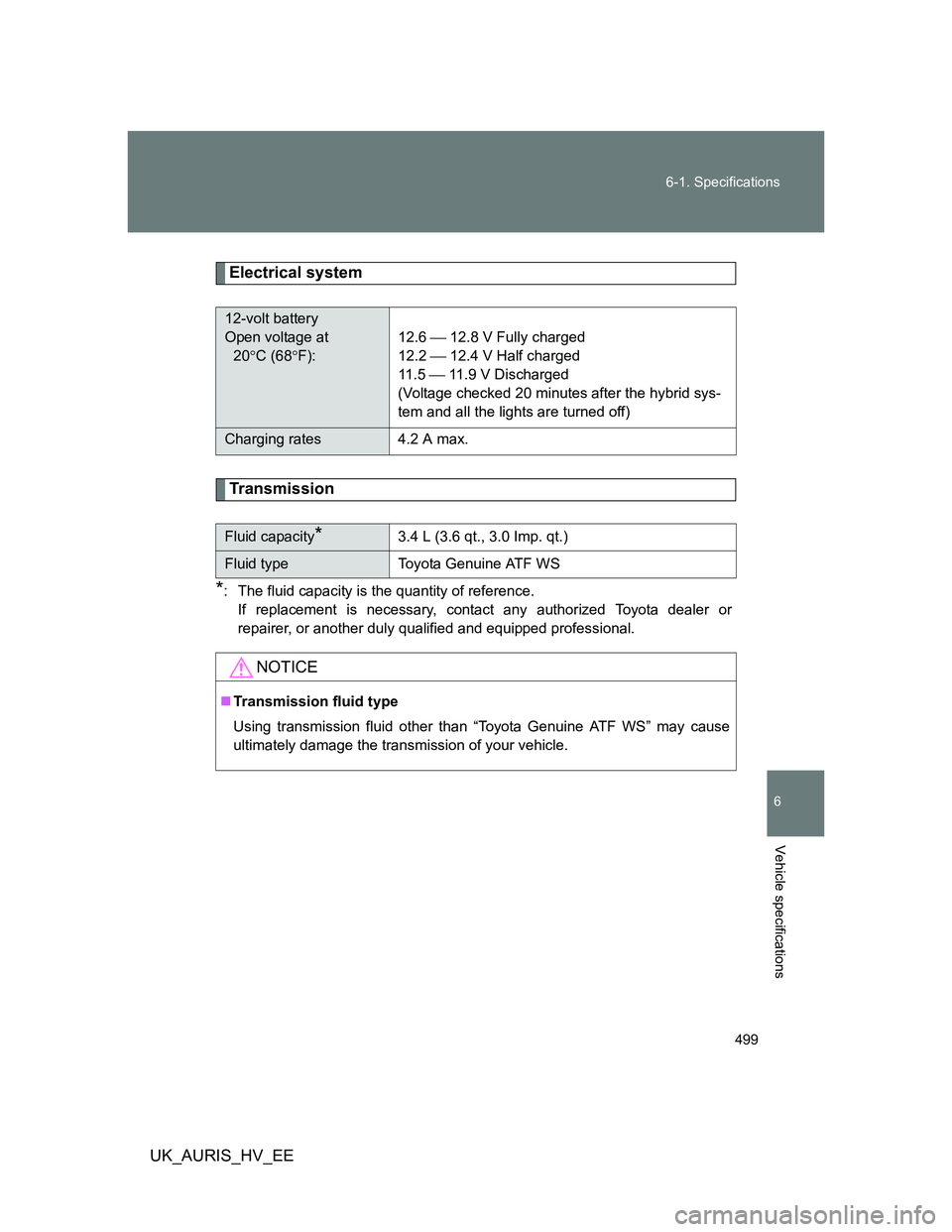
Electrical system
Transmission
*: The fluid capacity is the quantity of reference.
If replacement is necessary, contact any authorized Toyota dealer or
repairer, or another duly qualified and equipped professional.
12-volt battery
Open voltage at
20C (68F):12.6 12.8 V Fully charged
12.2 12.4 V Half charged
11 . 5 11.9 V Discharged
(Voltage checked 20 minutes after the hybrid sys-
tem and all the lights are turned off)
Charging rates 4.2 A max.
Fluid capacity*3.4 L (3.6 qt., 3.0 Imp. qt.)
Fluid type Toyota Genuine ATF WS
NOTICE
Transmission fluid type
Using transmission fluid other than “Toyota Genuine ATF WS” may cause
ultimately damage the transmission of your vehicle.