engine TOYOTA AURIS HYBRID 2012 Owner's Manual
[x] Cancel search | Manufacturer: TOYOTA, Model Year: 2012, Model line: AURIS HYBRID, Model: TOYOTA AURIS HYBRID 2012Pages: 524, PDF Size: 26.34 MB
Page 195 of 524
195 2-2. Instrument cluster
2
When driving
UK_AURIS_HV_EE
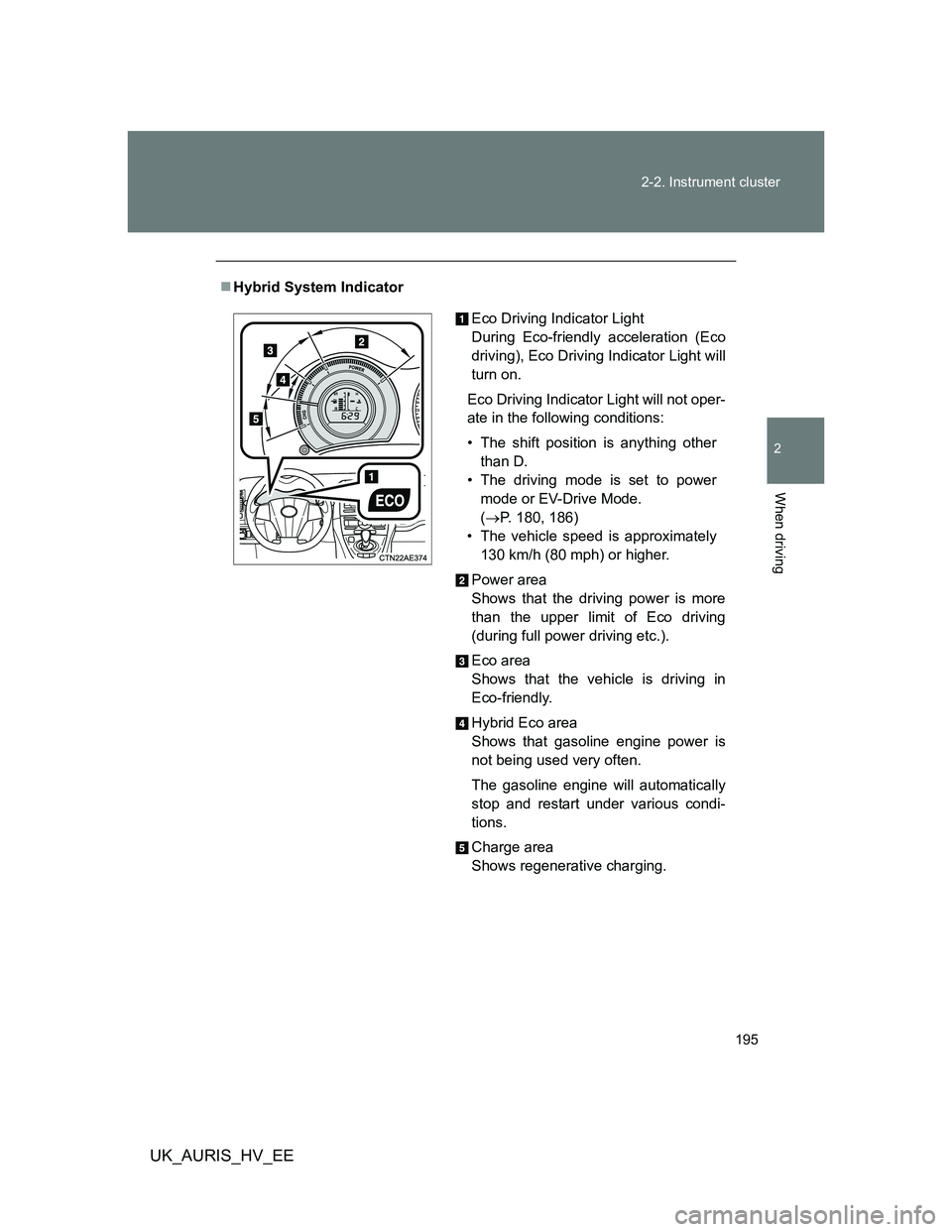
Hybrid System Indicator
Eco Driving Indicator Light
During Eco-friendly acceleration (Eco
driving), Eco Driving Indicator Light will
turn on.
Eco Driving Indicator Light will not oper-
ate in the following conditions:
• The shift position is anything other
than D.
• The driving mode is set to power
mode or EV-Drive Mode.
(P. 180, 186)
• The vehicle speed is approximately
130 km/h (80 mph) or higher.
Power area
Shows that the driving power is more
than the upper limit of Eco driving
(during full power driving etc.).
Eco area
Shows that the vehicle is driving in
Eco-friendly.
Hybrid Eco area
Shows that gasoline engine power is
not being used very often.
The gasoline engine will automatically
stop and restart under various condi-
tions.
Charge area
Shows regenerative charging.
Page 196 of 524
196 2-2. Instrument cluster
UK_AURIS_HV_EE
By keeping the indicator needle within Eco area, more Eco-friendly driv-
ing can be achieved.
Charge area indicates regeneration* status. Regenerated energy will be
used to charge the battery.
Eco Driving Indicator Light can be enabled or disabled. (P. 203)
*: When used in this manual, “regeneration” refers to the conversion of
energy created by the movement of the vehicle into electrical energy.
NOTICE
To prevent damage to the hybrid system and its components
The hybrid system may be overheating if the top segments of the engine
coolant temperature gauge are flashing. In this case, immediately stop the
vehicle in a safe place, and check the hybrid system after it has cooled com-
pletely. (P. 481)
Page 226 of 524
226 2-4. Using other driving systems
UK_AURIS_HV_EE
Sensor detection information
Certain vehicle conditions and the surrounding environment may affect
the ability of the sensor to correctly detect obstacles. Particular instances
where this may occur are listed below.
• There is dirt, snow or ice on the sensor. (Wiping the sensor will resolve
this problem.)
• The sensor is frozen. (Thawing the sensor will resolve this problem.)
• The sensor is covered in any way.
• In harsh sunlight or intense cold weather.
• When driving bumpy, sloped or gravel roads, or over grass.
• If there is something producing ultrasonic waves nearby, such as
another vehicle’s horn, motorcycle engine noise, air braking sound
from heavy-duty vehicles, or another vehicle using the park assist sys-
tem.
• In heavy rain, or if water is splashed on the sensors.
• The vehicle is leaning considerably to one side.
• If a commercial fender pole or radio antenna is installed.
• If moving towards a high curb or a curb corner.
• If towing eyelet is installed on your vehicle.
• The bumper or sensor receives a strong impact.
• A non-genuine Toyota suspension (lowered suspension etc.) is
installed.
In addition to the examples above, there are instances in which, because of
their shapes, signs and other objects may be judged by the sensors to be
closer than they are.
The shape of the obstacle may prevent the sensor from detecting it. Pay
particular attention to the following obstacles.
• Thin objects such as wire, fencing or rope.
• Objects that absorb sound waves, such as cotton or snow.
• Objects with sharp corners.
• Low objects.
• Objects where the upper section projects out over the lower section.
Page 229 of 524
229 2-4. Using other driving systems
2
When driving
UK_AURIS_HV_EE
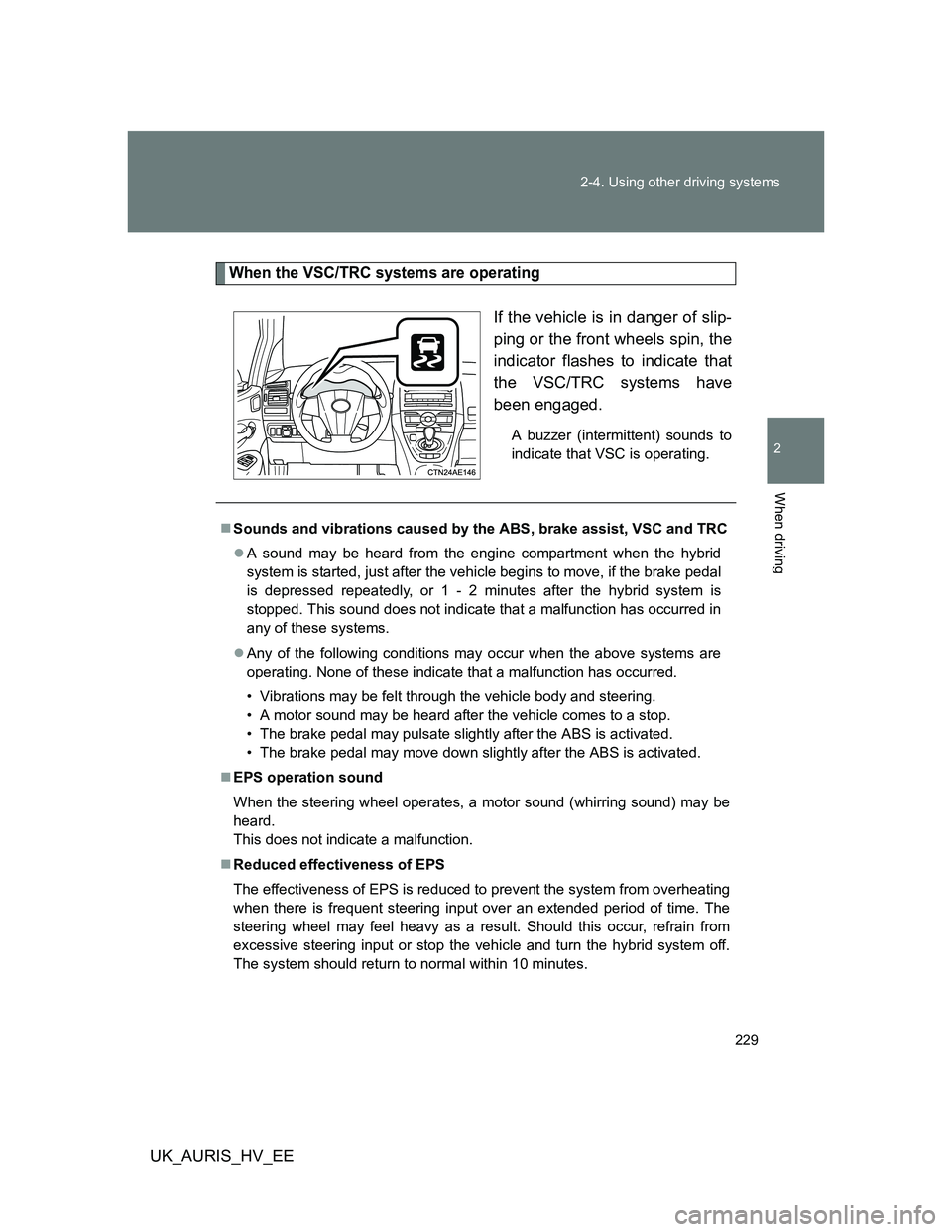
When the VSC/TRC systems are operating
If the vehicle is in danger of slip-
ping or the front wheels spin, the
indicator flashes to indicate that
the VSC/TRC systems have
been engaged.
A buzzer (intermittent) sounds to
indicate that VSC is operating.
Sounds and vibrations caused by the ABS, brake assist, VSC and TRC
A sound may be heard from the engine compartment when the hybrid
system is started, just after the vehicle begins to move, if the brake pedal
is depressed repeatedly, or 1 - 2 minutes after the hybrid system is
stopped. This sound does not indicate that a malfunction has occurred in
any of these systems.
Any of the following conditions may occur when the above systems are
operating. None of these indicate that a malfunction has occurred.
• Vibrations may be felt through the vehicle body and steering.
• A motor sound may be heard after the vehicle comes to a stop.
• The brake pedal may pulsate slightly after the ABS is activated.
• The brake pedal may move down slightly after the ABS is activated.
EPS operation sound
When the steering wheel operates, a motor sound (whirring sound) may be
heard.
This does not indicate a malfunction.
Reduced effectiveness of EPS
The effectiveness of EPS is reduced to prevent the system from overheating
when there is frequent steering input over an extended period of time. The
steering wheel may feel heavy as a result. Should this occur, refrain from
excessive steering input or stop the vehicle and turn the hybrid system off.
The system should return to normal within 10 minutes.
Page 236 of 524
236
2-5. Driving information
UK_AURIS_HV_EE
Winter driving tips
Carry out the necessary preparations and inspections before driving
the vehicle in winter. Always drive the vehicle in a manner appropri-
ate to the prevailing weather conditions.
Pre-winter preparations
Use fluids that are appropriate to the prevailing outside tem-
peratures.
• Engine oil
• Engine/power control unit coolant
• Washer fluid
Have the vehicle fitted with four snow tires or purchase a set
of tire chains for the front tires.
Ensure that all tires are the same size and brand, and that chains
match the size of the tires.
Before driving the vehicle
Perform the following according to the driving conditions.
Do not try to forcibly open a window, scrape an outside rear
view mirror surface or move a wiper or outside rear view mir-
ror that is frozen. Pour warm water over the frozen area to
melt the ice. Wipe away the water immediately to prevent it
from freezing.
To ensure proper operation of the climate control system fan,
remove any snow that has accumulated on the air inlet vents
in front of the windshield.
Remove any ice that has accumulated on the vehicle chassis.
Periodically check for and remove any excess ice or snow
that may have accumulated in the wheel well or on the
brakes.
Page 355 of 524
4Maintenance and care
355
UK_AURIS_HV_EE
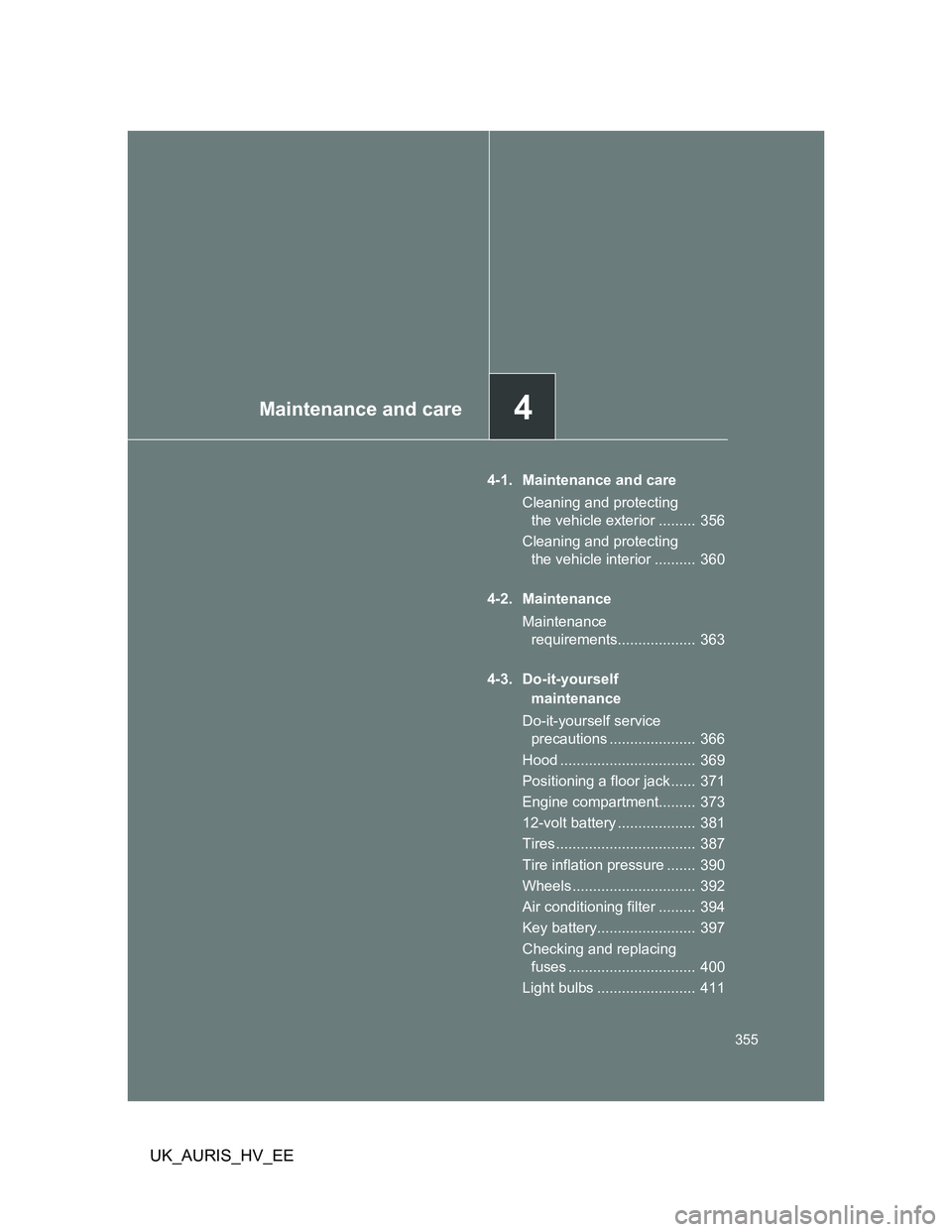
4-1. Maintenance and care
Cleaning and protecting
the vehicle exterior ......... 356
Cleaning and protecting
the vehicle interior .......... 360
4-2. Maintenance
Maintenance
requirements................... 363
4-3. Do-it-yourself
maintenance
Do-it-yourself service
precautions ..................... 366
Hood ................................. 369
Positioning a floor jack ...... 371
Engine compartment......... 373
12-volt battery ................... 381
Tires .................................. 387
Tire inflation pressure ....... 390
Wheels .............................. 392
Air conditioning filter ......... 394
Key battery........................ 397
Checking and replacing
fuses ............................... 400
Light bulbs ........................ 411
Page 364 of 524
364 4-2. Maintenance
UK_AURIS_HV_EE
Where to go for service?
In order to maintain your vehicle in the highest possible condition, Toyota
recommends that all repairs and service operations be carried out by autho-
rized Toyota dealers or repairers or other duly qualified and equipped profes-
sionals. For repairs and services covered by your warranty, please visit an
authorized Toyota dealer or repairer, who will use genuine Toyota parts in
repairing any difficulties you may encounter. There can also be advantages
in utilizing authorized Toyota dealers or repairers for non-warranty repairs
and services, as members of the Toyota network will be able to expertly
assist you with any difficulties you may encounter.
Your Toyota dealer or repairer, or another duly qualified and equipped
professional service department will perform all of the scheduled
maintenance on your vehicle-reliably and economically due to their
experience with Toyota vehicles.
Does your vehicle need repair?
Be on the alert for changes in performance and sounds, and visual tip-offs
that indicate service is needed. Some important clues are:
Engine missing, stumbling, or pinging
Appreciable loss of power
Strange engine noises
A fluid leak under the vehicle (However, water dripping from the air condi-
tioning after use is normal.)
Change in exhaust sound (This may indicate a dangerous carbon mon-
oxide leak. Drive with the windows open and have the exhaust system
checked immediately.)
Flat-looking tires, excessive tire squeal when cornering, uneven tire wear
Vehicle pulls to one side when driving straight on a level road
Strange noises related to suspension movement
Loss of brake effectiveness, spongy feeling brake pedal, pedal almost
touches the floor, vehicle pulls to one side when braking
Engine coolant temperature continually higher than normal
If you notice any of these clues, take your vehicle to any authorized Toyota
dealer or repairer, or another duly qualified and equipped professional, as
soon as possible. Your vehicle may need adjustment or repair.
Page 366 of 524
366
UK_AURIS_HV_EE
4-3. Do-it-yourself maintenance
Do-it-yourself ser vice precautions
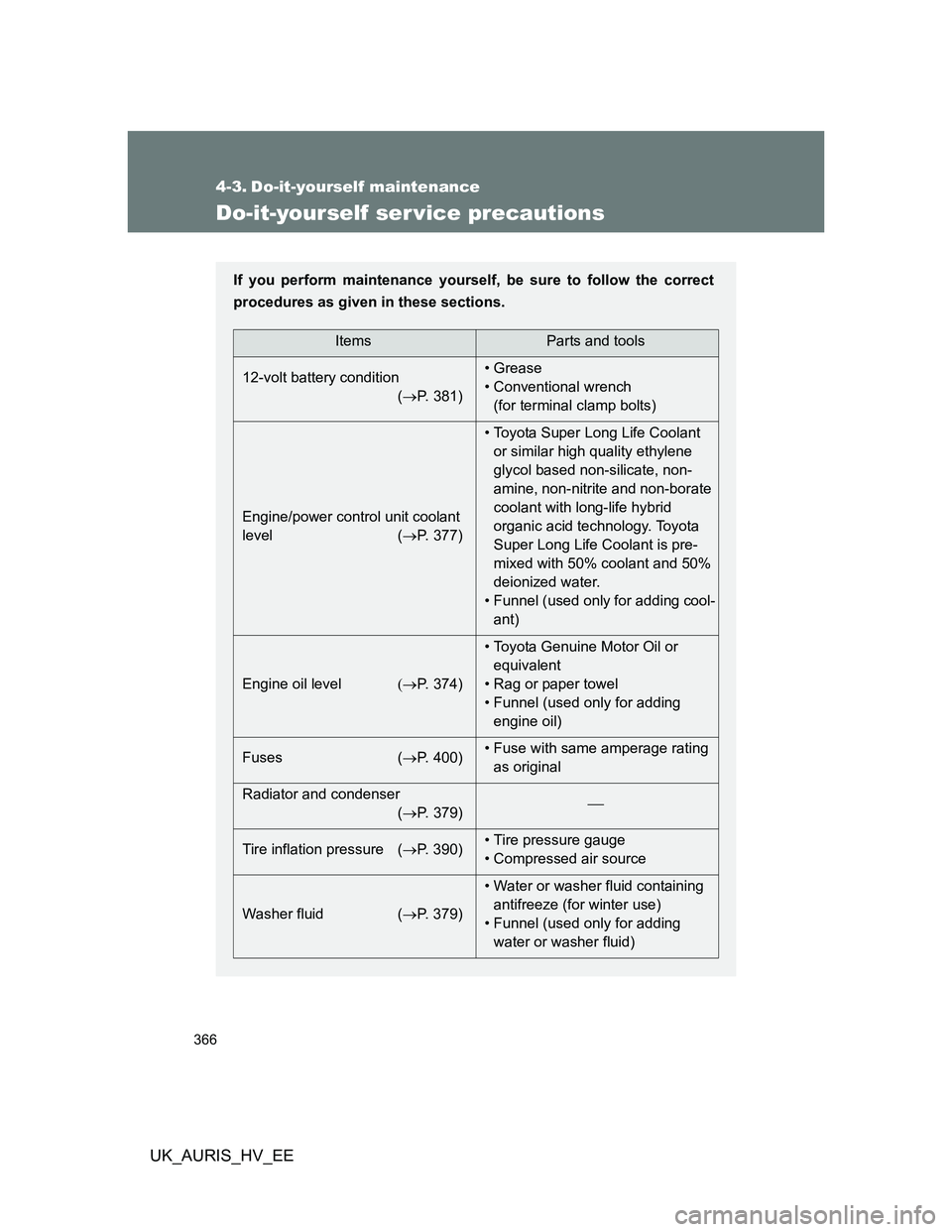
If you perform maintenance yourself, be sure to follow the correct
procedures as given in these sections.
ItemsParts and tools
12-volt battery condition
(P. 381)• Grease
• Conventional wrench
(for terminal clamp bolts)
Engine/power control unit coolant
level (P. 377)• Toyota Super Long Life Coolant
or similar high quality ethylene
glycol based non-silicate, non-
amine, non-nitrite and non-borate
coolant with long-life hybrid
organic acid technology. Toyota
Super Long Life Coolant is pre-
mixed with 50% coolant and 50%
deionized water.
• Funnel (used only for adding cool-
ant)
Engine oil levelP. 374)• Toyota Genuine Motor Oil or
equivalent
• Rag or paper towel
• Funnel (used only for adding
engine oil)
Fuses (P. 400)• Fuse with same amperage rating
as original
Radiator and condenser
(P. 379)
Tire inflation pressure (P. 390)• Tire pressure gauge
• Compressed air source
Washer fluid (P. 379)• Water or washer fluid containing
antifreeze (for winter use)
• Funnel (used only for adding
water or washer fluid)
Page 367 of 524
367 4-3. Do-it-yourself maintenance
4
Maintenance and care
UK_AURIS_HV_EE
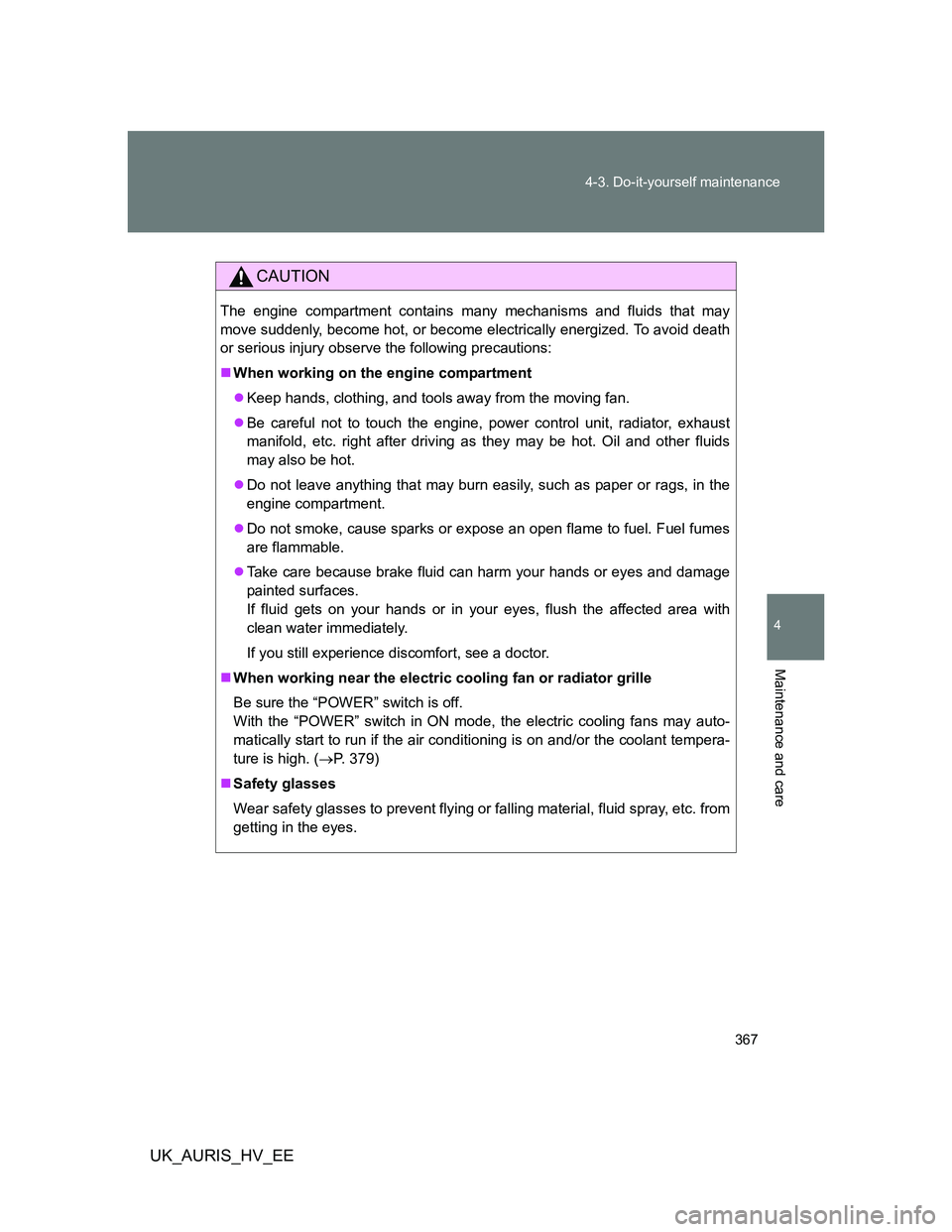
CAUTION
The engine compartment contains many mechanisms and fluids that may
move suddenly, become hot, or become electrically energized. To avoid death
or serious injury observe the following precautions:
When working on the engine compartment
Keep hands, clothing, and tools away from the moving fan.
Be careful not to touch the engine, power control unit, radiator, exhaust
manifold, etc. right after driving as they may be hot. Oil and other fluids
may also be hot.
Do not leave anything that may burn easily, such as paper or rags, in the
engine compartment.
Do not smoke, cause sparks or expose an open flame to fuel. Fuel fumes
are flammable.
Take care because brake fluid can harm your hands or eyes and damage
painted surfaces.
If fluid gets on your hands or in your eyes, flush the affected area with
clean water immediately.
If you still experience discomfort, see a doctor.
When working near the electric cooling fan or radiator grille
Be sure the “POWER” switch is off.
With the “POWER” switch in ON mode, the electric cooling fans may auto-
matically start to run if the air conditioning is on and/or the coolant tempera-
ture is high. (P. 379)
Safety glasses
Wear safety glasses to prevent flying or falling material, fluid spray, etc. from
getting in the eyes.
Page 368 of 524
368 4-3. Do-it-yourself maintenance
UK_AURIS_HV_EE
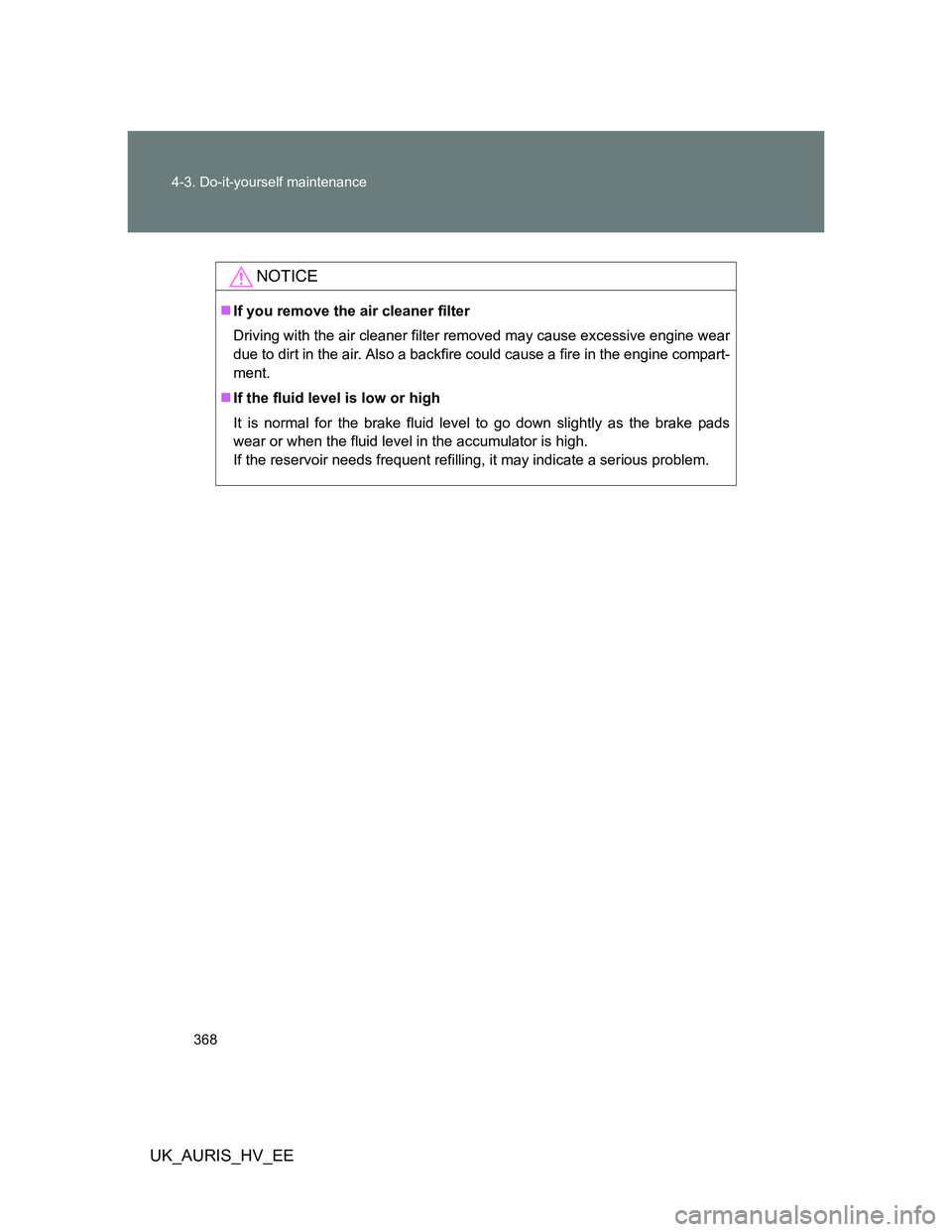
NOTICE
If you remove the air cleaner filter
Driving with the air cleaner filter removed may cause excessive engine wear
due to dirt in the air. Also a backfire could cause a fire in the engine compart-
ment.
If the fluid level is low or high
It is normal for the brake fluid level to go down slightly as the brake pads
wear or when the fluid level in the accumulator is high.
If the reservoir needs frequent refilling, it may indicate a serious problem.