inflation pressure TOYOTA AURIS HYBRID 2013 User Guide
[x] Cancel search | Manufacturer: TOYOTA, Model Year: 2013, Model line: AURIS HYBRID, Model: TOYOTA AURIS HYBRID 2013Pages: 768, PDF Size: 21.22 MB
Page 535 of 768
5356-3. Do-it-yourself maintenance
UK_AURIS/AURIS_HV_EE (OM12F76E)
6
Maintenance and care
CAUTION
Proper inflation is critical to save tire performance
Keep your tires properly inflated. Otherwise, the following conditions may
occur and result in an accident causing death or serious injury:
Excessive wear
Uneven wear
Poor handling
Possibility of blowouts resulting from overheated tires
Poor sealing of the tire bead
Wheel deformation and/or tire separation
A greater possibility of tire damage from road hazards
NOTICE
When inspecting and adjusting tire inflation pressure
Be sure to put the tire valve caps back on.
Without the valve caps, dirt or moisture could get into the valve and cause
air leakage, which could result in an accident. If the caps are lost, replace
them as soon as possible.
Page 649 of 768
6497-2. Steps to take in an emergency
UK_AURIS/AURIS_HV_EE (OM12F76E)
7
When trouble arises
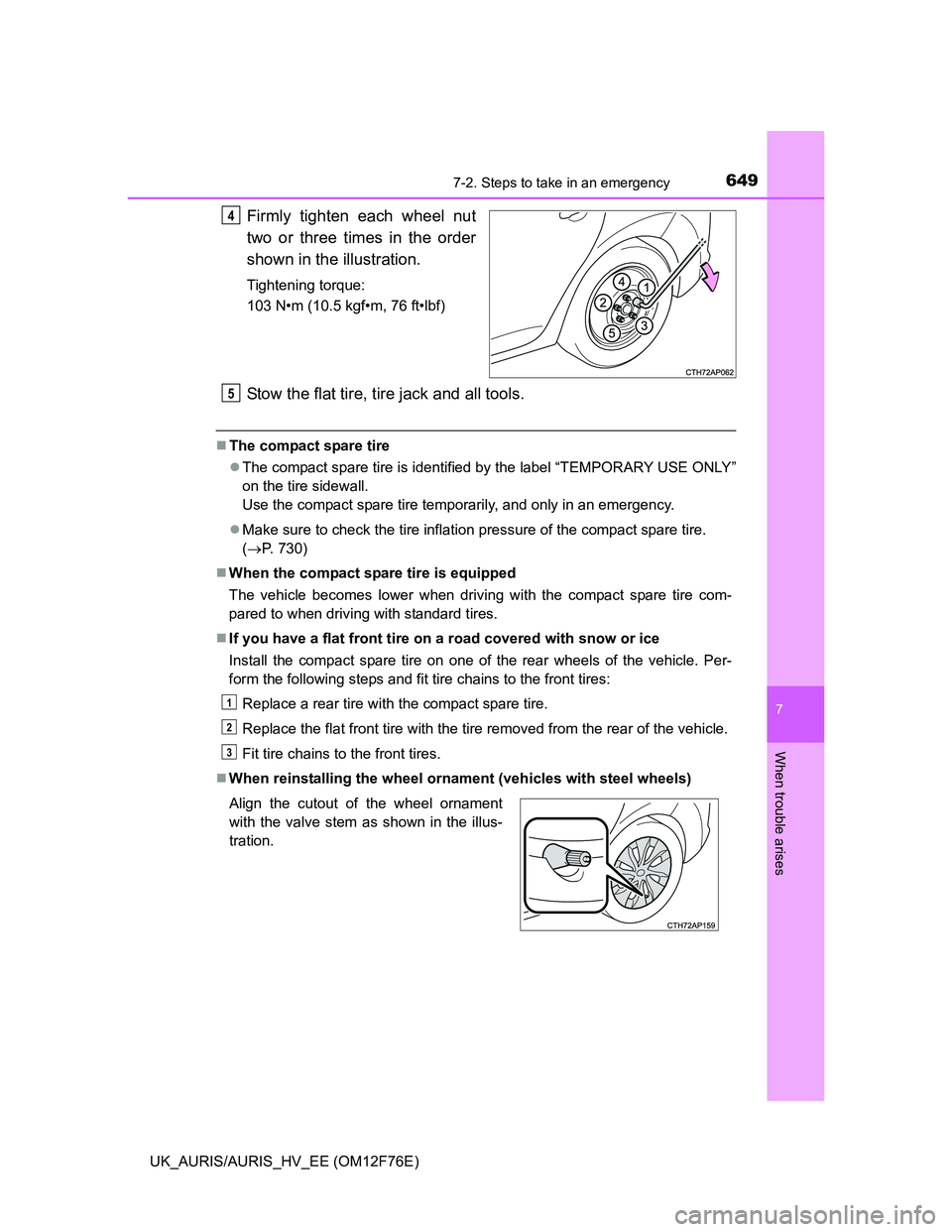
Firmly tighten each wheel nut
two or three times in the order
shown in the illustration.
Tightening torque:
103 N•m (10.5 kgf•m, 76 ft•lbf)
Stow the flat tire, tire jack and all tools.
The compact spare tire
The compact spare tire is identified by the label “TEMPORARY USE ONLY”
on the tire sidewall.
Use the compact spare tire temporarily, and only in an emergency.
Make sure to check the tire inflation pressure of the compact spare tire.
(P. 730)
When the compact spare tire is equipped
The vehicle becomes lower when driving with the compact spare tire com-
pared to when driving with standard tires.
If you have a flat front tire on a road covered with snow or ice
Install the compact spare tire on one of the rear wheels of the vehicle. Per-
form the following steps and fit tire chains to the front tires:
Replace a rear tire with the compact spare tire.
Replace the flat front tire with the tire removed from the rear of the vehicle.
Fit tire chains to the front tires.
When reinstalling the wheel ornament (vehicles with steel wheels)
4
Align the cutout of the wheel ornament
with the valve stem as shown in the illus-
tration.
5
1
2
3
Page 662 of 768
6627-2. Steps to take in an emergency
UK_AURIS/AURIS_HV_EE (OM12F76E)
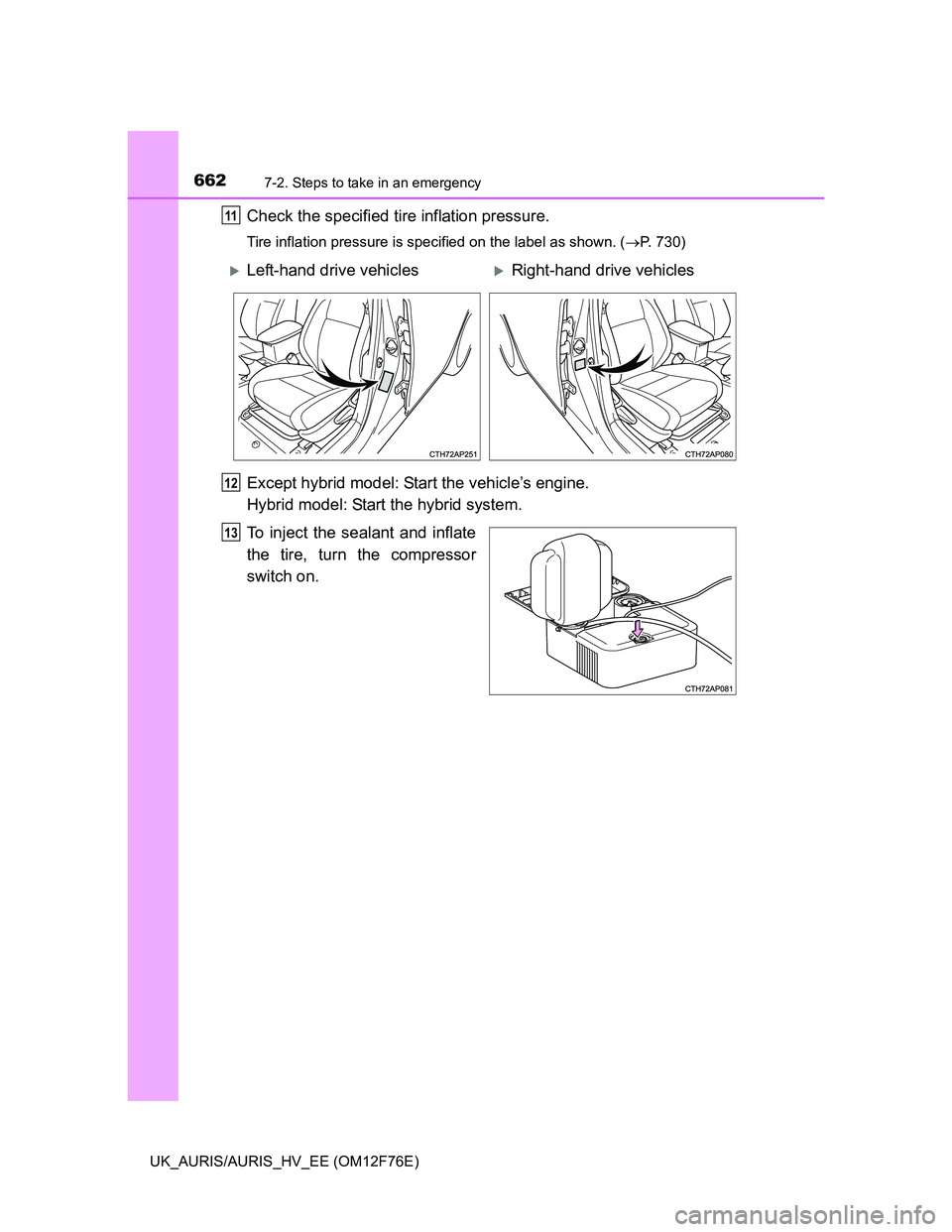
Check the specified tire inflation pressure.
Tire inflation pressure is specified on the label as shown. (P. 730)
Except hybrid model: Start the vehicle’s engine.
Hybrid model: Start the hybrid system.
To inject the sealant and inflate
the tire, turn the compressor
switch on.
11
Left-hand drive vehiclesRight-hand drive vehicles
12
13
Page 663 of 768
6637-2. Steps to take in an emergency
UK_AURIS/AURIS_HV_EE (OM12F76E)
7
When trouble arises
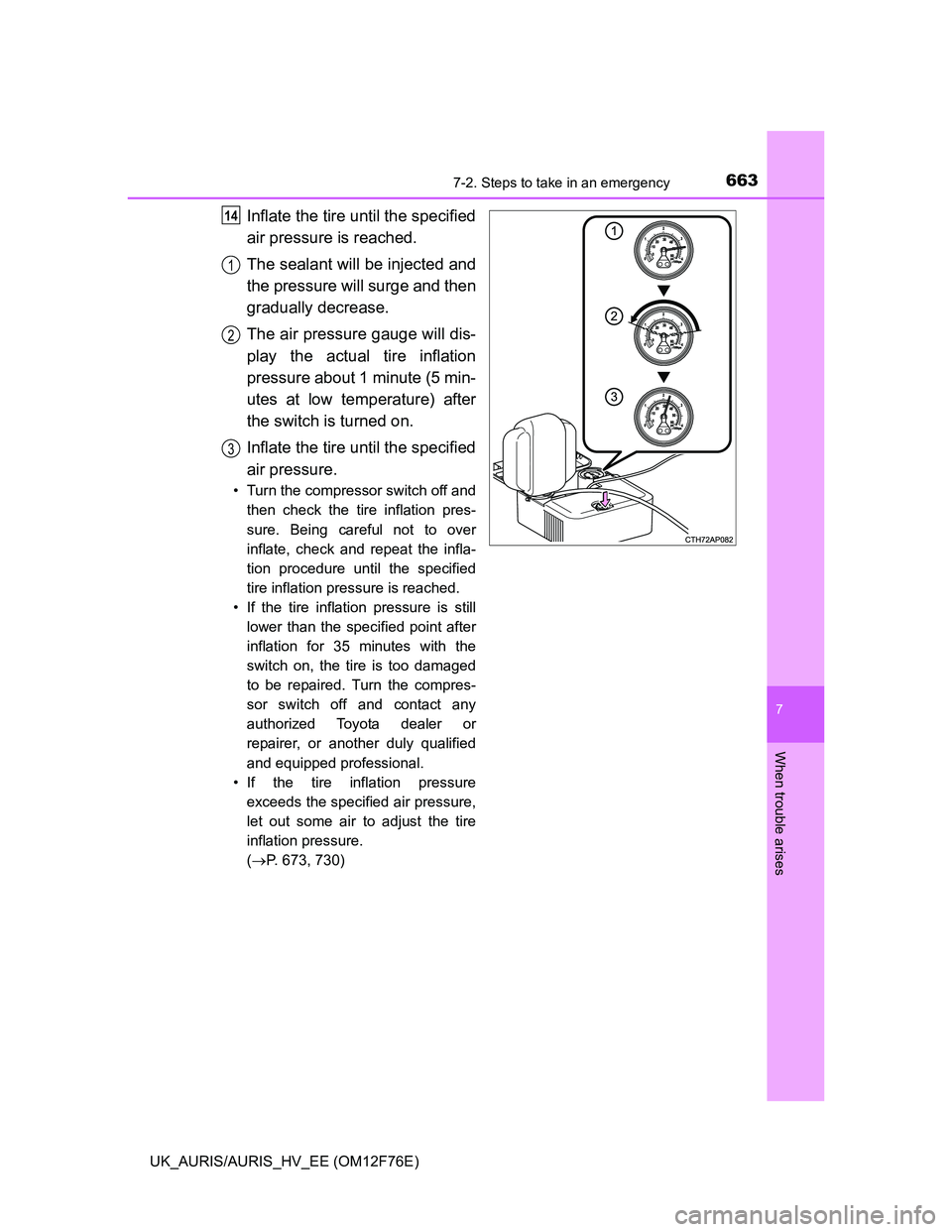
Inflate the tire until the specified
air pressure is reached.
The sealant will be injected and
the pressure will surge and then
gradually decrease.
The air pressure gauge will dis-
play the actual tire inflation
pressure about 1 minute (5 min-
utes at low temperature) after
the switch is turned on.
Inflate the tire until the specified
air pressure.
• Turn the compressor switch off and
then check the tire inflation pres-
sure. Being careful not to over
inflate, check and repeat the infla-
tion procedure until the specified
tire inflation pressure is reached.
• If the tire inflation pressure is still
lower than the specified point after
inflation for 35 minutes with the
switch on, the tire is too damaged
to be repaired. Turn the compres-
sor switch off and contact any
authorized Toyota dealer or
repairer, or another duly qualified
and equipped professional.
• If the tire inflation pressure
exceeds the specified air pressure,
let out some air to adjust the tire
inflation pressure.
(P. 673, 730)
14
1
2
3
Page 665 of 768
6657-2. Steps to take in an emergency
UK_AURIS/AURIS_HV_EE (OM12F76E)
7
When trouble arises
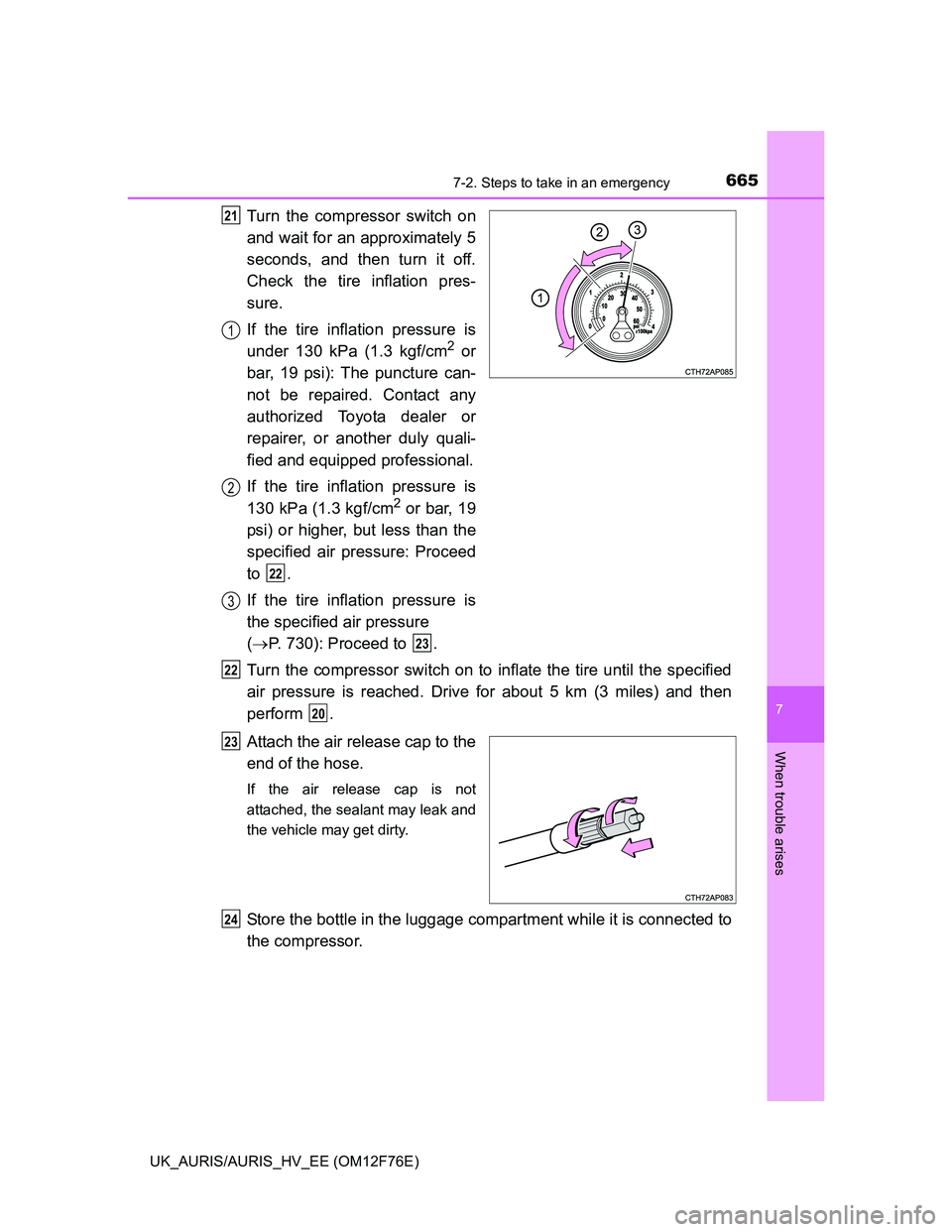
Turn the compressor switch on
and wait for an approximately 5
seconds, and then turn it off.
Check the tire inflation pres-
sure.
If the tire inflation pressure is
under 130 kPa (1.3 kgf/cm
2 or
bar, 19 psi): The puncture can-
not be repaired. Contact any
authorized Toyota dealer or
repairer, or another duly quali-
fied and equipped professional.
If the tire inflation pressure is
130 kPa (1.3 kgf/cm
2 or bar, 19
psi) or higher, but less than the
specified air pressure: Proceed
to .
If the tire inflation pressure is
the specified air pressure
(P. 730): Proceed to .
Turn the compressor switch on to inflate the tire until the specified
air pressure is reached. Drive for about 5 km (3 miles) and then
perform .
Attach the air release cap to the
end of the hose.
If the air release cap is not
attached, the sealant may leak and
the vehicle may get dirty.
Store the bottle in the luggage compartment while it is connected to
the compressor.
21
1
2
22
3
23
22
20
23
24
Page 669 of 768
6697-2. Steps to take in an emergency
UK_AURIS/AURIS_HV_EE (OM12F76E)
7
When trouble arises
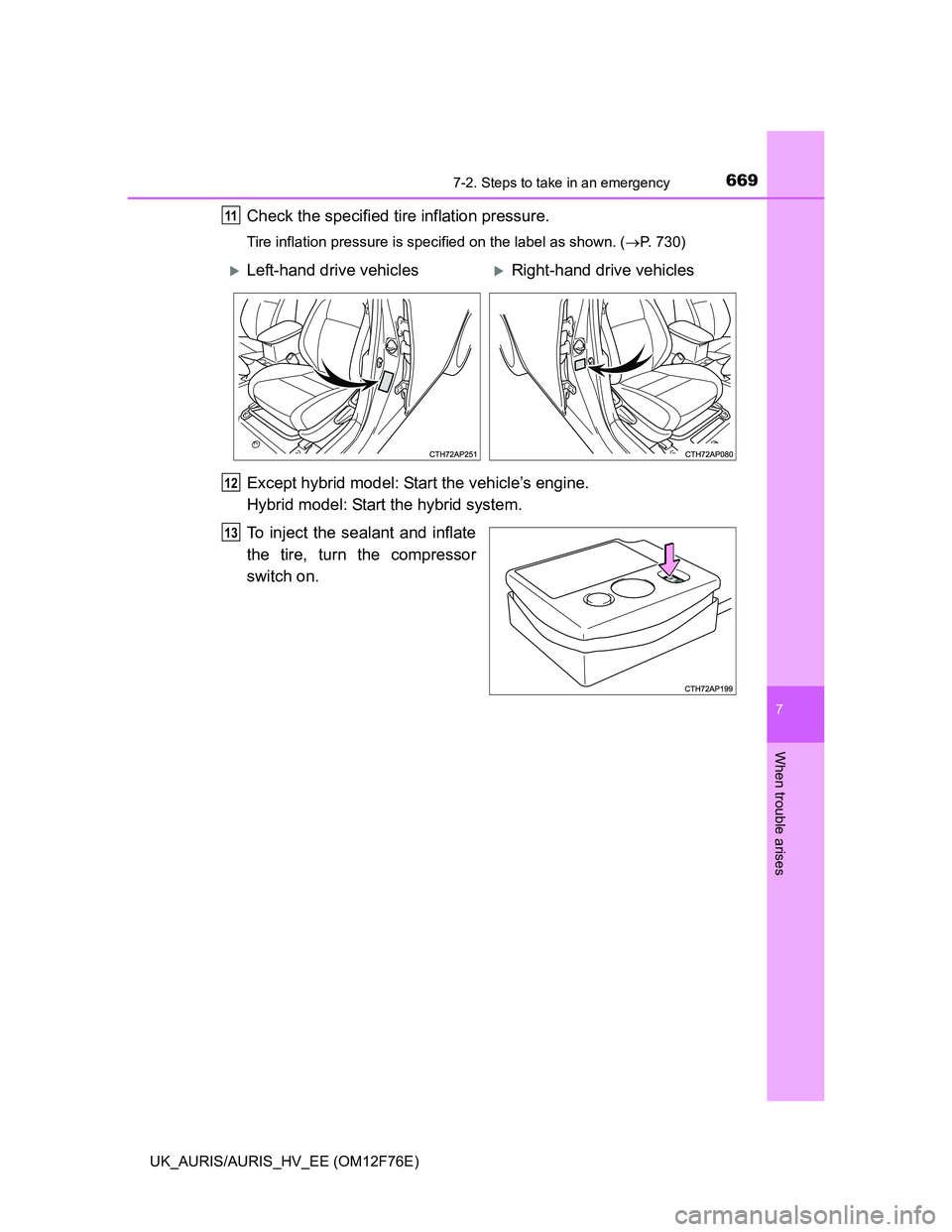
Check the specified tire inflation pressure.
Tire inflation pressure is specified on the label as shown. (P. 730)
Except hybrid model: Start the vehicle’s engine.
Hybrid model: Start the hybrid system.
To inject the sealant and inflate
the tire, turn the compressor
switch on.
11
Left-hand drive vehiclesRight-hand drive vehicles
12
13
Page 670 of 768
6707-2. Steps to take in an emergency
UK_AURIS/AURIS_HV_EE (OM12F76E)
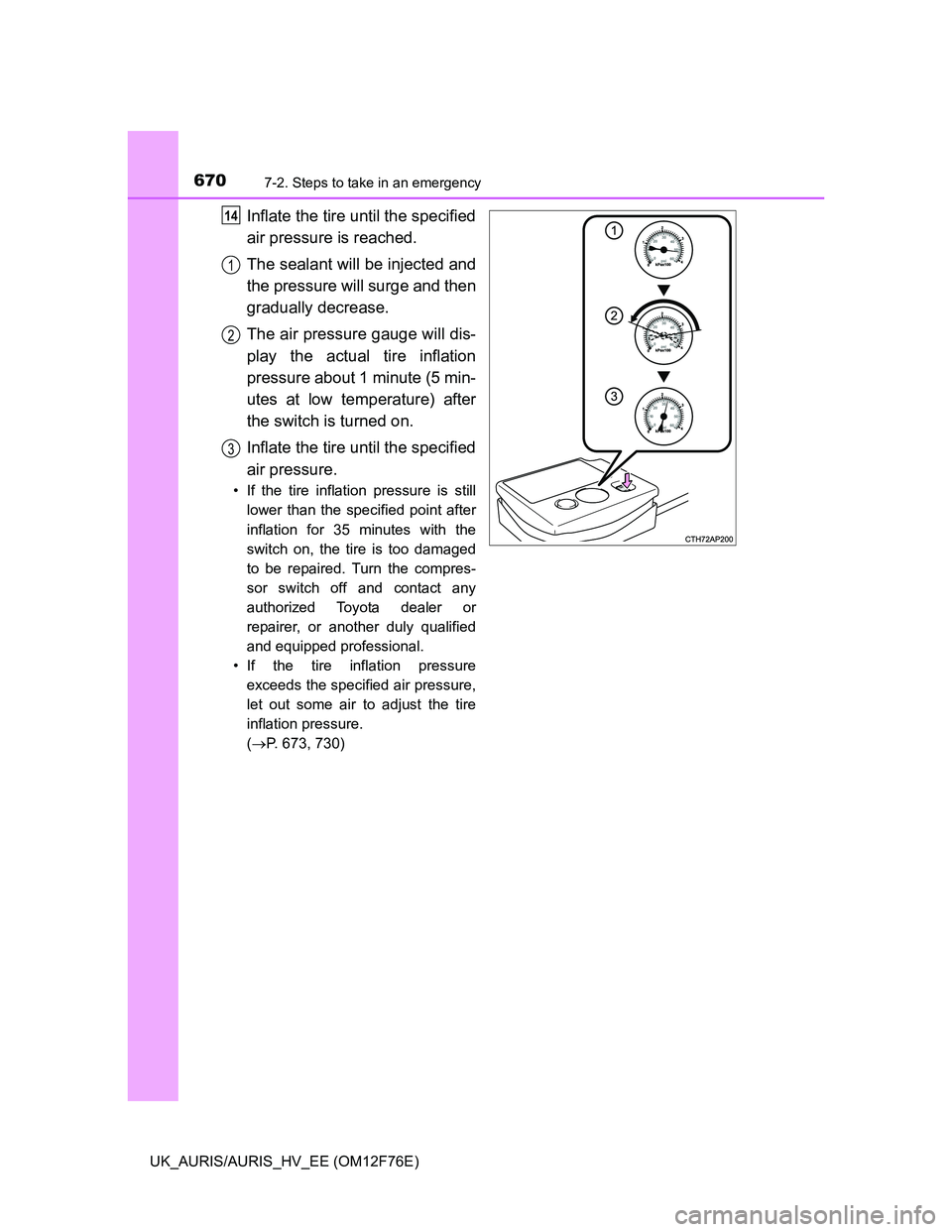
Inflate the tire until the specified
air pressure is reached.
The sealant will be injected and
the pressure will surge and then
gradually decrease.
The air pressure gauge will dis-
play the actual tire inflation
pressure about 1 minute (5 min-
utes at low temperature) after
the switch is turned on.
Inflate the tire until the specified
air pressure.
• If the tire inflation pressure is still
lower than the specified point after
inflation for 35 minutes with the
switch on, the tire is too damaged
to be repaired. Turn the compres-
sor switch off and contact any
authorized Toyota dealer or
repairer, or another duly qualified
and equipped professional.
• If the tire inflation pressure
exceeds the specified air pressure,
let out some air to adjust the tire
inflation pressure.
(P. 673, 730)
14
1
2
3
Page 672 of 768
6727-2. Steps to take in an emergency
UK_AURIS/AURIS_HV_EE (OM12F76E)
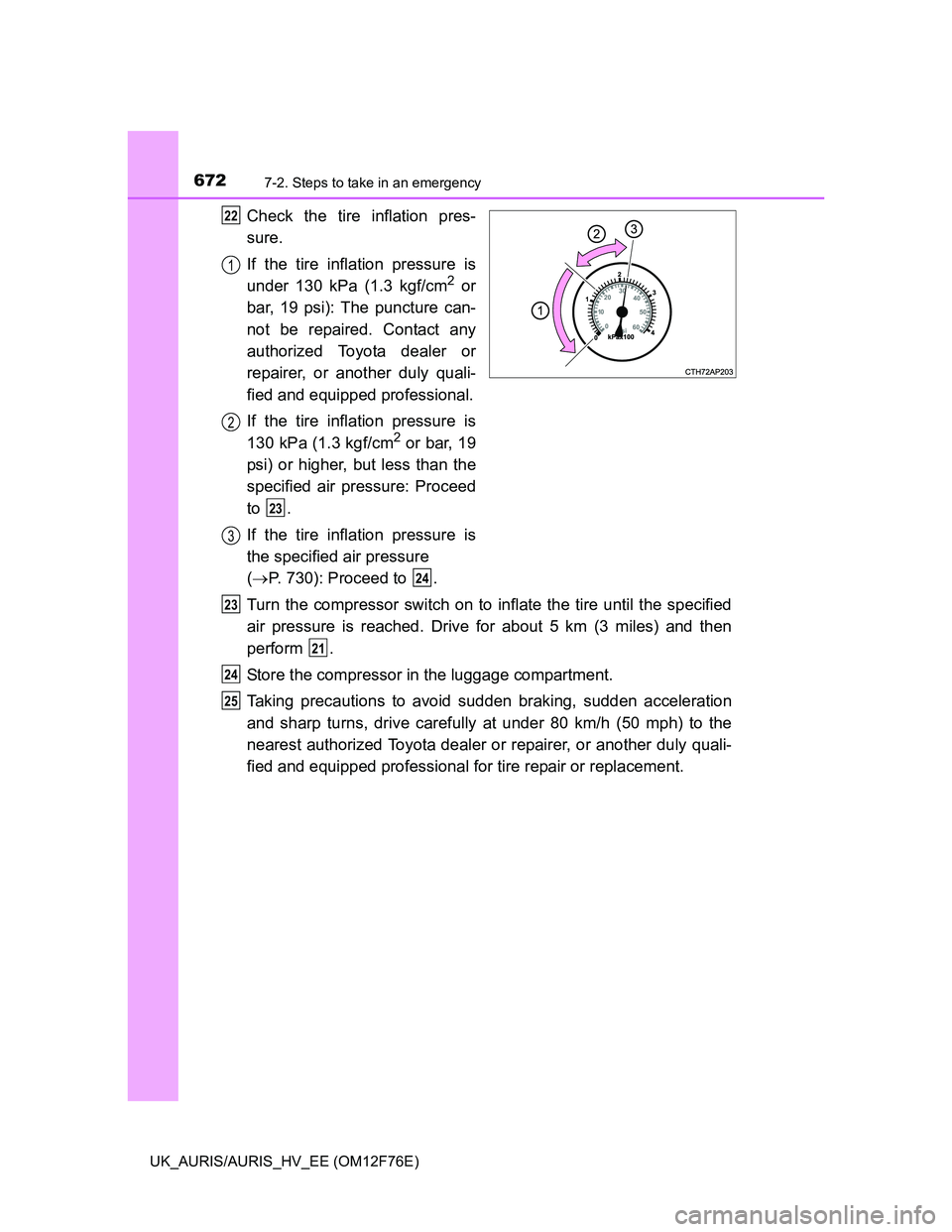
Check the tire inflation pres-
sure.
If the tire inflation pressure is
under 130 kPa (1.3 kgf/cm
2 or
bar, 19 psi): The puncture can-
not be repaired. Contact any
authorized Toyota dealer or
repairer, or another duly quali-
fied and equipped professional.
If the tire inflation pressure is
130 kPa (1.3 kgf/cm
2 or bar, 19
psi) or higher, but less than the
specified air pressure: Proceed
to .
If the tire inflation pressure is
the specified air pressure
(P. 730): Proceed to .
Turn the compressor switch on to inflate the tire until the specified
air pressure is reached. Drive for about 5 km (3 miles) and then
perform .
Store the compressor in the luggage compartment.
Taking precautions to avoid sudden braking, sudden acceleration
and sharp turns, drive carefully at under 80 km/h (50 mph) to the
nearest authorized Toyota dealer or repairer, or another duly quali-
fied and equipped professional for tire repair or replacement.
22
1
2
23
3
24
23
21
24
25
Page 673 of 768
6737-2. Steps to take in an emergency
UK_AURIS/AURIS_HV_EE (OM12F76E)
7
When trouble arises
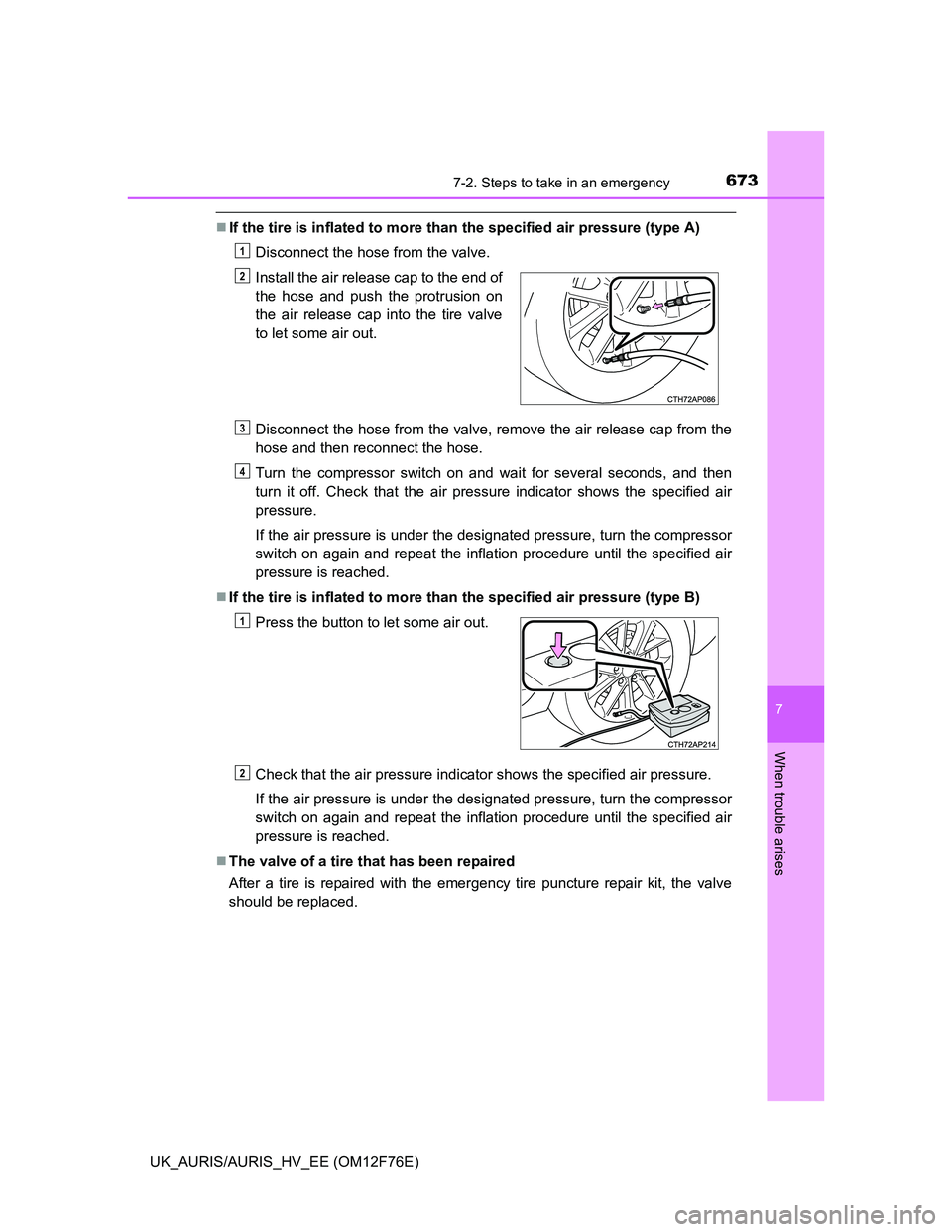
If the tire is inflated to more than the specified air pressure (type A)
Disconnect the hose from the valve.
Disconnect the hose from the valve, remove the air release cap from the
hose and then reconnect the hose.
Turn the compressor switch on and wait for several seconds, and then
turn it off. Check that the air pressure indicator shows the specified air
pressure.
If the air pressure is under the designated pressure, turn the compressor
switch on again and repeat the inflation procedure until the specified air
pressure is reached.
If the tire is inflated to more than the specified air pressure (type B)
Check that the air pressure indicator shows the specified air pressure.
If the air pressure is under the designated pressure, turn the compressor
switch on again and repeat the inflation procedure until the specified air
pressure is reached.
The valve of a tire that has been repaired
After a tire is repaired with the emergency tire puncture repair kit, the valve
should be replaced.Install the air release cap to the end of
the hose and push the protrusion on
the air release cap into the tire valve
to let some air out.
Press the button to let some air out.
1
2
3
4
1
2
Page 676 of 768
6767-2. Steps to take in an emergency
UK_AURIS/AURIS_HV_EE (OM12F76E)
CAUTION
When fixing the flat tire
After inflation of the tire has completed, the sealant may splatter when the
hose is disconnected or some air is let out of the tire.
Follow the operation procedure to repair the tire. If the procedures not fol-
lowed, the sealant may spray out.
Keep back from the tire while it is being repaired, as there is a chance of it
bursting while the repair operation is being performed. If you notice any
cracks or deformation of the tire, turn off the compressor switch and stop
the repair operation immediately.
The repair kit may overheat if operated for a long period of time. Do not
operate the repair kit continuously for more than 40 minutes.
Parts of the repair kit become hot during operation. Be careful when han-
dling the repair kit during and after operation. Do not touch the metal part
around the connecting area between the bottle and compressor. It will be
extremely hot.
Do not attach the vehicle speed warning sticker to an area other than the
one indicated. If the sticker is attached to an area where an SRS airbag is
located, such as the pad of the steering wheel, it may prevent the SRS air-
bag from operating properly.
Driving to spread the liquid sealant evenly
Observe the following precautions to reduce the risk of accidents.
Failing to do so may result in a loss of vehicle control and cause death or
serious injury.
Drive the vehicle carefully at a low speed. Be especially careful when turn-
ing and cornering.
If the vehicle does not drive straight or you feel a pull through the steering
wheel, stop the vehicle and check the following.
• Tire condition. The tire may have separated from the wheel.
• Tire inflation pressure. If the tire inflation pressure is 130 kPa (1.3
kgf/cm
2 or bar, 19 psi) or less, the tire may be severely damaged.