tires TOYOTA AURIS HYBRID 2014 Owners Manual
[x] Cancel search | Manufacturer: TOYOTA, Model Year: 2014, Model line: AURIS HYBRID, Model: TOYOTA AURIS HYBRID 2014Pages: 788, PDF Size: 21.16 MB
Page 5 of 788
5
1
8 7
6
5
4
3
2
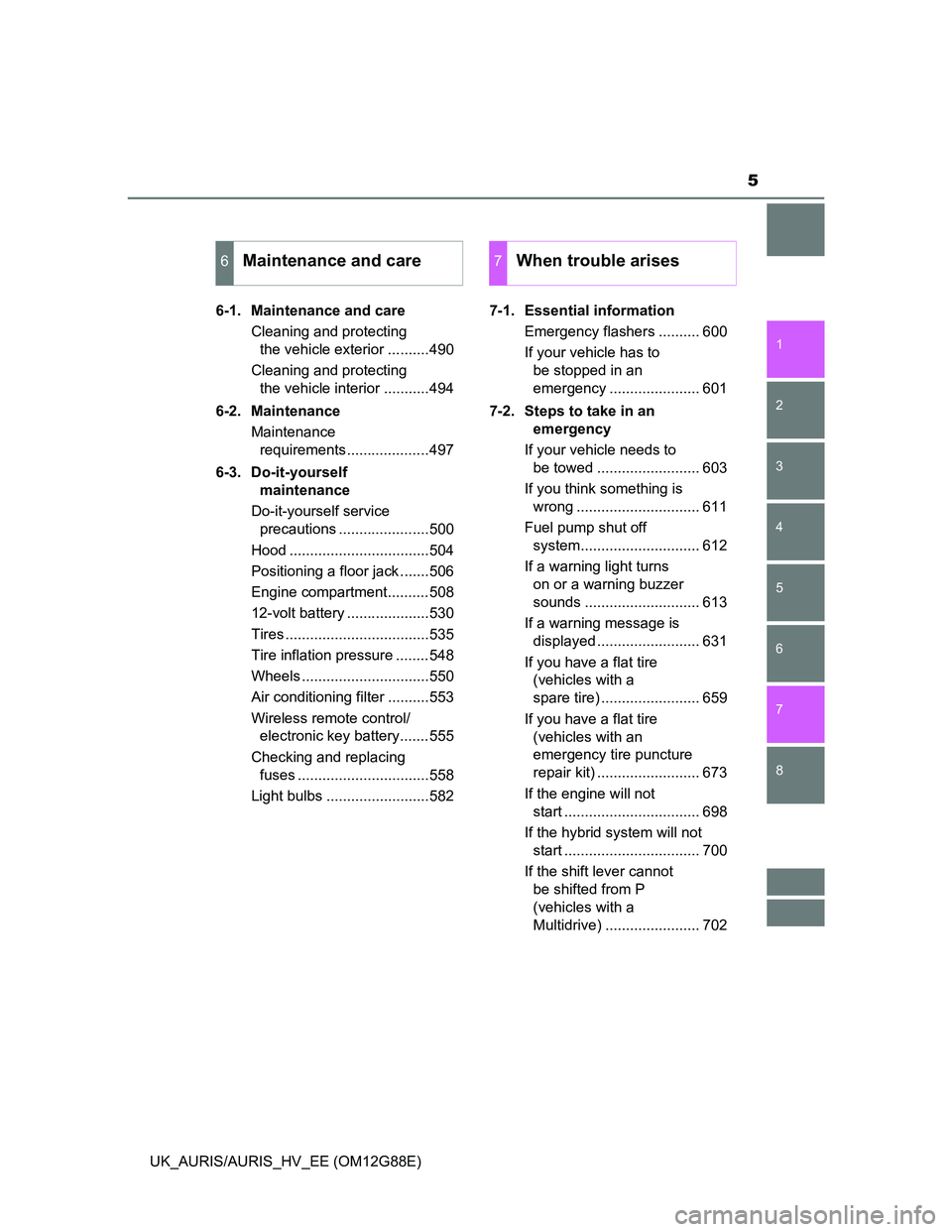
UK_AURIS/AURIS_HV_EE (OM12G88E)6-1. Maintenance and care
Cleaning and protecting
the vehicle exterior ..........490
Cleaning and protecting
the vehicle interior ...........494
6-2. Maintenance
Maintenance
requirements....................497
6-3. Do-it-yourself
maintenance
Do-it-yourself service
precautions ......................500
Hood ..................................504
Positioning a floor jack .......506
Engine compartment..........508
12-volt battery ....................530
Tires ...................................535
Tire inflation pressure ........548
Wheels ...............................550
Air conditioning filter ..........553
Wireless remote control/
electronic key battery.......555
Checking and replacing
fuses ................................558
Light bulbs .........................5827-1. Essential information
Emergency flashers .......... 600
If your vehicle has to
be stopped in an
emergency ...................... 601
7-2. Steps to take in an
emergency
If your vehicle needs to
be towed ......................... 603
If you think something is
wrong .............................. 611
Fuel pump shut off
system............................. 612
If a warning light turns
on or a warning buzzer
sounds ............................ 613
If a warning message is
displayed ......................... 631
If you have a flat tire
(vehicles with a
spare tire) ........................ 659
If you have a flat tire
(vehicles with an
emergency tire puncture
repair kit) ......................... 673
If the engine will not
start ................................. 698
If the hybrid system will not
start ................................. 700
If the shift lever cannot
be shifted from P
(vehicles with a
Multidrive) ....................... 702
6Maintenance and care7When trouble arises
Page 15 of 788
15Pictorial index
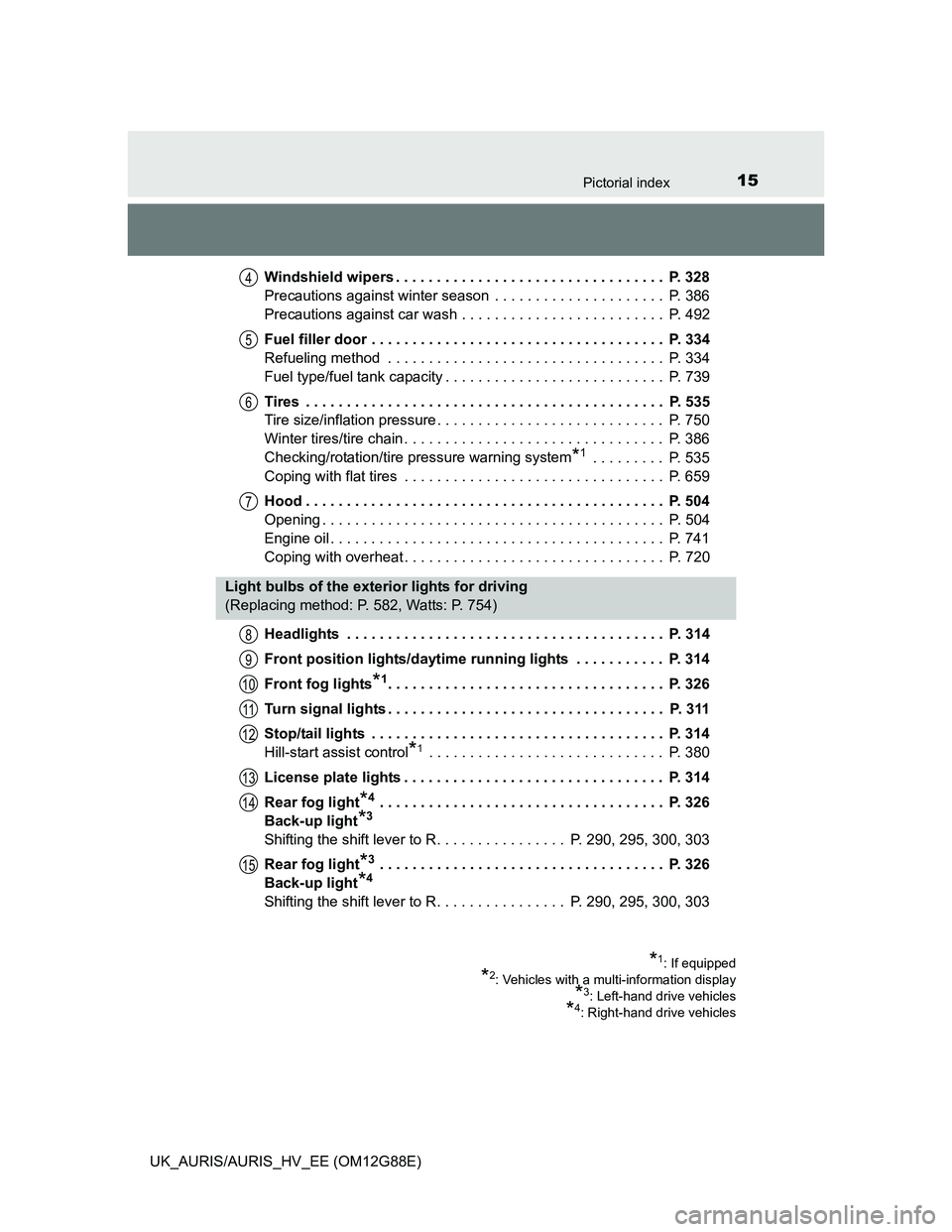
UK_AURIS/AURIS_HV_EE (OM12G88E)Windshield wipers . . . . . . . . . . . . . . . . . . . . . . . . . . . . . . . . . P. 328
Precautions against winter season . . . . . . . . . . . . . . . . . . . . . P. 386
Precautions against car wash . . . . . . . . . . . . . . . . . . . . . . . . . P. 492
Fuel filler door . . . . . . . . . . . . . . . . . . . . . . . . . . . . . . . . . . . . P. 334
Refueling method . . . . . . . . . . . . . . . . . . . . . . . . . . . . . . . . . . P. 334
Fuel type/fuel tank capacity . . . . . . . . . . . . . . . . . . . . . . . . . . . P. 739
Tires . . . . . . . . . . . . . . . . . . . . . . . . . . . . . . . . . . . . . . . . . . . . P. 535
Tire size/inflation pressure . . . . . . . . . . . . . . . . . . . . . . . . . . . . P. 750
Winter tires/tire chain . . . . . . . . . . . . . . . . . . . . . . . . . . . . . . . . P. 386
Checking/rotation/tire pressure warning system
*1 . . . . . . . . . P. 535
Coping with flat tires . . . . . . . . . . . . . . . . . . . . . . . . . . . . . . . . P. 659
Hood . . . . . . . . . . . . . . . . . . . . . . . . . . . . . . . . . . . . . . . . . . . . P. 504
Opening . . . . . . . . . . . . . . . . . . . . . . . . . . . . . . . . . . . . . . . . . . P. 504
Engine oil . . . . . . . . . . . . . . . . . . . . . . . . . . . . . . . . . . . . . . . . . P. 741
Coping with overheat . . . . . . . . . . . . . . . . . . . . . . . . . . . . . . . . P. 720
Headlights . . . . . . . . . . . . . . . . . . . . . . . . . . . . . . . . . . . . . . . P. 314
Front position lights/daytime running lights . . . . . . . . . . . P. 314
Front fog lights
*1. . . . . . . . . . . . . . . . . . . . . . . . . . . . . . . . . . P. 326
Turn signal lights . . . . . . . . . . . . . . . . . . . . . . . . . . . . . . . . . . P. 311
Stop/tail lights . . . . . . . . . . . . . . . . . . . . . . . . . . . . . . . . . . . . P. 314
Hill-start assist control
*1 . . . . . . . . . . . . . . . . . . . . . . . . . . . . . P. 380
License plate lights . . . . . . . . . . . . . . . . . . . . . . . . . . . . . . . . P. 314
Rear fog light
*4 . . . . . . . . . . . . . . . . . . . . . . . . . . . . . . . . . . . P. 326
Back-up light
*3
Shifting the shift lever to R. . . . . . . . . . . . . . . . P. 290, 295, 300, 303
Rear fog light
*3 . . . . . . . . . . . . . . . . . . . . . . . . . . . . . . . . . . . P. 326
Back-up light
*4
Shifting the shift lever to R. . . . . . . . . . . . . . . . P. 290, 295, 300, 303
4
5
6
7
Light bulbs of the exterior lights for driving
(Replacing method: P. 582, Watts: P. 754)
*1: If equipped
*2: Vehicles with a multi-information display
*3: Left-hand drive vehicles
*4: Right-hand drive vehicles
8
9
10
11
12
13
14
15
Page 234 of 788
2344-1. Before driving
UK_AURIS/AURIS_HV_EE (OM12G88E)
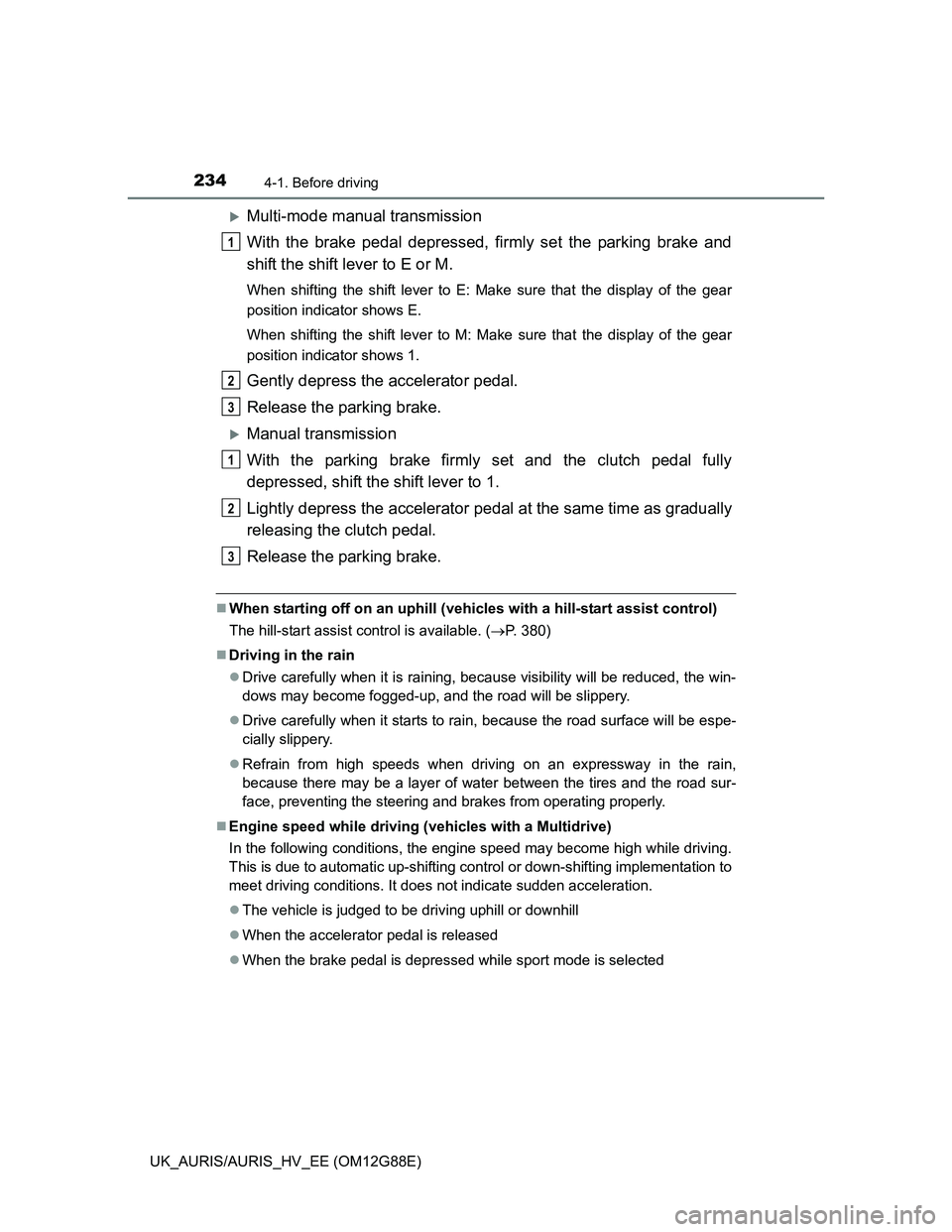
Multi-mode manual transmission
With the brake pedal depressed, firmly set the parking brake and
shift the shift lever to E or M.
When shifting the shift lever to E: Make sure that the display of the gear
position indicator shows E.
When shifting the shift lever to M: Make sure that the display of the gear
position indicator shows 1.
Gently depress the accelerator pedal.
Release the parking brake.
Manual transmission
With the parking brake firmly set and the clutch pedal fully
depressed, shift the shift lever to 1.
Lightly depress the accelerator pedal at the same time as gradually
releasing the clutch pedal.
Release the parking brake.
When starting off on an uphill (vehicles with a hill-start assist control)
The hill-start assist control is available. (P. 380)
Driving in the rain
Drive carefully when it is raining, because visibility will be reduced, the win-
dows may become fogged-up, and the road will be slippery.
Drive carefully when it starts to rain, because the road surface will be espe-
cially slippery.
Refrain from high speeds when driving on an expressway in the rain,
because there may be a layer of water between the tires and the road sur-
face, preventing the steering and brakes from operating properly.
Engine speed while driving (vehicles with a Multidrive)
In the following conditions, the engine speed may become high while driving.
This is due to automatic up-shifting control or down-shifting implementation to
meet driving conditions. It does not indicate sudden acceleration.
The vehicle is judged to be driving uphill or downhill
When the accelerator pedal is released
When the brake pedal is depressed while sport mode is selected
1
2
3
1
2
3
Page 253 of 788
2534-1. Before driving
UK_AURIS/AURIS_HV_EE (OM12G88E)
4
Driving
Tire information
Increase the tire inflation pressure to 20.0 kPa (0.2 kgf/cm
2 or bar, 3 psi)
greater than the recommended value when towing. (P. 750)
Increase the air pressure of the trailer tires in accordance with the total
trailer weight and according to the values recommended by the manufac-
turer of your trailer.
Trailer lights
Please consult at any authorized dealer or repairer, or another duly qualified
and equipped professional when installing trailer lights, as incorrect installa-
tion may cause damage to the vehicle’s lights. Please take care to comply
with your state’s laws when installing trailer lights.
Break-in schedule
Toyota recommends that vehicles fitted with new power train components
should not be used for towing trailers for the first 800 km (500 miles).
Safety checks before towing
Check that the maximum load limit for the towing hitch/bracket and hitch ball
is not exceeded. Bear in mind that the coupling weight of the trailer will add
to the load exerted on the vehicle. Also make sure that the total load exerted
on the vehicle is within the range of the weight limits. (P. 249)
Ensure that the trailer load is secure.
Supplementary outside rear view mirrors should be added to the vehicle if
the traffic behind cannot be clearly seen with standard mirrors. Adjust the
extending arms of these mirrors on both sides of the vehicle so that they
always provide maximum visibility of the road behind.
Maintenance
Maintenance must be performed more frequently when using the vehicle for
towing due to the greater weight burden placed on the vehicle compared to
normal driving.
Retighten all bolts securing the hitching ball and bracket after towing for
approximately 1000 km (600 miles).
Page 264 of 788
2644-1. Before driving
UK_AURIS/AURIS_HV_EE (OM12G88E)
Tire information
Increase the tire inflation pressure to 20.0 kPa (0.2 kgf/cm
2 or bar, 3 psi)
greater than the recommended value when towing. (P. 750)
Increase the air pressure of the trailer tires in accordance with the total
trailer weight and according to the values recommended by the manufac-
turer of your trailer.
Trailer lights
Please consult at any authorized dealer or repairer, or another duly qualified
and equipped professional when installing trailer lights, as incorrect installa-
tion may cause damage to the vehicle’s lights. Please take care to comply
with your state’s laws when installing trailer lights.
Break-in schedule
Toyota recommends that vehicles fitted with new power train components
should not be used for towing trailers for the first 800 km (500 miles).
Safety checks before towing
Check that the maximum load limit for the towing hitch/bracket and hitch ball
is not exceeded. Bear in mind that the coupling weight of the trailer will add
to the load exerted on the vehicle. Also make sure that the total load exerted
on the vehicle is within the range of the weight limits. (P. 249)
Ensure that the trailer load is secure.
Supplementary outside rear view mirrors should be added to the vehicle if
the traffic behind cannot be clearly seen with standard mirrors. Adjust the
extending arms of these mirrors on both sides of the vehicle so that they
always provide maximum visibility of the road behind.
Maintenance
Maintenance must be performed more frequently when using the vehicle for
towing due to the greater weight burden placed on the vehicle compared to
normal driving.
Retighten all bolts securing the hitching ball and bracket after towing for
approximately 1000 km (600 miles).
Page 359 of 788
3594-5. Using the driving support systems
UK_AURIS/AURIS_HV_EE (OM12G88E)
4
Driving
“IPA CANCELED, TAKE
OVER”
The steering wheel
could not be turned suf-
ficiently due to reasons
such as low tire pres-
sure, tire wear, the influ-
ence of road conditions,
being on a slope, etc.,
therefore the vehicle
could not be parked in
the desired space.
• Check tires for wear
and pressure.
• If this message is dis-
played when the vehi-
cle is parked in other
spaces, have the vehi-
cle inspected by any
authorized Toyota
dealer or repairer, or
another duly qualified
and equipped profes-
sional.
The power steering tem-
porarily overheated.Attempt to use Simple-
IPA after waiting a little
while.
Possible system mal-
function.
Have the vehicle
inspected by any autho-
rized Toyota dealer or
repairer, or another duly
qualified and equipped
professional.
“IPA CANCELED, TAKE
OVER, DRIVER INTER-
VENED”The steering wheel was
manually operated
during automatic steer-
ing.Park the vehicle manu-
ally or detect another
parking space.
“IPA CANCELED, TAKE
OVER, SPEED TOO
HIGH”
The vehicle speed
exceeded 50 km/h (31
mph) during detection of
a parking space.Reduce vehicle speed
to 30 km/h (18 mph) or
less and turn the Sim-
ple-IPA switch on.
The vehicle speed
exceeded 6 km/h (3
mph) during automatic
steering.Park the vehicle manu-
ally or detect another
parking space.
MessageCauseWhat to do
Page 365 of 788
3654-5. Using the driving support systems
UK_AURIS/AURIS_HV_EE (OM12G88E)
4
Driving
Initializing Simple-IPA
Within 15 seconds of turning the Simple-IPA switch on, turn the steering
wheel all the way to the left or right and then to the opposite side.
When the parking space detection screen is displayed, the initialization is
complete.
If pressing the Simple-IPA switch again still shows “IPA NOT AVAILABLE,
STOP THE VEHICLE, TURN WHEEL FROM LEFT END TO RIGHT END” on
the multi-information display, the initialization has failed. Have the vehicle
inspected at any authorized Toyota dealer or repairer, or another duly quali-
fied and equipped professional.
CAUTION
Cautions regarding the use of Simple-IPA
Never depend on the Simple-IPA entirely when parking. The driver is
responsible for safety. Use caution, just as you would when parking any
vehicle.
Back up slowly, using the brake pedal to control the vehicle's speed.
If it seems likely to hit nearby vehicles, obstacles, or people, depress the
brake pedal to stop the vehicle, and the disable the system.
Conditions in which the use of Simple-IPA is prohibited
Do not use Simple-IPA under the following conditions.
Doing so may cause improper operation and lead to an unexpected acci-
dent.
On sharp bends or slopes.
On slippery or icy roads, or in snow.
On uneven road surfaces such as gravel.
During bad weather such as heavy rain, fog, snow, or a sandstorm.
When the tires are extremely worn or tire pressure is low.
When the vehicle has improper wheel alignment due to tires having
received a strong impact such as bumping against a curb.
When the compact spare tire (if equipped) or snow chains are installed.
When the tires slid while attempting to park.
When fallen leaves or snow is in a parking space.
Models that can tow a trailer: When items such as a towing bracket, trailer,
bicycle carrier, etc. are installed on the rear of the vehicle.
Page 367 of 788
3674-5. Using the driving support systems
UK_AURIS/AURIS_HV_EE (OM12G88E)
4
Driving
NOTICE
When using the Simple-IPA
Check that the parking space is suitable. (Width of the space, if there are
any obstacles, road surface condition, etc.)
Simple-IPA will not operate properly if the vehicle at the front or back of the
parking space moves, or if an obstacle enters the parking space after the
sensors have detected the parking space. Always check the surrounding
area during parking assist operation.
The sensors may not be able to detect curbs. The vehicle may drive onto
the curb depending on the situation, such as if a vehicle at the front or
back of the parking space has driven on the curb.
Check the surrounding area to prevent the tires and wheels from being
damaged.
Except hybrid model: The vehicle may not be able to be parked at a target
parking space if the vehicle moves forward when the shift lever is in R or
reverses when the shift lever is in a position other than R, such as when
parking on a slope.
Hybrid model: The vehicle may not be able to be parked at a target parking
space if the vehicle moves forward when the shift position is in R or
reverses when the shift position is in a position other than R, such as when
parking on a slope.
When reversing, reverse the vehicle
slowly to prevent the front end of the
vehicle from hitting an obstacle in the
front of the vehicle.
When reversing, reverse the vehicle
slowly to prevent the front end of the
vehicle from hitting the vehicle parked in
front of the parking space.
Page 378 of 788
3784-5. Using the driving support systems
UK_AURIS/AURIS_HV_EE (OM12G88E)Reduced effectiveness of the EPS system
Except hybrid model: The effectiveness of the EPS system is reduced to pre-
vent the system from overheating when there is frequent steering input over
an extended period of time. The steering wheel may feel heavy as a result.
Should this occur, refrain from excessive steering input or stop the vehicle
and turn the engine off. The EPS system should return to normal within 10
minutes.
Hybrid model: The effectiveness of the EPS system is reduced to prevent the
system from overheating when there is frequent steering input over an
extended period of time. The steering wheel may feel heavy as a result.
Should this occur, refrain from excessive steering input or stop the vehicle
and turn the hybrid system off. The EPS system should return to normal
within 10 minutes.
Operating conditions of emergency brake signal
When the following three conditions are met, the emergency brake signal will
operate:
The emergency flashers are off.
Actual vehicle speed is over 55 km/h (35 mph).
The brake pedal is depressed in a manner that cause the system to judge
from the vehicle deceleration that this is a sudden braking operation.
Automatic system cancelation of emergency brake signal
The emergency brake signal will turn off in any of the following situations:
The emergency flashers are turned on.
The brake pedal is released.
The system judges from the vehicle deceleration that is not a sudden brak-
ing operation.
CAUTION
The ABS does not operate effectively when
The limits of tire gripping performance have been exceeded (such as
excessively worn tires on a snow covered road).
The vehicle hydroplanes while driving at high speed on wet or slick roads.
Page 379 of 788
3794-5. Using the driving support systems
UK_AURIS/AURIS_HV_EE (OM12G88E)
4
Driving
CAUTION
Stopping distance when the ABS is operating may exceed that of nor-
mal conditions
The ABS is not designed to shorten the vehicle’s stopping distance. Always
maintain a safe distance from the vehicle in front of you, especially in the
following situations:
When driving on dirt, gravel or snow-covered roads
When driving with tire chains
When driving over bumps in the road
When driving over roads with potholes or uneven surfaces
TRC may not operate effectively when
Directional control and power may not be achievable while driving on slip-
pery road surfaces, even if the TRC system is operating.
Drive the vehicle carefully in conditions where stability and power may be
lost.
When the VSC is activated
The slip indicator light flashes. Always drive carefully. Reckless driving may
cause an accident. Exercise particular care when the indicator light flashes.
When the TRC/VSC systems are turned off (except hybrid model)
Be especially careful and drive at a speed appropriate to the road condi-
tions. As these are the systems to help ensure vehicle stability and driving
force, do not turn the TRC/VSC systems off unless necessary.
Replacing tires
Make sure that all tires are of the specified size, brand, tread pattern and
total load capacity. In addition, make sure that the tires are inflated to the
recommended tire inflation pressure level.
The ABS, TRC and VSC systems will not function correctly if different tires
are installed on the vehicle.
Contact any authorized Toyota dealer or repairer, or another duly qualified
and equipped professional for further information when replacing tires or
wheels.
Handling of tires and the suspension
Using tires with any kind of problem or modifying the suspension will affect
the driving assist systems, and may cause a system to malfunction.