inflation pressure TOYOTA AURIS HYBRID 2016 Owner's Manual
[x] Cancel search | Manufacturer: TOYOTA, Model Year: 2016, Model line: AURIS HYBRID, Model: TOYOTA AURIS HYBRID 2016Pages: 592, PDF Size: 16.67 MB
Page 495 of 592
4958-2. Steps to take in an emergency
UK AURIS_HV_HB_EE (OM12K47E)
8
When trouble arises
■Front passenger detection sensor, seat belt reminder and warning
buzzer
● If luggage is placed on the front passenger seat, the front passenger detec-
tion sensor may cause the warning light to flash and the warning buzzer to
sound even if a passenger is not sitting in the seat.
● If a cushion is placed on the seat, the sensor may not detect a passenger,
and the warning light may not operate properly.
■ If the malfunction indicator lamp comes on while driving
The malfunction indicator lamp will come on if the fuel tank becomes com-
pletely empty. If the fuel tank is empt y, refuel the vehicle immediately. The
malfunction indicator lamp will go off after several trips.
If the malfunction indicator lamp does not go off, contact any authorized
Toyota dealer or repairer, or another duly qualified and equipped professional
as soon as possible.
■ When the tire pressure warning light comes on (vehicles with a tire pres-
sure warning system)
Carry out the following procedure after the tire temperature has lowered suffi-
ciently.
● Check the tire inflation pressure and adjust it to the appropriate level.
● If the warning light does not go out after several minutes, check that the tire
inflation pressure is at the specified level and carry out initialization.
The warning light may come on again if the above operations are conducted
without first allowing the tire temperature to lower sufficiently.
■ The tire pressure warning light may come on due to natural causes
(vehicles with a tire pressure warning system)
The tire pressure warning light may come on due to natural causes such as
natural air leaks and tire inflation pressure changes caused by temperature.
In this case, adjusting the tire inflation pressure will turn off the warning light
(after a few minutes).
■ When a tire is replaced with a spare tire (vehicles with a tire pressure
warning system)
The compact spare tire is not equipped with a tire pressure warning valve and
transmitter. If a tire goes flat, the tire pressure warning light will not turn off
even though the flat tire has been replaced with the spare tire. Replace the
spare tire with the repaired tire and adjus t the tire inflation pressure. The tire
pressure warning light will go off after a few minutes.
■ Conditions that the tire pressure warning system may not function prop-
erly (vehicles with a ti re pressure warning system)
→ P. 443
Page 497 of 592
4978-2. Steps to take in an emergency
UK AURIS_HV_HB_EE (OM12K47E)
8
When trouble arises
WARNING
■ If both the ABS and the brake system warning lights remain on
Stop your vehicle in a safe place immediately and contact any authorized
Toyota dealer or repairer, or another duly qualified and equipped profes-
sional. The vehicle will become extremely unstable during braking, and the
ABS system may fail, which could cause an accident resulting in death or
serious injury.
■ When the electric power steering system warning light comes on
The steering wheel may become extremely heavy.
If the steering wheel becomes heavier than usual when operating, hold
firmly and operate using more force than usual.
■ If the tire pressure warning light comes on (vehicles with a tire pres-
sure warning system)
Be sure to observe the following precautions. Failure to do so could cause a
loss of vehicle control and result in death or serious injury.
●Stop your vehicle in a safe place as soon as possible. Adjust the tire infla-
tion pressure immediately.
● Vehicles with a compact spare tire: If the tire pressure warning light comes
on even after tire inflation pressure adjustment, it is probable that you have
a flat tire. Check the tires. If a tire is flat, change it with the spare tire and
have the flat tire repaired by the nearest authorized Toyota dealer or
repairer, or another duly qualified and equipped professional.
● Vehicles with an emergency tire puncture repair kit: If the tire pressure
warning light comes on even after tire inflation pressure adjustment, it is
probable that you have a flat tire. Check the tires. If a tire is flat, repair the
flat tire by using emergency tire puncture repair kit.
● Avoid abrupt maneuvering and braking. If the vehicle tires deteriorate, you
could lose control of the steering wheel or the brakes.
■ If a blowout or sudden air leakage should occur (vehicles with a tire
pressure warning system)
The tire pressure warning system may not activate immediately.
NOTICE
■To ensure the tire pressure warn ing system operates properly (vehi-
cles with a tire pressure warning system)
Do not install tires with different specifications or makers, as the tire pres-
sure warning system may not operate properly.
Page 515 of 592
5158-2. Steps to take in an emergency
UK AURIS_HV_HB_EE (OM12K47E)
8
When trouble arises
■The compact spare tire
●The compact spare tire is identified by the label “TEMPORARY USE ONLY”
on the tire sidewall.
Use the compact spare tire temporarily, and only in an emergency.
● Make sure to check the tire inflation pressure of the compact spare tire.
(→ P. 560)
■ When the compact spare tire is equipped
The vehicle becomes lower when driving with the compact spare tire com-
pared to when driving with standard tires.
■ When using the spare tire (vehicles with a tire pressure warning system)
As the spare tire is not equipped with a tire pressure warning valve and trans-
mitter, low inflation pressure of the spare tire will not be indicated by the tire
pressure warning system. Also, if you replace the spare tire after the tire pres-
sure warning light comes on, the light remains on.
■ If you have a flat front tire on a road covered with snow or ice
Install the compact spare tire on one of the rear wheels of the vehicle. Per-
form the following steps and fit tire chains to the front tires:
Replace a rear tire with the compact spare tire.
Replace the flat front tire with the tire removed from the rear of the vehicle.
Fit tire chains to the front tires.
1
2
3
Page 525 of 592
5258-2. Steps to take in an emergency
UK AURIS_HV_HB_EE (OM12K47E)
8
When trouble arises
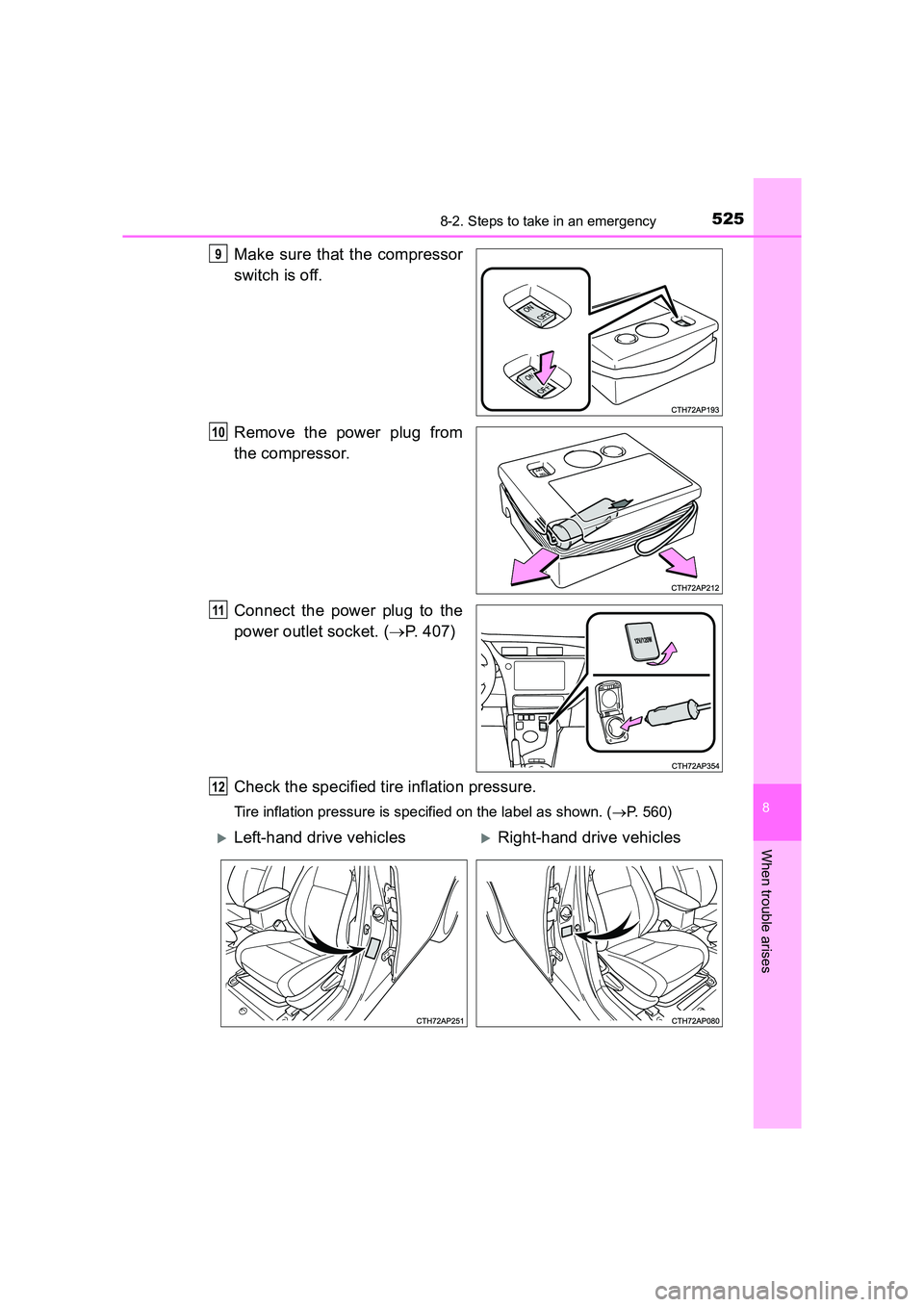
Make sure that the compressor
switch is off.
Remove the power plug from
the compressor.
Connect the power plug to the
power outlet socket. (→P. 407)
Check the specified tire inflation pressure.
Tire inflation pressure is specified on the label as shown. ( →P. 560)
9
10
11
12
XLeft-hand drive vehiclesXRight-hand drive vehicles
Page 526 of 592
5268-2. Steps to take in an emergency
UK AURIS_HV_HB_EE (OM12K47E)
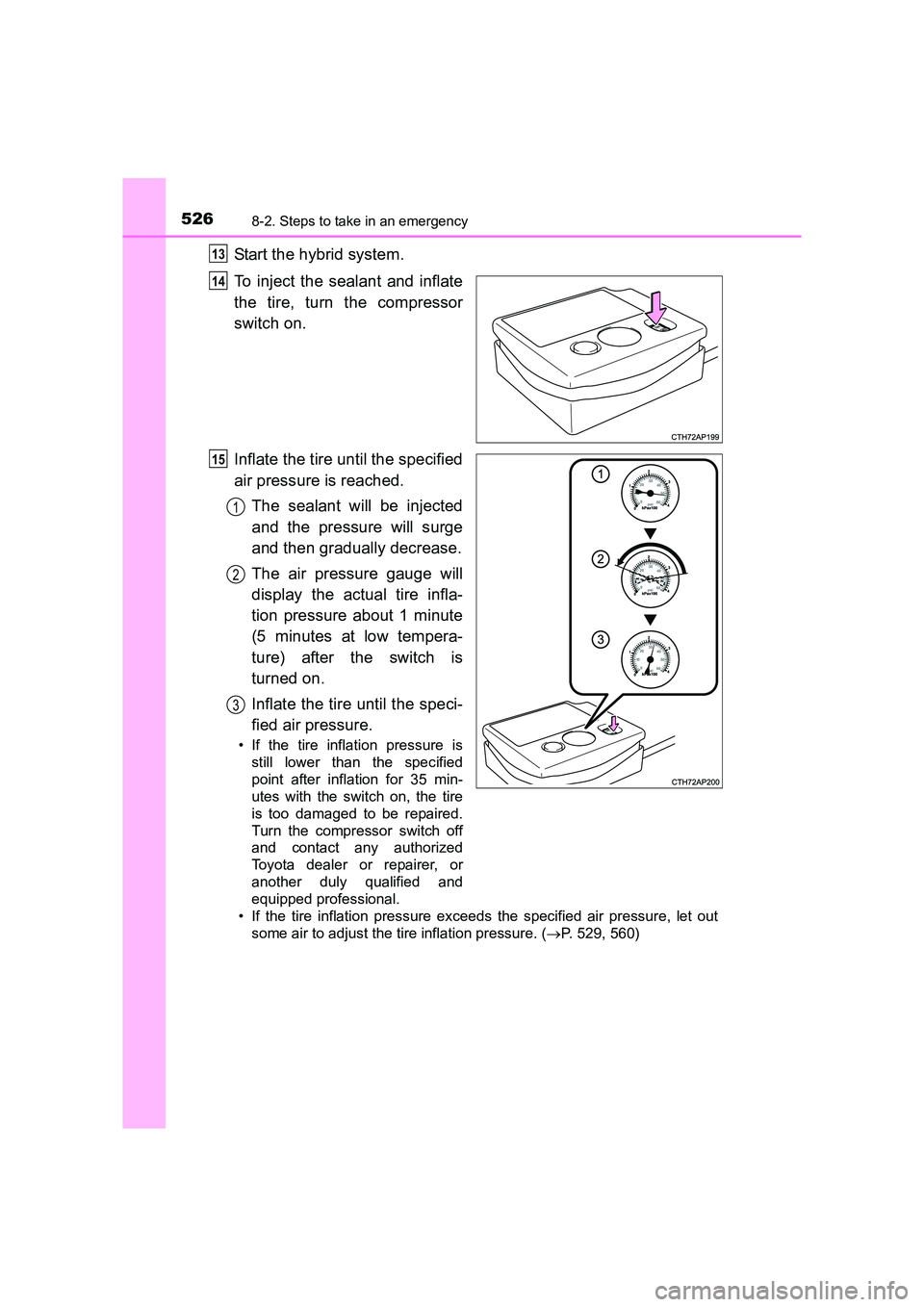
Start the hybrid system.
To inject the sealant and inflate
the tire, turn the compressor
switch on.
Inflate the tire until the specified
air pressure is reached.The sealant will be injected
and the pressure will surge
and then gradually decrease.
The air pressure gauge will
display the actual tire infla-
tion pressure about 1 minute
(5 minutes at low tempera-
ture) after the switch is
turned on.
Inflate the tire until the speci-
fied air pressure.
• If the tire inflation pressure isstill lower than the specified
point after inflation for 35 min-
utes with the switch on, the tire
is too damaged to be repaired.
Turn the compressor switch off
and contact any authorized
Toyota dealer or repairer, or
another duly qualified and
equipped professional.
• If the tire inflation pressure exceeds the specified air pressure, let out some air to adjust the tire inflation pressure. ( →P. 529, 560)
13
14
15
1
2
3
Page 528 of 592
5288-2. Steps to take in an emergency
UK AURIS_HV_HB_EE (OM12K47E)
Temporarily store the bottle and compressor in the luggage com-
partment.
To spread the liquid sealant evenly within the tire, immediately drive
safely for about 5 km (3 miles) below 80 km/h (50 mph).
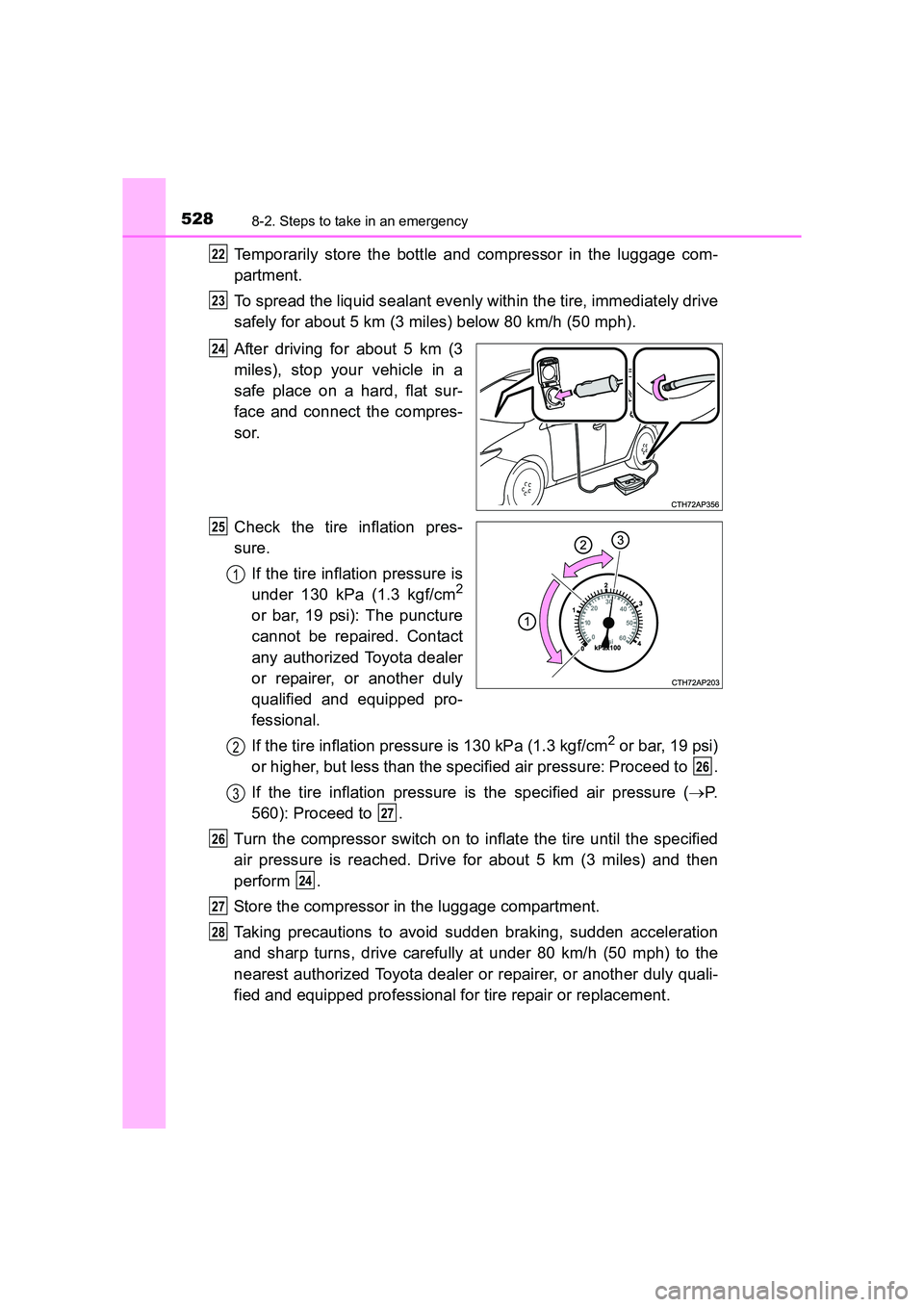
After driving for about 5 km (3
miles), stop your vehicle in a
safe place on a hard, flat sur-
face and connect the compres-
sor.
Check the tire inflation pres-
sure.If the tire inflation pressure is
under 130 kPa (1.3 kgf/cm
2
or bar, 19 psi): The puncture
cannot be repaired. Contact
any authorized Toyota dealer
or repairer, or another duly
qualified and equipped pro-
fessional.
If the tire inflation pressure is 130 kPa (1.3 kgf/cm
2 or bar, 19 psi)
or higher, but less than the specified air pressure: Proceed to .
If the tire inflation pressure is the specified air pressure ( →P.
560): Proceed to .
Turn the compressor switch on to inflate the tire until the specified
air pressure is reached. Drive for about 5 km (3 miles) and then
perform .
Store the compressor in the luggage compartment.
Taking precautions to avoid sudden braking, sudden acceleration
and sharp turns, drive carefully at under 80 km/h (50 mph) to the
nearest authorized Toyota dealer or repairer, or another duly quali-
fied and equipped professional for tire repair or replacement.
22
23
24
25
1
2
26
3
27
26
24
27
28
Page 529 of 592
5298-2. Steps to take in an emergency
UK AURIS_HV_HB_EE (OM12K47E)
8
When trouble arises
■In the following cases, the tire cannot be repaired with the emergency
tire puncture repair kit. Contact any authorized Toyota dealer or repairer,
or another duly qualified and equipped professional.
●When the tire is damaged due to driving without sufficient air pressure
● When there are any cracks or damage at any location on the tire, such as on
the side wall, except the tread
● When the tire is visibly separated from the wheel
● When the cut or damage to the tread is 4 mm (0.16 in.) long or more
● When the wheel is damaged
● When two or more tires have been punctured
● When 2 or more sharp objects such as nails or screws have passed through
the tread on a single tire
● When the sealant has expired
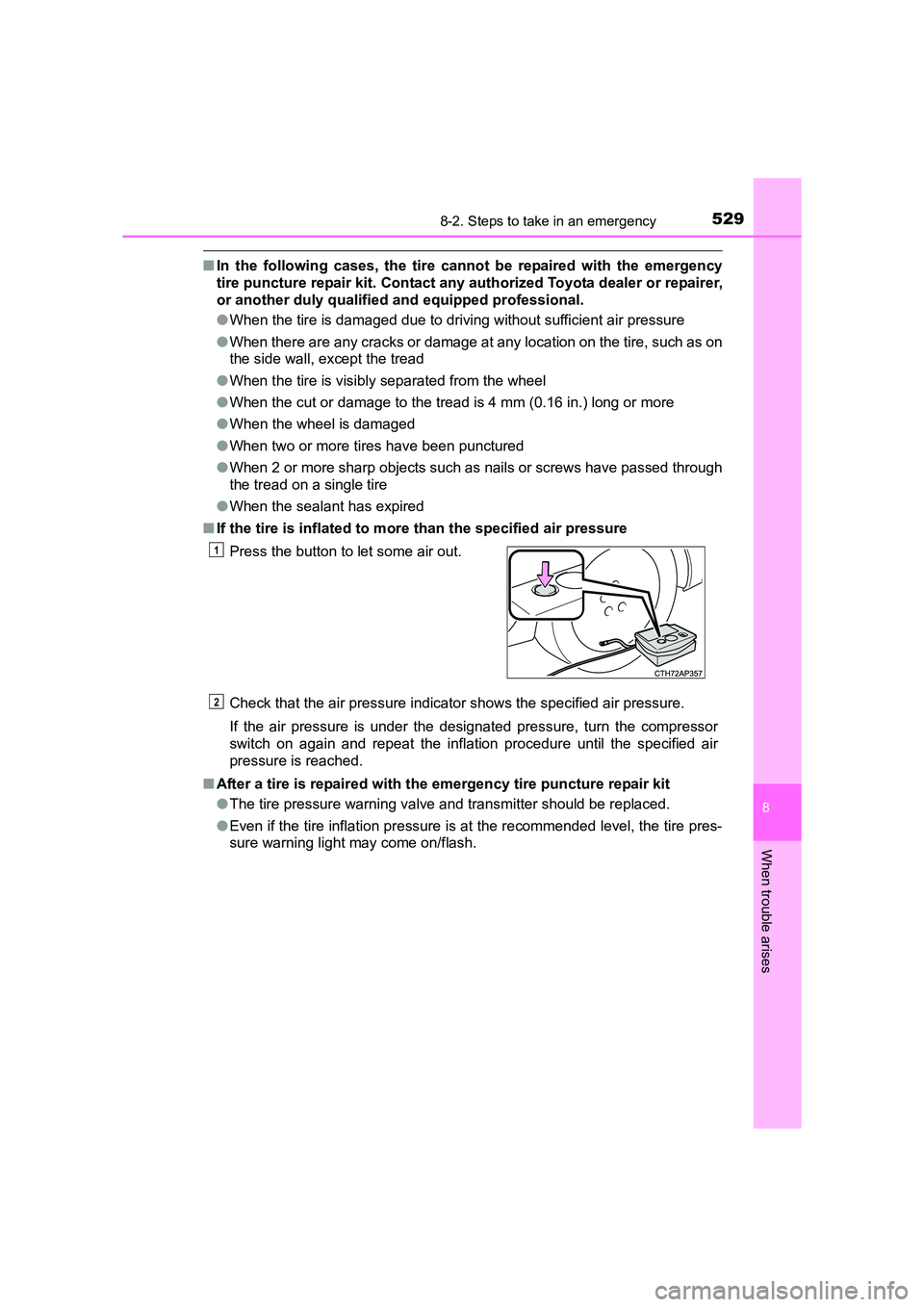
■ If the tire is inflated to mo re than the specified air pressure
Check that the air pressure indicator shows the specified air pressure.
If the air pressure is under the designated pressure, turn the compressor
switch on again and repeat the inflation procedure until the specified air
pressure is reached.
■ After a tire is repaired with the emergency tire puncture repair kit
●The tire pressure warning valve and transmitter should be replaced.
● Even if the tire inflation pressure is at the recommended level, the tire pres-
sure warning light may come on/flash. Press the button to let some air out.
1
2
Page 532 of 592
5328-2. Steps to take in an emergency
UK AURIS_HV_HB_EE (OM12K47E)
WARNING
■ When fixing the flat tire
●After inflation of the tire has completed, the sealant may splatter when the
hose is disconnected or some air is let out of the tire.
● Follow the operation procedure to repair the tire. If the procedures not fol-
lowed, the sealant may spray out.
● Keep back from the tire while it is being repaired, as there is a chance of it
bursting while the repair operation is being performed. If you notice any
cracks or deformation of the tire, turn off the compressor switch and stop
the repair operation immediately.
● The repair kit may overheat if operated for a long period of time. Do not
operate the repair kit continuously for more than 40 minutes.
● Parts of the repair kit become hot during operation. Be careful when han-
dling the repair kit during and after operation. Do not touch the metal part
around the connecting area between the bottle and compressor. It will be
extremely hot.
● Do not attach the vehicle speed warning sticker to an area other than the
one indicated. If the sticker is attached to an area where an SRS airbag is
located, such as the pad of the steering wheel, it may prevent the SRS air-
bag from operating properly.
■ Driving to spread the liquid sealant evenly
Observe the following precautions to reduce the risk of accidents.
Failing to do so may result in a loss of vehicle control and cause death or
serious injury.
●Drive the vehicle carefully at a low speed. Be especially careful when turn-
ing and cornering.
● If the vehicle does not drive straight or you feel a pull through the steering
wheel, stop the vehicle and check the following.
• Tire condition. The tire may have separated from the wheel.
• Tire inflation pressure. If the tire inflation pressure is 130 kPa (1.3
kgf/cm
2 or bar, 19 psi) or less, the tire may be severely damaged.
Page 560 of 592
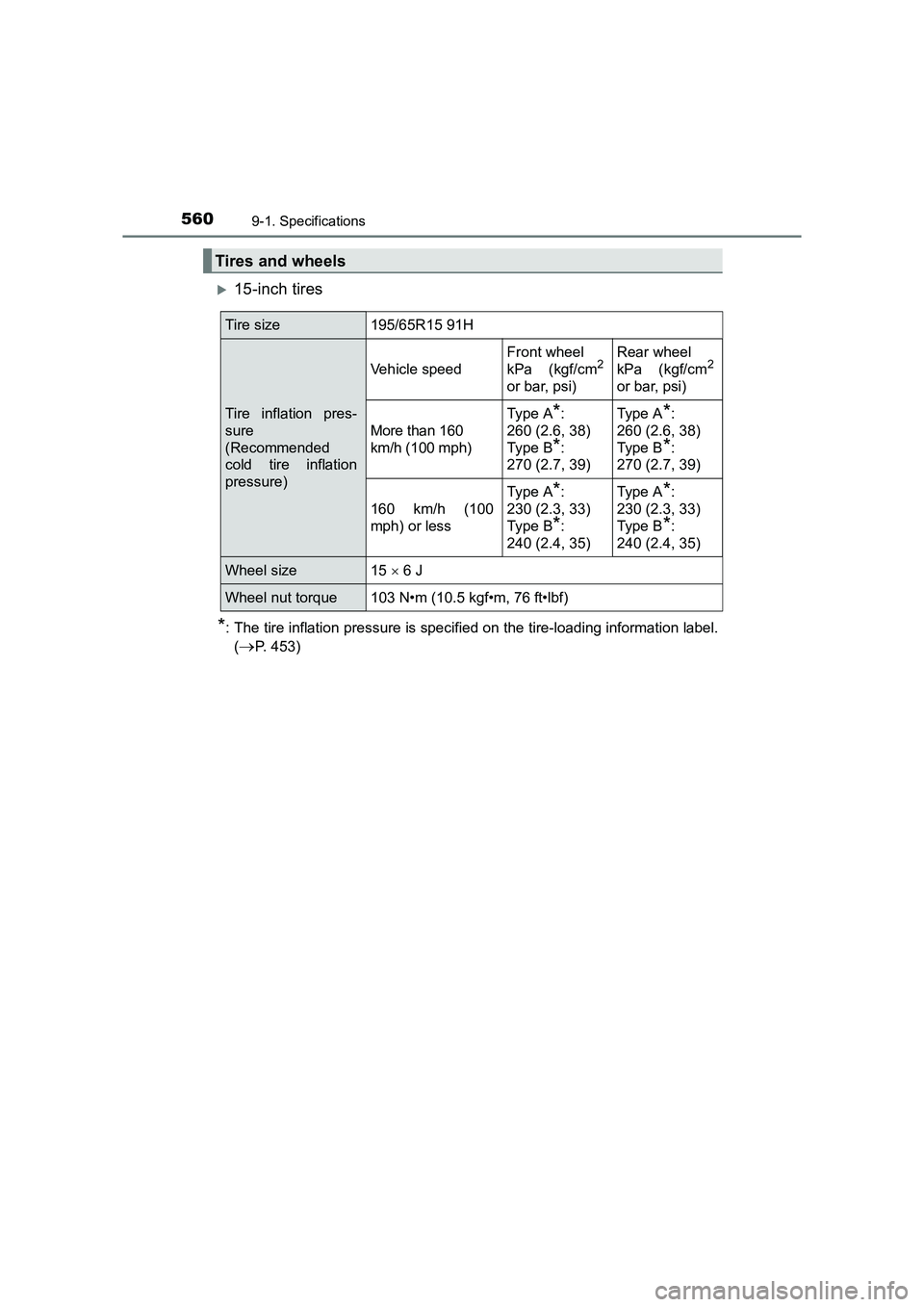
5609-1. Specifications
UK AURIS_HV_HB_EE (OM12K47E)
X15-inch tires
*: The tire inflation pressure is specified on the tire-loading information label.
(
→P. 453)
Tires and wheels
Tire size195/65R15 91H
Tire inflation pres-
sure
(Recommended
cold tire inflation
pressure)
Vehicle speed
Front wheel
kPa (kgf/cm2
or bar, psi)
Rear wheel
kPa (kgf/cm2
or bar, psi)
More than 160
km/h (100 mph)
Type A*:
260 (2.6, 38)
Type B
*:
270 (2.7, 39)
Type A*:
260 (2.6, 38)
Type B
*:
270 (2.7, 39)
160 km/h (100
mph) or less
Type A*:
230 (2.3, 33)
Type B
*:
240 (2.4, 35)
Type A*:
230 (2.3, 33)
Type B
*:
240 (2.4, 35)
Wheel size15 × 6 J
Wheel nut torque103 N•m (10.5 kgf•m, 76 ft•lbf)
Page 561 of 592
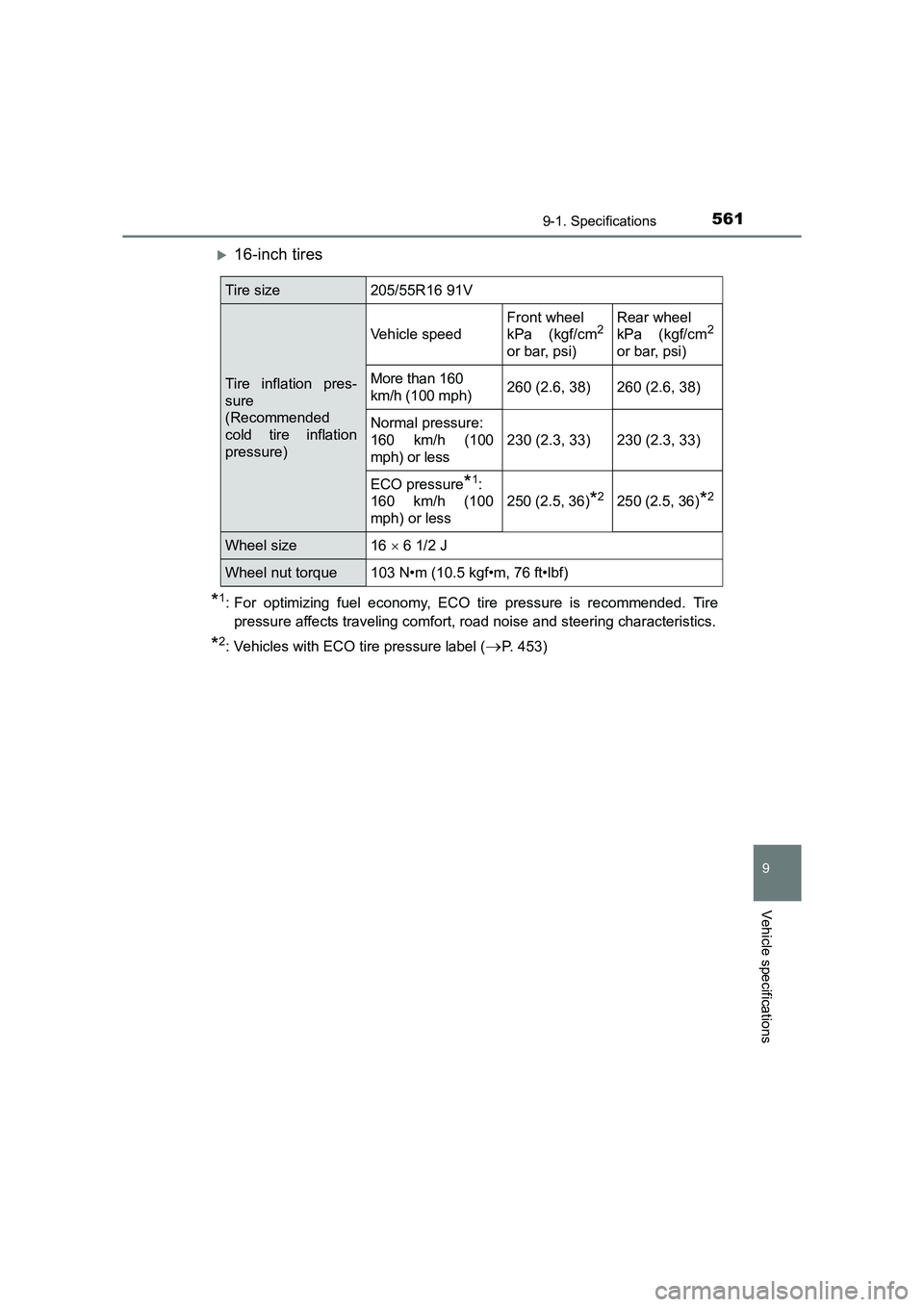
5619-1. Specifications
UK AURIS_HV_HB_EE (OM12K47E)
9
Vehicle specifications
X16-inch tires
*1: For optimizing fuel economy, ECO tire pressure is recommended. Tirepressure affects traveling comfort, road noise and steering characteristics.
*2: Vehicles with ECO tire pressure label (→P. 453)
Tire size205/55R16 91V
Tire inflation pres-
sure
(Recommended
cold tire inflation
pressure)
Vehicle speed
Front wheel
kPa (kgf/cm2
or bar, psi)
Rear wheel
kPa (kgf/cm2
or bar, psi)
More than 160
km/h (100 mph)260 (2.6, 38)260 (2.6, 38)
Normal pressure:
160 km/h (100
mph) or less
230 (2.3, 33)230 (2.3, 33)
ECO pressure*1:
160 km/h (100
mph) or less
250 (2.5, 36)*2250 (2.5, 36)*2
Wheel size16 × 6 1/2 J
Wheel nut torque103 N•m (10.5 kgf•m, 76 ft•lbf)