ECU TOYOTA AURIS HYBRID 2017 User Guide
[x] Cancel search | Manufacturer: TOYOTA, Model Year: 2017, Model line: AURIS HYBRID, Model: TOYOTA AURIS HYBRID 2017Pages: 664, PDF Size: 27.42 MB
Page 45 of 664
451-1. For safe use
1
For safety and security
AURIS Touring Sports_EE (12L13E)
WARNING
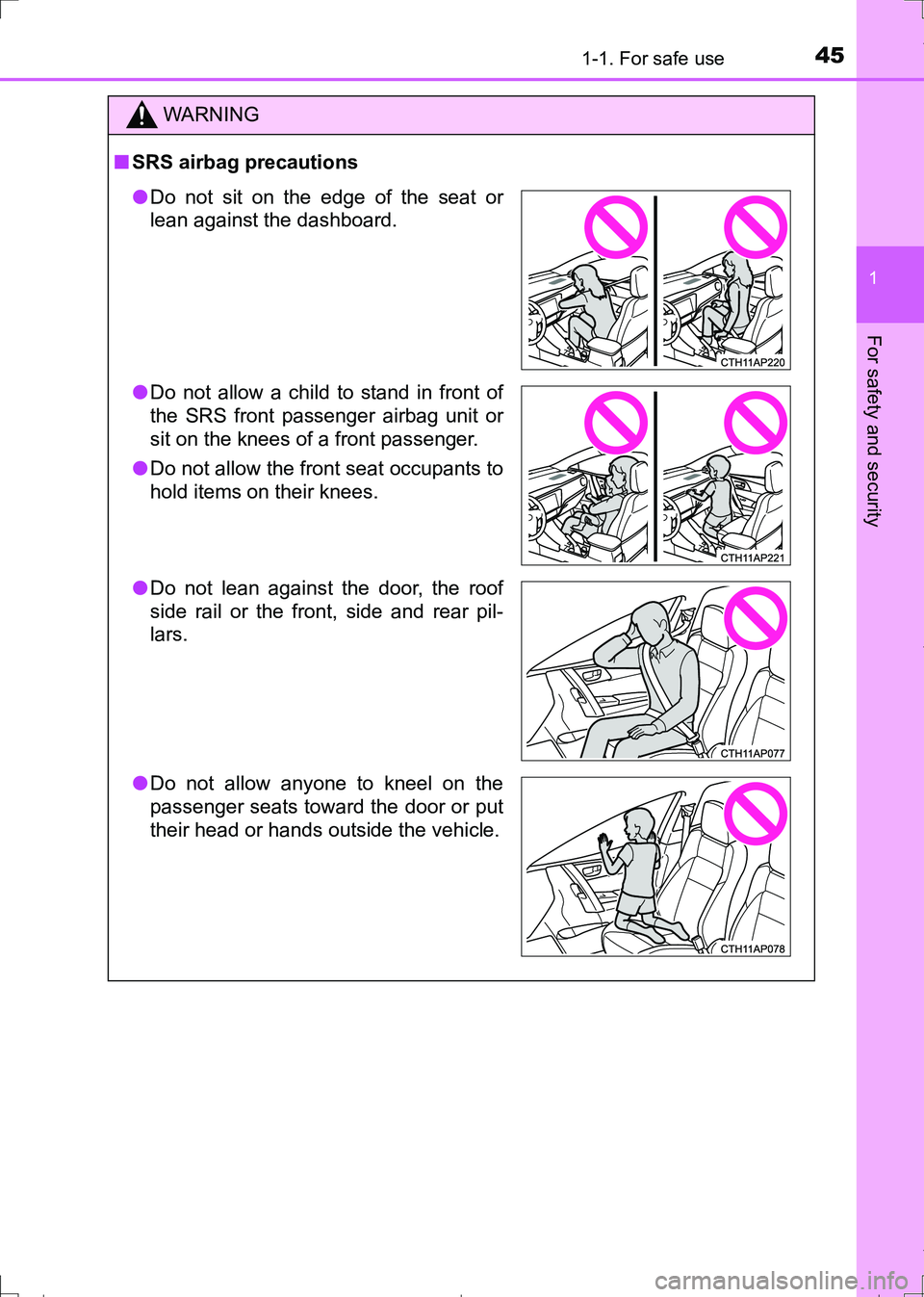
■SRS airbag precautions
●Do not sit on the edge of the seat or
lean against the dashboard.
●Do not allow a child to stand in front of
the SRS front passenger airbag unit or
sit on the knees of a front passenger.
●Do not allow the front seat occupants to
hold items on their knees.
●Do not lean against the door, the roof
side rail or the front, side and rear pil-
lars.
●Do not allow anyone to kneel on the
passenger seats toward the door or put
their head or hands outside the vehicle.
AURIS Touring Sports_OM_Europe_OM12L13E.book 45 ページ 2016年6月27日 月曜日 午後5時21分
Page 47 of 664
471-1. For safe use
1
For safety and security
AURIS Touring Sports_EE (12L13E)
WARNING
■SRS airbag precautions
●Do not use seat accessories which cover the parts where the SRS side
airbags inflate as they may interfere with inflation of the airbags. Such
accessories may prevent the side airbags from activating correctly, disable
the system or cause the side airbags to inflate accidentally, resulting in
death or serious injury.
●Do not strike or apply significant levels of force to the area of the SRS
airbag components.
Doing so can cause the SRS airbags to malfunction.
●Do not touch any of the component parts immediately after the SRS
airbags have deployed (inflated) as they may be hot.
●If breathing becomes difficult after the SRS airbags have deployed, open a
door or window to allow fresh air in, or leave the vehicle if it is safe to do
so. Wash off any residue as soon as possible to prevent skin irritation.
●If the areas where the SRS airbags are stored, such as the steering wheel
pad and front and rear pillar garnishes are damaged or cracked, have
them replaced by any authorized Toyota dealer or repairer, or another duly
qualified and equipped professional.
■Modification and disposal of SRS airbag system components
Do not dispose of your vehicle or perform any of the following modifications
without consulting any authorized Toyota dealer or repairer, or another duly
qualified and equipped professional. The SRS airbags may malfunction or
deploy (inflate) accidentally, causing death or serious injury.
●Installation, removal, disassembly and repair of the SRS airbags
●Repairs, modifications, removal or replacement of the steering wheel,
instrument panel, dashboard, seats or seat upholstery, front, side and rear
pillars or roof side rails
●Repairs or modifications of the front fender, front bumper, or side of the
occupant compartment
●Installation of a grille guard (bull bars, kangaroo bar, etc.), snow plows or
winches
●Modifications to the vehicle’s suspension system
●Installation of electronic devices such as mobile two-way radios (RF-trans-
mitter) and CD players
●Modifications to your vehicle for a person with a physical disability
AURIS Touring Sports_OM_Europe_OM12L13E.book 47 ページ 2016年6月27日 月曜日 午後5時21分
Page 49 of 664
491-1. For safe use
1
For safety and security
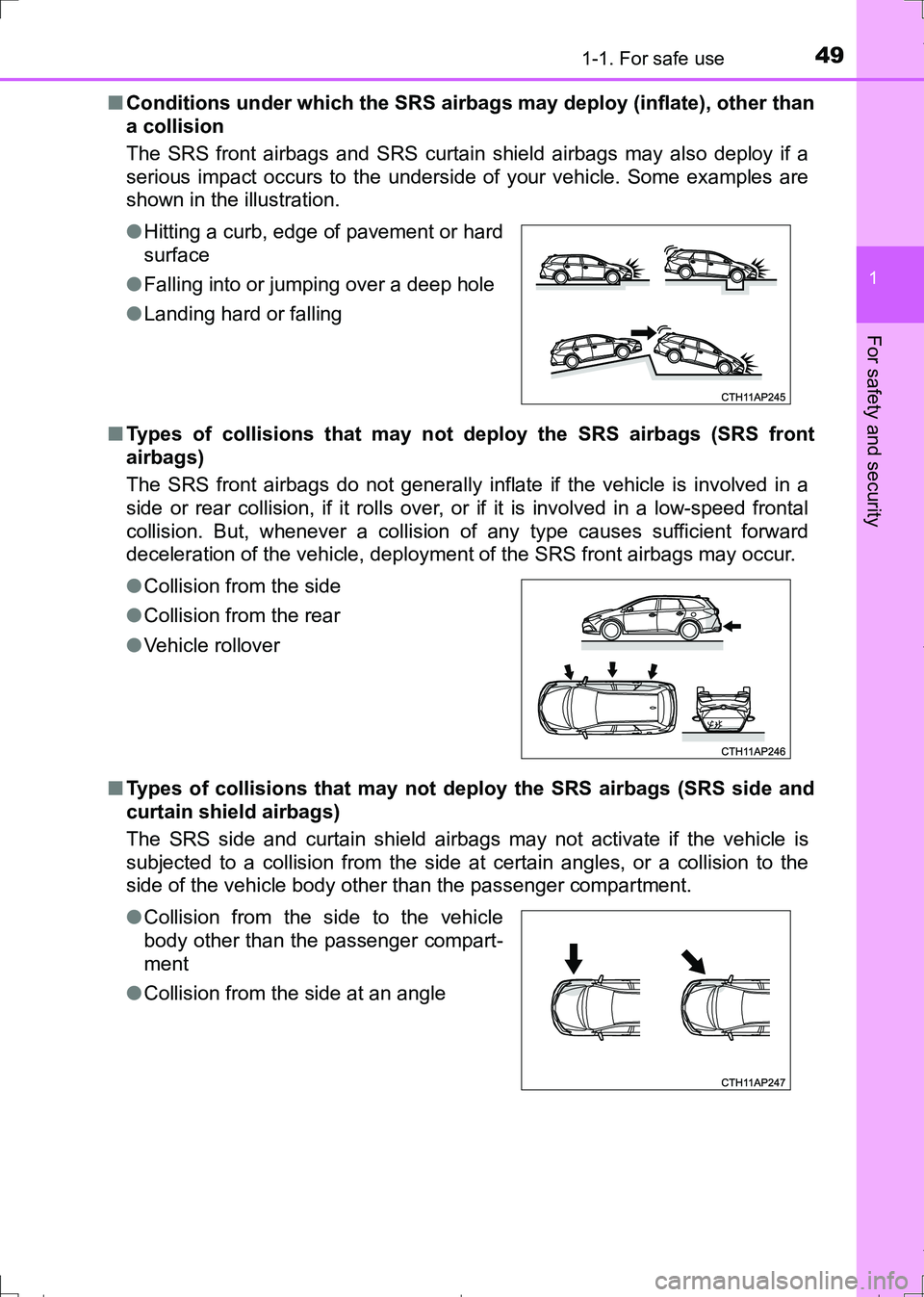
AURIS Touring Sports_EE (12L13E)■Conditions under which the SRS airbags may deploy (inflate), other than
a collision
The SRS front airbags and SRS curtain shield airbags may also deploy if a
serious impact occurs to the underside of your vehicle. Some examples are
shown in the illustration.
■Types of collisions that may not deploy the SRS airbags (SRS front
airbags)
The SRS front airbags do not generally inflate if the vehicle is involved in a
side or rear collision, if it rolls over, or if it is involved in a low-speed frontal
collision. But, whenever a collision of any type causes sufficient forward
deceleration of the vehicle, deployment of the SRS front airbags may occur.
■Types of collisions that may not deploy the SRS airbags (SRS side and
curtain shield airbags)
The SRS side and curtain shield airbags may not activate if the vehicle is
subjected to a collision from the side at certain angles, or a collision to the
side of the vehicle body other than the passenger compartment. ●Hitting a curb, edge of pavement or hard
surface
●Falling into or jumping over a deep hole
●Landing hard or falling
●Collision from the side
●Collision from the rear
●Vehicle rollover
●Collision from the side to the vehicle
body other than the passenger compart-
ment
●Collision from the side at an angle
AURIS Touring Sports_OM_Europe_OM12L13E.book 49 ページ 2016年6月27日 月曜日 午後5時21分
Page 51 of 664
511-1. For safe use
1
For safety and security
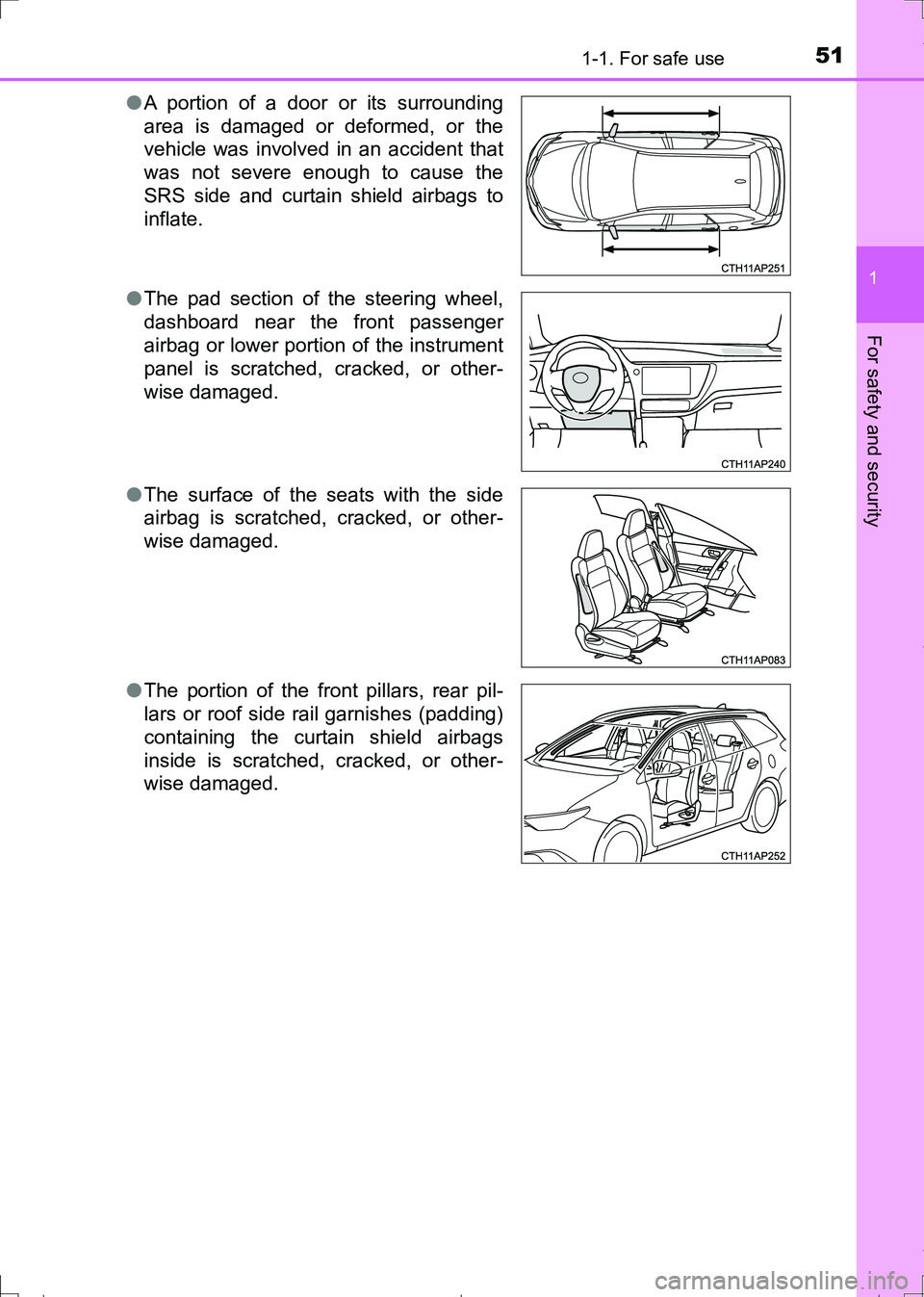
AURIS Touring Sports_EE (12L13E)●A portion of a door or its surrounding
area is damaged or deformed, or the
vehicle was involved in an accident that
was not severe enough to cause the
SRS side and curtain shield airbags to
inflate.
●The pad section of the steering wheel,
dashboard near the front passenger
airbag or lower portion of the instrument
panel is scratched, cracked, or other-
wise damaged.
●The surface of the seats with the side
airbag is scratched, cracked, or other-
wise damaged.
●The portion of the front pillars, rear pil-
lars or roof side rail garnishes (padding)
containing the curtain shield airbags
inside is scratched, cracked, or other-
wise damaged.
AURIS Touring Sports_OM_Europe_OM12L13E.book 51 ページ 2016年6月27日 月曜日 午後5時21分
Page 53 of 664
531-1. For safe use
1
For safety and security
AURIS Touring Sports_EE (12L13E)
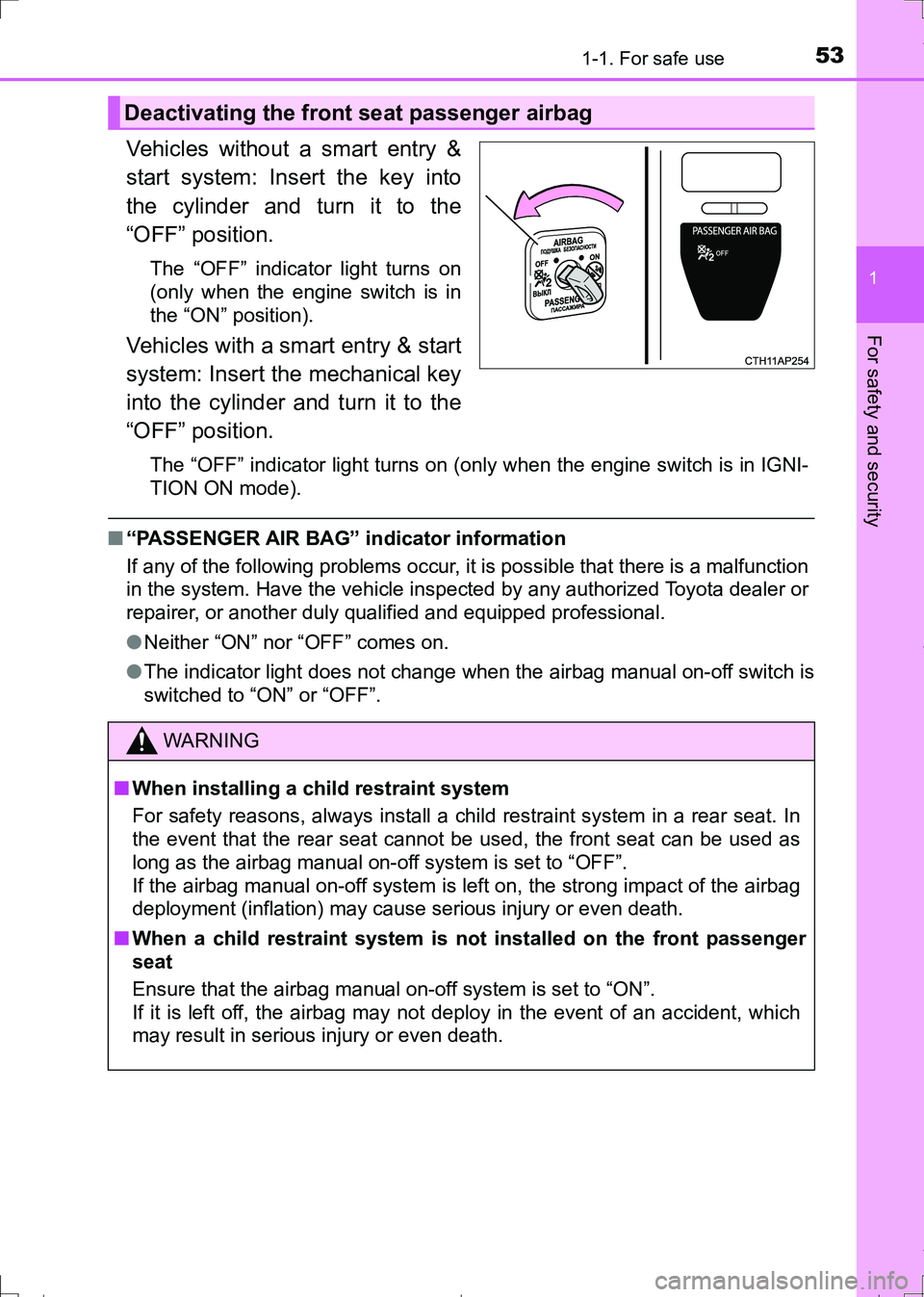
Vehicles without a smart entry &
start system: Insert the key into
the cylinder and turn it to the
“OFF” position.
The “OFF” indicator light turns on
(only when the engine switch is in
the “ON” position).
Vehicles with a smart entry & start
system: Insert the mechanical key
into the cylinder and turn it to the
“OFF” position.
The “OFF” indicator light turns on (only when the engine switch is in IGNI-
TION ON mode).
■“PASSENGER AIR BAG” indicator information
If any of the following problems occur, it is possible that there is a malfunction
in the system. Have the vehicle inspected by any authorized Toyota dealer or
repairer, or another duly qualified and equipped professional.
●Neither “ON” nor “OFF” comes on.
●The indicator light does not change when the airbag manual on-off switch is
switched to “ON” or “OFF”.
Deactivating the front seat passenger airbag
WARNING
■When installing a child restraint system
For safety reasons, always install a child restraint system in a rear seat. In
the event that the rear seat cannot be used, the front seat can be used as
long as the airbag manual on-off system is set to “OFF”.
If the airbag manual on-off system is left on, the strong impact of the airbag
deployment (inflation) may cause serious injury or even death.
■When a child restraint system is not installed on the front passenger
seat
Ensure that the airbag manual on-off system is set to “ON”.
If it is left off, the airbag may not deploy in the event of an accident, which
may result in serious injury or even death.
AURIS Touring Sports_OM_Europe_OM12L13E.book 53 ページ 2016年6月27日 月曜日 午後5時21分
Page 55 of 664
551-1. For safe use
1
For safety and security
AURIS Touring Sports_EE (12L13E)
Studies have shown that installing a child restraint on a rear seat is
much safer than installing one on the front passenger seat.
●Choose a child restraint system that suits your vehicle and is appro-
priate to the age and size of the child.
●For installation details, follow the instructions provided with the child
restraint system.
General installation instructions are provided in this manual.
(P. 64)
●If child restraint system regulations exist in the country where you
reside, please contact any authorized Toyota dealer or repairer, or
another duly qualified and equipped professional for the child
restraint system installation.
●Toyota recommends that you use a child restraint system which
conforms to the regulation ECE No.44.
Child restraint systems
Toyota strongly urges the use of child restraint systems.
Points to remember
AURIS Touring Sports_OM_Europe_OM12L13E.book 55 ページ 2016年6月27日 月曜日 午後5時21分
Page 56 of 664
561-1. For safe use
AURIS Touring Sports_EE (12L13E)
Child restraint systems are classified into the following 5 groups
according to the regulation ECE No.44:
Group 0: Up to 10 kg (22 lb.) (0 - 9 months)
Group 0
+: Up to 13 kg (28 lb.) (0 - 2 years)
Group I: 9 to 18 kg (20 to 39 lb.) (9 months - 4 years)
Group II: 15 to 25 kg (34 to 55 lb.) (4 years - 7 years)
Group III: 22 to 36 kg (49 to 79 lb.) (6 years - 12 years)
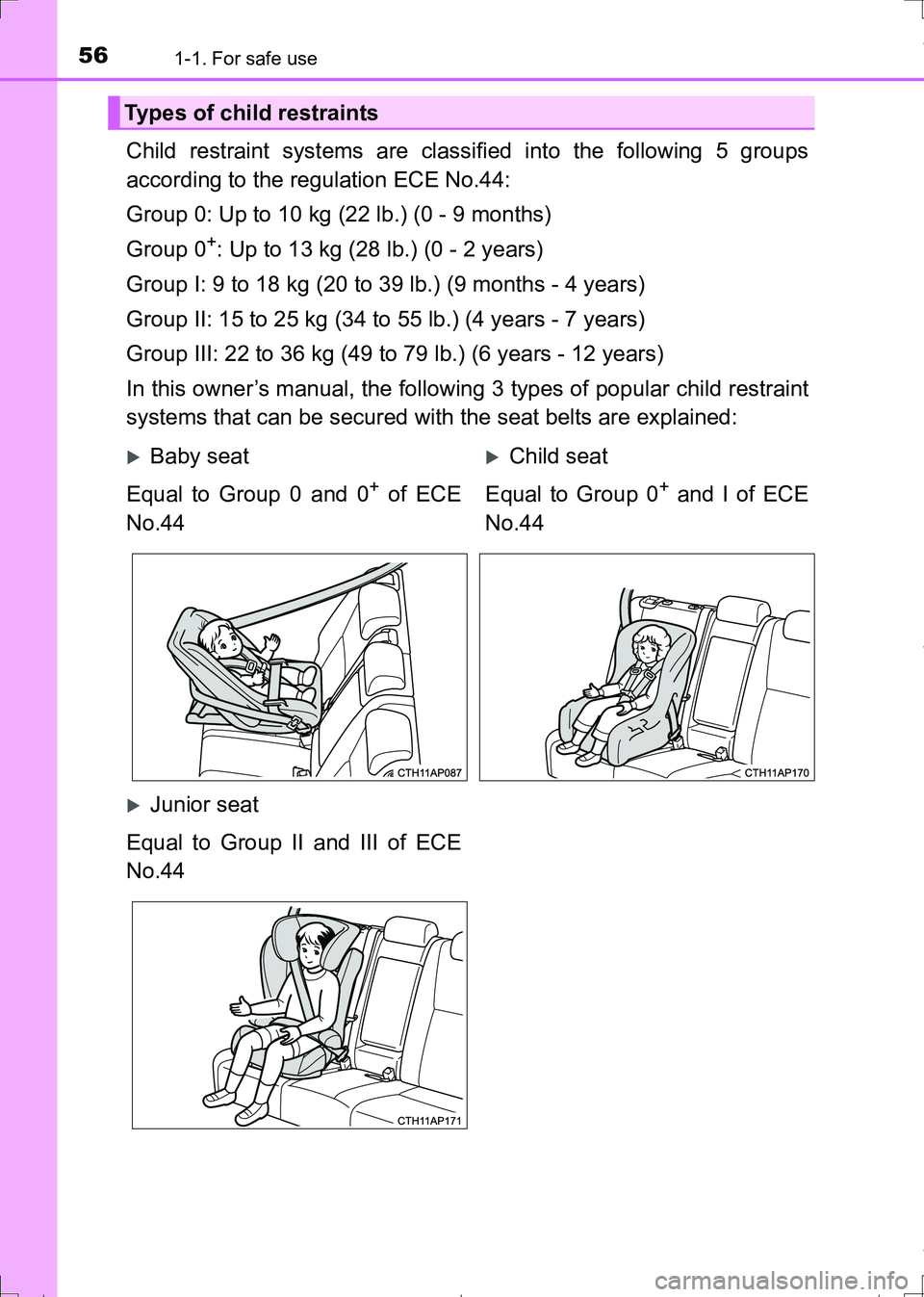
In this owner’s manual, the following 3 types of popular child restraint
systems that can be secured with the seat belts are explained:
Types of child restraints
Baby seatChild seat
Equal to Group 0 and 0
+ of ECE
No.44Equal to Group 0+ and I of ECE
No.44
Junior seat
Equal to Group II and III of ECE
No.44
AURIS Touring Sports_OM_Europe_OM12L13E.book 56 ページ 2016年6月27日 月曜日 午後5時21分
Page 57 of 664
571-1. For safe use
1
For safety and security
AURIS Touring Sports_EE (12L13E)
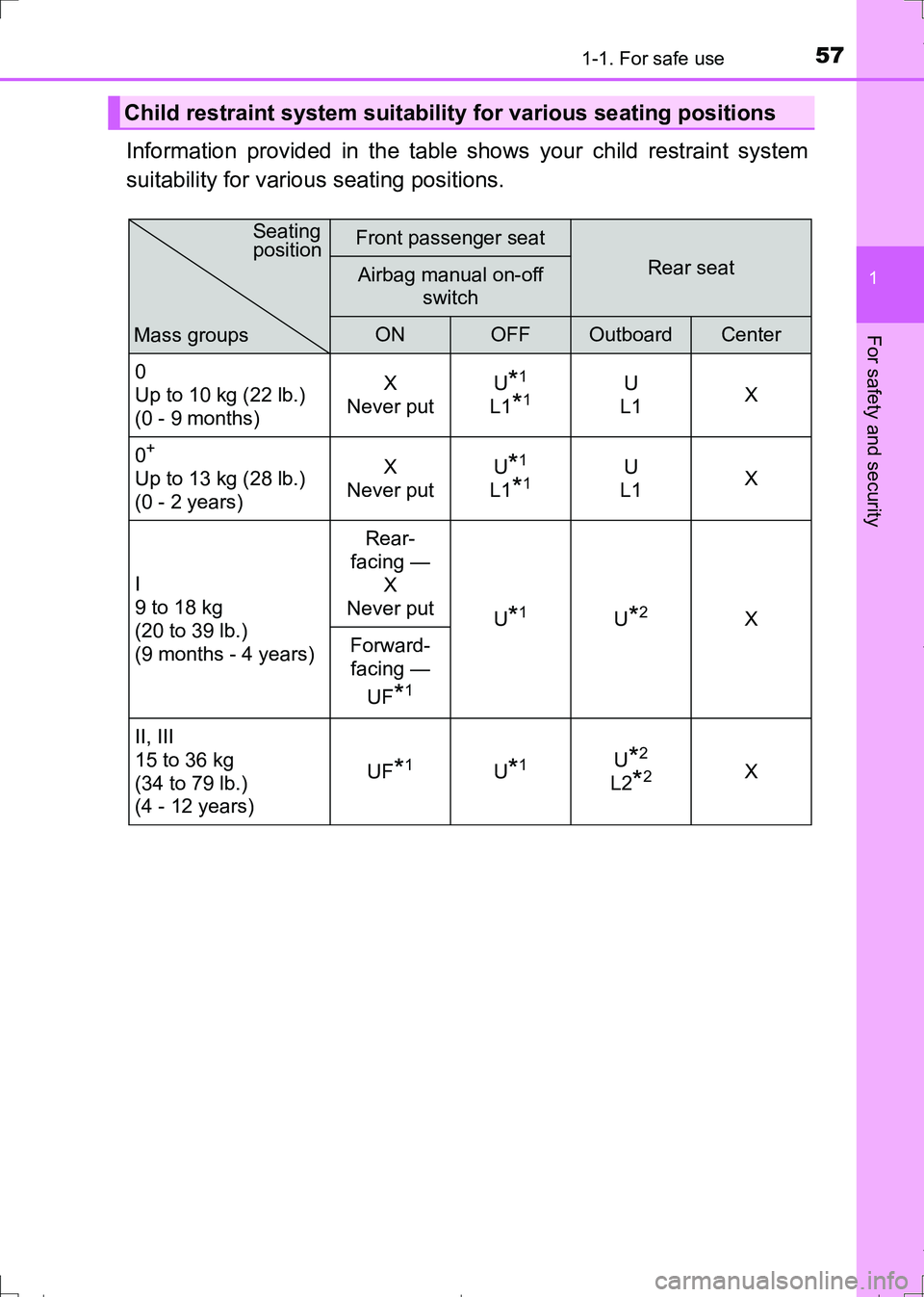
Information provided in the table shows your child restraint system
suitability for various seating positions.
Child restraint system suitability for various seating positions
Front passenger seat
Rear seatAirbag manual on-off
switch
ONOFFOutboardCenter
0
Up to 10 kg (22 lb.)
(0 - 9 months)X
Never putU
*1
L1*1U
L1X
0
+
Up to 13 kg (28 lb.)
(0 - 2 years)X
Never putU*1
L1*1U
L1X
I
9 to 18 kg
(20 to 39 lb.)
(9 months - 4 years)Rear-
facing —
X
Never put
U
*1U*2X
Forward-
facing —
UF
*1
II, III
15 to 36 kg
(34 to 79 lb.)
(4 - 12 years)UF
*1U*1U*2
L2*2X
Mass groupsSeating
position
AURIS Touring Sports_OM_Europe_OM12L13E.book 57 ページ 2016年6月27日 月曜日 午後5時21分
Page 59 of 664
591-1. For safe use
1
For safety and security
AURIS Touring Sports_EE (12L13E)
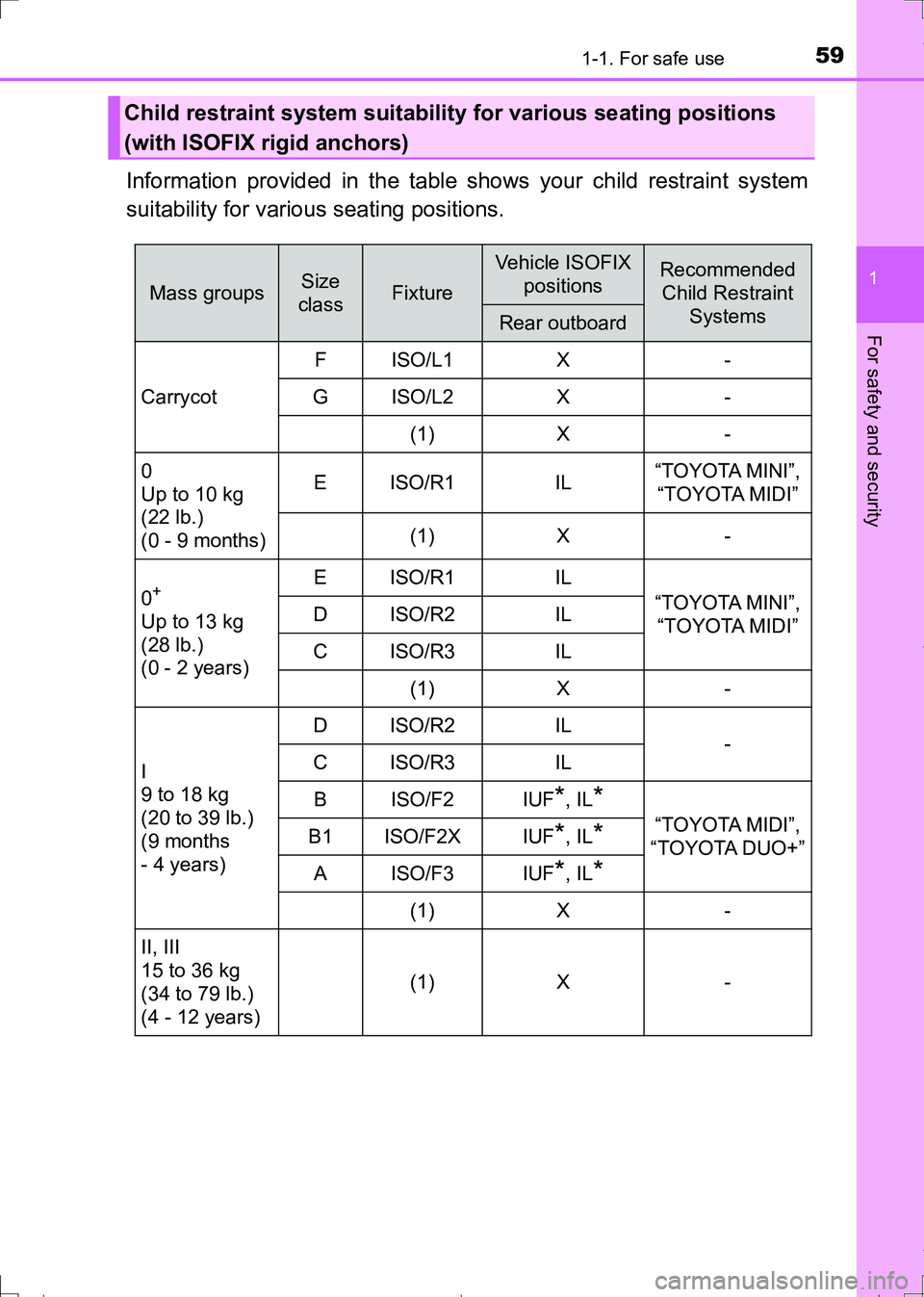
Information provided in the table shows your child restraint system
suitability for various seating positions.
Child restraint system suitability for various seating positions
(with ISOFIX rigid anchors)
Mass groupsSize
classFixture
Vehicle ISOFIX
positionsRecommended
Child Restraint
Systems
Rear outboard
CarrycotFISO/L1 X -
GISO/L2 X -
(1) X -
0
Up to 10 kg
(22 lb.)
(0 - 9 months)EISO/R1 IL“TOYOTA MINI”,
“TOYOTA MIDI”
(1) X -
0
+
Up to 13 kg
(28 lb.)
(0 - 2 years)EISO/R1 IL
“TOYOTA MINI”,
“TOYOTA MIDI” DISO/R2 IL
CISO/R3 IL
(1) X -
I
9 to 18 kg
(20 to 39 lb.)
(9 months
- 4 years)DISO/R2 IL
-
CISO/R3 IL
BISO/F2 IUF
*, IL*
“TOYOTA MIDI”,
“TOYOTA DUO+” B1 ISO/F2X IUF*, IL*
AISO/F3 IUF*, IL*
(1) X -
II, III
15 to 36 kg
(34 to 79 lb.)
(4 - 12 years)(1) X -
AURIS Touring Sports_OM_Europe_OM12L13E.book 59 ページ 2016年6月27日 月曜日 午後5時21分
Page 61 of 664
611-1. For safe use
1
For safety and security
AURIS Touring Sports_EE (12L13E)
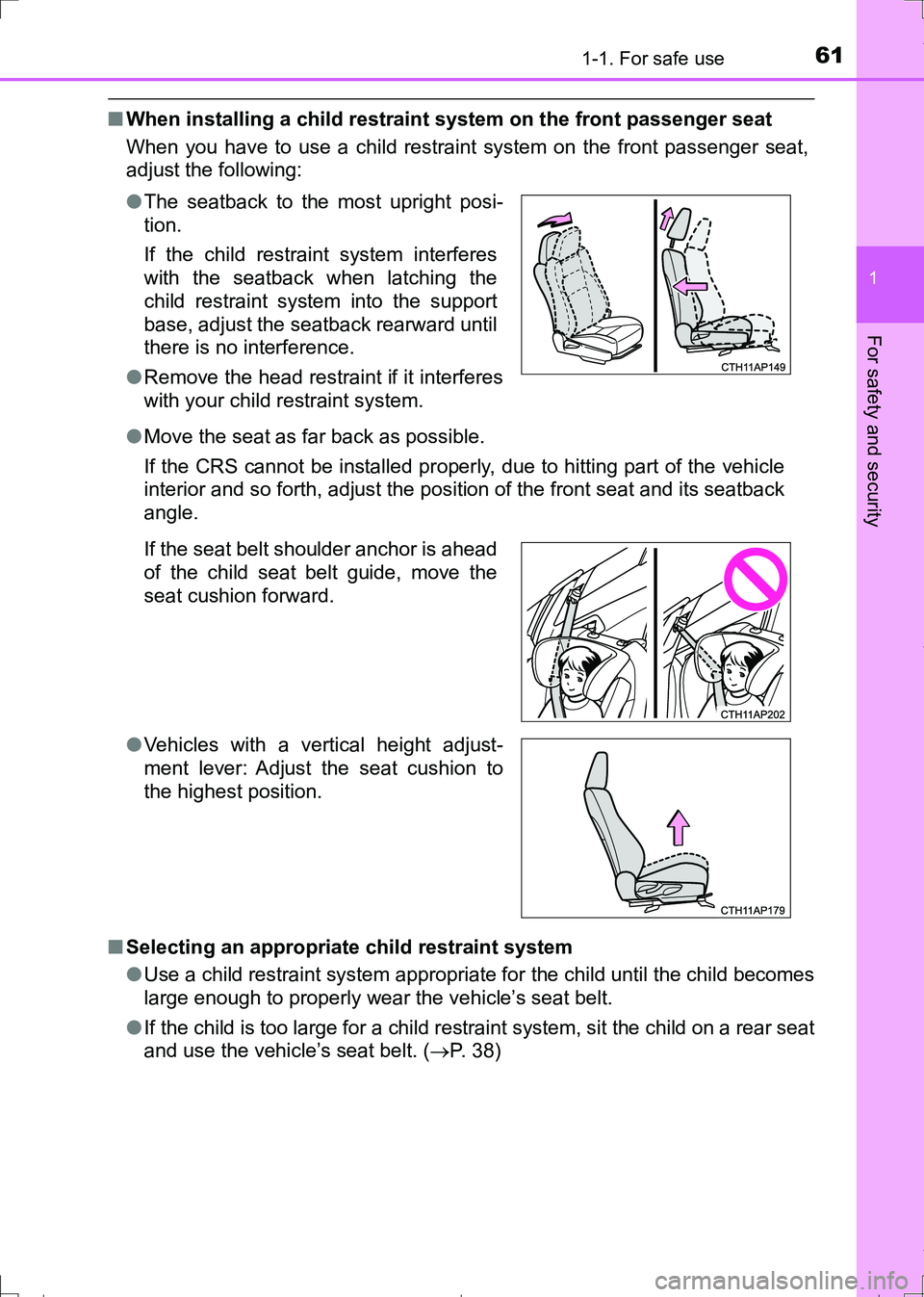
■When installing a child restraint system on the front passenger seat
When you have to use a child restraint system on the front passenger seat,
adjust the following:
■Selecting an appropriate child restraint system
●Use a child restraint system appropriate for the child until the child becomes
large enough to properly wear the vehicle’s seat belt.
●If the child is too large for a child restraint system, sit the child on a rear seat
and use the vehicle’s seat belt. (P. 38) ●The seatback to the most upright posi-
tion.
If the child restraint system interferes
with the seatback when latching the
child restraint system into the support
base, adjust the seatback rearward until
there is no interference.
●Remove the head restraint if it interferes
with your child restraint system.
●Move the seat as far back as possible.
If the CRS cannot be installed properly, due to hitting part of the vehicle
interior and so forth, adjust the position of the front seat and its seatback
angle.
If the seat belt shoulder anchor is ahead
of the child seat belt guide, move the
seat cushion forward.
●Vehicles with a vertical height adjust-
ment lever: Adjust the seat cushion to
the highest position.
AURIS Touring Sports_OM_Europe_OM12L13E.book 61 ページ 2016年6月27日 月曜日 午後5時21分