tire pressure TOYOTA AURIS TOURING SPORTS 2013 User Guide
[x] Cancel search | Manufacturer: TOYOTA, Model Year: 2013, Model line: AURIS TOURING SPORTS, Model: TOYOTA AURIS TOURING SPORTS 2013Pages: 616, PDF Size: 17.28 MB
Page 423 of 616
4236-3. Do-it-yourself maintenance
Auris Touring Sports_EE (OM12G12E)
6
Maintenance and care
CAUTION
When inspecting or replacing tires
Observe the following precautions to prevent accidents.
Failure to do so may cause damage to parts of the drive train as well as
dangerous handling characteristics, which may lead to an accident resulting
in death or serious injury.
Do not mix tires of different makes, models or tread patterns.
Also, do not mix tires of remarkably different treadwear.
Do not use tire sizes other than those recommended by Toyota.
Do not mix differently constructed tires (radial, bias-belted or bias-ply
tires).
Do not mix summer, all season and snow tires.
Do not use tires that have been used on another vehicle.
Do not use tires if you do not know how they were used previously.
Vehicles with a compact spare tire: Do not tow if your vehicle has a com-
pact spare tire installed.
NOTICE
Driving on rough roads
Take particular care when driving on roads with loose surfaces or potholes.
These conditions may cause losses in tire inflation pressure, reducing the
cushioning ability of the tires. In addition, driving on rough roads may cause
damage to the tires themselves, as well as the vehicle’s wheels and body.
Low profile tires (17-inch tires)
Low profile tires may cause greater damage than usual to the tire wheel
when sustaining impact from the road surface. Therefore, pay attention to
the following:
Be sure to use proper tire inflation pressure. If tires are under-inflated, they
may be damaged more severely.
Avoid potholes, uneven pavement, curbs and other road hazards. Failure
to do so may lead to severe tire and wheel damage.
If tire inflation pressure of each tire becomes low while driving
Do not continue driving, or your tires and/or wheels may be ruined.
Page 424 of 616
4246-3. Do-it-yourself maintenance
Auris Touring Sports_EE (OM12G12E)
Effects of incorrect tire inflation pressure
Driving with incorrect tire inflation pressure may result in the following:
Reduced fuel efficiency
Reduced driving comfort and tire life
Reduced safety
Damage to the drive train
If a tire needs frequent inflating, have it checked by any authorized Toyota
dealer or repairer, or another duly qualified and equipped professional.
Instructions for checking tire inflation pressure
When checking tire inflation pressure, observe the following:
Check only when the tires are cold.
If your vehicle has been parked for at least 3 hours or has not been driven
for more than 1.5 km or 1 mile, you will get an accurate cold tire inflation
pressure reading.
Always use a tire pressure gauge.
The appearance of the tire can be misleading. In addition, tire inflation pres-
sure that is even just a few pounds off can affect ride quality and handling.
Do not reduce tire inflation pressure after driving. It is normal for tire inflation
pressure to be higher after driving.
Never exceed the vehicle capacity weight.
Passengers and luggage weight should be placed so that the vehicle is bal-
anced.
Tire inflation pressure
Make sure to maintain proper tire inflation pressure. Tire infla-
tion pressure should be checked at least once per month. How-
ever, Toyota recommends that tire inflation pressure be checked
once every two weeks. (P. 583)
Page 425 of 616
4256-3. Do-it-yourself maintenance
Auris Touring Sports_EE (OM12G12E)
6
Maintenance and care
CAUTION
Proper inflation is critical to save tire performance
Keep your tires properly inflated. Otherwise, the following conditions may
occur and result in an accident causing death or serious injury:
Excessive wear
Uneven wear
Poor handling
Possibility of blowouts resulting from overheated tires
Poor sealing of the tire bead
Wheel deformation and/or tire separation
A greater possibility of tire damage from road hazards
NOTICE
When inspecting and adjusting tire inflation pressure
Be sure to put the tire valve caps back on.
Without the valve caps, dirt or moisture could get into the valve and cause
air leakage, which could result in an accident. If the caps are lost, replace
them as soon as possible.
Page 520 of 616
5207-2. Steps to take in an emergency
Auris Touring Sports_EE (OM12G12E)
Firmly tighten each wheel nut
two or three times in the order
shown in the illustration.
Tightening torque:
103 N•m (10.5 kgf•m, 76 ft•lbf)
Stow the flat tire, tire jack and all tools.
The compact spare tire
The compact spare tire is identified by the label “TEMPORARY USE ONLY”
on the tire sidewall.
Use the compact spare tire temporarily, and only in an emergency.
Make sure to check the tire inflation pressure of the compact spare tire.
(P. 583)
When the compact spare tire is equipped
The vehicle becomes lower when driving with the compact spare tire com-
pared to when driving with standard tires.
If you have a flat front tire on a road covered with snow or ice
Install the compact spare tire on one of the rear wheels of the vehicle. Per-
form the following steps and fit tire chains to the front tires:
Replace a rear tire with the compact spare tire.
Replace the flat front tire with the tire removed from the rear of the vehicle.
Fit tire chains to the front tires.
When reinstalling the wheel ornament (vehicles with steel wheels)
4
Align the cutout of the wheel ornament
with the valve stem as shown in the illus-
tration.
5
1
2
3
Page 526 of 616
5267-2. Steps to take in an emergency
Auris Touring Sports_EE (OM12G12E)
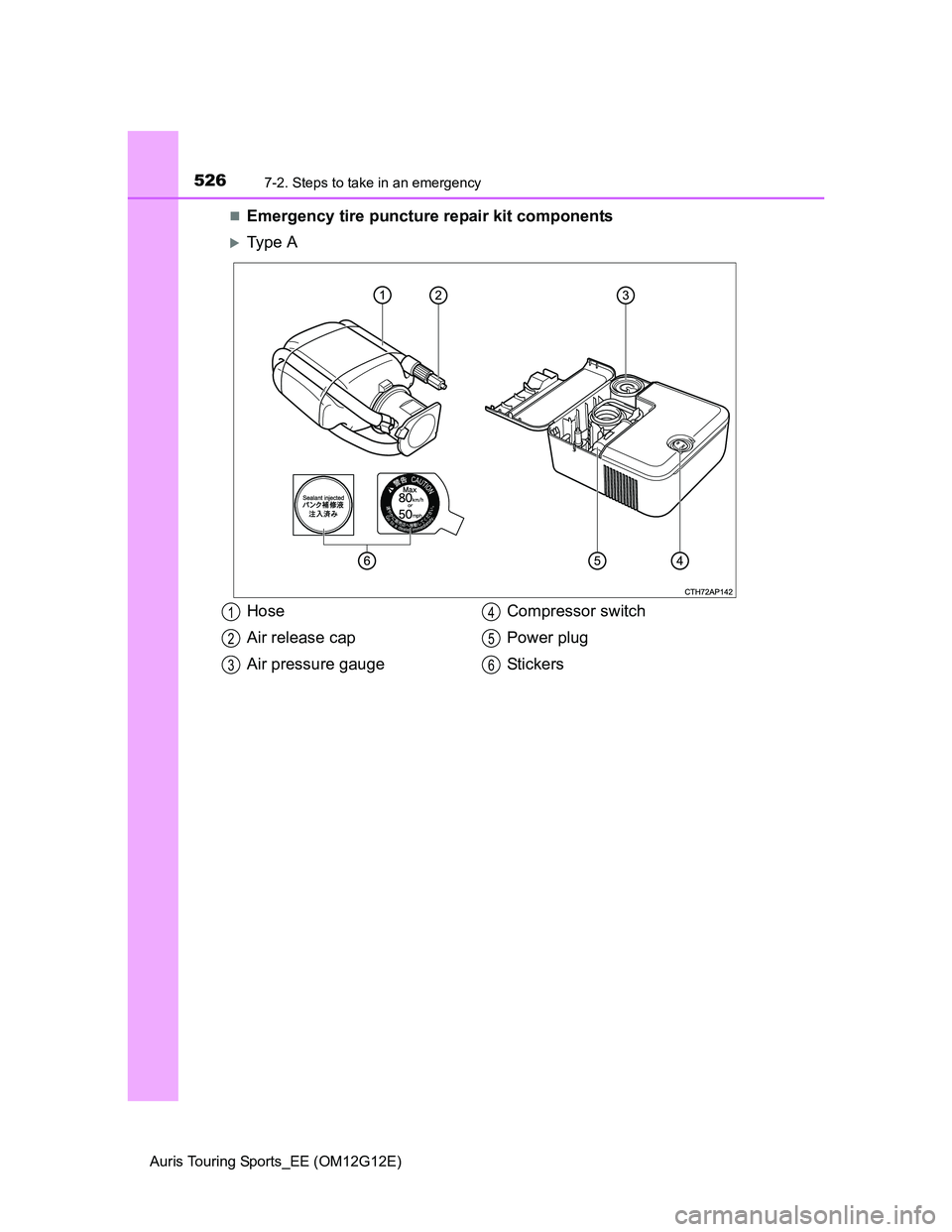
Emergency tire puncture repair kit components
Ty p e A
Hose
Air release cap
Air pressure gaugeCompressor switch
Power plug
St ic ke rs1
2
3
4
5
6
Page 528 of 616
5287-2. Steps to take in an emergency
Auris Touring Sports_EE (OM12G12E)
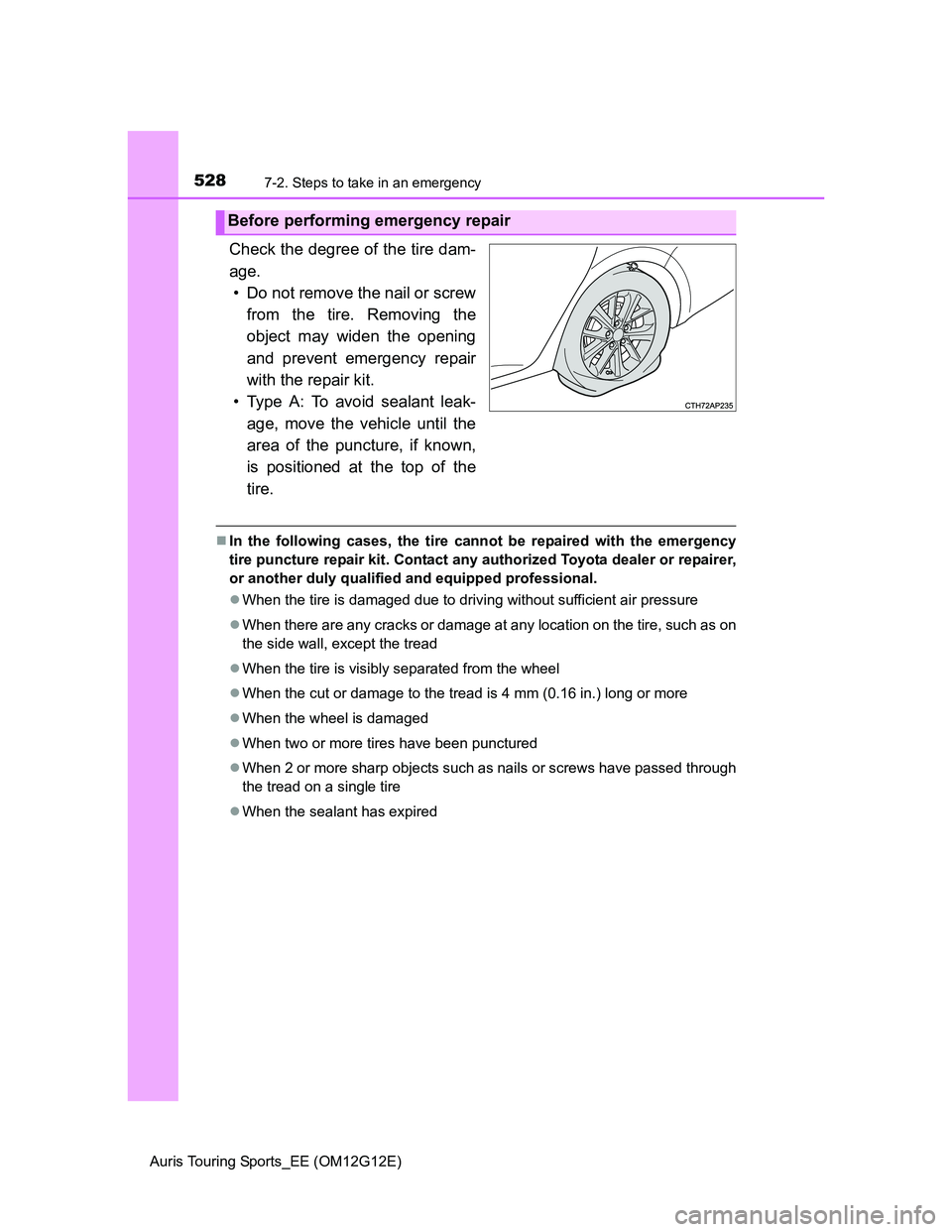
Check the degree of the tire dam-
age.
• Do not remove the nail or screw
from the tire. Removing the
object may widen the opening
and prevent emergency repair
with the repair kit.
• Type A: To avoid sealant leak-
age, move the vehicle until the
area of the puncture, if known,
is positioned at the top of the
tire.
In the following cases, the tire cannot be repaired with the emergency
tire puncture repair kit. Contact any authorized Toyota dealer or repairer,
or another duly qualified and equipped professional.
When the tire is damaged due to driving without sufficient air pressure
When there are any cracks or damage at any location on the tire, such as on
the side wall, except the tread
When the tire is visibly separated from the wheel
When the cut or damage to the tread is 4 mm (0.16 in.) long or more
When the wheel is damaged
When two or more tires have been punctured
When 2 or more sharp objects such as nails or screws have passed through
the tread on a single tire
When the sealant has expired
Before performing emergency repair
Page 532 of 616
5327-2. Steps to take in an emergency
Auris Touring Sports_EE (OM12G12E)
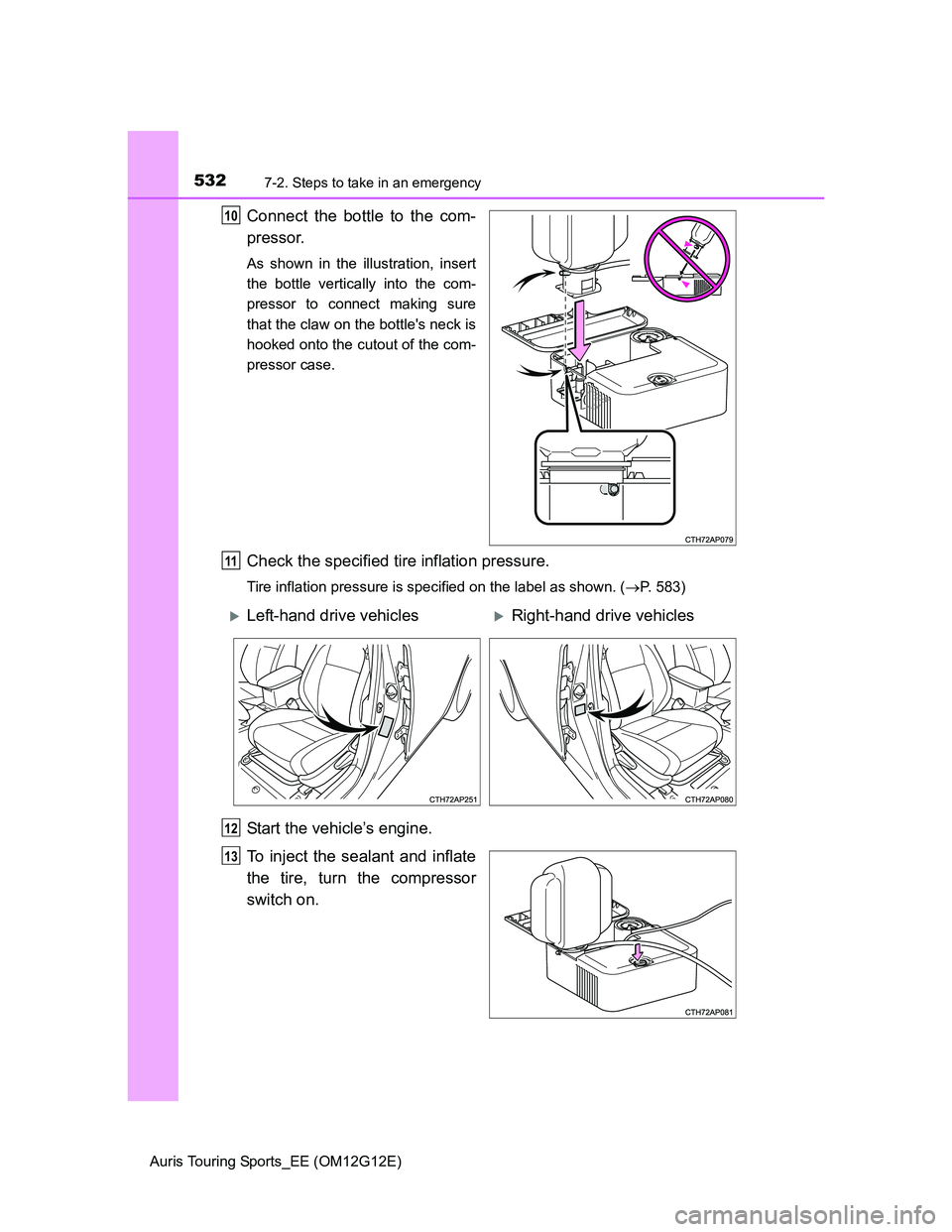
Connect the bottle to the com-
pressor.
As shown in the illustration, insert
the bottle vertically into the com-
pressor to connect making sure
that the claw on the bottle's neck is
hooked onto the cutout of the com-
pressor case.
Check the specified tire inflation pressure.
Tire inflation pressure is specified on the label as shown. (P. 583)
Start the vehicle’s engine.
To inject the sealant and inflate
the tire, turn the compressor
switch on.
10
11
Left-hand drive vehiclesRight-hand drive vehicles
12
13
Page 533 of 616
5337-2. Steps to take in an emergency
Auris Touring Sports_EE (OM12G12E)
7
When trouble arises
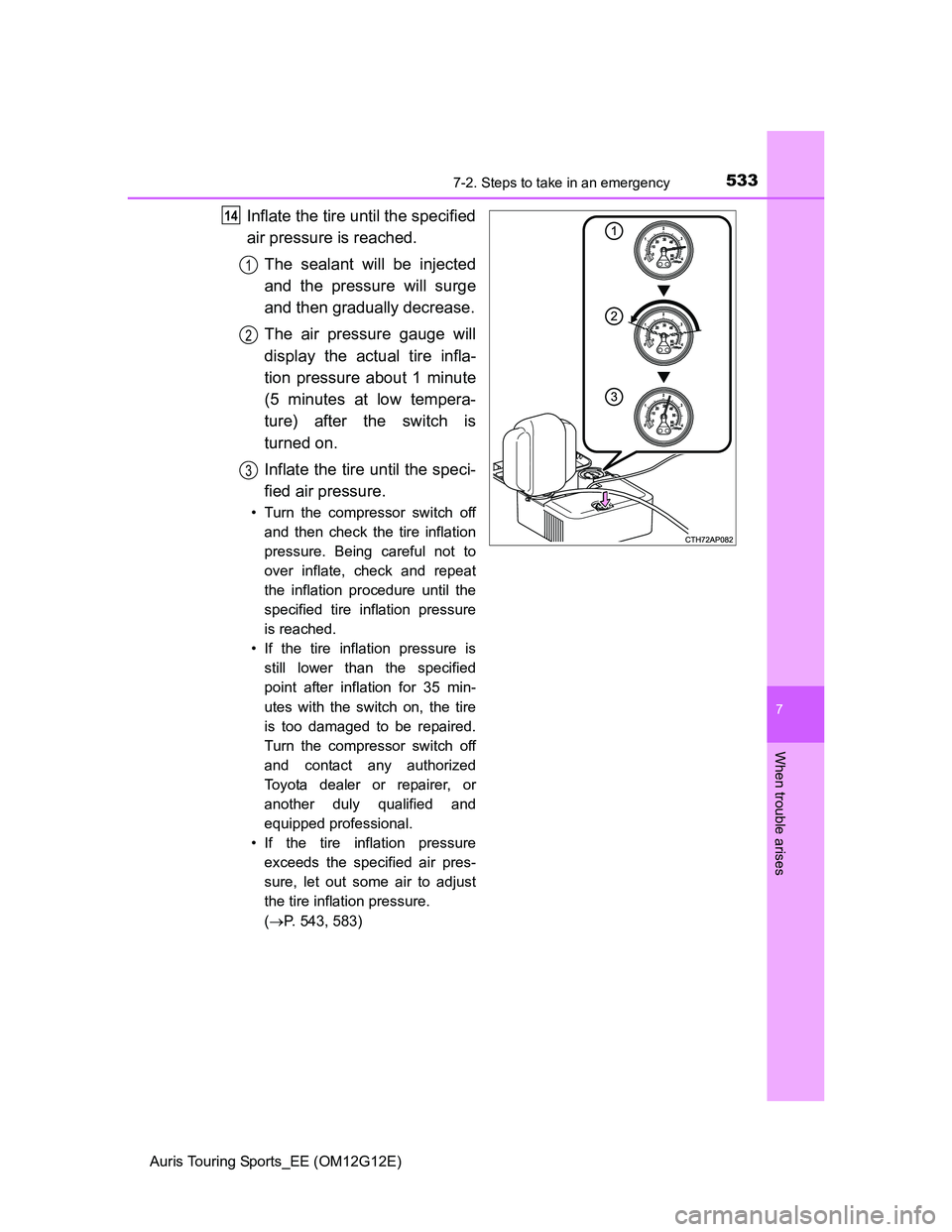
Inflate the tire until the specified
air pressure is reached.
The sealant will be injected
and the pressure will surge
and then gradually decrease.
The air pressure gauge will
display the actual tire infla-
tion pressure about 1 minute
(5 minutes at low tempera-
ture) after the switch is
turned on.
Inflate the tire until the speci-
fied air pressure.
• Turn the compressor switch off
and then check the tire inflation
pressure. Being careful not to
over inflate, check and repeat
the inflation procedure until the
specified tire inflation pressure
is reached.
• If the tire inflation pressure is
still lower than the specified
point after inflation for 35 min-
utes with the switch on, the tire
is too damaged to be repaired.
Turn the compressor switch off
and contact any authorized
Toyota dealer or repairer, or
another duly qualified and
equipped professional.
• If the tire inflation pressure
exceeds the specified air pres-
sure, let out some air to adjust
the tire inflation pressure.
(P. 543, 583)
14
1
2
3
Page 535 of 616
5357-2. Steps to take in an emergency
Auris Touring Sports_EE (OM12G12E)
7
When trouble arises
Turn the compressor switch on
and wait for an approximately 5
seconds, and then turn it off.
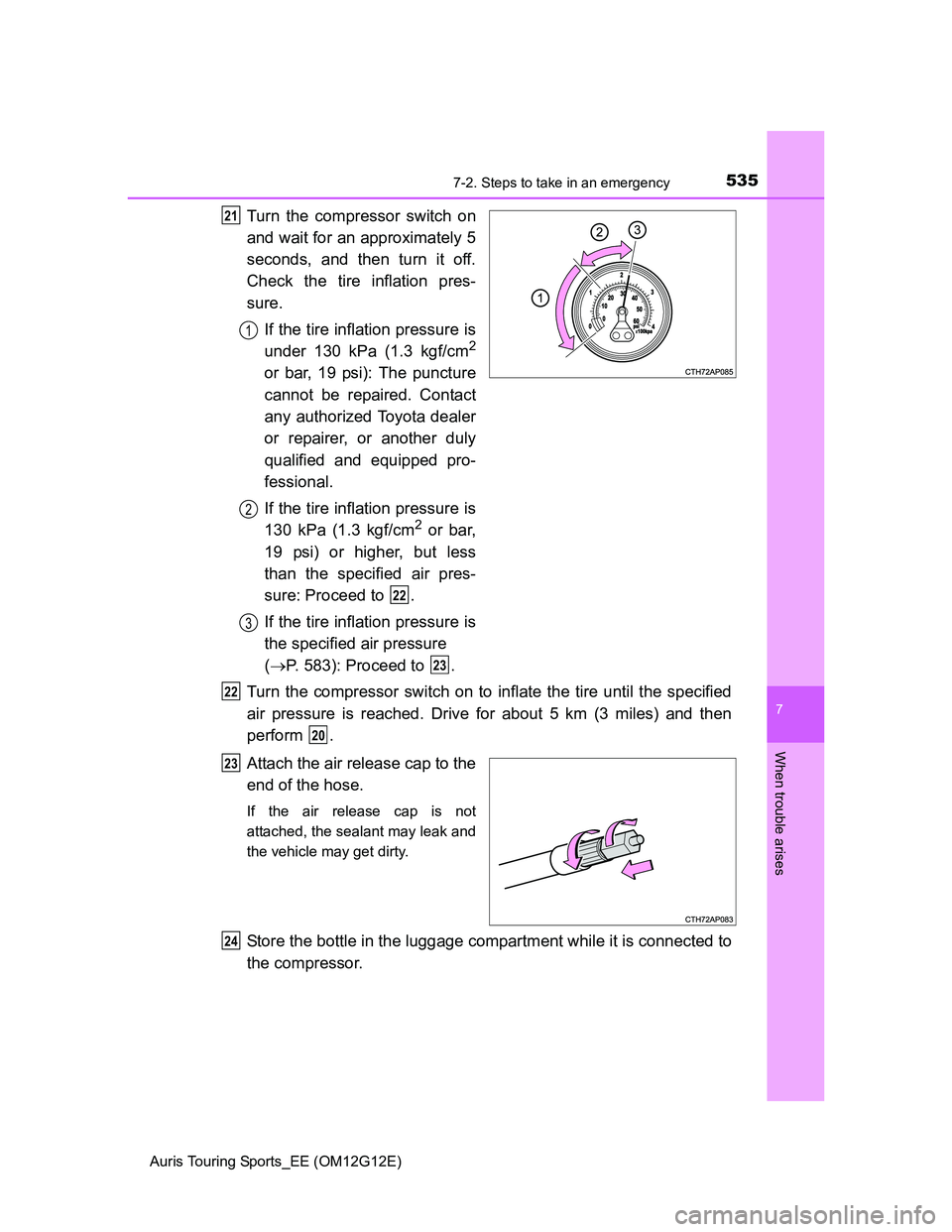
Check the tire inflation pres-
sure.
If the tire inflation pressure is
under 130 kPa (1.3 kgf/cm
2
or bar, 19 psi): The puncture
cannot be repaired. Contact
any authorized Toyota dealer
or repairer, or another duly
qualified and equipped pro-
fessional.
If the tire inflation pressure is
130 kPa (1.3 kgf/cm
2 or bar,
19 psi) or higher, but less
than the specified air pres-
sure: Proceed to .
If the tire inflation pressure is
the specified air pressure
(P. 583): Proceed to .
Turn the compressor switch on to inflate the tire until the specified
air pressure is reached. Drive for about 5 km (3 miles) and then
perform .
Attach the air release cap to the
end of the hose.
If the air release cap is not
attached, the sealant may leak and
the vehicle may get dirty.
Store the bottle in the luggage compartment while it is connected to
the compressor.
21
1
2
22
3
23
22
20
23
24
Page 539 of 616
5397-2. Steps to take in an emergency
Auris Touring Sports_EE (OM12G12E)
7
When trouble arises
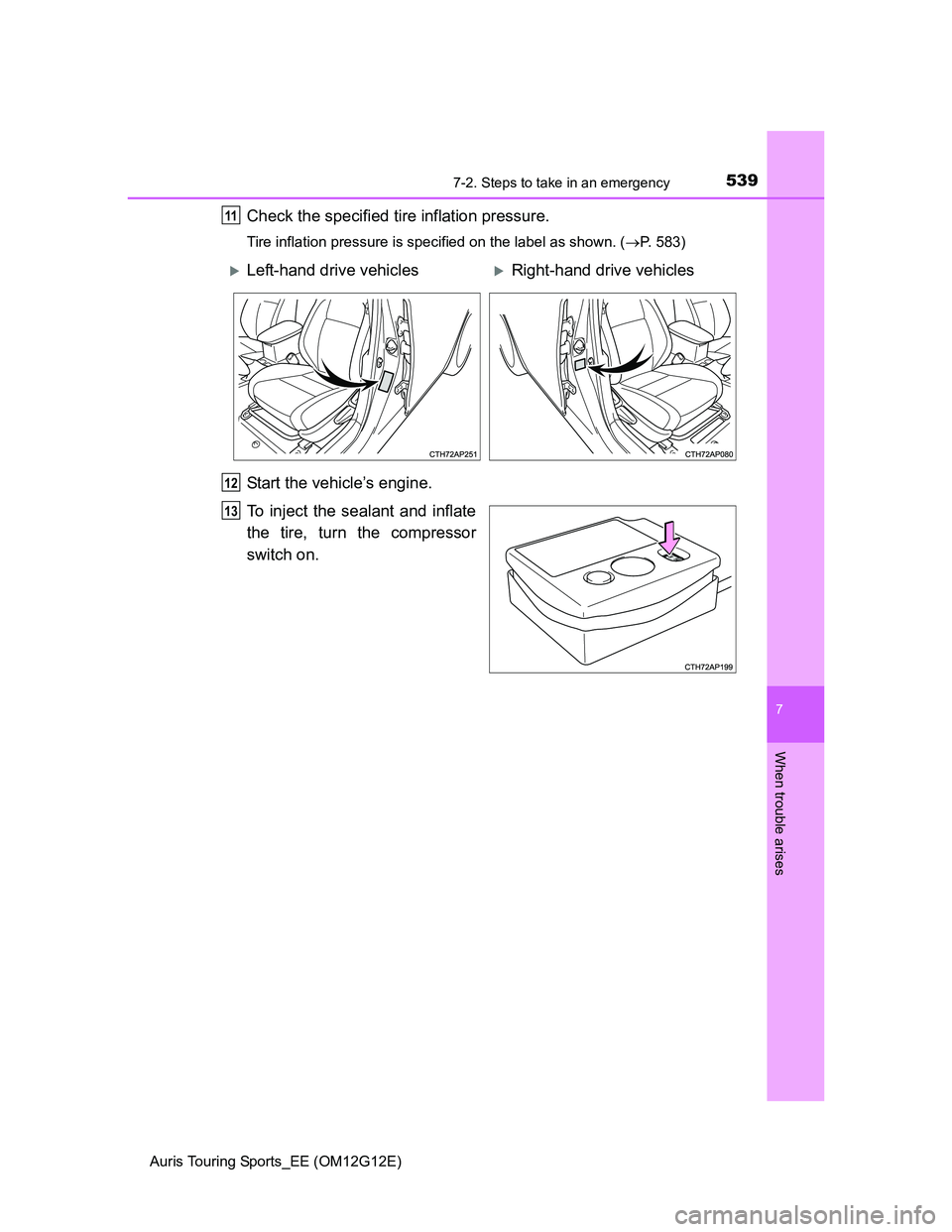
Check the specified tire inflation pressure.
Tire inflation pressure is specified on the label as shown. (P. 583)
Start the vehicle’s engine.
To inject the sealant and inflate
the tire, turn the compressor
switch on.
11
Left-hand drive vehiclesRight-hand drive vehicles
12
13