torque TOYOTA AURIS TOURING SPORTS 2013 Owners Manual
[x] Cancel search | Manufacturer: TOYOTA, Model Year: 2013, Model line: AURIS TOURING SPORTS, Model: TOYOTA AURIS TOURING SPORTS 2013Pages: 616, PDF Size: 17.28 MB
Page 174 of 616
1744-1. Before driving
Auris Touring Sports_EE (OM12G12E)
CAUTION
Observe the following precautions.
Failure to do so may result in death or serious injury.
When taking a nap in the vehicle
Always turn the engine off. Otherwise, if you accidentally move the shift
lever or depress the accelerator pedal, this could cause an accident or fire
due to engine overheating. Additionally, if the vehicle is parked in a poorly
ventilated area, exhaust gases may collect and enter the vehicle, leading to
death or a serious health hazard.
When braking
When the brakes are wet, drive more cautiously.
Braking distance increases when the brakes are wet, and this may cause
one side of the vehicle to brake differently than the other side. Also, the
parking brake may not securely hold the vehicle.
If the brake booster does not operate, do not follow other vehicles closely
and avoid hills or sharp turns that require braking.
In this case, braking is still possible, but the brake pedal should be
depressed more firmly than usual. Also, the braking distance will increase.
Do not pump the brake pedal if the engine stalls.
Each push on the brake pedal uses up the reserve for the power-assisted
brakes.
The brake system consists of 2 individual hydraulic systems; if one of the
systems fails, the other will still operate. In this case, the brake pedal
should be depressed more firmly than usual and the braking distance will
increase.
If this happens, do not continue to drive the vehicle. Have your brakes
fixed immediately.
NOTICE
When driving the vehicle (vehicles with a Multidrive)
Do not depress the accelerator and brake pedals at the same time during
driving, as this may restrain driving torque.
Do not use the accelerator pedal or depress the accelerator and brake
pedals at the same time to hold the vehicle on a hill.
Page 175 of 616
1754-1. Before driving
Auris Touring Sports_EE (OM12G12E)
4
Driving
NOTICE
When driving the vehicle (vehicles with a manual transmission)
Do not depress the accelerator and brake pedals at the same time during
driving, as this may restrain driving torque.
Do not shift gears unless the clutch pedal is fully depressed. After shifting,
do not release the clutch pedal abruptly. Doing so may damage the clutch,
transmission and gears.
Observe the following to prevent the clutch from being damaged.
• Do not rest your foot on the clutch pedal while driving.
Doing so may cause clutch trouble.
• Do not use any gear other than the 1st gear when starting off and mov-
ing forward.
Doing so may damage the clutch.
• Do not use the clutch to hold the vehicle when stopping on an uphill
grade.
Doing so may damage the clutch.
Do not shift the shift lever to R when the vehicle is still moving. Doing so
may damage the clutch, transmission and gears.
When parking the vehicle (vehicles with a Multidrive)
Always shift the shift lever to P. Failure to do so may cause the vehicle to
move or the vehicle may accelerate suddenly if the accelerator pedal is
accidentally depressed.
Avoiding damage to vehicle parts
Do not turn the steering wheel fully in either direction and hold it there for
an extended period of time.
Doing so may damage the power steering motor.
When driving over bumps in the road, drive as slowly as possible to avoid
damaging the wheels, underside of the vehicle, etc.
Diesel engine: Make sure to idle the engine immediately after high-speed
driving or hill climbing. Stop the engine only after the turbocharger has
cooled down.
Failure to do so may cause damage to the turbocharger.
Page 518 of 616
5187-2. Steps to take in an emergency
Auris Touring Sports_EE (OM12G12E)
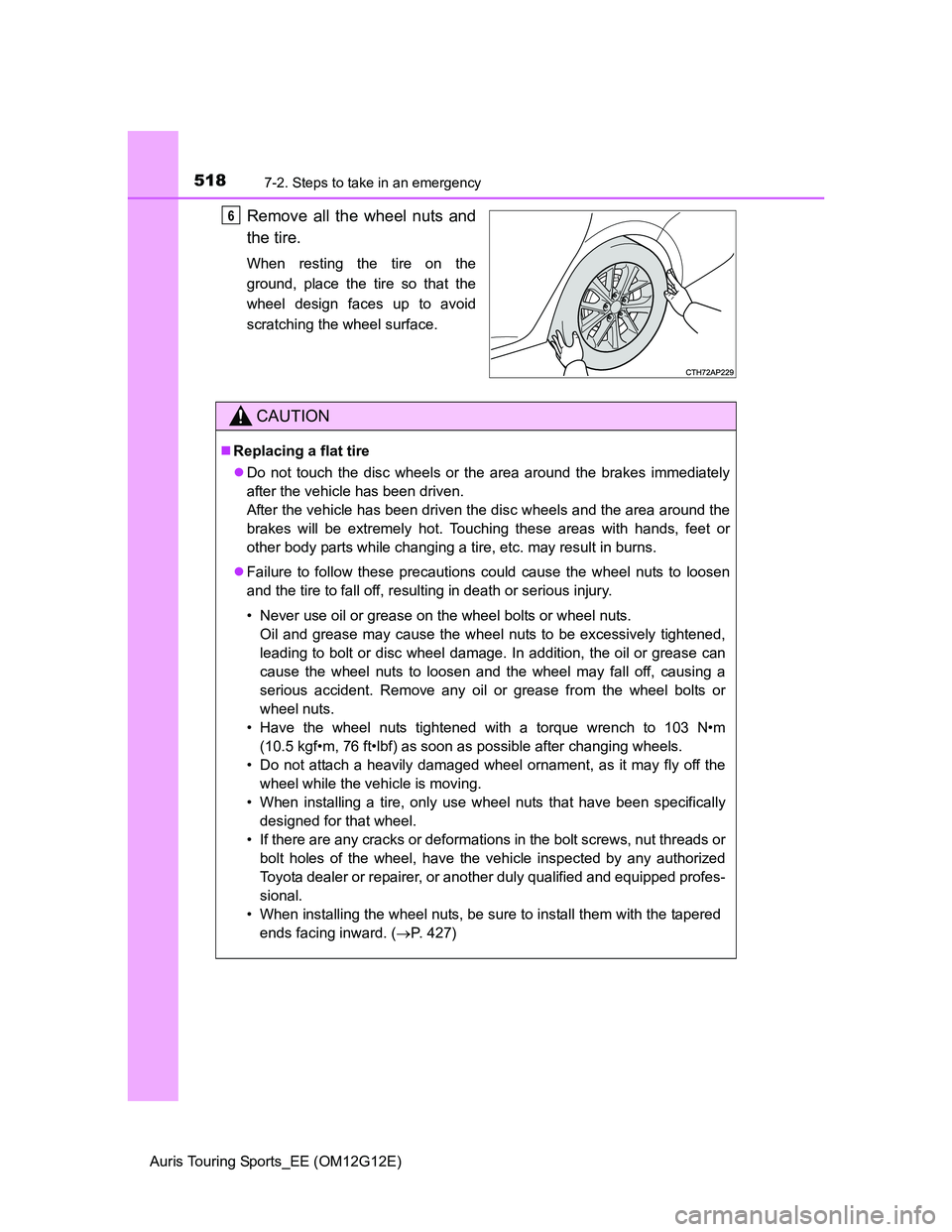
Remove all the wheel nuts and
the tire.
When resting the tire on the
ground, place the tire so that the
wheel design faces up to avoid
scratching the wheel surface.
6
CAUTION
Replacing a flat tire
Do not touch the disc wheels or the area around the brakes immediately
after the vehicle has been driven.
After the vehicle has been driven the disc wheels and the area around the
brakes will be extremely hot. Touching these areas with hands, feet or
other body parts while changing a tire, etc. may result in burns.
Failure to follow these precautions could cause the wheel nuts to loosen
and the tire to fall off, resulting in death or serious injury.
• Never use oil or grease on the wheel bolts or wheel nuts.
Oil and grease may cause the wheel nuts to be excessively tightened,
leading to bolt or disc wheel damage. In addition, the oil or grease can
cause the wheel nuts to loosen and the wheel may fall off, causing a
serious accident. Remove any oil or grease from the wheel bolts or
wheel nuts.
• Have the wheel nuts tightened with a torque wrench to 103 N•m
(10.5 kgf•m, 76 ft•lbf) as soon as possible after changing wheels.
• Do not attach a heavily damaged wheel ornament, as it may fly off the
wheel while the vehicle is moving.
• When installing a tire, only use wheel nuts that have been specifically
designed for that wheel.
• If there are any cracks or deformations in the bolt screws, nut threads or
bolt holes of the wheel, have the vehicle inspected by any authorized
Toyota dealer or repairer, or another duly qualified and equipped profes-
sional.
• When installing the wheel nuts, be sure to install them with the tapered
ends facing inward. (P. 427)
Page 520 of 616
5207-2. Steps to take in an emergency
Auris Touring Sports_EE (OM12G12E)
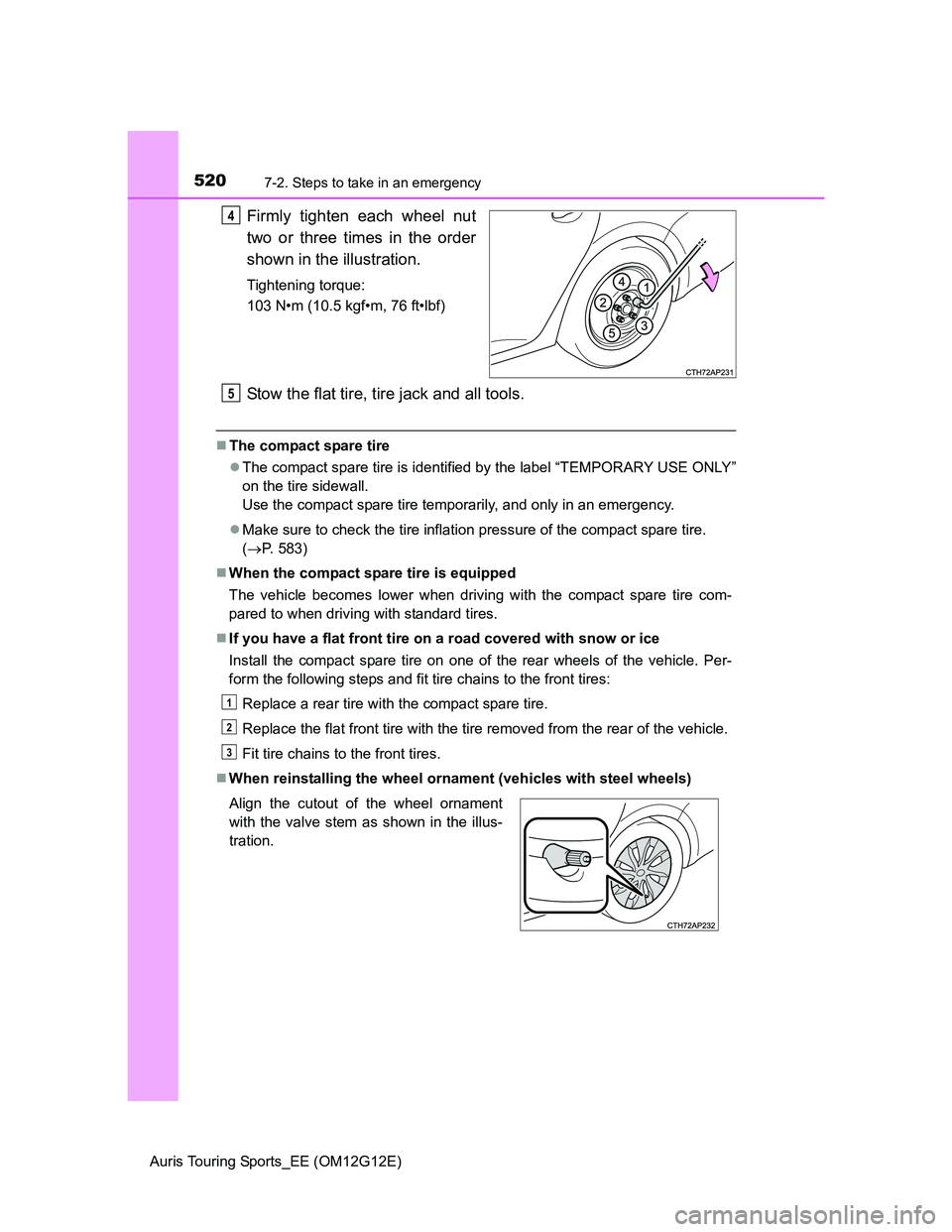
Firmly tighten each wheel nut
two or three times in the order
shown in the illustration.
Tightening torque:
103 N•m (10.5 kgf•m, 76 ft•lbf)
Stow the flat tire, tire jack and all tools.
The compact spare tire
The compact spare tire is identified by the label “TEMPORARY USE ONLY”
on the tire sidewall.
Use the compact spare tire temporarily, and only in an emergency.
Make sure to check the tire inflation pressure of the compact spare tire.
(P. 583)
When the compact spare tire is equipped
The vehicle becomes lower when driving with the compact spare tire com-
pared to when driving with standard tires.
If you have a flat front tire on a road covered with snow or ice
Install the compact spare tire on one of the rear wheels of the vehicle. Per-
form the following steps and fit tire chains to the front tires:
Replace a rear tire with the compact spare tire.
Replace the flat front tire with the tire removed from the rear of the vehicle.
Fit tire chains to the front tires.
When reinstalling the wheel ornament (vehicles with steel wheels)
4
Align the cutout of the wheel ornament
with the valve stem as shown in the illus-
tration.
5
1
2
3
Page 583 of 616
5838-1. Specifications
Auris Touring Sports_EE (OM12G12E)
8
Vehicle specifications
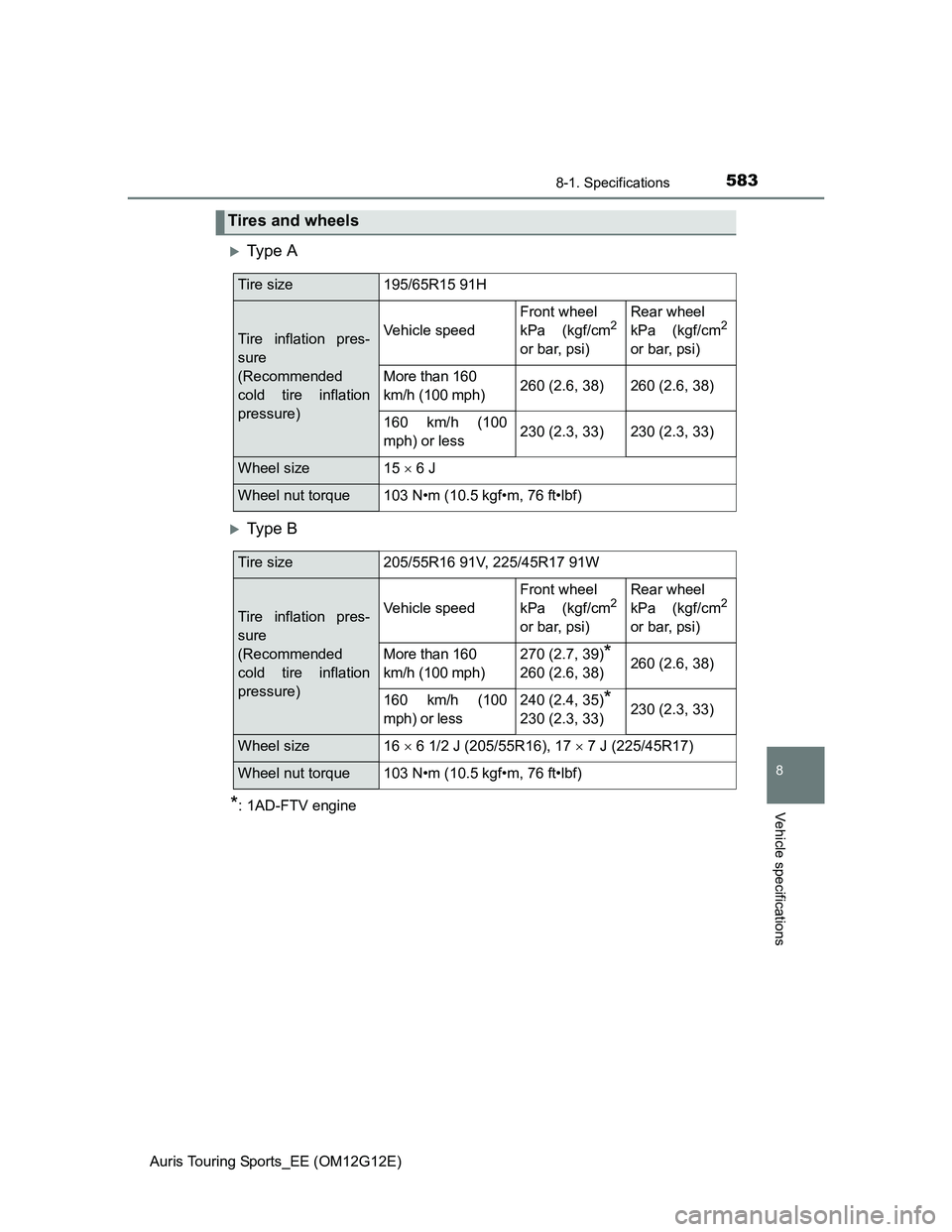
Ty p e A
Ty p e B
*: 1AD-FTV engine
Tires and wheels
Tire size195/65R15 91H
Tire inflation pres-
sure
(Recommended
cold tire inflation
pressure)Vehicle speed
Front wheel
kPa (kgf/cm2
or bar, psi)
Rear wheel
kPa (kgf/cm2
or bar, psi)
More than 160
km/h (100 mph)260 (2.6, 38)260 (2.6, 38)
160 km/h (100
mph) or less230 (2.3, 33)230 (2.3, 33)
Wheel size15 6 J
Wheel nut torque103 N•m (10.5 kgf•m, 76 ft•lbf)
Tire size205/55R16 91V, 225/45R17 91W
Tire inflation pres-
sure
(Recommended
cold tire inflation
pressure)Vehicle speed
Front wheel
kPa (kgf/cm2
or bar, psi)
Rear wheel
kPa (kgf/cm2
or bar, psi)
More than 160
km/h (100 mph)270 (2.7, 39)*
260 (2.6, 38)260 (2.6, 38)
160 km/h (100
mph) or less240 (2.4, 35)*
230 (2.3, 33)230 (2.3, 33)
Wheel size16 6 1/2 J (205/55R16), 17 7 J (225/45R17)
Wheel nut torque103 N•m (10.5 kgf•m, 76 ft•lbf)
Page 584 of 616
5848-1. Specifications
Auris Touring Sports_EE (OM12G12E)
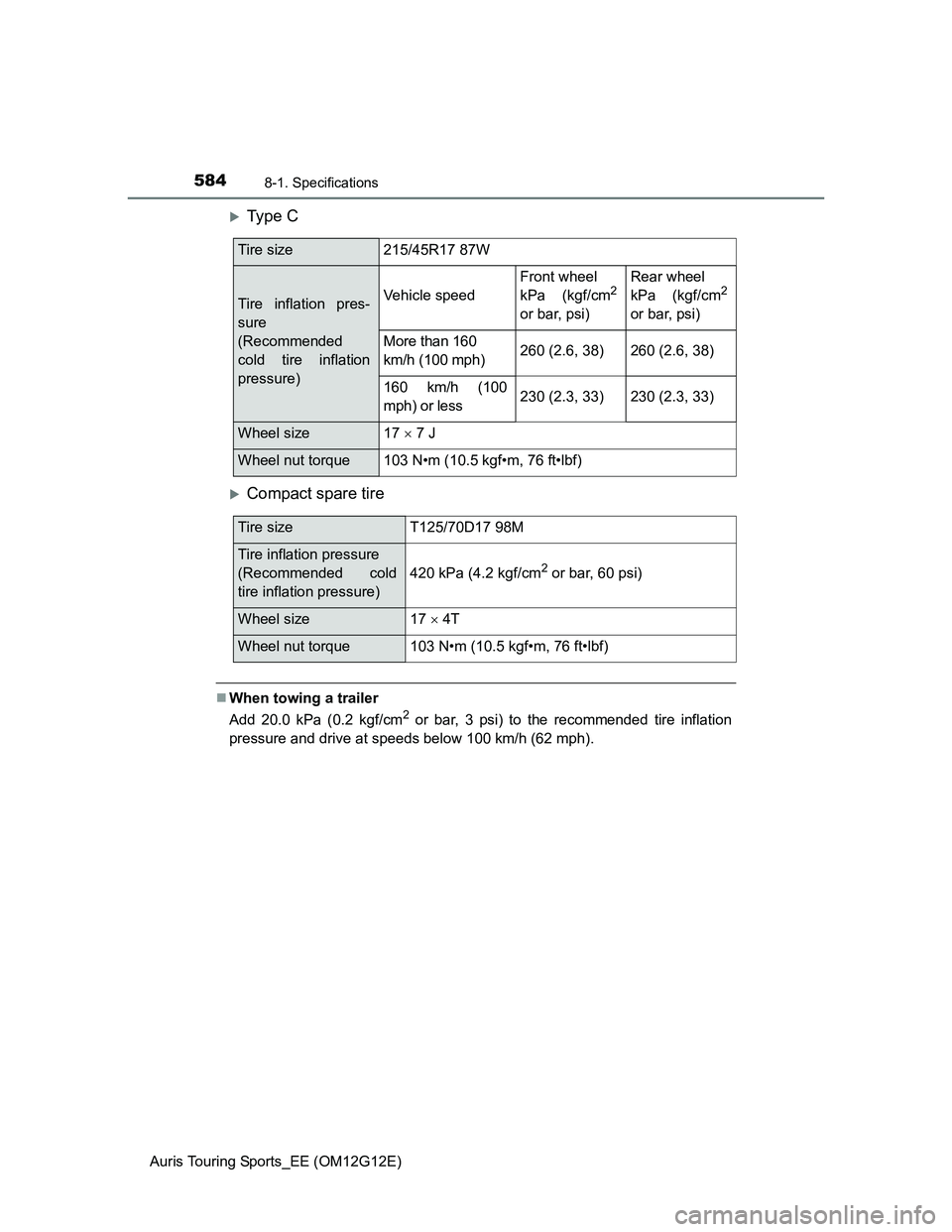
Ty p e C
Compact spare tire
When towing a trailer
Add 20.0 kPa (0.2 kgf/cm
2 or bar, 3 psi) to the recommended tire inflation
pressure and drive at speeds below 100 km/h (62 mph).
Tire size215/45R17 87W
Tire inflation pres-
sure
(Recommended
cold tire inflation
pressure)Vehicle speed
Front wheel
kPa (kgf/cm2
or bar, psi)
Rear wheel
kPa (kgf/cm2
or bar, psi)
More than 160
km/h (100 mph)260 (2.6, 38)260 (2.6, 38)
160 km/h (100
mph) or less230 (2.3, 33)230 (2.3, 33)
Wheel size17 7 J
Wheel nut torque103 N•m (10.5 kgf•m, 76 ft•lbf)
Tire sizeT125/70D17 98M
Tire inflation pressure
(Recommended cold
tire inflation pressure)
420 kPa (4.2 kgf/cm2 or bar, 60 psi)
Wheel size17 4T
Wheel nut torque103 N•m (10.5 kgf•m, 76 ft•lbf)