brakes TOYOTA AVALON 1996 User Guide
[x] Cancel search | Manufacturer: TOYOTA, Model Year: 1996, Model line: AVALON, Model: TOYOTA AVALON 1996Pages: 202, PDF Size: 1.54 MB
Page 148 of 202
147
If towing service is not available in an
emergency, your vehicle may be tem-
porarily towed by a cable secured to
one of the emergency towing eyelets
under the vehicle.
A driver must be in the vehicle to steer it
and operate the brakes.
Towing in this manner may be done only
on hard-surfaced roads for a short dis-
tance and at low speeds. Also, the
wheels, axles, drive train, steering and
brakes must all be in good condition.
Before towing, release the parking brake
and put the transmission in Nº. The key
must be in ACCº (engine off) or ONº (en-
gine running).
CAUTION!
If the engine is not running, the
power assist for the brakes and
steering will not work so steering
and braking will be much harder
than usual.
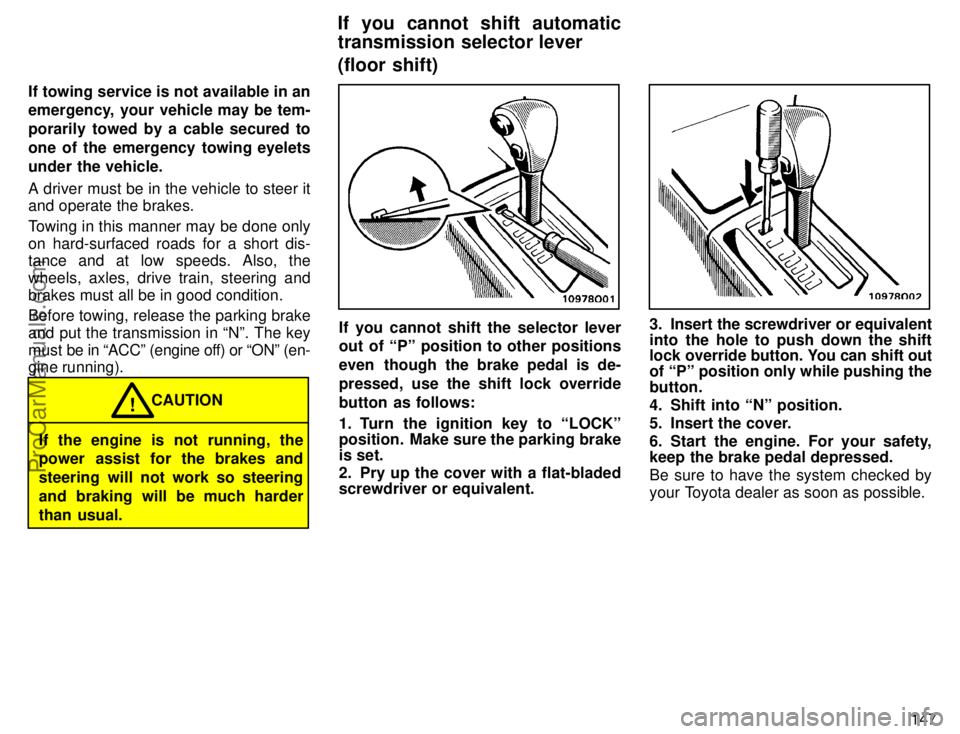
If you cannot shift the selector lever
out of Pº position to other positions
even though the brake pedal is de-
pressed, use the shift lock override
button as follows:
1. Turn the ignition key to LOCKº
position. Make sure the parking brake
is set.
2. Pry up the cover with a flat-bladed
screwdriver or equivalent.3. Insert the screwdriver or equivalent
into the hole to push down the shift
lock override button. You can shift out
of Pº position only while pushing the
button.
4. Shift into Nº position.
5. Insert the cover.
6. Start the engine. For your safety,
keep the brake pedal depressed.
Be sure to have the system checked by
your Toyota dealer as soon as possible.
If you cannot shift automatic
transmission selector lever
(floor shift)
ProCarManuals.com
Page 160 of 202

159
Tire surface and wheel nuts
Check the tires carefully
for cuts, damage
or excessive wear. See Chapter 7-2 for
additional information. When checking
the tires, make sure no nuts are missing,
and check the nuts for looseness. T ighten
them if necessary.
Tire rotation
Rotate the tires every 12000 km (7500
miles). See Chapter 7-2 for additional in-
formation.
Fluid leaks
Check underneath for leaking fuel, oil, wa-
ter or other fluid after the vehicle has been
parked for a while. If you smell fuel fumes
or notice any leak, have the cause found
and corrected immediately.
Doors and engine hood
Check that all doors including trunk lid op-
erate smoothly and all latches lock se-
curely. M ake sure the engine hood secon-
dary latch secures the hood from opening
when the primary latch is released.
INSIDE THE VEHICLE
Items listed below should be checked
regularly, e.g. while performing peri-
odic services, cleaning the vehicle,
etc. Lights
Make sure the headlights, stop lights, tail
lights, turn signal lights, and other lights
are all working. Check headlight aim.
Service reminder indicators and
warn-
ing buzzers
Check that all service reminder indicators
and warning buzzers function properly.
Steering wheel
Check that it has the specified freeplay.
Be alert for changes in steering condition,
such as hard steering or strange noise.
Seats
Check that all front seat controls such as
seat adjusters, seatback recliner, etc. op-
erate smoothly and that all latches lock
securely in any position. Check that the
head restraints move up and down
smoothly and that the locks hold securely
in any latched position.
Seat belts
Check that the seat belt system such as
buckles, retractors and anchors operate
properly and smoothly. Make sure the belt
webbing is not cut, frayed, worn or dam-
aged.
Accelerator pedal
Check the pedal for smooth operation and
uneven pedal effort or catching. Brake pedal
Check
the pedal for smooth operation and
that the pedal has the proper clearance.
Check the brake booster function.
Brakes
At a safe place, check that the brakes do
not pull to one side when applied.
Parking brake
Check that the pedal has the proper travel
and that, on a safe incline, your vehicle is
held securely with only the parking brake
applied.
Automatic transmission Parkº mech-
anism
Check the lock release button of the se-
lector lever for proper and smooth opera-
tion. On a safe incline, check that your ve-
hicle is held securely with the selector
lever in ºPº position and all brakes re-
leased.
IN THE ENGINE COMPARTMENT
Items listed below should be checked
from time to time, e.g. each time when
refueling.
Washer fluid
Make sure there is sufficient fluid in the
tank. See Chapter 7-3 for additional infor-
mation.ProCarManuals.com
Page 192 of 202

191
Oil grade:
API SH, Energy-Conserving IIº mul-
tigrade engine oil or ILSAC multi-
grade engine oil is recommended.
Recommended oil viscosity (SAE):
COOLING SYSTEM
Total capacity, L (qt., Imp. qt.): 9.3 (9.8, 8.2)
Coolant type: With ethylene-glycol antifreeze
(Do not use alcohol type.) BATTERY
ÐMaintenance type battery
Specific gravity reading at 20
5C (685 F)
1.260 Fully charged
1.160 Half charged
1.060 Discharged
ÐNon-maintenance type battery
Open voltage* at 205 C (685F)
12.7 V Fully charged
12.3 V Half charged
11.9 V Discharged
*: Voltage that is checked 20 minutes af-
ter the key is removed with all the lights
turned off
Charging Rates: Non-maintenance battery 5 A max.
Maintenance type battery
Quick charge 15 A max.
Slow charge 5 A max.
AUTOMATIC TRANSAXLE
Automatic transmission Fluid capacity (drain and refill),
L (qt., Imp. qt.):
Up to 3.5 (3.7, 3.1) Differential
Fluid capacity, L (qt., Imp. qt.):
0.85 (0.9, 0.7)
Fluid type: Automatic transmission fluid
DEXRON
[-II
BRAKES
Minimum pedal clearance when de-
pressed with the pressure of 490 N (50
kgf, 110 lbf) with the engine running, mm
(in.): 70 (2.8)
Pedal freeplay, mm (in.): 1' 6 (0.04' 0.24)
Pad wear limit, mm (in.): 1.0 (0.04)
Lining wear limit, mm (in.):
1.0 (0.04)
Parking brake adjustment when
depressed with the force of 294 N (30 kgf,
66.1 lbf):
3Ð6 clicks
Fluid type:
SAE J1703 or
FMVSS No. 116 DOT 3
STEERING
Wheel freeplay:
Less than 30 mm (1.2 in.)
Power steering fluid type:
Automatic transmission fluid
DEXRON
[-II or -III
ProCarManuals.com