engine TOYOTA AVALON 2008 XX30 / 3.G Owner's Manual
[x] Cancel search | Manufacturer: TOYOTA, Model Year: 2008, Model line: AVALON, Model: TOYOTA AVALON 2008 XX30 / 3.GPages: 452, PDF Size: 7.59 MB
Page 72 of 452
72
AVALON_U_(L/O_0802)
1-5. Refueling
Opening the fuel tank cap
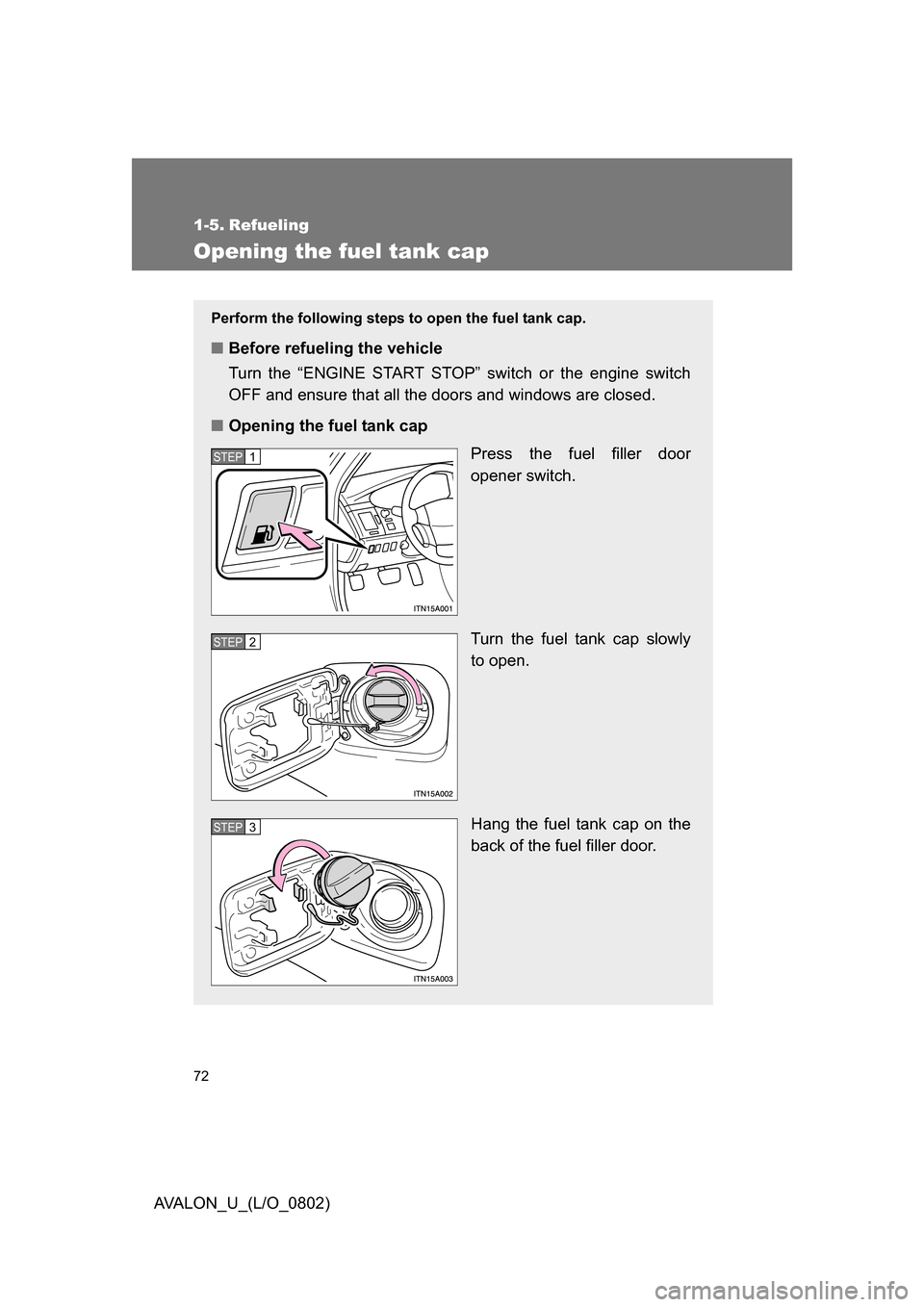
Perform the following steps to open the fuel tank cap.
■Before refueling the vehicle
Turn the “ENGINE START STOP” switch or the engine switch
OFF and ensure that all the doors and windows are closed.
■ Opening the fuel tank cap
Press the fuel filler door
opener switch.
Turn the fuel tank cap slowly
to open.
Hang the fuel tank cap on the
back of the fuel filler door.
STEP1
STEP2
STEP3
Page 75 of 452
75
1
Before driving
AVALON_U_(L/O_0802)
1-6. Theft deterrent system
Engine immobilizer system
■System maintenance
The vehicle has a maintenance-free type of engine immobilizer system.
■ Conditions that may cause the system to malfunction
● If the grip portion of the key is in contact with a metallic object.
● If the key is in close proximity to or touching a key to the security system
(key with a built-in transponder chip) of another vehicle.
■ Certifications for the engine immobilizer system
For vehicles sold in the U.S.A.
This device complies with Part 15 of the FCC Rules. Operation is subject to
the following two conditions: (1) this device may not cause harmful interfer-
ence, and (2) this device must accept any interference received, including
interference that may cause undesired operation.
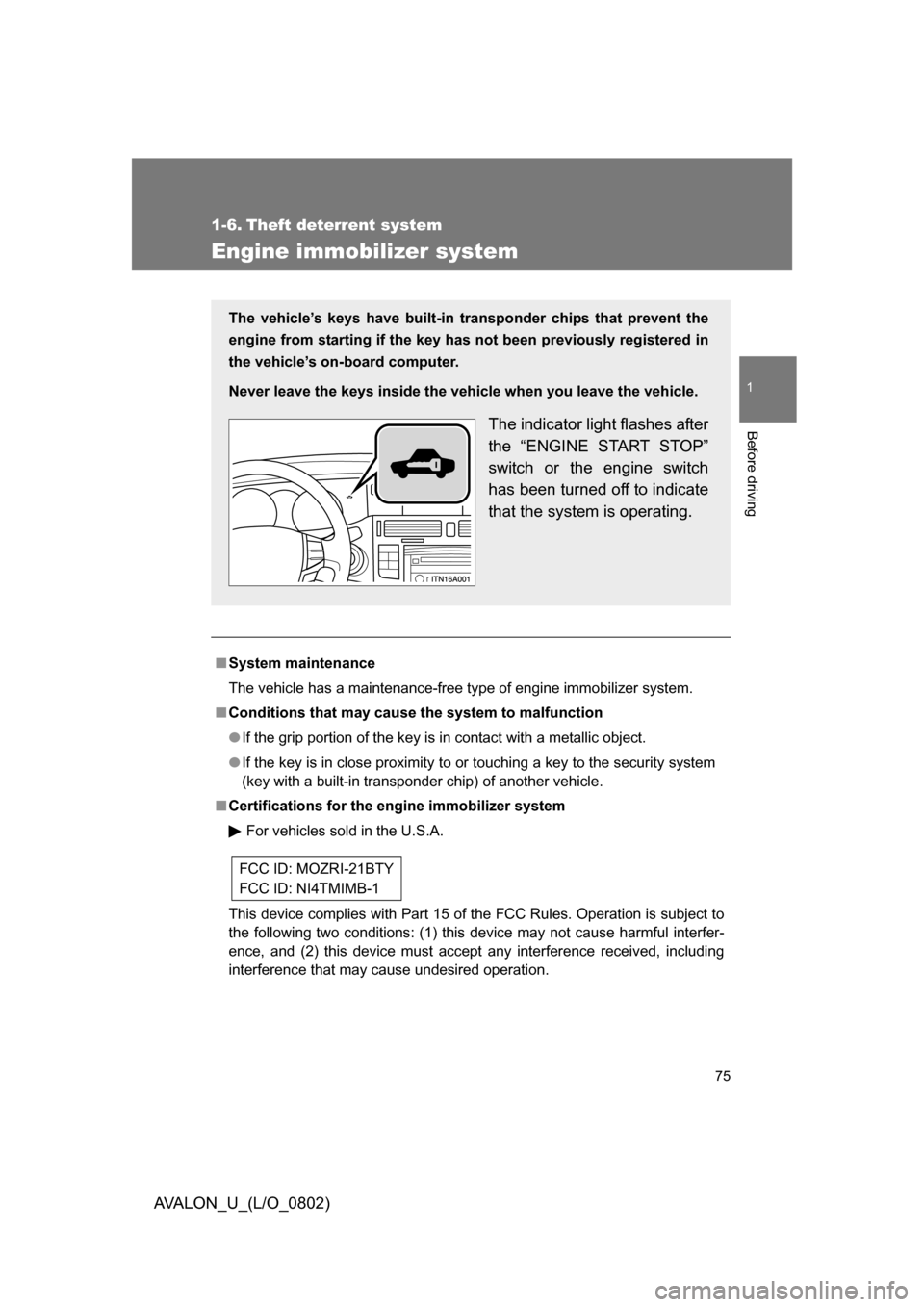
The vehicle’s keys have built-in tr ansponder chips that prevent the
engine from starting if the key has not been previously registered in
the vehicle’s on-board computer.
Never leave the keys inside the vehicle when you leave the vehicle.
The indicator light flashes after
the “ENGINE START STOP”
switch or the engine switch
has been turned off to indicate
that the system is operating.
FCC ID: MOZRI-21BTY
FCC ID: NI4TMIMB-1
Page 76 of 452
76 1-6. Theft deterrent system
AVALON_U_(L/O_0802)
For vehicles sold in Canada
Operation is subject to the following two conditions: (1) this device may not
cause interference, and (2) this device must accept any interference, includ-
ing interference that may cause undesired operation of the device.
CAUTION
■ Certifications for the engine immobilizer system
Changes or modifications not expressly approved by the party responsible
for compliance could void the user’s authority to operate the equipment.
NOTICE
■ For proper system operation
Do not modify, remove or disable the engine immobilizer system. If any
unauthorized changes or modifications are made, the proper operation of
the system cannot be guaranteed.
Page 77 of 452
77
1
1-6. Theft deterrent system
Before driving
AVALON_U_(L/O_0802)
Alarm (if equipped)
The system sounds the alarm and flashes lights when forcible entry
is detected.
■ Triggering the alarm
The alarm is triggered in the following situations.
●A locked door or trunk is unlocked or opened in any way other
than using the entry function, wi reless remote door lock func-
tion or using the mechanical key. (The doors will lock again
automatically.)
● The hood is opened while t he vehicle is locked.
● Vehicles with the glass breaka ge sensor: The side windows
are tapped or broken.
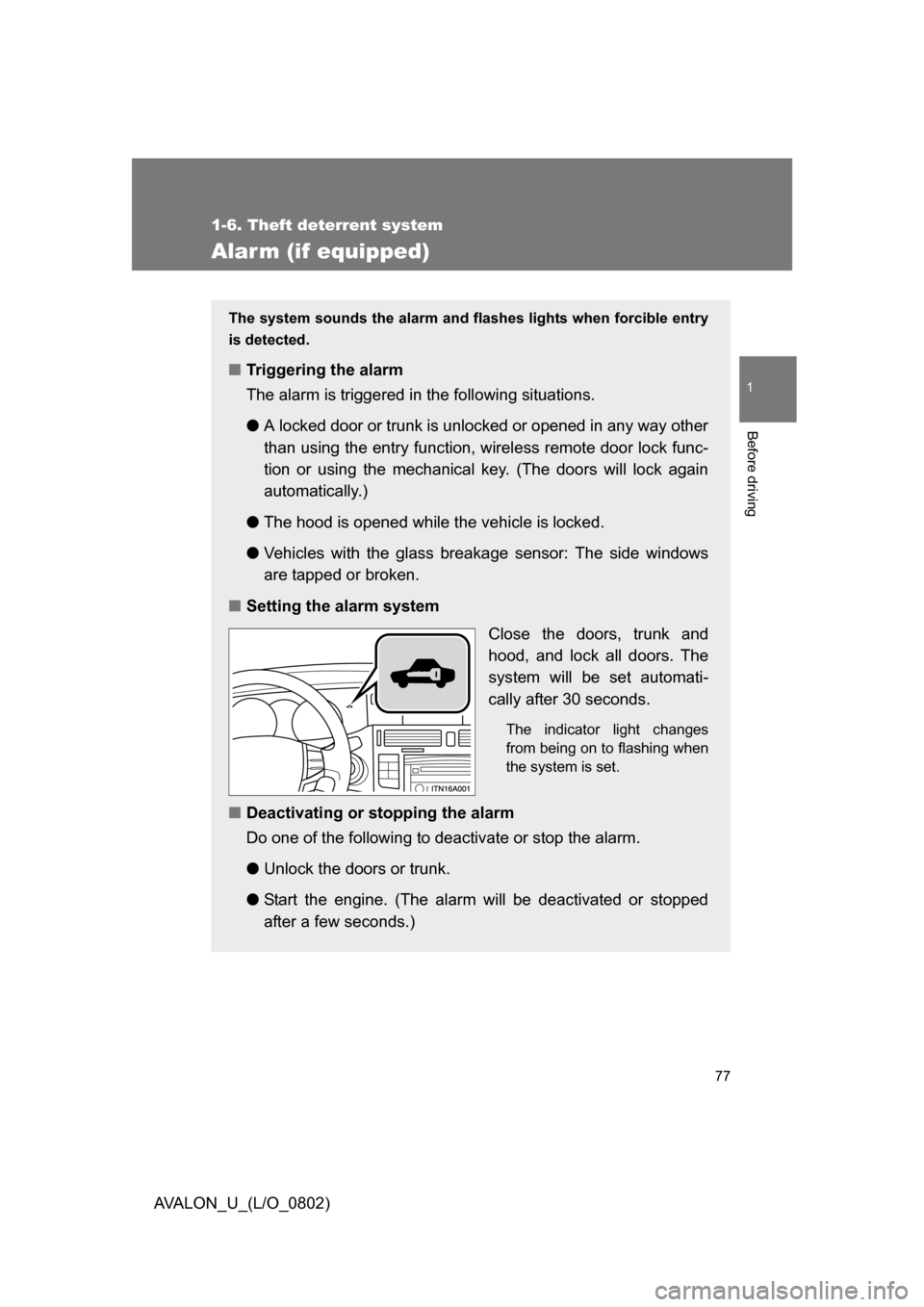
■ Setting the alarm system
Close the doors, trunk and
hood, and lock all doors. The
system will be set automati-
cally after 30 seconds.
The indicator light changes
from being on to flashing when
the system is set.
■Deactivating or stopping the alarm
Do one of the following to deactivate or stop the alarm.
●Unlock the doors or trunk.
● Start the engine. (The alarm will be deactivated or stopped
after a few seconds.)
Page 113 of 452
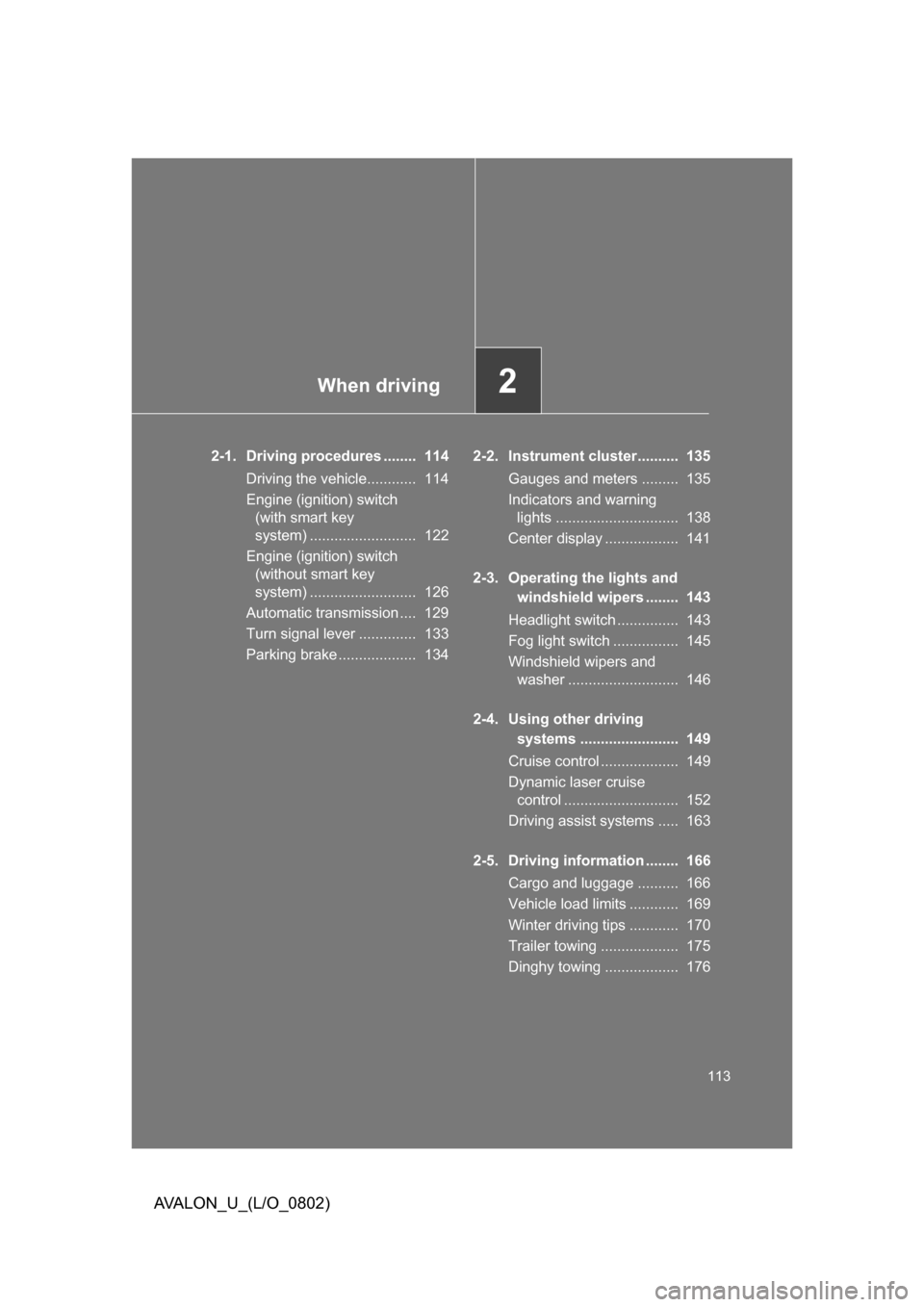
When driving2
113
AVALON_U_(L/O_0802)
2-1. Driving procedures ........ 114Driving the vehicle............ 114
Engine (ignition) switch
(with smart key
system) .......................... 122
Engine (ignition) switch
(without smart key
system) .......................... 126
Automatic transmission .... 129
Turn signal lever .............. 133
Parking brake ................... 134 2-2. Instrument cluster.......... 135
Gauges and meters ......... 135
Indicators and warning
lights .............................. 138
Center display .................. 141
2-3. Operating the lights and
windshield wipers ........ 143
Headlight switch ............... 143
Fog light switch ................ 145
Windshield wipers and
washer ........................... 146
2-4. Using other driving
systems ........................ 149
Cruise control ................... 149
Dynamic laser cruise
control ............................ 152
Driving assist systems ..... 163
2-5. Driving information ........ 166 Cargo and luggage .......... 166
Vehicle load limits ............ 169
Winter driving tips ............ 170
Trailer towing ................... 175
Dinghy towing .................. 176
Page 114 of 452
114
AVALON_U_(L/O_0802)
2-1. Driving procedures
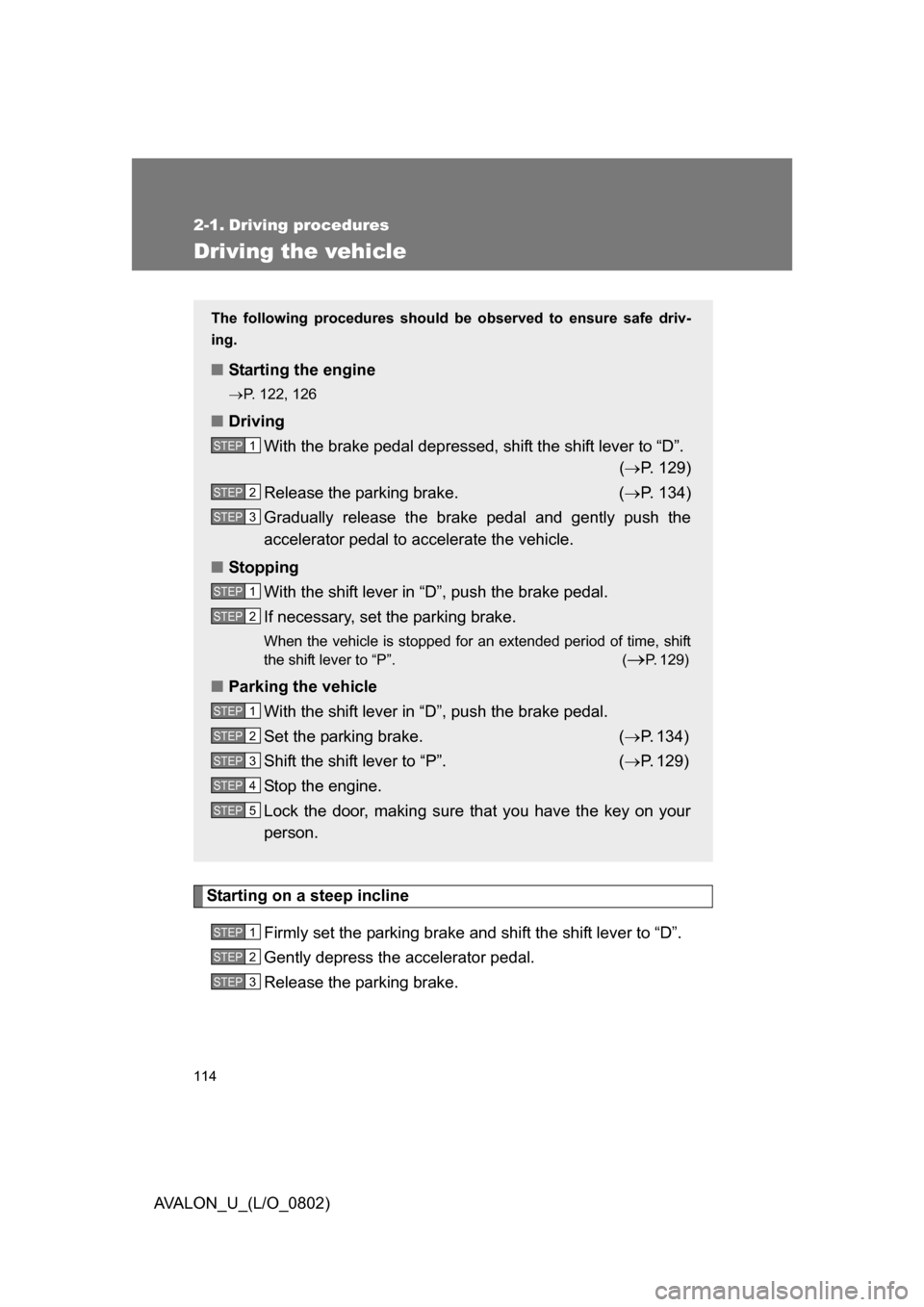
Driving the vehicle
Starting on a steep inclineFirmly set the parking brake and shift the shift lever to “D”.
Gently depress the accelerator pedal.
Release the parking brake.
The following procedures should be observed to ensure safe driv-
ing.
■ Starting the engine
P. 122, 126
■ Driving
With the brake pedal depressed, shift the shift lever to “D”.
( P. 129)
Release the parking brake. ( P. 134)
Gradually release the brake pedal and gently push the
accelerator pedal to accelerate the vehicle.
■ Stopping
With the shift lever in “D”, push the brake pedal.
If necessary, set the parking brake.
When the vehicle is stopped for an extended period of time, shift
the shift lever to “P”. (
P. 129)
■Parking the vehicle
With the shift lever in “D”, push the brake pedal.
Set the parking brake. ( P. 134)
Shift the shift lever to “P”. ( P. 129)
Stop the engine.
Lock the door, making sure that you have the key on your
person.
STEP1
STEP2
STEP3
STEP1
STEP2
STEP1
STEP2
STEP3
STEP4
STEP5
STEP1
STEP2
STEP3
Page 116 of 452
116 2-1. Driving procedures
AVALON_U_(L/O_0802)
CAUTION
■When starting the vehicle
Always keep your foot on the brake pedal while stopped with the engine run-
ning. This prevents the vehicle from creeping.
■ When driving the vehicle
● Do not drive if you are unfamiliar with the location of the brake and accel-
erator pedals to avoid depressing the wrong pedal.
• Accidentally depressing the accelerator pedal instead of the brake
pedal will result in sudden acceleration that may lead to an accident
that could result in death or serious injury.
• When backing up, you may twist your body around, leading to a diffi- culty in operating the pedals. Make sure to operate the pedals properly.
• Make sure to keep a correct driving posture even when moving the vehicle only slightly, allowing you to depress the brake and accelerator
pedals properly.
• Depress the brake pedal using your right foot. Depressing the brake pedal using your left foot may delay response in an emergency, result-
ing in an accident.
● Do not drive the vehicle over or st op the vehicle near flammable materials.
The exhaust system and exhaust gases can be extremely hot. This may
cause a fire if there is any flammable material nearby.
● Do not let the vehicle roll backwards while the shift lever is in a driving
position, or roll forward while the shift lever is in “R”.
Doing so may cause the engine not to operate or lead to poor brake and
steering performance, resulting in an accident or damage to the vehicle.\
● If the smell of exhaust is noticed inside the vehicle, open the windows and
check that the trunk is closed.
Large amounts of exhaust in the vehicle can cause driver drowsiness and
an accident, resulting in death or a serious health hazard. Have the cause
of the problem inspected immediately.
● Do not under any circumstances shift the shift lever to “P”, “R” or “N” while
the vehicle is moving.
Doing so can cause significant damage to the transmission and may result
in a loss of vehicle control.
Page 117 of 452
117
2-1. Driving procedures
2
When driving
AVALON_U_(L/O_0802)
CAUTION
■
When driving the vehicle
● Do not shift the shift lever to “N” while the vehicle is moving.
Doing so may cause the engine brake not to operate properly and lead to
an accident.
● Do not turn the engine off while driving.
The power steering and brake booster will not operate properly if the
engine is not running.
● Use engine braking (downshift) to maintain a safe speed when driving
down a steep hill.
Using the brakes continuously may cause the brakes to overheat and lose
effectiveness. ( P. 131)
● Be careful when driving on slippery surfaces, as the vehicle may spin or
skid when downshifting, rapidly accelerating, braking or turning.
● Do not adjust the position of the steering wheel, the seat, or the inside or
outside rear view mirrors while driving.
Doing so may result in a loss of vehicle control that can cause accidents
that may result in death or serious injury.
● Always check that all passengers’ arms, heads or other parts of their bod-
ies are not outside the vehicle, as this may result in death or serious injury.
Page 118 of 452
118 2-1. Driving procedures
AVALON_U_(L/O_0802)
CAUTION
■When driving on slippery road surfaces
● Sudden braking, acceleration and steering may cause tire slippage and
reduce your ability to control the vehicle, resulting in an accident.
● Sudden changes in engine speed, such as engine braking caused by up-
shifting or down-shifting, may cause the vehicle to skid, resulting in an
accident.
● After driving through a puddle, lightly depress the brake pedal to make
sure that the brakes are functioning properly. Wet brake pads may prevent
the brakes from functioning properly. If the brakes on only one side are wet
and not functioning properly, steering control may be affected, resulting in
an accident.
■ When shifting the shift lever
Be careful not to shift the shift lever with the accelerator pedal depressed.
This may lead to unexpected rapid acceleration of the vehicle that may
cause an accident and result in death or serious injury.
■ When the vehicle is stopped
● Do not race the engine.
If the vehicle is in any gear other than “P” or “N” the vehicle may acceler-
ate suddenly and unexpectedly, and may cause an accident.
● Do not leave the vehicle with the engine on for a long time.
If such a situation cannot be avoided, park the vehicle in an open space
and check that exhaust fumes do not enter the vehicle interior.
● Always keep a foot on the brake pedal while the engine is running to pre-
vent an accident caused by the vehicle moving.
Page 119 of 452
119
2-1. Driving procedures
2
When driving
AVALON_U_(L/O_0802)
CAUTION
■
When the vehicle is parked
● Do not leave glasses, cigarette lighters, spray cans, or soft drink cans in
the vehicle when it is in the sun.
Failure to do so may result in the following:
• Gas may leak from a cigarette lighter or spray can, and may lead to a fire.
• The temperature inside the vehicle may cause the plastic lenses and plastic material of eye glasses to deform or crack.
• Soft drink cans may fracture, causing the contents to spray over the interior of the vehicle, and may also cause a short circuit in the vehi-
cle’s electrical components.
● Always apply the parking brake, shift the shift lever to “P”, stop the engine
and lock the vehicle.
Do not leave the vehicle unattended while the engine is running.
● Do not touch the exhaust pipe while the engine is running or immediately
after turning the engine off.
Doing so may cause burns.
● Do not leave the engine running in an area with snow build up, or where
snow is expected to fall.
Exhaust gases may collect and enter the vehicle, leading to death or a
serious health hazard.
■ Exhaust gases
Exhaust gases include harmful carbon monoxide (CO) that is colorless and
odorless. Inhaling exhaust gases may lead to death or a serious health haz-
ard.
● If the vehicle is in a poorly ventilated area, stop the engine. In a closed
area, such as a garage, exhaust gases may collect and enter the vehicle.
This may lead to death or a serious health hazard.
● The exhaust should be checked occasionally. If there is a hole or crack
caused by corrosion, damage to a joint or abnormal exhaust noise, be
sure to have the vehicle inspected and repaired by your Toyota dealer.
Failure to do so may allow exhaust gases to enter the vehicle, resulting in
death or a serious health hazard.