towing TOYOTA AVALON 2010 XX30 / 3.G Owners Manual
[x] Cancel search | Manufacturer: TOYOTA, Model Year: 2010, Model line: AVALON, Model: TOYOTA AVALON 2010 XX30 / 3.GPages: 476, PDF Size: 6.77 MB
Page 3 of 476

1
2
3
4
5
6
7
3
AVALON_U (OM41437U)
2-3. Operating the lights and windshield wipers
Headlight switch .................. 156
Fog light switch ................... 159
Windshield wipers and washer .............................. 160
2-4. Using other driving systems Cruise control ...................... 165
Dynamic laser cruise control ............................... 168
Driving assist systems ........ 181
2-5. Driving information Cargo and luggage ............. 184
Vehicle load limits ............... 188
Winter driving tips ............... 189
Trailer towing ...................... 194
Dinghy towing ..................... 195
3-1. Using the air conditioning system and defogger
Automatic air conditioning system .............................. 198
Using the steering wheel climate control
switches ............................ 206
Rear window and outside rear view mirror
defoggers .......................... 208 3-2. Using the audio system
Audio system type .............. 210
Audio cover ........................ 212
Using the radio ................... 213
Using the CD player ........... 220
Playing MP3 and WMA discs ....................... 228
Optimal use of the audio system .............................. 236
Using the AUX adapter....... 238
Using the steering wheel audio switches.................. 239
3-3. Using the hands-free system (for cellular phone)
Hands-free system (for cellular phone) ........... 242
Using the hands-free system .............................. 246
Making a phone call ........... 254
Setting a cellular phone ...... 259
Security and system setup ................................ 264
Using the phone book ........ 267
3-4. Using the interior lights Interior lights list ................. 275
3-5. Using the storage features List of storage features ....... 278
3Interior features
Page 123 of 476
When driving2
123
AVALON_U (OM41437U)
2-1. Driving proceduresDriving the vehicle............ 124
Engine (ignition) switch (with smart key system).......... 133
Engine (ignition) switch (without smart key system).......... 137
Automatic transmission................... 140
Turn signal lever .............. 145
Parking brake ................... 146
Horn ................................. 147 2-2. Instrument cluster
Gauges and meters ......... 148
Indicators and warning lights .............................. 151
Center display .................. 154
2-3. Operating the lights and windshield wipers
Headlight switch ............... 156
Fog light switch ................ 159
Windshield wipers and washer ........................... 160
2-4. Using other driving systems Cruise control ................... 165
Dynamic laser cruise control ............................ 168
Driving assist systems ..... 181
2-5. Driving information Cargo and luggage .......... 184
Vehicle load limits ............ 188
Winter driving tips ............ 189
Trailer towing ................... 194
Dinghy towing .................. 195
Page 185 of 476
185
2-5. Driving information
2
When driving
AVALON_U (OM41437U)
(5) Determine the combined weight of luggage and cargo being
loaded on the vehicle.
That weight may not safely ex ceed the available cargo and lug-
gage load capacity calculated in Step 4.
(6) If your vehicle will be towing a tr ailer, load from your trailer will
be transferred to your vehicle. Consult this manual to determine
how this reduces the available cargo and luggage load capacity
of your vehicle. ( P. 188)
Toyota does not recommend towing a trailer with your vehicle. Your
vehicle is not designed for trailer towing.
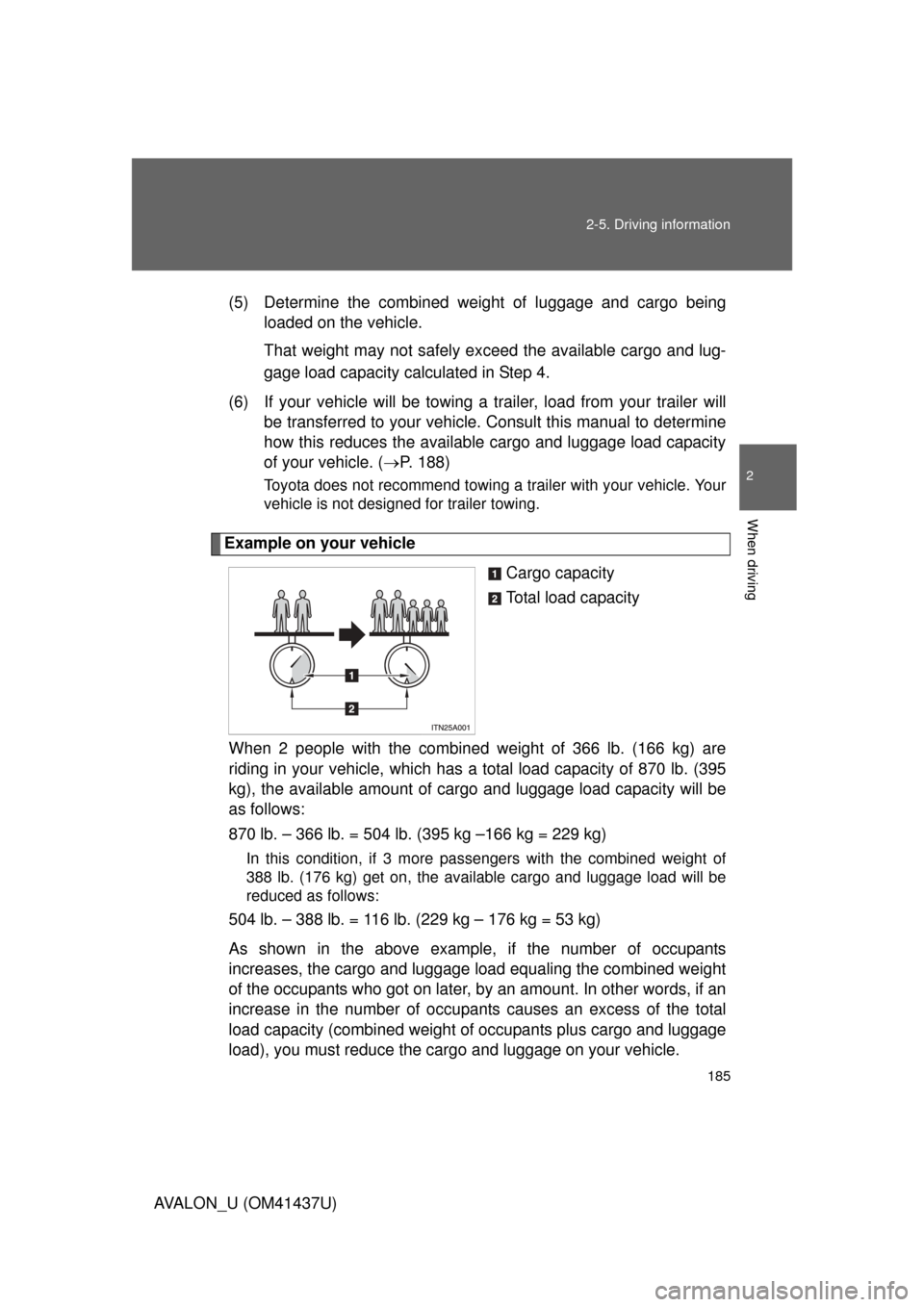
Example on your vehicle
Cargo capacity
Total load capacity
When 2 people with the combined weight of 366 lb. (166 kg) are
riding in your vehicle, which has a total load capacity of 870 lb. (395
kg), the available amount of cargo and luggage load capacity will be
as follows:
870 lb. – 366 lb. = 504 lb. (395 kg –166 kg = 229 kg)
In this condition, if 3 more pa ssengers with the combined weight of
388 lb. (176 kg) get on , the available cargo and luggage load will be
reduced as follows:
504 lb. – 388 lb. = 116 lb. (229 kg – 176 kg = 53 kg)
As shown in the above example, if the number of occupants
increases, the cargo and luggage load equaling the combined weight
of the occupants who got on later, by an amount. In other words, if an
increase in the number of occupants causes an excess of the total
load capacity (combined weight of occupants plus cargo and luggage
load), you must reduce the carg o and luggage on your vehicle.
Page 188 of 476
188
2-5. Driving information
AVALON_U (OM41437U)
Vehicle load limits
■Total load capacity and seating capacity
These details are also described on the tire and loading information
label. (P. 354)
CAUTION
■Overloading the vehicle
Do not overload the vehicle.
It may not only cause damage to the ti res, but also degrade steering and
braking ability, resulting in an accident.
Vehicle load limits include total load capacity, seating capacity,
towing capacity and cargo capacity.
■ Total load capacity: 870 lb. (395 kg)
Total load capacity means the combined weight of occupants,
cargo and luggage.
■ Seating capacity: 5 occupants (Front 2, Rear 3)
Seating capacity means the ma ximum number of occupants
whose estimated average weight is 150 lb. (68 kg) per person.
Even if the number of occupants are within the seating capacity,
do not exceed the total load capacity.
■ Towing capacity
Toyota does not recommend towing a trailer with your vehicle.
■ Cargo capacity
Cargo capacity may increase or decrease depending on the
weight and the number of occupants.
Page 194 of 476
194
2-5. Driving information
AVALON_U (OM41437U)
Trailer towing
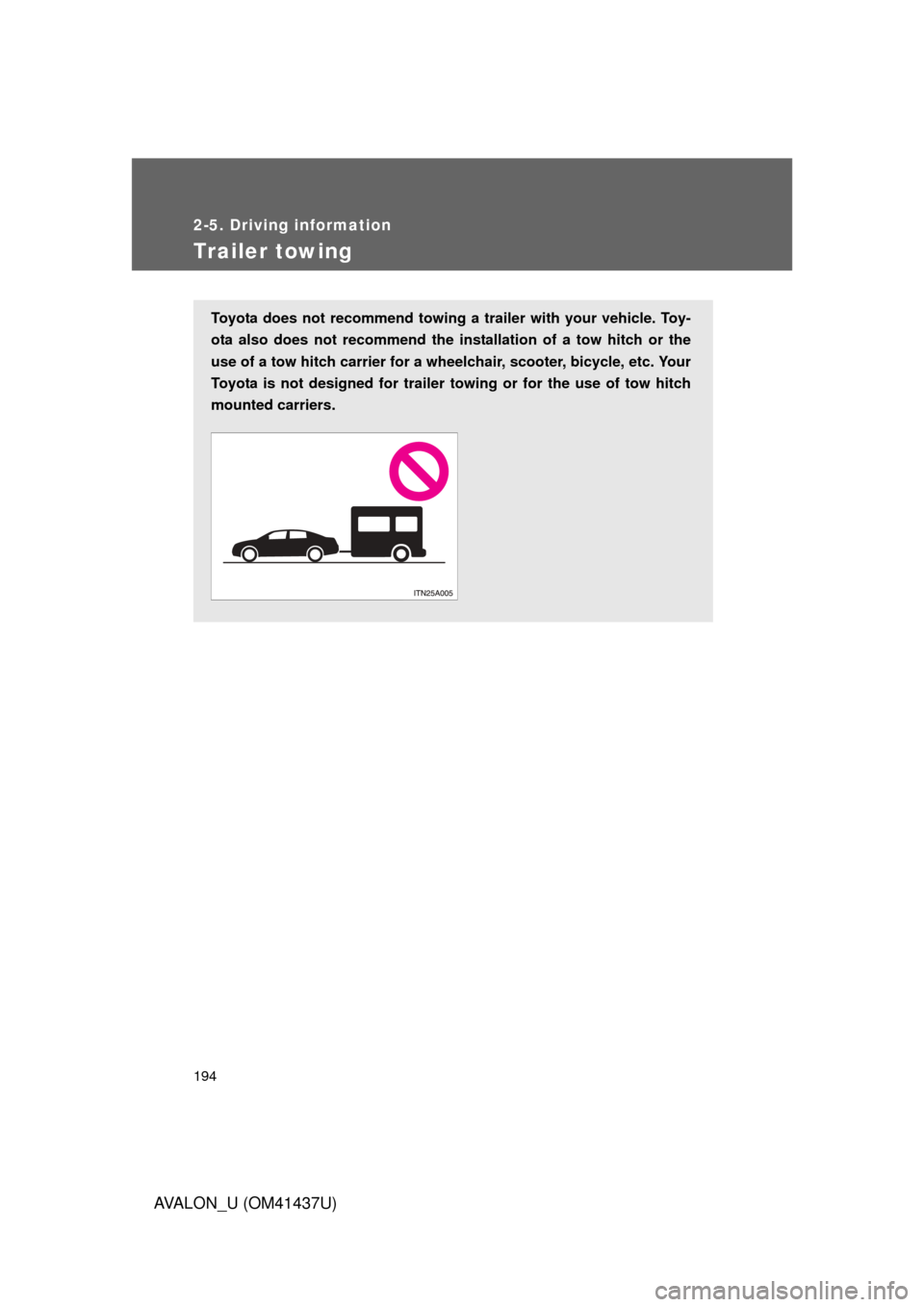
Toyota does not recommend towing a trailer with your vehicle. Toy-
ota also does not recommend the installation of a tow hitch or the
use of a tow hitch carri er for a wheelchair, scooter, bicycle, etc. Your
Toyota is not designed for trailer towing or for the use of tow hitch
mounted carriers.
Page 195 of 476
195
2-5. Driving information
2
When driving
AVALON_U (OM41437U)
Dinghy towing
NOTICE
■To avoid serious damage to your vehicle
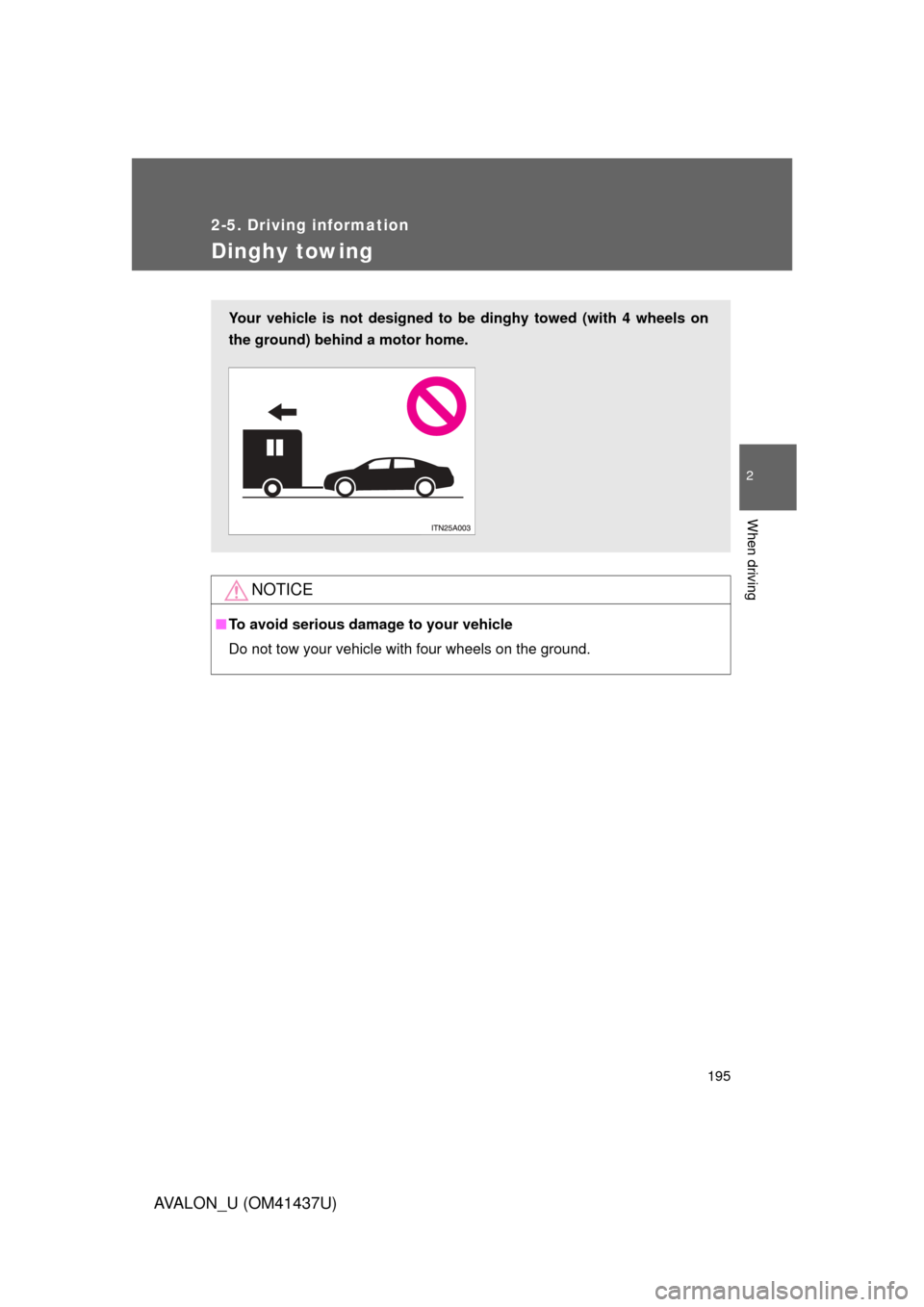
Do not tow your vehicle with four wheels on the ground.
Your vehicle is not designed to be dinghy towed (with 4 wheels on
the ground) behind a motor home.
Page 385 of 476
5
When trouble arises
385
5-1. Essential information
AVALON_U (OM41437U)
If your vehicle needs to be towed
Before towingThe following may indicate a problem with your transmission. Contact
your Toyota dealer before towing.
● The engine is running, but the vehicle will not move.
● The vehicle makes an abnormal sound.
If towing is necessary, we recommend having your vehicle towed by
your Toyota dealer or a commerci al towing service, using a lift-type
truck or a flat bed truck.
Use a safety chain system for all to wing, and abide by all state/pro-
vincial and local laws.
If towing from the front, the vehicle ’s rear wheel and axles must be in
good condition. ( P. 387)
If they are damaged, use a towing dolly or flat bed truck.
Page 386 of 476
386 5-1. Essential information
AVALON_U (OM41437U)
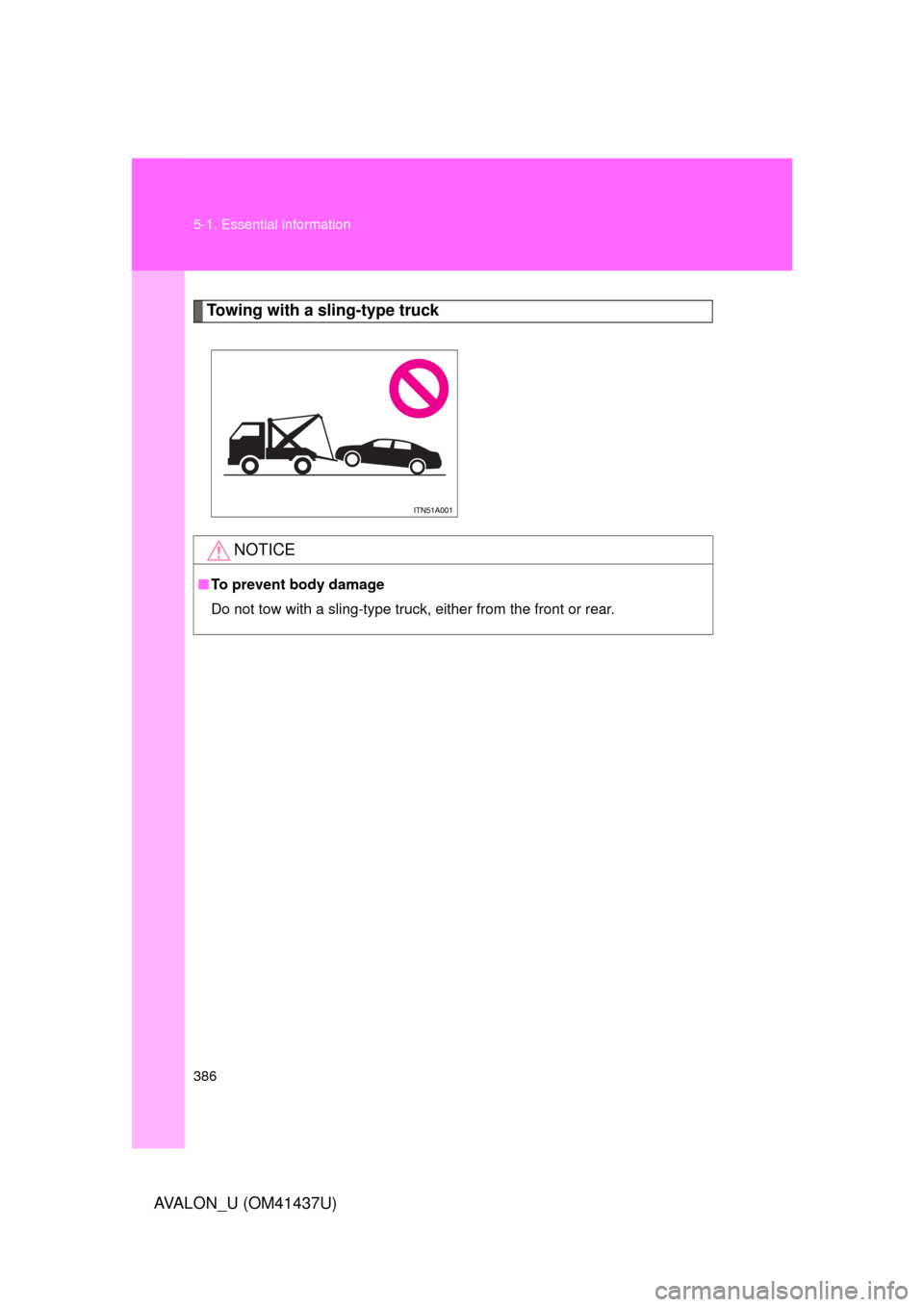
Towing with a sling-type truck
NOTICE
■To prevent body damage
Do not tow with a sling-type truck, either from the front or rear.
Page 387 of 476
5
When trouble arises
387
5-1. Essential information
AVALON_U (OM41437U)
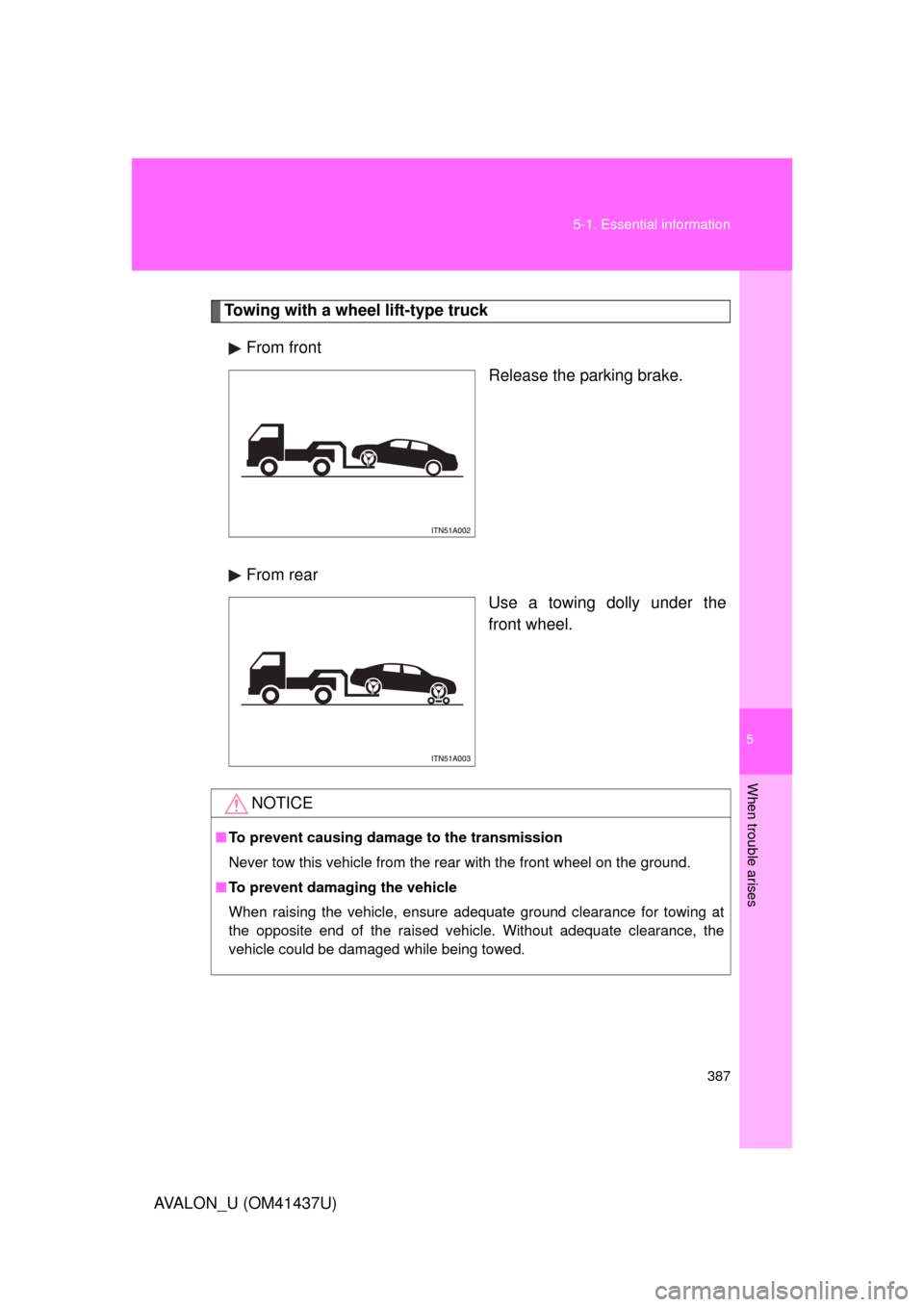
Towing with a wheel lift-type truck
From front Release the parking brake.
From rear Use a towing dolly under the
front wheel.
NOTICE
■To prevent causing damage to the transmission
Never tow this vehicle from the rear with the front wheel on the ground.
■ To prevent damaging the vehicle
When raising the vehicle, ensure adequate ground clearance for towing at
the opposite end of the raised vehicle. Without adequate clearance, the
vehicle could be damaged while being towed.
Page 427 of 476
5
When trouble arises
427
5-2. Steps to take in an emergency
AVALON_U (OM41437U)
If the vehicle becomes stuck
CAUTION
■When attempting to free a stuck vehicle
If you choose to rock the vehicle back and forth to free it, make sure the sur-
rounding area is clear, to avoid striking other vehicles, objects or persons.
The vehicle may also lunge forward or lunge back suddenly as it becomes
free. Use extreme caution.
■ When shifting the shift lever
Be careful not to shift the shift lever with the accelerator pedal depressed.
This may lead to unexpected rapid acceleration of the vehicle that may
cause an accident and result in death or serious injury.
NOTICE
■To avoid damaging the transmission and other components
● Avoid spinning the wheels and do not rev the engine.
● If the vehicle remains stuck after trying these procedures, the vehicle may
require towing to be freed.
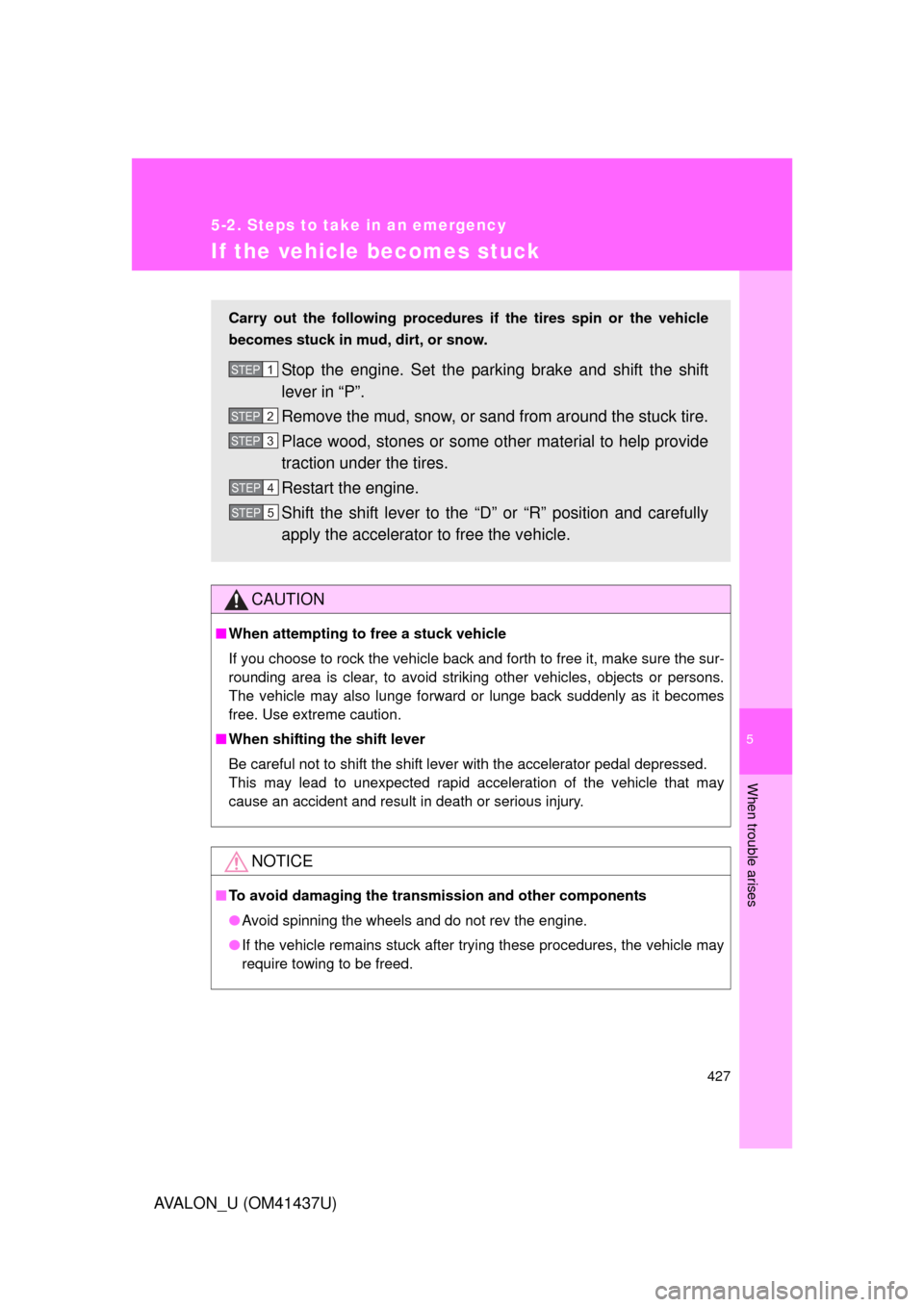
Carry out the following procedures if the tires spin or the vehicle
becomes stuck in mud, dirt, or snow.
Stop the engine. Set the parki ng brake and shift the shift
lever in “P”.
Remove the mud, snow, or sand from around the stuck tire.
Place wood, stones or some other material to help provide
traction under the tires.
Restart the engine.
Shift the shift lever to the “D ” or “R” position and carefully
apply the accelerator to free the vehicle.STEP1
STEP2
STEP3
STEP4
STEP5