engine TOYOTA AVALON 2017 XX40 / 4.G Owners Manual
[x] Cancel search | Manufacturer: TOYOTA, Model Year: 2017, Model line: AVALON, Model: TOYOTA AVALON 2017 XX40 / 4.GPages: 492, PDF Size: 7.17 MB
Page 420 of 492
4207-2. Steps to take in an emergency
WARNING
■When inspecting under the hood of your vehicle
Observe the following precautions.
Failure to do so may result in serious injury such as burns.
● If steam is seen coming from under the hood, do not open the hood until
the steam has subsided. The engine compartment may be very hot.
● Keep hands and clothing (especially a tie, a scarf or a muffler) away from
the fans and belts.
NOTICE
■When adding engine coolant
Wait until the engine has cooled down before adding engine coolant.
When adding coolant, do so slowly. Adding cool coolant to a hot engine too
quickly can cause damage to the engine.
■ To prevent damage to the cooling system
Observe the following precautions:
● Avoid contaminating the coolant with foreign matter (such as sand or dust
etc.).
● Do not use any coolant additive.
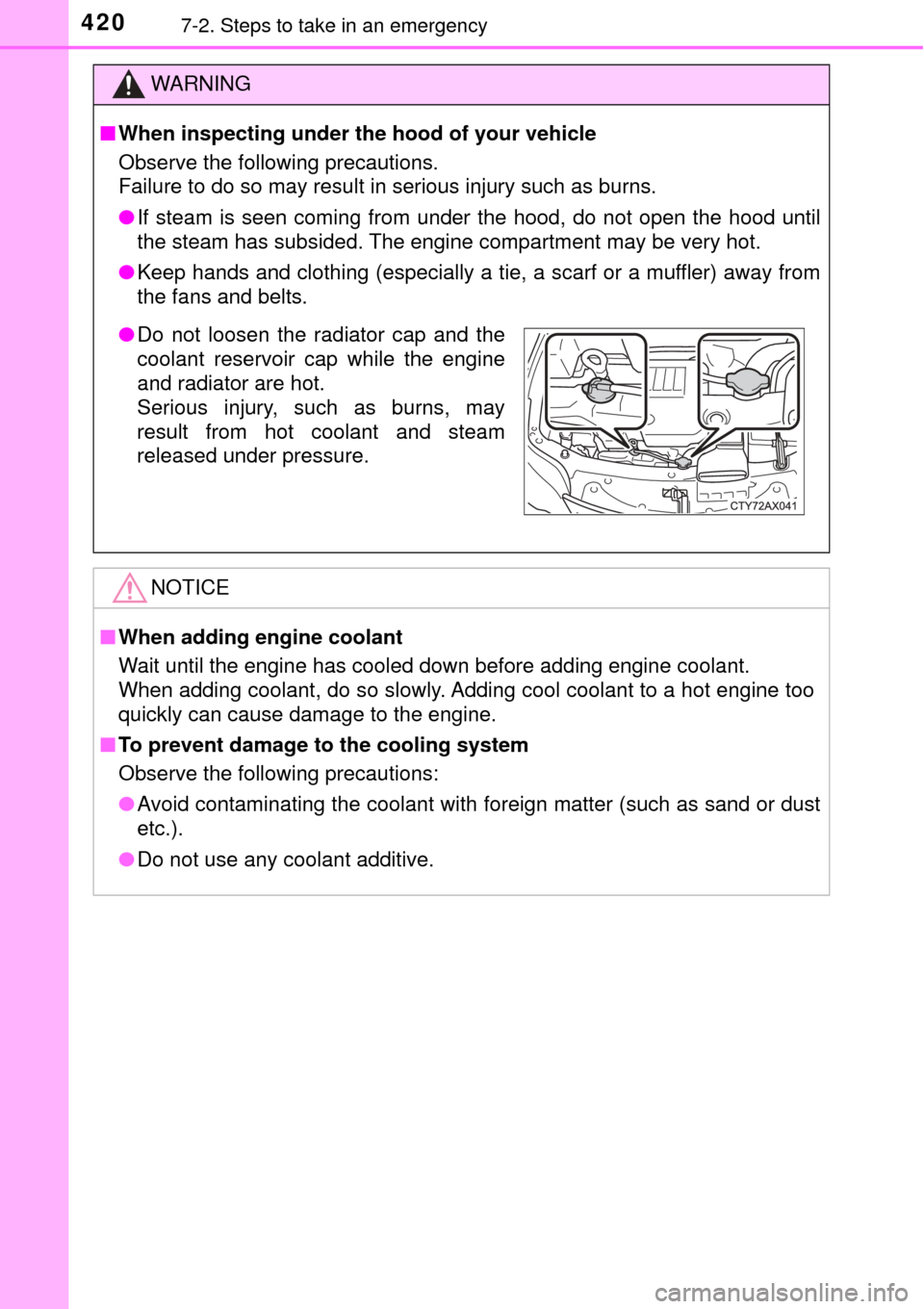
●Do not loosen the radiator cap and the
coolant reservoir cap while the engine
and radiator are hot.
Serious injury, such as burns, may
result from hot coolant and steam
released under pressure.
Page 421 of 492
4217-2. Steps to take in an emergency
7
When trouble arises
Stop the engine. Set the parking brake and shift the shift lever to P.
Remove the mud, snow or sand from around the front wheels.
Place wood, stones or some other material under the front wheels
to help provide traction.
Restart the engine.
Shift the shift lever to D or R and release the parking brake. Then,
while exercising caution, depress the accelerator pedal.
■ When it is difficult to free the vehicle
If the vehicle becomes stuck
Carry out the following procedures if the tires spin or the vehicle
becomes stuck in mud, dirt or snow:
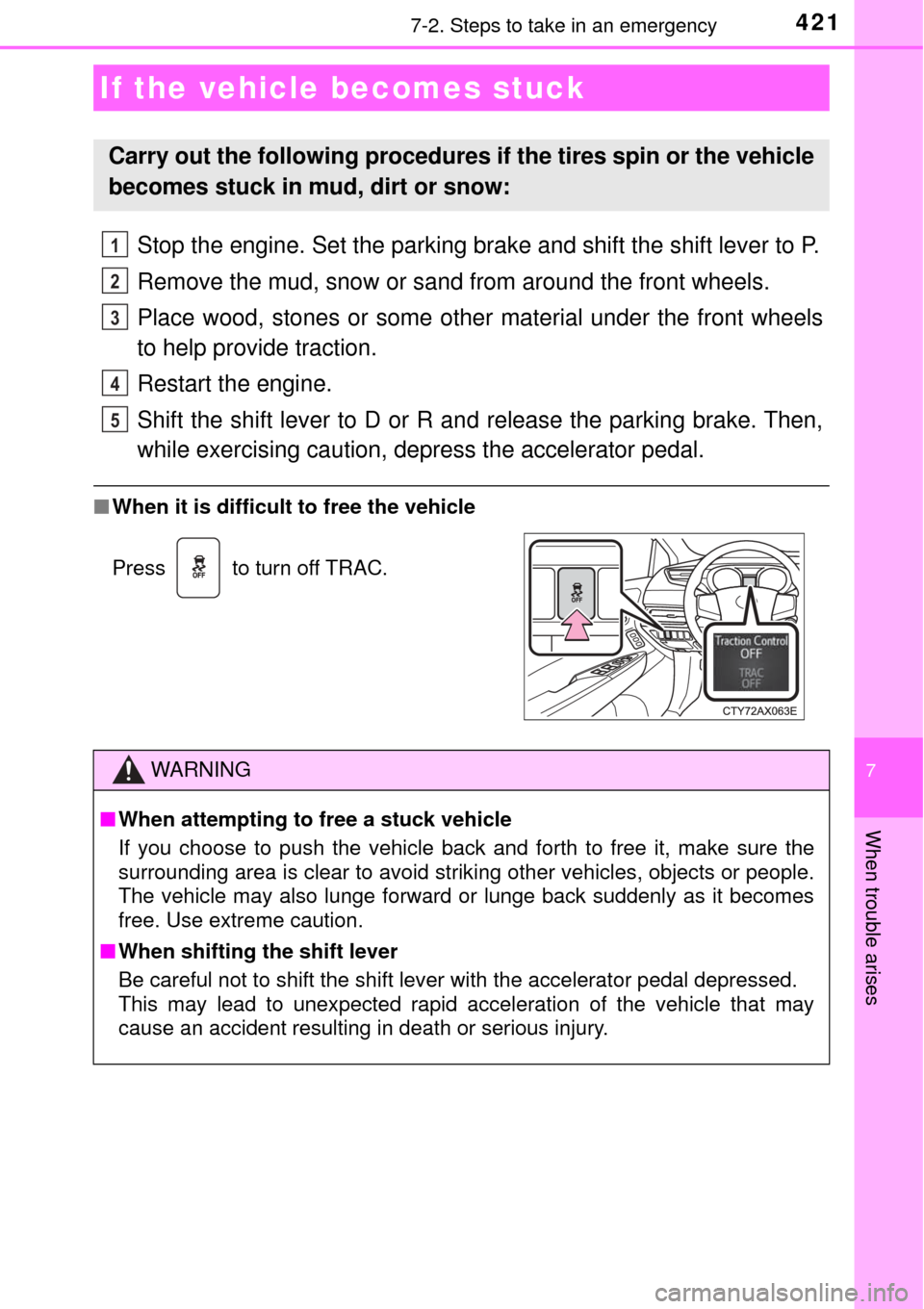
Press to turn off TRAC.
WARNING
■When attempting to free a stuck vehicle
If you choose to push the vehicle back and forth to free it, make sure the
surrounding area is clear to avoid striking other vehicles, objects or people.
The vehicle may also lunge forward or lunge back suddenly as it becomes
free. Use extreme caution.
■ When shifting the shift lever
Be careful not to shift the shift lever with the accelerator pedal depressed.
This may lead to unexpected rapid acceleration of the vehicle that may
cause an accident resulting in death or serious injury.
1
2
3
4
5
Page 425 of 492
4258-1. Specifications
8
Vehicle specifications
■Vehicle identification number
The vehicle identification number (VIN) is the legal identifier for
your vehicle. This is the primary identification number for your
Toyota. It is used in registering the ownership of your vehicle.
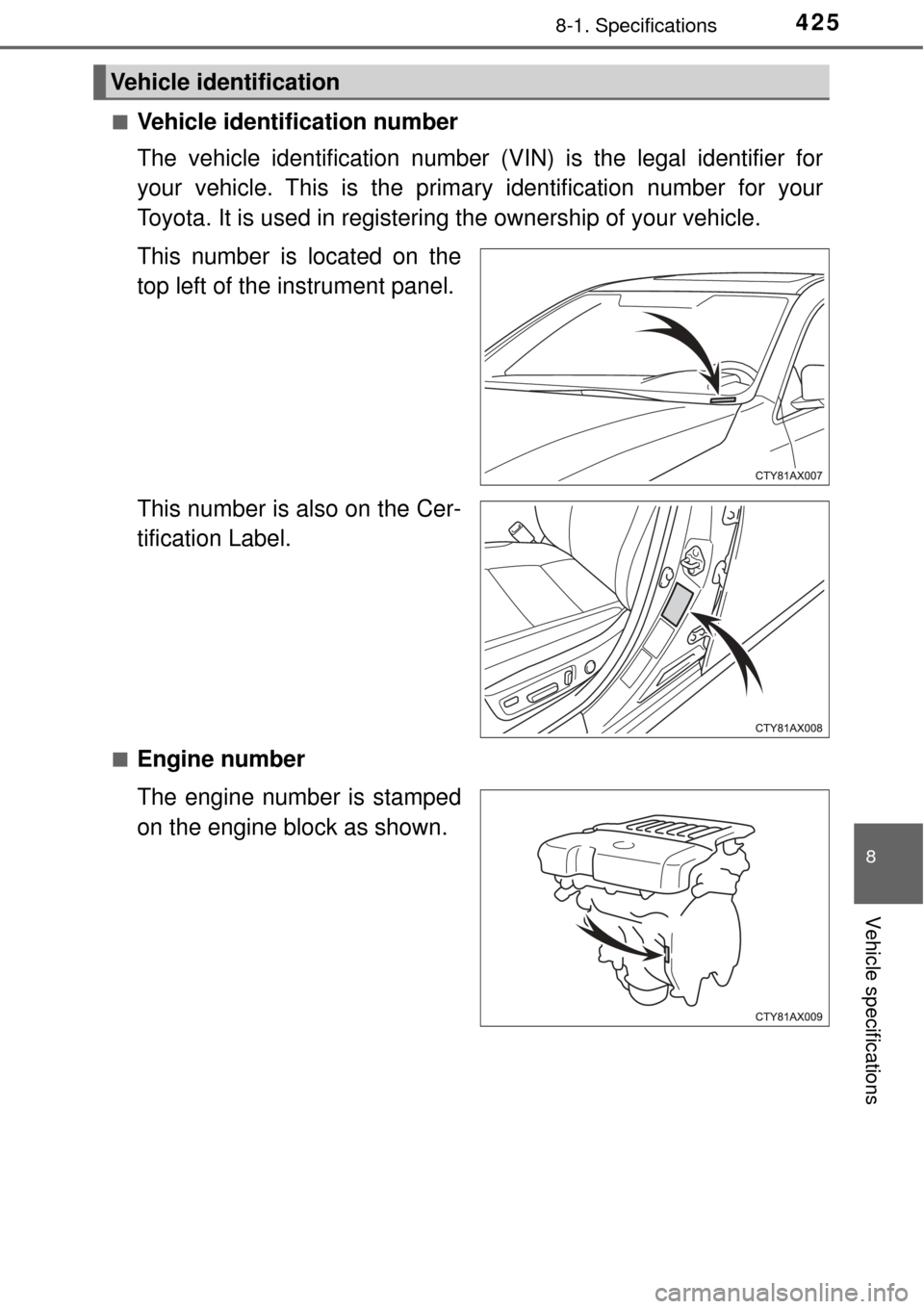
This number is located on the
top left of the instrument panel.
This number is also on the Cer-
tification Label.
■Engine number
The engine number is stamped
on the engine block as shown.
Vehicle identification
Page 426 of 492
4268-1. Specifications
*: The engine oil capacity is a reference quantity to be used when changingthe engine oil. Warm up and turn off the engine, wait more than 5 minutes,
and check the oil level on the dipstick.
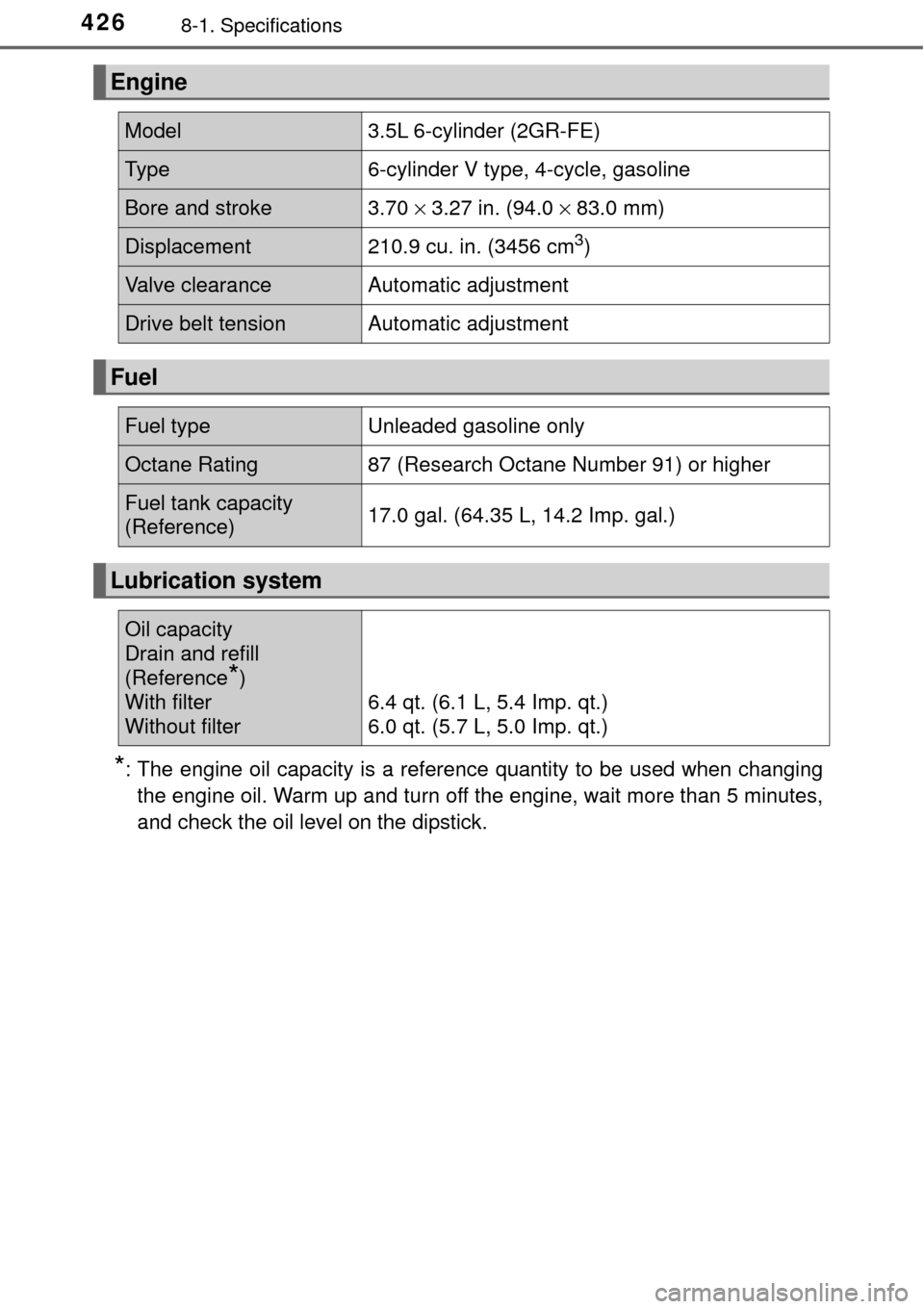
Engine
Model3.5L 6-cylinder (2GR-FE)
Ty p e6-cylinder V type, 4-cycle, gasoline
Bore and stroke3.70 × 3.27 in. (94.0 × 83.0 mm)
Displacement210.9 cu. in. (3456 cm3)
Valve clearanceAutomatic adjustment
Drive belt tensionAutomatic adjustment
Fuel
Fuel typeUnleaded gasoline only
Octane Rating87 (Research Octane Number 91) or higher
Fuel tank capacity
(Reference)17.0 gal. (64.35 L, 14.2 Imp. gal.)
Lubrication system
Oil capacity
Drain and refill
(Reference
*)
With filter
Without filter
6.4 qt. (6.1 L, 5.4 Imp. qt.)
6.0 qt. (5.7 L, 5.0 Imp. qt.)
Page 427 of 492
4278-1. Specifications
8
Vehicle specifications
■Engine oil selection
“Toyota Genuine Motor Oil” is used in your Toyota vehicle. Use
Toyota approved “Toyota Genuine Motor Oil” or equivalent to sat-
isfy the following grade and viscosity.
Oil grade: ILSAC GF-5 multigrade engine oil
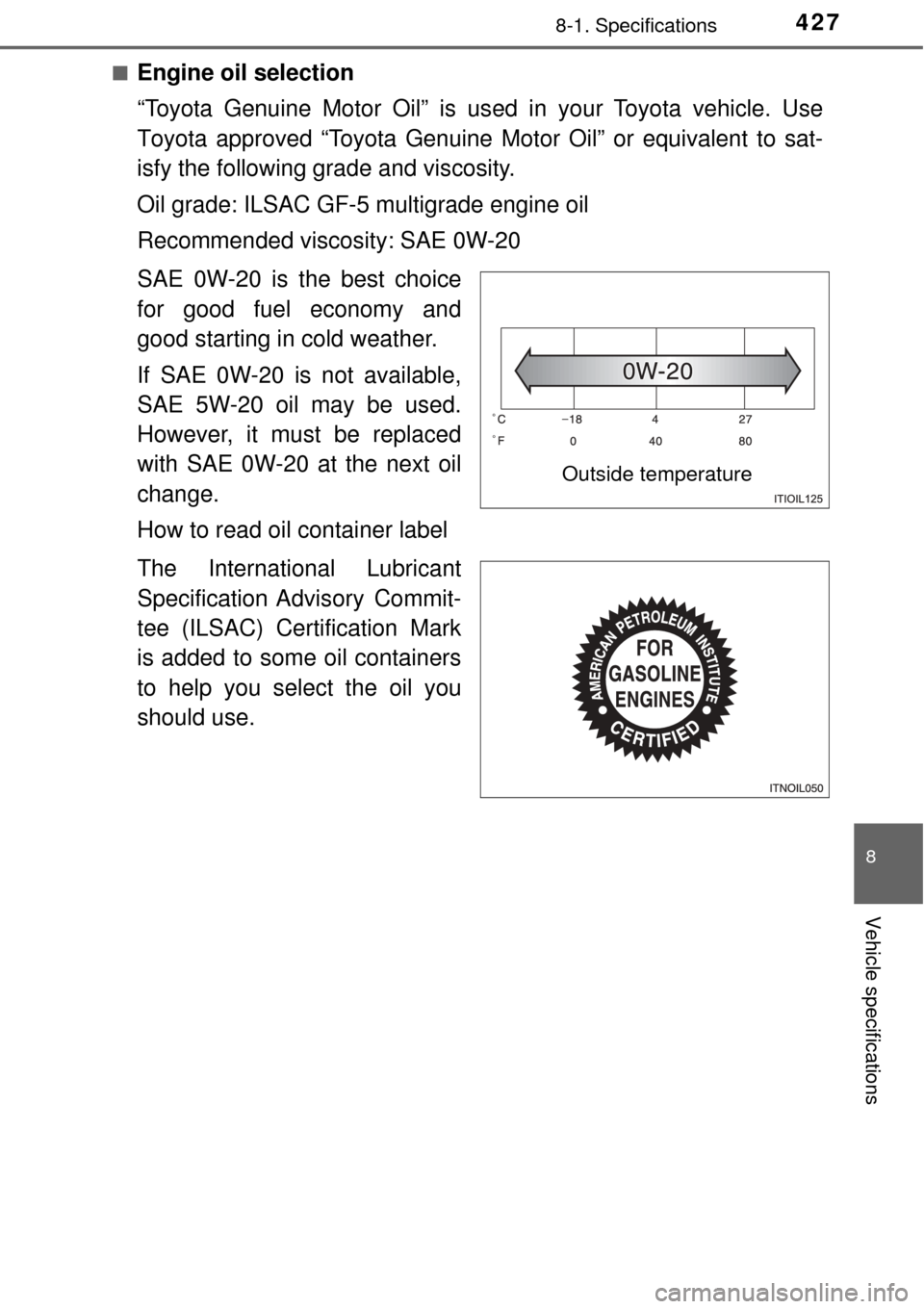
Recommended viscosity: SAE 0W-20
SAE 0W-20 is the best choice
for good fuel economy and
good starting in cold weather.
If SAE 0W-20 is not available,
SAE 5W-20 oil may be used.
However, it must be replaced
with SAE 0W-20 at the next oil
change.
How to read oil container label
The International Lubricant
Specification Advisory Commit-
tee (ILSAC) Certification Mark
is added to some oil containers
to help you select the oil you
should use.
Outside temperature
Page 429 of 492
4298-1. Specifications
8
Vehicle specifications
*: The fluid capacity is the quantity of reference.If replacement is necessary, contact your Toyota dealer.
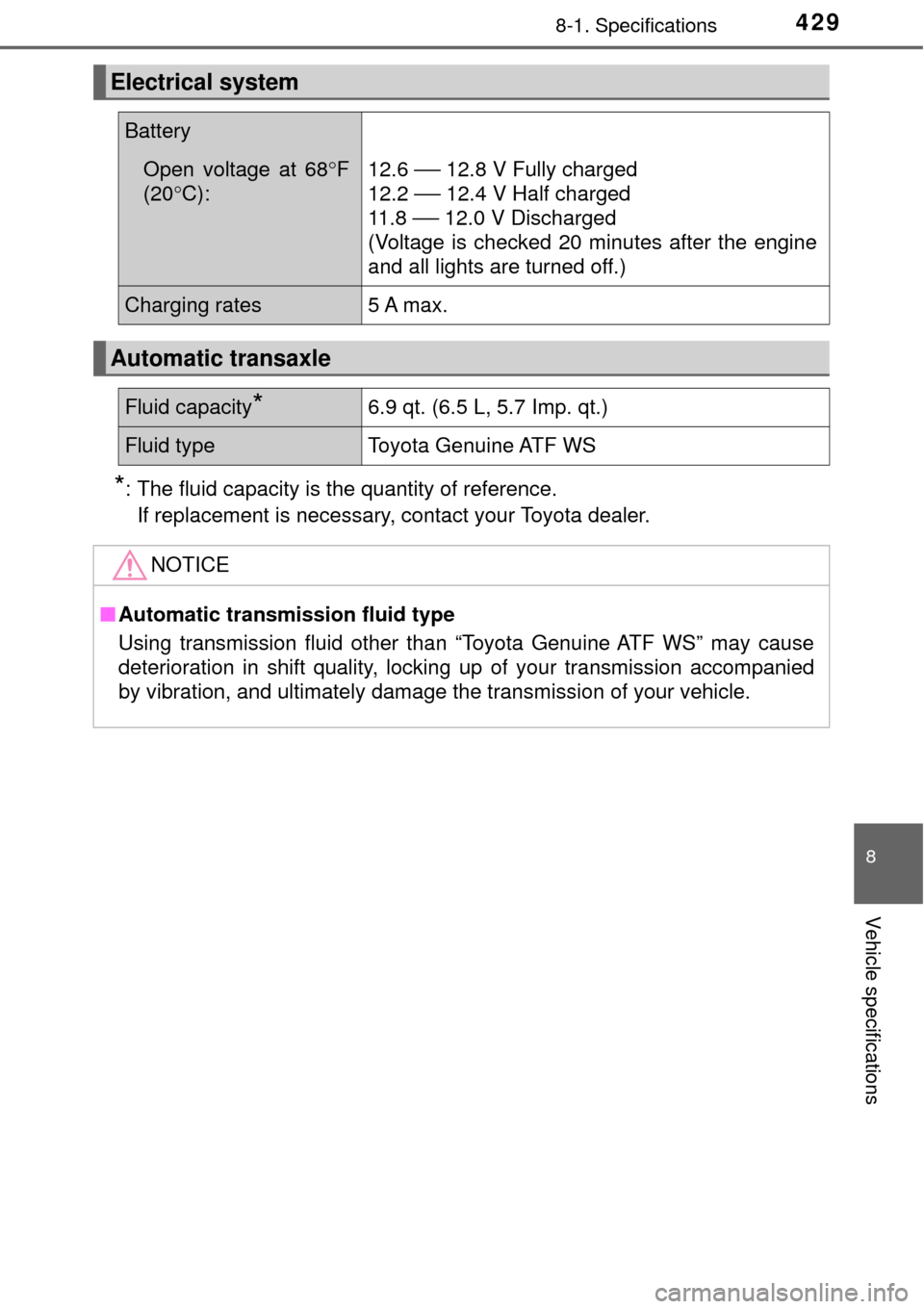
Electrical system
Battery
Open voltage at 68 °F
(20° C): 12.6 ⎯ 12.8 V Fully charged
12.2
⎯ 12.4 V Half charged
11 . 8
⎯ 12.0 V Discharged
(Voltage is checked 20 minutes after the engine
and all lights are turned off.)
Charging rates5 A max.
Automatic transaxle
Fluid capacity*6.9 qt. (6.5 L, 5.7 Imp. qt.)
Fluid typeToyota Genuine ATF WS
NOTICE
■ Automatic transmission fluid type
Using transmission fluid other than “Toyota Genuine ATF WS” may cause
deterioration in shift quality, locking up of your transmission accompanied
by vibration, and ultimately damage the transmission of your vehicle.
Page 430 of 492
4308-1. Specifications
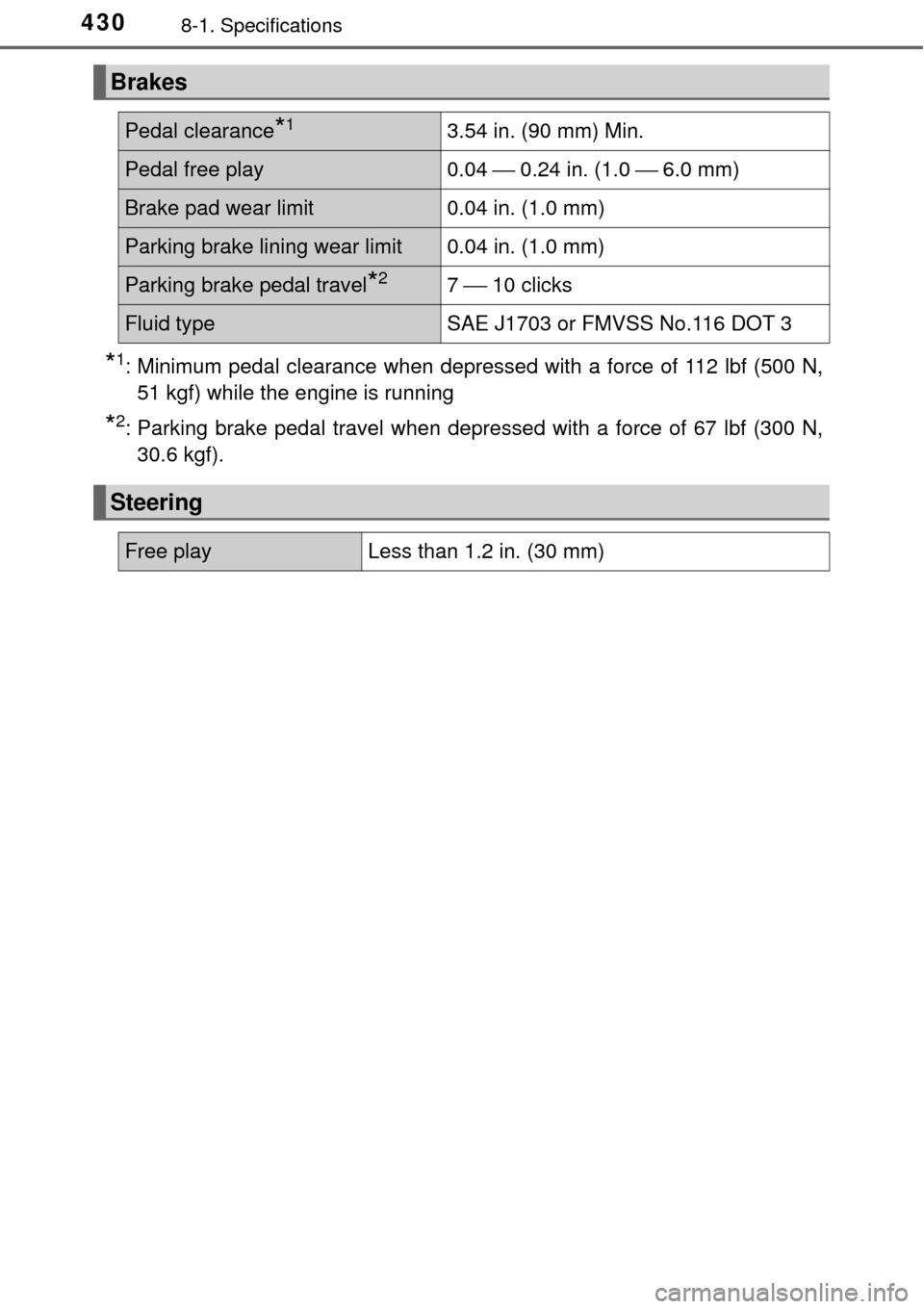
*1: Minimum pedal clearance when depressed with a force of 112 lbf (500 N,51 kgf) while the engine is running
*2: Parking brake pedal travel when depre ssed with a force of 67 lbf (300 N,
30.6 kgf).
Brakes
Pedal clearance*13.54 in. (90 mm) Min.
Pedal free play 0.04 ⎯ 0.24 in. (1.0 ⎯ 6.0 mm)
Brake pad wear limit0.04 in. (1.0 mm)
Parking brake lining wear limit 0.04 in. (1.0 mm)
Parking brake pedal travel*27 ⎯ 10 clicks
Fluid type SAE J1703 or FMVSS No.116 DOT 3
Steering
Free playLess than 1.2 in. (30 mm)
Page 433 of 492
4338-1. Specifications
8
Vehicle specifications
■Gasoline quality
In very few cases, driveability problems may be caused by the brand of gaso-
line you are using. If driveability problems persist, try changing the brand of
gasoline. If this does not correct the problem, consult your Toyota dealer.
■ Gasoline quality standards
●Automotive manufacturers in the U.S.A., Europe and Japan have developed
a specification for fuel quality called the World-Wide Fuel Charter (WWFC),
which is expected to be applied worldwide.
● The WWFC consists of four categor ies that are based on required emission
levels. In the U.S., category 4 has been adopted.
● The WWFC improves air quality by lowering emissions in vehicle fleets, and
improves customer satisfaction through better performance.
Fuel information
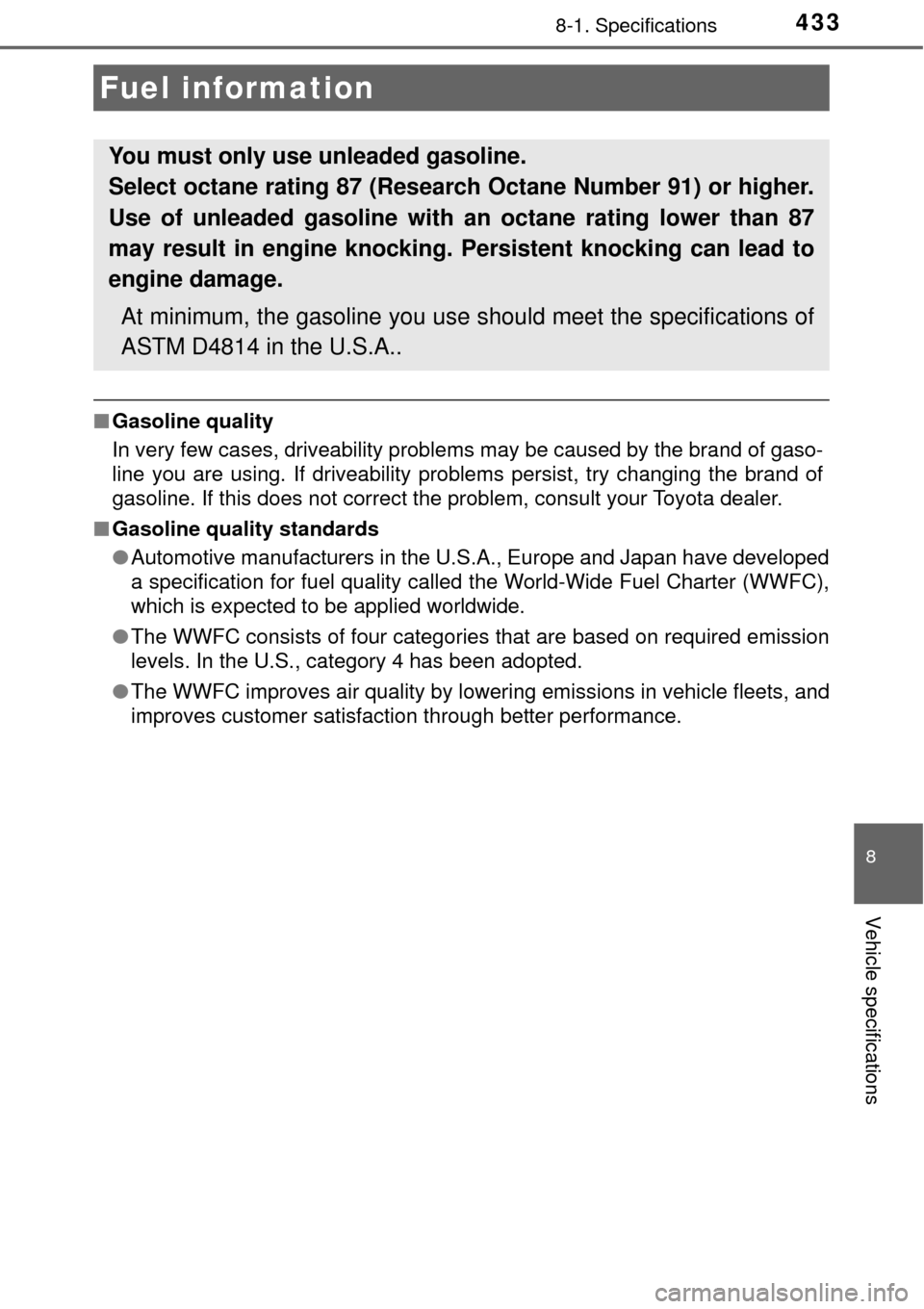
You must only use unleaded gasoline.
Select octane rating 87 (Research Octane Number 91) or higher.
Use of unleaded gasoline with an octane rating lower than 87
may result in engine knocking. Persistent knocking can lead to
engine damage.
At minimum, the gasoline you use s hould meet the specifications of
ASTM D4814 in the U.S.A..
Page 434 of 492
4348-1. Specifications
■Recommendation of the use of gaso line containing detergent additives
● Toyota recommends the use of gasoline that contains detergent additives to
avoid the build-up of engine deposits.
● All gasoline sold in the U.S.A. contains minimum detergent additives to
clean and/or keep clean intake systems, per EPA's lowest additives concen-
tration program.
● Toyota strongly recommends the use of Top Tier Detergent Gasoline. For
more information on Top Tier Detergent Gasoline and a list of marketers,
please go to the official website www.toptiergas.com.
■ Recommendation of the use of low emissions gasoline
Gasolines containing oxygenates such as ethers and ethanol, as well as
reformulated gasolines, are available in some cities. These fuels are typically
acceptable for use, providing they meet other fuel requirements.
Toyota recommends these fuels, since the formulations allow for reduced
vehicle emissions.
■ Non-recommendation of the use of blended gasoline
●If you use gasohol in your vehicle, be sure that it has an octane rating no
lower than 87.
● Toyota does not recommend the use of gasoline containing methanol.
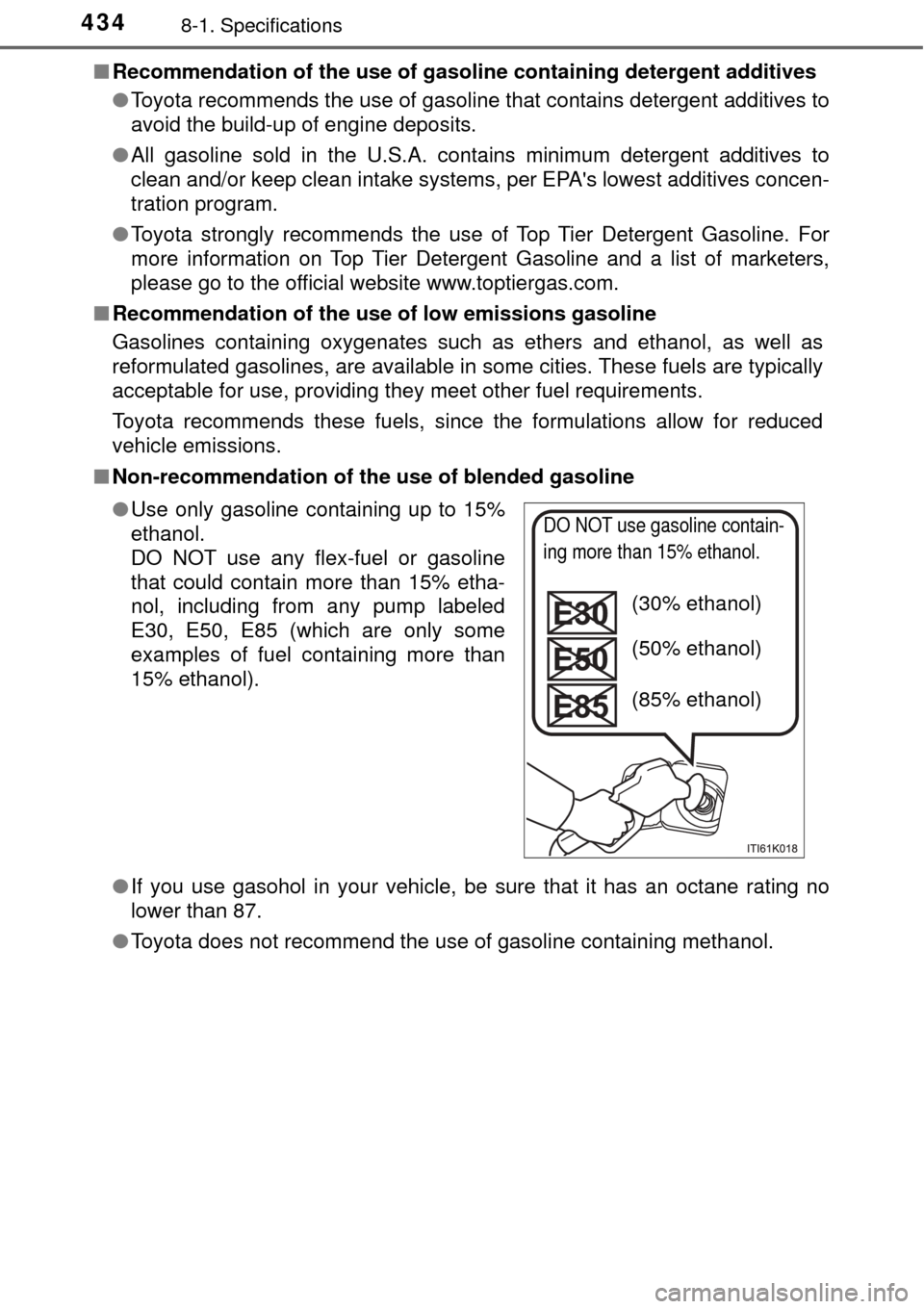
●
Use only gasoline containing up to 15%
ethanol.
DO NOT use any flex-fuel or gasoline
that could contain more than 15% etha-
nol, including from any pump labeled
E30, E50, E85 (which are only some
examples of fuel containing more than
15% ethanol).
DO NOT use gasoline contain-
ing more than 15% ethanol.
(30% ethanol)
(50% ethanol)
(85% ethanol)
Page 435 of 492
4358-1. Specifications
8
Vehicle specifications
■Non-recommendation of the use of gasoline containing MMT
Some gasoline contains an octane enhancing additive called MMT (Methylcy-
clopentadienyl Manganese Tricarbonyl).
Toyota does not recommend the use of gasoline that contains MMT. If fuel
containing MMT is used, your emission control system may be adversely
affected.
The malfunction indicator lamp on the instrument cluster may come on. If this
happens, contact your Toyota dealer for service.
■ If your engine knocks
●Consult your Toyota dealer.
● You may occasionally notice light knocking for a short time while accelerat-
ing or driving uphill. This is normal and there is no need for concern.
NOTICE
■Notice on fuel quality
● Do not use improper fuels. If improper fuels are used, the engine will be
damaged.
● Do not use leaded gasoline.
Leaded gasoline can cause damage to your vehicle’s three-way catalytic
converters causing the emission control system to malfunction.
● Do not use gasohol other than the type previously stated.
Other gasohol may cause fuel system damage or vehicle performance
problems.
● Using unleaded gasoline with an octane number or rating lower than the
level previously stated will cause persistent heavy knocking.
At worst, this will lead to engine damage.
■ Fuel-related poor driveability
If poor driveability (poor hot starting, vaporization, engine knocking, etc.) is
encountered after using a different type of fuel, discontinue the use of that
type of fuel.
■ When refueling with gasohol
Take care not to spill gasohol. It can damage your vehicle’s paint.