fuel pressure TOYOTA AVALON 2018 Owners Manual (in English)
[x] Cancel search | Manufacturer: TOYOTA, Model Year: 2018, Model line: AVALON, Model: TOYOTA AVALON 2018Pages: 492, PDF Size: 7.19 MB
Page 5 of 492

5
1
8 7
6
5
4
3
2
9
6-1. Maintenance and careCleaning and protecting the vehicle exterior .......... 312
Cleaning and protecting the vehicle interior ........... 316
6-2. Maintenance Maintenance requirements ................... 319
General maintenance ........ 321
Emission inspection and maintenance (I/M)
programs ......................... 325
6-3. Do-it-yourself maintenance
Do-it-yourself service precautions ..................... 326
Hood.................................. 328
Positioning a floor jack ...... 329
Engine compartment ......... 330
Tires .................................. 342
Tire inflation pressure........ 352
Wheels .............................. 355
Air conditioning filter .......... 358
Electronic key battery ........ 360
Checking and replacing fuses ............................... 362
Light bulbs ......................... 365 7-1. Essential information
Emergency flashers ........... 380
If your vehicle has to be stopped in
an emergency.................. 381
7-2. Steps to take in an emergency
If your vehicle needs to be towed .......................... 382
If you think something is wrong ........................... 386
Fuel pump shut off system ............................. 387
If a warning light turns on or a warning buzzer
sounds ............................. 388
If a warning message is displayed ......................... 396
If you have a flat tire .......... 397
If the engine will not start ................................. 409
If the electronic key does not operate
properly ........................... 411
If the vehicle battery is discharged ....................... 414
If your vehicle overheats......................... 418
If the vehicle becomes stuck ................................ 421
6Maintenance and care7When trouble arises
Page 15 of 492
15Pictorial index
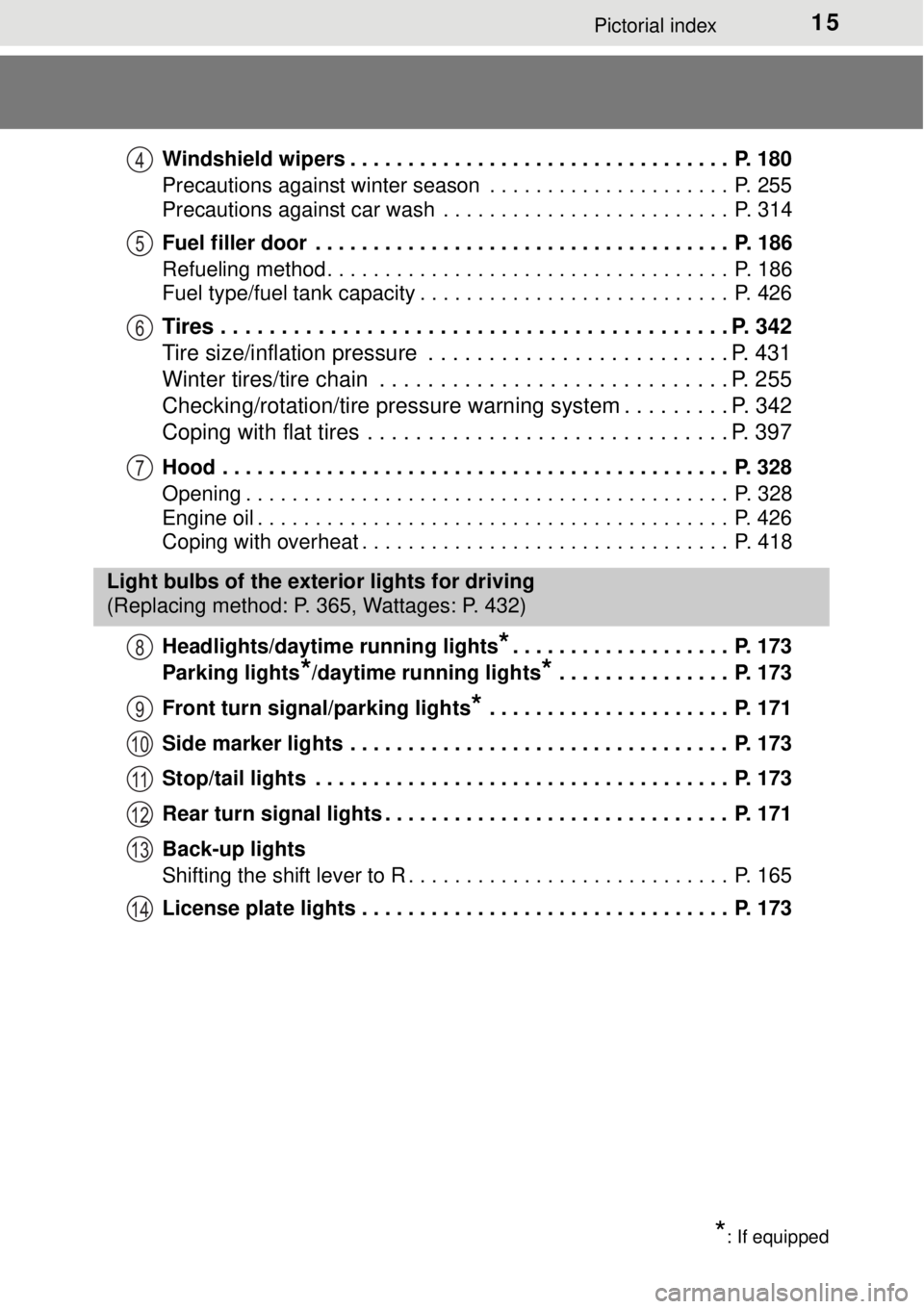
Windshield wipers . . . . . . . . . . . . . . . . . . . . . . . . . . . . . . . . . P. 180
Precautions against winter season . . . . . . . . . . . . . . . . . . . . . P. 255
Precautions against car wash . . . . . . . . . . . . . . . . . . . . . . . . . P. 314
Fuel filler door . . . . . . . . . . . . . . . . . . . . . . . . . . . . . . . . . . . . P. 186
Refueling method . . . . . . . . . . . . . . . . . . . . . . . . . . . . . . . . . . . P. 186
Fuel type/fuel tank capacity . . . . . . . . . . . . . . . . . . . . . . . . . . . P. 426
Tires . . . . . . . . . . . . . . . . . . . . . . . . . . . . . . . . . . . . . . . . . . P. 342
Tire size/inflation pressure . . . . . . . . . . . . . . . . . . . . . . . . . P. 431
Winter tires/tire chain . . . . . . . . . . . . . . . . . . . . . . . . . . . . . P. 255
Checking/rotation/tire pressure warning system . . . . . . . . . P. 342
Coping with flat tires . . . . . . . . . . . . . . . . . . . . . . . . . . . . . . P. 397
Hood . . . . . . . . . . . . . . . . . . . . . . . . . . . . . . . . . . . . . . . . . . . . P. 328
Opening . . . . . . . . . . . . . . . . . . . . . . . . . . . . . . . . . . . . . . . . . . P. 328
Engine oil . . . . . . . . . . . . . . . . . . . . . . . . . . . . . . . . . . . . . . . . . P. 426
Coping with overheat . . . . . . . . . . . . . . . . . . . . . . . . . . . . . . . . P. 418
Headlights/daytime running lights
*. . . . . . . . . . . . . . . . . . . P. 173
Parking lights
*/daytime running lights* . . . . . . . . . . . . . . . P. 173
Front turn signal/parking lights
* . . . . . . . . . . . . . . . . . . . . . P. 171
Side marker lights . . . . . . . . . . . . . . . . . . . . . . . . . . . . . . . . . P. 173
Stop/tail lights . . . . . . . . . . . . . . . . . . . . . . . . . . . . . . . . . . . . P. 173
Rear turn signal lights . . . . . . . . . . . . . . . . . . . . . . . . . . . . . . P. 171
Back-up lights
Shifting the shift lever to R . . . . . . . . . . . . . . . . . . . . . . . . . . . . P. 165
License plate lights . . . . . . . . . . . . . . . . . . . . . . . . . . . . . . . . P. 173
4
5
6
7
Light bulbs of the exter ior lights for driving
(Replacing method: P. 365, Wattages: P. 432)
*: If equipped
8
9
10
11
12
13
14
Page 75 of 492
752. Instrument cluster
2
Instrument cluster
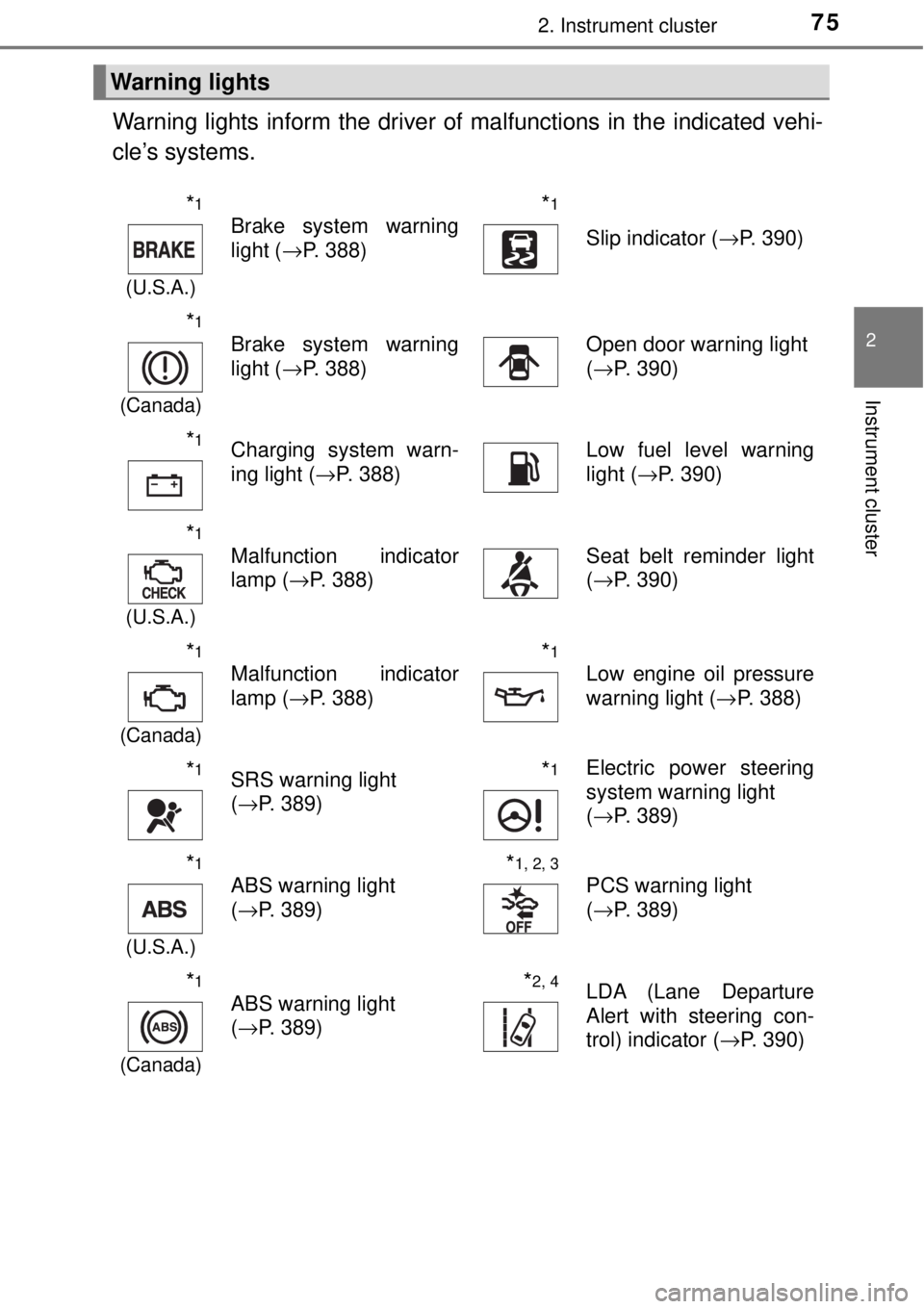
Warning lights inform the driver of malfunctions in the indicated vehi-
cle’s systems.
Warning lights
*1
(U.S.A.)
Brake system warning
light ( →P. 388)*1
Slip indicator ( →P. 390)
*1
(Canada)
Brake system warning
light (→P. 388)Open door warning light
(→P. 390)
*1Charging system warn-
ing light ( →P. 388)Low fuel level warning
light (→P. 390)
*1
(U.S.A.)
Malfunction indicator
lamp ( →P. 388)Seat belt reminder light
(→P. 390)
*1
(Canada)
Malfunction indicator
lamp ( →P. 388)*1
Low engine oil pressure
warning light ( →P. 388)
*1SRS warning light
(→P. 389)*1Electric power steering
system warning light
(→P. 389)
*1
(U.S.A.)
ABS warning light
(→P. 389)*1, 2, 3
PCS warning light
(→P. 389)
*1
(Canada)
ABS warning light
(→P. 389)*2, 4LDA (Lane Departure
Alert with steering con-
trol) indicator ( →P. 390)
Page 82 of 492
822. Instrument cluster
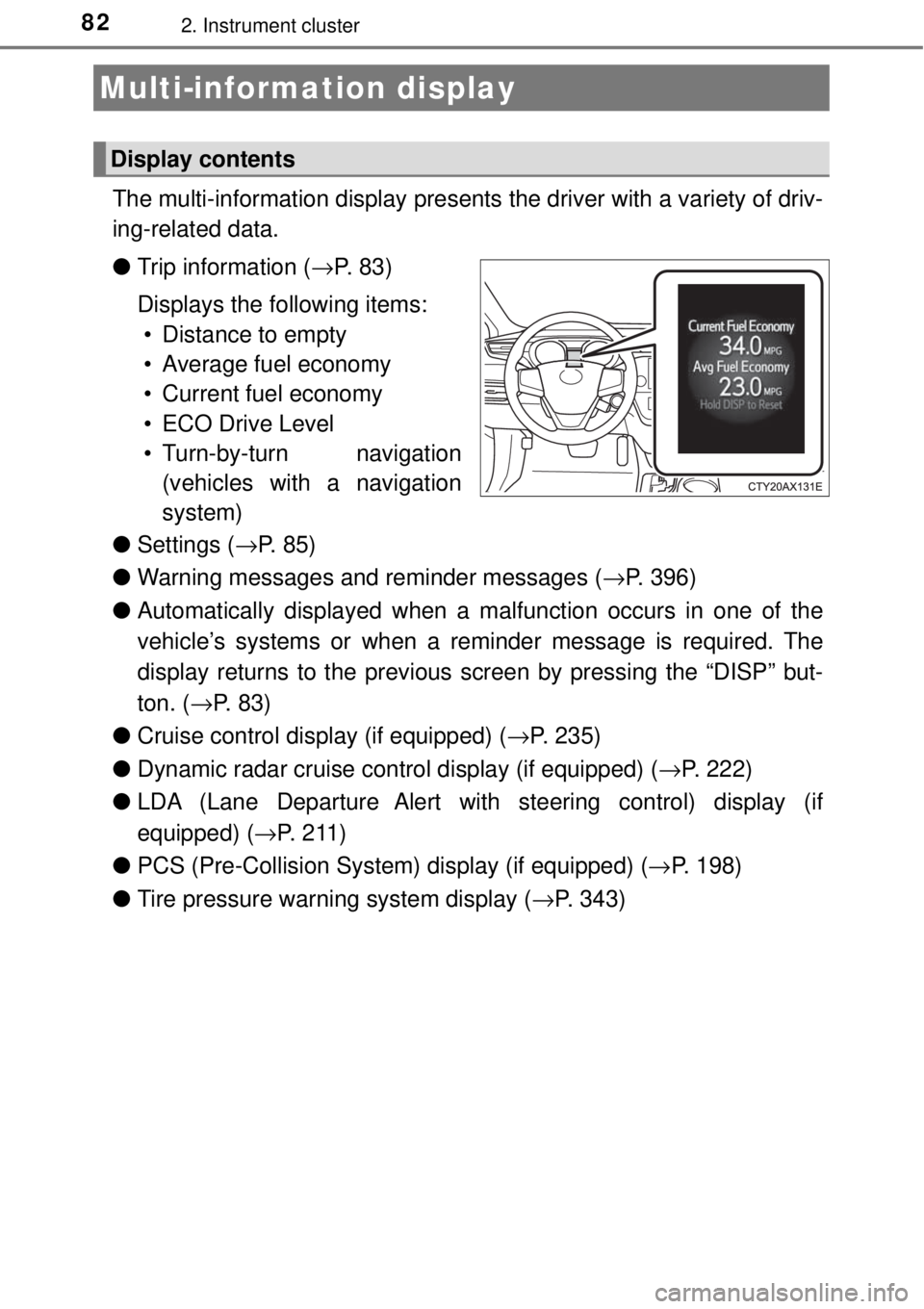
The multi-information display presents the driver with a variety of driv-
ing-related data.
● Trip information ( →P. 8 3 )
Displays the following items: • Distance to empty
• Average fuel economy
• Current fuel economy
• ECO Drive Level
• Turn-by-turn navigation (vehicles with a navigation
system)
● Settings ( →P. 8 5 )
● Warning messages and reminder messages ( →P. 396)
● Automatically displayed when a malfunction occurs in one of the
vehicle’s systems or when a remi nder message is required. The
display returns to the previous screen by pressing the “DISP” but-
ton. ( →P. 8 3 )
● Cruise control display (if equipped) ( →P. 235)
● Dynamic radar cruise control display (if equipped) ( →P. 222)
● LDA (Lane Departure Alert with steering control) display (if
equipped) ( →P. 2 1 1 )
● PCS (Pre-Collision System ) display (if equipped) (→P. 198)
● Tire pressure warning system display ( →P. 343)
Multi-information display
Display contents
Page 266 of 492

2665-1. Using the air conditioning system and defogger
■Operation of the air conditio ning system in Eco drive mode
In Eco drive mode, the air conditioning system is controlled as follows to pri-
oritize fuel efficiency:
● When the outside temperature exceeds 68°F (20°C), the air conditioning
system may switch to recirculated air mode automatically. This may also
reduce fuel consumption.
● It is possible to switch to outside air mode at any time by pressing
.
■Using automatic mode
Fan speed is adjusted automatically according to the temperature setting and
the ambient conditions.
Therefore, the fan may stop for a while until warm or cool air is ready to flow
immediately after is touched.
■ Fogging up of the windows
●The windows will easily fog up when the humidity in the vehicle is high.
Turning on will dehumidify the air from the outlets and defog the wind-
shield effectively.
● If you turn off, the windows may fog up more easily.
● The windows may fog up if the recirculated air mode is used.
■ Outside/recirculated air mode
●When driving on dusty roads such as tunnels or in heavy traffic, set the out-
side/recirculated air mode to the recirculated air mode. This is effective in
preventing outside air from entering the vehicle interior. During cooling oper-
ation, setting the recirculated air mode will also cool the vehicle interior
effectively.
● Outside/recirculated air mode may automatically switch depending on the
temperature setting, outside temperature, pressure, engine coolant tem-
perature or inside temperature.
■ When the outside temperature exceeds 75°F (24°C) and the air condition-
ing system is on (U.S.A. only)
● In order to reduce the air conditioning power consumption, the air condition-
ing system may switch to recirculated air mode automatically. This may also
reduce fuel consumption.
● Recirculated air mode is selected as a default mode when the engine switch
is turned to IGNITION ON mode.
● It is possible to switch to outside air mode at any time by pressing
.
■When the outside temperat ure falls to nearly 32°F (0°C)
The dehumidification function may not operate even when is touched.
Page 312 of 492
3126-1. Maintenance and care
●Working from top to bottom, liber ally apply water to the vehicle
body, wheel wells and underside of the vehicle to remove any dirt
and dust.
● Wash the vehicle body using a sponge or soft cloth, such as a
chamois.
● For hard-to-remove marks, use car wash soap and rinse thoroughly
with water.
● Wipe away any water.
● Wax the vehicle when the wate rproof coating deteriorates.
If water does not bead on a clean surface, apply wax when the vehicle
body is cool.
■Automatic car washes
●Fold the mirrors before washing the vehicle. Start washing from the fron\
t of
the vehicle. Make sure to extend the mirrors before driving.
● Brushes used in automatic car washes may scratch the vehicle surface and
harm your vehicle’s paint.
■ High pressure car washes
●Do not allow the nozzles of the car wash to come within close proximity of
the windows.
● Before using the car wash, check that the fuel filler door on your vehicle is
closed properly.
Cleaning and prot ecting the vehicle
exterior
Perform the following to protect the vehicle and maintain it in
prime condition:
Page 353 of 492
3536-3. Do-it-yourself maintenance
6
Maintenance and care
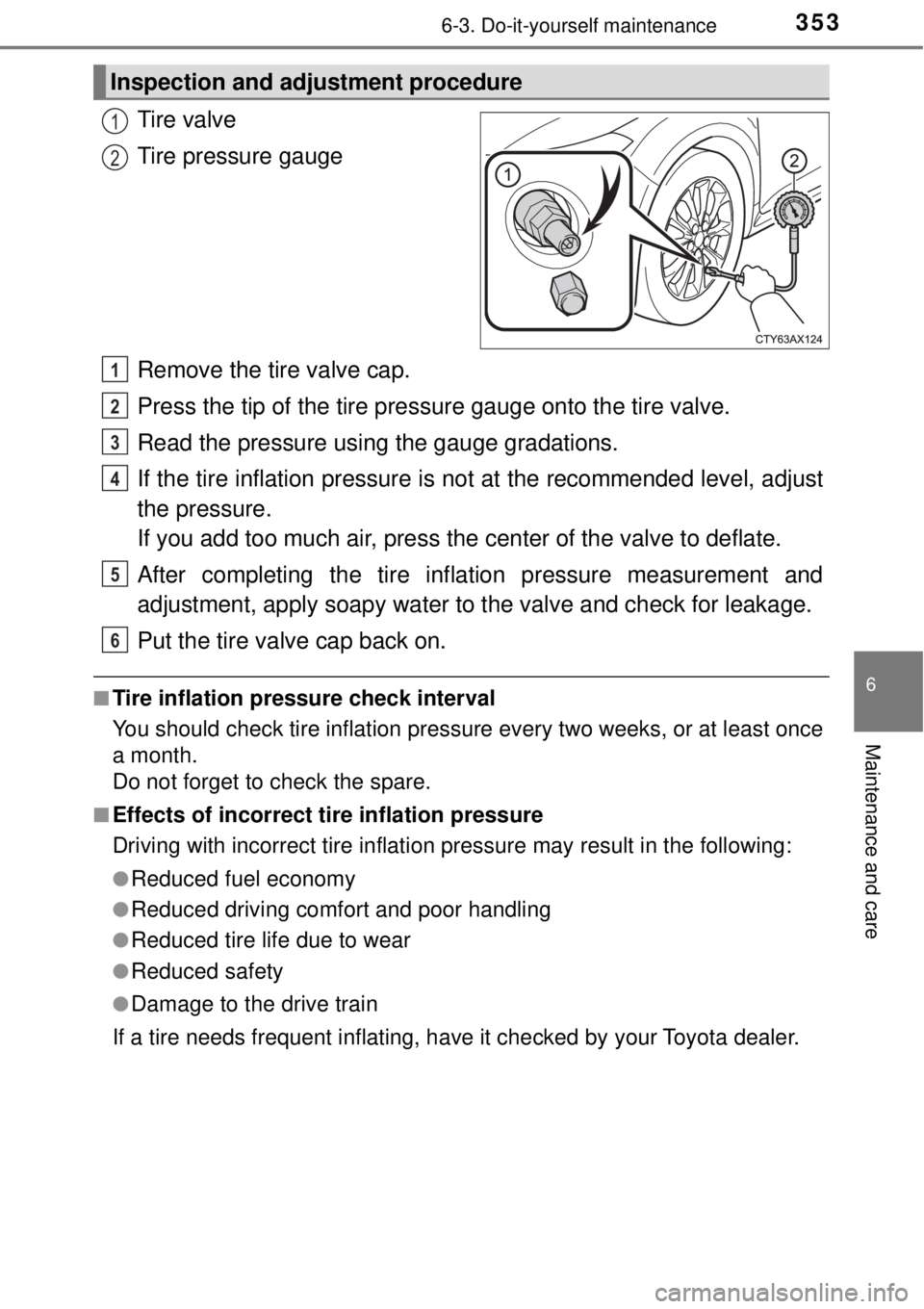
Tire valve
Tire pressure gauge
Remove the tire valve cap.
Press the tip of the tire pressure gauge onto the tire valve.
Read the pressure usi ng the gauge gradations.
If the tire inflation pressure is not at the recommended level, adjust
the pressure.
If you add too much air, press the center of the valve to deflate.
After completing the tire inflation pressure measurement and
adjustment, apply soapy water to the valve and check for leakage.
Put the tire valve cap back on.
■Tire inflation pressure check interval
You should check tire inflation pressure every two weeks, or at least once
a month.
Do not forget to check the spare.
■Effects of incorrect tire inflation pressure
Driving with incorrect tire inflation pressure may result in the following:
●Reduced fuel economy
●Reduced driving comfort and poor handling
●Reduced tire life due to wear
●Reduced safety
●Damage to the drive train
If a tire needs frequent inflating, have it checked by your Toyota dealer.
Inspection and adjustment procedure
1
2
1
2
3
4
5
6
Page 392 of 492

3927-2. Steps to take in an emergency
■SRS warning light
This warning light system monitors the airbag sensor assembly, front impact
sensors, side impact sensors (front door), side impact sensors (front), side
impact sensors (rear), driver’s seat belt buckle switch, front passenger occu-
pant classification system (ECU and sens ors), “AIR BAG ON” indicator light,
“AIR BAG OFF” indicator light, front passenger’s seat belt buckle switch, seat
belt pretensioners (front), airbags, interconnecting wiring and power sources.
( →P. 36)
■ Front passenger detection sensor, seat belt reminder and warning
buzzer
If luggage is placed on the front passenger seat, the front passenger detec-
tion sensor may cause the warning light to flash and the warning buzzer to
sound even if a passenger is not sitting in the seat.
■ If the malfunction indicator la mp comes on while driving
First check the following:
● Is the fuel tank empty?
If it is, fill the fuel tank immediately.
● Is the fuel tank cap loose?
If it is, tighten it securely.
The light will go off after several driving trips.
If the light does not go off even after several trips, contact your Toyota dealer
as soon as possible.
■ Electric power steering system warning light (warning buzzer)
When the battery charge becomes insufficient or the voltage temporarily
drops, the electric power steering system warning light may come on and \
the
warning buzzer may sound.
■
When the tire pressure warning light comes on
Check the tire inflation pressure and adjust to the appropriate level. Push-
ing the tire pressure warning reset switch will not turn off the tire pressure
warning light.
■The tire pressure warning light may come on due to natural causes
The tire pressure warning light may come on due to natural causes such
as natural air leaks and tire inflat ion pressure changes caused by tem-
perature. In this case, adjusting the ti re inflation pressure will turn off the
warning light (afte r a few minutes).
Page 394 of 492

3947-2. Steps to take in an emergency
WARNING
■Maintenance of the tires
Each tire, including the spare (if provided), should be checked monthly
when cold and inflated to the inflation pressure recommended by the
vehicle manufacturer on the vehicle placard or tire inflation pressure
label (tire and load information label). (If your vehicle has tires of a dif-
ferent size than the size indicated on the vehicle placard or tire inflation
pressure label [tire and load information label], you should determine
the proper tire inflation pressure for those tires.)
As an added safety feature, your vehicle has been equipped with a tire
pressure monitoring system (TPMS-ti re pressure warning system) that
illuminates a low tire pre ssure telltale (tire pressure warning light) when
one or more of your tires is significantly under-inflated. Accordingly,
when the low tire pressure telltale (tire pressure warning light) illumi-
nates, you should stop and check your tires as soon as possible, and
inflate them to the proper pressure. Driving on a significantly under-
inflated tire causes the tire to overheat and can lead to tire failure.
Under-inflation also reduces fuel effi ciency and tire tread life, and may
affect the vehicle’s hand ling and stopping ability.
Please note that the TPMS (tire pressure warning system) is not a sub-
stitute for proper ti re maintenance, and it is the driver’s responsibility to
maintain correct tire pressure, even if under-inflation has not reached
the level to trigger illumination of the TPMS low tire pressure telltale (tire
pressure warning light).
Your vehicle has also been equipped with a TPMS (tire pressure warn-
ing system) malfunction indicator to indicate when the system is not
operating properly. The TPMS (tire pressure warning system) malfunc-
tion indicator is combined with the lo w tire pressure telltale (tire pressure
warning light). When the system detects a malfunction, the telltale will
flash for approximately one minute and then remain continuously illumi-
nated. This sequence w ill continue upon subsequ ent vehicle start-ups
as long as the malfunction exists. When the malfunction indicator is illu-
minated, the system may not be able to detect or signal low tire pres-
sure as intended.
Page 443 of 492
4438-1. Specifications
8
Vehicle specifications
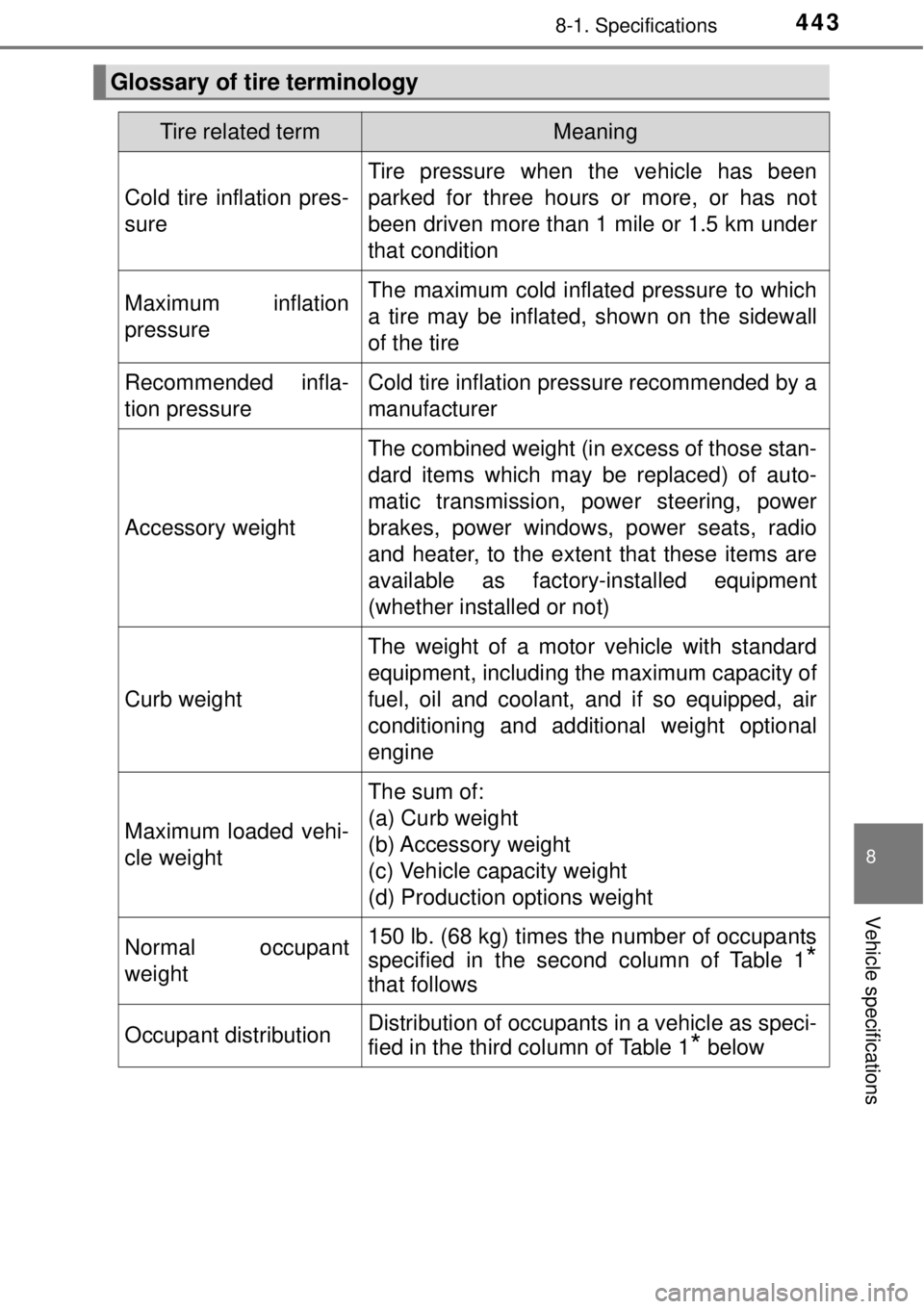
Glossary of tire terminology
Tire related termMeaning
Cold tire inflation pres-
sure
Tire pressure when the vehicle has been
parked for three hours or more, or has not
been driven more than 1 mile or 1.5 km under
that condition
Maximum inflation
pressureThe maximum cold inflated pressure to which
a tire may be inflated, shown on the sidewall
of the tire
Recommended infla-
tion pressureCold tire inflation pressure recommended by a
manufacturer
Accessory weight
The combined weight (in excess of those stan-
dard items which may be replaced) of auto-
matic transmission, power steering, power
brakes, power windows, power seats, radio
and heater, to the extent that these items are
available as factory-installed equipment
(whether installed or not)
Curb weight
The weight of a motor vehicle with standard
equipment, including the maximum capacity of
fuel, oil and coolant, and if so equipped, air
conditioning and additional weight optional
engine
Maximum loaded vehi-
cle weight
The sum of:
(a) Curb weight
(b) Accessory weight
(c) Vehicle capacity weight
(d) Production options weight
Normal occupant
weight150 lb. (68 kg) times the number of occupants
specified in the second column of Table 1
*
that follows
Occupant distributionDistribution of occupants in a vehicle as speci-
fied in the third column of Table 1
* below