warning TOYOTA AVALON 2022 Owners Manual
[x] Cancel search | Manufacturer: TOYOTA, Model Year: 2022, Model line: AVALON, Model: TOYOTA AVALON 2022Pages: 572, PDF Size: 9.42 MB
Page 431 of 572
4316-3. Do-it-yourself maintenance
6
Maintenance and care
When replacing wheels, care should be taken to ensure that they are
equivalent to those removed in load capacity, diameter, rim wid th and
inset
*.
Replacement wheels are available at your Toyota dealer.
*: Conventionally referred to as “offset”.
Toyota does not recommend using the following:
● Wheels of different sizes or types
● Used wheels
● Bent wheels that hav e been straightened
● Use only Toyota wheel nuts and wrenches designed for use with
your aluminum wheels.
● When rotating, repairing or changi ng your tires, check that the
wheel nuts are still tight afte r driving 1000 miles (1600 km).
● Be careful not to damage the aluminum wheels when using tire
chains.
● Use only Toyota genuine balance we ights or equivalent and a plas-
tic or rubber hammer when balancing your wheels.
■When replacing wheels
The wheels of your vehicle are equipped with tire pressure warn ing valve
and transmitters that allow the tire pressure warning system to provide
advance warning in the event of a loss in tire inflation pressu re. When-
ever wheels are replaced, tire pressure warning valve and trans mitters
must be installed. ( P. 416)
Wheels
If a wheel is bent, cracked or heavily corroded, it should be
replaced. Otherwise, the tire may separate from the wheel or
cause a loss of handling control.
Wheel selection
Aluminum wheel precautions
Page 432 of 572
4326-3. Do-it-yourself maintenance
WARNING
■When replacing wheels
●Do not use wheels that are a different size from those recommended in
the Owner’s Manual, as this may result in a loss of handling control.
●Never use an inner tube in a leaking wheel which is designed fo r a
tubeless tire. Doing so may result in an accident, causing death or seri-
ous injury.
■When installing the wheel nuts
●Be sure to install the wheel nuts with the tapered ends facing inward.
( P. 478) Installing the nuts with the tapered ends facing outwar d can
cause the wheel to break and eventually cause the wheel to come off
while driving, which could lead to an accident resulting in dea th or seri-
ous injury.
●Never use oil or grease on the wheel bolts or wheel nuts.
Oil and grease may cause the wheel nuts to be excessively tightened,
leading to bolt or disc wheel damage. In addition, the oil or g rease can
cause the wheel nuts to loosen and the wheel may fall off, causing an
accident and resulting in death or serious injury. Remove any o il or
grease from the wheel bolts or wheel nuts.
NOTICE
■Replacing tire pressure warning valve and transmitters
●Because tire repair or replacement may affect the tire pressure warn-
ing valve and transmitters, make sure to have tires serviced by your
Toyota dealer or other qualified service sh op. In addition, make sure to
purchase your tire pressure warning valve and transmitters at y our
Toyota dealer.
●Ensure that only genuine Toyota wheels are used on your vehicle .
Tire pressure warning valve and transmitters may not work prope rly
with non-genuine wheels.
Page 436 of 572
4366-3. Do-it-yourself maintenance
Operate the or switch and check that the doors can
be locked/unlocked.
■When replacing the key battery
Be careful not to lose the battery or any other small parts.
■ Use a CR2032 lithium battery
●Batteries can be purchased at your Toyota dealer, local electrical appliance
shops or camera stores.
● Replace only with the same or equivalent type recommended by the manu-
facturer.
● Dispose of used batteries according to local laws.
■ If the key battery is depleted
The following symptoms may occur:
●The smart key system and wireless remote control will not funct ion properly.
● The operational range will be reduced.
WARNING
■ Battery precautions
Observe the following precautions.
Failure to do so may result in death or serious injury.
● Do not swallow the battery. Doing so may cause chemical burns.
● A coin battery or button battery is used in the electronic key. If a battery is
swallowed, it may cause severe chemical burns in as little as 2 hours and
may result in death or serious injury.
● Keep away new and removed batteries from children.
● If the cover cannot be firmly closed, stop using the electronic key and stow
the key in the place where children cannot reach, and then contact your
Toyota dealer.
● If you accidentally swallow a battery or put a battery into a part of your
body, get emergency medical attention immediately.
■ To prevent battery explosion or leakage of flammable liquid or gas
● Replace the battery with a new battery of the same type. If a w rong type of
battery is used, it may explode.
● Do not expose batteries to extremely low pressure due to high altitude or
extremely high temperatures.
● Do not burn, break or cut a battery.
5
Page 440 of 572
4406-3. Do-it-yourself maintenance
■After a fuse is replaced
●If the lights do not turn on even after the fuse has been repla ced, a bulb may
need replacement. ( P. 441)
● If the replaced fuse blows again, have the vehicle inspected by your Toyota
dealer.
■ If there is an overload in a circuit
The fuses are designed to blow, protecting the wiring harness from damage.
WARNING
■ To prevent system breakdowns and vehicle fire
Observe the following precautions.
Failure to do so may cause damage to the vehicle, and possibly a fire or
injury.
● Never use a fuse of a higher amperage rating than that indicate d, or use
any other object in place of a fuse.
● Always use a genuine Toyota fuse or equivalent.
Never replace a fuse with a wire, even as a temporary fix.
● Do not modify the fuses or fuse boxes.
NOTICE
■Before replacing fuses
Have the cause of electrical overload determined and repaired b y your
Toyota dealer as soon as possible.
Page 443 of 572

443
7When trouble arises
7-1. Essential informationEmergency flashers .......... 444
If your vehicle has to be stopped in
an emergency ................. 445
If the vehicle is submerged or water on the road is
rising ............................... 446
7-2. Steps to take in an emergency
If your vehicle needs to be towed ..................... 448
If you think something is wrong .......................... 453
Fuel pump shut off system ............................ 454
If a warning light turns on or a warning
buzzer sounds ................ 455
If a warning message is displayed ..................... 465
If you have a flat tire.......... 470
If the engine will not start ................................. 482
If the electronic key does not operate properly........ 484
If the vehicle battery is discharged ................... 487
If your vehicle overheats ........................ 492
If the vehicle becomes stuck ............................... 495
Page 445 of 572
4457-1. Essential information
7
When trouble arises
Steadily step on the brake pedal with both feet and firmly depress it.
Do not pump the brake pedal repeatedly as this will increase th e effort
required to slow the vehicle.
Shift the shift lever to N.
If the shift lever is shifted to N
After slowing down, stop the vehi cle in a safe place by the road.
Stop the engine.
If the shift lever cann ot be shifted to N
Keep depressing the brake pedal with both feet to reduce vehicl e
speed as much as possible.
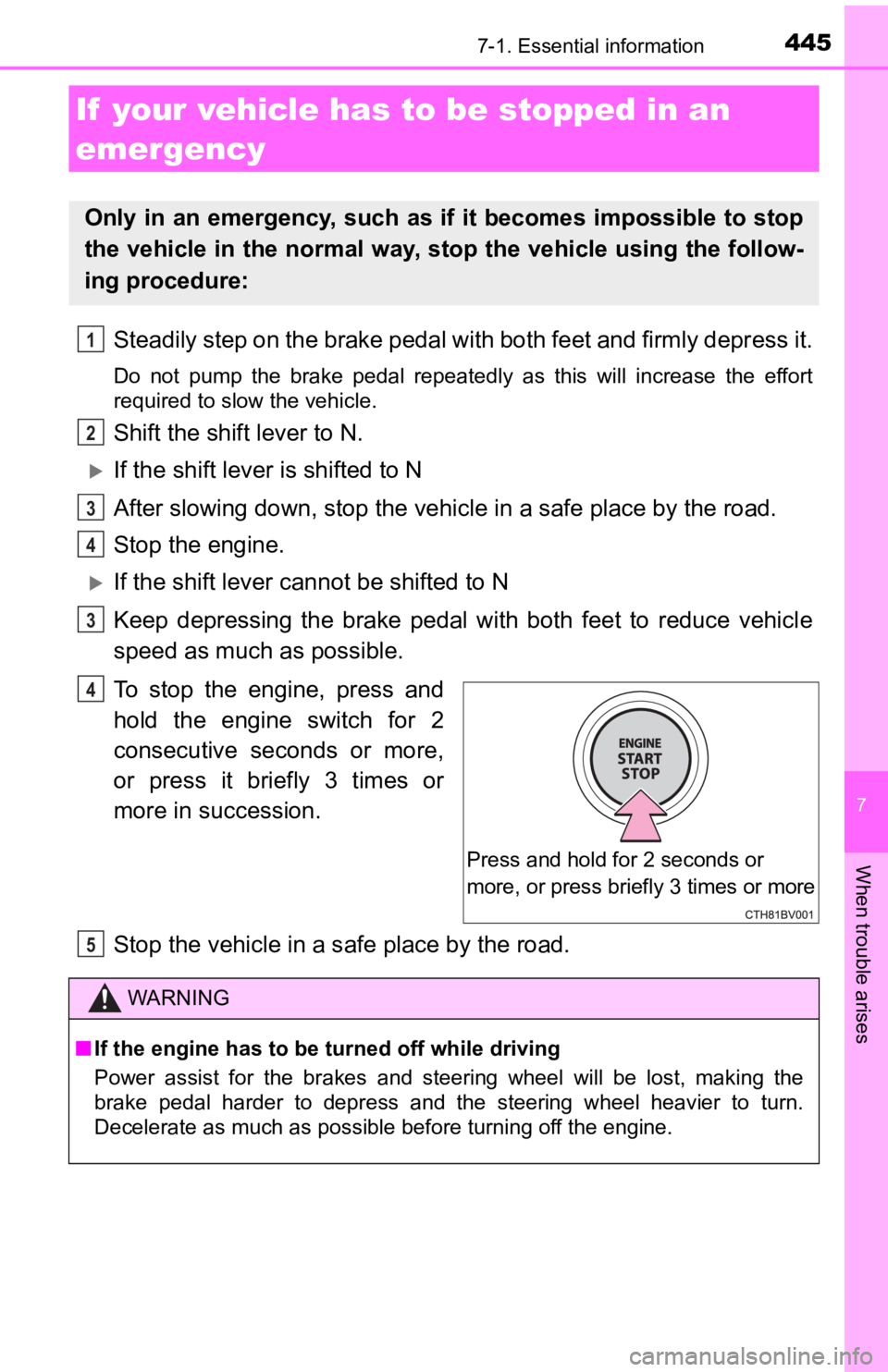
To stop the engine, press and
hold the engine switch for 2
consecutive seconds or more,
or press it briefly 3 times or
more in succession.
Stop the vehicle in a s afe place by the road.
If your vehicle has to be stopped in an
emergency
Only in an emergency, such as if it becomes impossible to stop
the vehicle in the normal way, st op the vehicle using the follow-
ing procedure:
1
2
3
4
3
Press and hold for 2 seconds or
more, or press briefly 3 times or more
4
WARNING
■ If the engine has to be turned off while driving
Power assist for the brakes and steering wheel will be lost, making the
brake pedal harder to depress and the steering wheel heavier to turn.
Decelerate as much as possible before turning off the engine.
5
Page 447 of 572
4477-1. Essential information
7
When trouble arises
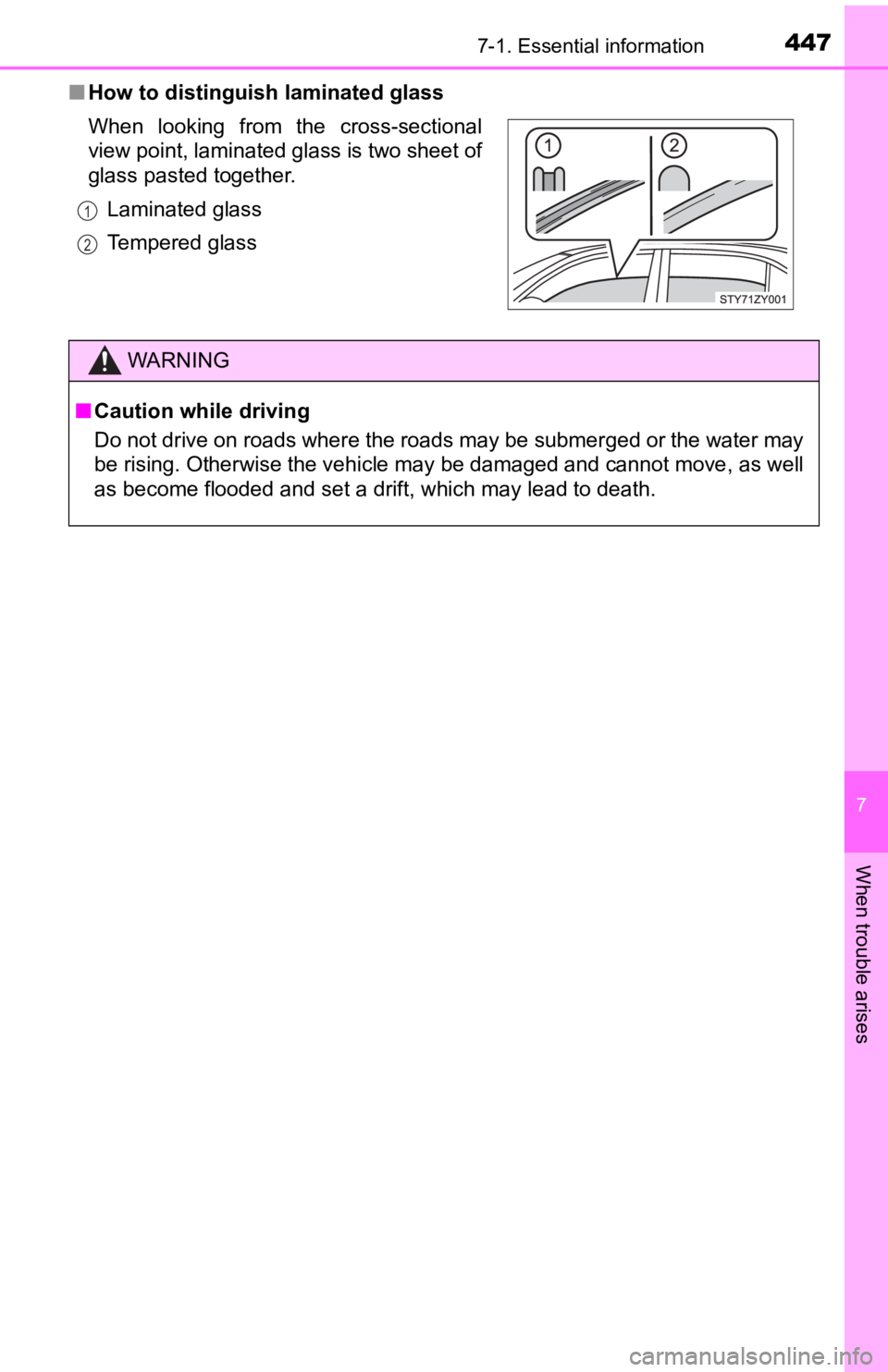
■How to distinguish laminated glass
When looking from the cross-sectional
view point, laminated glass is two sheet of
glass pasted together.
Laminated glass
Tempered glass
WARNING
■Caution while driving
Do not drive on roads where the roads may be submerged or the w ater may
be rising. Otherwise the vehicle may be damaged and cannot move, as well
as become flooded and set a drift, which may lead to death.
1
2
Page 449 of 572
4497-2. Steps to take in an emergency
7
When trouble arises
WARNING
Observe the following precautions.
Failure to do so may result in death or serious injury.
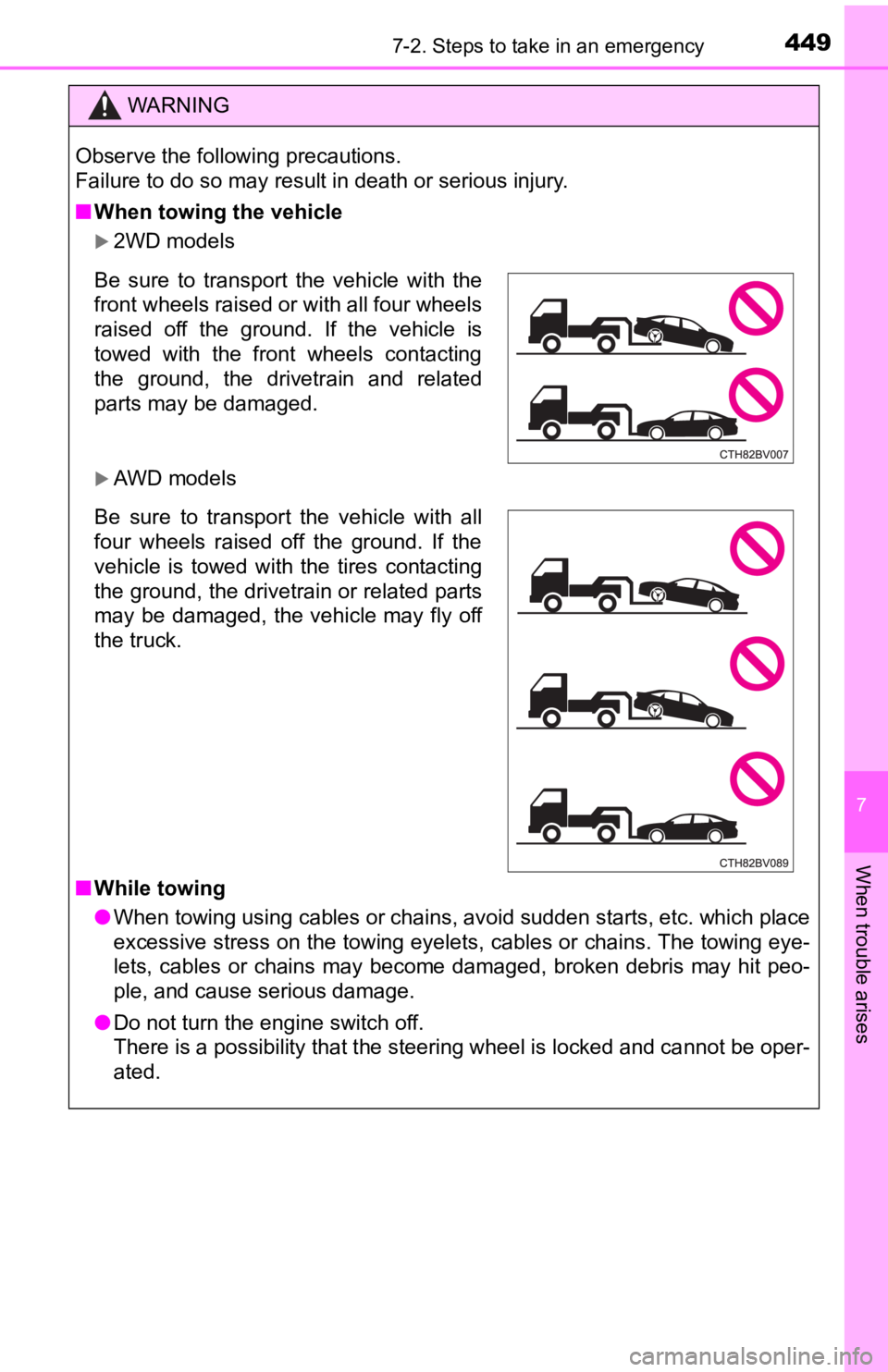
■When towing the vehicle
2WD models
AWD models
■ While towing
● When towing using cables or chains, avoid sudden starts, etc. w hich place
excessive stress on the towing eyelets, cables or chains. The t owing eye-
lets, cables or chains may become damaged, broken debris may hit peo-
ple, and cause serious damage.
● Do not turn the engine switch off.
There is a possibility that the steering wheel is locked and ca nnot be oper-
ated.
Be sure to transport the vehicle with the
front wheels raised or with all four wheels
raised off the ground. If the vehicle is
towed with the front wheels contacting
the ground, the drivetrain and related
parts may be damaged.
Be sure to transport the vehicle with all
four wheels raised off the ground. If the
vehicle is towed with the tires contacting
the ground, the drivetrain or related parts
may be damaged, the vehicle may fly off
the truck.
Page 455 of 572
4557-2. Steps to take in an emergency
7
When trouble arises
If a warning light turns on or a war ning
buzzer sounds
Calmly perform the following actions if any of the warning ligh ts
comes on or flashes. If a light comes on or flashes, but then
goes off, this does not necessarily indicate a malfunction in the
system. However, if this continues to occur, have the vehicle
inspected by your Toyota dealer.
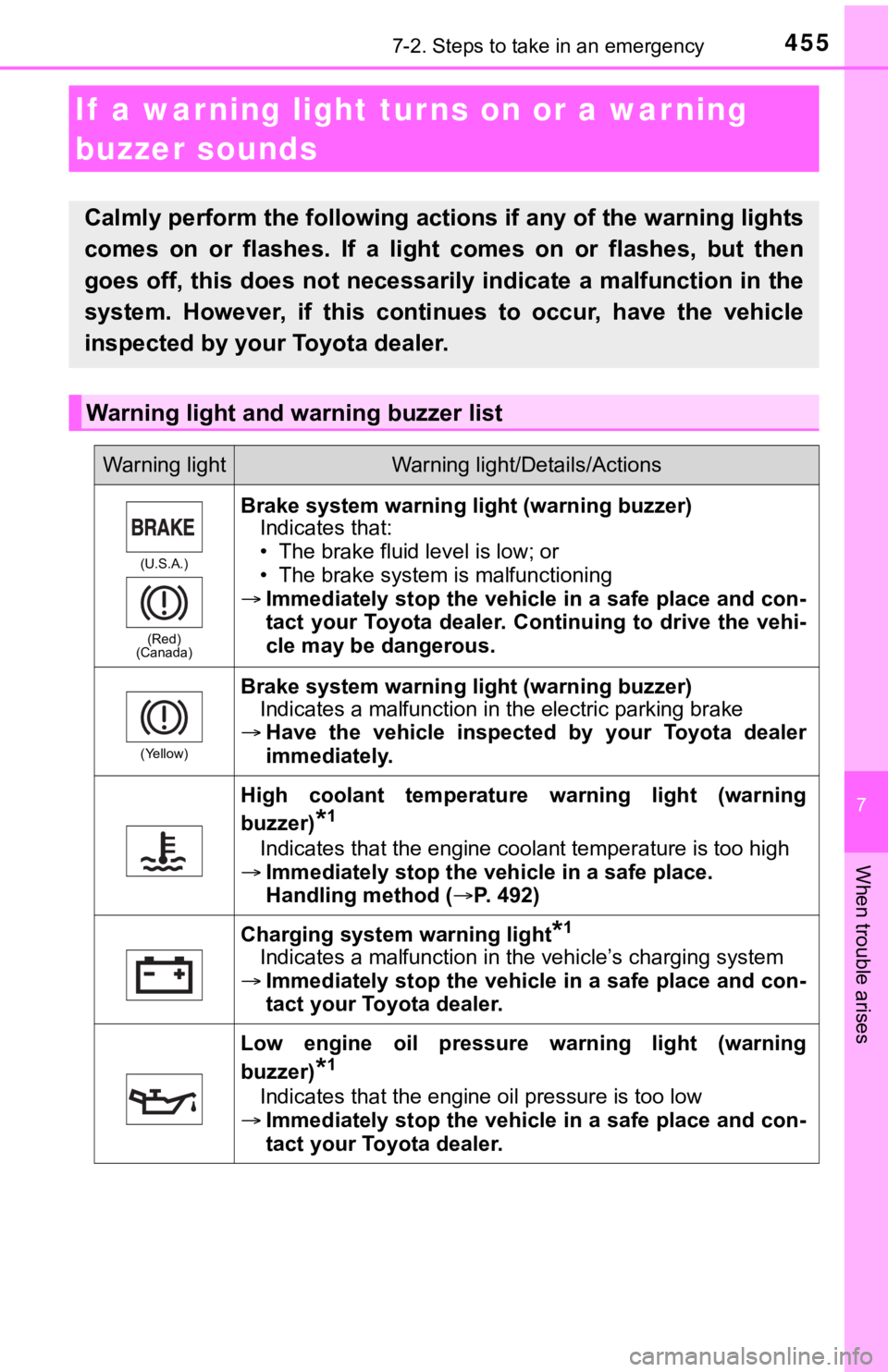
Warning light and w arning buzzer list
Warning lightWarning light/Details/Actions
(U.S.A.)
(Red)
(Canada)
Brake system warning li ght (warning buzzer)
Indicates that:
• The brake fluid level is low; or
• The brake system is malfunctioning
Immediately stop the vehicle in a safe place and con-
tact your Toyota dealer. Continuing to drive the vehi-
cle may be dangerous.
(Yellow)
Brake system warning li ght (warning buzzer)
Indicates a malfunction in the electric parking brake
Have the vehicle inspected by your Toyota dealer
immediately.
High coolant temperature warning light (warning
buzzer)
*1
Indicates that the engine coolant temperature is too high
Immediately stop the vehicle in a safe place.
Handling method ( P. 492)
Charging system warning light*1
Indicates a malfunction in the vehicle’s charging system
Immediately stop the vehicle in a safe place and con-
tact your Toyota dealer.
Low engine oil pressure warning light (warning
buzzer)
*1
Indicates that the engine oil pressure is too low
Immediately stop the vehicle in a safe place and con-
tact your Toyota dealer.
Page 456 of 572
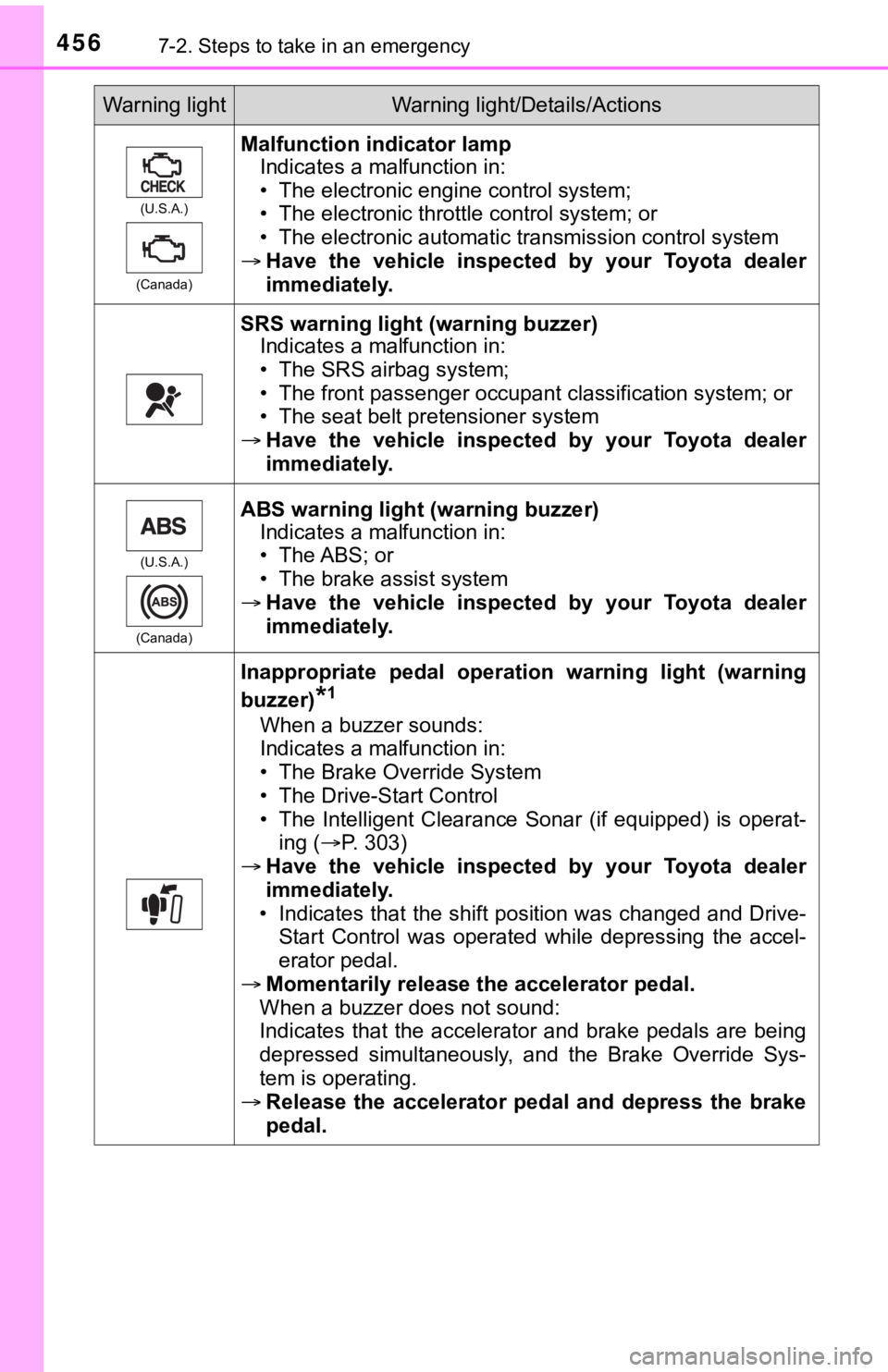
4567-2. Steps to take in an emergency
(U.S.A.)
(Canada)
Malfunction indicator lamp Indicates a malfunction in:
• The electronic engine control system;
• The electronic throttle control system; or
• The electronic automatic transmission control system
Have the vehicle inspected by your Toyota dealer
immediately.
SRS warning light (warning buzzer)
Indicates a malfunction in:
• The SRS airbag system;
• The front passenger occupant classification system; or
• The seat belt pretensioner system
Have the vehicle inspected by your Toyota dealer
immediately.
(U.S.A.)
(Canada)
ABS warning light (warning buzzer) Indicates a malfunction in:
• The ABS; or
• The brake assist system
Have the vehicle inspected by your Toyota dealer
immediately.
Inappropriate pedal operation warning light (warning
buzzer)
*1
When a buzzer sounds:
Indicates a malfunction in:
• The Brake Override System
• The Drive-Start Control
• The Intelligent Clearance Sonar (if equipped) is operat-
ing ( P. 303)
Have the vehicle inspected by your Toyota dealer
immediately.
• Indicates that the shift position was changed and Drive- Start Control was operated while depressing the accel-
erator pedal.
Momentarily release th e accelerator pedal.
When a buzzer does not sound:
Indicates that the accelerator and brake pedals are being
depressed simultaneously, and the Brake Override Sys-
tem is operating.
Release the accelerator pedal and depress the brake
pedal.
Warning lightWarning light/Details/Actions