suspension TOYOTA AVALON 2022 User Guide
[x] Cancel search | Manufacturer: TOYOTA, Model Year: 2022, Model line: AVALON, Model: TOYOTA AVALON 2022Pages: 572, PDF Size: 9.42 MB
Page 324 of 572
3244-5. Using the driving support systems
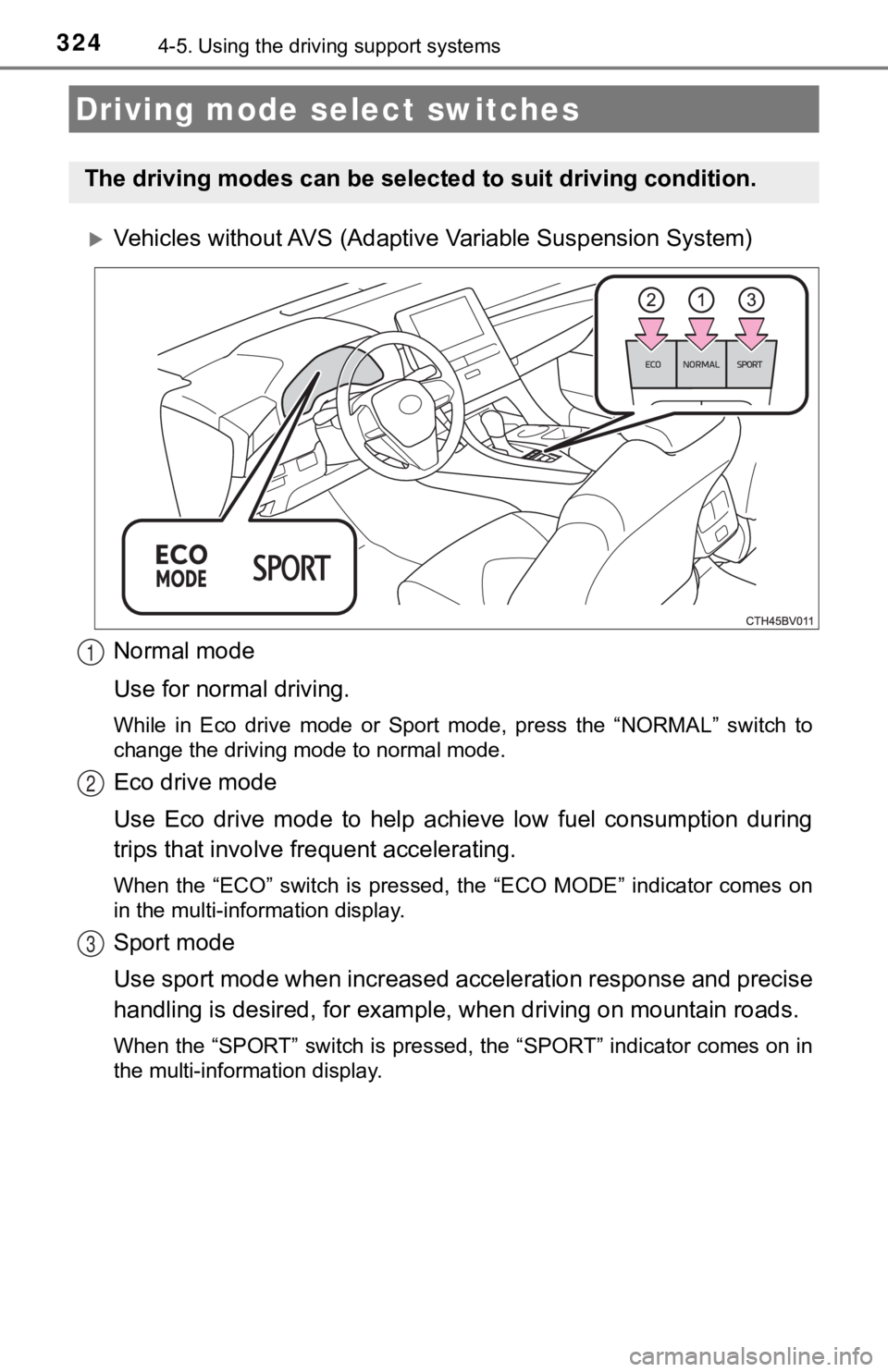
Vehicles without AVS (Adaptive Variable Suspension System)
Normal mode
Use for normal driving.
While in Eco drive mode or Sport mode, press the “NORMAL” switch to
change the driving mode to normal mode.
Eco drive mode
Use Eco drive mode to help achieve low fuel consumption during
trips that involve frequent accelerating.
When the “ECO” switch is pressed, the “ECO MODE” indicator comes on
in the multi-information display.
Sport mode
Use sport mode when increased acceleration response and precise
handling is desired, for exampl e, when driving on mountain road s.
When the “SPORT” switch is pressed, the “SPORT” indicator comes on in
the multi-information display.
Driving mode select switches
The driving modes can be select ed to suit driving condition.
1
2
3
Page 325 of 572
3254-5. Using the driving support systems
4
Driving
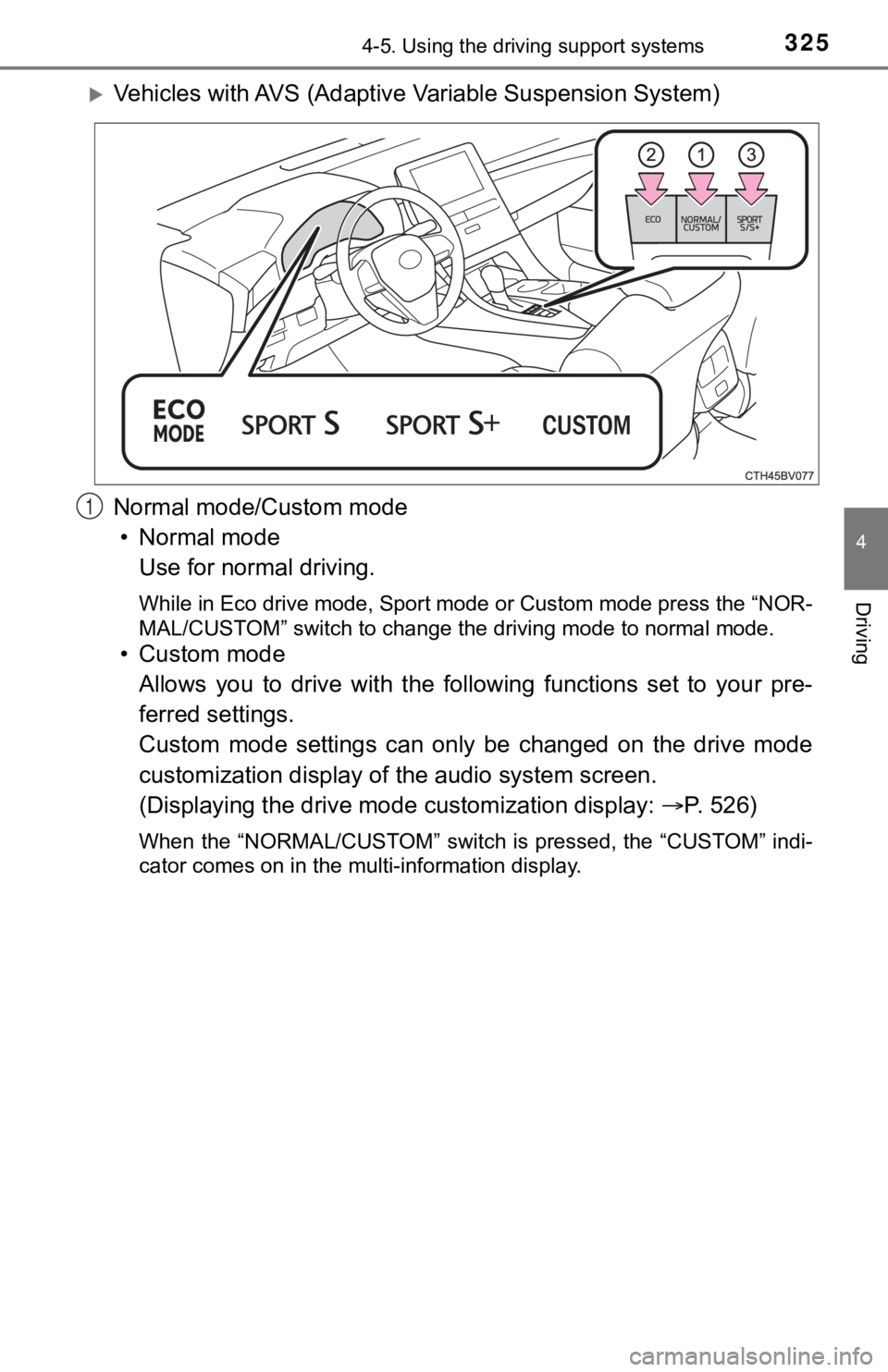
Vehicles with AVS (Adaptive Variable Suspension System)
Normal mode/Custom mode • Normal mode Use for normal driving.
While in Eco drive mode, Sport mode or Custom mode press the “N OR-
MAL/CUSTOM” switch to change the driving mode to normal mode.
• Custom mode
Allows you to drive with the following functions set to your pr e-
ferred settings.
Custom mode settings can only be changed on the drive mode
customization display of the audio system screen.
(Displaying the drive mode customization display: P. 5 2 6 )
When the “NORMAL/CUSTOM” switch is pressed, the “CUSTOM” indi-
cator comes on in the multi-information display.
1
Page 326 of 572
3264-5. Using the driving support systems
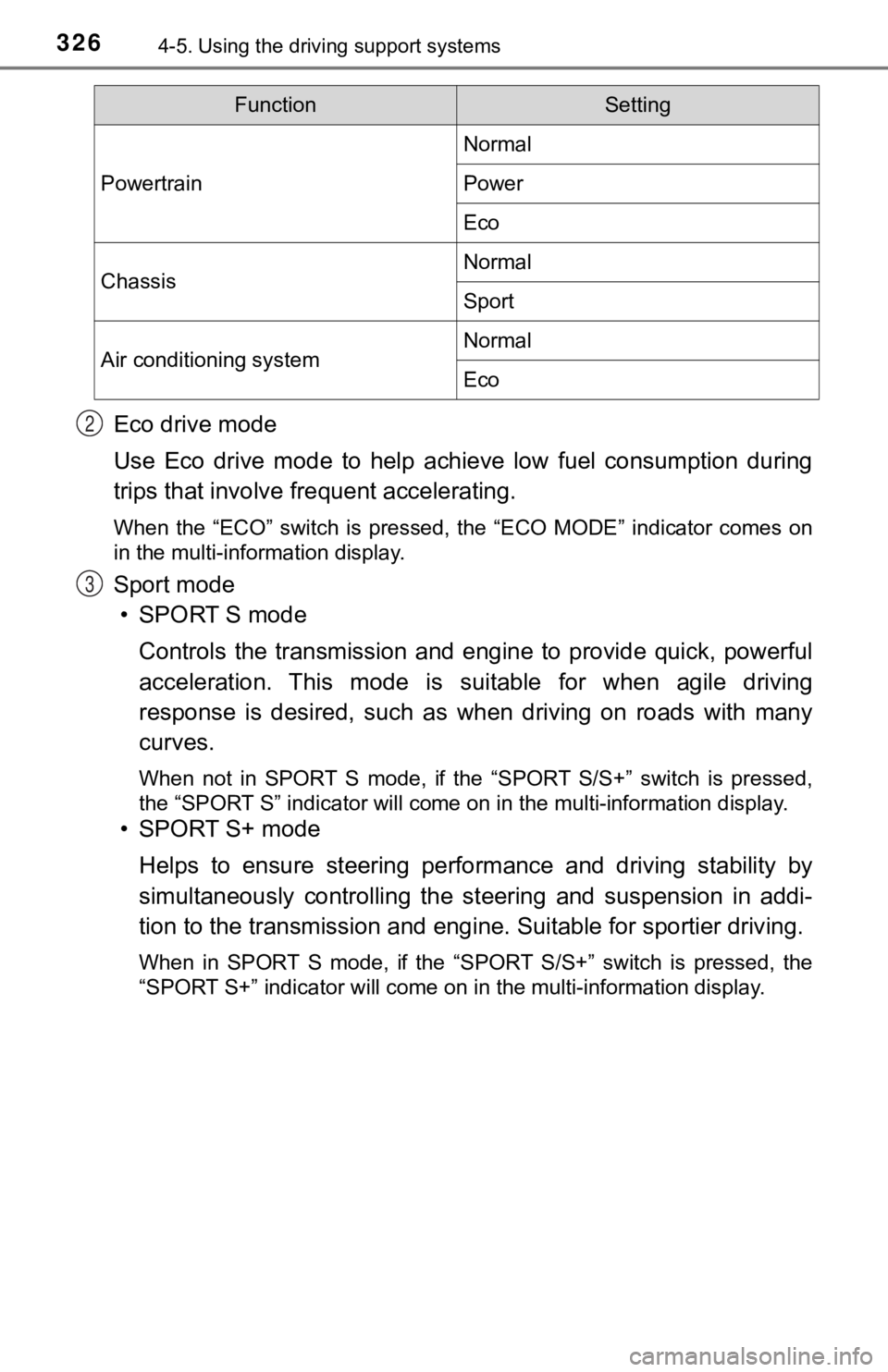
Eco drive mode
Use Eco drive mode to help achieve low fuel consumption during
trips that involve frequent accelerating.
When the “ECO” switch is pressed, the “ECO MODE” indicator comes on
in the multi-information display.
Sport mode
• SPORT S mode
Controls the transmission and eng ine to provide quick, powerful
acceleration. This mode is suitable for when agile driving
response is desired, such as when driving on roads with many
curves.
When not in SPORT S mode, if the “SPORT S/S+” switch is pressed ,
the “SPORT S” indicator will come on in the multi-information d isplay.
• SPORT S+ mode
Helps to ensure steering perfo rmance and driving stability by
simultaneously controlling the steering and suspension in addi-
tion to the transmission and engi ne. Suitable for sportier driving.
When in SPORT S mode, if the “SPORT S/S+” switch is pressed, th e
“SPORT S+” indicator will come on in the multi-information disp lay.
FunctionSetting
Powertrain
Normal
Power
Eco
ChassisNormal
Sport
Air conditioning systemNormal
Eco
2
3
Page 329 of 572
3294-5. Using the driving support systems
4
Driving
◆EPS (Electric Power Steering)
Employs an electric motor to reduce the amount of effort needed to
turn the steering wheel
◆Adaptive Variable Suspension System (if equipped)
By independently controlling the damping force of the shock
absorbers for each of the 4 wheels according to the road and dr iv-
ing conditions, this system helps riding comfort with superior vehi-
cle stability, and helps good vehicle posture ( P. 3 2 4 )
◆The Secondary Collision Brake
When the SRS airbag sensor detects a collision and the system
operates, the brakes and stop li ghts are automatically controlled to
reduce the vehicle speed and hel p reduce the possibility of further
damage due to a secondary collision.
◆Dynamic Torque Control AWD system (if equipped)
Automatically switches from fron t-wheel drive to all-wheel drive
(AWD) according to the driving conditions, helping to ensure re li-
able handling and stability. Ex amples of conditions where the s ys-
tem will switch to AWD are when cornering, going uphill, starting off
or accelerating, and when the road surface is slippery due to s now,
rain, etc.
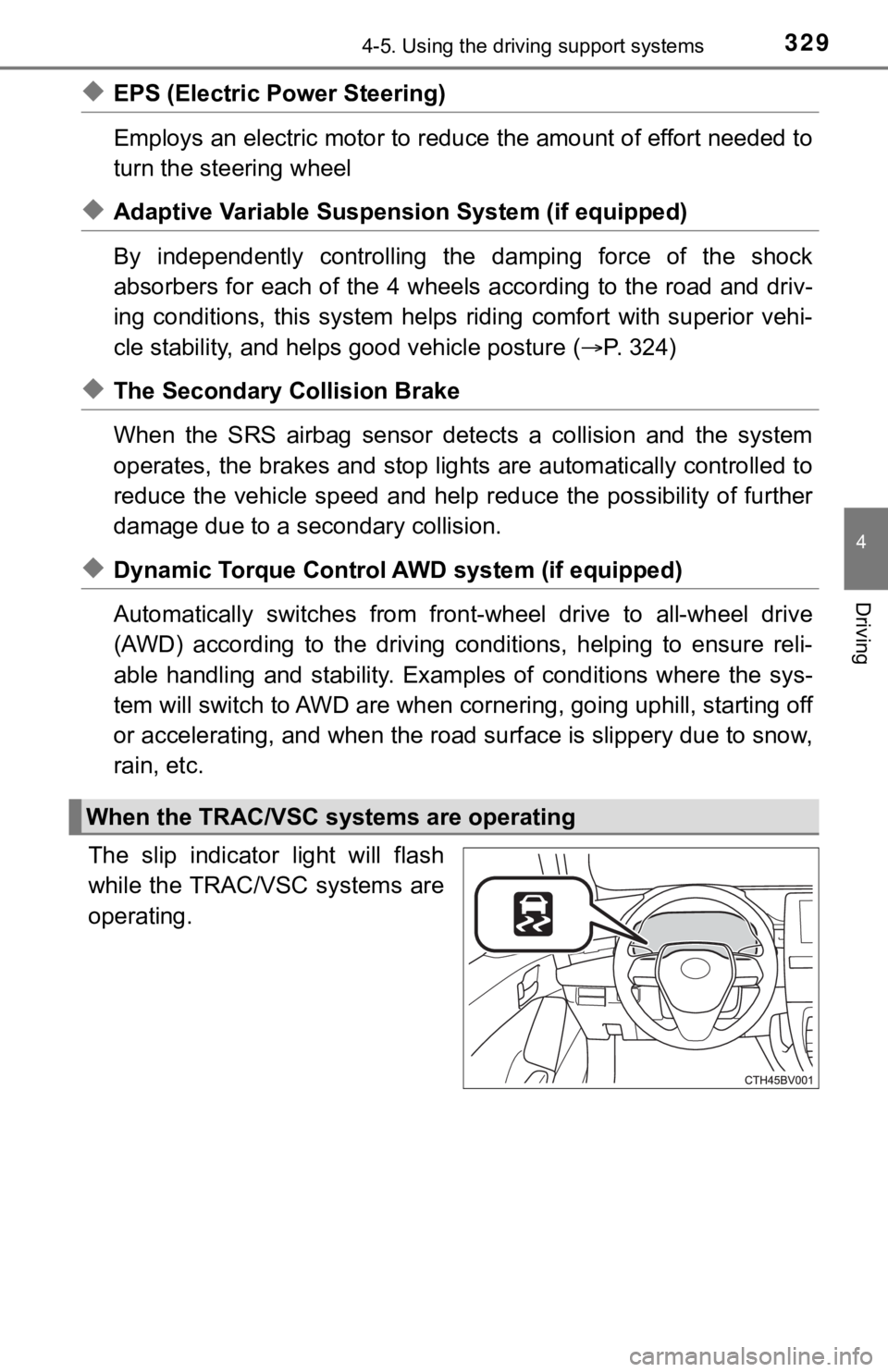
The slip indicator light will flash
while the TRAC/VSC systems are
operating.
When the TRAC/VSC systems are operating
Page 335 of 572

3354-5. Using the driving support systems
4
Driving
WARNING
■Hill- start assist control does not operate effectively when
● Do not overly rely on hill-start assist control. Hill-start assist control may
not operate effectively on steep inclines and roads covered wit h ice.
● Unlike the parking brake, hill-st art assist control is not intended to hold the
vehicle stationary for an extended period of time. Do not attempt to use
hill-start assist control to hold the vehicle on an incline, as doing so may
lead to an accident.
■ When the TRAC/VSC is activated
The slip indicator light flashes. Always drive carefully. Reckless driving may
cause an accident. Exercise particular care when the indicator light flashes.
■ When the TRAC/VSC systems are turned off
Be especially careful and drive at a speed appropriate to the r oad condi-
tions. As these are the systems to help ensure vehicle stability and driving
force, do not turn the TRAC/VSC systems off unless necessary.
■ Replacing tires
Make sure that all tires are of the specified size, brand, trea d pattern and
total load capacity. In addition, make sure that the tires are inflated to the
recommended tire inflation pressure level.
The ABS, TRAC and VSC systems will not function correctly if different tires
are installed on the vehicle.
Contact your Toyota dealer for further information when replaci ng tires or
wheels.
■ Handling of tires and the suspension
Using tires with any kind of problem or modifying the suspensio n will affect
the driving assist systems, and may cause a system to malfunction.
■ Secondary Collision Brake
Do not rely solely upon the Secondary Collision Brake. This system is
designed to help reduce the possibility of further damage due to a second-
ary collision, however, that effect changes according to variou s conditions.
Overly relying on the system may result in death or serious inj ury.
Page 388 of 572

3886-1. Maintenance and care
NOTICE
■To prevent paint deterioration an d corrosion on the body and compo-
nents (aluminum wheels, etc.)
● Wash the vehicle immediately in the following cases:
• After driving near the sea coast
• After driving on salted roads
• If coal tar or tree sap is present on the paint surface
• If dead insects, insect droppings or bird droppings are present on the
paint surface
• After driving in an area contaminated with soot, oily smoke, mine dust,
iron powder or chemical substances
• If the vehicle becomes heavily soiled with dust or mud
• If liquids such as benzene and gasoline are spilled on the pai nt surface
● If the paint is chipped or scratched, have it repaired immediately.
● To prevent the wheels from corroding, remove any dirt and store in a place
with low humidity when storing the wheels.
■ Cleaning the exterior lights
● Wash carefully. Do not use organic substances or scrub with a h ard brush.
This may damage the surfaces of the lights.
● Do not apply wax to the surfaces of the lights.
Wax may cause damage to the lenses.
■ When using a high pressure car wash
Do not bring the nozzle tip close to boots (rubber or resin manufactured
cover), connectors or the following parts. The parts may be damaged if they
come into contact with high-pressure water.
• Traction related parts
• Steering parts
• Suspension parts
• Brake parts.
● Keep the cleaning nozzle at least 11.9 in. (30 cm) away from th e vehicle
body. Otherwise resin section, such as moldings and bumpers, may be
deformed and damaged. Also, do not continuously hold the nozzle in the
same place.
● Do not spray the lower part of the windshield continuously. If water enters
the air conditioning system intake located near the lower part of the wind-
shield, the air conditioning system may not operate correctly.
● Do not wash the underside of the vehicle using a high pressure car
washer.
Page 450 of 572
4507-2. Steps to take in an emergency
NOTICE
■To prevent damage to the vehicle when towing using a wheel-lift type
truck
● Do not tow the vehicle from the rear when the engine switch is off. The
steering lock mechanism is not strong enough to hold the front wheels
straight.
● When raising the vehicle, ensure adequate ground clearance for towing at
the opposite end of the raised vehicle. Without adequate clearance, the
vehicle could be damaged while being towed.
■ To prevent damage to the vehicle when towing with a sling-type truck
Do not tow with a sling-type truck, either from the front or re a r.
■ To prevent damage to the vehicle during emergency towing
Do not secure cables or chains to the suspension components.
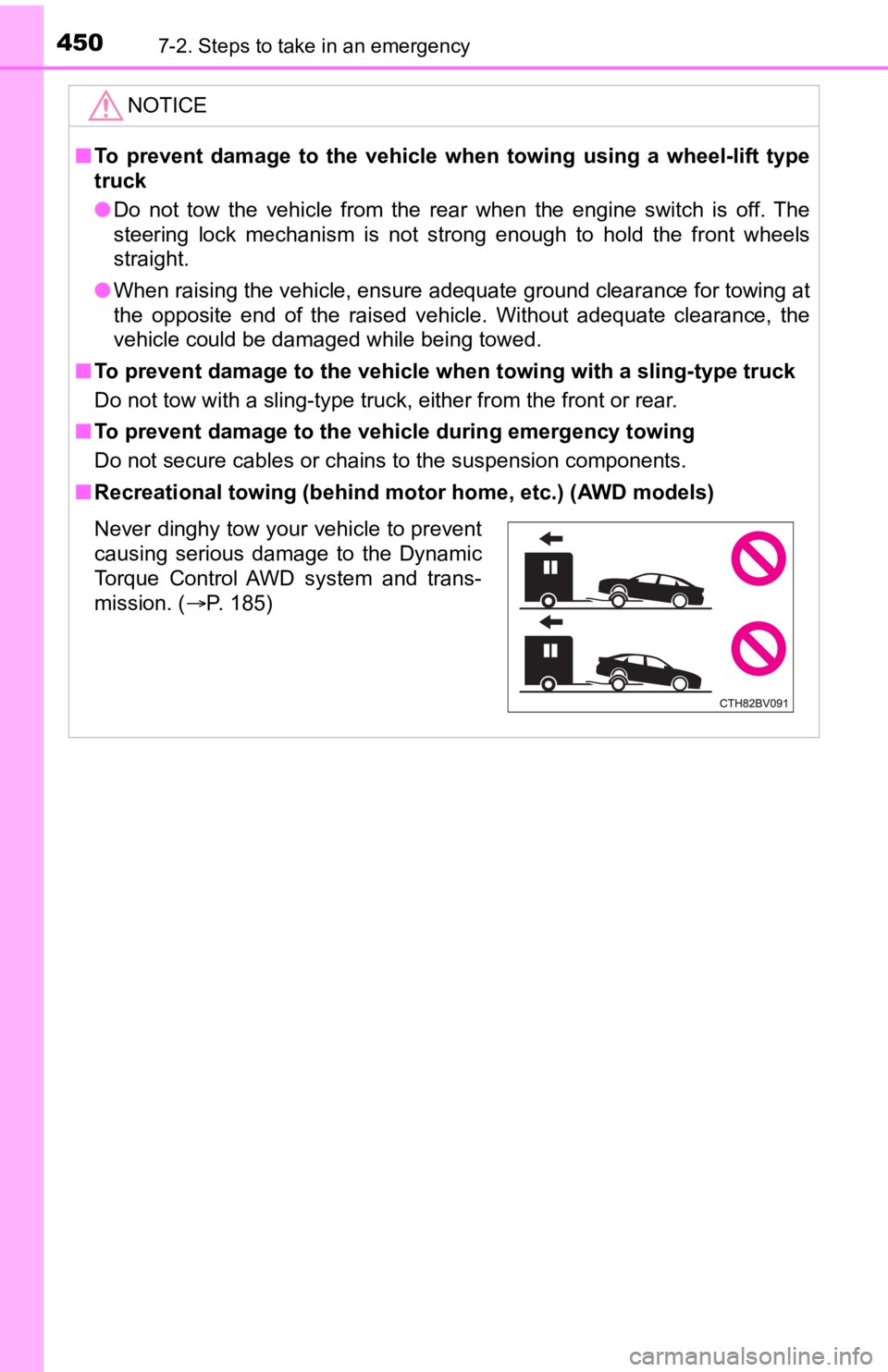
■ Recreational towing (behind motor home, etc.) (AWD models)
Never dinghy tow your vehicle to prevent
causing serious damage to the Dynamic
Torque Control AWD system and trans-
mission. ( P. 185)
Page 453 of 572
4537-2. Steps to take in an emergency
7
When trouble arises
●Fluid leaks un der the vehicle.
(Water dripping from the air conditioning a fter use is normal.)
● Flat-looking tires or uneven tire wear
● Engine coolant temperature gauge needle continually points high er
than normal
● Changes in exhaust sound
● Excessive tire squeal when cornering
● Strange noises related to the suspension system
● Pinging or other noises related to the engine
● Engine missing, stumb ling or running roughly
● Appreciable loss of power
● Vehicle pulls heavily to one side when braking
● Vehicle pulls heavily to one s ide when driving on a level road
● Loss of brake effectiveness, spongy feeling, pedal almost touch es
the floor
If you think something is wrong
If you notice any of the followi ng symptoms, your vehicle proba -
bly needs adjustment or repair. Contact your Toyota dealer as
soon as possible.
Visible symptoms
Audible symptoms
Operational symptoms
Page 549 of 572

549
9
For owners
AVERTISSEMENT
■Modification et mise au rebut des composants du système de cous sins
gonflables SRS
Ne mettez pas votre véhicule au rebut et ne procédez à aucune d es modifi-
cations suivantes sans consulter votre concessionnaire Toyota. Les cous-
sins gonflables SRS peuvent ne pas fonctionner correctement ou se
déployer (se gonfler) accidentellement, provoquant la mort ou d e graves
blessures.
● Installation, dépose, démontage et réparation des coussins gonf lables
SRS
● Réparations, modifications, démontage ou remplacement du volant, du
tableau de bord, de la planche de bord, des sièges ou de leur garnissage,
des montants avant, latéraux et arrière, des rails latéraux de toit, des pan-
neaux de porte avant, des garnitures de porte avant ou des haut-parleurs
de porte avant
● Modifications du panneau de porte avant (par exemple, perçage d 'un trou
dans le panneau)
● Réparations ou modifications des ailes avant, du pare-chocs ava nt ou des
flancs de l'habitacle
● Installation d'un protège-calandre (pare-buffle, pare-kangourou, etc.), de
chasse-neige, de treuils, ou d'un porte-bagages de toit
● Modifications du système de suspension du véhicule
● Installation d'appareils électroniques tels que les émetteurs/r écepteurs
radios mobiles et les lecteurs CD
● Modifications de votre véhicule pour une personne atteinte d'un handicap
physique
Page 555 of 572
555Alphabetical index
Alphabetical index
A/C ............................................ 342Air conditioning filter ............. 433
Automatic air conditioning system ............ 342
ABS (Anti-lock Brake System)...... 328
Warning light ......................... 456
Adaptive Variable Suspension System .............. 329
Air conditioning filter .............. 433
Air conditioning
system .................................... 342 Air conditioning filter ............. 433
Automatic air
conditioning system ............ 342
Airbags ....................................... 36
Airbag operating conditions .... 45
Airbag preca utions for
your child .............................. 39
Correct driving posture ........... 28
Curtain shield airbag operating conditions ............. 46
Curtain shield airbag precautions ........................... 42
Front passenger occupant
classification syst em............. 50
General airbag precautions .... 39
Locations of airbags................ 36
Modification and disposal of airbags.............................. 44
Side airbag operating
conditions ............................. 46
Side airbag precautions .......... 39 Side and curtain shield
airbags operating
conditions ............................. 46
Side and curtain shield airbags precautions .............. 39
SRS airbag instructions for Canadian owners ............... 540
SRS airbags ........................... 36
SRS warning light ................. 456
Alarm .......................................... 80
Ambient lights ......................... 354
Anchor brackets ........................ 60
Antennas
(smart key system) ............... 137
Anti-lock Brake System (ABS) ...................................... 328
Warning light......................... 456
Approach warning ................... 272
Armrest..................................... 375
Assist grips .............................. 375
Audio Plus
*
Audio/visual system*
Automatic air conditioning system ............. 342 Air conditioning filter ............. 433
Automatic High Beam ............. 208
Automatic light control system.................................... 204
Automatic transmission ......... 191 If the shift lever cannot be shifted from P .... 195
Paddle shift switches ............ 193
S mode ................................. 192
Auxiliary boxes ........................ 359
A
*: Refer to the “NAVIGATION AND MULTIMEDIA SYSTEM OWNER’S MANUAL”.