ECU TOYOTA AVALON 2022 Repair Manual
[x] Cancel search | Manufacturer: TOYOTA, Model Year: 2022, Model line: AVALON, Model: TOYOTA AVALON 2022Pages: 572, PDF Size: 9.42 MB
Page 473 of 572
4737-2. Steps to take in an emergency
7
When trouble arises
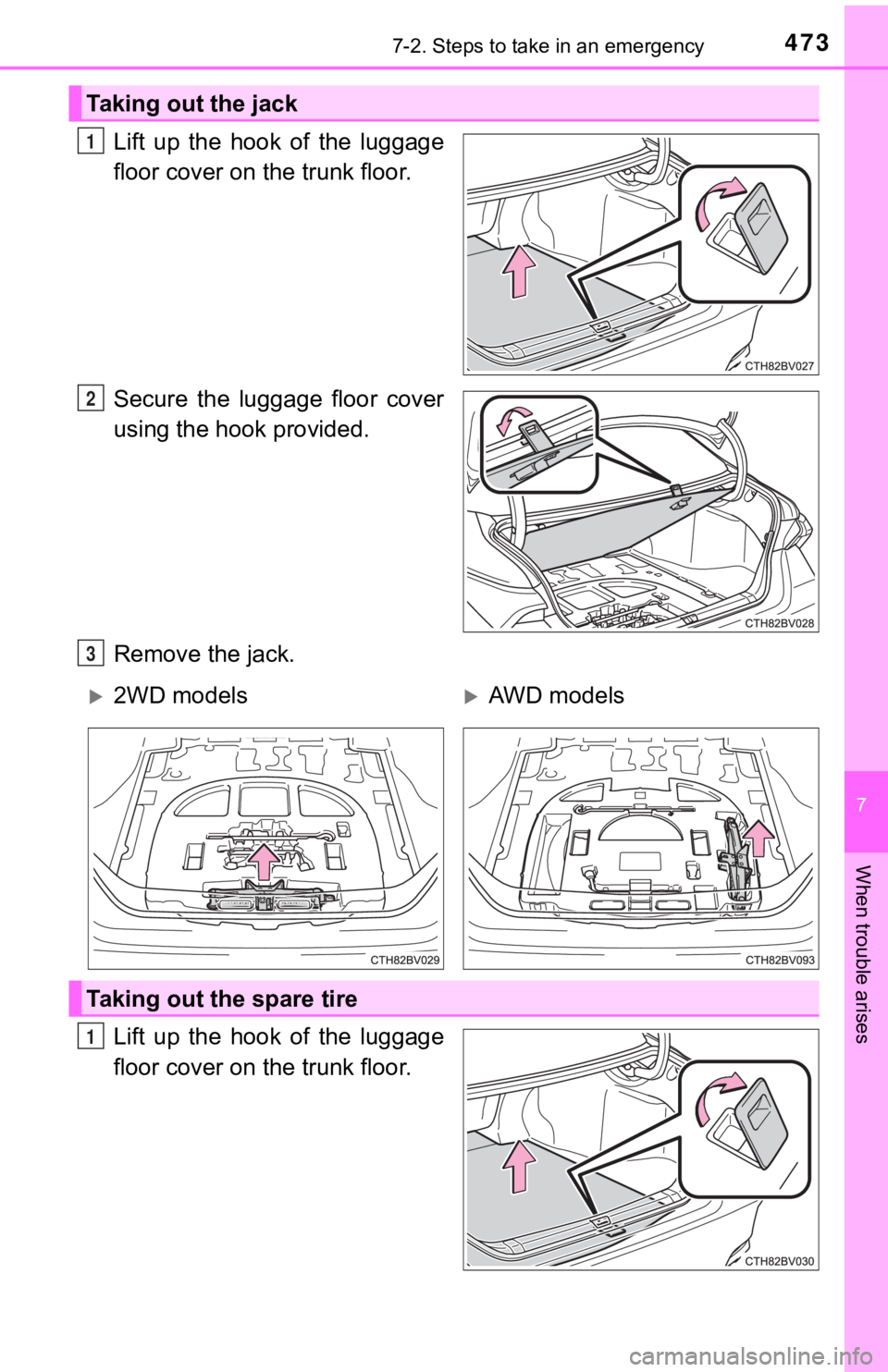
Lift up the hook of the luggage
floor cover on the trunk floor.
Secure the luggage floor cover
using the hook provided.
Remove the jack.
Lift up the hook of the luggage
floor cover on the trunk floor.
Taking out the jack
1
2
3
2WD modelsAWD models
Taking out the spare tire
1
Page 474 of 572
4747-2. Steps to take in an emergency
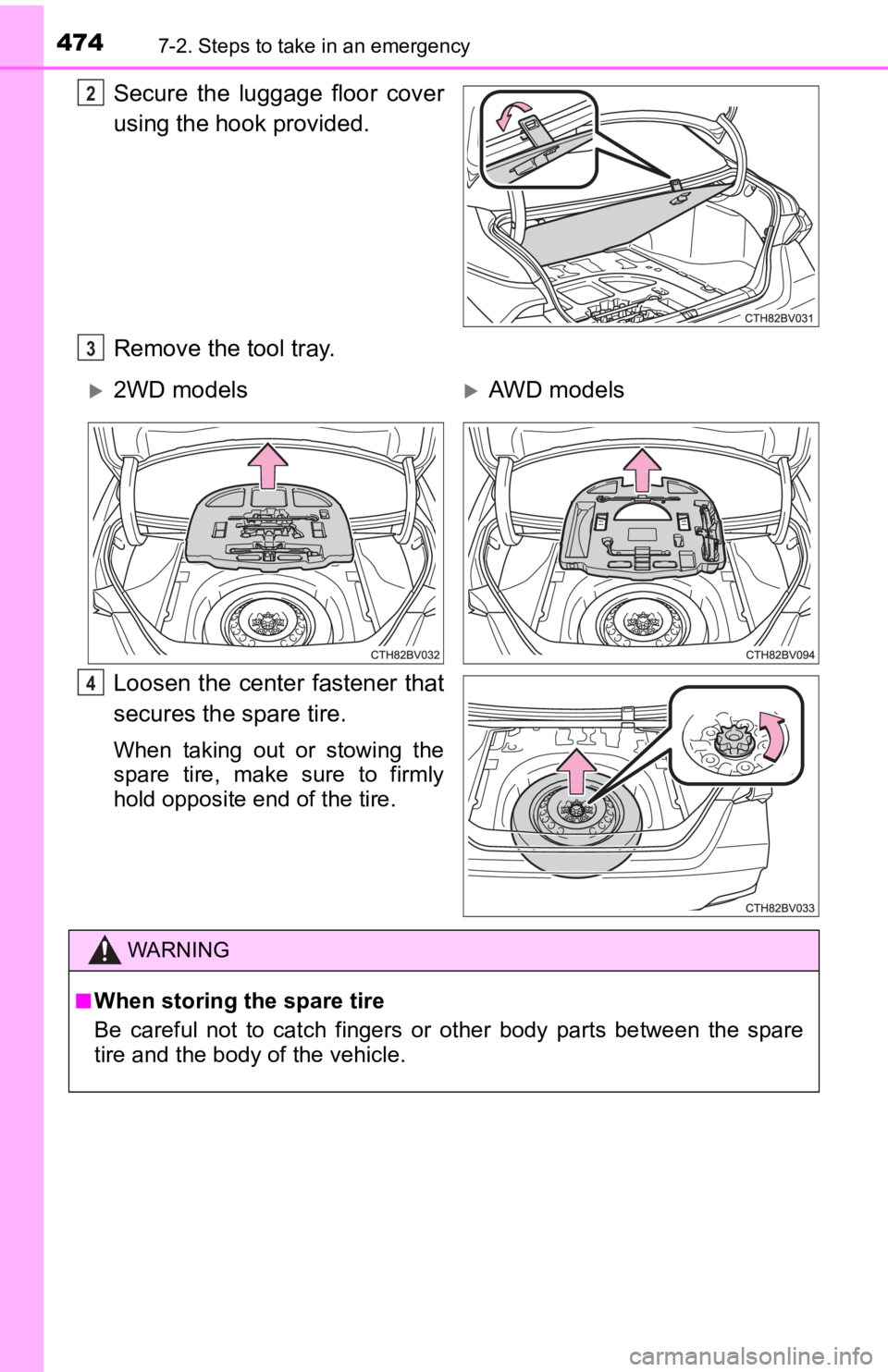
Secure the luggage floor cover
using the hook provided.
Remove the tool tray.
Loosen the center fastener that
secures the spare tire.
When taking out or stowing the
spare tire, make sure to firmly
hold opposite end of the tire.
2
3
2WD modelsAWD models
4
WARNING
■When storing the spare tire
Be careful not to catch fingers or other body parts between the spare
tire and the body of the vehicle.
Page 480 of 572

4807-2. Steps to take in an emergency
WARNING
■When using the compact spare tire
●Remember that the compact spare tire provided is specifically
designed for use with your vehicle. Do not use your compact spare tire
on another vehicle.
●Do not use more than one compact spare tires simultaneously.
●Replace the compact spare tire with a standard tire as soon as possi-
ble.
●Avoid sudden acceleration, abrupt steering, sudden braking and shift-
ing operations that cause sudden engine braking.
■When the compact spa re tire is attached
The vehicle speed may not be co rrectly detected, and the following sys-
tems may not operate correctly:
Also, not only can the following systems not be utilized fully, but they may
actually negatively affect the drive-train components:
• Dynamic Torque Control AWD system
*
*:If equipped
■Speed limit when using the compact spare tire
Do not drive at speeds in excess of 50 mph (80 km/h) when a com pact
spare tire is installed on the vehicle.
The compact spare tire is not designed for driving at high spee ds. Fail-
ure to observe this precaution may lead to an accident causing death or
serious injury.
■After using the tools and jack
Before driving, make sure all t he tools and jack are securely i n place in
their storage location to reduce the possibility of personal in jury during a
collision or sudden braking.
• ABS & Brake assist
• VSC
• TRAC
• EPS
• AHB (Automatic High Beam)
• Dynamic radar cruise control with full-speed range
• LTA (Lane Tracing Assist)
• PCS (Pre-Collision System)
• Tire pressure warning system
• BSM (Blind Spot Monitor)
•Intuitive parking assist*
•Intelligent Clearance Sonar
(ICS)
*
•Rear view monitor system*
• Toyota parking assist monitor
•Panoramic view monitor*
•Navigation system*
Page 490 of 572

4907-2. Steps to take in an emergency
■Starting the engine when t he battery is discharged
The engine cannot be started by push-starting.
■ To prevent battery discharge
●Turn off the headlights and the audio system while the engine is off.
● Turn off any unnecessary electrical components when the vehicle is running
at a low speed for an extended period, such as in heavy traffic .
■ When the battery is r emoved or discharged
● Information stored in the ECU is cleared. When the battery is d epleted, have
the vehicle inspected at your Toyota dealer.
● Some systems may require initialization. ( P. 533)
■ When removing the battery terminals
When the battery terminals are removed, the information stored in the ECU is
cleared. Before removing the battery terminals, contact your Toyota dealer.
■ Charging the battery
The electricity stored in the battery will discharge gradually even when the
vehicle is not in use, due to natural discharge and the draining effects of cer-
tain electrical appliances. If the vehicle is left for a long t ime, the battery may
discharge, and the engine may be unable to start. (The battery recharges
automatically during driving.)
■ When recharging or replacing the battery
●In some cases, it may not be possible to unlock the doors using the smart
key system when the battery is discharged. Use the wireless rem ote control
or the mechanical key to lock or unlock the doors.
● The engine may not start on the first attempt after the battery has recharged
but will start normally after the second attempt. This is not a malfunction.
● The engine switch mode is memorized by the vehicle. When the ba ttery is
reconnected, the system will return to the mode it was in befor e the battery
was discharged. Before disconnecting the battery, turn the engine switch off.
If you are unsure what mode the engine switch was in before the battery dis-
charged, be especially careful when reconnecting the battery.
■ When replacing the battery
●Use a battery that conforms to European regulations.
● Use a battery that the case size is same as the previous one (L N3), 20 hour
rate capacity (20HR) is equivalent (70Ah) or greater, and perfo rmance rating
(CCA) is equivalent (603A) or greater.
• If the sizes differ, the battery cannot be properly secured.
• If the 20 hour rate capacity is low, even if the time period w here the vehi-
cle is not used is a short time, the battery may discharge and the engine
may not be able to start.
● For details, consult your Toyota dealer.
Page 523 of 572
5238-1. Specifications
8
Vehicle specifications
*: Table 1 Occupant loading and distribution for vehicle normal load for
various designated seating capacities
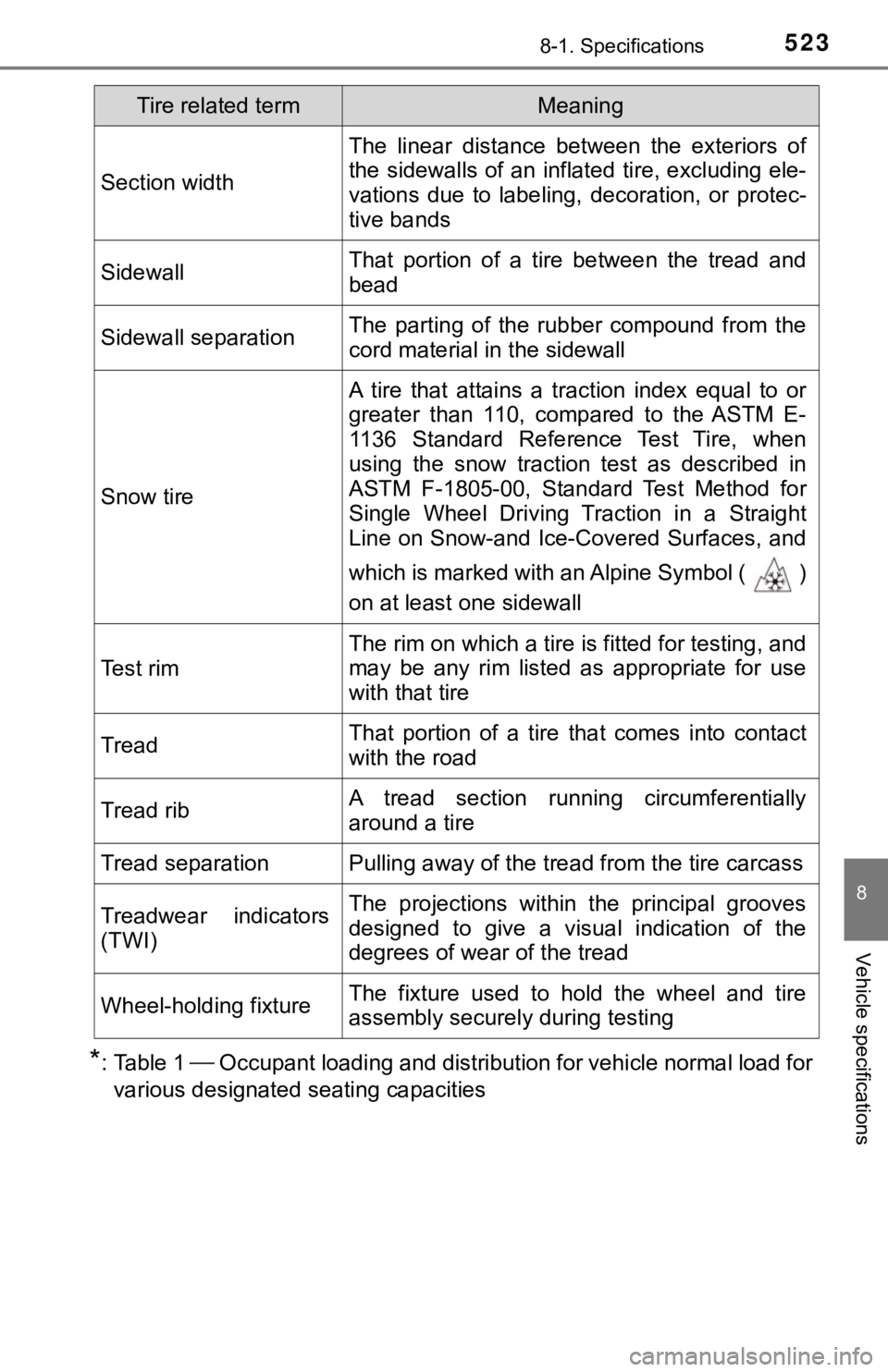
Section width
The linear distance between the exteriors of
the sidewalls of an inflated tire, excluding ele-
vations due to labeling, decoration, or protec-
tive bands
SidewallThat portion of a tire between the tread and
bead
Sidewall separationThe parting of the rubber compound from the
cord material in the sidewall
Snow tire
A tire that attains a traction index equal to or
greater than 110, compared to the ASTM E-
1136 Standard Reference Test Tire, when
using the snow traction test as described in
ASTM F-1805-00, Standard Test Method for
Single Wheel Driving Traction in a Straight
Line on Snow-and Ice-Covered Surfaces, and
which is marked with an Alpine Symbol ( )
on at least one sidewall
Te s t r i m
The rim on which a tire is fitted for testing, and
may be any rim listed as appropriate for use
with that tire
TreadThat portion of a tire that comes into contact
with the road
Tread ribA tread section running circumferentially
around a tire
Tread separationPulling away of the tread from the tire carcass
Treadwear indicators
(TWI)The projections within the principal grooves
designed to give a visual indication of the
degrees of wear of the tread
Wheel-holding fixtureThe fixture used to hold the wheel and tire
assembly securely during testing
Tire related termMeaning
Page 528 of 572
5288-2. Customization
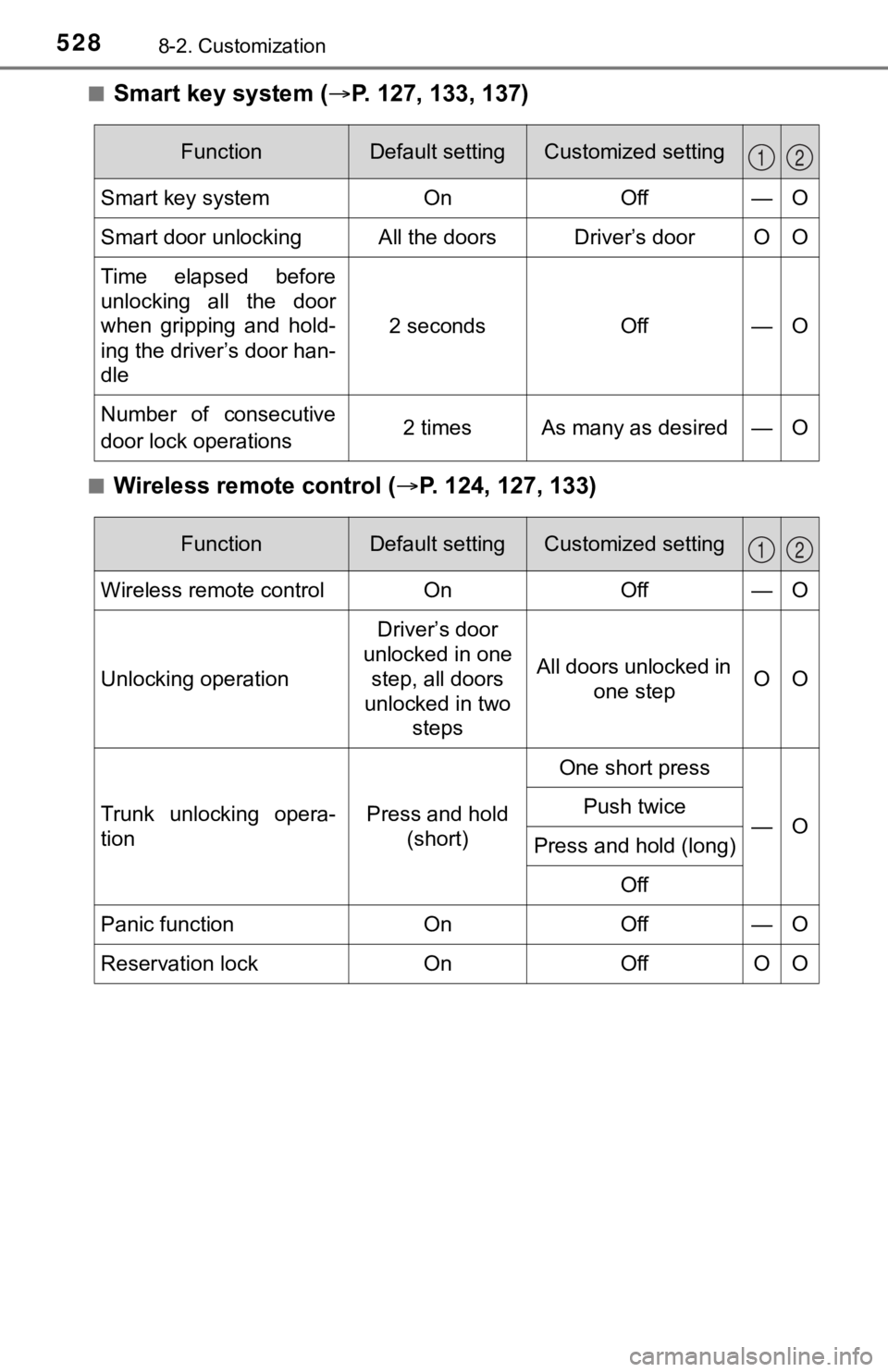
■Smart key system (P. 127, 133, 137)
■Wireless remote control ( P. 124, 127, 133)
FunctionDefault settingCustomized setting
Smart key systemOnOff—O
Smart door unlockingAll the doorsDriver’s door O O
Time elapsed before
unlocking all the door
when gripping and hold-
ing the driver’s door han-
dle
2 secondsOff—O
Number of consecutive
door lock operations 2 times As many as desired — O
12
FunctionDefault settingCustomized setting
Wireless remote controlOnOff—O
Unlocking operation
Driver’s door
unlocked in one step, all doors
unlocked in two steps
All doors unlocked in one stepOO
Trunk unlocking opera-
tionPress and hold (short)
One short press
—OPush twice
Press and hold (long)
Off
Panic functionOnOff—O
Reservation lockOnOffOO
12
Page 538 of 572
538
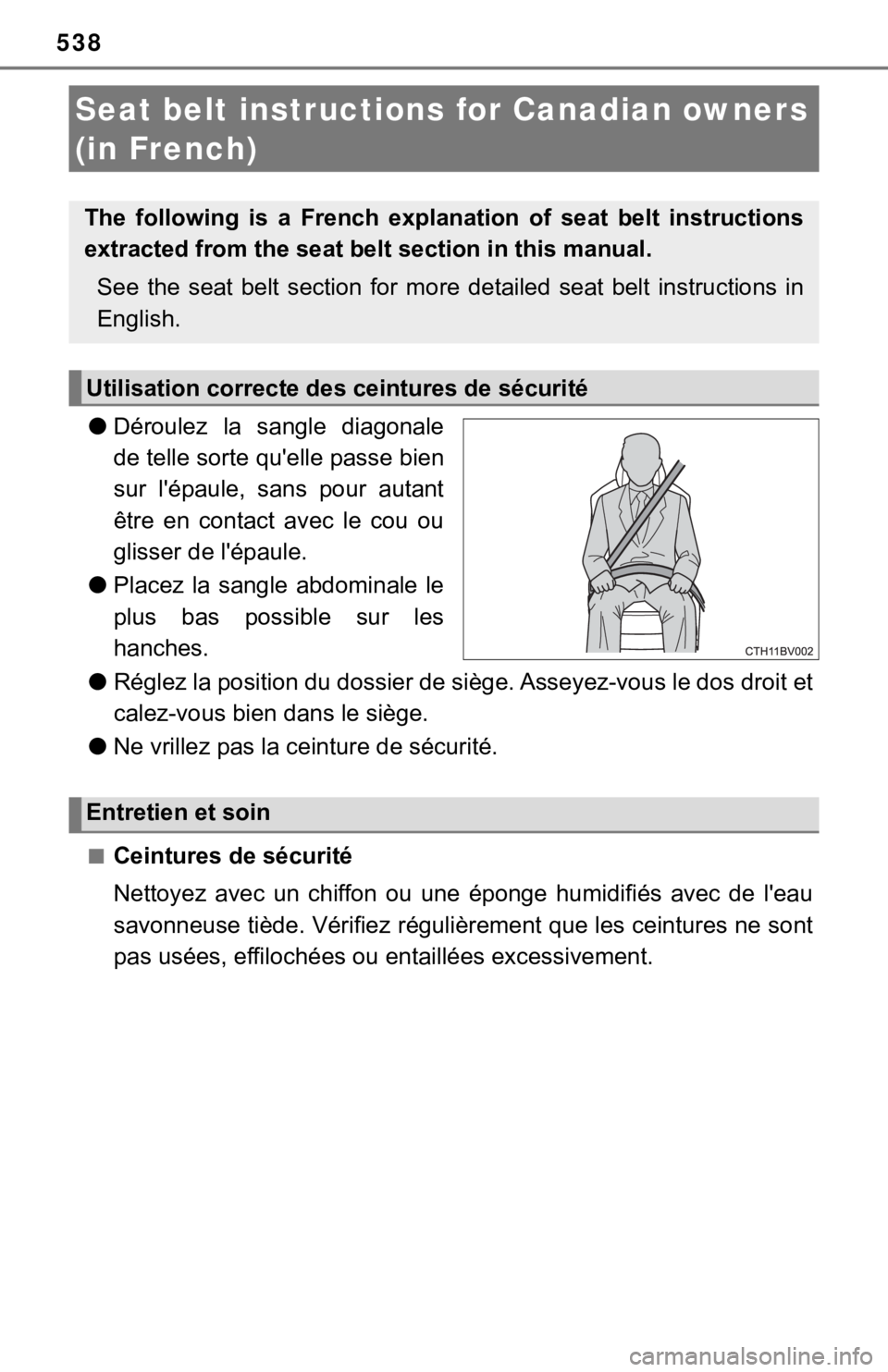
●Déroulez la sangle diagonale
de telle sorte qu'elle passe bien
sur l'épaule, sans pour autant
être en contact avec le cou ou
glisser de l'épaule.
● Placez la sangle abdominale le
plus bas possible sur les
hanches.
● Réglez la position du dossier de siège. Asseyez-vous le dos dro it et
calez-vous bien dans le siège.
● Ne vrillez pas la cei nture de sécurité.
■Ceintures de sécurité
Nettoyez avec un chiffon ou une éponge humidifiés avec de l'eau
savonneuse tiède. Vérifiez régulièrement que les ceintures ne s ont
pas usées, effiloc hées ou entaillées excessivement.
Seat belt instructions for Canadian owners
(in French)
The following is a French explan ation of seat belt instructions
extracted from the seat bel t section in this manual.
See the seat belt section for mo re detailed seat belt instructions in
English.
Utilisation correcte d es ceintures de sécurité
Entretien et soin
Page 539 of 572

539
9
For owners
AVERTISSEMENT
■Détérioration et usure des ceintures de sécurité
Inspectez le système de ceintures de sécurité régulièrement. Co ntrôlez
l'absence de coupures, d'effilochages et de pièces desserrées. N'utilisez
pas une ceinture de sécurité endommagée avant qu'elle ne soit r emplacée.
Une ceinture de sécurité endommagée ne permet pas de protéger u n occu-
pant de blessures graves ou mortelles.
Page 542 of 572
542
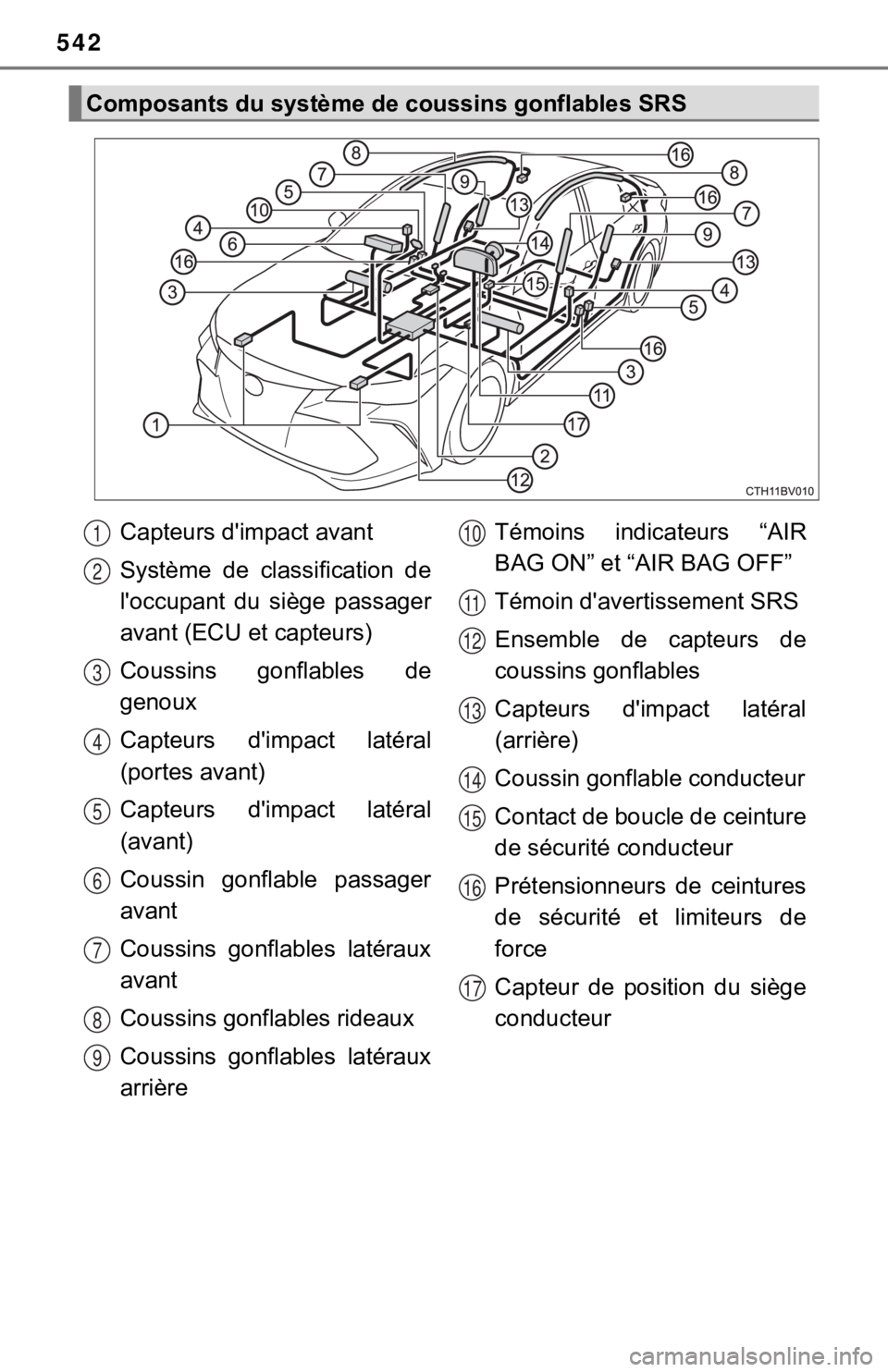
Composants du système de coussins gonflables SRS
Capteurs d'impact avant
Système de classification de
l'occupant du siège passager
avant (ECU et capteurs)
Coussins gonflables de
genoux
Capteurs d'impact latéral
(portes avant)
Capteurs d'impact latéral
(avant)
Coussin gonflable passager
avant
Coussins gonflables latéraux
avant
Coussins gonflables rideaux
Coussins gonflables latéraux
arrière Témoins indicateurs “AIR
BAG ON” et “AIR BAG OFF”
Témoin d'avertissement SRS
Ensemble de capteurs de
coussins gonflables
Capteurs d'impact latéral
(arrière)
Coussin gonflable conducteur
Contact de boucle de ceinture
de sécurité conducteur
Prétensionneurs de ceintures
de sécurité et limiteurs de
force
Capteur de position du siège
conducteur1
2
3
4
5
6
7
8
9
10
11
12
13
14
15
16
17
Page 543 of 572

543
9
For owners
Votre véhicule est équipé de COUSSINS GONFLABLES INTELLI-
GENTS conçus selon les normes de sécurité américaines applicables
aux véhicules à moteur (FMVSS208). L'ensemble de capteurs de
coussins gonflables (E CU) régule le déploiement des coussins gon-
flables sur la base des informa tions qu'il reçoit des capteurs, etc., indi-
qués ci-dessus dans le schéma illu strant les composants du système.
Parmi ces informations figurent la gravité du choc et l'occupat ion du
véhicule par les passagers. Le d éploiement rapide des coussins gon-
flables est obtenu au moyen d'une réaction chimique dans les di sposi-
tifs pyrotechniques, qui produit un gaz inoffensif permettant d'amortir
le mouvement des occupants.