warning light TOYOTA AVALON 2022 Repair Manual
[x] Cancel search | Manufacturer: TOYOTA, Model Year: 2022, Model line: AVALON, Model: TOYOTA AVALON 2022Pages: 572, PDF Size: 9.42 MB
Page 418 of 572
4186-3. Do-it-yourself maintenance
■How to register the ID codesSelect on the multi-information display using the meter con-
trol switches on the steering wheel. ( P. 1 0 0 )
Select and then press and hold .
Select “TPWS” and then press .
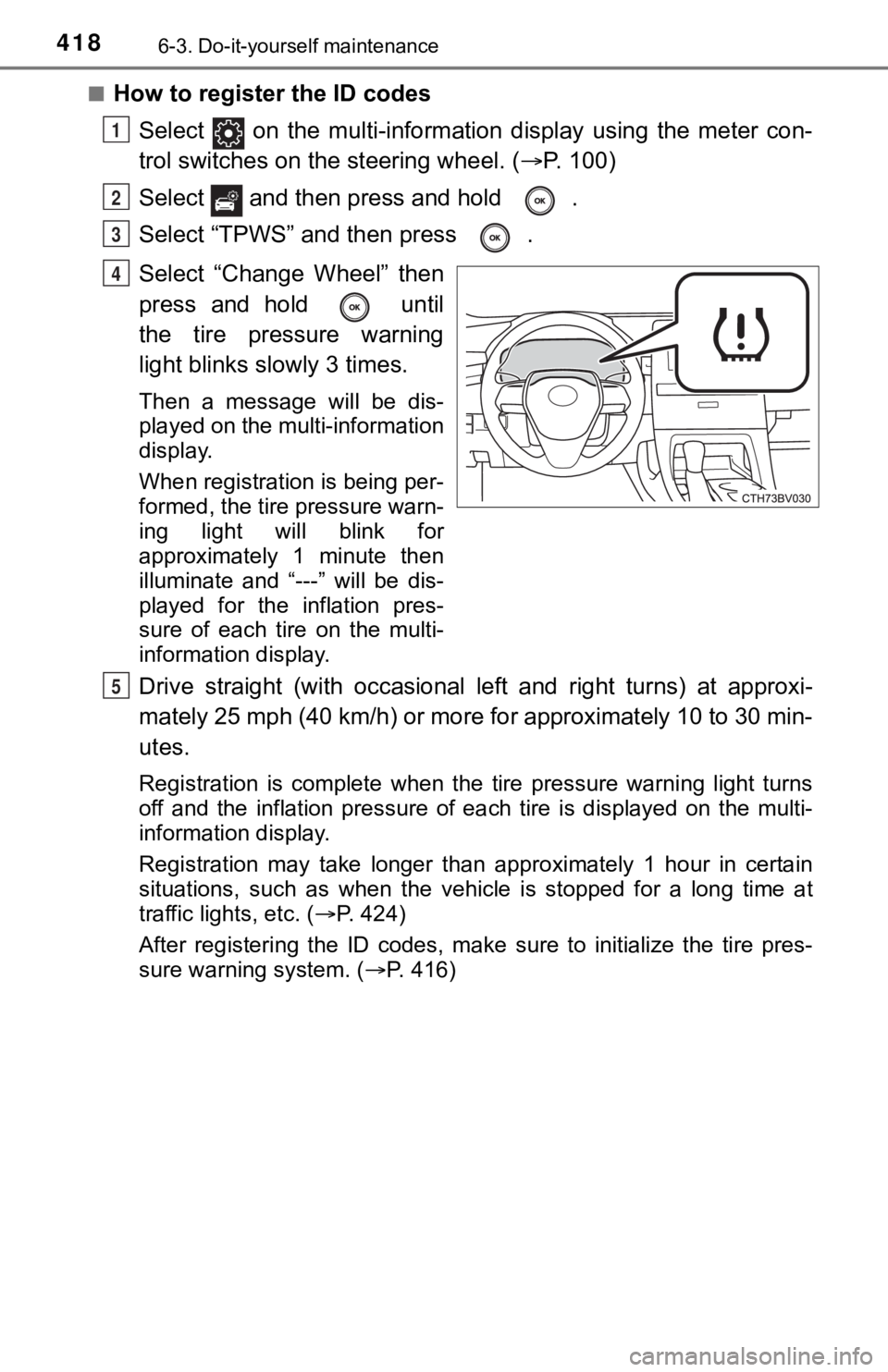
Select “Change Wheel” then
press and hold until
the tire pressure warning
light blinks slowly 3 times.
Then a message will be dis-
played on the multi-information
display.
When registration is being per-
formed, the tire pressure warn-
ing light will blink for
approximately 1 minute then
illuminate and “---” will be dis-
played for the inflation pres-
sure of each tire on the multi-
information display.
Drive straight (with occasional left and right turns) at approxi-
mately 25 mph (40 km/h) or more for approximately 10 to 30 min-
utes.
Registration is complete when the tire pressure warning light t urns
off and the inflation pressure of each tire is displayed on the multi-
information display.
Registration may take longer than approximately 1 hour in certain
situations, such as when the veh icle is stopped for a long time at
traffic lights, etc. ( P. 424)
After registering the ID codes, make sure to initialize the tir e pres-
sure warning system. ( P. 416)
1
2
3
4
5
Page 419 of 572
4196-3. Do-it-yourself maintenance
6
Maintenance and care
■When to replace your vehicle’s tires
Tires should be replaced if:
●The treadwear indicators are showing on a tire.
●You have tire damage such as cuts, splits, cracks deep enough t o
expose the fabric, and bulges indicating internal damage
●A tire goes flat repeatedly or c annot be properly repaired due to the size
or location of a cut or other damage
If you are not sure, consult with your Toyota dealer.
■Replacing tires and wheels
If the ID codes of the tire pressure warning valve and transmit ters are not
registered, the tire pressure warning system will not work properly. In this
case, after driving for about 20 minutes, the tire pressure warning light will
blink for approximately 1 minute and then illuminate to indicat e a system
malfunction.
■Tire life
Any tire over 6 years old must be checked by a qualified techni cian even
if it has seldom or never been u sed or damage is not obvious.
■Routine tire inflation pressure checks
The tire pressure warning system does not replace routine tire inflation
pressure checks. Make sure to chec k tire inflation pressure as part of
your routine of daily vehicle checks.
■Low profile tires (vehicles with 18 or 19-inch wheels)
Generally, low profile tires will wear more rapidly and tire gr ip perfor-
mance will be reduced on snowy and /or icy roads when compared to
standard tires. Be sure to use snow tires on snowy and/or icy r oads and
drive carefully at a speed approp riate for road and weather conditions.
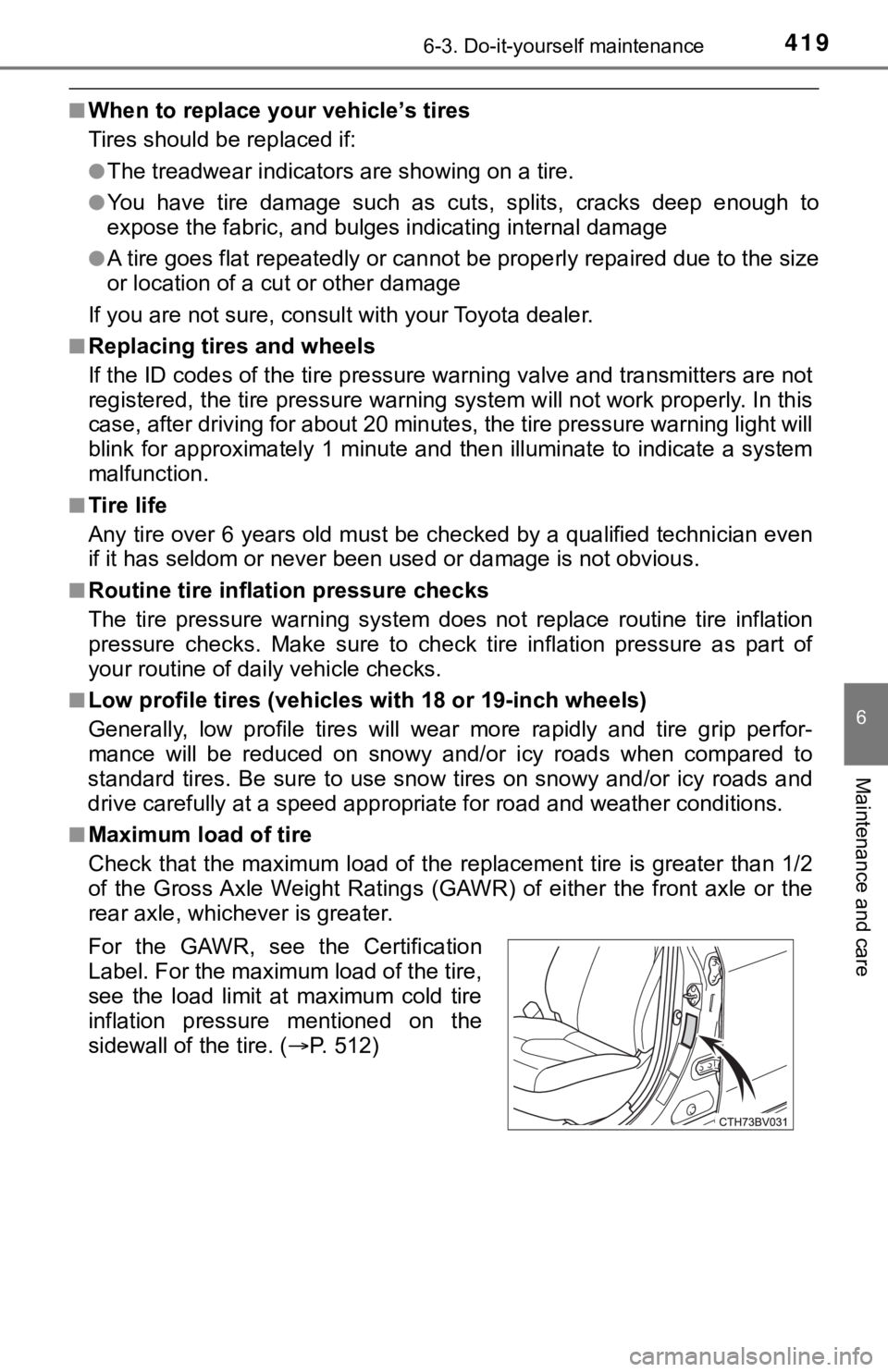
■Maximum load of tire
Check that the maximum load of t he replacement tire is greater than 1/2
of the Gross Axle Weight Ratings (GAWR) of either the front axl e or the
rear axle, whichever is greater.
For the GAWR, see the Certification
Label. For the maximum load of the tire,
see the load limit at maximum cold tire
inflation pressure mentioned on the
sidewall of the tire. ( P. 5 1 2 )
Page 422 of 572

4226-3. Do-it-yourself maintenance
■If the tire pressure warning system is not initialized properly
●In the following situations, init ialization may take longer than usual to be
completed or may not be possible. (Usually, the vehicle will ne ed to be
driven for approximately 10 to 30 minutes to complete initializ ation.)
If initialization is not complete after driving approximately 3 0 minutes,
continue driving for a while.
• If the vehicle is driven on an unpaved road, it may take longe r to com-
plete initialization.
• If the vehicle is backed up while performing initialization, d ata col-
lected during initialization will be cleared and it will take l onger than
normal to complete.
• If the vehicle is driven in heavy traffic or another situation where other
vehicles are driven close by, i t may take time for the system to recog-
nize the tire pressure warning valve and transmitters of your v ehicle
over those of other vehicles.
If initialization is not complete after driving for approximate ly 1 hour,
park the vehicle in a safe place for approximately 20 minutes and then
drive the vehicle again.
●In the following situ ations, initialization will not be started or was not
completed properly and the system will not operate properly. Pe rform
the initialization procedure again.
• If, when attempting to start initialization, the tire pressure warning light
does not blink 3 times.
• If, when the vehicle has been driven for about 20 minutes afte r per-
forming initializatio n, the tire pressure warning light blinks for approxi-
mately 1 minute and then illuminates.
●If initialization cannot be completed after performing the abov e proce-
dure, contact your Toyota dealer.
Page 423 of 572

4236-3. Do-it-yourself maintenance
6
Maintenance and care
■When registering ID codes
●Before performing ID code registration, make sure that no wheels with
tire pressure warning valve and transmitters installed are near the vehi-
cle.
●Make sure to initialize the tire pressure warning system after registering
the ID codes. If the system is initialized before registering t he ID codes,
the initialized values will be invalid.
●As the tires will be war m when registration is completed, make sure to
allow the tires to cool befo re performing initialization.
■Canceling ID code registration
●To cancel ID code registration after it has been started, turn the engine
switch off before driving the vehicle.
If the vehicle is driven after ID code registration is started, to cancel reg-
istration, perform the ID code r egistration start procedure aga in and turn
the engine switch of f before driving.
●If ID code registration has been canceled, the tire pressure wa rning light
will blink for approximately 1 mi nute when the engine switch is turned to
IGNITION ON mode and then illumina te. The tire pressure warning sys-
tem will be operational when the tire pressure warning light tu rns off.
●If the warning light does not turn off even after several minut es have
elapsed, ID code registration may not have been cancelled corre ctly. To
cancel registration, perform the ID code registration start procedure
again and then turn the engine switch off before driving.
Page 424 of 572

4246-3. Do-it-yourself maintenance
■If ID codes are not registered properly
●In the following situations, ID code registration may take longer than
usual to be completed or may not be possible. (Usually, the veh icle will
need to be driven for approximately 10 to 30 minutes to complet e ID
code registration.)
If ID code registration is not complete after driving for appro ximately 30
minutes, continue driving for a while.
• If the vehicle is driven on an unpaved road, it may take longe r than
normal to complete registration.
• If the vehicle is backed up while performing registration, dat a col-
lected during registration will be cleared, and it will take longer than
normal to complete.
• If the vehicle is driven in heavy traffic or another situation where other
vehicles are driven close by, i t may take time for the system to recog-
nize the tire pressure warning valve and transmitters of your v ehicle
over those of other vehicles.
• If a wheel with a tire pressure warning valve and transmitter installed
is inside or near the vehicle, registration of the ID codes for the
installed wheels may not be possible.
If ID registration is not complete after driving for approximately 1 hour,
park the vehicle in a safe place for approximately 20 minutes and then
perform the ID code regi stration procedure again.
●In the following situations, ID c ode registration will not be started or was
not completed properly and the system will not operate properly. Per-
form the ID code registr ation procedure again.
• If, when attempting to start ID code registration, the tire pr essure
warning light does not blink slowly 3 times.
• If, when the vehicle has been driven for about 20 minutes afte r per-
forming ID code registration, the tire pressure warning light b links for
approximately 1 minute and then illuminates.
●If ID code registration cannot be completed after performing th e above
procedure, contact your Toyota dealer.
Page 426 of 572

4266-3. Do-it-yourself maintenance
WARNING
■When inspecting or replacing tires
Observe the following precautions to prevent accidents.
Failure to do so may cause damage to parts of the drive train as well as
dangerous handling characteristics, which may lead to an accide nt
resulting in death o r serious injury.
●Do not mix tires of different ma kes, models or tread patterns.
Also, do not mix tires of remarkably different treadwear.
●Do not use tire sizes other th an those recommended by Toyota.
●Do not mix differently constructed tires (radial, bias-belted o r bias-ply
tires).
●Do not mix summer, all season and snow tires.
●Do not use tires that have been used on another vehicle.
Do not use tires if you do not kn ow how they were used previously.
■When initializing the tire pressure warning system
Do not initialize the tire press ure warning system without firs t adjusting
the tire inflation pressure to t he specified level. Otherwise, the tire pres-
sure warning light may not come on even if the tire inflation p ressure is
low, or it may come on when the tire inflation pressure is actu ally nor-
mal.
Page 440 of 572
4406-3. Do-it-yourself maintenance
■After a fuse is replaced
●If the lights do not turn on even after the fuse has been repla ced, a bulb may
need replacement. ( P. 441)
● If the replaced fuse blows again, have the vehicle inspected by your Toyota
dealer.
■ If there is an overload in a circuit
The fuses are designed to blow, protecting the wiring harness from damage.
WARNING
■ To prevent system breakdowns and vehicle fire
Observe the following precautions.
Failure to do so may cause damage to the vehicle, and possibly a fire or
injury.
● Never use a fuse of a higher amperage rating than that indicate d, or use
any other object in place of a fuse.
● Always use a genuine Toyota fuse or equivalent.
Never replace a fuse with a wire, even as a temporary fix.
● Do not modify the fuses or fuse boxes.
NOTICE
■Before replacing fuses
Have the cause of electrical overload determined and repaired b y your
Toyota dealer as soon as possible.
Page 443 of 572

443
7When trouble arises
7-1. Essential informationEmergency flashers .......... 444
If your vehicle has to be stopped in
an emergency ................. 445
If the vehicle is submerged or water on the road is
rising ............................... 446
7-2. Steps to take in an emergency
If your vehicle needs to be towed ..................... 448
If you think something is wrong .......................... 453
Fuel pump shut off system ............................ 454
If a warning light turns on or a warning
buzzer sounds ................ 455
If a warning message is displayed ..................... 465
If you have a flat tire.......... 470
If the engine will not start ................................. 482
If the electronic key does not operate properly........ 484
If the vehicle battery is discharged ................... 487
If your vehicle overheats ........................ 492
If the vehicle becomes stuck ............................... 495
Page 455 of 572
4557-2. Steps to take in an emergency
7
When trouble arises
If a warning light turns on or a war ning
buzzer sounds
Calmly perform the following actions if any of the warning ligh ts
comes on or flashes. If a light comes on or flashes, but then
goes off, this does not necessarily indicate a malfunction in the
system. However, if this continues to occur, have the vehicle
inspected by your Toyota dealer.
Warning light and w arning buzzer list
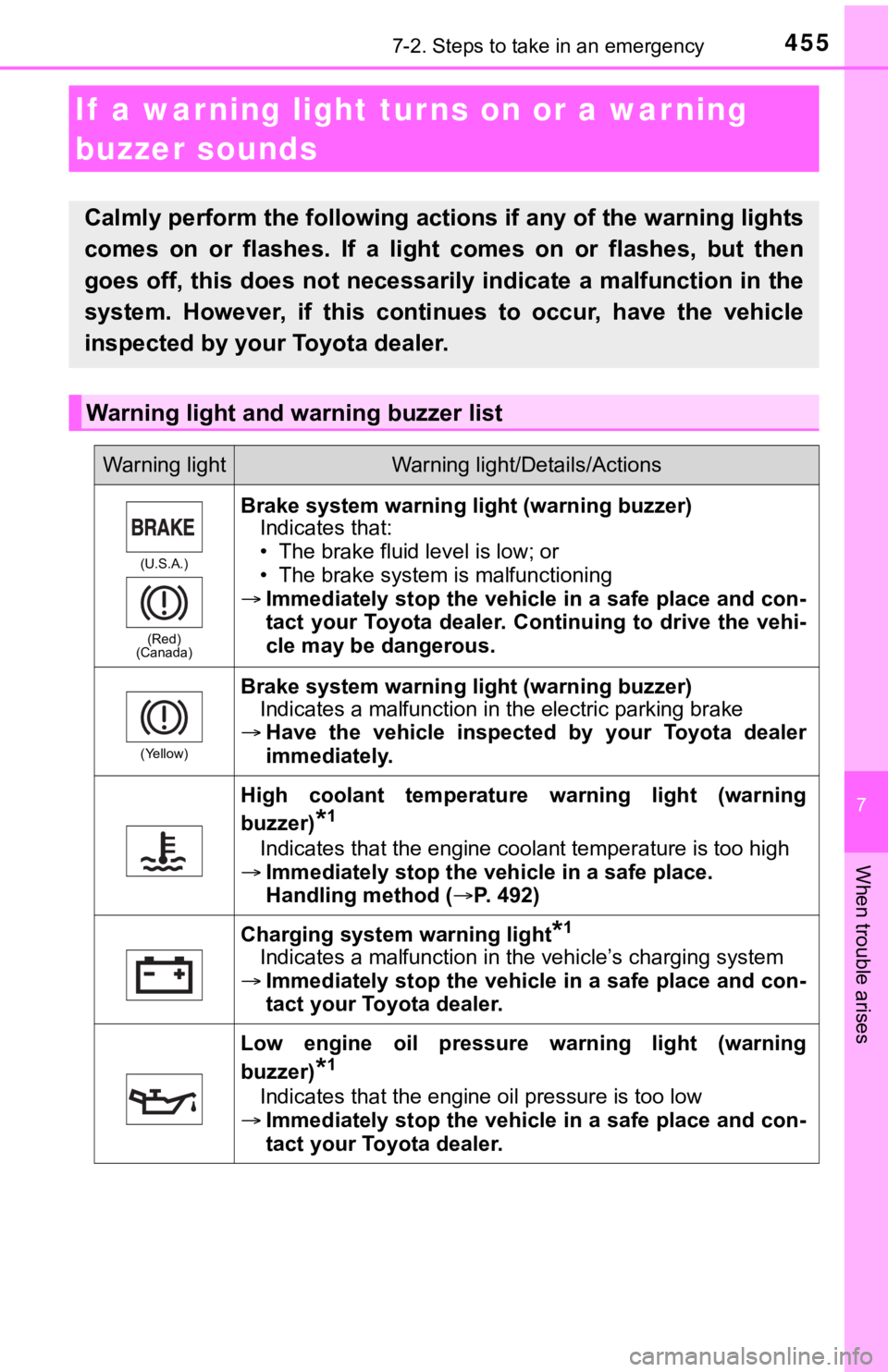
Warning lightWarning light/Details/Actions
(U.S.A.)
(Red)
(Canada)
Brake system warning li ght (warning buzzer)
Indicates that:
• The brake fluid level is low; or
• The brake system is malfunctioning
Immediately stop the vehicle in a safe place and con-
tact your Toyota dealer. Continuing to drive the vehi-
cle may be dangerous.
(Yellow)
Brake system warning li ght (warning buzzer)
Indicates a malfunction in the electric parking brake
Have the vehicle inspected by your Toyota dealer
immediately.
High coolant temperature warning light (warning
buzzer)
*1
Indicates that the engine coolant temperature is too high
Immediately stop the vehicle in a safe place.
Handling method ( P. 492)
Charging system warning light*1
Indicates a malfunction in the vehicle’s charging system
Immediately stop the vehicle in a safe place and con-
tact your Toyota dealer.
Low engine oil pressure warning light (warning
buzzer)
*1
Indicates that the engine oil pressure is too low
Immediately stop the vehicle in a safe place and con-
tact your Toyota dealer.
Page 456 of 572
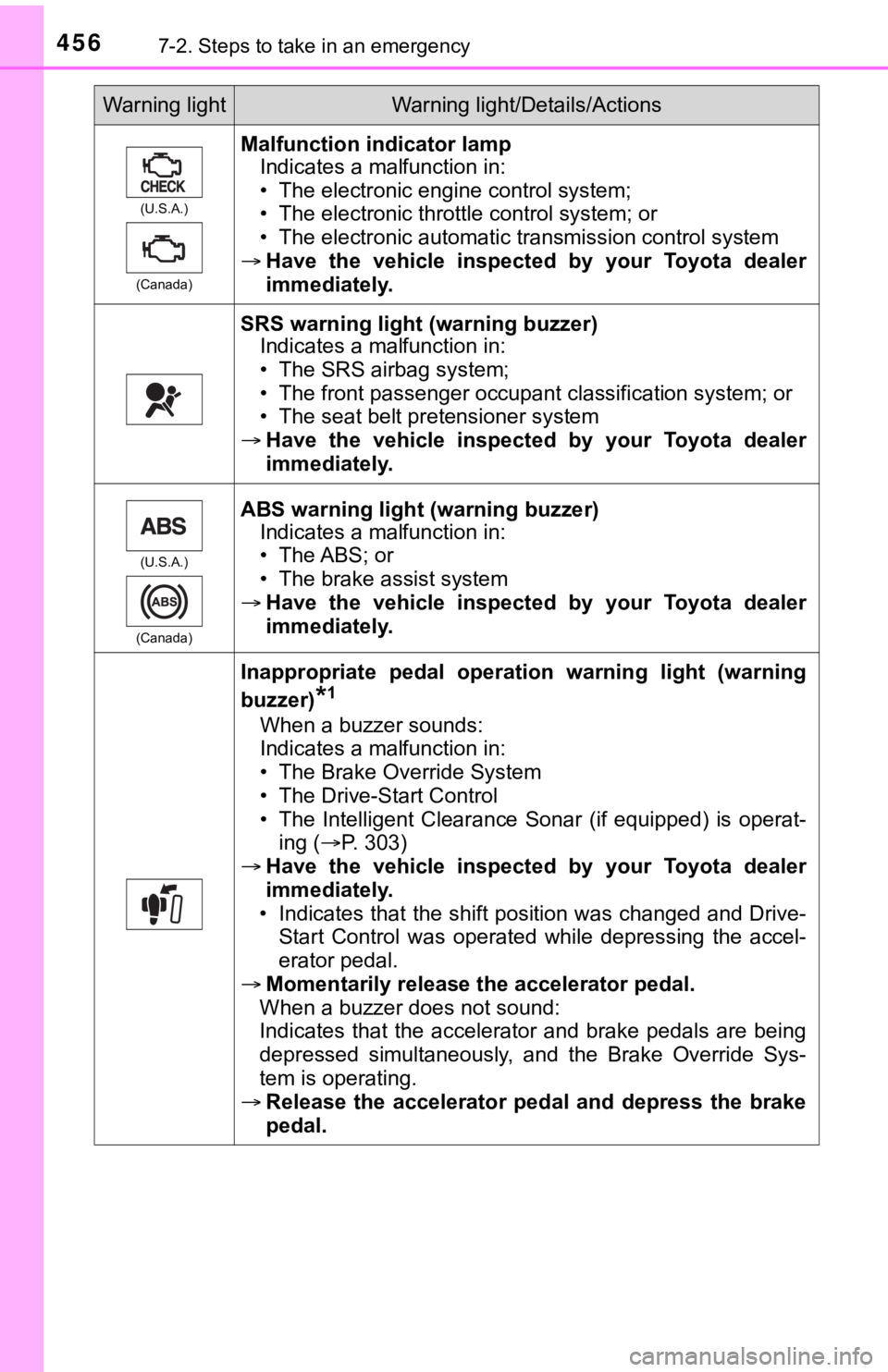
4567-2. Steps to take in an emergency
(U.S.A.)
(Canada)
Malfunction indicator lamp Indicates a malfunction in:
• The electronic engine control system;
• The electronic throttle control system; or
• The electronic automatic transmission control system
Have the vehicle inspected by your Toyota dealer
immediately.
SRS warning light (warning buzzer)
Indicates a malfunction in:
• The SRS airbag system;
• The front passenger occupant classification system; or
• The seat belt pretensioner system
Have the vehicle inspected by your Toyota dealer
immediately.
(U.S.A.)
(Canada)
ABS warning light (warning buzzer) Indicates a malfunction in:
• The ABS; or
• The brake assist system
Have the vehicle inspected by your Toyota dealer
immediately.
Inappropriate pedal operation warning light (warning
buzzer)
*1
When a buzzer sounds:
Indicates a malfunction in:
• The Brake Override System
• The Drive-Start Control
• The Intelligent Clearance Sonar (if equipped) is operat-
ing ( P. 303)
Have the vehicle inspected by your Toyota dealer
immediately.
• Indicates that the shift position was changed and Drive- Start Control was operated while depressing the accel-
erator pedal.
Momentarily release th e accelerator pedal.
When a buzzer does not sound:
Indicates that the accelerator and brake pedals are being
depressed simultaneously, and the Brake Override Sys-
tem is operating.
Release the accelerator pedal and depress the brake
pedal.
Warning lightWarning light/Details/Actions