battery TOYOTA AVALON HYBRID 2018 (in English) Service Manual
[x] Cancel search | Manufacturer: TOYOTA, Model Year: 2018, Model line: AVALON HYBRID, Model: TOYOTA AVALON HYBRID 2018Pages: 492, PDF Size: 7.3 MB
Page 305 of 492
3055-4. Other interior features
5
Interior features
■The rear sunshade can be used when
The power switch is in ON mode.
■ Reverse operation feature
To ensure adequate rear visibility, the rear sunshade automatically lowers
when the shift lever is shifted to R.
However, the rear sunshade is raised again if either of the following occurs:
●The button is pressed again.
● The shift lever is shifted out of R, and the vehicle reaches a speed of 9 mph
(15 km/h).
If the hybrid system is turned off when the rear sunshade has been lowered
due to the reverse operation feature, it will not be raised even when the
hybrid system is turned on again and the vehicle reaches a speed of 9 mph
(15 km/h). To raise the sunshade again, press the button.
■ Customization
Settings (e.g. time elapsed before the reverse operation feature activates)
can be changed.
(Customizable features: →P. 461)
WARNING
When the rear sunshade is being raised or lowered, do not place fingers \
or
other objects in the fastener section or in the opening. They may get caught,
causing injury.
NOTICE
To prevent 12-volt battery discharge, do not operate the rear sunshade
when the hybrid system is off.
To ensure normal operation of the sunshade, observe the following precau-
tions.
●Do not place excessive load on the motor or other components.
● Do not place objects where they may hinder opening and closing opera-
tions.
● Do not attach items to the rear sunshade.
● Keep the opening clean and clear of obstructions.
● Do not operate the rear sunshade continuously for long periods of time.
Page 313 of 492
3135-4. Other interior features
5
Interior features
■Before programming
●Install a new battery in the transmitter.
● The battery side of the transmitter must be pointed away from the
HomeLink
.
■ Certification for the garage door opener
FCC ID: NZLWZLHL4
NOTE:
This device complies with Part 15 of the FCC Rules.
Operation is subject to the following two conditions: (1) this device may not
cause harmful interference, and (2) this device must accept any interference
received, including interference that may cause undesired operation.
FCC WARNING:
Changes or modifications not expressly approved by the party responsible for
compliance could void the user’s authority to operate the equipment.
■ For additional programming assistance with your HomeLink
® Universal
Transceiver
Visit on the web at www.homelink.com
or call 1-800-355-3515.
WARNING
■ When programming a garage door or other remote control device
The garage door may operate, so ensure people and objects are out of dan-
ger to prevent potential harm.
■ Conforming to federal safety standards
Do not use the HomeLink
Compatible Transceiver with any garage door
opener or device that lacks safety stop and reverse features as required by
federal safety standards.
This includes any garage door that cannot detect an obstruction object. A
door or device without these features increases the risk of death or ser\
ious
injury.
Page 323 of 492
3235-4. Other interior features
5
Interior features
■Conditions unfavorable to correct operation
The compass may not show the correct direction in the following conditions:
●The vehicle is stopped immediately after turning.
● The vehicle is on an inclined surface.
● The vehicle is in a place where the earth’s magnetic field is subject to inter-
ference by artificial magnetic fields (underground car park/parking lot, under
a steel tower, between buildings, roof car park/parking lot, near an intersec-
tion, near a large vehicle, etc.).
● The vehicle has become magnetized.
(There is a magnet or metal object near the inside rear view mirror.)
● The 12-volt battery has been disconnected.
● A door is open.
WARNING
■While driving
Do not adjust the display.
Be sure to adjust the display only when the vehicle is stopped.
■ When doing the circling calibration
Be sure to secure a wide space, and watch out for people and vehicles in
the neighborhood. Do not violate any local traffic rules while performing cir-
cling calibration.
NOTICE
■To avoid the compass malfunctions
Do not place magnets or any metal objec ts near the inside rear view mirror.
Doing this may cause a malfunction of the compass sensor.
■ To ensure normal op eration of the compass
● Do not perform circling calibration of the compass in a place where the
earth’s magnetic field is subject to inte rference by artificial magnetic fields.
● During calibration, do not operate electric systems (moon roof, power win-
dows, etc.) as they may interfere with the calibration.
Page 325 of 492

325
Maintenance and care6
6-1. Maintenance and careCleaning and protecting the vehicle exterior .......... 326
Cleaning and protecting the vehicle interior ........... 329
6-2. Maintenance Maintenance requirements ................... 332
General maintenance........ 334
Emission inspection and maintenance (I/M)
programs......................... 338
6-3. Do-it-yourself maintenance
Do-it-yourself service precautions ..................... 339
Hood ................................. 341
Positioning a floor jack ...... 342
Engine compartment ......... 343
12-volt battery ................... 352
Tires .................................. 356
Tire inflation pressure ....... 365
Wheels .............................. 368
Air conditioning filter.......... 371
Electronic key battery........ 373
Checking and replacing fuses ............................... 375
Light bulbs......................... 378
Page 326 of 492
3266-1. Maintenance and care
●Working from top to bottom, liber ally apply water to the vehicle
body, wheel wells and underside of the vehicle to remove any dirt
and dust.
● Wash the vehicle body using a sponge or soft cloth, such as a
chamois.
● For hard-to-remove marks, use car wash soap and rinse thoroughly
with water.
● Wipe away any water.
● Wax the vehicle when the wate rproof coating deteriorates.
If water does not bead on a clean surface, apply wax when the vehicle
body is cool.
■Automatic car washes
●Fold the mirrors before washing the vehicle. Start washing from the fron\
t of
the vehicle. Make sure to extend the mirrors before driving.
● Brushes used in automatic car washes may scratch the vehicle surface and
harm your vehicle’s paint.
■ High pressure car washes
●Do not allow the nozzles of the car wash to come within close proximity of
the windows.
● Before using the car wash, check that the fuel filler door on your vehicle is
closed properly.
■ When using a car wash
If the door handle becomes wet while the electronic key is within the ef\
fective
range, the door may lock and unlock repeatedly. In that case, follow the fol-
lowing correction procedures to wash the vehicle:
●Place the key in a position 6 ft. (2 m) or more separate from the vehicle
while the vehicle is being washed. (Take care to ensure that the key is not
stolen.)
● Set the electronic key to battery-saving mode to disable the smart key sys-
tem. ( →P. 125)
Cleaning and prot ecting the vehicle
exterior
Perform the following to protect the vehicle and maintain it in
prime condition:
Page 330 of 492
3306-1. Maintenance and care
■Caring for leather areas
Toyota recommends cleaning the interior of the vehicle at least twice a year to
maintain the quality of the vehicle’s interior.
■ Shampooing the carpets
There are several commercial foaming-type cleaners available. Use a sponge
or brush to apply the foam. Rub in overlapping circles. Do not use water.
Wipe dirty surfaces and let them dry. Excellent results are obtained by keep-
ing the carpet as dry as possible.
■ Seat belts
Clean with mild soap and lukewarm water using a cloth or sponge. Also
check the belts periodically for excessive wear, fraying or cuts.
■ When cleaning the carpeted portions of the glove box, console box, etc.
If a strong adhesive tape is used, there is a possibility that the surface of the
carpet could be damaged.
WARNING
■Water in the vehicle
● Do not splash or spill liquid in the vehicle, such as on the floor, in the
hybrid battery (traction battery) air vents, and in the trunk.
Doing so may cause the hybrid battery, electrical components, etc. to mal-
function or catch fire.
● Do not get any of the SRS components or wiring in the vehicle interior wet.
(→P. 38)
An electrical malfunction may cause the airbags to deploy or not function
properly, resulting in death or serious injury.
■ Cleaning the interior (especially instrument panel)
Do not use polish wax or polish cleaner. The instrument panel may reflect
off the windshield, obstructing the driver’s view and leading to an accident,
resulting in death or serious injury.
Page 333 of 492
3336-2. Maintenance
6
Maintenance and care
■Repair and replacement
It is recommended that genuine Toyota parts be used for repairs to ensure
performance of each system. If non-Toyota parts are used in replacement or if
a repair shop other than a Toyota dealer performs repairs, confirm the war-
ranty coverage.
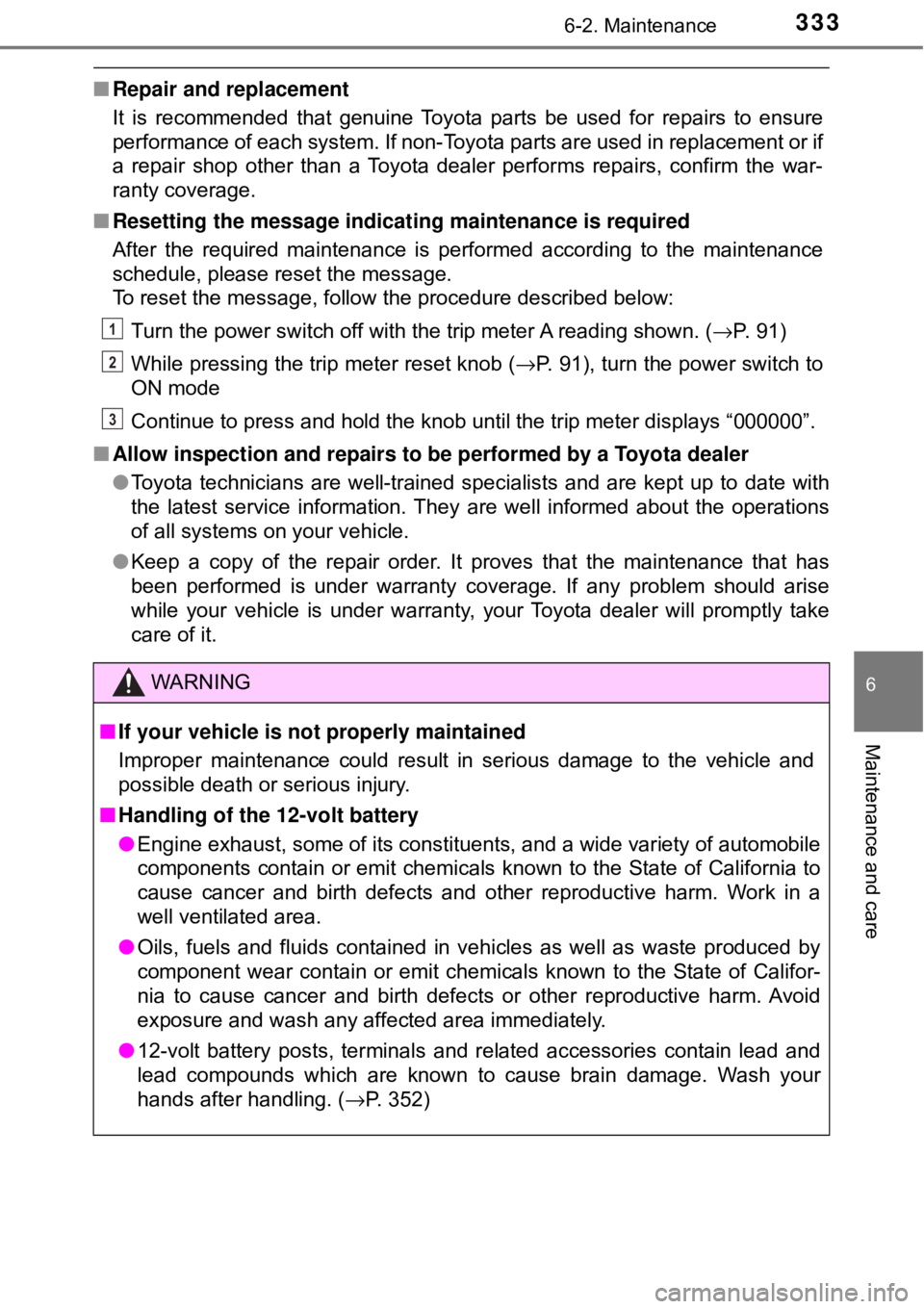
■ Resetting the message indicating maintenance is required
After the required maintenance is performed according to the maintenance
schedule, please reset the message.
To reset the message, follow the procedure described below:
Turn the power switch off with the trip meter A reading shown. ( →P. 91)
While pressing the trip meter reset knob ( →P. 91), turn the power switch to
ON mode
Continue to press and hold the knob until the trip meter displays “000000”.
■ Allow inspection and repairs to be performed by a Toyota dealer
●Toyota technicians are well-trained specialists and are kept up to date with
the latest service information. They are well informed about the operations
of all systems on your vehicle.
● Keep a copy of the repair order. It proves that the maintenance that has
been performed is under warranty covera ge. If any problem should arise
while your vehicle is under warranty, your Toyota dealer will promptly take
care of it.
WARNING
■ If your vehicle is not properly maintained
Improper maintenance could result in serious damage to the vehicle and
possible death or serious injury.
■ Handling of the 12-volt battery
● Engine exhaust, some of its constituents, and a wide variety of automobile
components contain or emit chemicals known to the State of California to
cause cancer and birth defects and other reproductive harm. Work in a
well ventilated area.
● Oils, fuels and fluids contained in vehicles as well as waste produced by
component wear contain or emit chemic als known to the State of Califor-
nia to cause cancer and birth defects or other reproductive harm. Avoid
exposure and wash any affected area immediately.
● 12-volt battery posts, terminals and related accessories contain lead and
lead compounds which are known to cause brain damage. Wash your
hands after handling. ( →P. 352)
1
2
3
Page 334 of 492
3346-2. Maintenance
General maintenance
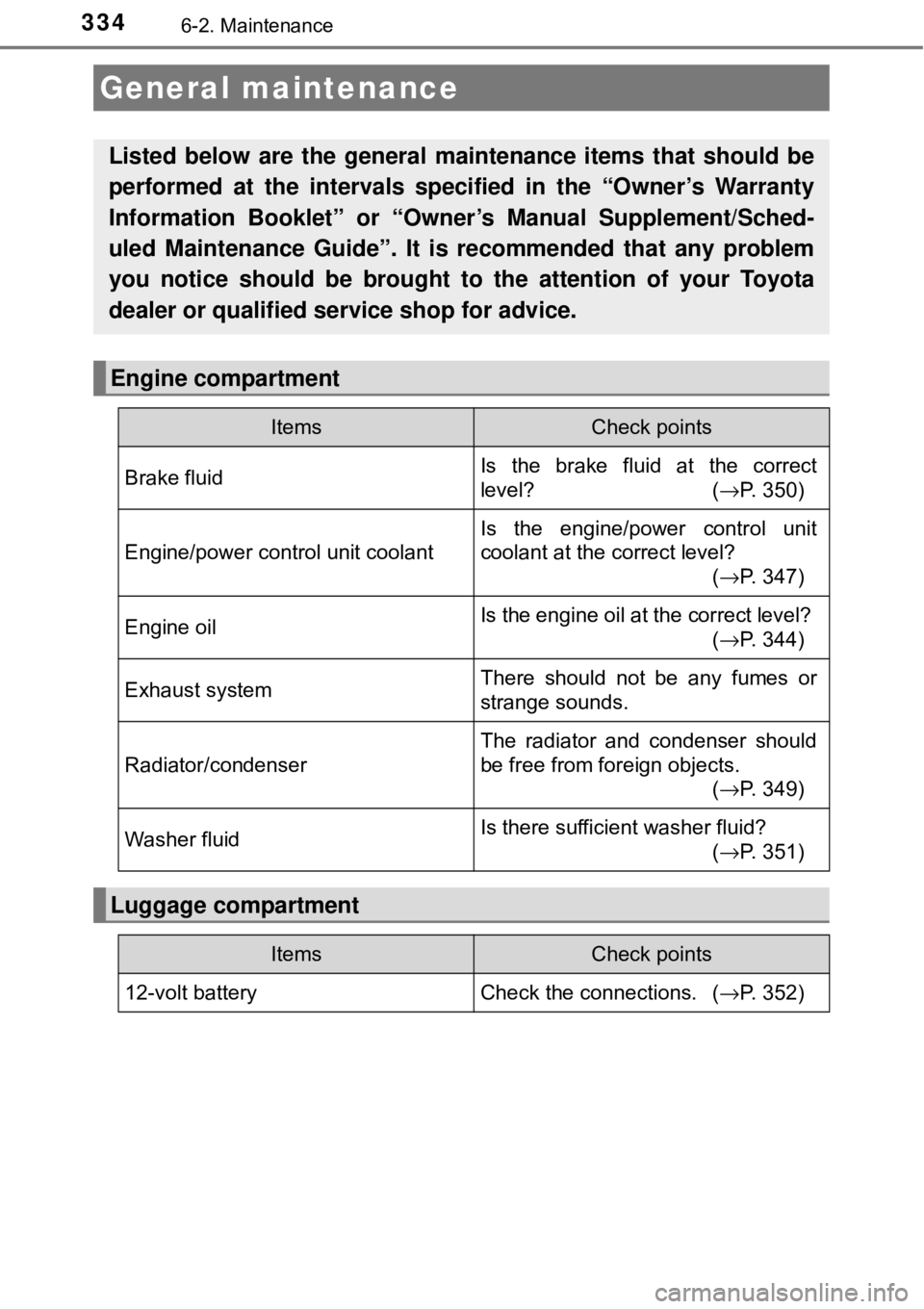
Listed below are the general maintenance items that should be
performed at the intervals specified in the “Owner’s Warranty
Information Booklet” or “Owner’s Manual Supplement/Sched-
uled Maintenance Guide”. It is recommended that any problem
you notice should be brought to the attention of your Toyota
dealer or qualified service shop for advice.
Engine compartment
ItemsCheck points
Brake fluidIs the brake fluid at the correct
level? ( →P. 350)
Engine/power control unit coolant
Is the engine/power control unit
coolant at the correct level?
(→P. 347)
Engine oilIs the engine oil at the correct level?
(→P. 344)
Exhaust systemThere should not be any fumes or
strange sounds.
Radiator/condenser
The radiator and condenser should
be free from foreign objects.
(→P. 349)
Washer fluidIs there sufficient washer fluid?
(→P. 351)
Luggage compartment
ItemsCheck points
12-volt batteryCheck the connections. ( →P. 352)
Page 338 of 492
3386-2. Maintenance
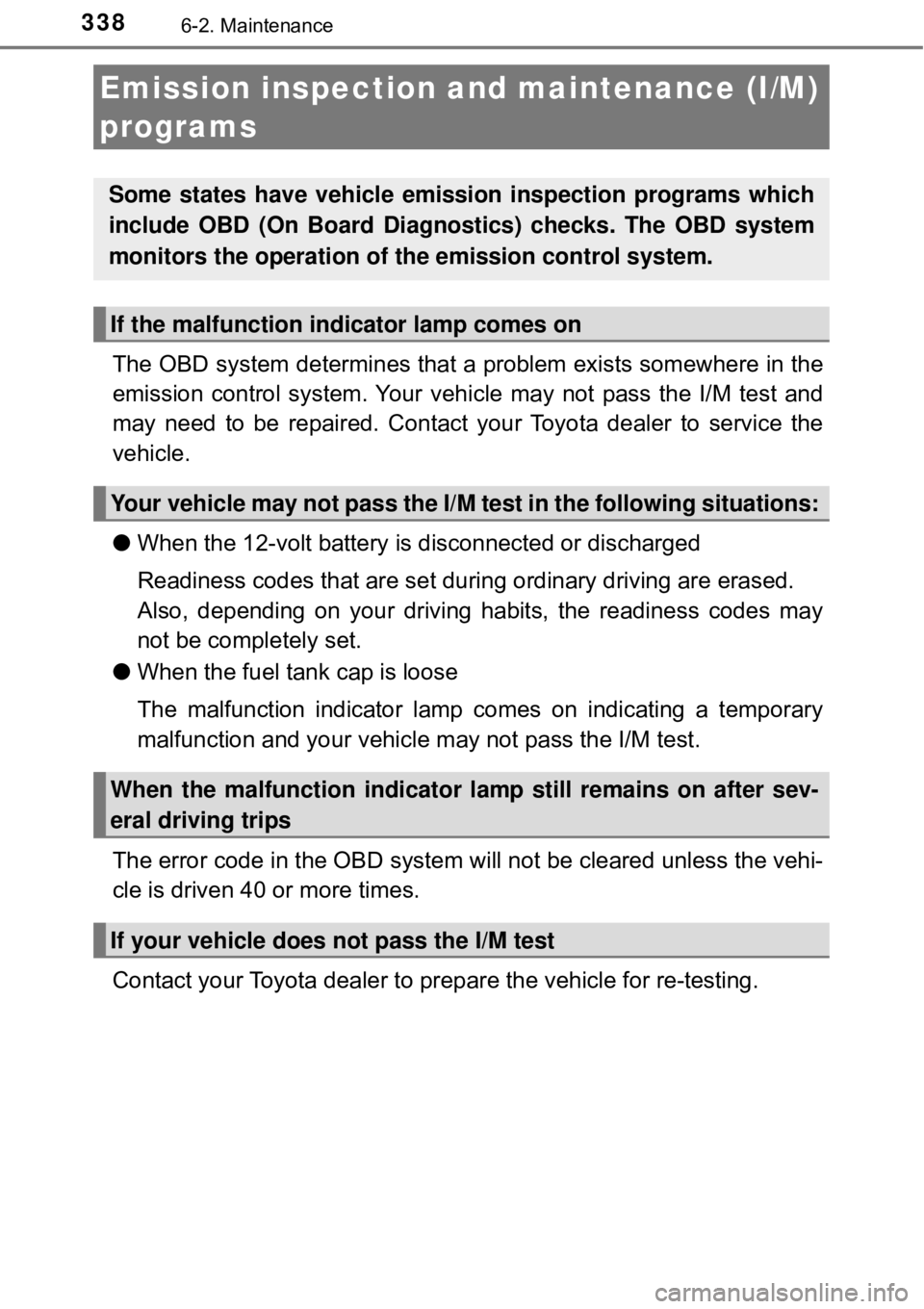
The OBD system determines that a problem exists somewhere in the
emission control system. Your vehi cle may not pass the I/M test and
may need to be repaired. Contact your Toyota dealer to service the
vehicle.
● When the 12-volt battery is disconnected or discharged
Readiness codes that are set duri ng ordinary driving are erased.
Also, depending on your driving habits, the readiness codes may
not be completely set.
● When the fuel tank cap is loose
The malfunction indicator lamp comes on indicating a temporary
malfunction and your vehicle may not pass the I/M test.
The error code in the OBD system will not be cleared unless the vehi-
cle is driven 40 or more times.
Contact your Toyota dealer to prepare the vehicle for re-testing.
Emission inspection an d maintenance (I/M)
programs
Some states have vehicle emission inspection programs which
include OBD (On Board Diagnos tics) checks. The OBD system
monitors the operation of the emission control system.
If the malfunction indicator lamp comes on
Your vehicle may not pass the I/M test in the following situations:
When the malfunction indicator la mp still remains on after sev-
eral driving trips
If your vehicle does not pass the I/M test
Page 339 of 492
339
6
Maintenance and care
6-3. Do-it-yourself maintenance
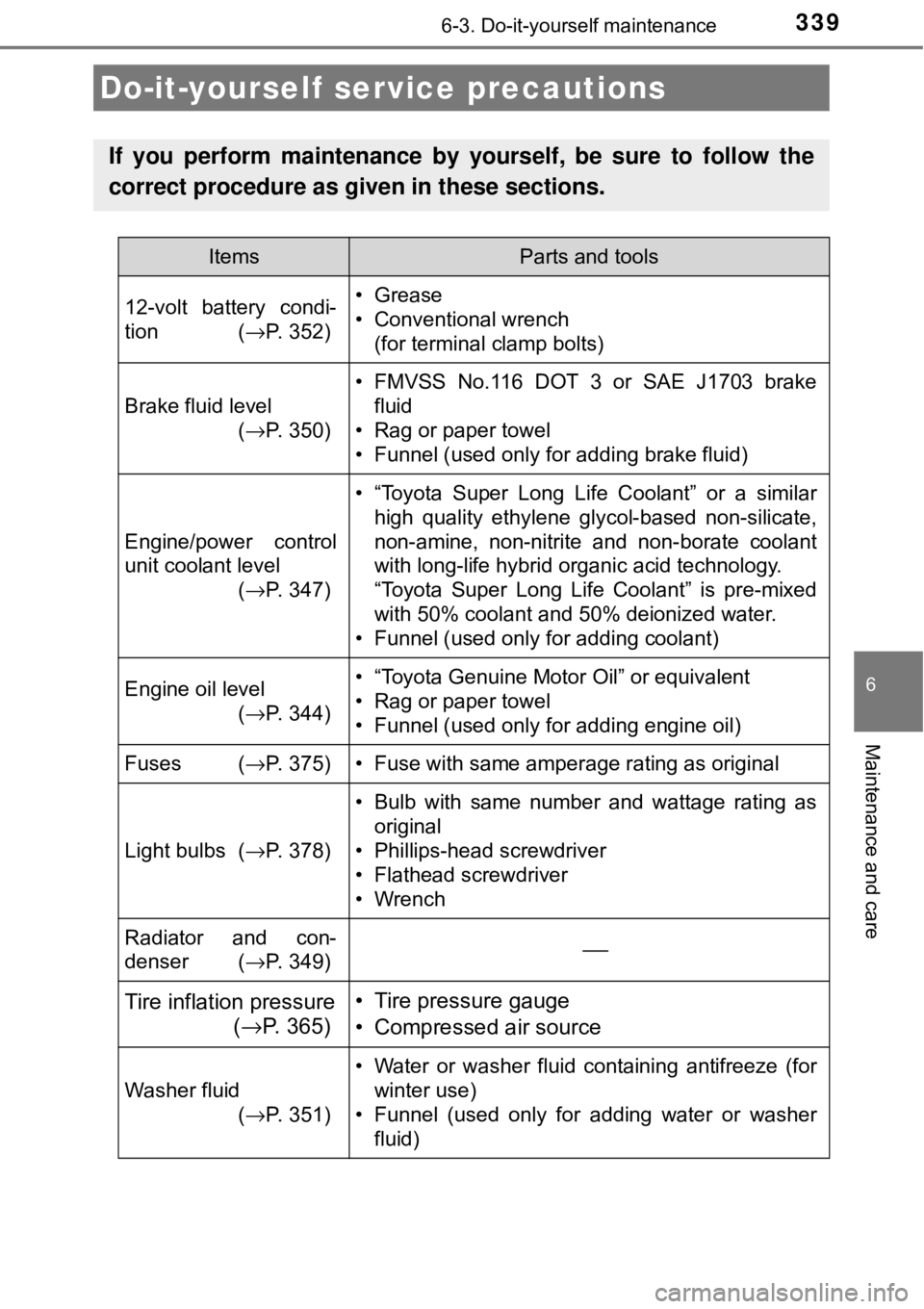
Do-it-yourself service precautions
If you perform maintenance by yourself, be sure to follow the
correct procedure as given in these sections.
ItemsParts and tools
12-volt battery condi-
tion (→P. 352)• Grease
• Conventional wrench
(for terminal clamp bolts)
Brake fluid level (→P. 350)
• FMVSS No.116 DOT 3 or SAE J1703 brake
fluid
• Rag or paper towel
• Funnel (used only for adding brake fluid)
Engine/power control
unit coolant level (→P. 347)
• “Toyota Super Long Life Coolant” or a similar
high quality ethylene glycol-based non-silicate,
non-amine, non-nitrite and non-borate coolant
with long-life hybrid organic acid technology.
“Toyota Super Long Life Coolant” is pre-mixed
with 50% coolant and 50% deionized water.
• Funnel (used only for adding coolant)
Engine oil level
(→P. 344)• “Toyota Genuine Motor Oil” or equivalent
• Rag or paper towel
• Funnel (used only for adding engine oil)
Fuses ( →P. 375)• Fuse with same amperage rating as original
Light bulbs (→P. 378)
• Bulb with same number and wattage rating as
original
• Phillips-head screwdriver
• Flathead screwdriver
• Wrench
Radiator and con-
denser ( →P. 349)⎯
Tire inflation pressure
(→ P. 365)• Tire pressure gauge
• Compressed air source
Washer fluid
(→P. 351)
• Water or washer fluid containing antifreeze (for
winter use)
• Funnel (used only for adding water or washer fluid)