warning light TOYOTA AVALON HYBRID 2018 Owners Manual (in English)
[x] Cancel search | Manufacturer: TOYOTA, Model Year: 2018, Model line: AVALON HYBRID, Model: TOYOTA AVALON HYBRID 2018Pages: 492, PDF Size: 7.3 MB
Page 1 of 492
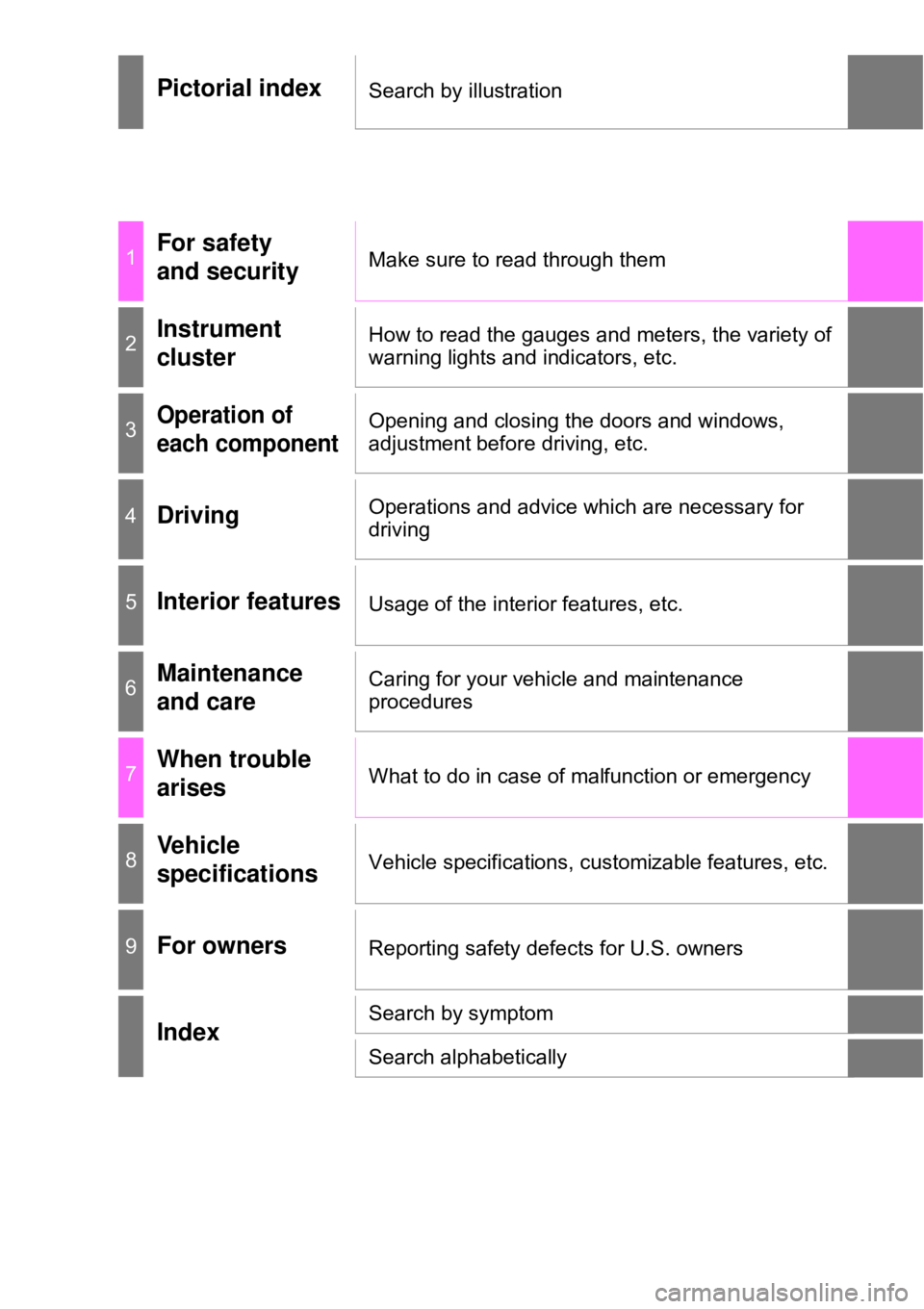
Pictorial indexSearch by illustration
1For safety
and securityMake sure to read through them
2Instrument
clusterHow to read the gauges and meters, the variety of
warning lights and indicators, etc.
3Operation of
each componentOpening and closing the doors and windows,
adjustment before driving, etc.
4DrivingOperations and advice which are necessary for
driving
5Interior featuresUsage of the interior features, etc.
6Maintenance
and careCaring for your vehicle and maintenance
procedures
7When trouble
arisesWhat to do in case of malfunction or emergency
8Vehicle
specificationsVehicle specifications, customizable features, etc.
9For ownersReporting safety defects for U.S. owners
IndexSearch by symptom
Search alphabetically
Page 2 of 492

TABLE OF CONTENTS2
For your information....................... 8
Reading this manual .................... 14
How to search .............................. 15
Pictorial index .............................. 16
1-1. For safe useBefore driving ...................... 26
For safe driving ................... 28
Seat belts ............................ 30
SRS airbags ........................ 36
Front passenger occupant classification system ......... 48
Safety information for children ............................. 54
Child restraint systems ........ 55
Installing child restraints ...... 59
Exhaust gas precautions ....................... 69
1-2. Hybrid system Hybrid system features ....... 70
Hybrid system precautions ....................... 74
1-3. Theft deterrent system Immobilizer system ............. 79
Alarm ................................... 81
Theft prevention labels ........ 83 2. Instrument cluster
Warning lights and indicators ........................... 86
Gauges and meters ............. 90
Multi-information display ...... 94
Energy monitor/ consumption screen ........ 100
3-1. Key information Keys................................... 106
3-2. Opening, closing and locking the doors
and trunk
Doors ................................. 110
Trunk ................................. 116
Smart key system .............. 121
3-3. Adjusting the seats Front seats......................... 131
Driving position memory ........................... 133
Head restraints .................. 138
3-4. Adjusting the steering wheel and mirrors
Steering wheel ................... 141
Inside rear view mirror ....... 143
Outside rear view mirrors ............................. 145
3-5. Opening, closing the windows and
moon roof
Power windows.................. 148
Moon roof .......................... 151
1For safety and security
2Instrument cluster
3Operation of
each component
Page 5 of 492

5
1
8 7
6
5
4
3
2
9
6-1. Maintenance and careCleaning and protecting the vehicle exterior .......... 326
Cleaning and protecting the vehicle interior ........... 329
6-2. Maintenance Maintenance requirements ................... 332
General maintenance ........ 334
Emission inspection and maintenance (I/M)
programs ......................... 338
6-3. Do-it-yourself maintenance
Do-it-yourself service precautions ..................... 339
Hood.................................. 341
Positioning a floor jack ...... 342
Engine compartment ......... 343
12-volt battery ................... 352
Tires .................................. 356
Tire inflation pressure........ 365
Wheels .............................. 368
Air conditioning filter .......... 371
Electronic key battery ........ 373
Checking and replacing fuses ............................... 375
Light bulbs ......................... 378 7-1. Essential information
Emergency flashers ........... 392
If your vehicle has to be stopped in an
emergency....................... 393
7-2. Steps to take in an emergency
If your vehicle needs to be towed ...................... 394
If you think something is wrong ........................... 397
If a warning light turns on or a warning buzzer
sounds ............................. 398
If a warning message is displayed...................... 407
If you have a flat tire .......... 408
If the hybrid system will not start ........................... 420
If the electronic key does not operate properly ........ 422
If the 12-volt battery is discharged ................... 424
If your vehicle overheats......................... 429
If the vehicle becomes stuck ................................ 433
6Maintenance and care7When trouble arises
Page 16 of 492
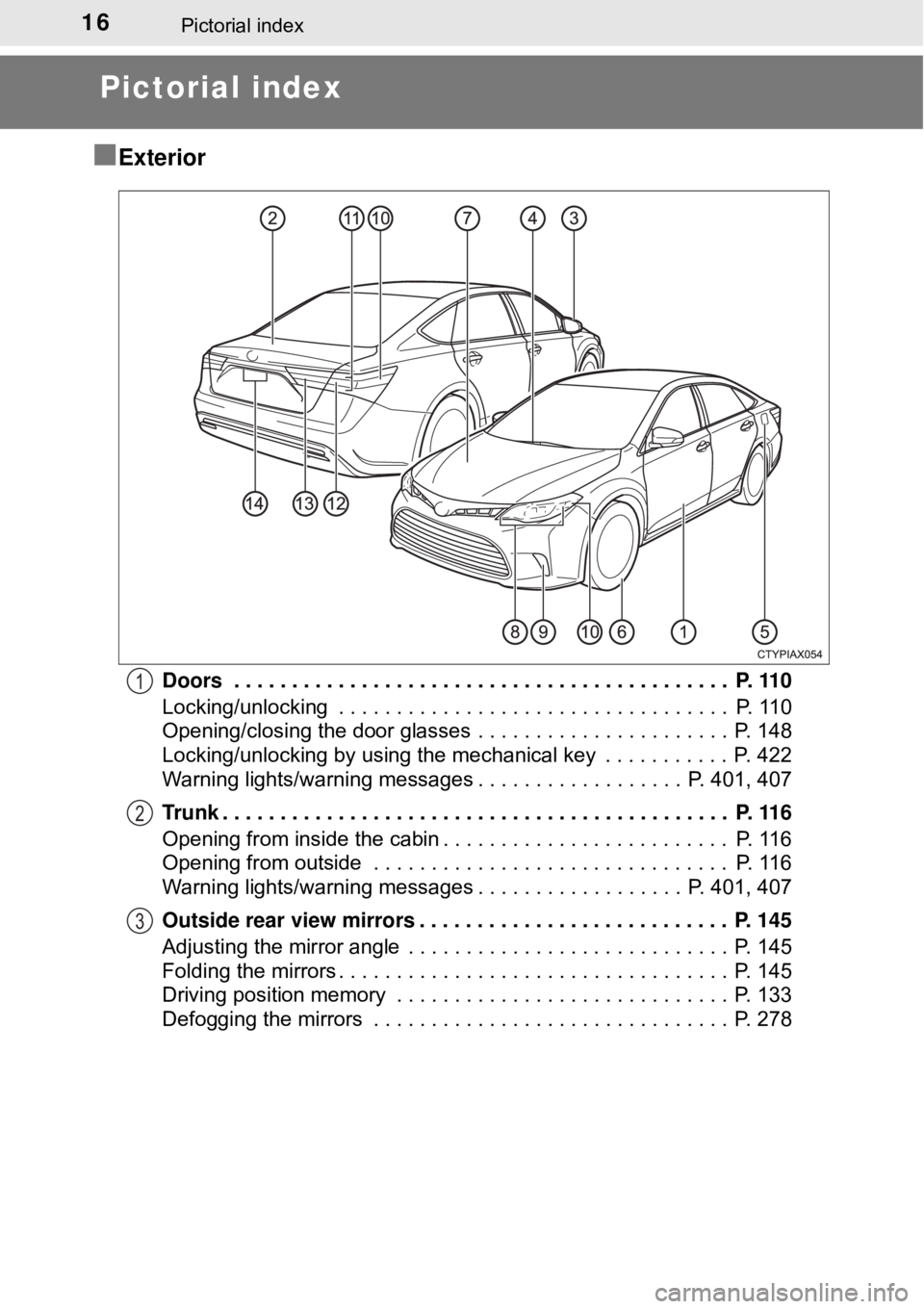
16Pictorial index
Pictorial index
■
Exterior
Doors . . . . . . . . . . . . . . . . . . . . . . . . . . . . . . . . . . . . . . . . . . . P. 110
Locking/unlocking . . . . . . . . . . . . . . . . . . . . . . . . . . . . . . . . . . P. 110
Opening/closing the door glasses . . . . . . . . . . . . . . . . . . . . . . P. 148
Locking/unlocking by using the mechanical key . . . . . . . . . . . P. 422
Warning lights/warning messages . . . . . . . . . . . . . . . . . . P. 401, 407
Trunk . . . . . . . . . . . . . . . . . . . . . . . . . . . . . . . . . . . . . . . . . . . . P. 116
Opening from inside the cabin . . . . . . . . . . . . . . . . . . . . . . . . . P. 116
Opening from outside . . . . . . . . . . . . . . . . . . . . . . . . . . . . . . . P. 116
Warning lights/warning messages . . . . . . . . . . . . . . . . . . P. 401, 407
Outside rear view mirrors . . . . . . . . . . . . . . . . . . . . . . . . . . . P. 145
Adjusting the mirror angle . . . . . . . . . . . . . . . . . . . . . . . . . . . . P. 145
Folding the mirrors . . . . . . . . . . . . . . . . . . . . . . . . . . . . . . . . . . P. 145
Driving position memory . . . . . . . . . . . . . . . . . . . . . . . . . . . . . P. 133
Defogging the mirrors . . . . . . . . . . . . . . . . . . . . . . . . . . . . . . . P. 2781
2
3
Page 17 of 492
17Pictorial index
Windshield wipers . . . . . . . . . . . . . . . . . . . . . . . . . . . . . . . . . P. 193
Precautions against winter season . . . . . . . . . . . . . . . . . . . . . P. 269
Precautions against car wash . . . . . . . . . . . . . . . . . . . . . . . . . P. 327
Fuel filler door . . . . . . . . . . . . . . . . . . . . . . . . . . . . . . . . . . . . P. 198
Refueling method . . . . . . . . . . . . . . . . . . . . . . . . . . . . . . . . . . . P. 198
Fuel type/fuel tank capacity . . . . . . . . . . . . . . . . . . . . . . . . . . . P. 438
Tires . . . . . . . . . . . . . . . . . . . . . . . . . . . . . . . . . . . . . . . . . . P. 356
Tire size/inflation pressure . . . . . . . . . . . . . . . . . . . . . . . . . P. 443
Winter tires/tire chain . . . . . . . . . . . . . . . . . . . . . . . . . . . . . P. 269
Checking/rotation/tire pressure warning system . . . . . . . . . P. 356
Coping with flat tires . . . . . . . . . . . . . . . . . . . . . . . . . . . . . . P. 408
Hood . . . . . . . . . . . . . . . . . . . . . . . . . . . . . . . . . . . . . . . . . . . . P. 341
Opening . . . . . . . . . . . . . . . . . . . . . . . . . . . . . . . . . . . . . . . . . . P. 341
Engine oil . . . . . . . . . . . . . . . . . . . . . . . . . . . . . . . . . . . . . . . . . P. 439
Coping with overheat . . . . . . . . . . . . . . . . . . . . . . . . . . . . . . . . P. 429
Headlights/daytime running lights
*. . . . . . . . . . . . . . . . . . . P. 186
Parking lights
*/daytime running lights* . . . . . . . . . . . . . . . P. 186
Front turn signal/parking lights
* . . . . . . . . . . . . . . . . . . . . . P. 184
Side marker lights . . . . . . . . . . . . . . . . . . . . . . . . . . . . . . . . . P. 186
Stop/tail lights . . . . . . . . . . . . . . . . . . . . . . . . . . . . . . . . . . . . P. 186
Rear turn signal lights . . . . . . . . . . . . . . . . . . . . . . . . . . . . . . P. 184
Back-up lights
Shifting the shift lever to R . . . . . . . . . . . . . . . . . . . . . . . . . . . . P. 180
License plate lights . . . . . . . . . . . . . . . . . . . . . . . . . . . . . . . . P. 186
4
5
6
7
Light bulbs of the exter ior lights for driving
(Replacing method: P. 378, Wattages: P. 444)
*: If equipped
8
9
10
11
12
13
14
Page 18 of 492
18Pictorial index
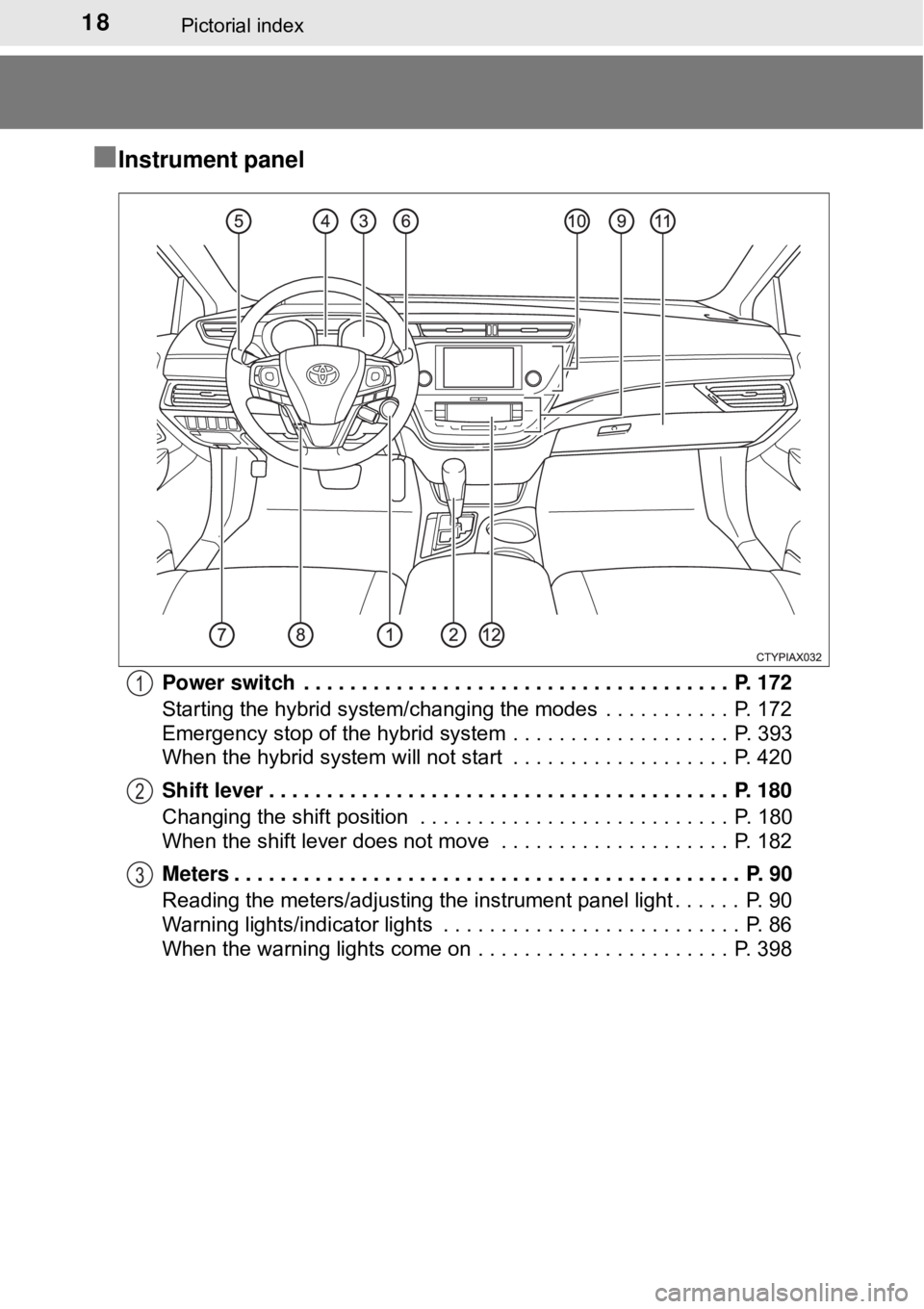
■Instrument panel
Power switch . . . . . . . . . . . . . . . . . . . . . . . . . . . . . . . . . . . . . P. 172
Starting the hybrid system/changing the modes . . . . . . . . . . . P. 172
Emergency stop of the hybrid system . . . . . . . . . . . . . . . . . . . P. 393
When the hybrid system will not start . . . . . . . . . . . . . . . . . . . P. 420
Shift lever . . . . . . . . . . . . . . . . . . . . . . . . . . . . . . . . . . . . . . . . P. 180
Changing the shift position . . . . . . . . . . . . . . . . . . . . . . . . . . . P. 180
When the shift lever does not move . . . . . . . . . . . . . . . . . . . . P. 182
Meters . . . . . . . . . . . . . . . . . . . . . . . . . . . . . . . . . . . . . . . . . . . . P. 90
Reading the meters/adjusting the instrument panel light . . . . . . P. 90
Warning lights/indicator lights . . . . . . . . . . . . . . . . . . . . . . . . . . P. 86
When the warning lights come on . . . . . . . . . . . . . . . . . . . . . . P. 3981
2
3
Page 19 of 492

19Pictorial index
Multi-information display . . . . . . . . . . . . . . . . . . . . . . . . . . . . P. 94
Display . . . . . . . . . . . . . . . . . . . . . . . . . . . . . . . . . . . . . . . . . . . . P. 94
Energy monitor . . . . . . . . . . . . . . . . . . . . . . . . . . . . . . . . . . . . P. 100
When the warning messages are displayed . . . . . . . . . . . . . . P. 407
Turn signal lever . . . . . . . . . . . . . . . . . . . . . . . . . . . . . . . . . . P. 184
Headlight switch . . . . . . . . . . . . . . . . . . . . . . . . . . . . . . . . . . . . P. 186
Headlights/parking lights/tail lights/daytime running lights . . . . P. 186
Windshield wiper and washer switch . . . . . . . . . . . . . . . . . P. 193
Usage . . . . . . . . . . . . . . . . . . . . . . . . . . . . . . . . . . . . . . . . . . . P. 193
Adding washer fluid . . . . . . . . . . . . . . . . . . . . . . . . . . . . . . . . . P. 351
Hood lock release lever. . . . . . . . . . . . . . . . . . . . . . . . . . . . . P. 341
Tilt and telescopic steering lock release lever . . . . . . . . . . P. 141
Air conditioning system . . . . . . . . . . . . . . . . . . . . . . . . . . . . P. 274
Usage . . . . . . . . . . . . . . . . . . . . . . . . . . . . . . . . . . . . . . . . . . . P. 274
Rear window defogger . . . . . . . . . . . . . . . . . . . . . . . . . . . . . . . P. 278
Audio/Navigation system
*
Glove box . . . . . . . . . . . . . . . . . . . . . . . . . . . . . . . . . . . . . . . . P. 290
Clock . . . . . . . . . . . . . . . . . . . . . . . . . . . . . . . . . . . . . . . . . . . . P. 300
*: Refer to “NAVIGATION AND MULTIMEDIA SYSTEM OWNER’S MANUAL”.
4
5
6
7
8
9
10
11
12
Page 34 of 492

341-1. For safe use
WARNING
■People suffering illness
Obtain medical advice and wear the seat belt in the proper way. ( →P. 30)
■ When children are in the vehicle
Do not allow children to play with the seat belt. If the seat belt becomes
twisted around a child’s neck, it may lead to choking or other serious injuries
that could result in death.
If this occurs and the buckle cannot be unfastened, scissors should be used
to cut the belt.
■ Seat belt pretensioners (front seats)
● Do not place anything, such as a cushion, on the front passenger's seat.
Doing so will disperse the passenger's weight, which prevents the sensor
from detecting the passenger's weight properly. As a result, the seat belt
pretensioner for the front passenger's seat may not activate in the event of
a collision.
● If the pretensioner has activated, the SRS warning light will come on. In
that case, the seat belt cannot be used again and must be replaced at
your Toyota dealer.
■ Adjustable shoulder anchor (front seats)
Always make sure the shoulder belt is positioned across the center of your
shoulder. The belt should be kept away from your neck, but not falling off
your shoulder. Failure to do so could reduce the amount of protection in an
accident and cause death or serious injuries in the event of a sudden stop,
sudden swerve or accident. ( →P. 31)
Page 38 of 492
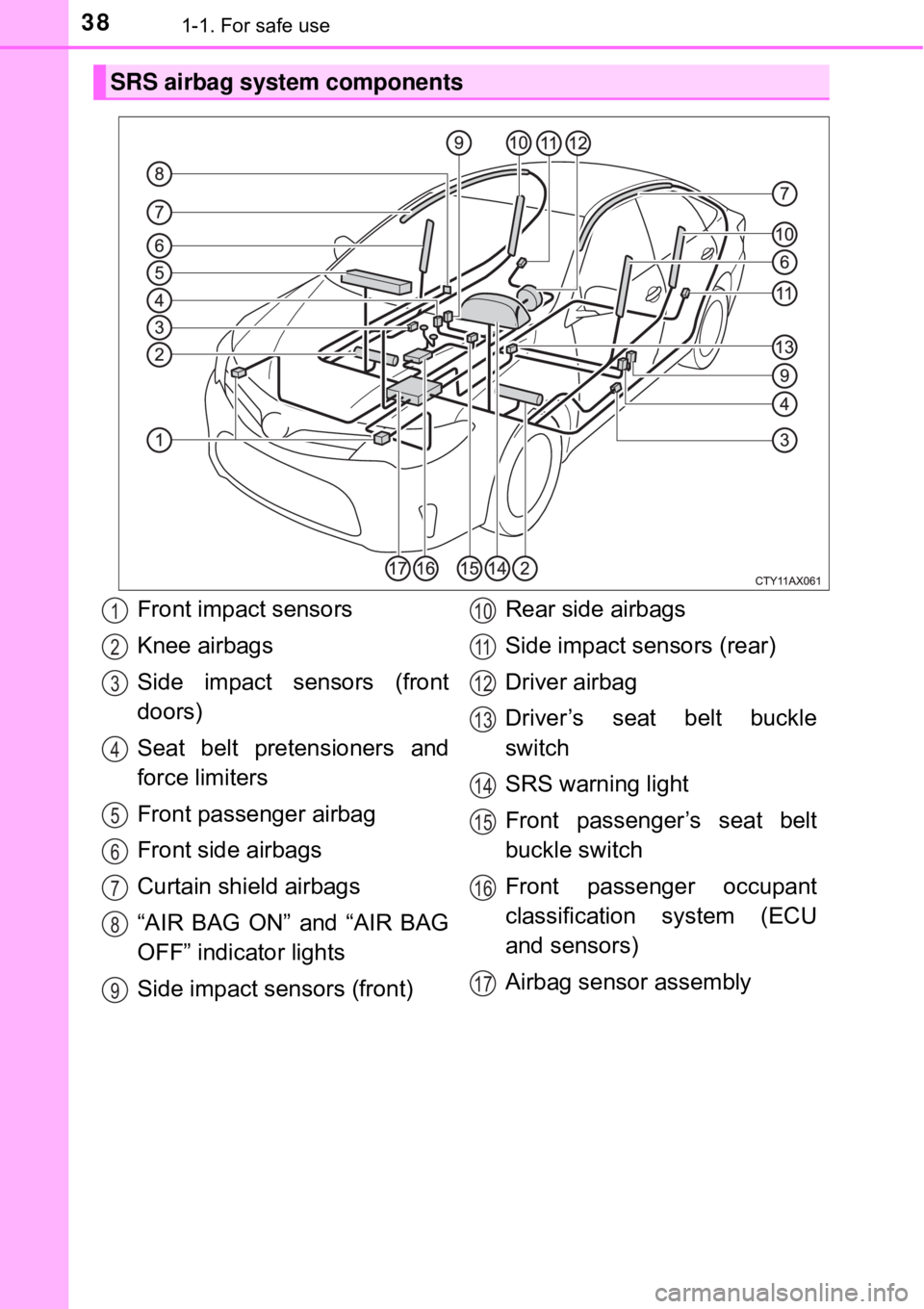
381-1. For safe use
SRS airbag system components
Front impact sensors
Knee airbags
Side impact sensors (front
doors)
Seat belt pretensioners and
force limiters
Front passenger airbag
Front side airbags
Curtain shield airbags
“AIR BAG ON” and “AIR BAG
OFF” indicator lights
Side impact sensors (front)Rear side airbags
Side impact sensors (rear)
Driver airbag
Driver’s seat belt buckle
switch
SRS warning light
Front passenger’s seat belt
buckle switch
Front passenger occupant
classification system (ECU
and sensors)
Airbag sensor assembly1
2
3
4
5
6
7
8
9
10
11
12
13
14
15
16
17
Page 39 of 492

391-1. For safe use
1
For safety and security
Your vehicle is equipped with ADVANCED AIRBAGS designed based
on the US motor vehicle safety standards (FMVSS208). The airbag
sensor assembly (ECU ) controls airbag deployment based on infor-
mation obtained from the sensors et c. shown in the system compo-
nents diagram above. This informat ion includes crash severity and
occupant information. As the airbags deploy, a chemical reaction in
the inflators quickly fills the airbag s with non-toxic gas to help restrain
the motion of the occupants.
WARNING
■ SRS airbag precautions
Observe the following precautions regarding the SRS airbags.
Failure to do so may cause death or serious injury.
● The driver and all passengers in the vehicle must wear their seat belts
properly.
The SRS airbags are supplemental devices to be used with the seat belts.
● The SRS driver airbag deploys with considerable force, and can cause
death or serious injury especially if the driver is very close to the airbag.
The National Highway Traffic Safety Administration (NHTSA) advises:
Since the risk zone for the driver’s airbag is the first 2 - 3 in. (50 - 75 mm)
of inflation, placing yourself 10 in. (250 mm) from your driver airbag pro-
vides you with a clear margin of safety. This distance is measured from
the center of the steering wheel to your breastbone. If you sit less than 10
in. (250 mm) away now, you can change your driving position in several
ways:
• Move your seat to the rear as far as you can while still reaching the ped- als comfortably.
• Slightly recline the back of the seat.
Although vehicle designs vary, many drivers can achieve the 10 in. (250
mm) distance, even with the driver seat all the way forward, simply by
reclining the back of the seat somewhat. If reclining the back of your
seat makes it hard to see the road, raise yourself by using a firm, non-
slippery cushion, or raise the seat if your vehicle has that feature.
• If your steering wheel is adjustable, tilt it downward. This points the air-
bag toward your chest instead of your head and neck.
The seat should be adjusted as recommended by NHTSA above, while
still maintaining control of the foot pedals, steering wheel, and your v\
iew
of the instrument panel controls.