chain TOYOTA AVENSIS 2011 Owners Manual
[x] Cancel search | Manufacturer: TOYOTA, Model Year: 2011, Model line: AVENSIS, Model: TOYOTA AVENSIS 2011Pages: 772, PDF Size: 34.43 MB
Page 324 of 772
324 2-4. Using other driving systems
AVENSIS_EE (OM20B44E)
CAUTION
Turn the LKA off while driving in any of the following conditions
Do not use LKA in any of the following situations.
Otherwise, the system may not function correctly and could result in an acci-
dent.
When driving with snow tires, tire chains, a spare tire, or similar equip-
ment.
When driving with non-standard parts or aftermarket equipment installed.
(including modified tires and suspensions, etc.)
When towing a trailer.
When there are objects or structures along the roadside that might be mis-
interpreted as lane markers (such as guardrails, curb, reflector posts, etc.).
When there are wheel ruts, icy trademarks, etc. or if snow remains on the
road surface.
When there are shadows on the road running parallel with lane markers,
or if a shadow covers the lane markers.
When there are visible lines on the pavement from road repairs, or if the
remains of old lane markers are still visible on the road.
When driving on slippery roads, such as those covered with rain, ice or
snow.
When driving in a lane other than the driving or passing lanes on a freeway
or highway.
When driving on a road with lane closures due to maintenance, or when
driving in a temporary lane.
When driving on winding roads or roads that are rough or uneven.
Page 331 of 772
331 2-4. Using other driving systems
2
When driving
AVENSIS_EE (OM20B44E)
CAUTION
Any of the following conditions may result in an accident which could cause
death or serious injury:
The ABS does not operate effectively when
The limits of tire gripping performance have been exceeded.
The vehicle hydroplanes while driving at high speed on a wet or slick road.
Stopping distance when the ABS is operating may exceed that of nor-
mal conditions
The ABS is not designed to shorten the vehicle’s stopping distance. Always
maintain a safe distance from the vehicle in front of you in the following situ-
ations:
When driving on dirt, gravel or snow-covered roads
When driving with tire chains
When driving over bumps in the road
When driving over roads with potholes or roads with uneven roads
TRC may not operate effectively when
Directional control and power may not be achievable while driving on slip-
pery road surfaces, even if the TRC is operating.
Do not drive the vehicle in conditions where stability and power may be lost.
When the VSC is activated
The slip indicator light flashes. Always drive carefully.
Reckless driving may cause an accident. Exercise particular care when the
indicator light flashes.
Page 344 of 772
344
2-5. Driving information
AVENSIS_EE (OM20B44E)
Winter driving tips
Carry out the necessary preparations and inspections before driving
the vehicle in winter. Always drive the vehicle in a manner appropri-
ate to the prevailing weather conditions.
Pre-winter preparations
Use fluids that are appropriate to the prevailing outside tem-
peratures.
• Engine oil
• Engine coolant
• Washer fluid
Have a service technician inspect the level and specific grav-
ity of battery electrolyte.
Have the vehicle fitted with four snow tires or purchase a set
of tire chains for the front tires.
Ensure that all tires are the same size and brand, and that chains
match the size of the tires.
Page 346 of 772
346 2-5. Driving information
AVENSIS_EE (OM20B44E)
Selecting tire chains
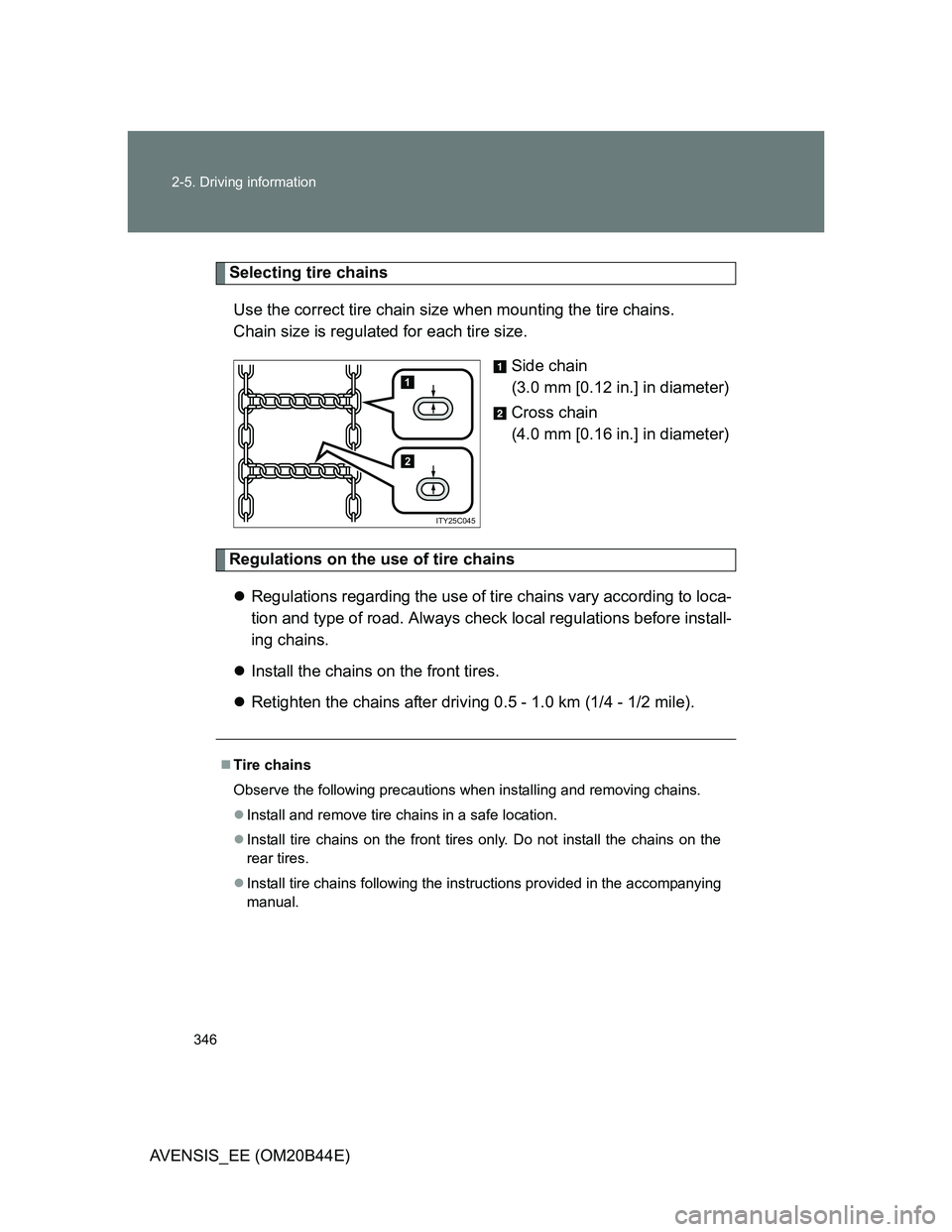
Use the correct tire chain size when mounting the tire chains.
Chain size is regulated for each tire size.
Side chain
(3.0 mm [0.12 in.] in diameter)
Cross chain
(4.0 mm [0.16 in.] in diameter)
Regulations on the use of tire chains
Regulations regarding the use of tire chains vary according to loca-
tion and type of road. Always check local regulations before install-
ing chains.
Install the chains on the front tires.
Retighten the chains after driving 0.5 - 1.0 km (1/4 - 1/2 mile).
1
2
ITY25C045
Tire chains
Observe the following precautions when installing and removing chains.
Install and remove tire chains in a safe location.
Install tire chains on the front tires only. Do not install the chains on the
rear tires.
Install tire chains following the instructions provided in the accompanying
manual.
Page 347 of 772
347 2-5. Driving information
2
When driving
AVENSIS_EE (OM20B44E)
CAUTION
Driving with snow tires
Observe the following precautions to reduce the risk of accidents.
Failing to do so may result in a loss of vehicle control and cause death or
serious injury.
Use tires of the size specified for your vehicle.
Maintain the recommended level of tire inflation pressure.
Do not drive at speeds in excess of the speed limit or the speed limit spec-
ified for the snow tires being used.
Snow tires should be installed on all wheels.
Driving with tire chains
Observe the following precautions to reduce the risk of accidents.
Failing to do so may result in the vehicle being unable to be driven safely,
and may cause death or serious injury.
Do not drive in excess of the speed limit specified for the tire chains being
used or 50 km/h (30 mph), whichever is lower.
Avoid driving on bumpy road surfaces or over potholes.
Avoid sudden turns and braking, as use of chains may adversely affect
vehicle handling.
Slow down sufficiently before entering a curve to ensure that vehicle con-
trol is maintained.
Page 554 of 772
554 4-3. Do-it-yourself maintenance
AVENSIS_EE (OM20B44E)
Low profile tires (225/45R18 tires)
Generally, low profile tires will wear more rapidly and tire grip performance
will be reduced on snowy and/or icy roads when compared to standard tires.
Be sure to use snow tires or tire chains on snowy and/or icy roads and drive
carefully at a speed appropriate for road and weather conditions.
CAUTION
When inspecting or replacing tires
Observe the following precautions to prevent accidents.
Failure to do so may cause damage to parts of the drive train, as well as
dangerous handling characteristics, which may lead to an accident resulting
in death or serious injury.
Do not mix tires of different makes, models or tread patterns.
Also, do not mix tires of remarkably different treadwear.
Do not use tire sizes other than those recommended by Toyota.
Do not mix differently constructed tires (radial, bias-belted or bias-ply
tires).
Do not mix summer, all season and snow tires.
Do not use tires that have been used on another vehicle.
Do not use tires if you do not know how they were used previously.
Page 558 of 772
558
4-3. Do-it-yourself maintenance
AVENSIS_EE (OM20B44E)
Wheels
If a wheel is bent, cracked or heavily corroded, it should be replaced.
Otherwise, the tire may separate from the wheel or cause loss of
handling control.
Wheel selection
When replacing wheels, care should be taken to ensure that
they are equivalent to those removed in load capacity, diameter,
rim width, and inset
*.
Replacement wheels are available at any authorized Toyota
dealer or repairer, or another duly qualified and equipped profes-
sional.
*: Conventionally referred to as “offset”.
Toyota does not recommend using:
Wheels of different sizes or types
Used wheels
Bent wheels that have been straightened
Aluminum wheel precautions
Use only Toyota wheel nuts and wrenches designed for use
with your aluminum wheels.
When rotating, repairing or changing your tires, check that the
wheel nuts are still tight after driving 1600 km (1000 miles).
Be careful not to damage the aluminum wheels when using
tire chains.
Use only Toyota genuine balance weights or equivalent and a
plastic or rubber hammer when balancing your wheels.
Page 605 of 772
5
605
5-1. Essential information
When trouble arises
AVENSIS_EE (OM20B44E)
If your vehicle needs to be towed
Before towing
The following may indicate a problem with your transmission. Contact
any authorized Toyota dealer or repairer, or another duly qualified
and equipped professional, before towing.
The engine is running, but the vehicle will not move.
The vehicle makes an abnormal sound.
If towing is necessary, we recommend having your vehicle towed by
any authorized Toyota dealer or repairer, or another duly qualified
and equipped professional, such as a commercial towing service,
using a lift-type truck or a flat bed truck.
Use a safety chain system for all towing, and abide by all state/pro-
vincial and local laws.
If towing from the front, the vehicle’s rear wheels and axles must be
in good condition. (P. 612)
If they are damaged, use a towing dolly or flat bed truck.
Page 606 of 772
606 5-1. Essential information
AVENSIS_EE (OM20B44E)
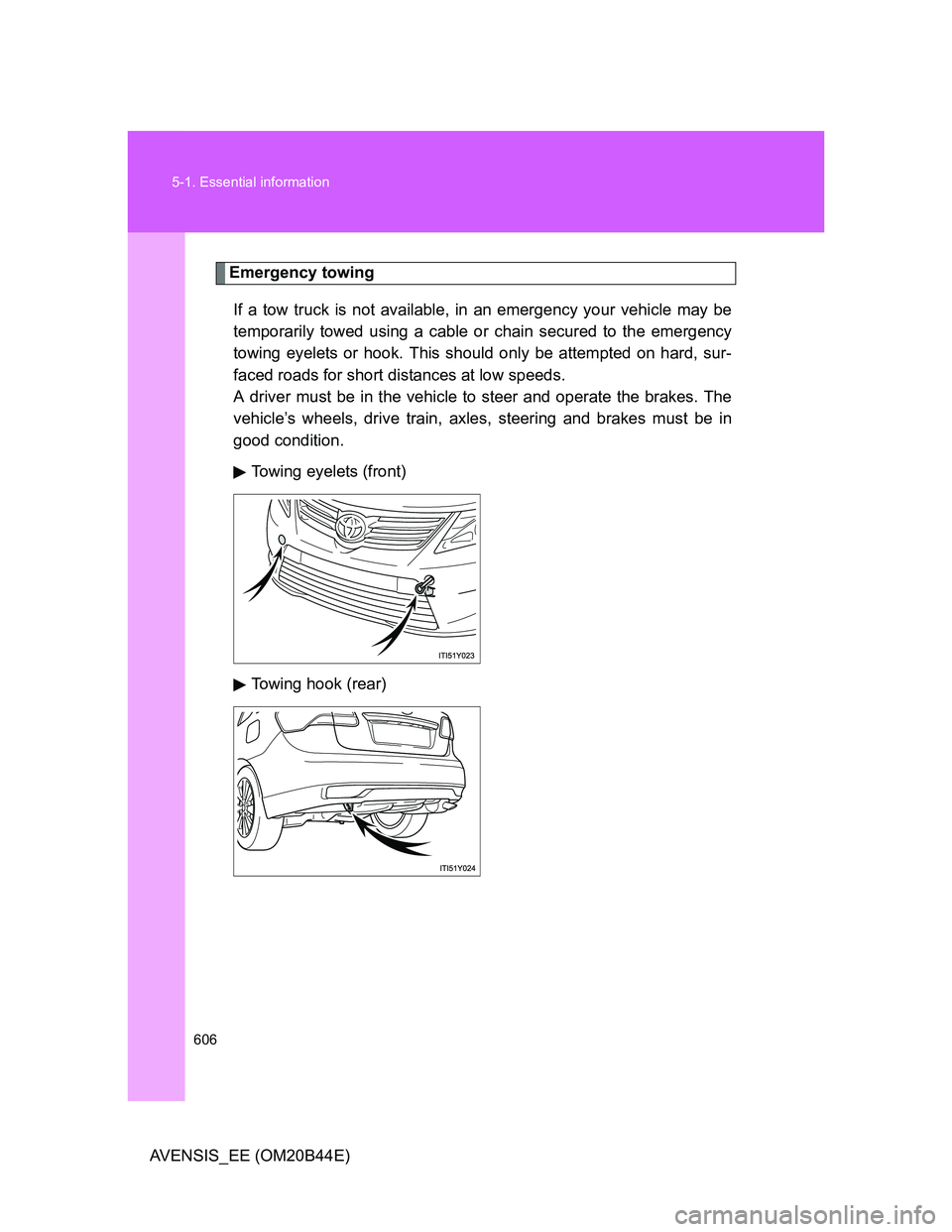
Emergency towing
If a tow truck is not available, in an emergency your vehicle may be
temporarily towed using a cable or chain secured to the emergency
towing eyelets or hook. This should only be attempted on hard, sur-
faced roads for short distances at low speeds.
A driver must be in the vehicle to steer and operate the brakes. The
vehicle’s wheels, drive train, axles, steering and brakes must be in
good condition.
Towing eyelets (front)
Towing hook (rear)
Page 607 of 772
5
607 5-1. Essential information
When trouble arises
AVENSIS_EE (OM20B44E)
Emergency towing procedure
Vehicles with smart entry & start system
Release the parking brake.
Put the shift lever in “N”.
The “ENGINE START STOP” switch must be in ACCESSORY
mode (engine off) or IGNITION ON mode (engine running).
Vehicles without smart entry & start system
Release the parking brake.
Put the shift lever in “N”.
Put the engine switch in the “ACC” (engine off) or “ON” position
(engine running).
CAUTION
While towing
Use extreme caution when towing the vehicle.
Avoid sudden starts or erratic driving maneuvers which place excessive
stress on the emergency towing eyelets and the cables or chains. Always
be cautious of the surroundings and other vehicles while towing.
If the engine is not running, the power assist for the brakes and steering
will not function, making steering and braking more difficult.
STEP1
STEP2
STEP3
STEP1
STEP2
STEP3