ECU TOYOTA AVENSIS 2012 User Guide
[x] Cancel search | Manufacturer: TOYOTA, Model Year: 2012, Model line: AVENSIS, Model: TOYOTA AVENSIS 2012Pages: 772, PDF Size: 34.43 MB
Page 147 of 772
147 1-6. Theft deterrent system
1
Before driving
AVENSIS_EE (OM20B44E)
Intrusion sensor (if equipped)
The intrusion sensor detects an intruder or movement in the vehicle.
The intrusion sensor can be canceled using the cancel switch.
This system is designed to deter and prevent vehicle theft but does
not guarantee absolute security against all intrusions.
Deactivating or stopping the alarm
Do one of the following to deactivate or stop the alarm.
Unlock the doors, trunk or back door using the smart entry &
start system or the wireless remote control.
Start the engine. (The alarm will be deactivated or stopped
after a few seconds.)
Page 164 of 772
164 1-7. Safety information
AVENSIS_EE (OM20B44E)
CAUTION
SRS airbag precautions
The SRS front passenger airbag also deploys with considerable force, and
can cause death or serious injury especially if the front passenger is very
close to the airbag. The front passenger seat should be as far from the air-
bag as possible with the seatback adjusted, so the front passenger sits
upright.
Improperly seated and/or restrained infants and children can be killed or
seriously injured by a deploying airbag. An infant or child who is too small
to use a seat belt should be properly secured using a child restraint sys-
tem. Toyota strongly recommends that all infants and children be placed in
the rear seats of the vehicle and properly restrained. The rear seats are
the safest for infants and children. (P. 168)
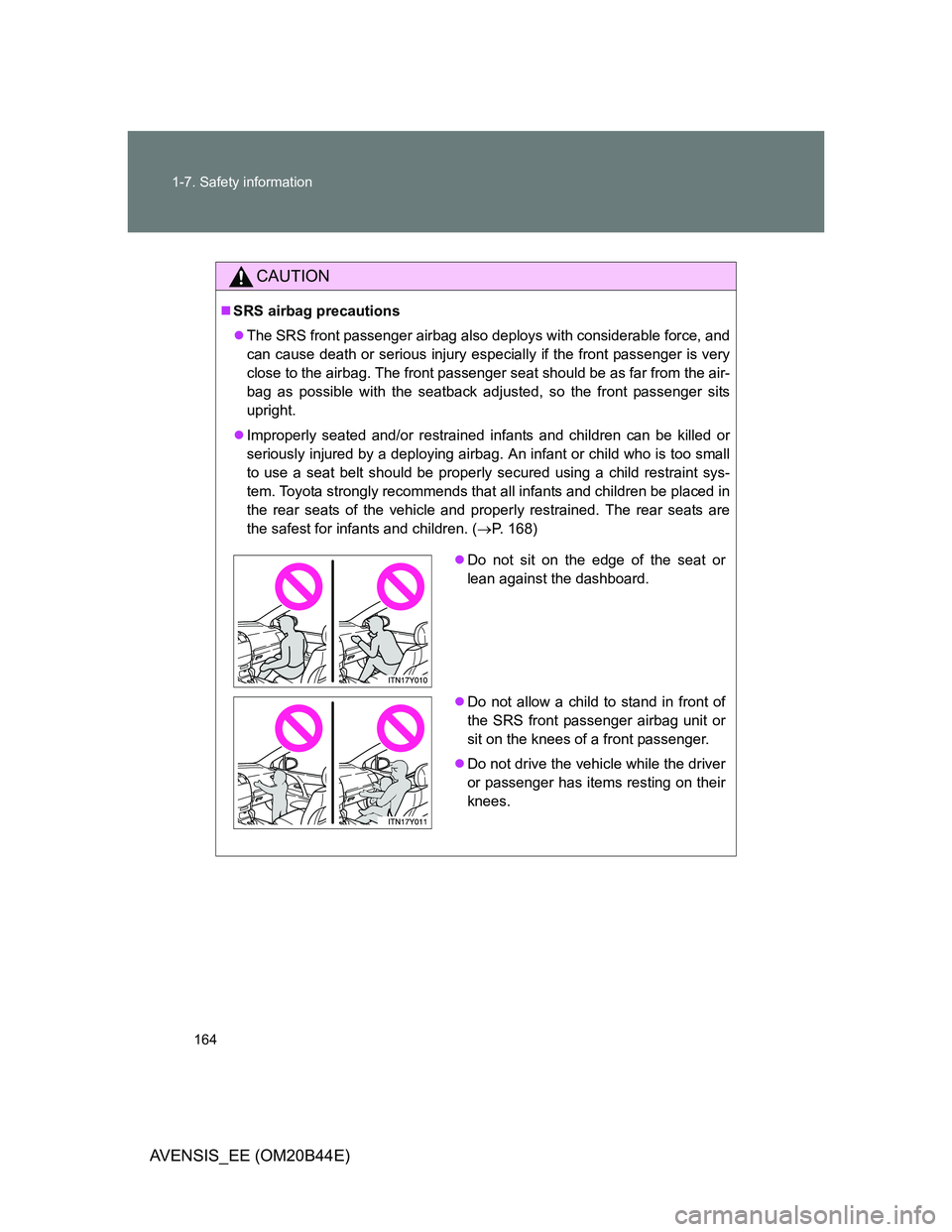
Do not sit on the edge of the seat or
lean against the dashboard.
Do not allow a child to stand in front of
the SRS front passenger airbag unit or
sit on the knees of a front passenger.
Do not drive the vehicle while the driver
or passenger has items resting on their
knees.
Page 168 of 772
168
1-7. Safety information
AVENSIS_EE (OM20B44E)
Child restraint systems
Points to remember
Studies have shown that installing a child restraint system on a rear
seat is much safer than installing one to the front passenger seat.
Choose a child restraint system appropriate to the age and size of
the child.
For installation details, follow the instructions provided with the
child restraint system.
General installation instructions are provided in this manual.
(P. 176)
Toyota recommends that you use a child restraint system which
conforms to the regulation “ECE No.44”.
Types of child restraints
Child restraint systems are classified into the following 5 groups
according to the regulation “ECE No.44”.
Group 0: Up to 10 kg (22 lb.) (0 - 9 months)
Group 0
+: Up to 13 kg (28 lb.) (0 - 2 years)
Group I: 9 to 18 kg (20 to 39 lb.) (9 months - 4 years)
Group II: 15 to 25 kg (34 to 55 lb.) (4 years - 7 years)
Group III: 22 to 36 kg (49 to 79 lb.) (6 years - 12 years)
In this owner’s manual, the following popular 3 types of child restraint
systems that can be secured with the seat belts are explained.
Toyota strongly urges the use of child restraint systems.
Page 174 of 772
174 1-7. Safety information
AVENSIS_EE (OM20B44E)
Selecting an appropriate child restraint system
Get an appropriate child restraint system for the child. If a child is too large
for a child restraint system, sit the child on a rear seat and use the vehicle’s
seat belt. (P. 108)
CAUTION
Using a child restraint system
The use of a child restraint system not suitable for the vehicle may not prop-
erly secure the infant or child, resulting in serious injury or even death.
Child restraint precautions
For effective protection in automobile accidents and sudden stops, a child
must be properly restrained, using a seat belt or child restraint system
depending on the age and size of the child. Holding a child in your arms is
not a substitute for a child restraint system. In an accident, the child can be
crushed against the windshield, or between you and the vehicle’s interior.
Toyota strongly urges the use of a proper child restraint system that con-
forms to the size of the child, installed on the rear seat. According to acci-
dent statistics, the child is safer when properly restrained in the rear seat
than in the front seat.
Never install a rear-facing child restraint system on the front passenger
seat when the airbag manual on-off switch is “ON”. (P. 190)
In the event of an accident, the force of the rapid inflation of the front pas-
senger airbag can cause death or serious injury to the child.
Page 175 of 772
175 1-7. Safety information
1
Before driving
AVENSIS_EE (OM20B44E)
CAUTION
Child restraint precautions
A forward-facing child restraint system should allowed to be installed on
the front passenger seat only when it is unavoidable. Always move the
seat as far back as possible, because the front passenger airbag could
inflate with considerable speed and force. Otherwise, the child may be
killed or seriously injured.
Do not allow the child to lean his/her head or any part of his/her body
against the door or the area of the seat, front and rear pillars or roof side
rail from which the side airbags or curtain shield airbags deploy even if the
child is seated in the child restraint system. It is dangerous if the side air-
bags and curtain shield airbags inflate, and the impact could cause death
or serious injury to the child.
Make sure you have complied with all installation instructions provided by
the child restraint manufacturer and that the system is properly secured. If
it is not secured properly, it may cause death or serious injury to the child
in the event of a sudden stop, sudden swerve or an accident.
When children are in the vehicle
Do not allow children to play with the seat belt. If the seat belt becomes
twisted around a child’s neck, it may lead to choking or other serious injuries
that could result in death.
If this occurs and the buckle cannot be unfastened, scissors should be used
to cut the belt.
When the child restraint system is not in use
Keep the child restraint system properly secured on the seat even if it is
not in use. Do not store the restraint unsecured in the passenger compart-
ment.
If it is necessary to detach the child restraint system, remove it from the
vehicle or store it securely in the trunk/luggage compartment. This will pre-
vent it from injuring passengers in the event of a sudden stop, sudden
swerve or accident.
Page 176 of 772
176
1-7. Safety information
AVENSIS_EE (OM20B44E)
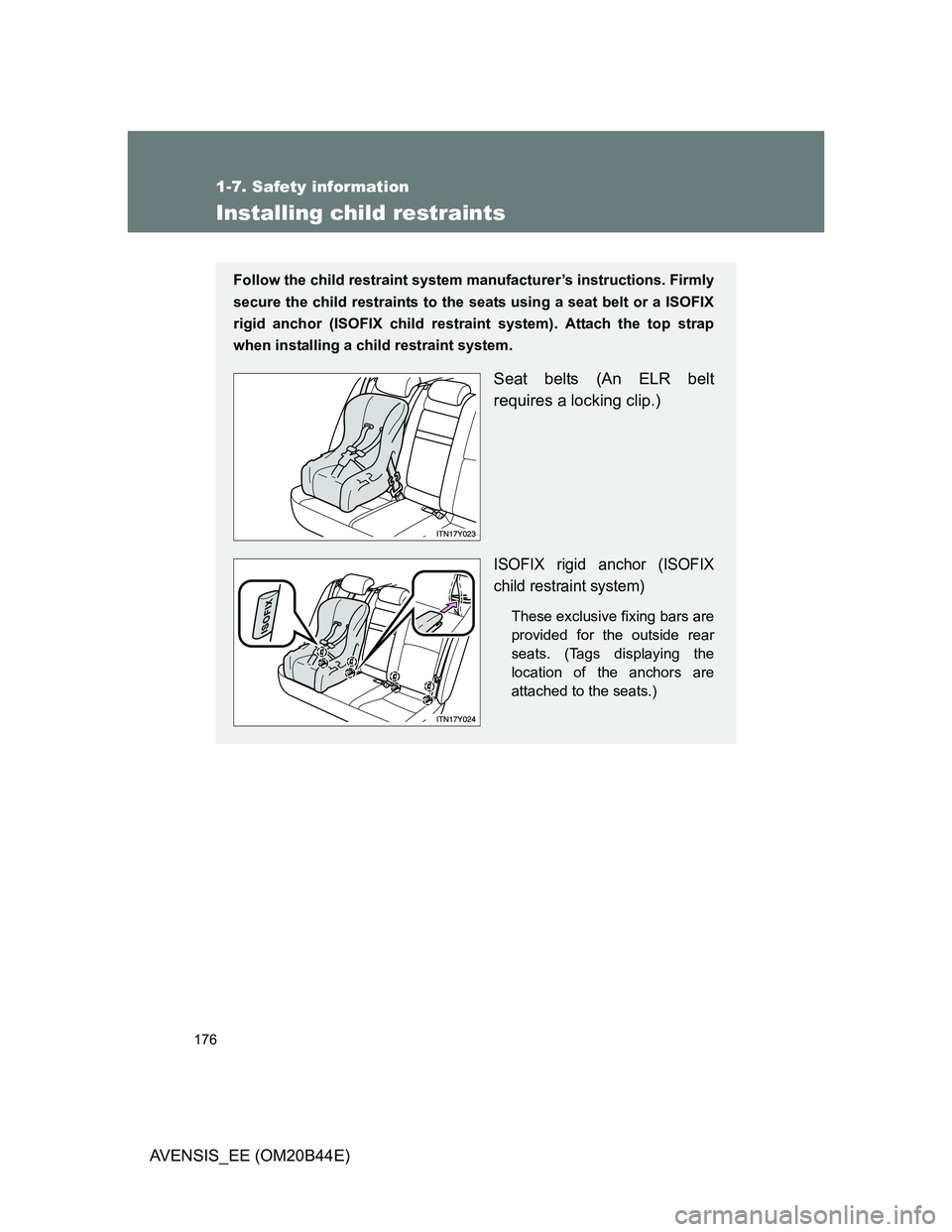
Installing child restraints
Follow the child restraint system manufacturer’s instructions. Firmly
secure the child restraints to the seats using a seat belt or a ISOFIX
rigid anchor (ISOFIX child restraint system). Attach the top strap
when installing a child restraint system.
Seat belts (An ELR belt
requires a locking clip.)
ISOFIX rigid anchor (ISOFIX
child restraint system)
These exclusive fixing bars are
provided for the outside rear
seats. (Tags displaying the
location of the anchors are
attached to the seats.)
Page 182 of 772
182 1-7. Safety information
AVENSIS_EE (OM20B44E)
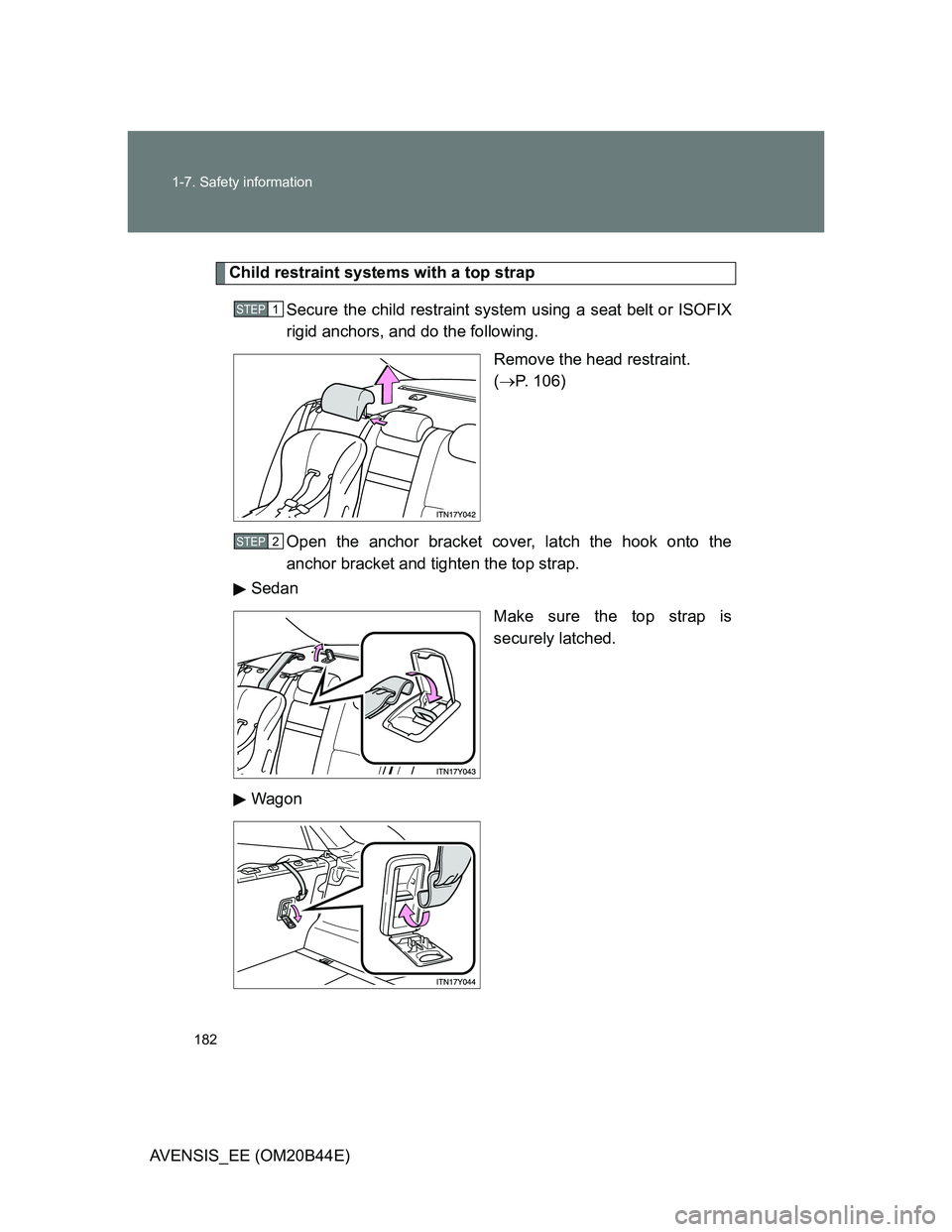
Child restraint systems with a top strap
Secure the child restraint system using a seat belt or ISOFIX
rigid anchors, and do the following.
Remove the head restraint.
(P. 106)
Open the anchor bracket cover, latch the hook onto the
anchor bracket and tighten the top strap.
Sedan
Make sure the top strap is
securely latched.
Wagon
STEP1
STEP2
Page 184 of 772
184 1-7. Safety information
AVENSIS_EE (OM20B44E)
CAUTION
When installing a child restraint system
Follow the directions given in the child restraint system installation manual
and fix the child restraint system securely in place.
If the child restraint system is not correctly fixed in place, the child or other
passengers may be seriously injured or even killed in the event of sudden
braking, sudden swerving or an accident.
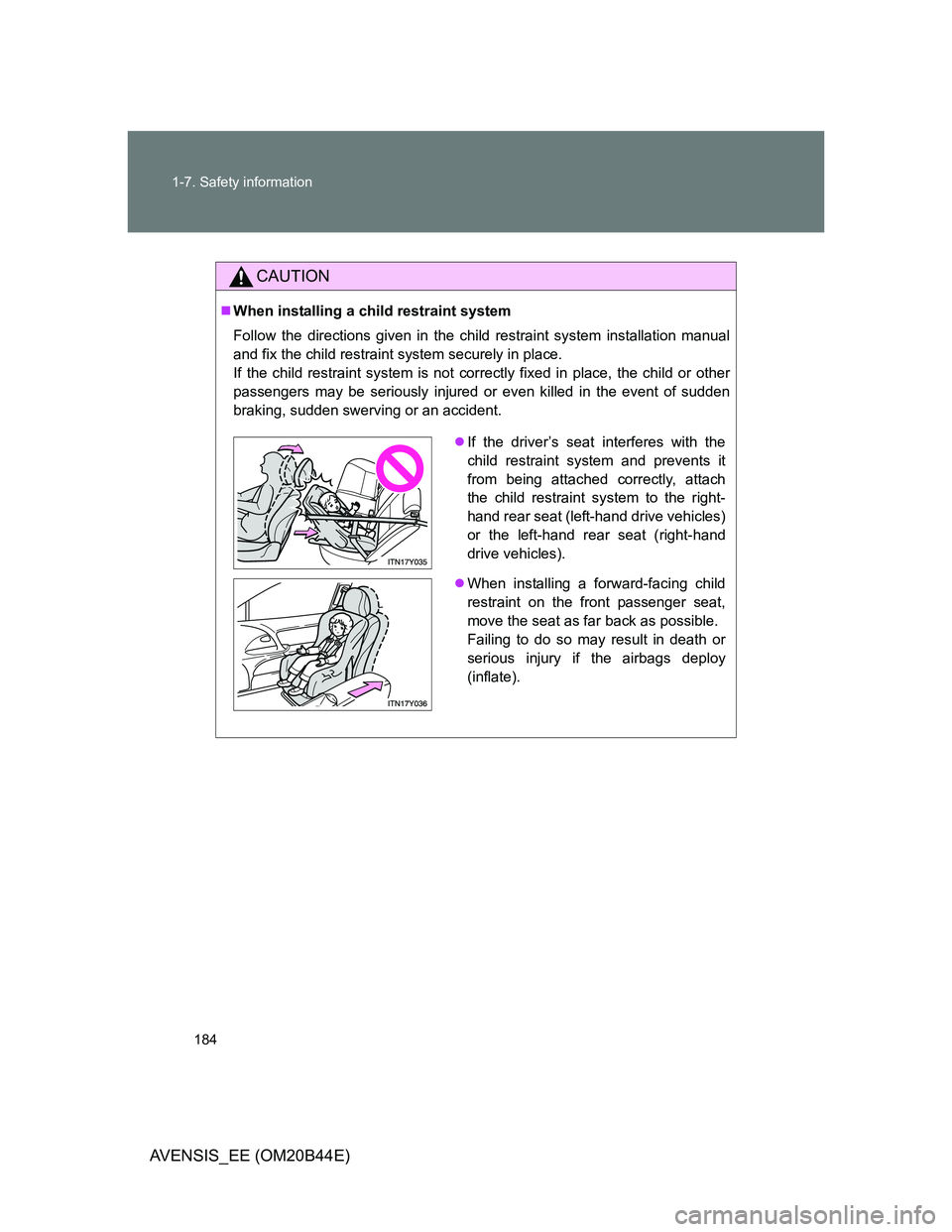
If the driver’s seat interferes with the
child restraint system and prevents it
from being attached correctly, attach
the child restraint system to the right-
hand rear seat (left-hand drive vehicles)
or the left-hand rear seat (right-hand
drive vehicles).
When installing a forward-facing child
restraint on the front passenger seat,
move the seat as far back as possible.
Failing to do so may result in death or
serious injury if the airbags deploy
(inflate).
Page 189 of 772
189 1-7. Safety information
1
Before driving
AVENSIS_EE (OM20B44E)
CAUTION
When installing a child restraint system
Ensure that the belt and tab are securely locked and the seat belt is not
twisted.
Shake the child restraint left and right, and forward and back to ensure that
it has been securely installed.
Follow all installation instructions provided by the child restraint system
manufacturer.
To correctly attach a child restraint system to the anchors
When using the ISOFIX rigid anchors, be sure that there are no foreign
objects around the anchors and that the seat belt is not caught behind the
child restraint system. Make sure the child restraint system is securely
attached, or it may cause death or serious injury to the child or other passen-
gers in the event of a sudden stop, sudden swerve or accident.
Page 203 of 772
203 2-1. Driving procedures
2
When driving
AVENSIS_EE (OM20B44E)
CAUTION
When shifting the shift lever (vehicles with a Multidrive or automatic
transmission)
Be careful not to shift the shift lever with the accelerator pedal depressed.
This may lead to unexpected rapid acceleration of the vehicle that may
cause an accident and result in death or serious injury.
When the vehicle is stopped
Do not race the engine.
If the vehicle is in any shift positions other than “P” (vehicles with a Multid-
rive or automatic transmission) or “N”, the vehicle may accelerate sud-
denly and unexpectedly, and may cause an accident.
Do not leave the vehicle with the engine running for a long time.
If such a situation cannot be avoided, park the vehicle in an open space
and check that exhaust fumes do not enter the vehicle interior.
Vehicles with a Multidrive or automatic transmission: In order to prevent
accidents due to the vehicle rolling away, always keep depressing the
brake pedal while the engine is running, and apply the parking brake as
necessary.
If the vehicle is stopped on an incline, in order to prevent accidents caused
by the vehicle rolling forward or backward, always depress the brake pedal
and securely apply the parking brake as needed.
Avoid revving or racing the engine.
Running the engine at high speed while the vehicle is stopped may cause
the exhaust system to overheat, which could result in a fire if combustible
material is nearby.