headlights TOYOTA AVENSIS 2012 User Guide
[x] Cancel search | Manufacturer: TOYOTA, Model Year: 2012, Model line: AVENSIS, Model: TOYOTA AVENSIS 2012Pages: 772, PDF Size: 34.43 MB
Page 270 of 772
270 2-3. Operating the lights and wipers
AVENSIS_EE (OM20B44E)
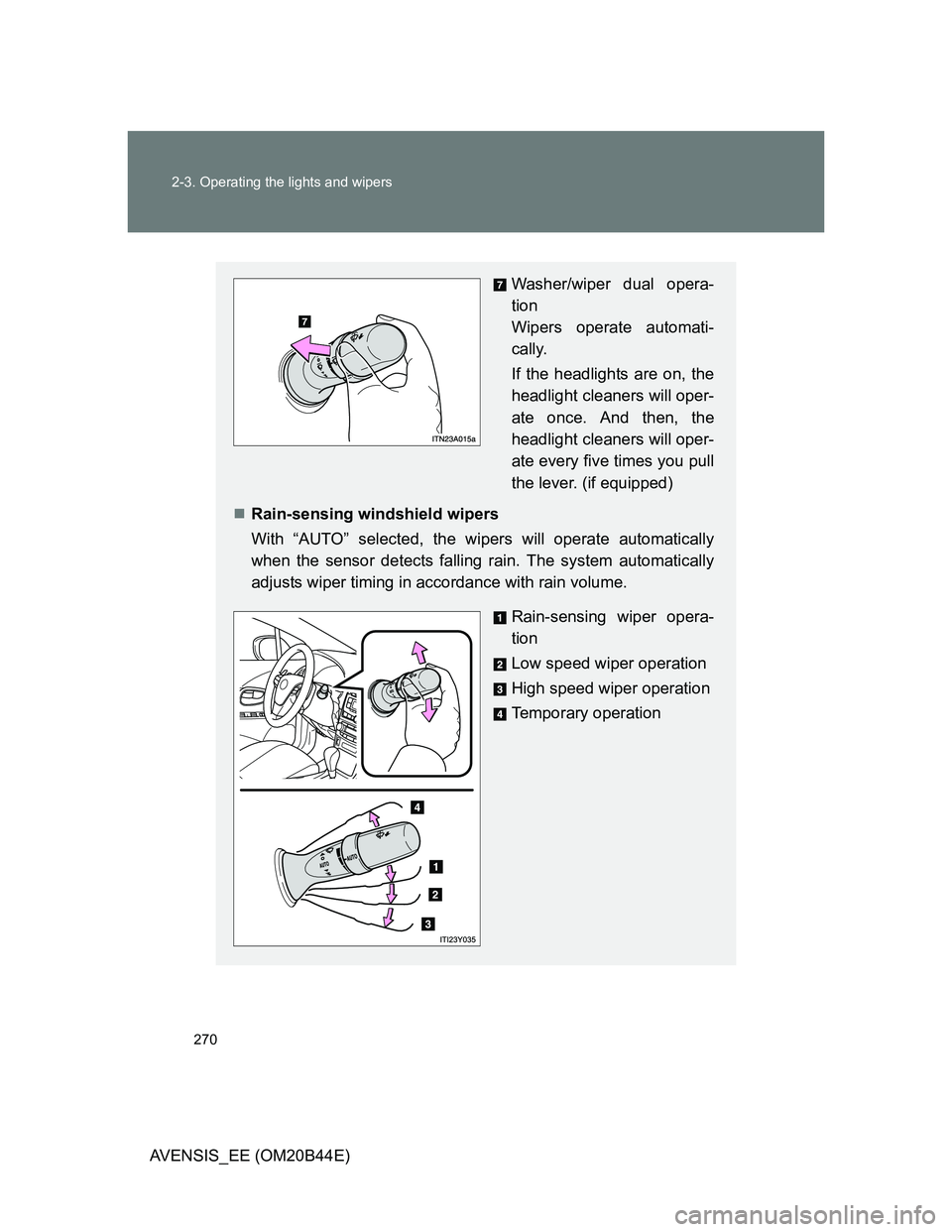
Washer/wiper dual opera-
tion
Wipers operate automati-
cally.
If the headlights are on, the
headlight cleaners will oper-
ate once. And then, the
headlight cleaners will oper-
ate every five times you pull
the lever. (if equipped)
Rain-sensing windshield wipers
With “AUTO” selected, the wipers will operate automatically
when the sensor detects falling rain. The system automatically
adjusts wiper timing in accordance with rain volume.
Rain-sensing wiper opera-
tion
Low speed wiper operation
High speed wiper operation
Temporary operation
Page 271 of 772
271 2-3. Operating the lights and wipers
2
When driving
AVENSIS_EE (OM20B44E)
The windshield wiper and washer can be operated when
Vehicles with smart entry & start system
The “ENGINE START STOP” switch is in IGNITION ON mode.
Vehicles without smart entry & start system
The engine switch is in the “ON” position.
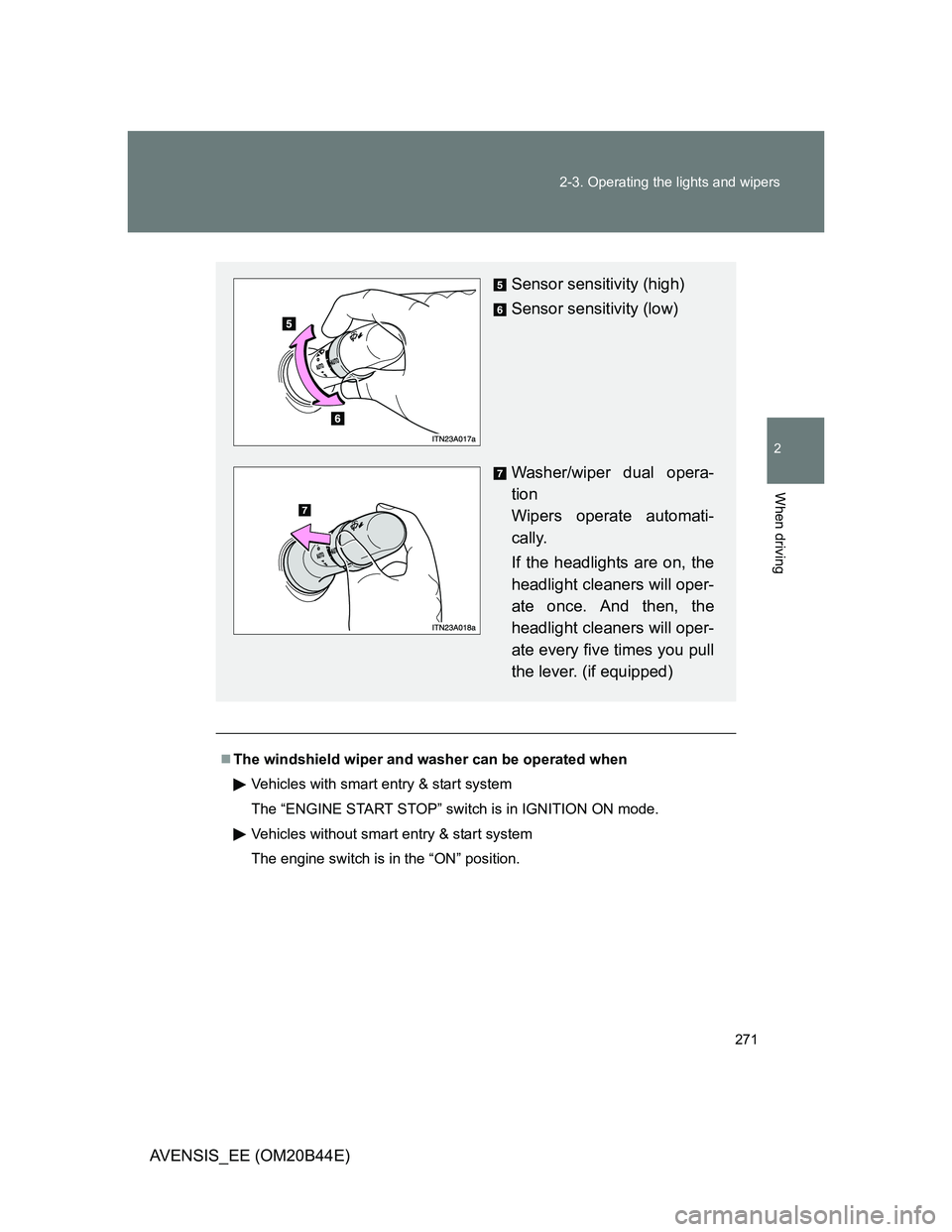
Sensor sensitivity (high)
Sensor sensitivity (low)
Washer/wiper dual opera-
tion
Wipers operate automati-
cally.
If the headlights are on, the
headlight cleaners will oper-
ate once. And then, the
headlight cleaners will oper-
ate every five times you pull
the lever. (if equipped)
Page 313 of 772
313 2-4. Using other driving systems
2
When driving
AVENSIS_EE (OM20B44E)
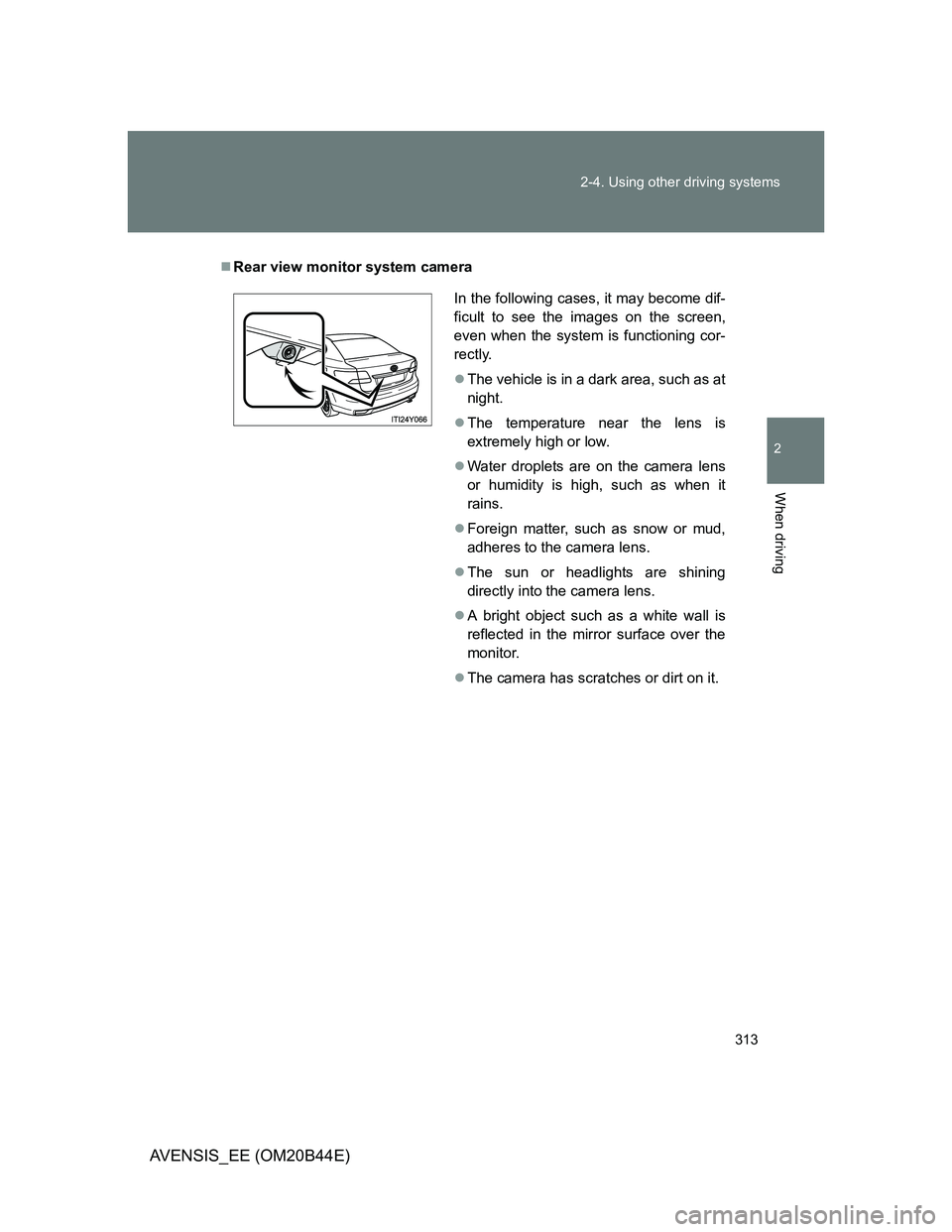
Rear view monitor system camera
In the following cases, it may become dif-
ficult to see the images on the screen,
even when the system is functioning cor-
rectly.
The vehicle is in a dark area, such as at
night.
The temperature near the lens is
extremely high or low.
Water droplets are on the camera lens
or humidity is high, such as when it
rains.
Foreign matter, such as snow or mud,
adheres to the camera lens.
The sun or headlights are shining
directly into the camera lens.
A bright object such as a white wall is
reflected in the mirror surface over the
monitor.
The camera has scratches or dirt on it.
Page 325 of 772
325 2-4. Using other driving systems
2
When driving
AVENSIS_EE (OM20B44E)
NOTICE
In the following situations, the LKA will not work, or will not perform
reliably
When lane markers are interrupted or are not present, such as before a
tollbooth.
When lane markers are only on one side of the road.
When driving on a sharp curve.
When lanes are extremely narrow or extremely wide.
When the vehicle leans to one side an unusual amount due to a heavy
load or improper tire inflation pressure.
When the following distance between your vehicle and the vehicle ahead
is extremely short.
When the lane markers are broken or “Raised pavement marker”.
When lane markers are obscured or partially obscured by sand, dirt, etc.
When driving on a particularly bright road surface, such as concrete.
When driving on a road surface that is bright due to reflected light.
When driving in a location where the light level changes rapidly, such as
the entrance to or exit from a tunnel.
When sunlight or the headlights of oncoming vehicles are shining directly
into the camera lens.
When driving on roads that are branching or merging.
When pavement lane markers are difficult to see due to rain, snow, fog,
etc.
When driving on a road surface that is wet due to rain, previous rainfall,
standing water, etc.
When the vehicle experiences strong up-and-down motion such as when
driving on an extremely rough road or on a seam in the pavement.
When headlight brightness is reduced due to dirt on the lenses, or when
the headlights are misaligned.
When driving with a strong crosswind.
Page 578 of 772
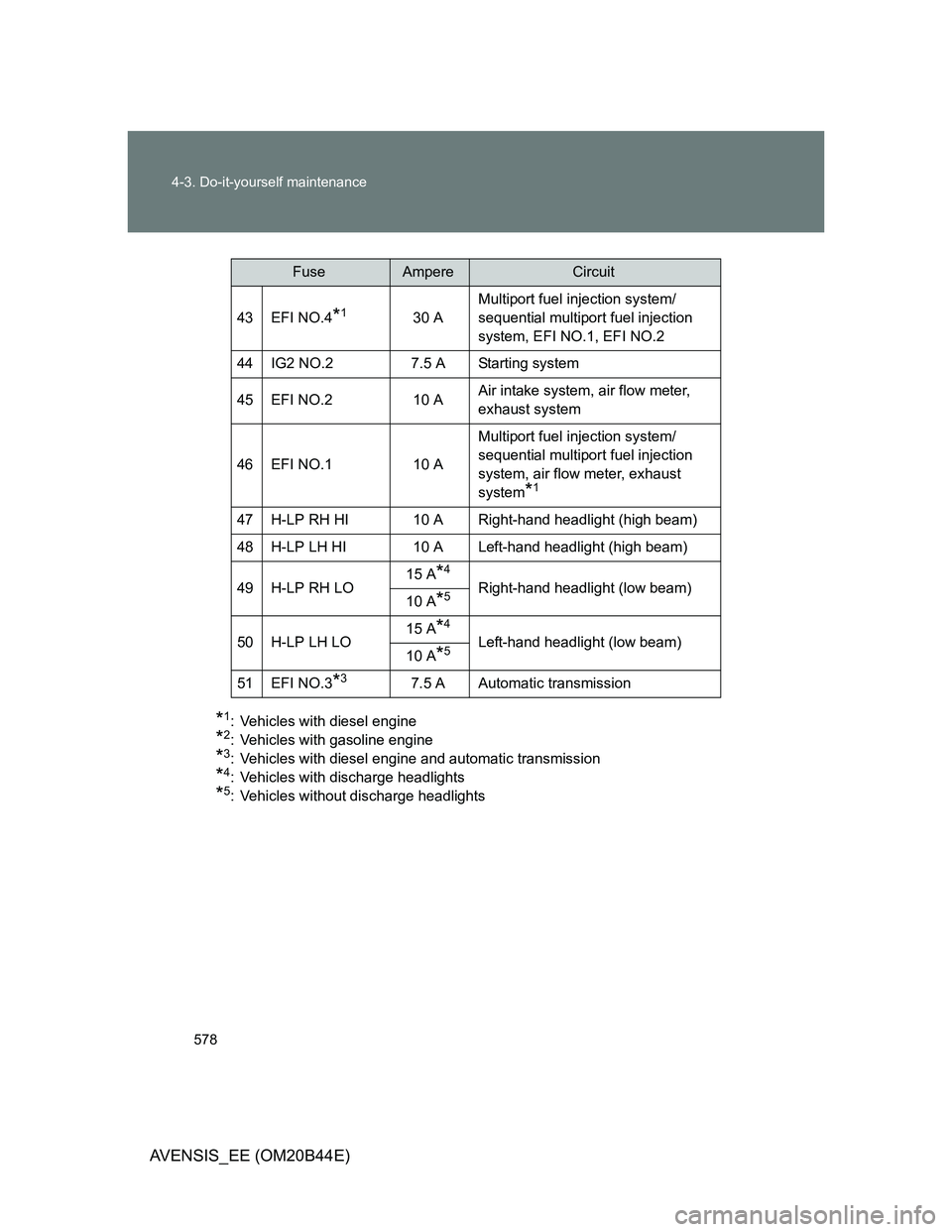
578 4-3. Do-it-yourself maintenance
AVENSIS_EE (OM20B44E)
*1: Vehicles with diesel engine
*2: Vehicles with gasoline engine
*3: Vehicles with diesel engine and automatic transmission
*4: Vehicles with discharge headlights
*5: Vehicles without discharge headlights43 EFI NO.4
*130 AMultiport fuel injection system/
sequential multiport fuel injection
system, EFI NO.1, EFI NO.2
44 IG2 NO.2 7.5 A Starting system
45 EFI NO.2 10 AAir intake system, air flow meter,
exhaust system
46 EFI NO.1 10 AMultiport fuel injection system/
sequential multiport fuel injection
system, air flow meter, exhaust
system
*1
47 H-LP RH HI 10 A Right-hand headlight (high beam)
48 H-LP LH HI 10 A Left-hand headlight (high beam)
49 H-LP RH LO15 A
*4
Right-hand headlight (low beam)
10 A*5
50 H-LP LH LO15 A*4
Left-hand headlight (low beam)
10 A*5
51 EFI NO.3*37.5 A Automatic transmission
FuseAmpereCircuit
Page 599 of 772
599 4-3. Do-it-yourself maintenance
4
Maintenance and care
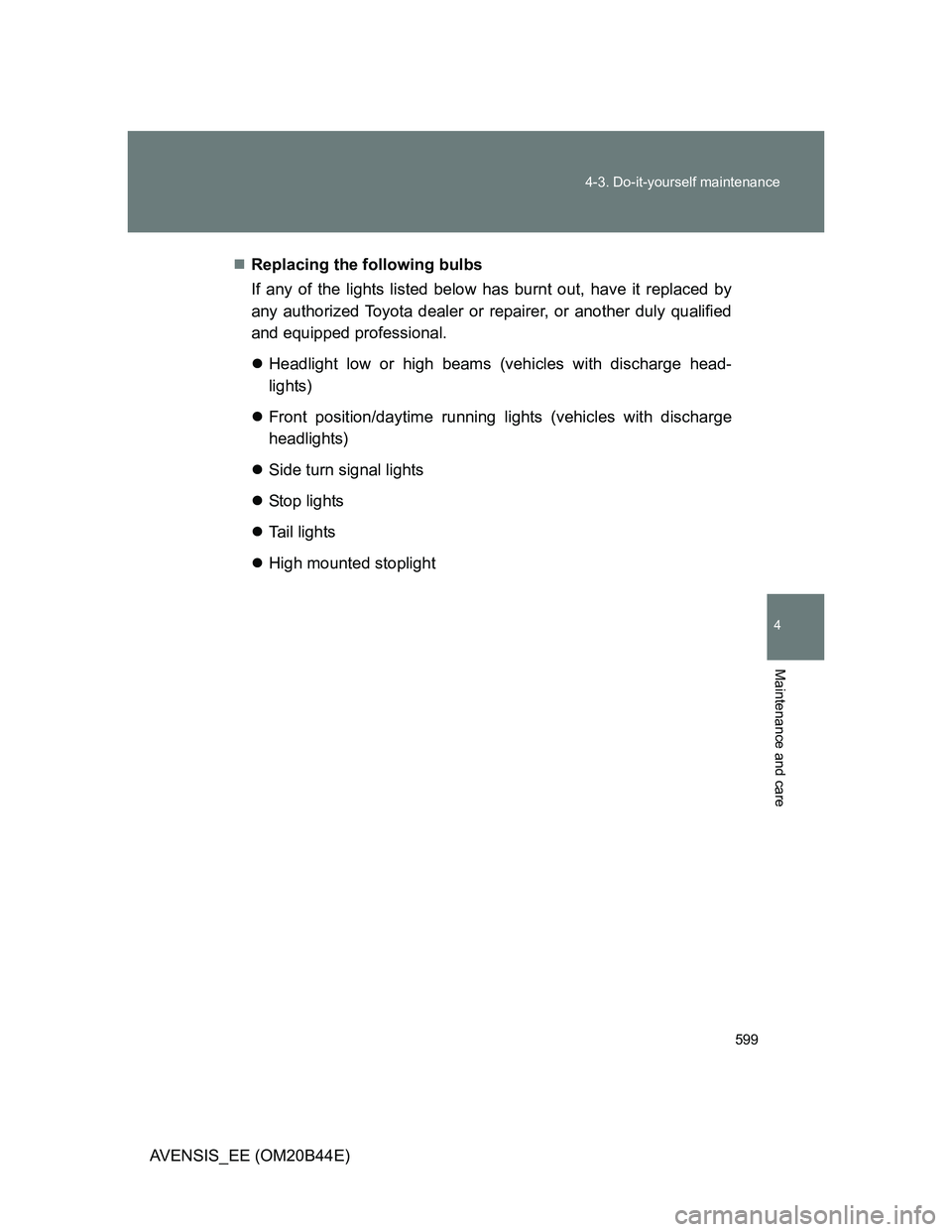
AVENSIS_EE (OM20B44E)Replacing the following bulbs
If any of the lights listed below has burnt out, have it replaced by
any authorized Toyota dealer or repairer, or another duly qualified
and equipped professional.
Headlight low or high beams (vehicles with discharge head-
lights)
Front position/daytime running lights (vehicles with discharge
headlights)
Side turn signal lights
Stop lights
Tail lights
High mounted stoplight
Page 601 of 772
601 4-3. Do-it-yourself maintenance
4
Maintenance and care
AVENSIS_EE (OM20B44E)
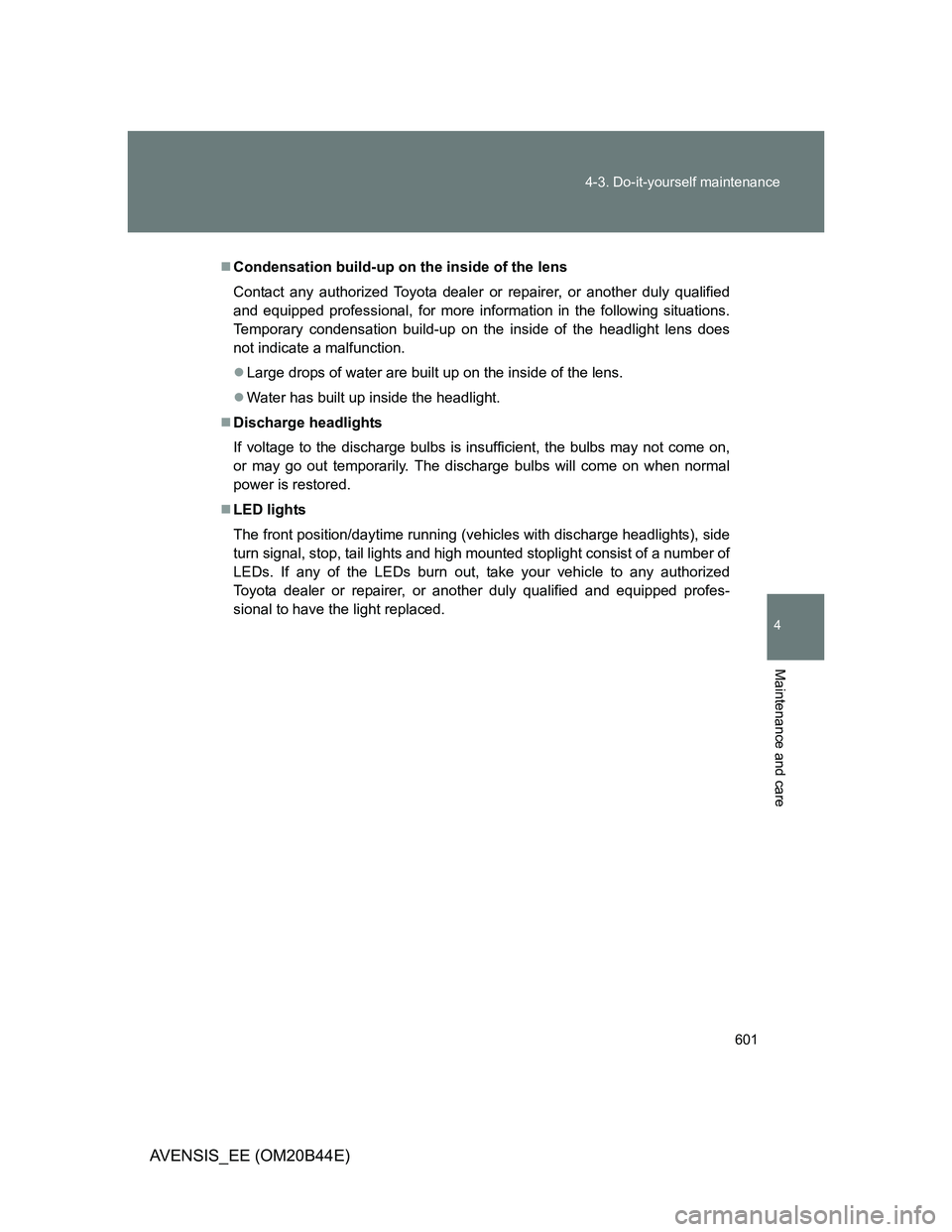
Condensation build-up on the inside of the lens
Contact any authorized Toyota dealer or repairer, or another duly qualified
and equipped professional, for more information in the following situations.
Temporary condensation build-up on the inside of the headlight lens does
not indicate a malfunction.
Large drops of water are built up on the inside of the lens.
Water has built up inside the headlight.
Discharge headlights
If voltage to the discharge bulbs is insufficient, the bulbs may not come on,
or may go out temporarily. The discharge bulbs will come on when normal
power is restored.
LED lights
The front position/daytime running (vehicles with discharge headlights), side
turn signal, stop, tail lights and high mounted stoplight consist of a number of
LEDs. If any of the LEDs burn out, take your vehicle to any authorized
Toyota dealer or repairer, or another duly qualified and equipped profes-
sional to have the light replaced.
Page 602 of 772
602 4-3. Do-it-yourself maintenance
AVENSIS_EE (OM20B44E)
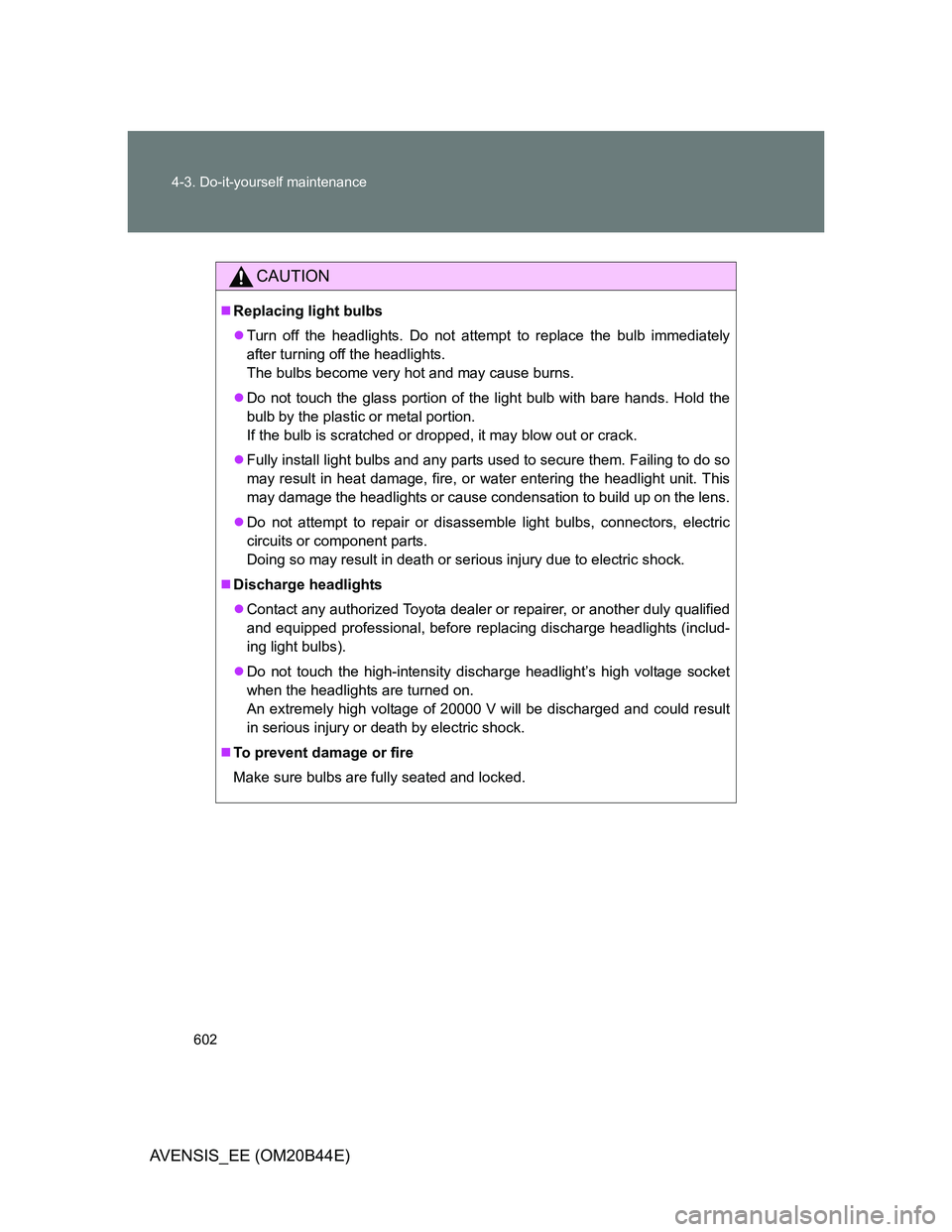
CAUTION
Replacing light bulbs
Turn off the headlights. Do not attempt to replace the bulb immediately
after turning off the headlights.
The bulbs become very hot and may cause burns.
Do not touch the glass portion of the light bulb with bare hands. Hold the
bulb by the plastic or metal portion.
If the bulb is scratched or dropped, it may blow out or crack.
Fully install light bulbs and any parts used to secure them. Failing to do so
may result in heat damage, fire, or water entering the headlight unit. This
may damage the headlights or cause condensation to build up on the lens.
Do not attempt to repair or disassemble light bulbs, connectors, electric
circuits or component parts.
Doing so may result in death or serious injury due to electric shock.
Discharge headlights
Contact any authorized Toyota dealer or repairer, or another duly qualified
and equipped professional, before replacing discharge headlights (includ-
ing light bulbs).
Do not touch the high-intensity discharge headlight’s high voltage socket
when the headlights are turned on.
An extremely high voltage of 20000 V will be discharged and could result
in serious injury or death by electric shock.
To prevent damage or fire
Make sure bulbs are fully seated and locked.
Page 636 of 772
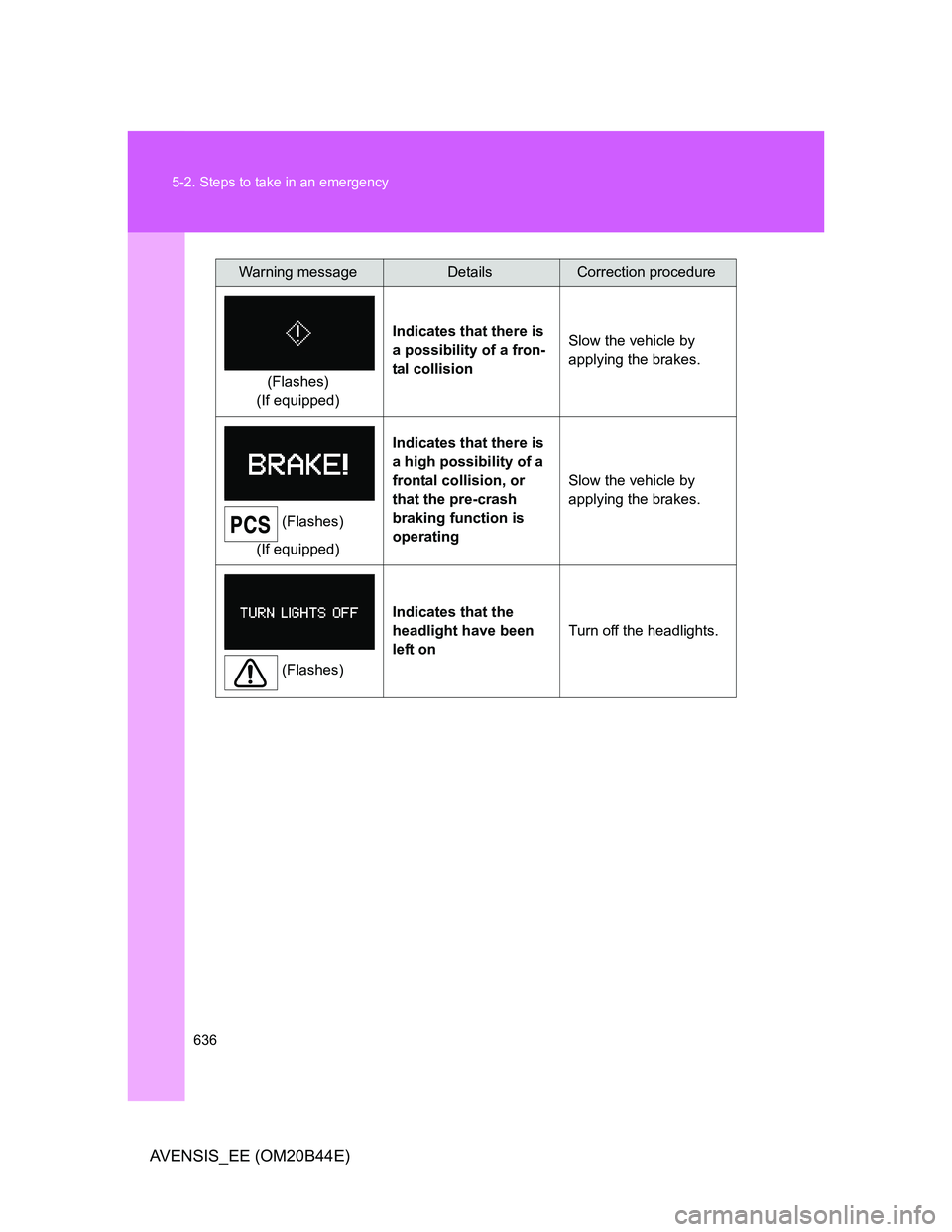
636 5-2. Steps to take in an emergency
AVENSIS_EE (OM20B44E)
(Flashes)
(If equipped)Indicates that there is
a possibility of a fron-
tal collisionSlow the vehicle by
applying the brakes.
(Flashes)
(If equipped)Indicates that there is
a high possibility of a
frontal collision, or
that the pre-crash
braking function is
operatingSlow the vehicle by
applying the brakes.
(Flashes)Indicates that the
headlight have been
left onTurn off the headlights.
Warning messageDetailsCorrection procedure
Page 689 of 772
5
689
5-2. Steps to take in an emergency
When trouble arises
AVENSIS_EE (OM20B44E)
If the engine will not start
If the engine still does not start after following the correct starting
procedure (P. 210, 215) or releasing the steering lock (P. 213,
217), confirm the following points.
The engine will not start even if you are carrying the correct
key
One of the following may be the cause of the problem.
There may not be sufficient fuel in the vehicle’s tank.
Gasoline engine: Refuel the vehicle.
Diesel engine: (P. 713)
The engine may be flooded. (gasoline engine)
Try to restart the engine once more following correct starting
procedures. (P. 210, 215)
There may be a malfunction in the engine immobilizer system.
(P. 135)
The starter motor turns over slowly, the personal/interior
lights and headlights are dim, or the horn does not sound or
sounds at a low volume
One of the following may be the cause of the problem.
The battery may be discharged. (P. 705)
The battery terminal connections may be loose or corroded.