cooling TOYOTA AVENSIS 2014 Owners Manual (in English)
[x] Cancel search | Manufacturer: TOYOTA, Model Year: 2014, Model line: AVENSIS, Model: TOYOTA AVENSIS 2014Pages: 776, PDF Size: 33.54 MB
Page 522 of 776
522 4-3. Do-it-yourself maintenance
AVENSIS_OM_OM20B88E_(EE)
CAUTION
When working near the electric cooling fan or radiator grille
Vehicles with smart entry & start system
Be sure the “ENGINE START STOP” switch is OFF.
With the “ENGINE START STOP” switch in IGNITION ON mode, the
electric cooling fan may automatically start to run if the air conditioning is
on and/or the coolant temperature is high. (P. 538)
Vehicles without smart entry & start system
Be sure the engine switch is in the “LOCK” position.
With the engine switch in the “ON” position, the electric cooling fan may
automatically start to run if the air conditioning is on and/or the coolant
temperature is high. (P. 538)
Safety glasses
Wear safety glasses to prevent flying or falling material, fluid spray, etc. from
getting in the eyes.
NOTICE
If you remove the air cleaner filter
Driving with the air cleaner filter removed may cause excessive engine wear
due to dirt in the air.
If the brake fluid level is low or high
It is normal for the brake fluid level to go down slightly as the brake pads
wear or when the fluid level in the accumulator is high.
If the reservoir needs frequent refilling, it may indicate a serious problem.
Page 527 of 776
527
4-3. Do-it-yourself maintenance
4
Maintenance and care
AVENSIS_OM_OM20B88E_(EE)
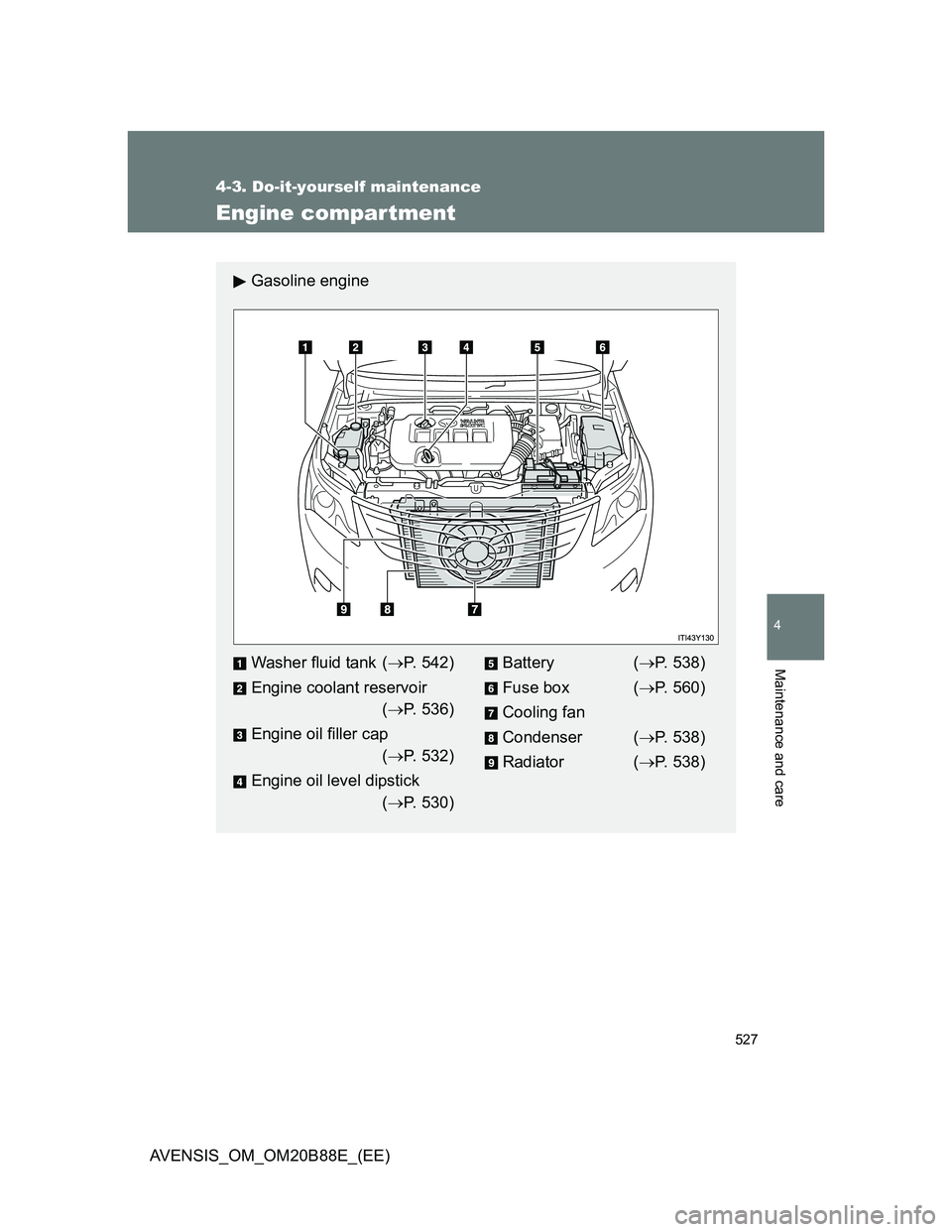
Engine compartment
Gasoline engine
Washer fluid tank (P. 542)
Engine coolant reservoir
(P. 536)
Engine oil filler cap
(P. 532)
Engine oil level dipstick
(P. 530)Battery (P. 538)
Fuse box (P. 560)
Cooling fan
Condenser (P. 538)
Radiator (P. 538)
Page 528 of 776
528 4-3. Do-it-yourself maintenance
AVENSIS_OM_OM20B88E_(EE)
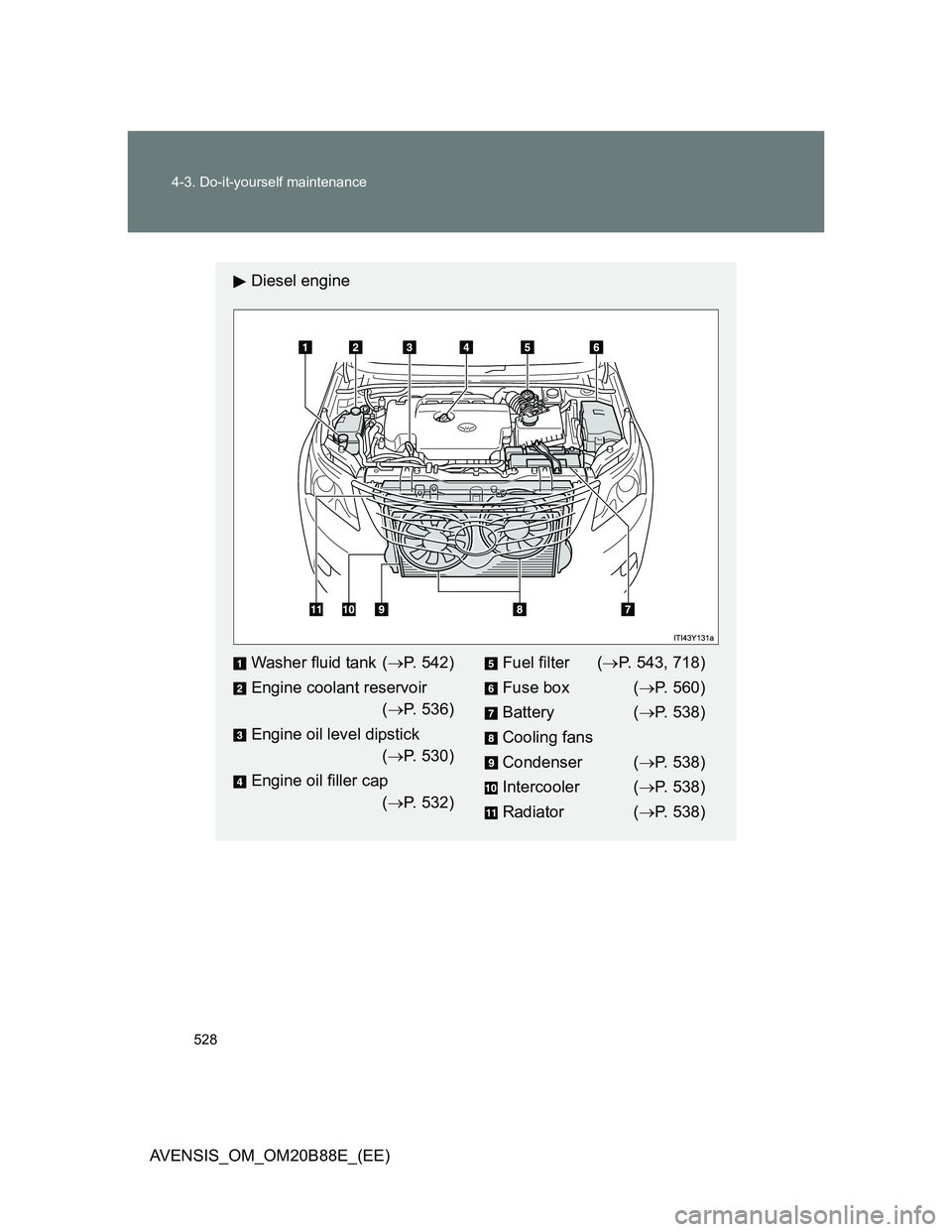
Diesel engine
Washer fluid tank (P. 542)
Engine coolant reservoir
(P. 536)
Engine oil level dipstick
(P. 530)
Engine oil filler cap
(P. 532)Fuel filter (P. 543, 718)
Fuse box (P. 560)
Battery (P. 538)
Cooling fans
Condenser (P. 538)
Intercooler (P. 538)
Radiator (P. 538)
Page 536 of 776
536 4-3. Do-it-yourself maintenance
AVENSIS_OM_OM20B88E_(EE)
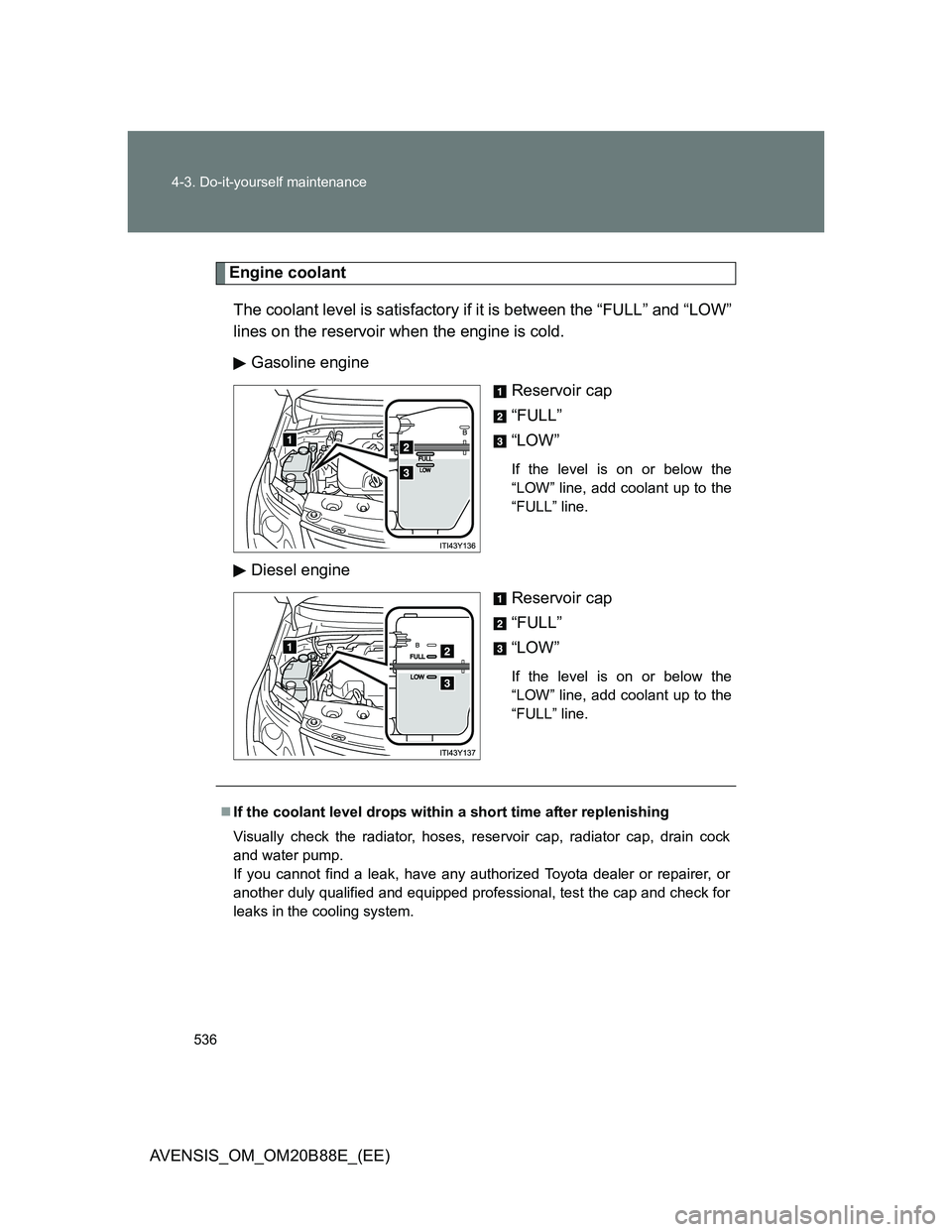
Engine coolant
The coolant level is satisfactory if it is between the “FULL” and “LOW”
lines on the reservoir when the engine is cold.
Gasoline engine
Reservoir cap
“FULL”
“LOW”
If the level is on or below the
“LOW” line, add coolant up to the
“FULL” line.
Diesel engine
Reservoir cap
“FULL”
“LOW”
If the level is on or below the
“LOW” line, add coolant up to the
“FULL” line.
If the coolant level drops within a short time after replenishing
Visually check the radiator, hoses, reservoir cap, radiator cap, drain cock
and water pump.
If you cannot find a leak, have any authorized Toyota dealer or repairer, or
another duly qualified and equipped professional, test the cap and check for
leaks in the cooling system.
Page 537 of 776
537 4-3. Do-it-yourself maintenance
4
Maintenance and care
AVENSIS_OM_OM20B88E_(EE)
Coolant selection
Only use “Toyota Super Long Life Coolant” or similar high quality ethylene
glycol based non-silicate, non-amine, non-nitrite, and non-borate coolant
with long-life hybrid organic acid technology.
“Toyota Super Long Life Coolant” is a mixture of 50% coolant and 50%
deionized water. (Enabled: -35C [-31F])
For more details about engine coolant, contact any authorized Toyota dealer
or repairer, or another duly qualified and equipped professional.
CAUTION
When the engine is hot
Do not remove the coolant reservoir cap.
The cooling system may be under pressure and may spray hot coolant if the
cap is removed, causing serious injuries, such as burns.
NOTICE
When adding engine coolant
Coolant is neither plain water nor straight antifreeze. The correct mixture of
water and antifreeze must be used to provide proper lubrication, corrosion
protection and cooling. Be sure to read the antifreeze or coolant label.
If you spill coolant
Be sure to wash it off with water to prevent damage to parts or paint.
Page 565 of 776
565 4-3. Do-it-yourself maintenance
4
Maintenance and care
AVENSIS_OM_OM20B88E_(EE)
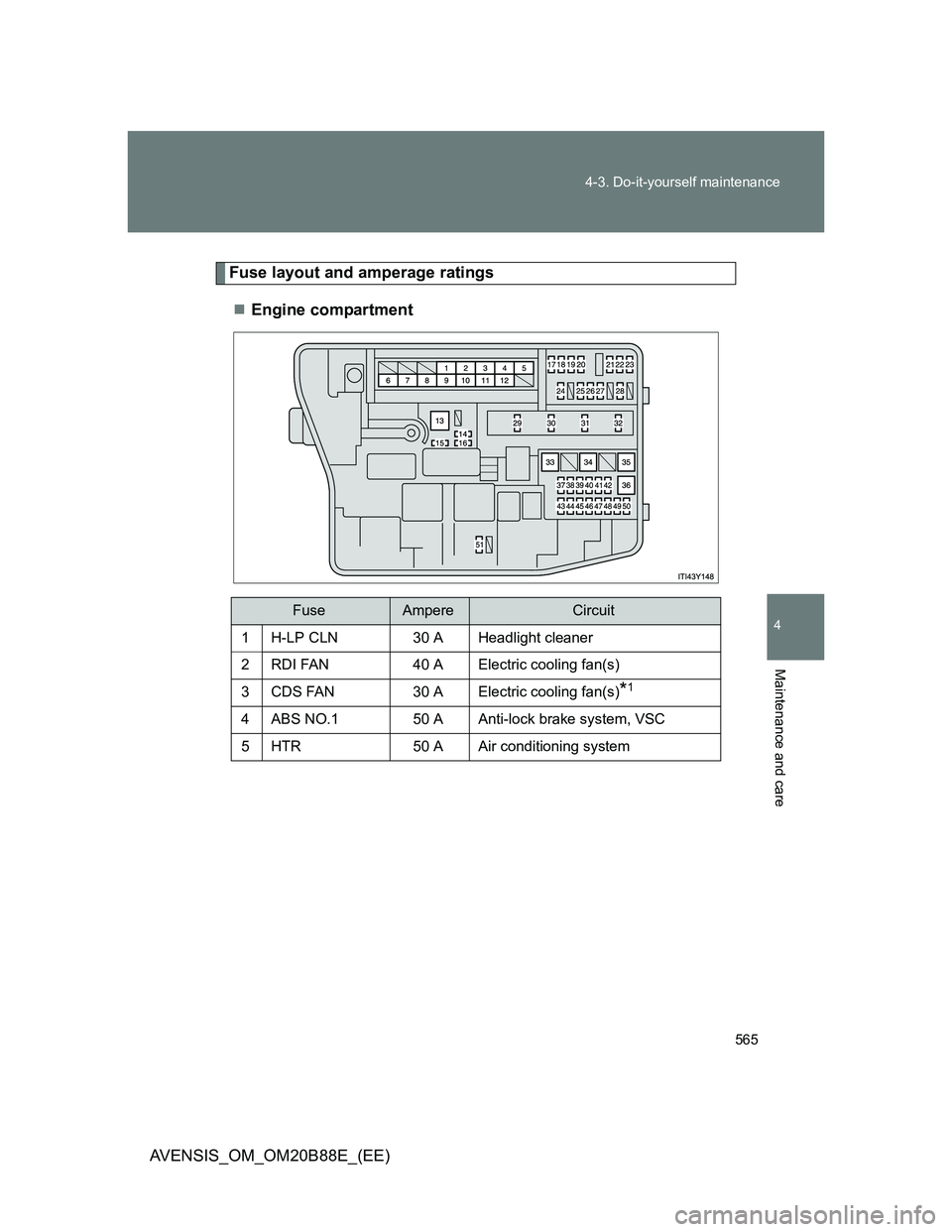
Fuse layout and amperage ratings
Engine compartment
FuseAmpereCircuit
1H-LP CLN30 A Headlight cleaner
2RDI FAN40 A Electric cooling fan(s)
3CDS FAN30 A Electric cooling fan(s)*1
4 ABS NO.1 50 A Anti-lock brake system, VSC
5 HTR 50 A Air conditioning system
Page 572 of 776
572 4-3. Do-it-yourself maintenance
AVENSIS_OM_OM20B88E_(EE)
13 METER 7.5 A Gauges and meters
14 SEAT HTR 15 A Seat heaters
15 HTR-IG 10 A Air conditioning system
16 WIPER 30 AWindshield wipers, rain sensing
windshield wipers
17 RR WIPER 15 A Rear window wiper
*1
18 WASHER 15 AWindshield washers, rear window
washer*1
19 ECU-IG NO.1 10 AMain body ECU, smart entry & start
system, electric cooling fan(s), shift
lock system, panoramic roof
shade
*1, auto anti-glare inside rear
view mirror, anti-lock brake system,
steering sensor, yaw rate & G sen-
sor, VSC, headlight cleaner, pre-
crash safety system, LKA, driver
support system
20 ECU-IG NO.2 10 ABack-up lights, charging system,
emergency flashers, rear window
defogger, “PASSENGER AIRBAG”
indicator, air conditioning system,
AFS, rear view monitor, Toyota
parking assist-sensor
21 OBD 7.5 A On-board diagnosis system
FuseAmpereCircuit
Page 713 of 776
5
713 5-2. Steps to take in an emergency
When trouble arises
AVENSIS_OM_OM20B88E_(EE)
CAUTION
Battery precautions
The battery contains poisonous and corrosive acidic electrolyte, while
related parts contain lead and lead compounds. Observe the following pre-
cautions when handling the battery.
When working with the battery, always wear safety glasses and take care
not to allow any battery fluids (acid) to come into contact with skin, clothing
or the vehicle body.
Do not lean over the battery.
In the event that battery fluid comes into contact with the skin or eyes,
immediately wash the affected area with water and seek medical attention.
Place a wet sponge or cloth over the affected area until medical attention
can be received.
Always wash your hands after handling the battery support, terminals, and
other battery-related parts.
Do not allow children near the battery.
NOTICE
To prevent damaging the vehicle (vehicles with a manual transmission)
Do not pull- or push-start the vehicle, because the catalytic converter may
overheat and become a fire hazard.
When handling jumper cables
Be careful that the jumper cables do not become tangled in the cooling fan
or any of the belts when connecting or disconnecting them.
Page 714 of 776
714
5-2. Steps to take in an emergency
AVENSIS_OM_OM20B88E_(EE)
If your vehicle overheats
The following may indicate that your vehicle is overheating.
The engine coolant temperature gauge (P. 232) enters the red
zone or a loss of power is experienced.
Steam is coming from under the hood.
Follow the correction procedure as described below.
Stop the vehicle in a safe place and turn off the air condi-
tioning system, and then stop the engine.
If you see steam:
Carefully lift the hood after the steam subsides.
If you do not see steam:
Carefully lift the hood.
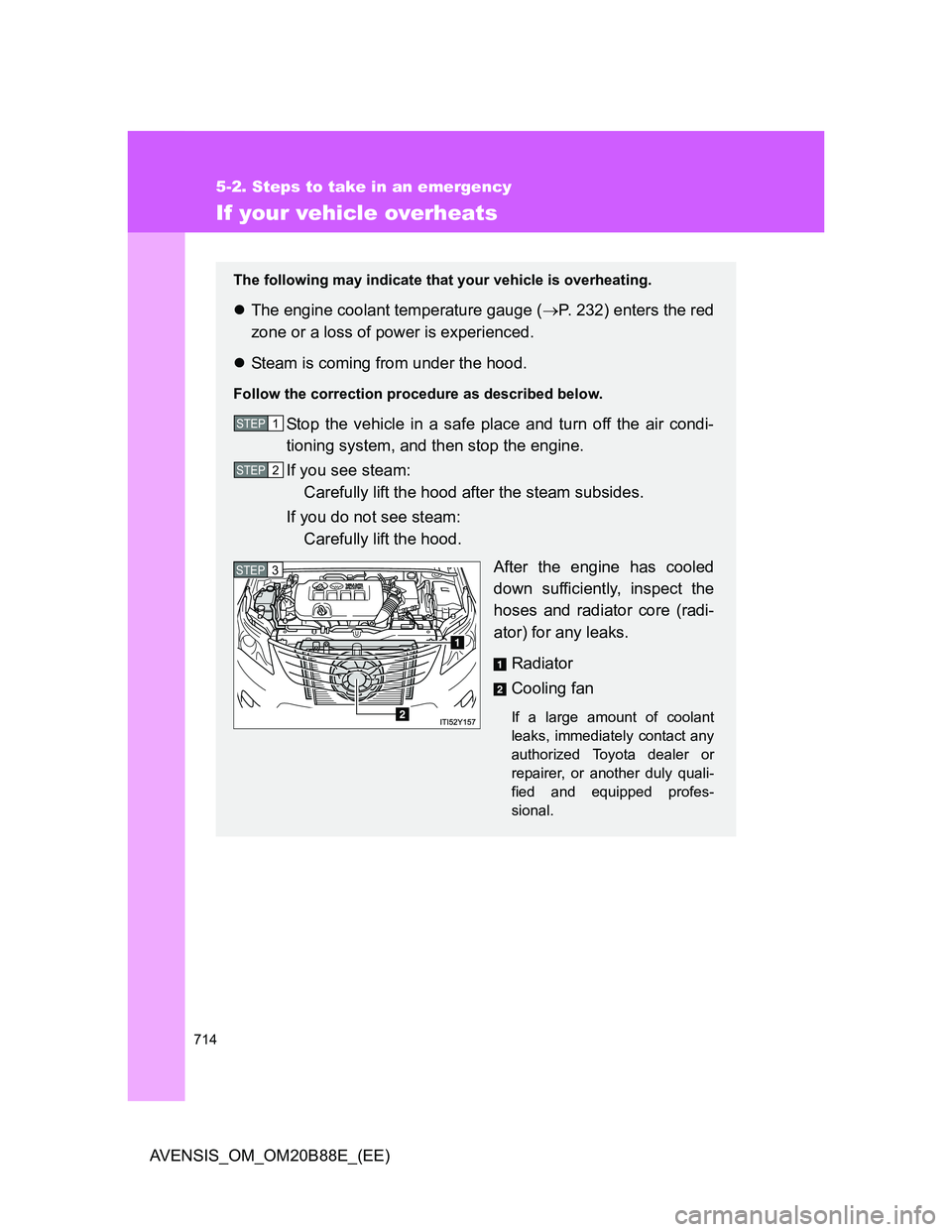
After the engine has cooled
down sufficiently, inspect the
hoses and radiator core (radi-
ator) for any leaks.
Radiator
Cooling fan
If a large amount of coolant
leaks, immediately contact any
authorized Toyota dealer or
repairer, or another duly quali-
fied and equipped profes-
sional.
STEP1
STEP2
STEP3
Page 715 of 776
5
715 5-2. Steps to take in an emergency
When trouble arises
AVENSIS_OM_OM20B88E_(EE)
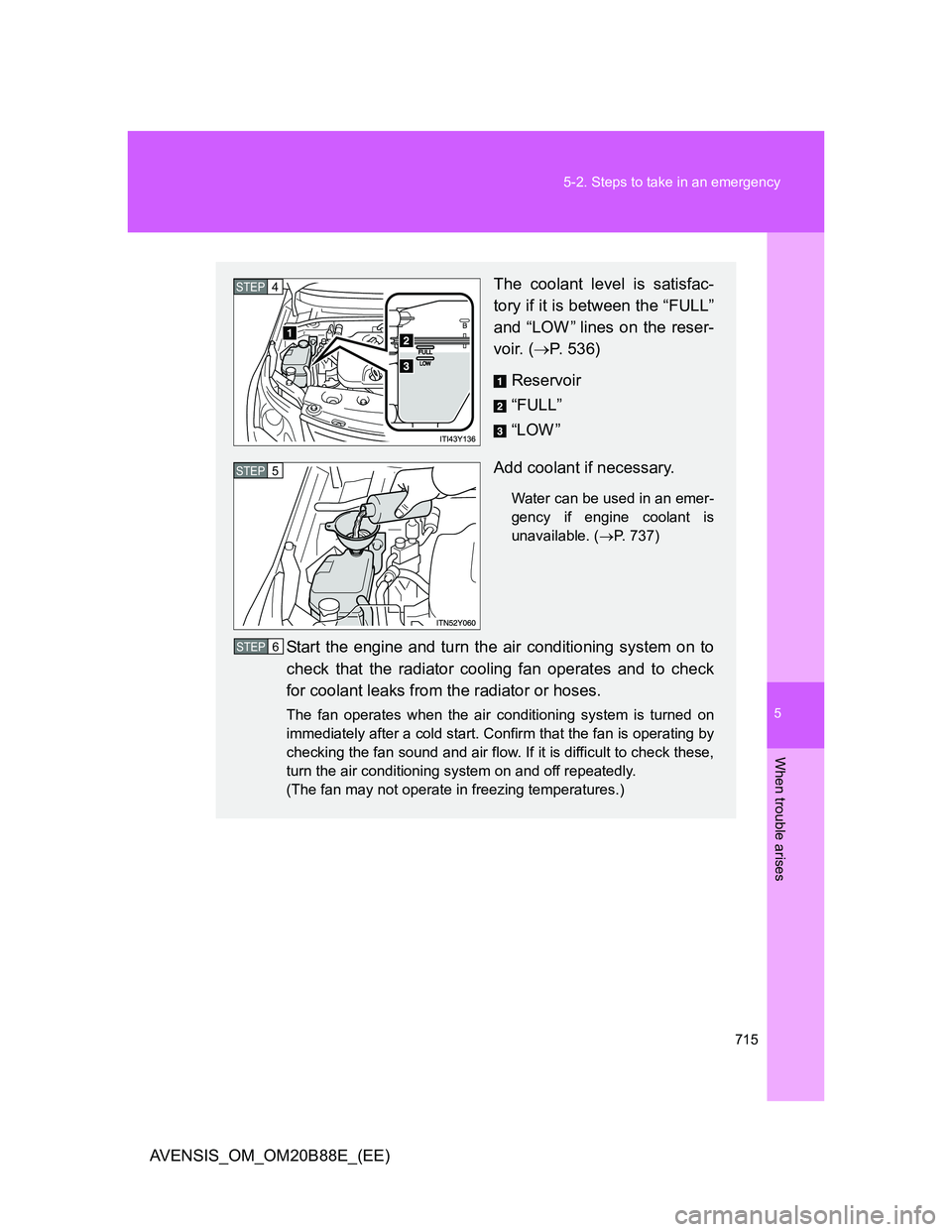
The coolant level is satisfac-
tory if it is between the “FULL”
and “LOW ” lines on the reser-
voir. (P. 536)
Reservoir
“FULL”
“LOW ”
Add coolant if necessary.
Water can be used in an emer-
gency if engine coolant is
unavailable. (P. 737)
Start the engine and turn the air conditioning system on to
check that the radiator cooling fan operates and to check
for coolant leaks from the radiator or hoses.
The fan operates when the air conditioning system is turned on
immediately after a cold start. Confirm that the fan is operating by
checking the fan sound and air flow. If it is difficult to check these,
turn the air conditioning system on and off repeatedly.
(The fan may not operate in freezing temperatures.)
STEP4
STEP5
STEP6