tire size TOYOTA AVENSIS 2014 Owners Manual (in English)
[x] Cancel search | Manufacturer: TOYOTA, Model Year: 2014, Model line: AVENSIS, Model: TOYOTA AVENSIS 2014Pages: 776, PDF Size: 33.54 MB
Page 324 of 776
324 2-4. Using other driving systems
AVENSIS_OM_OM20B88E_(EE)
CAUTION
When the TRC and VSC are off
Be especially careful and drive at a speed appropriate to the road condi-
tions. As these are systems to ensure vehicle stability and driving force, do
not turn off TRC and VSC unless necessary.
Replacing tires
Make sure that all tires are of the same size, brand, tread pattern and total
load capacity. In addition, make sure that the tires are inflated to the speci-
fied tire pressure level.
The ABS, TRC and VSC systems will not function correctly if different tires
are fitted on the vehicle.
Contact any authorized Toyota dealer or repairer, or another duly qualified
and equipped professional for further information when replacing tires or
wheels.
Handling of tires and suspension
Using tires with any kind of problem or modifying the suspension will affect
the driving assist systems, and may cause the system to malfunction.
Page 336 of 776
336
2-5. Driving information
AVENSIS_OM_OM20B88E_(EE)
Winter driving tips
Carry out the necessary preparations and inspections before driving
the vehicle in winter. Always drive the vehicle in a manner appropri-
ate to the prevailing weather conditions.
Pre-winter preparations
Use fluids that are appropriate to the prevailing outside tem-
peratures.
• Engine oil
• Engine coolant
• Washer fluid
Have a service technician inspect the level and specific grav-
ity of battery electrolyte.
Have the vehicle fitted with four snow tires or purchase a set
of tire chains for the front tires.
Ensure that all tires are the same size and brand, and that chains
match the size of the tires.
Page 338 of 776
338 2-5. Driving information
AVENSIS_OM_OM20B88E_(EE)
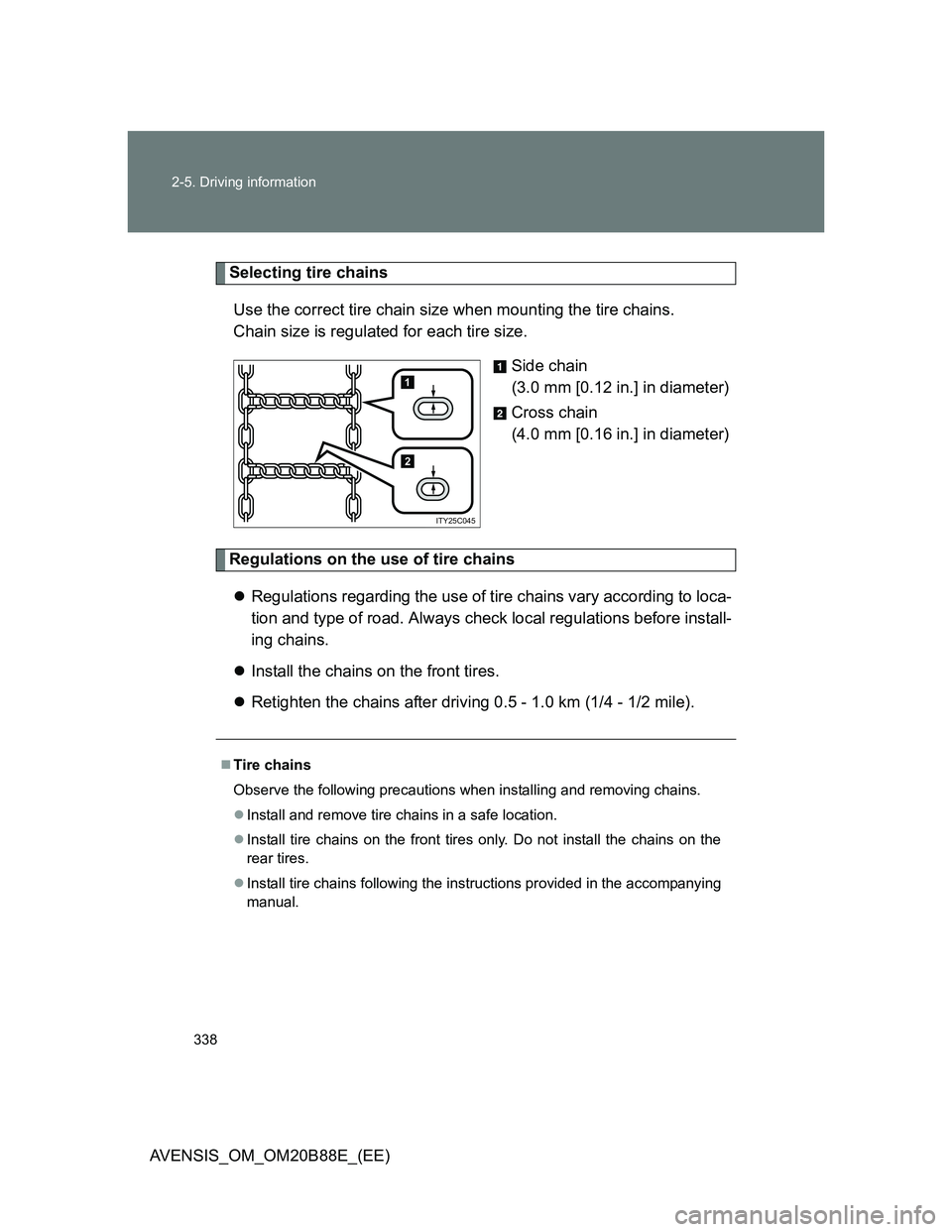
Selecting tire chains
Use the correct tire chain size when mounting the tire chains.
Chain size is regulated for each tire size.
Side chain
(3.0 mm [0.12 in.] in diameter)
Cross chain
(4.0 mm [0.16 in.] in diameter)
Regulations on the use of tire chains
Regulations regarding the use of tire chains vary according to loca-
tion and type of road. Always check local regulations before install-
ing chains.
Install the chains on the front tires.
Retighten the chains after driving 0.5 - 1.0 km (1/4 - 1/2 mile).
1
2
ITY25C045
Tire chains
Observe the following precautions when installing and removing chains.
Install and remove tire chains in a safe location.
Install tire chains on the front tires only. Do not install the chains on the
rear tires.
Install tire chains following the instructions provided in the accompanying
manual.
Page 339 of 776
339 2-5. Driving information
2
When driving
AVENSIS_OM_OM20B88E_(EE)
CAUTION
Driving with snow tires
Observe the following precautions to reduce the risk of accidents.
Failing to do so may result in a loss of vehicle control and cause death or
serious injury.
Use tires of the size specified for your vehicle.
Maintain the recommended level of tire inflation pressure.
Do not drive at speeds in excess of the speed limit or the speed limit spec-
ified for the snow tires being used.
Snow tires should be installed on all wheels.
Driving with tire chains
Observe the following precautions to reduce the risk of accidents.
Failing to do so may result in the vehicle being unable to be driven safely,
and may cause death or serious injury.
Do not drive in excess of the speed limit specified for the tire chains being
used or 50 km/h (30 mph), whichever is lower.
Avoid driving on bumpy road surfaces or over potholes.
Avoid sudden turns and braking, as use of chains may adversely affect
vehicle handling.
Slow down sufficiently before entering a curve to ensure that vehicle con-
trol is maintained.
Page 546 of 776
546 4-3. Do-it-yourself maintenance
AVENSIS_OM_OM20B88E_(EE)
When to replace your vehicle’s tires
Tires should be replaced if:
You have tire damage such as cuts, splits, cracks deep enough to
expose the fabric or bulges indicating internal damage
A tire goes flat repeatedly or cannot be properly repaired due to the size
or location of a cut or other damage
If you are not sure, consult with any authorized Toyota dealer or repairer, or
another duly qualified and equipped professional.
Tire life
Any tire over 6 years old must be checked by a qualified technician even if
they have seldom or never been used or damage is not obvious.
If the tread wears down 4 mm (0.16 in.) or more on snow tires
The effectiveness of snow tires is lost.
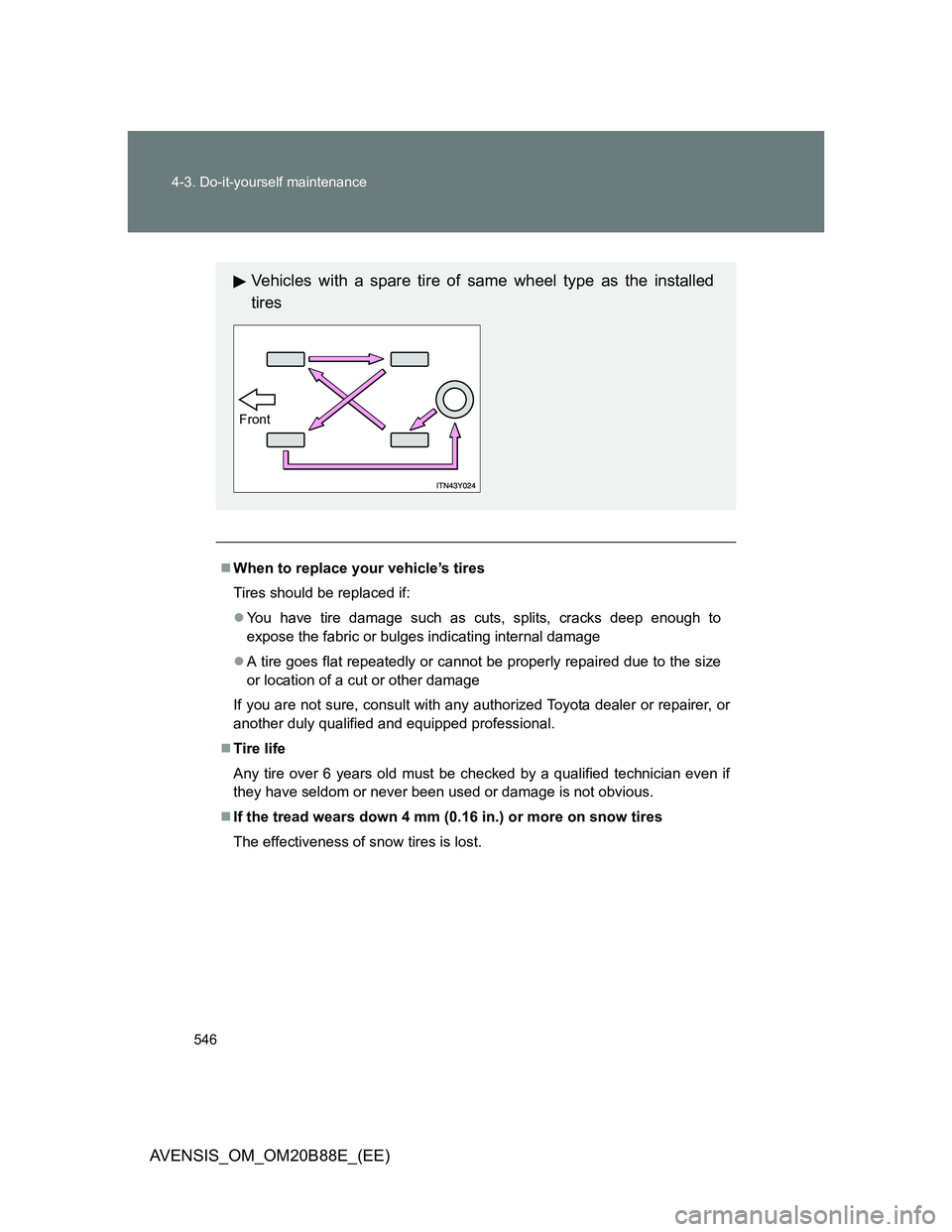
Vehicles with a spare tire of same wheel type as the installed
tires
Front
Page 547 of 776
547 4-3. Do-it-yourself maintenance
4
Maintenance and care
AVENSIS_OM_OM20B88E_(EE)
Low profile tires (225/45R18 tires)
Generally, low profile tires will wear more rapidly and tire grip performance
will be reduced on snowy and/or icy roads when compared to standard tires.
Be sure to use snow tires or tire chains on snowy and/or icy roads and drive
carefully at a speed appropriate for road and weather conditions.
CAUTION
When inspecting or replacing tires
Observe the following precautions to prevent accidents.
Failure to do so may cause damage to parts of the drive train, as well as
dangerous handling characteristics, which may lead to an accident resulting
in death or serious injury.
Do not mix tires of different makes, models or tread patterns.
Also, do not mix tires of remarkably different treadwear.
Do not use tire sizes other than those recommended by Toyota.
Do not mix differently constructed tires (radial, bias-belted or bias-ply
tires).
Do not mix summer, all season and snow tires.
Do not use tires that have been used on another vehicle.
Do not use tires if you do not know how they were used previously.
Page 551 of 776
551
4-3. Do-it-yourself maintenance
4
Maintenance and care
AVENSIS_OM_OM20B88E_(EE)
Wheels
If a wheel is bent, cracked or heavily corroded, it should be replaced.
Otherwise, the tire may separate from the wheel or cause loss of
handling control.
Wheel selection
When replacing wheels, care should be taken to ensure that
they are equivalent to those removed in load capacity, diameter,
rim width, and inset
*.
Replacement wheels are available at any authorized Toyota
dealer or repairer, or another duly qualified and equipped profes-
sional.
*: Conventionally referred to as “offset”.
Toyota does not recommend using:
Wheels of different sizes or types
Used wheels
Bent wheels that have been straightened
Aluminum wheel precautions
Use only Toyota wheel nuts and wrenches designed for use
with your aluminum wheels.
When rotating, repairing or changing your tires, check that the
wheel nuts are still tight after driving 1600 km (1000 miles).
Be careful not to damage the aluminum wheels when using
tire chains.
Use only Toyota genuine balance weights or equivalent and a
plastic or rubber hammer when balancing your wheels.
Page 552 of 776
552 4-3. Do-it-yourself maintenance
AVENSIS_OM_OM20B88E_(EE)
CAUTION
When replacing wheels
Do not use wheels that are a different size from those recommended in the
Owner’s Manual, as this may result in loss of handling control.
Never use an inner tube in a leaking wheel which is designed for a tube-
less tire. Doing so may result in an accident, causing death or serious
injury.
When installing the wheel nuts
Never use oil or grease on the wheel bolts or wheel nuts.
Oil and grease may cause the wheel nuts to be excessively tightened,
leading to bolt or disc wheel damage. In addition, the oil or grease can
cause the wheel nuts to loosen and the wheel may fall off, causing an acci-
dent and resulting in death or serious injury. Remove any oil or grease
from the wheel bolts or wheel nuts.
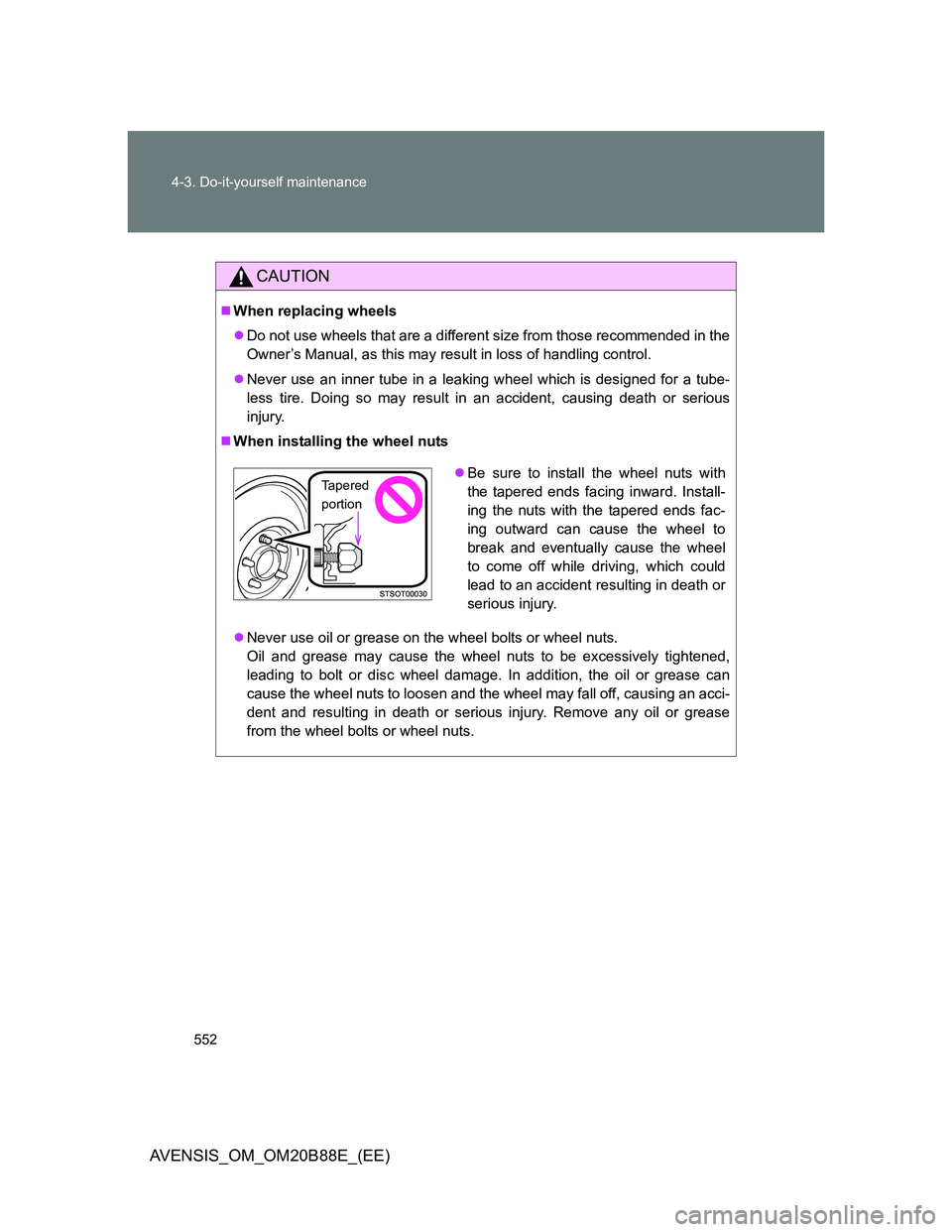
Be sure to install the wheel nuts with
the tapered ends facing inward. Install-
ing the nuts with the tapered ends fac-
ing outward can cause the wheel to
break and eventually cause the wheel
to come off while driving, which could
lead to an accident resulting in death or
serious injury.Tapered
portion
Page 689 of 776
5
689 5-2. Steps to take in an emergency
When trouble arises
AVENSIS_OM_OM20B88E_(EE)
Emergency tire puncture repair kit
The sealant stored in the emergency tire puncture repair kit can be used
only once to temporarily repair a single tire. If the sealant has been used
and needs to be replaced, purchase a new bottle at any authorized
Toyota dealer or repairer, or another duly qualified and equipped profes-
sional. The compressor is reusable.
The sealant can be used when the outside temperature is from -30°C
(-22°F) to 60°C (140°F).
The repair kit is exclusively designed for size and type of tires originally
installed on your vehicle. Do not use it for tires that a different size than
the original ones, or for any other purposes.
The sealant has a limited lifespan. The expiry date is marked on the bot-
tle. The bottle of sealant should be replaced with a new bottle before the
expiry date. Contact any authorized Toyota dealer or repairer, or another
duly qualified and equipped professional for replacement.
If the sealant gets on your clothes, it may stain.
If the sealant adheres to a wheel or the surface of the vehicle body, the
stain may not be removable if it is not cleaned at once. Immediately wipe
away the sealant with a wet cloth.
During operation of the repair kit, a loud operation noise is produced.
This does not indicate a malfunction.
Do not use to check or to adjust the tire pressure.
CAUTION
Do not drive the vehicle with a flat tire
Do not continue driving with a flat tire.
Driving even a short distance with a flat tire can damage the tire and the
wheel beyond repair.
Driving with a flat tire may cause a circumferential groove on the side wall. In
such a case, the tire may explode when using a repair kit.
Page 690 of 776
690 5-2. Steps to take in an emergency
AVENSIS_OM_OM20B88E_(EE)
CAUTION
Caution while driving
The repair kit is exclusively only for your vehicle.
Do not use repair kit on other vehicles, which could lead to an accident
causing death or serious injury.
Do not use repair kit for tires that are different size than the original ones,
or for any other purpose. If the tires have not been completely repaired, it
could lead to an accident causing death or serious injury.
Precautions for use of the sealant
Ingesting the sealant is hazardous to your health. If you ingest sealant,
consume as much water as possible, and then immediately consult a doc-
tor.
If sealant gets in eyes or adheres to skin, immediately wash it off with
water. If discomfort persists, consult a doctor.
When fixing the flat tire
Stop your vehicle in a safe and flat area.
Do not touch the wheels or the area around the brakes immediately after
the vehicle has been driven.
After the vehicle has been driven, the wheels and the area around the
brakes may be extremely hot. Touching these areas with hands, feet or
other body parts may result in burns.
To avoid risk of burst or severe leakage, do not drop or damage the bottle.
Visually inspect the bottle before use. Do not use a bottle with shock,
crack, scratch, leakage or any other damage. In such case, immediately
replace.
Connect the valve and hose securely with the tire installed on the vehicle.
If the hose is not properly connected to the valve, air leakage may occur
as sealant may be sprayed out.
If the hose comes off the valve while inflating the tire, there is a risk that
the hose will move abruptly due to air pressure.