cooling TOYOTA AVENSIS 2018 Owners Manual
[x] Cancel search | Manufacturer: TOYOTA, Model Year: 2018, Model line: AVENSIS, Model: TOYOTA AVENSIS 2018Pages: 660, PDF Size: 63.16 MB
Page 299 of 660
2994-6. Using the driving support systems
4
Driving
AVENSIS_OM_OM20C79E_(EE)■When to use the Stop & Start system
●If the engine is stopped by the Stop & Start system and the shift lever is
shifted into a position other than N with the clutch pedal released, a buzzer
will sound and Stop & Start indicator will flash. This indicates that the engine
is only stopped by the Stop & Start system, not that the engine has been
turned off completely.
●Use the Stop & Start system when stopping the vehicle temporarily at red
lights, intersections, etc. When stopping the vehicle for a longer period of
time, turn off the engine completely.
●When the system cannot operate, is canceled, or is malfunctioning, warning
messages and the warning buzzer are used to inform the driver. (P. 539)
●Vehicles with smart entry and start system: Even if the engine switch is
pressed during an engine stop, the engine does not restart. Start the engine
by shifting the shift lever to N and performing a normal engine start opera-
tion.
●When the engine restarts after having been stopped by the Stop & Start sys-
tem, the power outlet may be temporarily unusable, but this does not indi-
cate a malfunction.
●Installation and removal of electrical components and wireless devices may
affect the Stop & Start system, contact any authorized Toyota retailer or
Toyota authorized repairer, or any reliable repairer.
■If the windshield is fogged up while the engine is stopped by the Stop &
Start system
Turn the windshield defogger on. (The engine will start due to the automatic
engine start function.) (P. 394, 401)
If the windshield fogs up frequently, press the Stop & Start cancel switch to
deactivate the system.
■Air conditioning system while the engine is stopped by the Stop & Start
system (vehicles with an air conditioning system)
While the engine is stopped by the Stop & Start system, the air conditioning
system (cooling, heating and dehumidifying functions) is cancelled and it only
blows air or stops blowing air. In order to prevent the air conditioning system
from being cancelled, deactivate the Stop & Start system by pressing the Stop
& Start cancel switch.
Page 396 of 660
3966-1. Using the air conditioning system and defogger
AVENSIS_OM_OM20C79E_(EE)
■Fogging up of the windows
● The windows will easily fog up when the humidity in the vehicle is high.
Turning on will dehumidify the air from the outlets and defog the
windshield effectively.
● If you turn off, the windows may fog up more easily.
● The windows may fog up if the recirculated air mode is used.
■ Outside/recirculated air mode
● When driving on dusty roads such as tunnels or in heavy traffic, set the out-
side/recirculated air mode button to the recirculated air mode. This is effec-
tive in preventing outside air from entering the vehicle interior.
● Vehicles with air conditioning system: During cooling operation, setting the
recirculated air mode will also cool the vehicle interior effectively.
■ When the outside temperature falls to nearly 0°C (32°F) (vehicles with air
conditioning system)
The dehumidification function may not operate even when is
pressed.
■ Ventilation and air conditioning odors
● To let fresh air in, set the air conditioning system to the outside air mode.
● During use, various odors from inside and outside the vehicle may enter into
and accumulate in the air conditioning system. This may then cause odor to
be emitted from the vents.
● To reduce potential odors from occurring:
It is recommended that the air conditi oning system be set to outside air
mode prior to turning the vehicle off.
■ Air conditioning system operations when the engine is stopped due to
the Stop & Start system (vehicles with Stop & Start system)
When the engine is stopped due to the Stop & Start system operations, the air
conditioning cooling, heating and dehumidif ication functions turn off and only
ambient temperature air is blown, and there is a possibility that the blowing of
ambient temperature air will stop. To prevent the air conditioning system from
turning off, press the Stop & Start cancel switch to deactivate the system.
■ When the windshield is fogged up and the engine is stopped due to the
Stop & Start system (vehicl es with Stop & Start system)
Press the Stop & Start cancel switch to restart the engine and turn
on to defog the windshield. Simply pressing will restart the engine
and defog the windshield.
If the windshield continuously fogs up, press the Stop & Start cancel switch
and refrain from using the Stop & Start system.
Page 403 of 660
4036-1. Using the air conditioning system and defogger
AVENSIS_OM_OM20C79E_(EE)
6
Interior features
■Fogging up of the windows
● The windows will easily fog up when the humidity in the vehicle is high.
Turning on will dehumidify the air from the outlets and defog the
windshield effectively.
● If you turn off, the windows may fog up more easily.
● The windows may fog up if the recirculated air mode is used.
■ Outside/recirculated air mode
● When driving on dusty roads such as tunnels or in heavy traffic, set the out-
side/recirculated air mode button to the recirculated air mode. This is effec-
tive in preventing outside air from entering the vehicle interior. During
cooling operation, setting the recirculat ed air mode will also cool the vehicle
interior effectively.
● Outside/recirculated air mode may automatically switch depending on the
temperature setting or the inside temperature.
■ When the outside temperature falls to nearly 0°C (32°F)
The dehumidification function may not operate even when is
pressed.
■ Ventilation and air conditioning odors
● To let fresh air in, set the air conditioning system to the outside air mode.
● During use, various odors from inside and outside the vehicle may enter into
and accumulate in the air conditioning system. This may then cause odor to
be emitted from the vents.
● To reduce potential odors from occurring:
• It is recommended that the air conditioning system be set to outside air
mode prior to turning the vehicle off.
• The start timing of the blower may be delayed for a short period of time
immediately after the air conditioning system is started in AUTO mode.
■ Air conditioning system operations when the engine is stopped due to
the Stop & Start system (vehicles with Stop & Start system)
When the engine is stopped due to the Stop & Start system operations, the air
conditioning cooling, heating and dehumidif ication functions turn off and only
ambient temperature air is blown, and there is a possibility that the blowing of
ambient temperature air will stop. To prevent the air conditioning system from
turning off, press the Stop & Start cancel switch to deactivate the system.
■ When the windshield is fogged up and the engine is stopped due to the
Stop & Start system (vehicl es with Stop & Start system)
Press the Stop & Start cancel switch to restart the engine and turn
on to defog the windshield. Simply pressing will restart the engine
and defog the windshield.
If the windshield continuously fogs up, press the Stop & Start cancel switch
and refrain from using the Stop & Start system.
Page 448 of 660
4487-3. Do-it-yourself maintenance
AVENSIS_OM_OM20C79E_(EE)
WARNING
The engine compartment contains many mechanisms and fluids that may
move suddenly, become hot, or become el ectrically energized. To avoid death
or serious injury observe the following precautions.
■ When working on the engine compartment
● Keep hands, clothing, and tools away from the moving fan and engine
drive belt.
● Be careful not to touch the engine, radiator, exhaust manifold, etc. right
after driving as they may be hot. Oil and other fluids may also be hot.
● Do not leave anything that may burn easily, such as paper or rags, in the
engine compartment.
● Do not smoke, cause sparks or expose an open flame to fuel or the bat-
tery. Fuel and battery fumes are flammable.
● Be extremely cautious when working on the battery. It contains poisonous
and corrosive sulfuric acid.
● Take care because brake fluid can harm your hands or eyes and damage
painted surfaces.
If fluid gets on your hands or in your eyes, flush the affected area with
clean water immediately.
If you still experience discomfort, see a doctor.
■ When working near the electric cooling fan or radiator grille
Vehicles without smart entry & start system
Be sure the engine switch is in the “LOCK” position.
With the engine switch in the “ON” position, the electric cooling fan may
automatically start to run if the air conditioning is on and/or the coolant tem-
perature is high. ( P. 463)
Vehicles with smart entry & start system
Be sure the engine switch is off.
With the engine switch in IGNITION ON mode, the electric cooling fan may
automatically start to run if the air conditioning is on and/or the coolant tem-
perature is high. ( P. 463)
■ Safety glasses
Wear safety glasses to prevent flying or falling material, fluid spray, etc.
from getting in the eyes.
Page 453 of 660
4537-3. Do-it-yourself maintenance
AVENSIS_OM_OM20C79E_(EE)
7
Maintenance and care
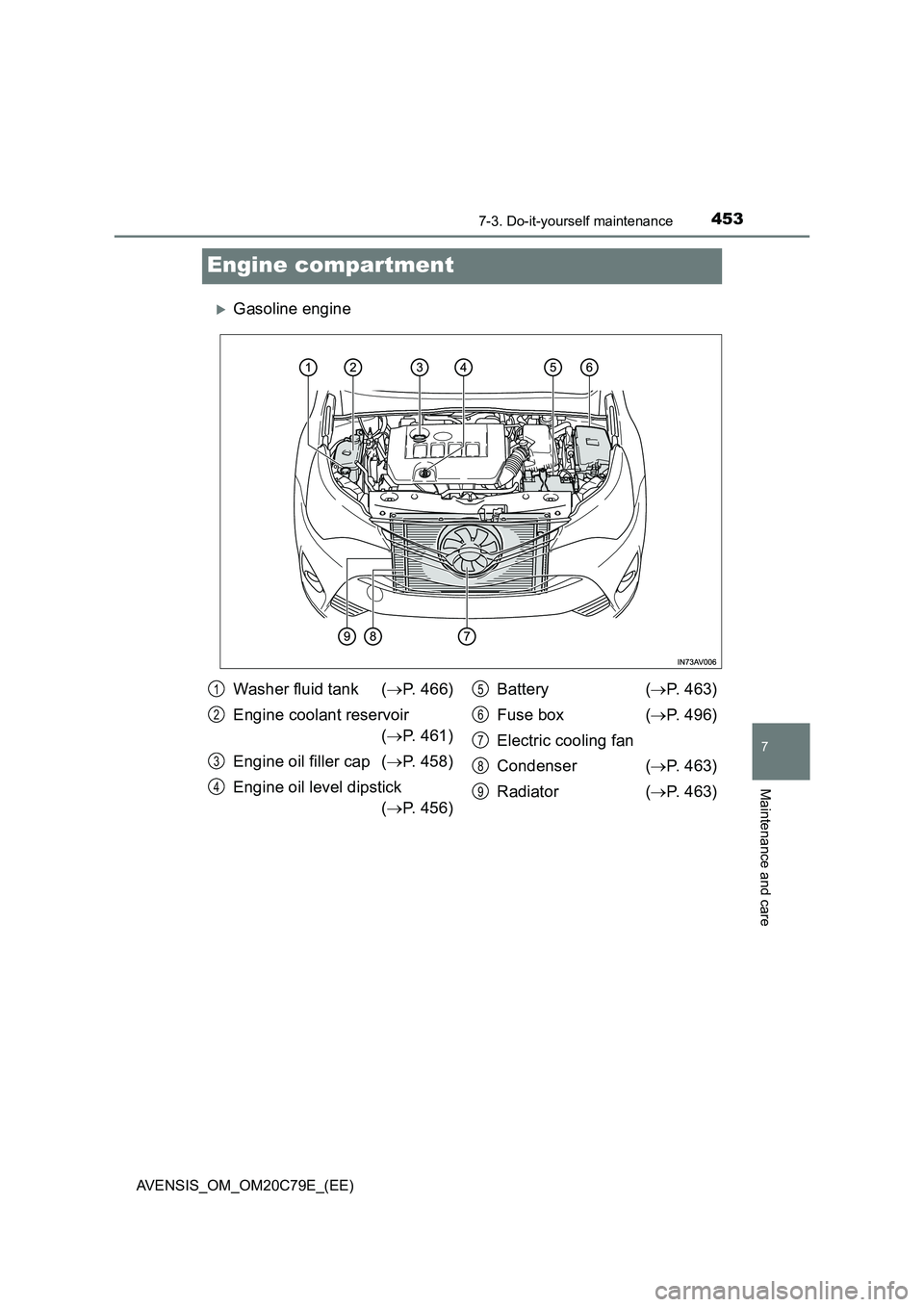
Engine compartment
Gasoline engine
Washer fluid tank (P. 466)
Engine coolant reservoir
(P. 461)
Engine oil filler cap (P. 458)
Engine oil level dipstick
(P. 456)Battery (P. 463)
Fuse box (P. 496)
Electric cooling fan
Condenser (P. 463)
Radiator (P. 463)1
2
3
4
5
6
7
8
9
Page 454 of 660
4547-3. Do-it-yourself maintenance
AVENSIS_OM_OM20C79E_(EE)
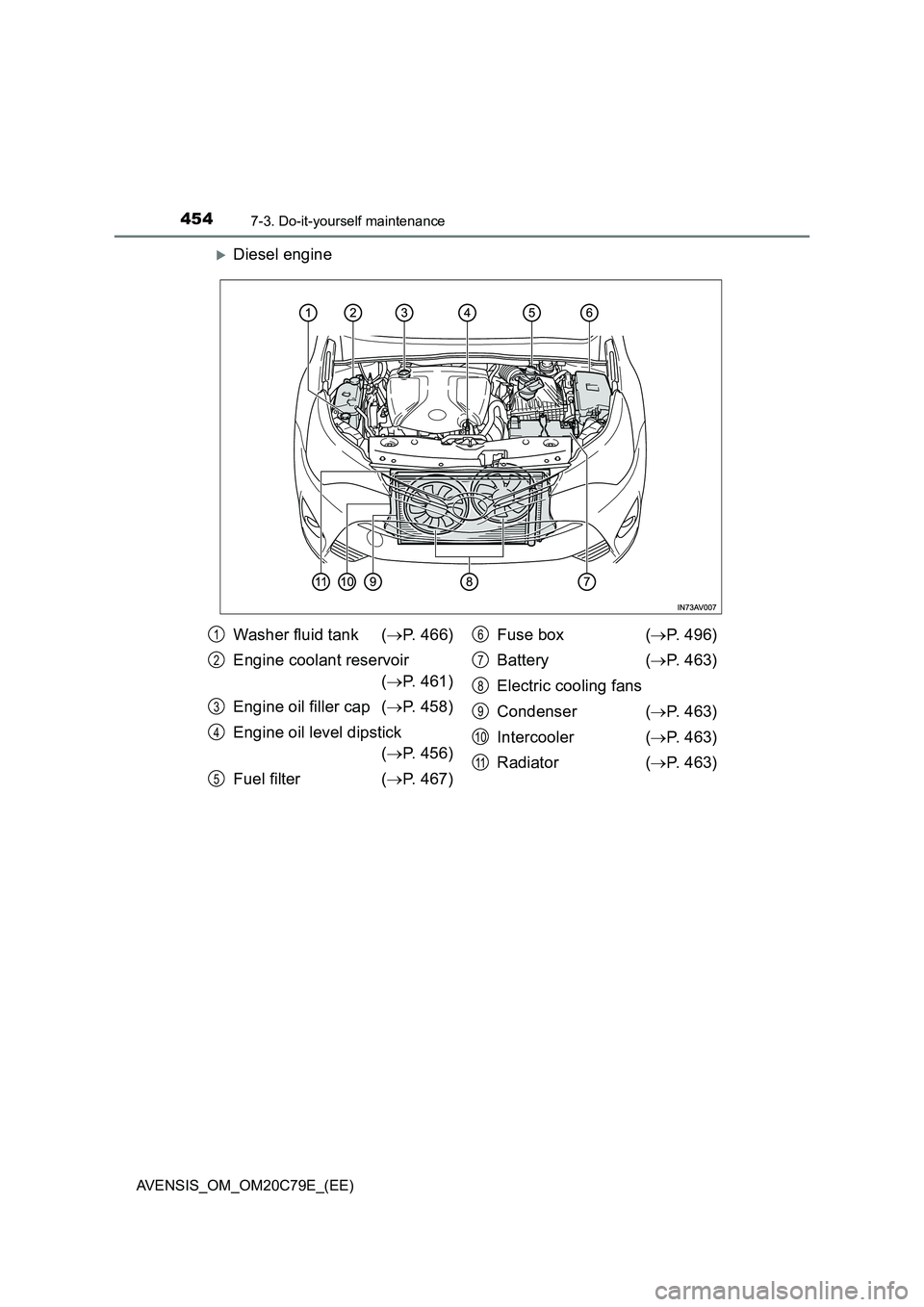
Diesel engine
Washer fluid tank (P. 466)
Engine coolant reservoir
(P. 461)
Engine oil filler cap (P. 458)
Engine oil level dipstick
(P. 456)
Fuel filter (P. 467)Fuse box (P. 496)
Battery (P. 463)
Electric cooling fans
Condenser (P. 463)
Intercooler (P. 463)
Radiator (P. 463)1
2
3
4
5
6
7
8
9
10
11
Page 462 of 660
4627-3. Do-it-yourself maintenance
AVENSIS_OM_OM20C79E_(EE)
■If the coolant level drops within a short time after replenishing
Visually check the radiator, hoses, engine coolant reservoir cap, drain cock
and water pump.
If you cannot find a leak, have any authorized Toyota retailer or Toyota autho-
rized repairer, or any reliable repairer, test the cap and check for leaks in the
cooling system.
■ Coolant selection
Gasoline engine
Only use “Toyota Super Long Life Cool ant” or similar high quality ethylene
glycol based non-silicate, non-amine, non- nitrite, and non-borate coolant with
long-life hybrid organic acid technology.
“Toyota Super Long Life Coolant” is a mixture of 50% coolant and 50% deion-
ized water. (Enabled: -35 C [-31F])
Diesel engine
Only use “Toyota Genuine Premium Long Life Coolant 1WW/2WW” or equiv-
alent. “Toyota Genuine Premium Long Life Coolant 1WW/2WW” concen-
trated product always needs to be mixed as 50% coolant and 50% deionized
water. (Enabled: -35 C [-31F])
For more details about engine coolant, contact any authorized Toyota retailer
or Toyota authorized repairer, or any reliable repairer.
WARNING
■ When the engine is hot
Do not remove the coolant reservoir cap.
The cooling system may be under pressure and may spray hot coolant if the
cap is removed, causing serious injuries, such as burns.
NOTICE
■ When adding engine coolant
Coolant is neither plain water nor straight antifreeze. The correct mixture of
water and antifreeze must be used to provide proper lubrication, corrosion
protection and cooling. Be sure to read the antifreeze or coolant label.
■ If you spill coolant
Be sure to wash it off with water to prevent damage to parts or paint.
Page 599 of 660
5998-2. Steps to take in an emergency
AVENSIS_OM_OM20C79E_(EE)
8
When trouble arises
NOTICE
■When handling jumper cables
When connecting the jumper cables, ensure that they do not become entan-
gled in the cooling fans or belt.
Page 600 of 660
6008-2. Steps to take in an emergency
AVENSIS_OM_OM20C79E_(EE)
If your vehicle overheats
Stop the vehicle in a safe place and turn off the air conditioning sys-
tem, and then stop the engine.
If you see steam:
Carefully lift the hood after the steam subsides.
If you do not see steam:
Carefully lift the hood.
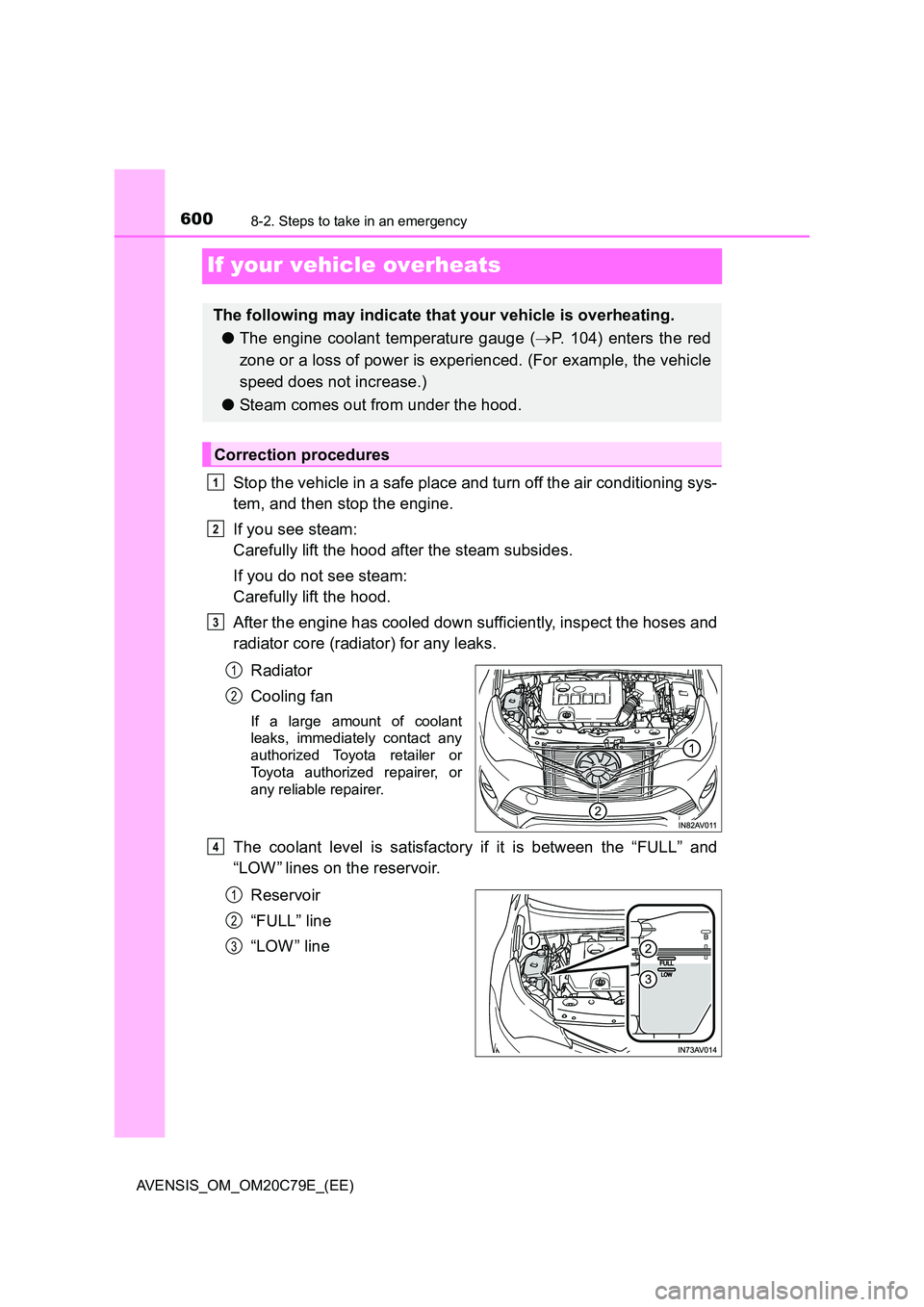
After the engine has cooled down sufficiently, inspect the hoses and
radiator core (radiator) for any leaks.
Radiator
Cooling fan
If a large amount of coolant
leaks, immediately contact any
authorized Toyota retailer or
Toyota authorized repairer, or
any reliable repairer.
The coolant level is satisfactory if it is between the “FULL” and
“LOW ” lines on the reservoir.
Reservoir
“FULL” line
“LOW ” line
The following may indicate that your vehicle is overheating.
● The engine coolant temperature gauge (P. 104) enters the red
zone or a loss of power is experienced. (For example, the vehicle
speed does not increase.)
● Steam comes out from under the hood.
Correction procedures
1
2
3
1
2
4
1
2
3
Page 601 of 660
6018-2. Steps to take in an emergency
AVENSIS_OM_OM20C79E_(EE)
8
When trouble arises
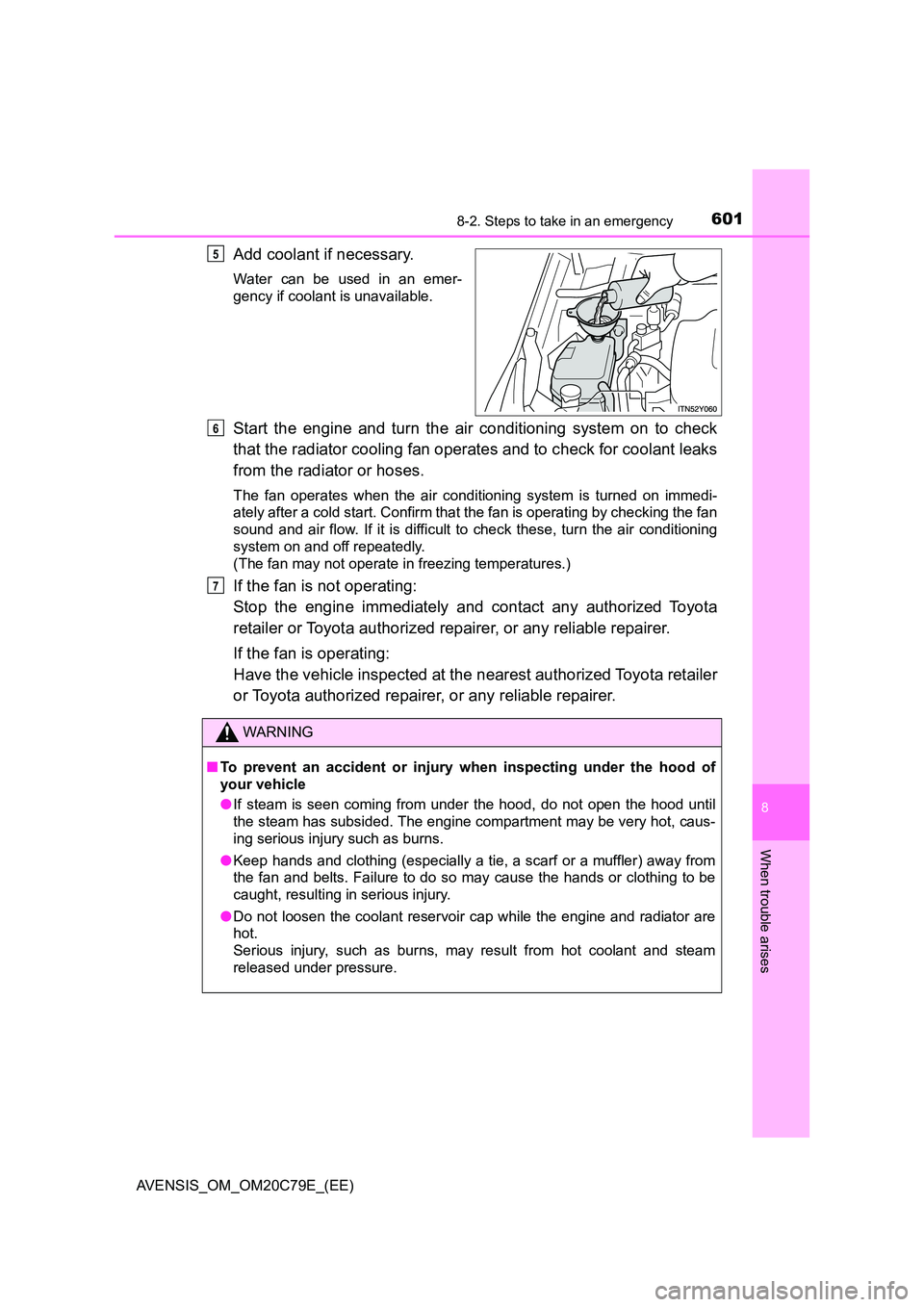
Add coolant if necessary.
Water can be used in an emer-
gency if coolant is unavailable.
Start the engine and turn the air conditioning system on to check
that the radiator cooling fan operates and to check for coolant leaks
from the radiator or hoses.
The fan operates when the air conditioning system is turned on immedi-
ately after a cold start. Confirm that the fan is operating by checking the fan
sound and air flow. If it is difficult to check these, turn the air conditioning
system on and off repeatedly.
(The fan may not operate in freezing temperatures.)
If the fan is not operating:
Stop the engine immediately and contact any authorized Toyota
retailer or Toyota authorized repairer, or any reliable repairer.
If the fan is operating:
Have the vehicle inspected at the nearest authorized Toyota retailer
or Toyota authorized repairer, or any reliable repairer.
5
WARNING
■ To prevent an accident or injury when inspecting under the hood of
your vehicle
● If steam is seen coming from under the hood, do not open the hood until
the steam has subsided. The engine compartment may be very hot, caus-
ing serious injury such as burns.
● Keep hands and clothing (especially a tie, a scarf or a muffler) away from
the fan and belts. Failure to do so may cause the hands or clothing to be
caught, resulting in serious injury.
● Do not loosen the coolant reservoir cap while the engine and radiator are
hot.
Serious injury, such as burns, may result from hot coolant and steam
released under pressure.
6
7