brake TOYOTA BZ4X 2022 Owners Manual (in English)
[x] Cancel search | Manufacturer: TOYOTA, Model Year: 2022, Model line: BZ4X, Model: TOYOTA BZ4X 2022Pages: 674, PDF Size: 120.02 MB
Page 5 of 674
3
Owners Manual_Europe_M42D76_en
TABLE OF CONTENTS
1
6
5
4
3
2
8
7
9
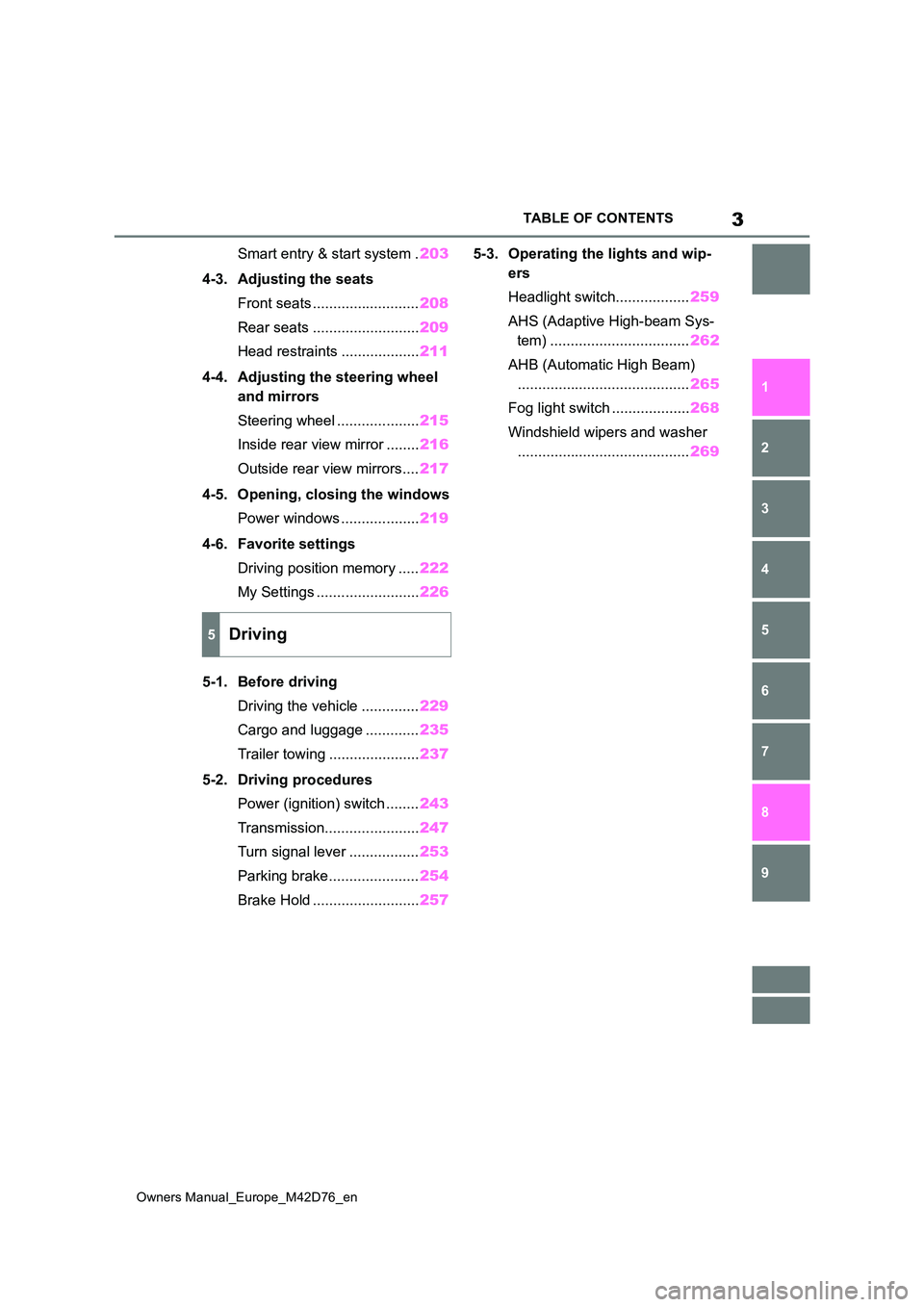
Smart entry & start system . 203
4-3. Adjusting the seats
Front seats .......................... 208
Rear seats .......................... 209
Head restraints ................... 211
4-4. Adjusting the steering wheel
and mirrors
Steering wheel .................... 215
Inside rear view mirror ........ 216
Outside rear view mirrors.... 217
4-5. Opening, closing the windows
Power windows ................... 219
4-6. Favorite settings
Driving position memory ..... 222
My Settings ......................... 226
5-1. Before driving
Driving the vehicle .............. 229
Cargo and luggage ............. 235
Trailer towing ...................... 237
5-2. Driving procedures
Power (ignition) switch ........ 243
Transmission....................... 247
Turn signal lever ................. 253
Parking brake...................... 254
Brake Hold .......................... 257
5-3. Operating the lights and wip-
ers
Headlight switch.................. 259
AHS (Adaptive High-beam Sys-
tem) .................................. 262
AHB (Automatic High Beam)
.......................................... 265
Fog light switch ................... 268
Windshield wipers and washer
.......................................... 269
5Driving
Page 6 of 674
4
Owners Manual_Europe_M42D76_en
TABLE OF CONTENTS
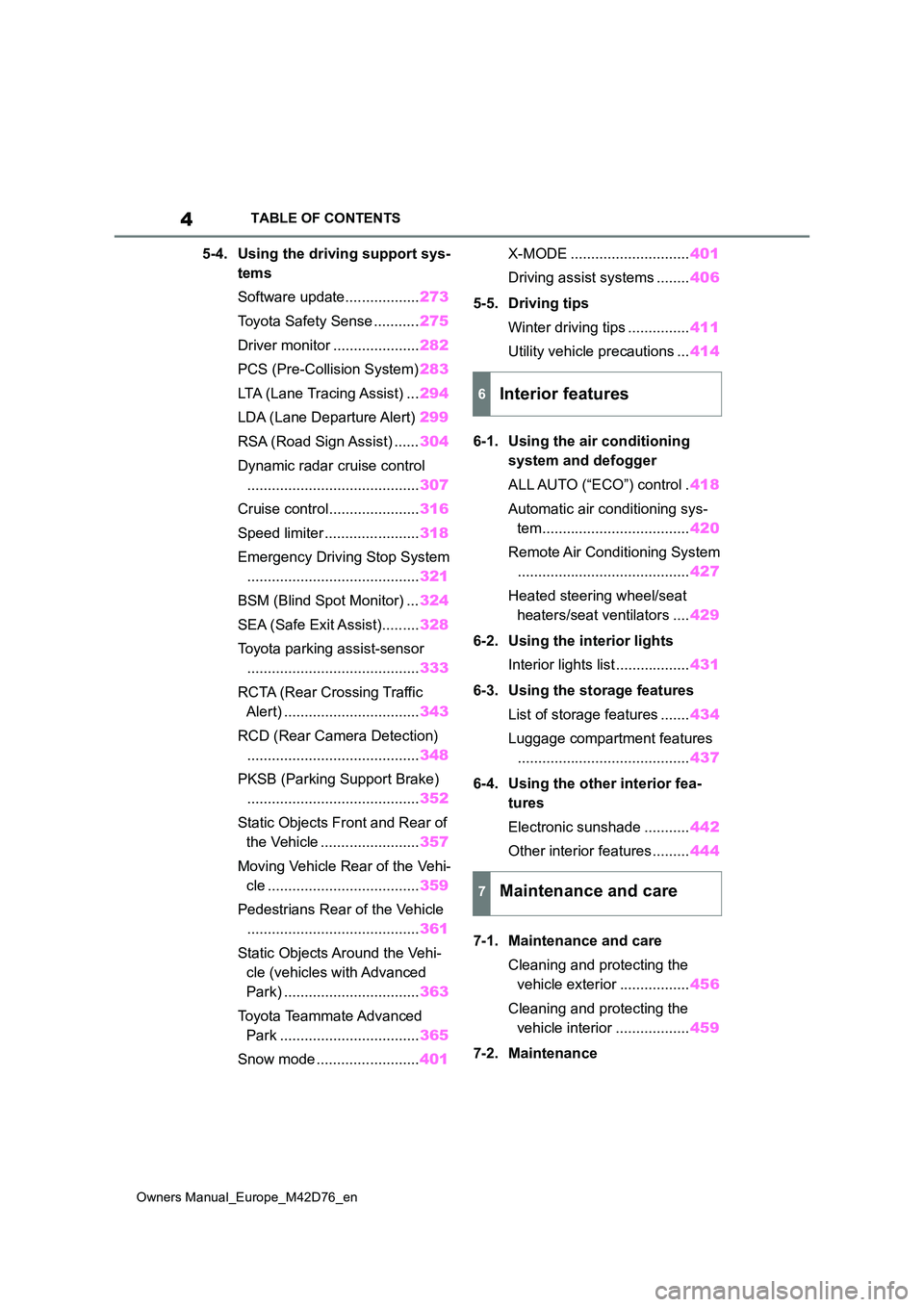
5-4. Using the driving support sys-
tems
Software update.................. 273
Toyota Safety Sense ........... 275
Driver monitor ..................... 282
PCS (Pre-Collision System) 283
LTA (Lane Tracing Assist) ... 294
LDA (Lane Departure Alert) 299
RSA (Road Sign Assist) ...... 304
Dynamic radar cruise control
.......................................... 307
Cruise control...................... 316
Speed limiter ....................... 318
Emergency Driving Stop System
.......................................... 321
BSM (Blind Spot Monitor) ... 324
SEA (Safe Exit Assist)......... 328
Toyota parking assist-sensor
.......................................... 333
RCTA (Rear Crossing Traffic
Alert) ................................. 343
RCD (Rear Camera Detection)
.......................................... 348
PKSB (Parking Support Brake)
.......................................... 352
Static Objects Front and Rear of
the Vehicle ........................ 357
Moving Vehicle Rear of the Vehi-
cle ..................................... 359
Pedestrians Rear of the Vehicle
.......................................... 361
Static Objects Around the Vehi-
cle (vehicles with Advanced
Park) ................................. 363
Toyota Teammate Advanced
Park .................................. 365
Snow mode ......................... 401
X-MODE ............................. 401
Driving assist systems ........ 406
5-5. Driving tips
Winter driving tips ............... 411
Utility vehicle precautions ... 414
6-1. Using the air conditioning
system and defogger
ALL AUTO (“ECO”) control . 418
Automatic air conditioning sys-
tem.................................... 420
Remote Air Conditioning System
.......................................... 427
Heated steering wheel/seat
heaters/seat ventilators .... 429
6-2. Using the interior lights
Interior lights list .................. 431
6-3. Using the storage features
List of storage features ....... 434
Luggage compartment features
.......................................... 437
6-4. Using the other interior fea-
tures
Electronic sunshade ........... 442
Other interior features ......... 444
7-1. Maintenance and care
Cleaning and protecting the
vehicle exterior ................. 456
Cleaning and protecting the
vehicle interior .................. 459
7-2. Maintenance
6Interior features
7Maintenance and care
Page 8 of 674
6
Owners Manual_Europe_M42D76_en
Please note that this manual
applies to all models and explains
all equipment, including options.
Therefore, you may find some
explanations for equipment not
installed on your vehicle.
All specifications provided in this
manual are current at the time of
printing. However, because of the
Toyota policy of continual product
improvement, we reserve the right
to make changes at any time with-
out notice.
Depending on specifications, the
vehicle shown in the illustrations
may differ from your vehicle in
terms of color and equipment.
Both genuine Toyota and a wide
variety of other spare parts and
accessories for Toyota vehicles are
currently available in the market.
Should it be determined that any of
the genuine Toyota parts or acces-
sories supplied with the vehicle
need to be replaced, Toyota recom-
mends that genuine Toyota parts or
accessories, be used to replace
them. Other parts or accessories of
matching quality can also be used.
Toyota cannot accept any liability or
guarantee spare parts and acces-
sories which are not genuine
Toyota products, nor for replace-
ment or installation involving such
parts. In addition, damage or per-
formance problems resulting from
the use of non-genuine Toyota
spare parts or accessories may not
be covered under warranty.
Also, remodeling like this will have
an effect on advanced safety equip-
ment such as Toyota Safety Sense
and there is a danger that it will not
work properly or the danger that it
may work in situations where it
should not be working.
The installation of an RF-transmit-
ter system in your vehicle could
affect electronic systems such as:
EV system
Toyota Safety Sense
Cruise control system
Anti-lock brake system
SRS airbag system
Seat belt pretensioner system
Be sure to check with any autho-
rized Toyota retailer or Toyota
authorized repairer, or any reliable
repairer for precautionary mea-
sures or special instructions regard-
ing installation of an RF-transmitter
system.
For your information
Main Owner’s Manual
Accessories, spare parts
and modification of your
To y o t a
Installation of an RF-trans-
mitter system
Page 9 of 674
7
Owners Manual_Europe_M42D76_en
Further information regarding fre-
quency bands, power levels,
antenna positions and installation
provisions for the installation of RF-
transmitters, is available on request
at any authorized Toyota retailer or
Toyota authorized repairer, or any
reliable repairer.
High voltage parts and cables on
the battery electric vehicles emit
approximately the same amount of
electromagnetic waves as the con-
ventional gasoline powered vehi-
cles or home electronic appliances
despite of their electromagnetic
shielding.
Unwanted noise may occur in the
reception of the radio frequency
transmitter (RF-transmitter).
The vehicle is equipped with
sophisticated computers that will
record certain data, such as:
• Engine speed/Electric motor
speed (traction motor speed)
• Accelerator status
• Brake status
• Vehicle speed
• Operation status of the driving
assist systems
• Images from the cameras
Your vehicle is equipped with cameras.
Contact any authorized Toyota retailer
or Toyota authorized repairer, or any
reliable repairer for the location of
recording cameras.
The recorded data varies according
to the vehicle grade level, options
and destinations with which it is
equipped.
These computers do not record
conversations or sounds, and only
record images outside of the vehi-
cle in certain situations.
Data usage
Toyota may use the data recorded in
this computer to diagnose malfunc-
tions, conduct research and develop-
ment, and improve quality.
Toyota will not disclose the recorded
data to a third party except:
• With the consent of the vehicle owner
or with the consent of the lessee if
the vehicle is leased
• In response to an official request by
the police, a court of law or a govern-
ment agency
• For use by Toyota in a lawsuit
• For research purposes where the
data is not tied to a specific vehicle or
vehicle owner
Recorded image information can
be erased by any authorized
Toyota retailer or Toyota autho-
rized repairer, or any reliable
repairer
The image recording function can
be disabled. However, if the func-
tion is disabled, data from when the
system operates will not be avail-
able.
The SRS airbag and seat belt
pretensioner devices in your Toyota
contain explosive chemicals. If the
Vehicle data recording
Scrapping of your Toyota
Page 15 of 674
13
Owners Manual_Europe_M42D76_en
Pictorial index
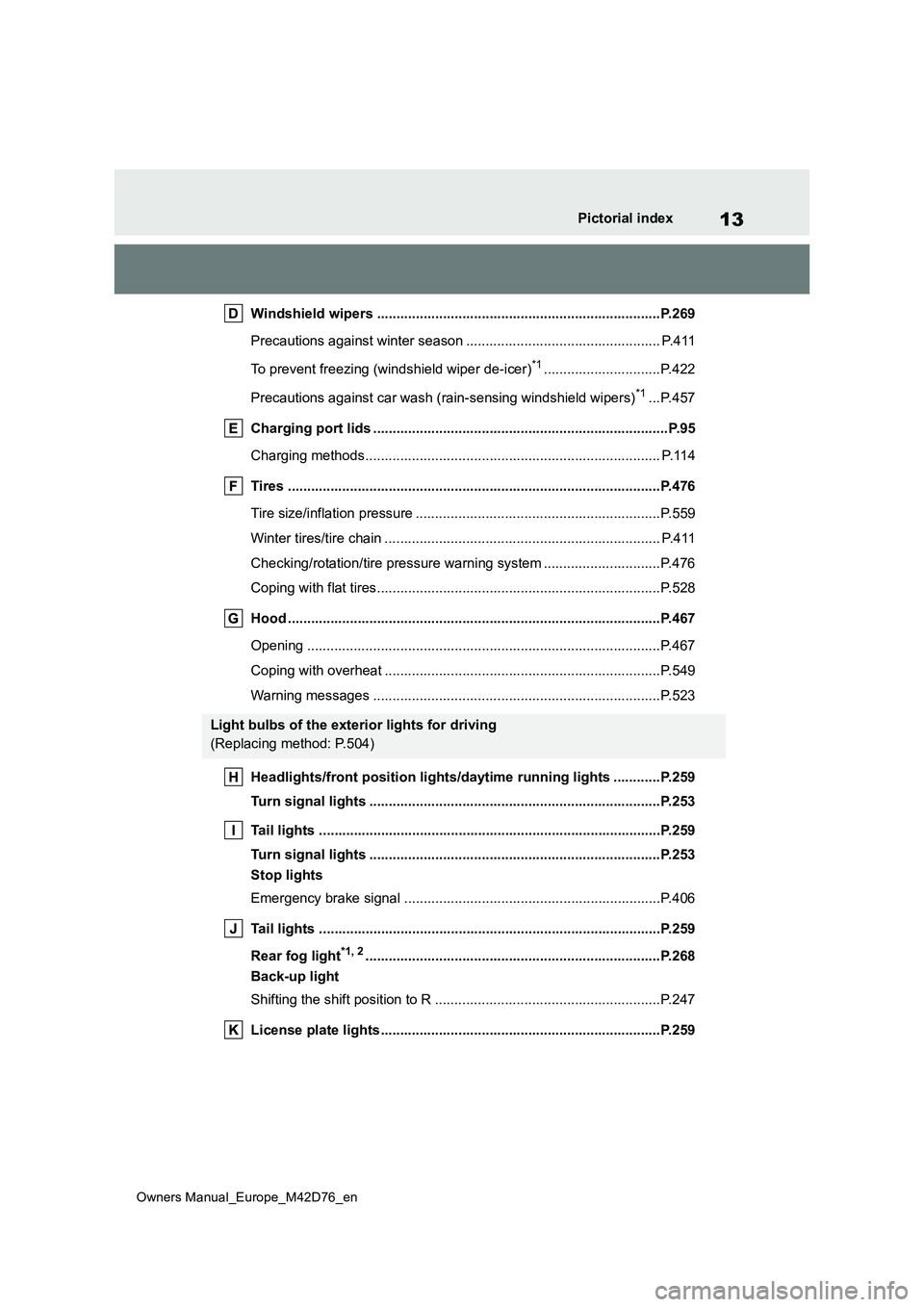
Windshield wipers .........................................................................P.269
Precautions against winter season .............................. .................... P.411
To prevent freezing (windshield wiper de-icer)*1..............................P.422
Precautions against car wash (rain-sensing windshield wipers)*1...P.457
Charging port lids ............................................. ...............................P.95
Charging methods............................................... ............................. P.114
Tires .......................................................... ......................................P.476
Tire size/inflation pressure ................................... ............................P.559
Winter tires/tire chain ........................................ ............................... P.411
Checking/rotation/tire pressure warning system ................. .............P.476
Coping with flat tires......................................... ................................P.528
Hood ........................................................... .....................................P.467
Opening ........................................................ ...................................P.467
Coping with overheat ........................................... ............................P.549
Warning messages ............................................... ...........................P.523
Headlights/front position lights/daytime running lights ........ ....P.259
Turn signal lights ............................................. ..............................P.253
Tail lights .................................................... ....................................P.259
Turn signal lights ............................................. ..............................P.253
Stop lights
Emergency brake signal ......................................... .........................P.406
Tail lights .................................................... ....................................P.259
Rear fog light*1, 2............................................................... .............P.268
Back-up light
Shifting the shift position to R ............................... ...........................P.247
License plate lights........................................... .............................P.259
Light bulbs of the exterior lights for driving
(Replacing method: P.504)
Page 19 of 674
17
Owners Manual_Europe_M42D76_en
Pictorial index
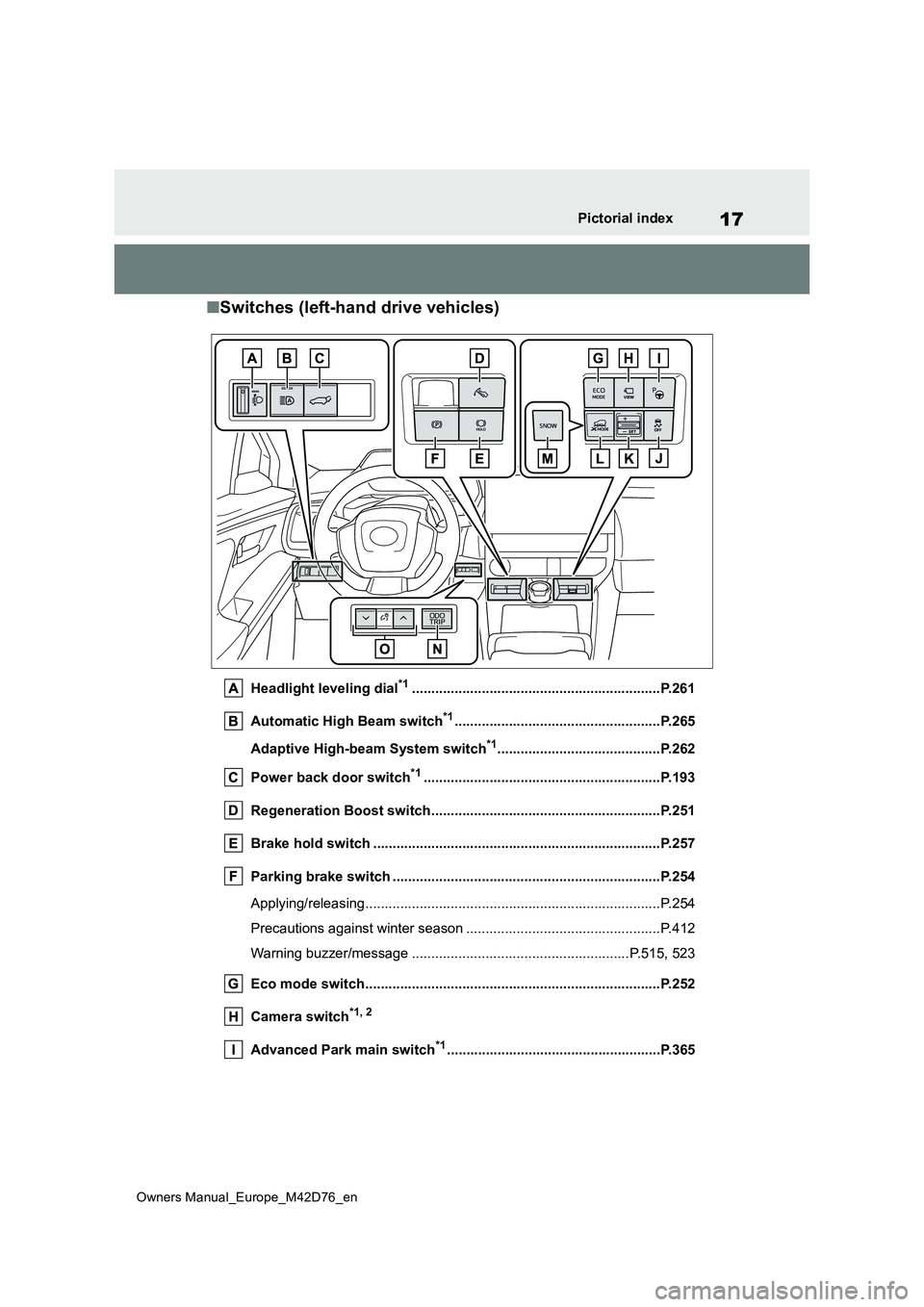
■Switches (left-hand drive vehicles)
Headlight leveling dial*1................................................................P.261
Automatic High Beam switch*1.....................................................P.265
Adaptive High-beam System switch*1..........................................P.262
Power back door switch*1.............................................................P. 193
Regeneration Boost switch...................................... .....................P.251
Brake hold switch .............................................. ............................P.257
Parking brake switch ........................................... ..........................P.254
Applying/releasing............................................. ...............................P.254
Precautions against winter season .............................. ....................P.412
Warning buzzer/message ......................................... ...............P.515, 523
Eco mode switch................................................ ............................P.252
Camera switch*1, 2
Advanced Park main switch*1.......................................................P.365
Page 27 of 674
25
Owners Manual_Europe_M42D76_en
Pictorial index
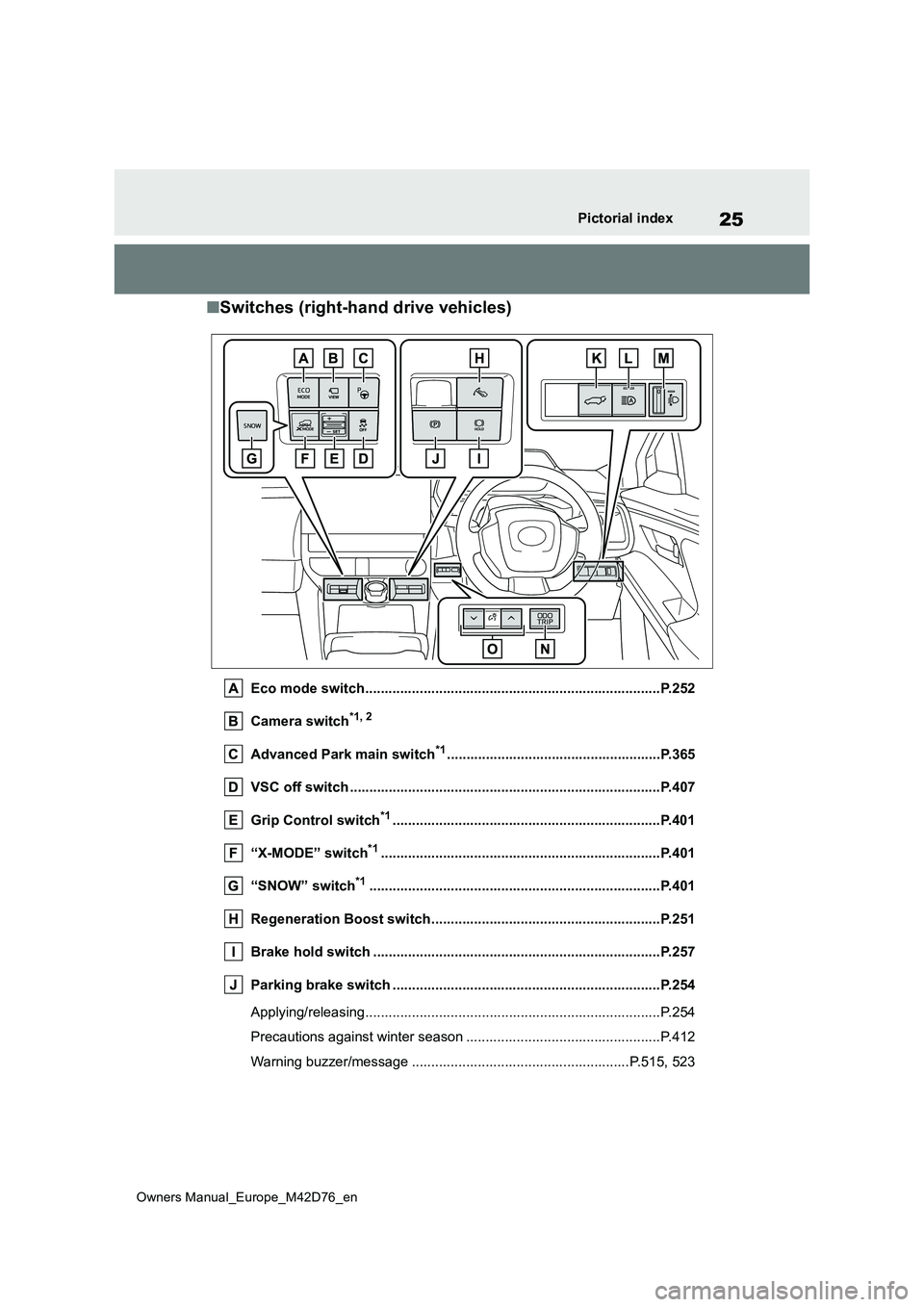
■Switches (right-hand drive vehicles)
Eco mode switch............................................................................P.252
Camera switch*1, 2
Advanced Park main switch*1.......................................................P.365
VSC off switch ................................................. ...............................P.407
Grip Control switch*1............................................................... ......P.401
“X-MODE” switch*1............................................................... .........P.401
“SNOW” switch*1............................................................... ............P.401
Regeneration Boost switch...................................... .....................P.251
Brake hold switch .............................................. ............................P.257
Parking brake switch ........................................... ..........................P.254
Applying/releasing............................................. ...............................P.254
Precautions against winter season .............................. ....................P.412
Warning buzzer/message ......................................... ...............P.515, 523
Page 43 of 674
41
1
Owners Manual_Europe_M42D76_en
1-1. For safe use
For safety and security
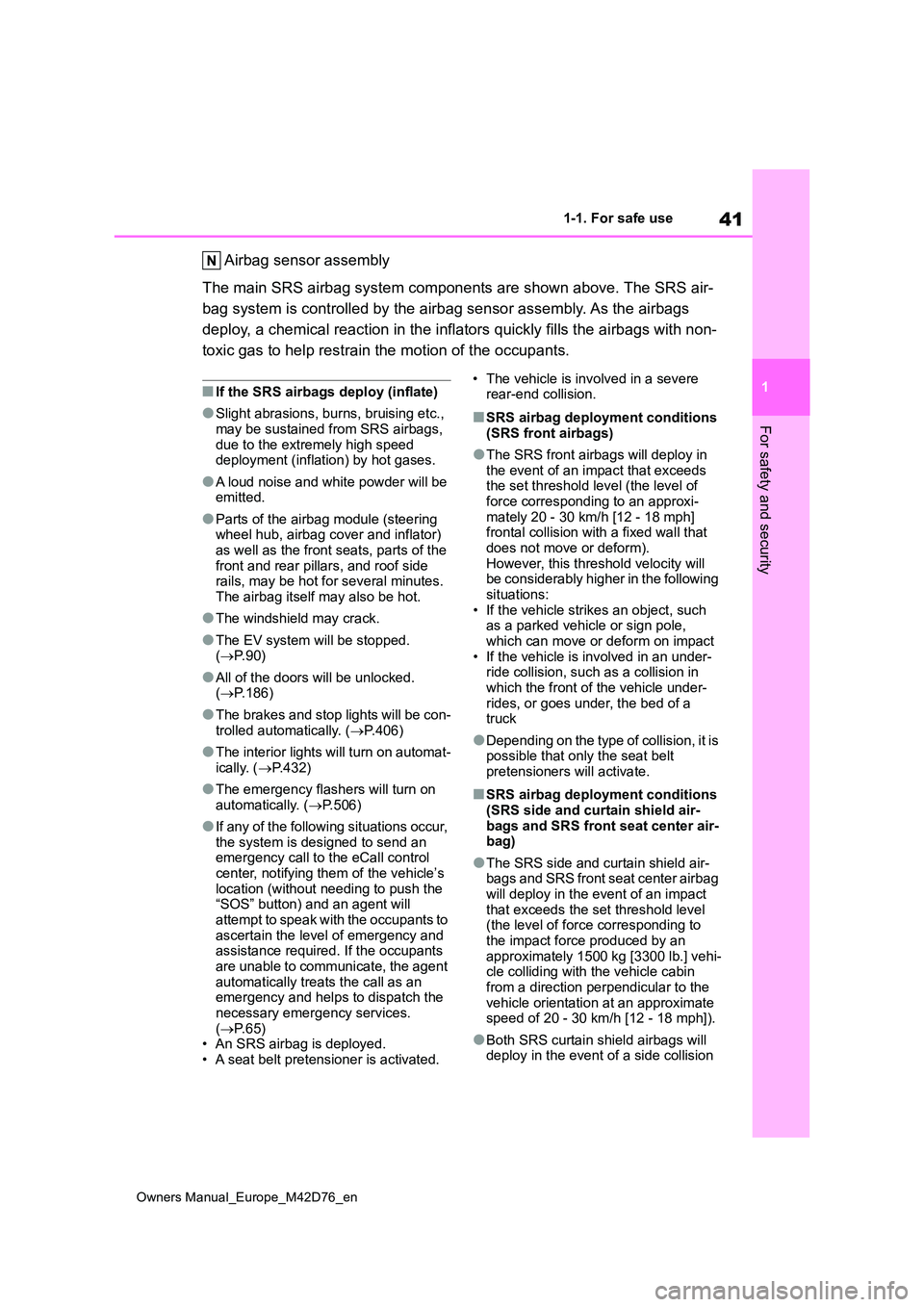
Airbag sensor assembly
The main SRS airbag system components are shown above. The SRS air-
bag system is controlled by the airbag sensor assembly. As the airbags
deploy, a chemical reaction in the inflators quickly fills the airbags with non-
toxic gas to help restrain the motion of the occupants.
■If the SRS airbags deploy (inflate)
●Slight abrasions, burns, bruising etc.,
may be sustained from SRS airbags, due to the extremely high speed deployment (inflation) by hot gases.
●A loud noise and white powder will be emitted.
●Parts of the airbag module (steering wheel hub, airbag cover and inflator)
as well as the front seats, parts of the front and rear pillars, and roof side rails, may be hot for several minutes.
The airbag itself may also be hot.
●The windshield may crack.
●The EV system will be stopped. ( P. 9 0 )
●All of the doors will be unlocked. ( P.186)
●The brakes and stop lights will be con-
trolled automatically. ( P.406)
●The interior lights will turn on automat-
ically. ( P.432)
●The emergency flashers will turn on
automatically. ( P.506)
●If any of the following situations occur,
the system is designed to send an emergency call to the eCall control center, notifying them of the vehicle’s
location (without needing to push the “SOS” button) and an agent will attempt to speak with the occupants to
ascertain the level of emergency and assistance required. If the occupants are unable to communicate, the agent
automatically treats the call as an emergency and helps to dispatch the necessary emergency services.
( P. 6 5 ) • An SRS airbag is deployed.• A seat belt pretensioner is activated.
• The vehicle is involved in a severe rear-end collision.
■SRS airbag deployment conditions
(SRS front airbags)
●The SRS front airbags will deploy in
the event of an impact that exceeds the set threshold level (the level of force corresponding to an approxi-
mately 20 - 30 km/h [12 - 18 mph] frontal collision with a fixed wall that does not move or deform).
However, this threshold velocity will be considerably higher in the following situations:
• If the vehicle strikes an object, such as a parked vehicle or sign pole, which can move or deform on impact
• If the vehicle is involved in an under- ride collision, such as a collision in which the front of the vehicle under-
rides, or goes under, the bed of a truck
●Depending on the type of collision, it is possible that only the seat belt pretensioners will activate.
■SRS airbag deployment conditions
(SRS side and curtain shield air- bags and SRS front seat center air-bag)
●The SRS side and curtain shield air-bags and SRS front seat center airbag
will deploy in the event of an impact that exceeds the set threshold level (the level of force corresponding to
the impact force produced by an approximately 1500 kg [3300 lb.] vehi-cle colliding with the vehicle cabin
from a direction perpendicular to the vehicle orientation at an approximate speed of 20 - 30 km/h [12 - 18 mph]).
●Both SRS curtain shield airbags will deploy in the event of a side collision
Page 85 of 674
83
2
Owners Manual_Europe_M42D76_en
2-1. Electric vehicle system
Electric Vehicle system
12-volt battery
Provides electricity to various vehicle systems such as the SRS airbags, headlights,
wipers, etc.
*: AWD models only
■When braking (regenerative
braking)
The battery electric motor (traction
motor) charges the traction battery.
The driving range can be extended
by actively using this regenerative
braking to store electricity in the
traction battery.
The battery electric vehicle is
driven using electricity, which is
received from an external power
source and stored in the traction
battery. Not only public charging
stations, but also household sock-
ets can be used for charging. Pro-
cedures are different from refueling
a conventional vehicle. Therefore,
make sure to read the following
thoroughly.
Charging equipment (P.95)
AC charging cable (P. 9 8 )
Power sources that can be used
( P.112)
Things to know before charging
( P.118)
How to charge your vehicle
( P.121, 129)
When charging cannot be per-
formed normally ( P.152)
■Regenerative braking
In the following situations, kinetic energy
is converted to electric energy and deceleration force can be obtained in conjunction with the recharging of the
traction battery.
●The accelerator pedal is released
while driving with the shift position in D.
●The brake pedal is depressed while driving with the shift position in D.
■Charging the 12-volt battery
The 12-volt battery is charged from the
traction battery when the EV system is operated or while the traction battery is being charged.
If the vehicle has not been used for a long time, the 12-volt battery may become low due to self-discharge. If this
occurs, follow the correct procedures. ( P.544)
■When not using the vehicle for an
extended period of time
●When the vehicle will not be used for
an extended period of time, charge the traction battery once a month. This protects the traction battery from
extreme voltage decline due to self discharging.
●When the vehicle will not be used for an extended period of time, the 12-volt battery will be charged from the
traction battery to reduce the risk of the 12-volt battery discharged. In this case, the cooling fan may operate,
however it is not a malfunction.
●To prevent the 12-volt battery from
being discharged, do not leave the charging port lid open or the charging cable connected to the vehicle.
Charging
Page 86 of 674
84
Owners Manual_Europe_M42D76_en
2-1. Electric vehicle system
■Charging the traction battery
Be sure to maintain the traction battery charge level suitable for your driving needs.
If the traction battery fully discharges, the vehicle cannot be driven at all. When the battery becomes low, charge it as
soon as possible.
■If the traction battery becomes low
●If the traction battery becomes low,
the traction battery charge warning light comes on or flashes and a mes-sage will be displayed on the multi-
information display. ( P.517)
●If the traction battery is completely
discharged, the EV system cannot be started and driving will not be possi-ble. When the traction battery
becomes low, charge it as soon as possible.
■Sounds and vibrations specific to an battery electric vehicle
Because there is no engine sound or vibration, it is easy to mistake the bat-tery electric vehicle for being off when it
is actually still running, as indicated by the “READY” indicator being illuminated. For safety, make sure to always shift the
shift position to P and apply the parking brake when parked.
Before and after the EV system is
started, the following sounds and vibra- tions may occur. However, these sounds and/or vibrations are not signs of mal-
functions:
●The brake system operation sound
may be heard from the front of the vehicle when the driver’s door is opened.
●Motor sounds may be heard from the motor compartment or luggage com-
partment.
●Electrical relay sounds may be heard
from the motor compartment when the EV system starts or stops.
●Relay operating sounds such as a snap or soft clank will be emitted from the traction battery in the following sit-
uations:
• When the EV system is started or stopped• When charging starts or completes
• When the vehicle is driven the first time after the traction battery has been charged using DC charging
●Sounds may be heard due to regener-ative braking when the brake pedal is
depressed or as the accelerator pedal is released.
●Cooling fan operating sounds from the radiator.
●The operation sound of the air condi-tioning system (air conditioning com-pressor, blower motor).
■Maintenance, repair, recycling, and
disposal
Contact any authorized Toyota retailer or Toyota authorized repairer, or any reli-
able repairer regarding maintenance, repair, recycling and disposal. Do not dispose of the vehicle yourself.
A sound which changes in accor-
dance with the driving speed, will
be played in order to warn people
nearby of the vehicle’s approach.
This sound may be heard inside the
vehicle. The sound will stop when
the vehicle speed exceeds approxi-
mately 25 km/h (15 mph).
■Acoustic Vehicle Alerting System
In the following cases, the Acoustic Vehicle Alerting System may be difficult
for surrounding people to hear.
●In very noisy areas
●In the wind or the rain
Also, as the Acoustic Vehicle Alerting
System is installed on the front of the
Acoustic Vehicle Alerting
System