fuel pressure TOYOTA C-HR 2019 Owners Manual (in English)
[x] Cancel search | Manufacturer: TOYOTA, Model Year: 2019, Model line: C-HR, Model: TOYOTA C-HR 2019Pages: 532, PDF Size: 10.35 MB
Page 13 of 532
13Pictorial index
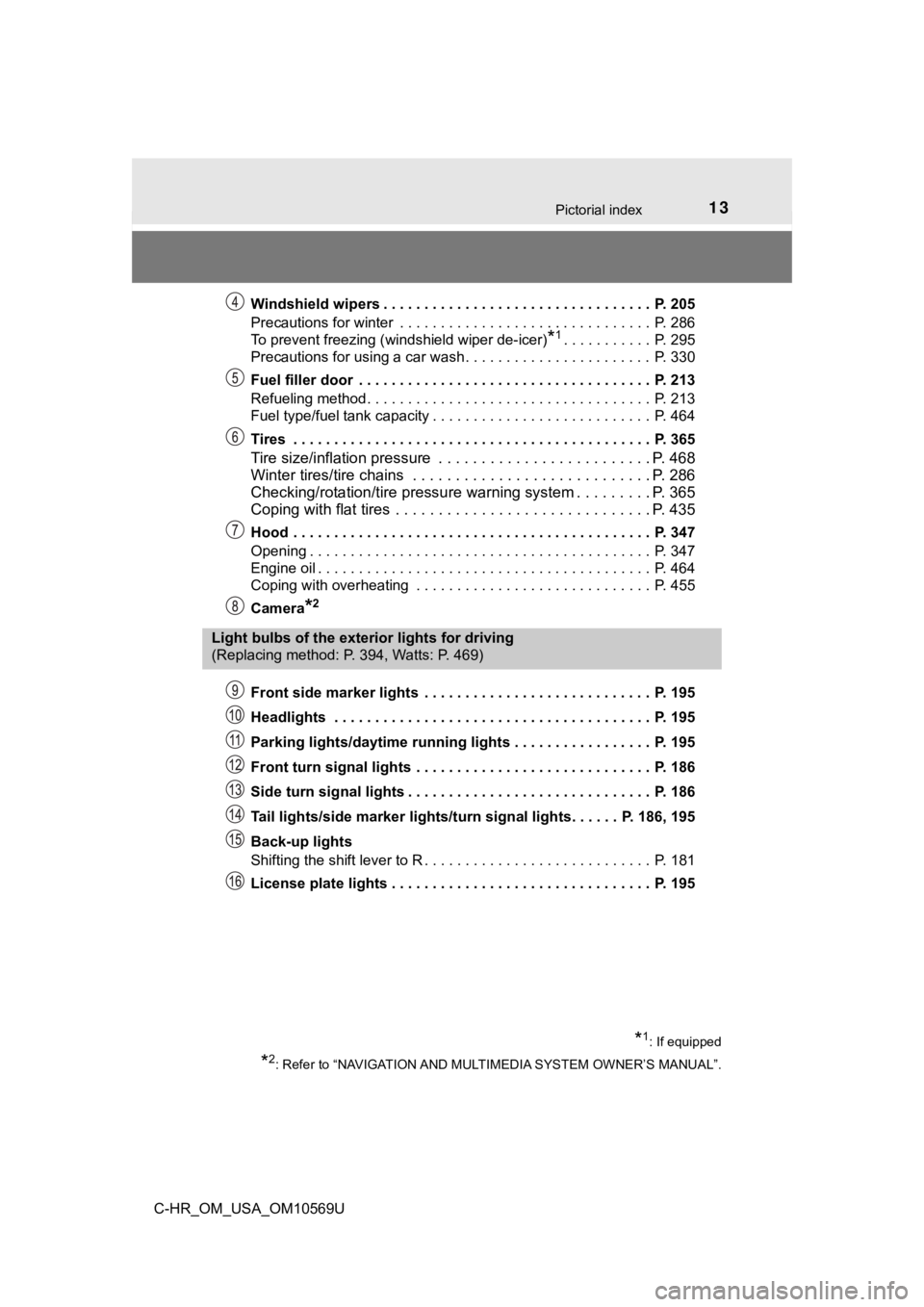
C-HR_OM_USA_OM10569UWindshield wipers . . . . . . . . . . . . . . . . . . . . . . . . . . . . . . . . . P. 205
Precautions for winter . . . . . . . . . . . . . . . . . . . . . . . . . . . . . . . P. 286
To prevent freezing (windshield wiper de-icer)
*1. . . . . . . . . . . P. 295
Precautions for using a car wash . . . . . . . . . . . . . . . . . . . . . . . P. 330
Fuel filler door . . . . . . . . . . . . . . . . . . . . . . . . . . . . . . . . . . . . P. 213
Refueling method . . . . . . . . . . . . . . . . . . . . . . . . . . . . . . . . . . . P. 213
Fuel type/fuel tank capacity . . . . . . . . . . . . . . . . . . . . . . . . . . . P. 464
Tires . . . . . . . . . . . . . . . . . . . . . . . . . . . . . . . . . . . . . . . . . . . . P. 365
Tire size/inflation pressure . . . . . . . . . . . . . . . . . . . . . . . . . P. 468
Winter tires/tire chains . . . . . . . . . . . . . . . . . . . . . . . . . . . . P. 286
Checking/rotation/tire pressur e warning system . . . . . . . . .P. 365
Coping with flat tires . . . . . . . . . . . . . . . . . . . . . . . . . . . . . . P. 435
Hood . . . . . . . . . . . . . . . . . . . . . . . . . . . . . . . . . . . . . . . . . . . . P. 347
Opening . . . . . . . . . . . . . . . . . . . . . . . . . . . . . . . . . . . . . . . . . . P. 347
Engine oil . . . . . . . . . . . . . . . . . . . . . . . . . . . . . . . . . . . . . . . . . P. 464
Coping with overheating . . . . . . . . . . . . . . . . . . . . . . . . . . . . . P. 455
Camera
*2
Front side marker lights . . . . . . . . . . . . . . . . . . . . . . . . . . . . P. 195
Headlights . . . . . . . . . . . . . . . . . . . . . . . . . . . . . . . . . . . . . . . P. 195
Parking lights/daytime running lights . . . . . . . . . . . . . . . . . P. 195
Front turn signal lights . . . . . . . . . . . . . . . . . . . . . . . . . . . . . P. 186
Side turn signal lights . . . . . . . . . . . . . . . . . . . . . . . . . . . . . . P. 186
Tail lights/side marker lights/turn signal lights. . . . . . P. 186, 195
Back-up lights
Shifting the shift lever to R . . . . . . . . . . . . . . . . . . . . . . . . . . . . P. 181
License plate lights . . . . . . . . . . . . . . . . . . . . . . . . . . . . . . . . P. 195
Light bulbs of the exterior lights for driving
(Replacing method: P. 394, Watts: P. 469)
*1: If equipped
*2: Refer to “NAVIGATION AND MULT IMEDIA SYSTEM OWNER’S MANUAL”.
Page 82 of 532
822. Instrument cluster
C-HR_OM_USA_OM10569U
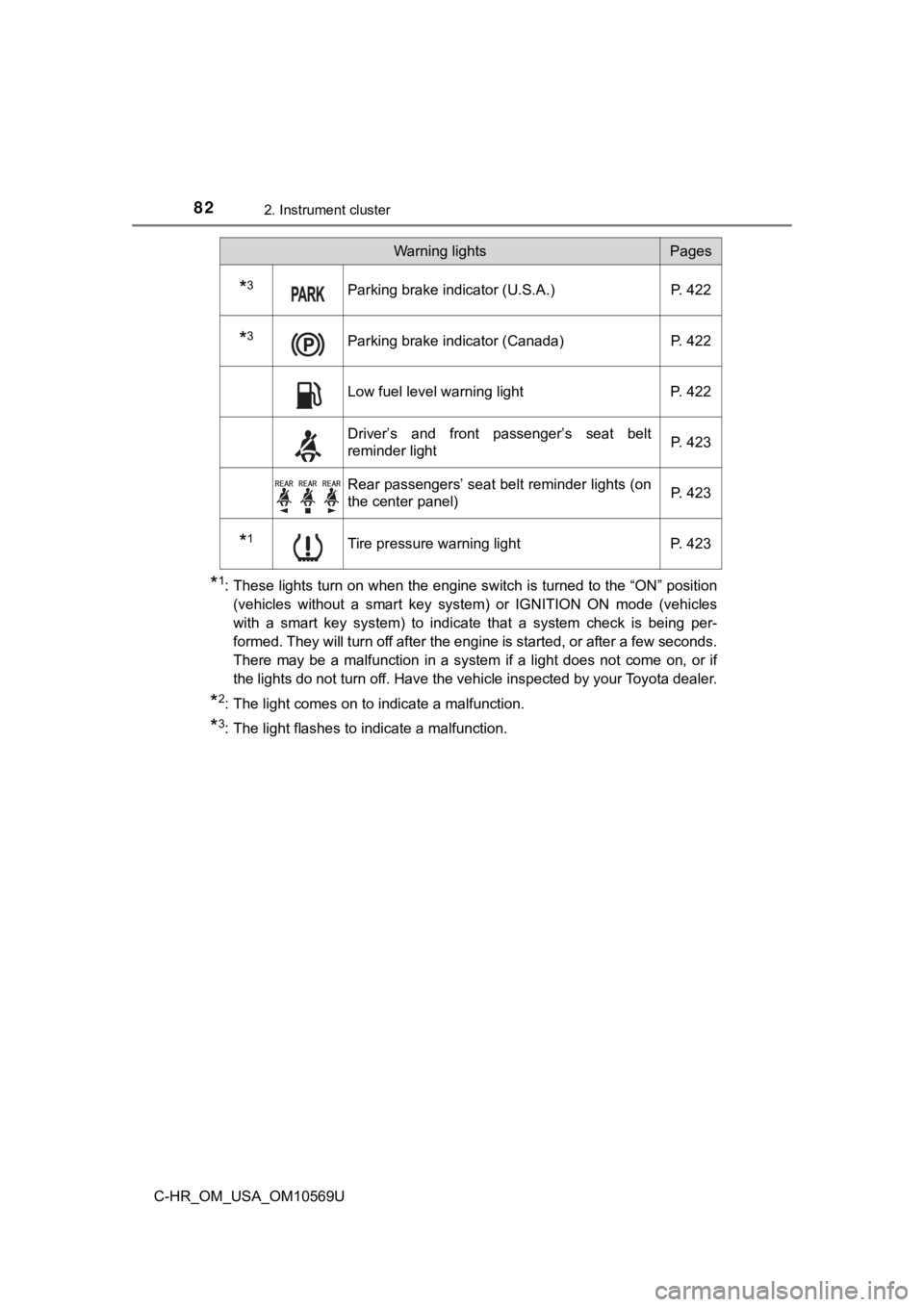
*1: These lights turn on when the engine switch is turned to the “ON” position
(vehicles without a smart key system) or IGNITION ON mode (vehi cles
with a smart key system) to indicate that a system check is bei ng per-
formed. They will turn off after the engine is started, or after a few seconds.
There may be a malfunction in a system if a light does not come on, or if
the lights do not turn off. Have the vehicle inspected by your Toyota dealer.
*2: The light comes on to indicate a malfunction.
*3: The light flashes to indicate a malfunction.
*3Parking brake indicator (U.S.A.)P. 422
*3Parking brake indicator (Canada)P. 422
Low fuel level warning lightP. 422
Driver’s and front passenger’s seat belt
reminder light P. 423
Rear passengers’ seat belt reminder lights (on
the center panel)
P. 423
*1Tire pressure warning light
P. 423
Warning lightsPages
Page 95 of 532

952. Instrument cluster
2
Instrument cluster
C-HR_OM_USA_OM10569U
● BSM (Blind Spot Mon itor) (if equipped) (P. 2 6 5 )
Select to set up the following items. • BSM function on/off
• RCTA function on/off
*
*
: The RCTA function can be enabled/disabled only when the BSM fu nc-
tion is enabled.
● Driving mode select ( P. 263)
● Vehicle Settings
(Tire pressure warning system) setup ( P. 367)
Select to initialize the tire pressure warning system.
● Meter settings
Select the menu to set up the following items.
• Language
Select to change the language on the display.
•Units
Select to change the unit of measure for fuel consumption.
• (Eco Driving Indicator Light) setup
Select to activate/deactivate the Eco Driving Indicator Light
• Drive information 1 and 2
Select to select up to 2 items that will be displayed on a Driv e informa-
tion screen, up to 2 Drive information screens can be set.
• Pop-up display
Select to set the pop-up displays*, which may appear in some situa-
tions, on/off.
• Speed limit
Select to setup speed limit indicated based on navigation syste m
(U.S.A. only)
• Default settings
Registered or changed meter settings will be deleted or returne d to their
default setting.
*: Route guidance display of the navigation system-linked system (if
equipped) and incoming call display of the hands-free phone sys tem.
Page 329 of 532

3296-1. Maintenance and care
6
Maintenance and care
C-HR_OM_USA_OM10569U■
Automatic car washes
●Fold the mirrors before washing the vehicle. Start washing from the front of
the vehicle. Make sure to extend the mirrors before driving.
● Brushes used in automatic car washes may scratch the vehicle su rface and
harm your vehicle's paint.
● Rear spoiler may not be washable in some automatic car washes. There
may also be an increased risk of damage to vehicle.
■ High pressure car washes
●Do not allow the nozzles of the car wash to come within close p roximity of
the windows.
● Before using the car wash, check that the fuel filler door on y our vehicle is
closed properly.
■ Note for a smart key system (if equipped)
If the door handle becomes wet while the electronic key is within the effective
range, the door may lock and unlock repeatedly. In that case, f ollow the fol-
lowing correction procedures to wash the vehicle:
● Place the key in a position 6 ft. (2 m) or more separate from t he vehicle
while the vehicle is being washed. (Take care to ensure that th e key is not
stolen.)
● Set the electronic key to battery-saving mode to disable the sm art key sys-
tem. ( P. 127)
■ Aluminum wheels (if equipped)
●Remove any dirt immediately by using a neutral detergent.
● Wash detergent off with water immediately after use.
● To protect the paint from damage, make sure to observe the following pre-
cautions.
• Do not use acidic, alkaline or abrasive detergent
• Do not use hard brushes
• Do not use detergent on the wheels when they are hot, such as after driv-
ing or parking in hot weather
■ Bumpers and side moldings
Do not scrub with abrasive cleaners.
Page 345 of 532
3456-3. Do-it-yourself maintenance
6
Maintenance and care
C-HR_OM_USA_OM10569U
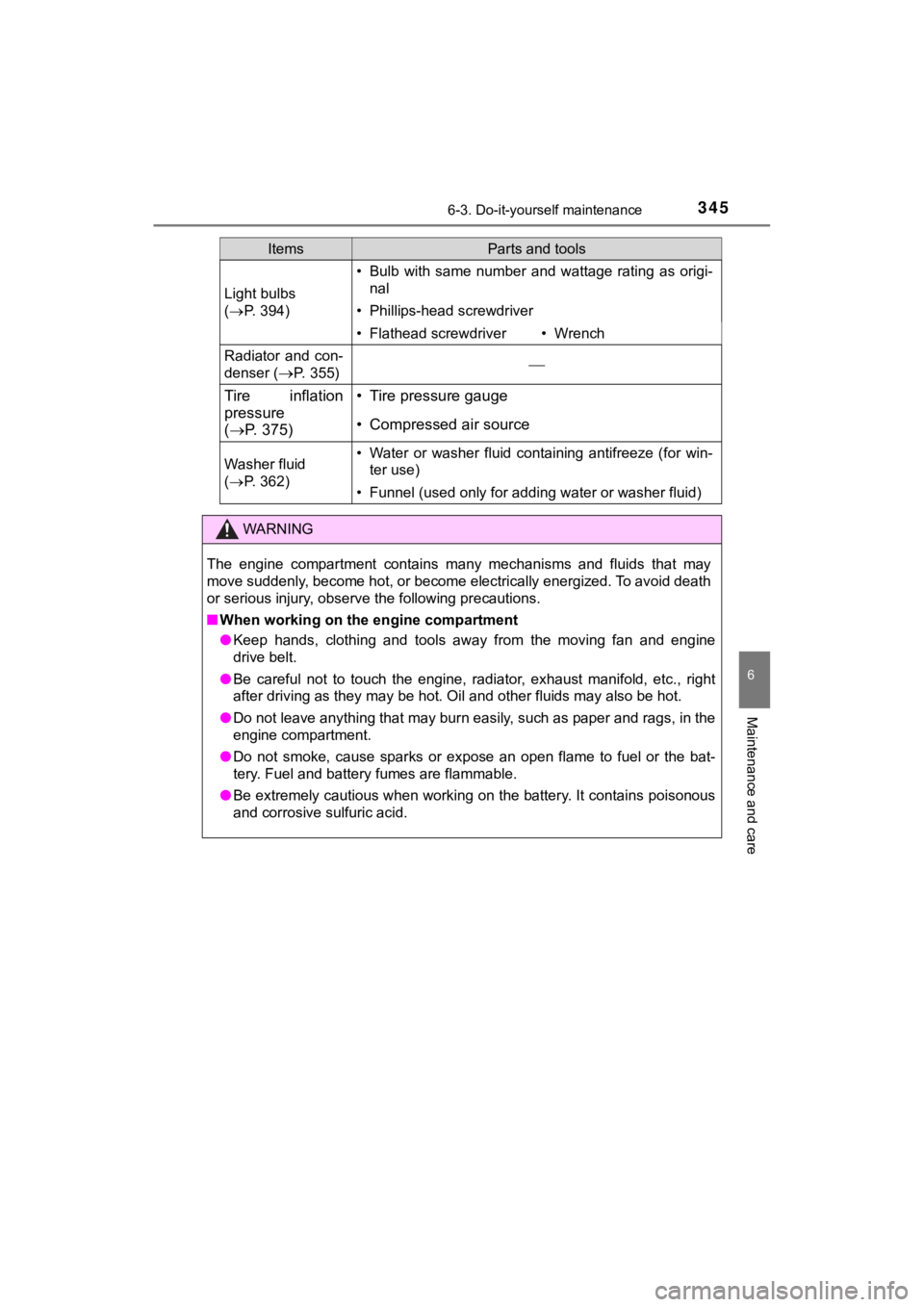
Light bulbs
( P. 3 9 4 )
• Bulb with same number and wattage rating as origi-
nal
• Phillips-head screwdriver
• Flathead screwdriver• Wrench
Radiator and con-
denser (
P. 355)
Tire inflation
pressure
( P. 375)• Tire pressure gauge
• Compressed air source
Washer fluid
( P. 3 6 2 )• Water or washer fluid containing antifreeze (for win-
ter use)
• Funnel (used only for adding water or washer fluid)
WARNING
The engine compartment contains many mechanisms and fluids that may
move suddenly, become hot, or become electrically energized. To avoid death
or serious injury, observe the following precautions.
■ When working on the engine compartment
● Keep hands, clothing and tools away from the moving fan and eng ine
drive belt.
● Be careful not to touch the engine, radiator, exhaust manifold, etc., right
after driving as they may be hot. Oil and other fluids may also be hot.
● Do not leave anything that may burn easily, such as paper and r ags, in the
engine compartment.
● Do not smoke, cause sparks or expose an open flame to fuel or t he bat-
tery. Fuel and battery fumes are flammable.
● Be extremely cautious when working on the battery. It contains poisonous
and corrosive sulfuric acid.
ItemsParts and tools
Page 377 of 532

3776-3. Do-it-yourself maintenance
6
Maintenance and care
C-HR_OM_USA_OM10569U
■Tire inflation pressure check interval
You should check tire inflation pressure every two weeks, or at least once
a month.
Do not forget to check the spare.
■Effects of incorrect tire inflation pressure
Driving with incorrec t tire inflation pressure may result in th e following:
●Reduced fuel economy
●Reduced driving comfort and poor handling
●Reduced tire life due to wear
●Reduced safety
●Damage to the drivetrain
If a tire needs frequent inflating , have it checked by your Toyota dealer.
■Instructions for checking tire inflation pressure
When checking tire inflation p ressure, observe the following:
●Check only when the tires are cold.
If your vehicle has been parked for at least 3 hours or has not been
driven for more than 1 mile or 1.5 km, you will get an accurate cold tire
inflation pressure reading.
●Always use a tire pressure gauge.
It is difficult to judge if a tire is properly inflated based o nly on its appear-
ance.
●It is normal for the tire inflation pressure to be higher after driving as
heat is generated in the tire. Do not reduce tire inflation pre ssure after
driving.
●Never exceed the vehicle capacity weight.
Passengers and luggage weight should be placed so that the vehi cle is
balanced.
Page 428 of 532

4287-2. Steps to take in an emergency
C-HR_OM_USA_OM10569U
WARNING
■Maintenance of the tires
Each tire, including the spare (if provided), should be checked monthly
when cold and inflated to the inflation pressure recommended by the
vehicle manufacturer on the vehicle placard or tire inflation p ressure
label (tire and load information label). (If your vehicle has t ires of a dif-
ferent size than the size indica ted on the vehicle placard or tire inflation
pressure label [tire and load information label], you should de termine
the proper tire inflation p ressure for those tires.)
As an added safety feature, your vehicle has been equipped with a tire
pressure monitoring system (TPMS -tire pressure warning system) that
illuminates a low tire pressure telltale (tire pressure warning light) when
one or more of your tires is significantly under-inflated. Acco rdingly,
when the low tire pressure telltale (tire pressure warning ligh t) illumi-
nates, you should stop and check your tires as soon as possible , and
inflate them to the proper pressure. Driving on a significantly under-
inflated tire causes the tire to overheat and can lead to tire failure.
Under-inflation also reduces fuel efficiency and tire tread lif e, and may
affect the vehicle’s handl ing and stopping ability.
Please note that the TPMS (tire pressure warning system) is not a sub-
stitute for proper tire maintena nce, and it is the driver’s responsibility to
maintain correct tire pressure, even if under-inflation has not reached
the level to trigger illumination of the TPMS low tire pressure telltale (tire
pressure warning light).
Your vehicle has also been equipped with a TPMS (tire pressure warn-
ing system) malfunction indicato r to indicate when the system is not
operating properly. The TPMS (tire pressure warning system) mal func-
tion indicator is combined with the low tire pressure telltale (tire pressure
warning light). When the system detects a malfunction, the tell tale will
flash for approximately one mi nute and then remain continuously illumi-
nated. This sequence will continue upon subsequent vehicle star t-ups
as long as the malfunction exists . When the malfunction indicator is illu-
minated, the system may not be able to detect or signal low tir e pres-
sure as intended.
TPMS (tire pressure warning system) malfunctions may occur for a vari-
ety of reasons, including the installation of replacement or al ternate tires
or wheels on the vehicle that prevent the TPMS (tire pressure w arning
system) from functioning properly. Always check the TPMS (tire pres-
sure warning system) malfunction telltale after replacing one o r more
tires or wheels on your vehicle to ensure that the replacement or alter-
nate tires and wheels allow the TPMS (tire pressure warning sys tem) to
continue to function properly.
Page 480 of 532
4808-1. Specifications
C-HR_OM_USA_OM10569U
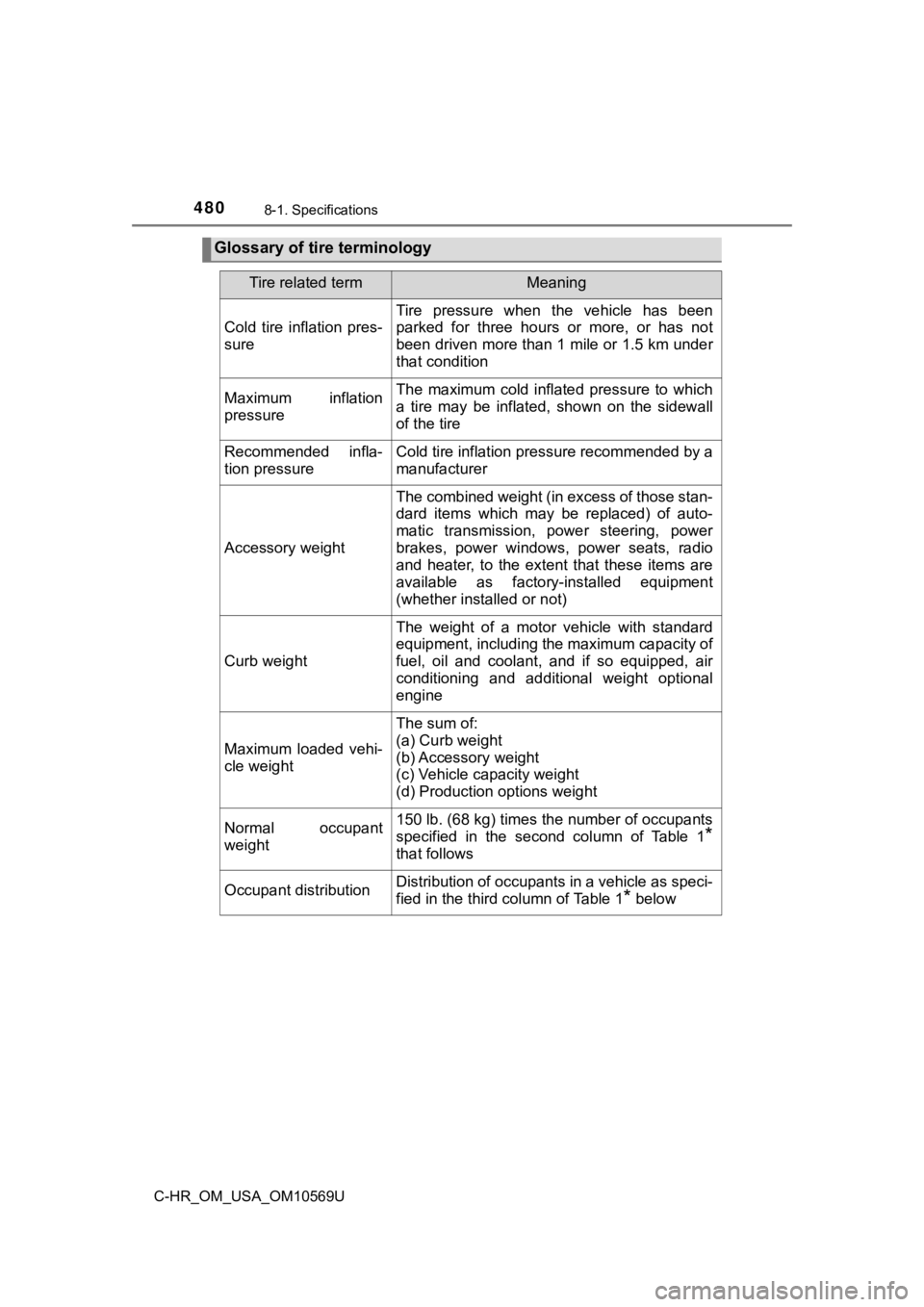
Glossary of tire terminology
Tire related termMeaning
Cold tire inflation pres-
sure
Tire pressure when the vehicle has been
parked for three hours or more, or has not
been driven more than 1 mile or 1.5 km under
that condition
Maximum inflation
pressureThe maximum cold inflated pressure to which
a tire may be inflated, shown on the sidewall
of the tire
Recommended infla-
tion pressureCold tire inflation pressure recommended by a
manufacturer
Accessory weight
The combined weight (in excess of those stan-
dard items which may be replaced) of auto-
matic transmission, power steering, power
brakes, power windows, power seats, radio
and heater, to the extent that these items are
available as factory-installed equipment
(whether installed or not)
Curb weight
The weight of a motor vehicle with standard
equipment, including the maximum capacity of
fuel, oil and coolant, and if so equipped, air
conditioning and additional weight optional
engine
Maximum loaded vehi-
cle weight
The sum of:
(a) Curb weight
(b) Accessory weight
(c) Vehicle capacity weight
(d) Production options weight
Normal occupant
weight150 lb. (68 kg) times the number of occupants
specified in the second column of Table 1
*
that follows
Occupant distributionDistribution of occupants in a vehicle as speci-
fied in the third column of Table 1
* below
Page 527 of 532
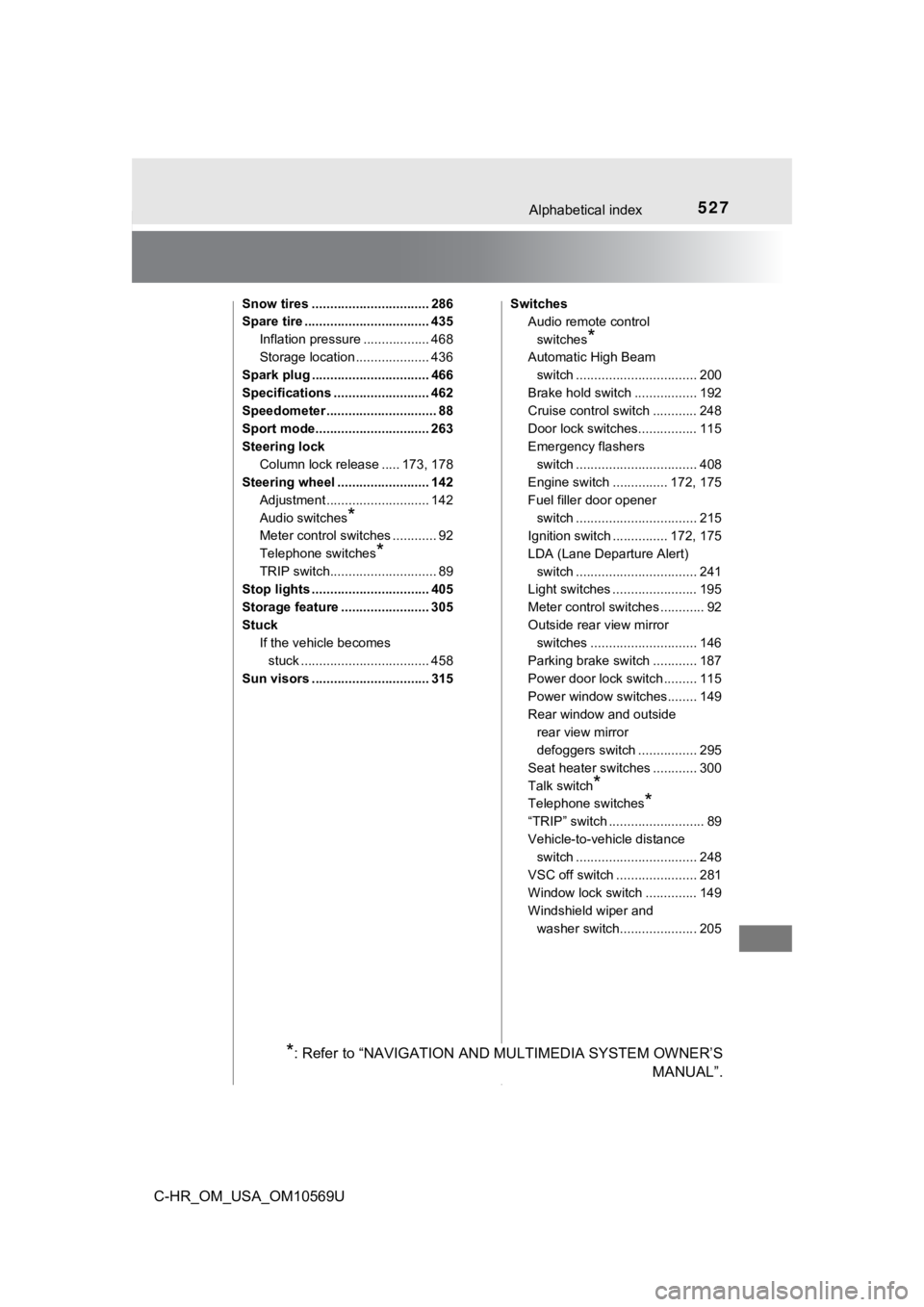
527Alphabetical index
C-HR_OM_USA_OM10569U
Snow tires ................................ 286
Spare tire .................................. 435Inflation pressure .................. 468
Storage location .................... 436
Spark plug ................................ 466
Specifications .......................... 462
Speedometer .............................. 88
Sport mode............................... 263
Steering lock
Column lock release ..... 173, 178
Steering wheel ......................... 142
Adjustment ............................ 142
Audio switches
*
Meter control switches ............ 92
Telephone switches
*
TRIP switch............................. 89
Stop lights ................................ 405
Storage feature ........................ 305
Stuck If the vehicle becomes
stuck ................................... 458
Sun visors ................................ 315 Switches
Audio remote control
switches
*
Automatic High Beam switch ................................. 200
Brake hold switch ................. 192
Cruise control switch ............ 248
Door lock switches................ 115
Emergency flashers switch ................................. 408
Engine switch ............... 172, 175
Fuel filler door opener
switch ................................. 215
Ignition switch ............... 172, 175
LDA (Lane Departure Alert)
switch ................................. 241
Light switches ....................... 195
Meter control switches ............ 92
Outside rear view mirror switches ............................. 146
Parking brake switch ............ 187
Power door lock switch ......... 115
Power window switches........ 149
Rear window and outside rear view mirror
defoggers switch ................ 295
Seat heater switches ............ 300
Talk switch
*
Telephone switches*
“TRIP” switch .......................... 89
Vehicle-to-vehicle distance
switch ................................. 248
VSC off switch ...................... 281
Window lock switch .............. 149
Windshield wiper and washer switch..................... 205
*: Refer to “NAVIGATION AND MULTIMEDIA SYSTEM OWNER’S MANUAL”.
Page 530 of 532

530Alphabetical index
C-HR_OM_USA_OM10569U
Warning lights............................ 81ABS....................................... 421
Brake Override System......... 424
Brake system ....... ......... 420, 422
Charging system ................... 420
Electric parking brake ........... 422
Electric power steering system ......... ....................... 421
Engine oil pressure ............... 420
High engine coolant temperature warning
light ..................................... 423
Low fuel level ........................ 422
Malfunction indicator lamp .... 421
PCS warning light ................. 422
Seat belt reminder light ......... 423
Slip indicator ......................... 421
SRS ...................................... 421
Tire pressure......................... 423 Warning messages.................. 430
Washer ............................. 205, 211
Checking............................... 362
Preparing and checking before winter ...................... 286
Switch ........................... 205, 211
Washing and waxing ............... 328
Weight ...................................... 462
What to do if... (Troubleshooting) ................. 512
Wheels ...................................... 379
Replacing.............................. 379
Size....................................... 468
Window glasses ...................... 149
Window lock switch ................ 149
Windows................................... 149 Power windows..................... 149
Rear window
defogger ............................. 295
Windshield wipers ................... 205
Winter driving tips ................... 286
Wireless remote control ......... 105 Battery-saving function ......... 127
Locking/Unlocking ................ 112
Replacing the battery............ 386