warning TOYOTA C_HR HYBRID 2016 Owners Manual
[x] Cancel search | Manufacturer: TOYOTA, Model Year: 2016, Model line: C_HR HYBRID, Model: TOYOTA C_HR HYBRID 2016Pages: 712, PDF Size: 49.31 MB
Page 552 of 712
5527-3. Do-it-yourself maintenance
C-HR_HV_OM_Europe_OM10538E
NOTICE
■Repairing or replacing tires, wheels, tire pressure warning valves,
transmitters and tire valve caps
● When removing or fitting the wheels, tires or the tire pressure warning
valves and transmitters, contact any authorized Toyota retailer or Toyota
authorized repairer, or any reliable repairer as the tire pressure warning
valves and transmitters may be damaged if not handled correctly.
● Make sure to install the tire valve caps. If the tire valve caps are not
installed, water could enter the tire pressure warning valves and the tire
pressure warning valves could be bound.
● When replacing tire valve caps, do not use tire valve caps other than those
specified.
The cap may become stuck.
■ Driving on rough roads
Take particular care when driving on roads with loose surfaces or potholes.
These conditions may cause losses in tire inflation pressure, reducing the
cushioning ability of the tires. In addition, driving on rough roads may cause
damage to the tires themselves, as well as the vehicle’s wheels and body.
■ To avoid damage to the tire pressure warning valves and transmitters
When a tire is repaired with liquid sealants, the tire pressure warning valve
and transmitter may not operate properly. If a liquid sealant is used, contact
any authorized Toyota retailer or Toyota authorized repairer, or any reliable
repairer or other qualified service shop as soon as possible. After use of liq-
uid sealant, make sure to replace the tire pressure warning valve and trans-
mitter when repairing or replacing the tire. ( P. 543)
■ If tire inflation pressure of each tire becomes low while driving
Do not continue driving, or your tires and/or wheels may be ruined.
Page 554 of 712
5547-3. Do-it-yourself maintenance
C-HR_HV_OM_Europe_OM10538E
WARNING
■Proper inflation is critical to save tire performance
Keep your tires properly inflated.
If the tires are not properly inflated, the following conditions may occur
which could lead to an accident resulting in death or serious injury:
● Excessive wear
● Uneven wear
● Poor handling
● Possibility of blowouts resulting from overheated tires
● Air leaking from between tire and wheel
● Wheel deformation and/or tire damage
● Greater possibility of tire damage while driving (due to road hazards,
expansion joints, sharp edges in the road, etc.)
NOTICE
■ When inspecting and adjusting tire inflation pressure
Be sure to put the tire valve caps back on.
If a valve cap is not installed, dirt or moisture may get into the valve and
cause an air leak, resulting in decreased tire inflation pressure.
Page 556 of 712
5567-3. Do-it-yourself maintenance
C-HR_HV_OM_Europe_OM10538E
■When replacing wheels
The wheels of your vehicle are equipped with tire pressure warning valves
and transmitters (except for compact spar e tire) that allow the tire pressure
warning system to provide advance warning in the event of a loss in tire infla-
tion pressure. Whenever wheels are repl aced, tire pressure warning valves
and transmitters must be installed. ( P. 543)
WARNING
■When replacing wheels
● Do not use wheels that are a different size from those recommended in the
Owner’s Manual, as this may result in a loss of handling control.
● Never use an inner tube in a leaking wheel which is designed for a tube-
less tire. Doing so may result in an accident, causing death or serious
injury.
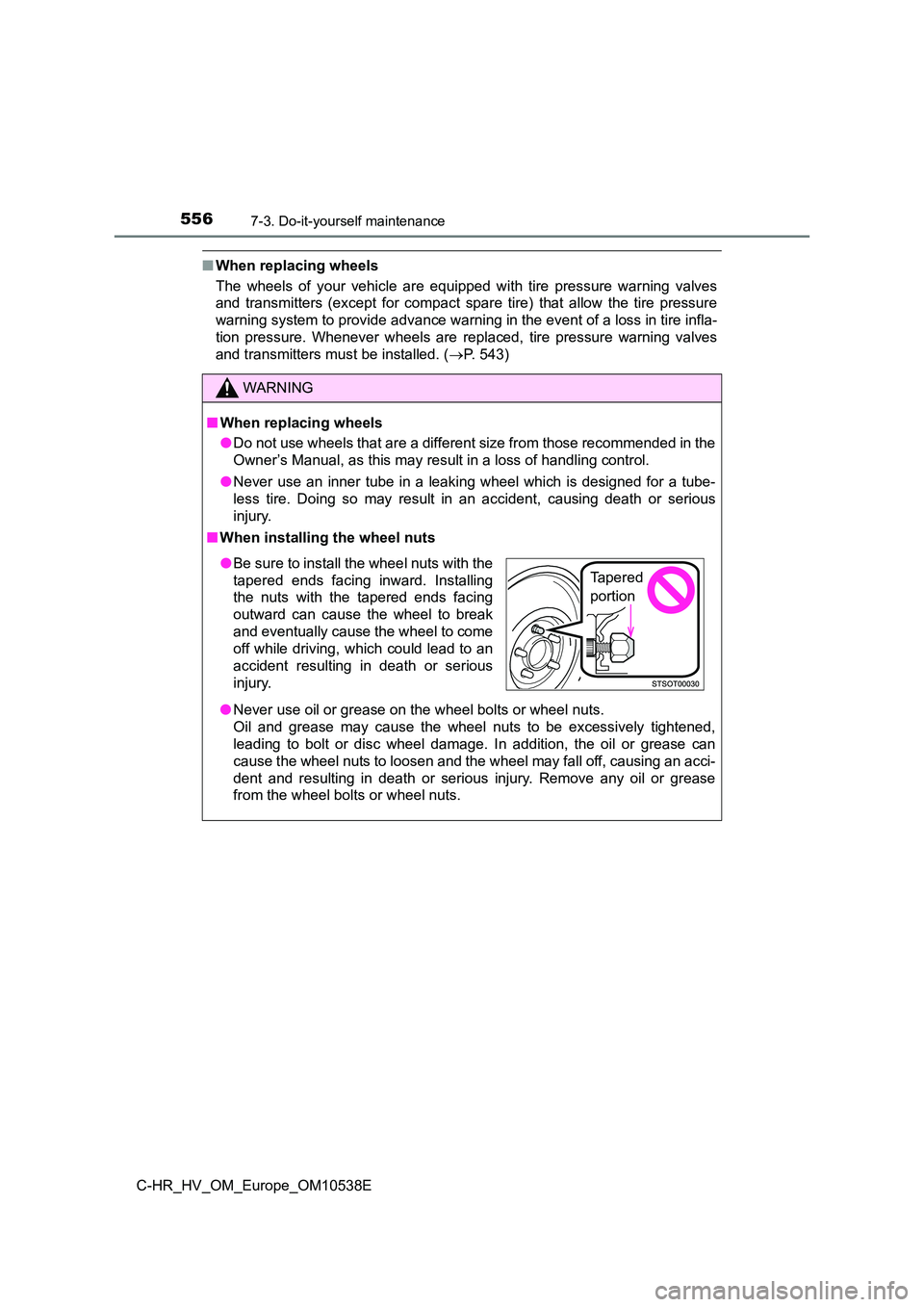
■ When installing the wheel nuts
● Never use oil or grease on the wheel bolts or wheel nuts.
Oil and grease may cause the wheel nuts to be excessively tightened,
leading to bolt or disc wheel damage. In addition, the oil or grease can
cause the wheel nuts to loosen and the wheel may fall off, causing an acci-
dent and resulting in death or serious injury. Remove any oil or grease
from the wheel bolts or wheel nuts.
● Be sure to install the wheel nuts with the
tapered ends facing inward. Installing
the nuts with the tapered ends facing
outward can cause the wheel to break
and eventually cause the wheel to come
off while driving, which could lead to an
accident resulting in death or serious
injury.
Tapered
portion
Page 557 of 712
5577-3. Do-it-yourself maintenance
C-HR_HV_OM_Europe_OM10538E
7
Maintenance and care
WARNING
■Use of defective wheels prohibited
Do not use cracked or deformed wheels.
Doing so could cause the tire to leak air during driving, possibly causing an
accident.
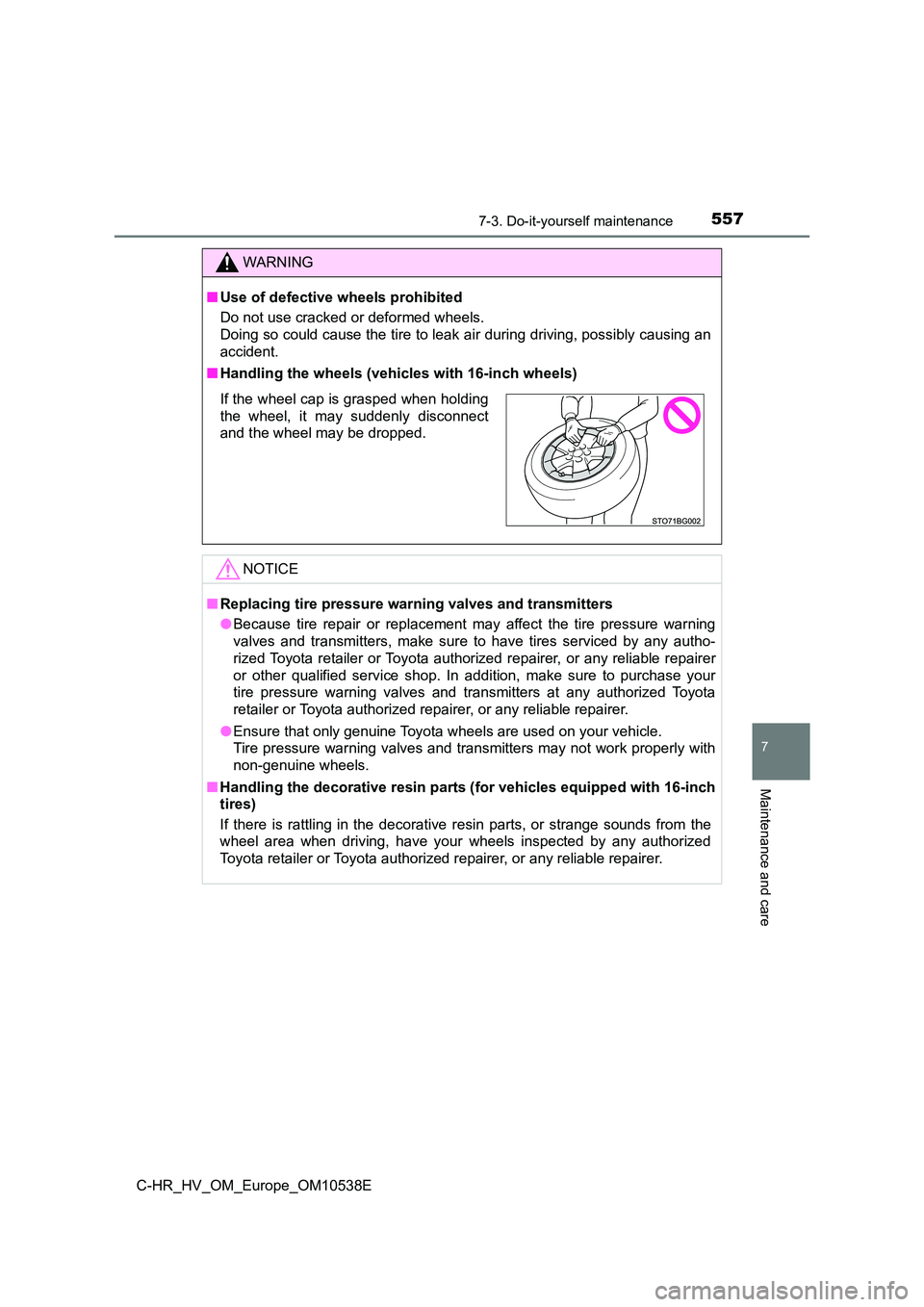
■ Handling the wheels (vehicles with 16-inch wheels)
NOTICE
■Replacing tire pressure warning valves and transmitters
● Because tire repair or replacement may affect the tire pressure warning
valves and transmitters, make sure to have tires serviced by any autho-
rized Toyota retailer or Toyota authorized repairer, or any reliable repairer
or other qualified service shop. In addition, make sure to purchase your
tire pressure warning valves and transmitters at any authorized Toyota
retailer or Toyota authorized repairer, or any reliable repairer.
● Ensure that only genuine Toyota wheels are used on your vehicle.
Tire pressure warning valves and transmitters may not work properly with
non-genuine wheels.
■ Handling the decorative resin parts (for vehicles equipped with 16-inch
tires)
If there is rattling in the decorative resin parts, or strange sounds from the
wheel area when driving, have your wheels inspected by any authorized
Toyota retailer or Toyota authorized repairer, or any reliable repairer.
If the wheel cap is grasped when holding
the wheel, it may suddenly disconnect
and the wheel may be dropped.
Page 563 of 712
5637-3. Do-it-yourself maintenance
C-HR_HV_OM_Europe_OM10538E
7
Maintenance and care
WARNING
■Removed battery and other parts
These parts are small and if swallowed by a child, they can cause choking.
Keep away from children. Failure to do so could result in death or serious
injury.
■ Certification for the lithium battery
CAUTION:
RISK OF EXPLOSION IF BATTERY IS REPLASED BY AN INCORRECT
TYPE. DISPOSE OF USED BATTERIES ACCORDING TO THE
INSTRUCTIONS
NOTICE
■ For normal operation after replacing the battery
Observe the following precautions to prevent accidents:
● Always work with dry hands.
Moisture may cause the battery to rust.
● Do not touch or move any other component inside the remote control.
● Do not bend either of the battery terminals.
Page 567 of 712
5677-3. Do-it-yourself maintenance
C-HR_HV_OM_Europe_OM10538E
7
Maintenance and care
■After a fuse is replaced
● If the lights do not turn on even after the fuse has been replaced, a bulb may
need replacement. ( P. 568)
● If the replaced fuse blows again, have the vehicle inspected by any autho-
rized Toyota retailer or Toyota authorized repairer, or any reliable repairer.
■ If there is an overload in a circuit
The fuses are designed to blow, protecting the wiring harness from damage.
■ When replacing light bulbs
Toyota recommends that you use genuine Toyota products designed for this
vehicle. Because certain bulbs are connected to circuits designed to prevent
overload, non-genuine parts or parts not designed for this vehicle may be
unusable.
WARNING
■ To prevent system breakdowns and vehicle fire
Observe the following precautions.
Failure to do so may cause damage to the vehicle, and possibly a fire or
injury.
● Never use a fuse of a higher amperage rating than that indicated, or use
any other object in place of a fuse.
● Always use a genuine Toyota fuse or equivalent.
Never replace a fuse with a wire, even as a temporary fix.
● Do not modify the fuses or fuse boxes.
NOTICE
■Before replacing fuses
Have the cause of electrical overload determined and repaired by any
authorized Toyota retailer or Toyota authorized repairer, or any reliable
repairer as soon as possible.
Page 584 of 712
5847-3. Do-it-yourself maintenance
C-HR_HV_OM_Europe_OM10538E
WARNING
■Replacing light bulbs
● Turn off the lights. Do not attempt to replace the bulb immediately after
turning off the lights.
The bulbs become very hot and may cause burns.
● Do not touch the glass portion of the light bulb with bare hands. When it is
unavoidable to hold the glass portion, use and hold with a clean dry cloth
to avoid getting moisture and oils on the bulb.
Also, if the bulb is scratched or dropped, it may blow out or crack.
● Fully install light bulbs and any parts used to secure them. Failure to do so
may result in heat damage, fire, or water entering the headlight unit. This
may damage the headlights or cause condensation to build up on the lens.
● Do not attempt to repair or disassemble light bulbs, connectors, electric
circuits or component parts.
Doing so may result in death or serious injury due to electric shock.
■ To prevent damage or fire
● Make sure bulbs are fully seated and locked.
● Check the wattage of the bulb before installing to prevent heat damage.
Page 585 of 712
585
8When trouble arises
C-HR_HV_OM_Europe_OM10538E
8-1. Essential information
Emergency flashers ........... 586
If your vehicle has to
be stopped in an
emergency ....................... 587
8-2. Steps to take in an
emergency
If your vehicle needs
to be towed ...................... 588
If you think something is
wrong ............................... 594
If a warning light turns on
or a warning buzzer
sounds ............................. 595
If a warning message is
displayed ......................... 606
If you have a flat tire
(vehicles with an
emergency tire
puncture repair kit)........... 612
If you have a flat tire
(vehicles with
a spare tire) ..................... 632
If the hybrid system will
not start............................ 646
If the electronic key does
not operate properly ........ 648
If the 12-volt battery is
discharged ....................... 651
If your vehicle
overheats ......................... 657
If the vehicle becomes
stuck ................................ 662
Page 587 of 712
5878-1. Essential information
C-HR_HV_OM_Europe_OM10538E
8
When trouble arises
If your vehicle has to be stopped in an
emergency
Steadily step on the brake pedal with both feet and firmly depress it.
Do not pump the brake pedal repeatedly as this will increase the effort
required to slow the vehicle.
Shift the shift lever to N.
If the shift lever is shifted to N
After slowing down, stop the vehicle in a safe place by the road.
Stop the hybrid system.
If the shift lever cannot be shifted to N
Keep depressing the brake pedal with both feet to reduce vehicle
speed as much as possible.
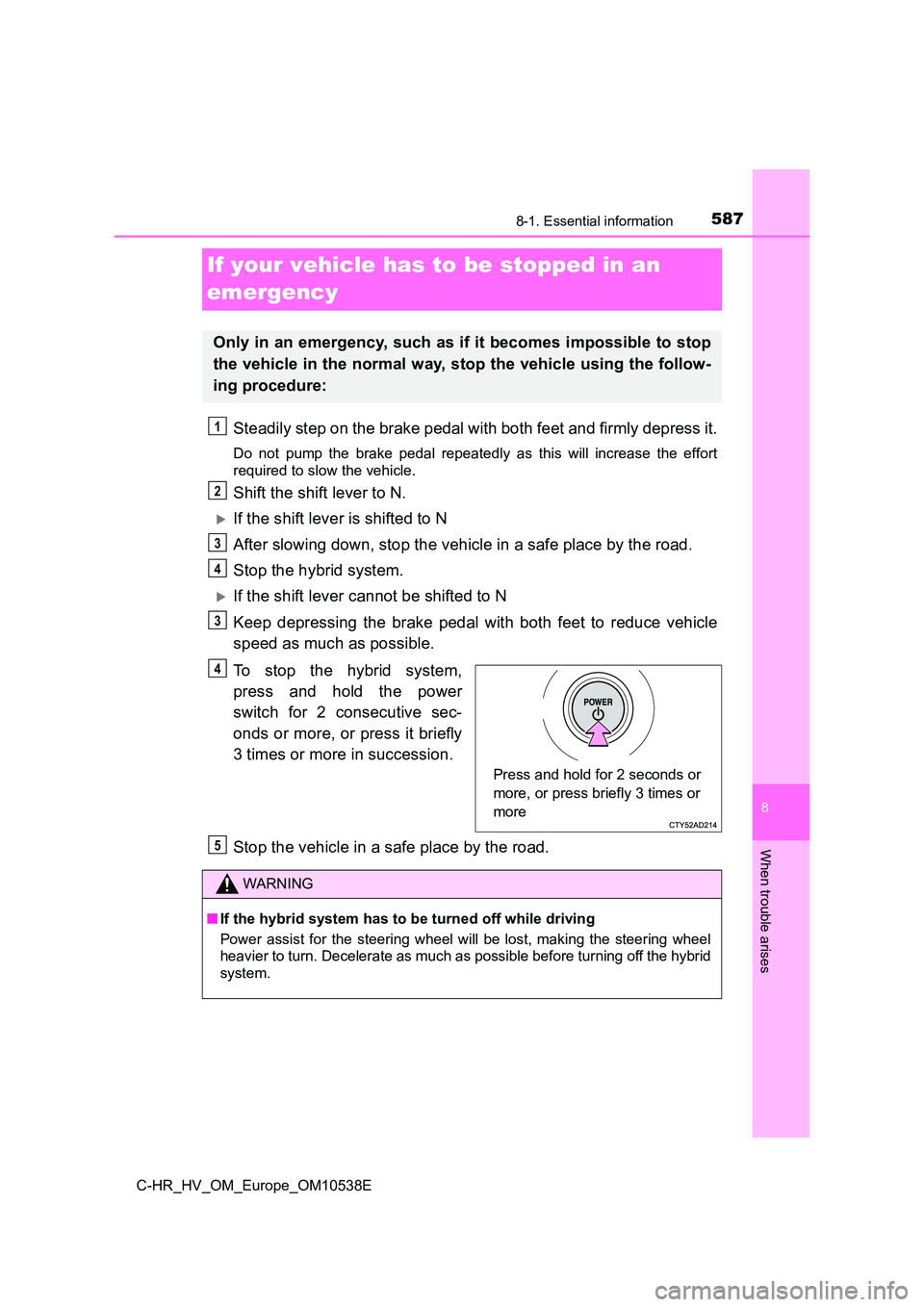
To stop the hybrid system,
press and hold the power
switch for 2 consecutive sec-
onds or more, or press it briefly
3 times or more in succession.
Stop the vehicle in a safe place by the road.
Only in an emergency, such as if it becomes impossible to stop
the vehicle in the normal way, stop the vehicle using the follow-
ing procedure:
1
2
3
4
3
Press and hold for 2 seconds or
more, or press briefly 3 times or
more
4
WARNING
■ If the hybrid system has to be turned off while driving
Power assist for the steering wheel will be lost, making the steering wheel
heavier to turn. Decelerate as much as possible before turning off the hybrid
system.
5
Page 588 of 712
5888-2. Steps to take in an emergency
C-HR_HV_OM_Europe_OM10538E
If your vehicle needs to be towed
The following may indicate a problem with your hybrid transmission.
Contact any authorized Toyota retailer or Toyota authorized repairer,
or any reliable repairer or commercial towing service before towing.
● The hybrid system warning message is displayed and the vehicle
does not move.
● The vehicle makes an abnormal sound.
If towing is necessary, we recommend having your vehicle
towed by any authorized Toyota retailer or Toyota authorized
repairer, or any reliable repairer or commercial towing service,
using a wheel-lift type truck or flatbed truck.
Use a safety chain system for all towing, and abide by all state/
provincial and local laws.
Situations when it is necessary to contact dealers before towing